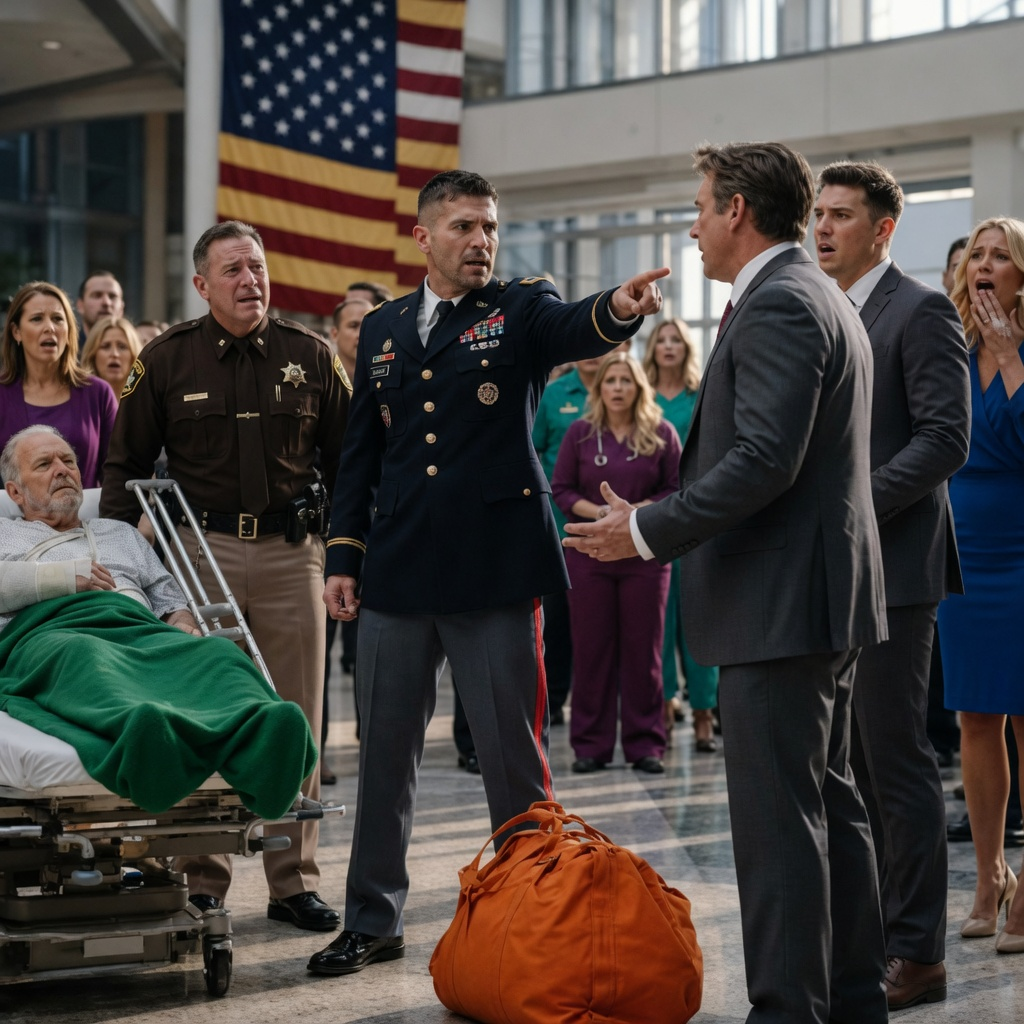
I Was Deployed In Afghanistan When The Sheriff Called. He Was Crying. “Hunter, It’s Your Dad. They Found Him In The Living Room.” He Paused, Choking Back Tears. “Your Stepmother’s Son Beat Him. He Used Victor’s Own Crutches.” I Felt My Blood Turn To Ice. I Asked, “Is He Alive?” The Sheriff Whispered, “Barely. But They Have A Lawyer. They Claim It Was Self-Defense.” I Hung Up And Walked Straight To The Armory. I Didn’t Call A Lawyer. I Loaded My Kit Bag. I Whispered To My C.O., “I’m Taking Leave. It’s Not A Visit. It’s A Hunt.”
What I Did To Them Is Banned By The Geneva Convention.
Part 1
The officer did not hand me a badge, a report, or even a cup of bad hospital coffee.
He handed me a clear plastic evidence bag.
Inside were two twisted pieces of aluminum, bent at ugly angles, the rubber grips torn, the metal scratched white where something hard had struck again and again. For one stupid second, my brain refused to understand what I was seeing. Then the shape clicked into place.
My father’s crutches.
The things he used to cross the kitchen in the morning. The things he hooked over the back of his chair when he sat on the porch. The things he hated needing but cleaned every Sunday like tools that deserved respect.
They had not simply been broken.
They had been used.
I looked through the ICU glass at the man inside room 304. Victor Hale, my father, lay under white blankets that made him look smaller than any memory I had of him. Tubes ran from his arm. A machine breathed beside him. His face was swollen in places I could barely recognize, but his hands hurt me most.
His hands were bruised across the knuckles and forearms.
Defensive wounds, some doctor had said gently.
That meant he had raised his hands over his head. That meant he had known the blows were coming. That meant the strongest man I had ever met had been afraid in his own living room.
“Mr. Hale?” the young deputy said behind me. “We believe it was a random break-in.”
I kept staring at Dad.
The monitor beeped steadily. Beep. Beep. Beep. A patient sound. A stubborn sound.
“A random break-in,” I repeated.
“Yes, sir. House was disturbed. Door damaged. Drawers opened. Looks like they were searching for valuables.”
“Did they take the TV?”
“No.”
“Dad’s watch collection?”
The deputy shifted his weight. “No.”
“Truck keys?”
“No, sir.”
I turned then. Slowly. I had learned a long time ago that fast movements made nervous men reach for things. “So these random thieves broke into a house, ignored the expensive things, beat a disabled veteran nearly to death with his own crutches, then left?”
His throat moved. “We’re exploring all possibilities.”
“Explore harder.”
The ICU door opened with a soft pneumatic hiss before he could answer. Cheap floral perfume rolled into the hallway like a warning.
“Oh, Hunter,” Morgan cried.
My stepmother crossed the hall in a blur of black dress, jangling bracelets, and dramatic grief. She threw herself into my arms before I could step back. Her body shook against mine, but it felt wrong. Not grief. Performance. I had seen men fake fear in rooms with no windows and one lightbulb. Morgan’s tremble had the same rhythm.
“Oh God, look at him,” she said, pulling away. “My poor Victor. I told him to install cameras. I told him this town wasn’t safe anymore.”
Behind her, Felix leaned against the wall, chewing gum.
Felix was Morgan’s son from before my father. Thirty-two years old, gym-built, sunburned, forever smelling faintly of beer and cologne. He looked me over, from my worn denim jacket to my muddy boots.
“Well, damn,” he said. “Soldier boy came home.”
I let my shoulders sag. I let my eyes look tired. I let him see what he wanted.
“Felix.”
“Heard you were doing security somewhere,” he said. “Mall cop, right?”
Morgan gave a little gasp. “Felix, please. Not now.”
But she did not sound angry.
I looked at Felix’s hands. His right knuckles were raw, the skin reddened and split.
“Rough workout?” I asked.
He glanced down too fast and shoved his hand into his pocket. “Heavy bag.”
“Without wraps?”
He grinned. “I’m not delicate like you.”
There it was. The old family picture they had kept in their heads: Hunter, the son who ran off after his mother died. Hunter, who never came back except for quick visits and shorter phone calls. Hunter, who wore cheap boots, drove rentals, and sent vague Christmas cards from nowhere.
A failure. A ghost. A man with nothing.
I had built that lie carefully.
For years, it protected Dad from the wrong kind of attention and me from the wrong kind of questions.
Now I wondered if the lie had protected the wrong people.
Morgan dabbed her dry eyes with a tissue. “I found him, Hunter. I came home and he was just lying there. There was blood on the rug. I screamed so loud Mrs. Gable heard me.”
Mrs. Gable lived two acres away and kept three radios on all day because she was scared of silence.
“You were out?” I asked.
“At the grocery store.”
“What time?”
She blinked. “What?”
“What time were you at the grocery store?”
Her mouth opened, then closed. “Around eight. Maybe eight-thirty. I don’t remember exactly. I was in shock.”
Felix pushed off the wall. “Why are you interrogating her?”
“I asked a question.”
“She’s his wife.”
I looked at Morgan.
A thin scratch marked the side of her neck, just under her left ear. It was fresh, shallow, and angry red.
Dad still had fingernails.
“I need to see the house,” I said.
Morgan’s face changed for half a second. It was quick, but I caught it. Alarm under the mascara. Fear under the widow act.
“The police are handling that,” she said.
“I grew up there.”
“And I live there,” she snapped, then softened instantly. “I mean… it’s a crime scene. It’s upsetting.”
“Good,” I said. “I’m already upset.”
Felix smiled with his teeth. “Don’t touch anything, mall cop.”
I looked through the glass one more time. Dad’s chest rose and fell because a machine told it to. His left hand lay above the blanket, curled slightly, as if still reaching for something he had lost.
I walked away before the sound of the monitor made me do something I could not undo.
Outside, the Texas afternoon was bright enough to hurt. The hospital doors opened behind me, and for a moment I smelled disinfectant, hot asphalt, and Morgan’s perfume clinging to my jacket like a stain.
I drove toward the ranch with the evidence bag burned into my mind.
By the time I turned onto the long gravel road, I had stopped being a grieving son.
I had become something colder.
And when I saw the yellow police tape fluttering from my father’s front porch, I knew the house was about to tell me what everyone else was trying to hide.
Part 2
The front door was cracked around the lock, wood splintered outward in a way that looked convincing if you did not know doors.
I knew doors.
I had kicked in enough of them overseas to understand force, angle, panic, and theater. This one had been damaged, yes, but not cleanly. Whoever broke it wanted it to look like a violent entry. They had kicked low, near the latch, after the door had already been opened or weakened.
A show.
Inside, the ranch house smelled like bleach, old wood, and something metallic trapped under the lemon cleaner.
I stood in the entryway and listened.
Houses have sounds when they are alive. A refrigerator hum. A pipe tick. A loose shutter tapping in the wind. My father’s house had always had a voice. That afternoon it felt like someone had pressed a hand over its mouth.
The living room was staged chaos. Drawers pulled out. Books knocked over. An end table on its side. But the expensive things were still there: the antique clock above the mantel, Mom’s silver-framed wedding photograph, Dad’s old service medals in a shadow box.
A thief would have taken those.
A stranger would not have known what mattered enough to leave behind.
I crossed the room slowly, careful not to step on the darker stains near Dad’s recliner. The carpet there was scrubbed pale in wide frantic circles. Bleach had soaked into the fibers so deeply it stung my nose.
Someone had cleaned.
Not well. Not patiently. Desperately.
I pictured Morgan on her knees with a towel, gagging, realizing the mess would not disappear. I pictured Felix pacing, sweating, asking what now. I pictured them turning a failed murder into a burglary because small-town cops liked easy answers.
Dad’s recliner sat overturned near the fireplace.
I lifted it upright.
The leather was torn along one arm where his fingers must have gripped. That detail punched air from my lungs harder than Felix ever could have. I could see Dad refusing to go down quietly. He had always been stubborn. A war had taken the full use of his legs. A work accident had made the damage worse. But nothing had taken his pride.
“Check the chair,” he had told me once.
It came back sharp and sudden.
I had called him from a base so far away the sky looked unfamiliar. He had been half joking, half serious, his voice scratchy through a satellite connection.
“Son, if anything ever feels off, check the chair. Old men hear more than people think.”
At the time, I laughed.
Now I dropped to my knees.
I searched beneath the cushion first. Nothing. Under the right arm. Nothing. Behind the fabric flap near the base, my fingers brushed tape.
I pulled gently.
A small digital recorder came loose, wrapped in black electrical tape.
For several seconds I just held it.
Dad, you paranoid old fox.
I sat on the floor with the afternoon sun making bars across the carpet. My thumb hovered over the button.
Then I pressed play.
Static whispered.
A door opened.
Not broke open. Opened.
Morgan’s voice came first, thin with anger. “You promised we would sell before the bank got worse.”
Dad sounded tired. “I promised nothing. The land stays in trust.”
“For Hunter?” she spat. “He doesn’t even come home.”
“He’s my son.”
“He’s a nobody, Victor. A broke veteran with no prospects. Felix has been here. I have been here.”
There was a thud. Not a blow yet. Something hitting wood.
Dad’s voice hardened. “Put that down.”
Felix laughed. “Or what?”
The next sound was metal scraping.
I stared at the broken crutch marks on the floor.
“Give those back,” Dad said.
“Sign the papers.”
“No.”
Morgan’s voice dropped lower. “Make him understand.”
Then came the first crack.
I stopped breathing.
Dad cried out. Not loudly. Not like in movies. It was a wounded, shocked sound, the kind a proud man makes when pain surprises him and shame arrives with it.
The second crack came faster.
“Felix!” Morgan hissed. “Not there. Are you stupid?”
“He won’t sign,” Felix said. His voice was breathless. Excited.
Dad gasped, “Morgan… please…”
For one horrible moment, she was quiet.
Then she said, “You should have thought of me before you chose a ghost over your wife.”
I pressed stop.
The house seemed to tilt.
Outside, a crow screamed from the fence line. Somewhere in the kitchen, the old refrigerator clicked on. Ordinary sounds. Impossible sounds. How could the world still function when my father’s pain had just filled the room?
I sat there until the rage stopped shaking and settled into something useful.
Rage burns hot. Discipline freezes.
I slipped the recorder into my jacket and stood.
The police would get it. Eventually.
But not yet.
I knew this county. Sheriff Dominic Miller had once shoved me into a locker senior year because I corrected his math homework in front of a girl. He was older now, heavier, wearing a badge instead of a letterman jacket, but men like Dominic did not change as much as they aged. They just found legal ways to be small.
And Morgan had survived in this town by making men feel big.
I needed more than truth. I needed proof so complete that even corruption could not swallow it.
The floor creaked near the kitchen.
I turned.
A shadow moved outside the back window.
Someone had come back to the house.
I slid the recorder deeper into my pocket and stepped silently into the hallway, because whoever stood outside had just found me standing in the middle of their lie.
Part 3
The shadow passed the kitchen window again, broad shoulders moving behind the faded curtains.
I picked up the nearest thing I could use without leaving questions: a cast iron fireplace poker from beside the hearth. Heavy, balanced badly, but good enough.
The back doorknob turned.
Unlocked.
That mattered.
Random thieves do not come back through the kitchen door with a key.
I moved into the mudroom, staying behind the coat rack where Dad kept three old jackets and one sun hat that had not fit him since 1998. The door opened with a groan.
Felix stepped in.
He wore sunglasses though the kitchen was dim, and he carried a black trash bag in one hand. His other hand was wrapped in a white bandage. He smelled like sweat, cigarette smoke, and mint gum.
“Mom?” he called softly.
I stayed still.
He set the bag on the counter and started opening drawers, not like a man searching for valuables. Like a man searching for something he already knew might exist. He checked under placemats, inside the bread box, behind the microwave. Then he moved to the living room.
When he saw the recliner upright, he froze.
His head turned slowly.
I stepped out.
“Looking for something?”
Felix jerked back so hard his hip hit the coffee table. “What the hell, Hunter?”
“Dad’s house,” I said. “I could ask you the same.”
He recovered quickly. Bullies usually do when they think the other person is afraid of them. “Morgan asked me to grab some clothes.”
“With a trash bag?”
“Laundry exists, genius.”
His eyes flicked to the recliner again.
I saw it.
He knew.
Maybe not about the recorder specifically, but Dad’s habit of hiding things. Maybe Dad had mentioned it in anger once. Maybe Morgan remembered. Either way, Felix had come to erase whatever the first cleanup missed.
“You should leave,” I said.
He laughed. “You giving orders now?”
“No. Advice.”
He stepped closer, rolling his neck like he was preparing for a bar fight. “You know what your problem always was, Hunter? You thought being quiet made you better than everybody. But you were just scared.”
I lowered my eyes on purpose.
He smiled wider.
“Yeah,” he said. “That’s what I thought.”
His finger jabbed my chest.
Every nerve in my body knew twelve ways to end him before he blinked.
I did none of them.
I stumbled back half a step and let the poker drop with a dull thump. Felix saw weakness. I gave him a little more.
“I don’t want trouble,” I said.
“You came to the wrong house for that.”
“It’s my father’s house.”
“Not for long.” Felix leaned close enough that I could see a tiny red dot on his collar. Not blood. Paint. Dark green, the same color as the old metal file cabinet in Dad’s office.
He had been in the office.
My pulse slowed.
New information.
“What does that mean?” I asked.
He snorted. “Means you should go back wherever you’ve been hiding.”
“Jersey,” I said.
“Right. Jersey.” He looked me up and down again. “You look like Jersey.”
That almost made me smile.
A truck rolled up outside. Gravel crunched.
Felix’s face changed.
A second later, Morgan burst through the front door, breathless. Behind her came Sheriff Dominic, hat low, one hand resting on his belt.
Morgan saw Felix. Then me. Then the chair.
“What happened?” she asked too quickly.
“Hunter was snooping,” Felix said.
“I came to get Dad’s things.”
Dominic’s eyes moved around the room. He noticed the chair upright, the open drawers, the poker on the floor. “This is an active crime scene.”
“Door was unlocked,” I said.
Morgan pressed a hand to her throat, covering the scratch. “Hunter, honey, you’re grieving. People do irrational things when they’re grieving.”
Dominic looked at me without warmth. “Best thing you can do is let us handle this.”
“Are you handling it?”
His jaw tightened. “Careful.”
Felix stepped behind him, smiling because he had found a bigger dog.
I looked at the three of them: Morgan with her perfume and panic, Felix with his bandaged hand and green paint, Dominic with his badge positioned like a shield.
For a moment, I saw the whole shape of the thing.
Not just an attack.
A plan.
Papers. The ranch. The trust. Dad refusing. Morgan desperate. Felix violent. Dominic useful.
I let my shoulders fold.
“You’re right,” I said quietly. “I’m tired. I’ll go.”
Morgan’s relief flashed bright enough to light the room.
Dominic followed me to the porch.
The sky had gone gray, and the air smelled like rain over dry dirt. He stood beside me while I walked down the steps.
“Hunter,” he said.
I paused.
“This town is not the place to play hero.”
I turned just enough to see him.
“No?”
“No. Heroes end up dead, broke, or gone.”
I nodded toward the house. “Which one are you?”
His eyes hardened.
I got into my rented pickup and drove away slow enough to look harmless.
A mile down the road, I pulled into a stand of mesquite trees, took out my phone, and called the number only twelve people in the world had.
A woman answered on the second ring. “Valkyrie.”
“It’s me,” I said.
Her voice changed. “Hunter?”
“I need a financial map of Morgan Hale, Felix Ward, Sheriff Dominic Miller, and Judge Alan Oliver. Bank liens, property transfers, private loans, everything. Quietly.”
There was a pause.
Then she said, “How deep?”
I looked back toward the ranch, where the house sat low under the storm clouds, holding my father’s secrets and my enemies’ fingerprints.
“All the way to bone.”
Part 4
I checked into the cheapest motel on the edge of town because nobody follows a man who looks like he is already losing.
The sign outside flickered between VACANCY and V CANCY. The room smelled of damp carpet, dust, and old cigarettes trapped in the curtains. A brown stain spread across the ceiling above the bed. The television remote had tape around the battery cover.
Perfect.
I locked the door, closed the blinds, and set my duffel on the bed.
Inside, under flannel shirts and worn jeans, was a laptop thinner than a magazine and worth more than the pickup I was driving. I opened it, connected through my private satellite line, and watched my real life wake up on the screen.
Valkyrie Holdings. Valkyrie Medical. Valkyrie Systems.
Companies I built after leaving the Rangers. Companies people in New York called aggressive, innovative, impossible. Companies that put my face on magazine covers Morgan had never read because she thought power always wore a tailored suit in public.
My power wore mud on its boots.
Brooke answered on video from Manhattan, sharp-eyed, dark hair pulled back, city lights behind her.
“You look terrible,” she said.
“Dad’s in a coma.”
Her expression changed. “I’m sorry.”
“I found audio. Morgan and Felix did it.”
Brooke went still. “Send it.”
“Not yet.”
“Hunter.”
“Small-town sheriff may be compromised. I need the full board before I move.”
She studied me through the screen. Brooke had been my lawyer for seven years. She knew the difference between anger and strategy. “You’re thinking like Afghanistan.”
“I’m thinking like a son.”
“That is more dangerous.”
I did not argue.
Files started arriving within the hour.
Morgan’s credit cards were maxed. Designer stores. Beauty treatments. Weekend trips Dad never took. Felix had a sports car registered under her name and a storage unit paid in cash. The ranch had a second lien attached six months earlier.
Dad had not signed it.
I knew my father’s signature. Strong downstroke. Slight hook on the V. The signature on the mortgage file looked like someone drawing from memory.
Then came Dominic.
Three cash deposits. Each under the federal reporting threshold. One two days after Dad argued with Morgan’s attorney. One the week the second lien cleared. One the morning after Dad was attacked.
Brooke whistled softly. “That is not a smoking gun, but it is smoking-adjacent.”
“Judge Oliver?”
“Dirty in the boring way. Too many favors, too much land speculation, too many hunting trips paid by people with court dates.”
“Can we acquire the lien?”
She blinked once. “On the ranch?”
“Yes.”
“That is your father’s house.”
“Exactly.”
“If the note holder sells, yes. Quietly. Through a holding company.”
“Do it.”
“Hunter, this will scare them.”
“Good.”
She leaned closer to the camera. “Scared people improvise.”
“Good.”
“That was not approval.”
“I know.”
After we hung up, I drove to the hospital.
Dad was still under sedation. A nurse named Carla adjusted his blanket with the tenderness of someone who had seen too many families arrive too late. She told me his pressure was stable. She told me swelling was the concern. She told me he had squeezed her hand once during the night.
That almost broke me.
Morgan arrived at noon wearing a cream-colored coat and sunglasses large enough to hide bad sleep. Felix followed with a coffee, his bandaged hand stuffed in his jacket.
“Hunter,” she said, putting on the voice again. “You poor thing. Have you eaten?”
“No.”
“You should. You look awful.”
“I’m sure.”
Felix snorted.
A doctor came out and said Dad had shown slight neurological response. Morgan grabbed my arm so hard her nails bit through denim.
“Response?” she said. “What kind?”
“Small movement,” the doctor said. “It is too early to know.”
Morgan’s smile trembled.
Felix stopped chewing gum.
I watched them receive hope like a threat.
Later, I sat in the corner of the ICU waiting room pretending to sleep while Morgan whispered into her phone near the vending machines.
“We need the papers now,” she hissed. “If he wakes up, everything gets harder.”
I did not move.
Felix answered from somewhere outside the frame of my hearing, low and angry. Morgan said, “No, you are not going back there in daylight. The neighbor watches everything.”
Neighbor.
Mrs. Gable.
I opened my eyes.
Morgan turned and saw me watching.
Her face emptied.
“Bad dream?” I asked.
She smiled so hard it looked painful. “Just talking to the insurance company.”
“Of course.”
At 6:14 p.m., Brooke texted me.
Lien purchase in motion. Private note holder accepted. Completion expected by morning.
At 6:17, another message came from an unknown number.
Stop digging before Victor loses more than his legs.
I stared at the words until the screen dimmed.
Morgan sat across the room, pretending to read a magazine upside down.
For the first time since I came home, I felt something almost like satisfaction.
They were afraid.
But fear can make guilty people confess, or it can make them finish what they started.
At 2:03 in the morning, the hospital monitor alarm went off inside Dad’s room, and when I ran through the doors, his bed was surrounded by nurses.
Morgan was already there.
And her hand was inside her purse.
Part 5
“Step away from the bed,” I said.
My voice cut through the alarm sharper than I intended. Two nurses looked at me. Morgan froze.
Her hand stayed in the purse.
“What?” she whispered.
“Move away from him.”
Carla, the nurse, stepped between us. “Mr. Hale, please. We need room.”
Dad’s monitors flashed. The sound was not the steady beep from before. It was frantic, uneven, a machine announcing confusion in a language everyone feared.
Morgan slowly withdrew her hand.
A lipstick tube rolled between her fingers.
She gave a wounded laugh. “You thought what, Hunter? That I was going to hurt him? My God, what is wrong with you?”
I looked at the lipstick. Then her purse. Then her face.
Maybe I had misread the moment.
Maybe she wanted me to think I had.
The doctor rushed in and the room became controlled chaos. Words snapped through the air. Oxygen. Response. Pressure. Light. Dad’s eyelids fluttered once, then twice.
I moved to the wall and forced myself not to interfere.
His right eye opened.
Clouded. Painful. Alive.
The room narrowed to that eye.
“Dad,” I said.
He turned toward my voice.
Morgan made a small strangled sound behind me.
The doctor leaned down. “Victor? You’re in the hospital. You’re safe.”
Dad’s mouth moved.
No sound came.
I stepped closer. “It’s Hunter.”
His eye focused.
A tear slid sideways into his hair.
I took his hand. Carefully. His fingers twitched against mine.
He tried again.
This time the word came like gravel.
“Run.”
The whole room disappeared.
Not help me. Not where am I. Not Morgan.
Run.
“I’m not running,” I whispered.
His grip tightened with impossible strength.
“Morgan,” he rasped.
Morgan began sobbing. “Yes, baby, I’m here.”
Dad’s eye rolled toward her.
Fear.
Pure, unmistakable fear.
Carla saw it. The doctor saw it. Morgan saw that they saw it, and her sobbing changed pitch.
“He’s confused,” she said quickly. “He doesn’t know where he is.”
The doctor cleared his throat. “Mrs. Hale, I think we should limit stimulation.”
“I’m his wife.”
“And I’m his physician.”
Morgan’s face hardened so fast the mask slipped clean off. “Are you telling me I can’t see my husband?”
“I’m telling everyone he needs rest.”
Everyone.
The word saved him from choosing sides in public, but I caught his glance. He knew something was wrong.
In the hallway, Morgan turned on me.
“What did you say to him?” she hissed.
“Nothing.”
“You poisoned him against me.”
“He woke up afraid of you all by himself.”
Her hand came up as if she might slap me. Felix caught her wrist.
Not to stop violence. To stop witnesses.
“Careful, Mom,” he muttered.
Mom.
Not Morgan. Not Mrs. Hale.
Mom.
The nurse at the station looked up.
Morgan pulled back and laughed weakly. “We’re all exhausted.”
I leaned close enough for only them to hear. “I know about the land.”
Felix’s nostrils flared.
Morgan’s eyes sharpened. “What land?”
“The trust. The fake signature. The lien.”
She stared at me for one second too long.
Then she smiled.
That smile was worse than the crying.
“Oh, Hunter,” she said. “You really should not involve yourself in adult matters.”
Felix stepped beside her, broad and eager. “Yeah. You heard her.”
My phone buzzed.
Brooke.
Completed. Valkyrie now controls the note.
I slipped the phone back into my pocket.
Morgan was still smiling because she thought she had the house, the sheriff, the judge, and a son willing to do anything ugly.
She did not know the ground had already shifted under her feet.
By sunrise, a courier delivered the first notice to the ranch. By nine, Morgan stormed into First National Bank with Felix behind her. I sat across the street in the pickup, wearing sunglasses and drinking coffee that had gone cold.
Brooke had arranged everything legally. Not dramatically. No tricks. No hacks. Just money moving faster than small-town corruption could understand.
When Morgan came back out of the bank, she looked like the sky had fallen.
Felix kicked the side of her car, then bent over, clutching his foot and cursing.
I almost laughed.
Almost.
My burner phone buzzed with sixteen missed calls from a number I did not answer.
Then a new text arrived.
Who are you?
I typed back:
Someone Victor should have had beside him sooner.
Three dots appeared. Disappeared. Appeared again.
Then:
What do you want?
I looked toward the hospital in the distance.
I want you to look over your shoulder until the truth catches up.
I sent it and started the truck.
Before I could pull away, another message came through.
Old Sawmill. Midnight. Come alone if you want proof.
A trap. Obviously.
But traps tell you who is hunting.
And I had spent half my life walking into dark places where men thought darkness belonged to them.
Part 6
I parked a mile from the old sawmill and walked in through the trees.
The moon hung thin above the pines. Wind moved through dead grass with a dry whispering sound. The sawmill had been closed since I was twelve, after a blade accident Dad said everybody saw coming except the owner. Now it sat at the edge of the county like a bad memory: rusted roof, broken windows, sagging loading dock.
I carried no rifle. No tactical gear. Just a flashlight, a pocketknife, and the kind of calm that made men nervous before they understood why.
A cigarette flared near the loading dock.
“Loud for a Ranger,” a voice said.
Sheriff Dominic Miller stepped into the moonlight.
I stopped twenty feet away. “I let you hear me.”
He gave a tired smile. “I wondered if that part was true.”
“What part?”
“That you weren’t just some washed-out soldier.”
I said nothing.
Dominic tossed the cigarette and ground it under his boot. “Morgan came to my office today. Hysterical. Said someone was harassing her. Said someone bought her mortgage.”
“Bad luck.”
“Valkyrie Holdings.” He looked at me closely. “That yours?”
“Never heard of it.”
“Yeah. And I’m the Pope.”
The sawmill groaned in the wind.
I watched his hands. Empty. Visible. Good.
“Why am I here, Sheriff?”
“Because Mrs. Gable has video.”
I kept my face still.
Dominic saw something anyway. “Across the road from your dad’s place. She has a camera facing the driveway and part of the living room window. Morgan paid her a visit yesterday.”
“Paid?”
“Threatened is a better word.”
“Why tell me?”
He looked away toward the dark roofline. For the first time since I had come home, he looked older than his badge. “Because Victor fixed my mom’s car for free for six years after Dad died. Because he taught my kid to fish. Because I took money from Morgan and told myself it was harmless until it wasn’t.”
The wind moved between us.
“There it is,” I said.
His jaw flexed. “My wife had surgery. Insurance fought it. Morgan offered a loan. Then another. Then she wanted small favors. Patrols delayed. Reports softened. Nothing that looked like evil when it happened one piece at a time.”
“Dad is in ICU because of those pieces.”
“I know.”
I wanted to hate him cleanly. It would have been easier.
“Arrest her,” I said.
“I need evidence that survives court.”
“You’re the sheriff.”
“And Oliver is the judge. Her attorney already has him on a leash.” Dominic rubbed his face. “Felix is going to Mrs. Gable’s tonight. Morgan thinks the old woman kept a copy after promising to delete it.”
“What time?”
He looked at his watch. “Now.”
I turned.
“Hunter.”
I paused.
“If Felix gets cornered, he’ll hurt her.”
I was already running.
The pickup roared alive, headlights off until I hit the county road. Gravel spat beneath the tires. The ranch land blurred past, fence posts flashing like dark teeth. Mrs. Gable’s cottage appeared at the end of a weed-choked driveway, its porch light swinging in the wind.
Felix’s car was already there.
Driver’s door open.
I killed my engine and moved fast.
Inside the house, Felix shouted, “Where is it?”
Mrs. Gable cried out. Something crashed.
The front door hung open. The living room was a canyon of stacked newspapers, old lamps, boxes labeled with years, jars of buttons, broken radios, all of it smelling like dust, lavender soap, and fear.
Felix stood over Mrs. Gable near the hallway.
She was tiny in a blue robe, white hair loose around her face. He had her by the arm.
“I know you kept it,” he said. “Old people keep everything.”
“Let her go,” I said.
Felix spun.
For once, there was real surprise on his face.
“You again?”
“Me again.”
His eyes dropped to my hands. No gun. He liked that.
Mrs. Gable pulled away and stumbled behind a stack of boxes.
Felix smiled. “You following me now?”
“I’m collecting disappointments.”
He grabbed a crowbar from a pile near the wall.
“Still think you’re funny?”
“No.”
He swung.
It was wide, angry, careless. I stepped inside the arc, caught his wrist, and drove my shoulder into his chest just hard enough to drop him without breaking anything. He hit a tower of magazines, sending paper across the floor like startled birds.
His eyes went wide.
For the first time, Felix looked at me and saw a stranger.
I took the crowbar and tossed it behind me.
“Leave,” I said.
He scrambled up, breathing hard. “You’re dead.”
“You keep saying that.”
“I mean it this time.”
He ran for the door, knocking over a lamp on his way out. His car screamed backward down the driveway and vanished.
Mrs. Gable shook so badly I thought she might collapse. I helped her into a chair by the window.
“I’m Hunter,” I said gently. “Victor’s son.”
“I know,” she whispered. “You have your mother’s eyes.”
That nearly undid me.
She reached into the cushion of the chair and pulled out a small hard drive wrapped in a handkerchief.
“I saw them,” she said. “I heard enough. I was scared.”
“You were smart.”
“No,” she said, tears sliding down her cheeks. “I was a coward.”
I took the drive carefully. “No. Cowards hurt helpless men in living rooms. You survived one more night.”
Outside, Felix’s taillights were gone.
But my phone buzzed before I reached the truck.
A picture came through from Morgan’s number.
Dad’s empty hospital bed.
Then one sentence.
If you can move him, so can I.
Part 7
For ten seconds, I did not breathe.
The picture showed Dad’s hospital bed from the foot, sheets thrown back, monitor leads hanging like loose wires after a storm. No nurse. No guard. No father.
Then I saw the detail Morgan wanted me to miss.
The clock on the wall read 11:12.
It was now 12:43.
Old picture.
Maybe.
I called the hospital. Carla answered on the third ring, breathless.
“ICU, this is Carla.”
“Room 304. Victor Hale.”
“He’s here,” she said immediately, because good nurses hear terror before words. “He’s sleeping. I’m looking at him right now.”
My knees almost weakened.
“Lock down his visitors.”
“We already did. Dr. Evans ordered it after tonight.”
“Did Morgan come by?”
“She tried. Security turned her away.”
I closed my eyes.
Morgan had sent an old photo to make me panic. Maybe Felix took it earlier. Maybe she had. Either way, she had wanted me rushing blind down a road at midnight with evidence in my pocket.
Not stupid. Not brilliant. Desperate.
Desperate people make noise.
I drove to the motel without headlights for the first mile, then took two back roads, stopping once under an overpass to check if I was followed. No headlights behind me. No engine echo.
In the room, I plugged in Mrs. Gable’s drive.
The first file opened grainy and gray. Her camera faced the side of Dad’s house, but through the living room window I could see enough: Dad’s recliner, Morgan pacing, Felix leaning forward like a dog waiting to be released.
The audio was poor, but the recorder in my pocket completed what the camera missed.
Then came the moment.
Felix snatched the crutches.
I paused before the first strike.
I had thought hearing it was the worst thing.
I was wrong.
Seeing Dad reach for the arm of the chair, seeing him try to pull himself upright with legs that would not obey, seeing Morgan stand there with one hand wrapped around a wineglass and the other holding papers—it made the room shrink around me.
She was not frantic.
She was not dragged into it.
She was waiting for a signature.
When Dad fell, Felix stepped over him.
Morgan looked at the window once, as if suddenly remembering the world existed beyond her greed. Then she yanked the curtains.
The video went dark.
But not before it caught the papers falling near Dad’s hand.
I copied everything to encrypted servers and sent one set to Brooke.
Her reply came in less than a minute.
Enough.
I typed:
Not yet.
Her response:
Hunter.
I did not answer.
Because I had found something else in Mrs. Gable’s files.
The morning after the attack, Morgan’s SUV pulled into Dad’s driveway at 5:18 a.m. Sheriff Dominic’s cruiser followed six minutes later. They walked inside together. When they came out, Dominic carried an evidence box.
He had not mentioned that.
At 5:42, Felix arrived with a gas station coffee and a black trash bag.
He handed the bag to Morgan.
She placed it in Dominic’s trunk.
I replayed it three times.
The same hollow feeling opened behind my ribs.
Dominic had given me Mrs. Gable because guilt finally caught up with him, but before that he had helped bury my father’s truth.
I sent the clip to Brooke with two words:
All of them.
At dawn, Valkyrie served the foreclosure notice.
At eight, Morgan and Felix were on the ranch porch when I arrived with a lawful process server, two private security contractors, and a tow truck. Sheriff Dominic pulled in five minutes later, pale and unshaven.
Morgan wore no makeup. Her face looked older, sharper, meaner without paint.
“You can’t do this,” she said.
“I already did.”
“This is my home.”
“It was Dad’s home. You were a guest who tried to kill the host.”
Her hand flew to her chest. “How dare you?”
Felix moved toward me. My security men stepped forward, silent and large.
Felix stopped.
Dominic looked at the papers, then at me. “Temporary stay.”
“No,” Brooke said through my earpiece from New York. “Judge Oliver refused to sign it this morning after receiving a courtesy copy of certain banking records.”
I repeated it aloud.
Dominic’s mouth tightened.
Morgan heard the judge’s name and went still.
I looked at her. “You are out of friends.”
Felix’s face reddened. “Mom?”
Morgan did not answer him.
The process server taped notice to the door. The sound of paper sticking to wood was small but final.
Felix lunged.
Not at me.
At the server.
I caught his arm before he reached the man and used his own momentum to put him against the porch rail. Not hard enough to injure. Hard enough to humiliate.
He gasped, cheek pressed to sun-warmed wood.
“You keep choosing witnesses,” I said quietly. “That is your real problem.”
Morgan screamed for Dominic to arrest me.
Dominic did not move.
Then a car came up the driveway too fast.
A black sedan.
A man in a gray suit stepped out, holding a court order.
Morgan’s smile returned like a knife.
“Actually,” the man said, “Judge Oliver has reconsidered.”
He handed Dominic the papers.
Dominic read them and would not meet my eyes.
Morgan stepped close to me, perfume cutting through the smell of dust and summer grass.
“You were saying?” she whispered.
For one moment, the whole ranch seemed to hold its breath.
Then smoke rose from behind the barn.
Part 8
Smoke changes a place before fire does.
It carries warning in its smell: hot oil, old hay, electrical wire, dry wood surrendering. I turned toward the barn and saw a gray column twisting into the morning sky from the workshop roof.
Dad’s workshop.
The building he had framed by hand after Mom died because grief needed somewhere to go. The building where he taught me to sand with the grain, measure twice, and never trust a man who blamed his tools.
Felix saw the smoke too.
His panic was real.
Morgan’s was not.
She had known.
My head turned slowly toward her.
“What did you do?”
Her lips parted. “I didn’t—”
A popping sound cracked from the workshop. Glass breaking from heat.
I ran.
People shouted behind me. Dominic. Brooke in my ear. The process server. Morgan screaming something about trespassing. None of it mattered.
By the time I reached the workshop, flames had crawled along the east wall. The side door stood open. Inside, orange light licked at shelves, old lumber, paint cans, the workbench Dad had built from reclaimed oak. The heat slapped my face.
I grabbed the fire extinguisher from beside the door.
Empty.
Of course.
Felix stumbled up behind me, breathless. “I didn’t do it.”
I looked at him.
His face was pale beneath the sunburn. For once, his fear did not look performed. “Mom said scare you. That’s all. She said pour some gas near the back, make smoke. I didn’t light it.”
Morgan arrived then, still holding her purse, still trying to look offended by reality.
“You idiot,” she snapped at Felix.
There it was.
Not fear for the building. Not worry someone could have died.
Anger that he had spoken.
Dominic heard it. So did the gray-suited lawyer. So did my security team, both wearing body cameras Brooke had insisted on.
I moved toward the open door.
Felix grabbed my sleeve. “You can’t go in there.”
I shoved him back. “Dad’s flag is inside.”
The flag from his unit. The one folded after his last deployment ceremony, not because he died, but because something in his life ended there. He kept it in a glass case above the bench, beside a picture of Mom holding me as a baby.
I went low through the smoke.
Heat pressed against my eyes. The air tasted bitter. I found the bench by memory, hand sliding along the edge. The flag case was hot but intact. I pulled it down, tucked it under my jacket, and backed toward the light.
A beam dropped behind me.
Sparks exploded.
For one second, the doorway disappeared behind smoke, and the old fear rose in me—not fear of dying, but fear of being trapped while people outside decided what my life was worth.
Then hands grabbed me.
One of my security men hauled me out by the collar. I hit the dirt coughing, flag case clutched to my chest.
Fire trucks wailed in the distance.
Morgan stood twenty feet away, crying now because cameras had arrived. The local news van sat at the end of the driveway, a reporter already running toward the smoke.
Smart, Brooke.
Very smart.
Felix sank onto the grass, staring at the flames with the expression of a man realizing his mother might burn him too if it helped her.
I stood slowly.
My jacket was singed at one shoulder. My lungs hurt. My eyes watered. But the flag was safe.
Morgan pointed at me. “He did this. He came here angry. He started the fire to frame me.”
The reporter’s camera swung toward me.
I looked at Dominic.
He looked at Morgan.
Then at Felix.
Then at the burning workshop.
Something broke in his face—not courage exactly, but exhaustion finally turning into honesty.
“No,” Dominic said.
Morgan whipped toward him. “What?”
He raised his voice. “No. I will not write that.”
The gray-suited lawyer stepped back.
Morgan’s face drained of color.
Felix started laughing. Not because anything was funny. Because his mind had reached a wall.
“You said he was weak,” Felix said to her. “You said Hunter was nothing.”
Morgan hissed, “Shut your mouth.”
“You said once Victor signed, we’d sell and leave.”
The camera caught every word.
Morgan slapped him.
The sound cracked across the yard.
Felix stared at her with a child’s wounded disbelief, and I saw the final seam split between them.
“You told me to hit him,” he said.
The yard went silent except for the fire.
Morgan whispered, “Felix.”
He pointed at her, hand shaking. “You told me to keep hitting until he signed.”
The reporter’s mouth fell open.
Dominic reached for his cuffs.
Morgan backed away. “No. No, he’s unstable. He’s lying.”
Felix looked at me then.
Not with regret. Not yet.
With hatred.
If he had gone for Morgan, maybe things would have ended there.
Instead, he grabbed the shovel leaning against the fence and charged at me like all his failures had my face.
The camera turned.
Dominic shouted.
I stood in the smoke with Dad’s flag under one arm and watched Felix make the last mistake of his free life.
Part 9
Felix swung the shovel with both hands.
He had strength. I will give him that. All those gym hours had made him powerful in straight lines. But violence is not strength. Violence is geometry, timing, breath, and choices.
Felix had only rage.
I shifted left. The shovel blade passed close enough that I felt the wind of it brush my cheek. I stepped into him, hooked his wrist, and turned his momentum down toward the dirt.
He hit the ground hard, face-first, the shovel skidding away.
I put one knee between his shoulder blades and held him there.
That was all.
No broken bones. No cinematic punishment. No revenge speech while a building burned behind us. Just control. Clean, ugly, public control.
Felix thrashed. “Get off me!”
“You are done,” I said.
He cursed, spit, twisted, tried to bite my hand. I pinned his wrist higher.
Dominic reached us, breathing hard. For a second, he looked at me like he expected me to go further.
Maybe part of me wanted to.
I thought of Dad’s hands raised over his head.
I thought of Morgan’s wineglass.
I thought of the crutches in the evidence bag.
My grip tightened.
Felix whimpered.
Then I looked at the camera. At the reporter. At Mrs. Gable standing near the road in slippers, one hand over her mouth. At Dad’s flag case in the grass.
Killing him would have been quick.
Letting the world know him would last longer.
I released his wrist and stood.
Dominic cuffed Felix.
Morgan screamed, “You can’t arrest him. Arrest Hunter. He attacked my son.”
Dominic turned toward her. “Morgan Hale, you are under arrest for conspiracy, assault on a vulnerable adult, fraud, and suspected arson pending investigation.”
She stared as if English had failed her.
The cuffs clicked around Felix first. Then Morgan.
That sound should have satisfied me more.
It did not.
Because Dad was still in a hospital bed, and the workshop was still burning, and nothing in the world could unmake the moment he begged his wife to stop.
Brooke arrived in person that afternoon.
She stepped out of a black SUV in a gray suit, sunglasses on, hair perfect, carrying a briefcase while everyone else smelled like smoke. She looked at the burned shell of the workshop, then at me.
“You look like you fought a chimney.”
“Won.”
“Barely.”
She hugged me. Brooke rarely hugged anyone. It lasted one second, but it held.
Then she went to work.
By evening, the county had the audio, the video, the lien documents, the fake signature analysis, the footage of Dominic’s evidence box, the recorded statements from Felix, the fire response report, and body camera video from my security team.
The story broke wider than the county by nightfall.
Decorated veteran beaten in his own home. Wife and stepson arrested. Billionaire son revealed as secret owner of defense-tech empire.
That was when the headline started.
Billionaire Ranger Son Beat Them All To Death.
It was not true.
Not physically.
But in America, sometimes reputation dies faster than flesh.
Morgan’s friends stopped answering calls. Judge Oliver resigned before breakfast and agreed to cooperate after Brooke showed him the documents she had spent the night assembling. Dominic turned in his badge two days later and gave a statement that made him look smaller than prison would have.
Felix, from his hospital room after injuring himself in the struggle, blamed Morgan.
Morgan blamed Felix.
They turned on each other so fast the prosecutors barely had to push.
I visited Dad three days after the arrests.
He was awake longer now. His speech came slowly, but his eyes were clear.
I brought the flag case.
When he saw the smoke stains on the wood frame, he shut his eyes.
“The shop?” he asked.
“Gone.”
His jaw moved. He swallowed pain, not physical this time.
“I got the flag.”
He opened his eyes.
“Your mother’s photo?”
I reached into my jacket and pulled out a smaller frame, wrapped in a towel. The glass was cracked. The picture was stained at one corner. But Mom’s face was still there, laughing at something outside the frame.
Dad cried silently.
I had seen him endure surgeries, funerals, bad news from old war buddies. I had never seen him cry like that.
“I’m sorry,” I said.
His fingers closed over mine. “For what?”
“For not coming sooner.”
He looked at me for a long time.
“You came,” he said.
Two words.
They should have healed me.
Instead, they opened a deeper wound.
Because the truth was I had built companies, made fortunes, survived wars, bought buildings, moved governments, and still failed to see my father being isolated in the house where he raised me.
Outside his room, Brooke waited with a tablet.
“They offered Morgan a deal,” she said.
“No.”
“You have not heard it.”
“No.”
“Hunter, the DA—”
“No forgiveness. No quiet plea. No sealed confession. No reduced charges so the town can pretend this was a family misunderstanding.”
Brooke studied me. “Your father may want peace.”
“He can have peace after truth.”
At the end of the hall, Felix’s attorney stepped out of an elevator.
Behind him came Felix in a wheelchair, one arm in a sling, face pale and furious.
He saw me.
And smiled.
Not guilty. Not broken.
Smiled.
That was when I understood the trial would not be about what happened.
It would be about whether men like Felix could make people doubt what they saw with their own eyes.
Part 10
Courtrooms smell different when they are small.
Not like justice. Not like marble and polished history. They smell like coffee breath, copier toner, old varnish, damp coats, and fear disguised as perfume.
Morgan wore navy blue to trial because someone told her it made her look trustworthy. Felix wore a suit too large at the shoulders, his injured arm held close to his body. He had shaved. He had practiced looking young.
Dad arrived in a wheelchair.
The room changed when people saw him.
He hated that part. I could feel it in the tightness of his jaw. Pity embarrassed him more than pain ever had. But he rolled in with his back straight, a cane resting across his lap, his eyes fixed forward.
I walked behind him, not beside him.
This was his day.
Morgan looked at him once and then away.
Felix looked longer. I saw something like shame flicker across his face, but it died before it became useful.
The prosecutor started clean.
Not dramatic. Better that way.
A disabled veteran. A wife in financial trouble. A stepson with violence in him. A trust that stood between greed and land worth millions. A forged signature. A staged break-in. A fire. A cover-up.
Morgan’s attorney tried to paint her as frightened, controlled by Felix. Felix’s attorney painted him as manipulated by Morgan. Together they created a picture where everyone was innocent because everyone else was worse.
Then Mrs. Gable testified.
She wore a lavender cardigan and clutched her purse with both hands. Her voice shook at first. The defense tried to rattle her with questions about her memory, her cluttered house, her age, her fear.
She looked at the jury and said, “Being scared does not make me blind.”
After that, the video played.
The courtroom went silent.
No one breathed loudly. No one shifted in their seats. The screen showed gray shapes through a window, but truth does not need perfect lighting. It only needs enough.
Dad did not watch.
He stared at his hands.
I watched Morgan watching herself.
That was the strangest part. She seemed offended by the recording, not ashamed. As if the real crime had been the camera’s refusal to look away.
The audio followed.
Dad’s voice filled the courtroom.
“Put that down.”
Then Felix.
“Sign the papers.”
A woman in the jury box covered her mouth.
Morgan’s face hardened.
Felix stared at the table.
When the first strike sounded through the speakers, Dad flinched.
I put a hand on the back of his chair.
He reached up and gripped my wrist.
Not for support.
To stop me from moving.
The prosecutor paused the audio before it got worse than necessary. I was grateful for that. So was the jury.
Then Brooke took the stand—not as my attorney, but as custodian of financial records. She explained the lien. The forged signature. The debt. The offshore communications. Judge Oliver’s cooperation. Dominic’s statement.
By then Morgan’s attorney looked like a man trying to hold water in a paper bag.
Felix testified against his mother on day four.
He rolled in pale, sweating, angry at the world for requiring consequences. He said Morgan planned the pressure campaign. Morgan brought the papers. Morgan told him Dad would ruin them. Morgan said nobody would believe Victor over his wife.
Then Morgan testified.
That was the moment the whole town had waited for.
She cried beautifully.
She said she loved Dad. She said Felix frightened her. She said I had always hated her. She said Dad had promised to provide, then humiliated her with legal tricks. She said she only wanted security.
The prosecutor asked, “Mrs. Hale, when Victor was on the floor, why did you not call 911 immediately?”
“I panicked.”
“Why did you close the curtains?”
“I don’t remember.”
“Why did you tell Felix to make him sign?”
“I was confused.”
“Why did you say, ‘No loose ends,’ outside the ranch three days later?”
Her face changed.
The prosecutor clicked a remote.
The body camera footage played.
Morgan’s own voice filled the room, cold and sharp.
“No comas this time.”
No one moved.
The mask did not slip then.
It shattered.
Morgan leaned back and whispered, “That was taken out of context.”
A juror actually shook his head.
The verdict came after six hours.
Guilty.
Guilty.
Guilty.
Morgan did not scream. She sat very still, as if stillness could make the room reconsider. Felix cried when they read his sentence recommendation. Real tears, but not for Dad. Not for what he had done. For himself.
Afterward, outside the courthouse, reporters shouted my name.
“Hunter, do you forgive them?”
I stopped.
Dad’s wheelchair was beside me. The sun hit his white hair and the lines carved into his face. He looked tired, but not defeated.
I looked into the cameras.
“No.”
The reporters surged.
I continued.
“Forgiveness belongs to victims when they choose it. It is not a coupon guilty people get to cash because consequences hurt.”
Dad’s hand found mine.
Morgan was led out behind us in cuffs. For one second, our eyes met.
She mouthed one word.
Please.
I felt nothing soft answer it.
The woman who came late with tears was carrying trash where love should have been.
I turned away before she could mistake silence for mercy.
Part 11
Six months later, the ranch smelled like cedar, sawdust, and rain.
The new workshop stood where the old one burned, but we kept part of the blackened stone foundation visible beneath glass along the front wall. Dad said scars should not be hidden if they held the house up.
He said it like a joke.
It was not a joke.
The morning sun spread gold over the pasture as I carried two mugs of coffee down the ramp we had built from the kitchen porch. Dad was already inside the workshop, standing at the new bench in carbon-fiber braces my company’s medical division had modified until he stopped calling them “robot legs” and started showing them off to every veteran who visited.
He moved slowly.
He moved.
That was enough to make ordinary mornings feel expensive.
“You’re hovering,” he said without turning.
“I brought coffee.”
“You brought worry in a mug.”
“Same recipe.”
He snorted and accepted it.
On the bench lay a half-finished rocking chair made from salvaged oak. Some of the wood had survived the fire, smoke-darkened along one edge. Dad refused to throw it out.
“Good wood doesn’t become bad because it’s been through flame,” he told me.
I had written that down later when he wasn’t looking.
The ranch had changed.
The back pasture now held three cabins for disabled veterans and their families. A therapy pond was being dug near the south fence. Brooke called it philanthropic brand alignment. Dad called it giving men something useful to do with their hands before their thoughts ate them alive.
We named it the Victor Hale Project.
He hated that too.
Which meant it stayed.
Morgan received life without parole after the conspiracy charges stacked with elder abuse, fraud, and arson. Felix took fifteen years and testified fully, though he tried to take half of it back at sentencing. The judge did not enjoy that. His letters started arriving two months later.
I never opened them.
Dad opened one.
He read three lines, folded it carefully, and put it in the stove.
“Anything important?” I asked.
“He discovered remorse after discovering prison.”
That was all he said.
Sheriff Dominic resigned and took a plea for tampering and bribery. He wrote Dad an apology. Dad read that one twice. Then he put it in a drawer instead of the stove.
“Why keep it?” I asked.
Dad looked toward the pasture. “Some men fail because they’re evil. Some fail because they’re weak. I don’t have to forgive either one, but I like knowing the difference.”
That was Dad.
Hard, but not careless.
As for me, the internet kept the headline alive for weeks.
Billionaire Ranger Son Beat Them All To Death.
They wanted blood, a porch fight, a revenge fantasy with broken bodies and a clean ending. The truth was messier and better. I had not killed Morgan or Felix. I killed their power. I killed the story where they were victims. I killed the silence that let them stand in my father’s house and call greed love.
That was enough.
One evening, Dad and I sat on the dock by the pond, watching dragonflies skim the surface. The air was warm. Frogs called from the reeds. Somewhere behind us, a hammer rang from the workshop where two veterans argued cheerfully about chair legs.
Dad held a cane across his knees.
Not a crutch.
Never a crutch again.
“You staying?” he asked.
I looked at the water.
For years, I had confused motion with purpose. Planes, boardrooms, bases, hotel rooms, cities where nobody knew my middle name. I had built an empire partly because building was easier than coming home to a house full of Mom’s absence and Dad’s disappointment.
Now the house had both grief and healing in it.
“I’m staying,” I said.
Dad nodded like he already knew.
After a while, he said, “You know I never cared about the money.”
“I know.”
“I cared that you stopped calling.”
The words landed soft but deep.
“I thought you were better without me around,” I admitted.
He looked at me then, eyes sharp under gray brows. “That was stupid.”
I laughed once. It hurt.
“Yes, sir.”
He placed his rough hand over mine. “Don’t do stupid twice.”
We sat there until the sunset turned the pond copper.
In the distance, the new workshop lights glowed warm against the darkening trees. Not replacing what burned. Nothing could. But standing anyway.
That was the thing about legacy.
People think it is land, money, buildings, names on signs.
It is not.
Legacy is what refuses to die when cruel people try to bury it.
Morgan and Felix took my father’s crutches and thought they had found his weakness.
They had only found the line.
And once they crossed it, everything they stole began walking back toward them.
Part 12
The last time I saw Morgan, it was through reinforced glass.
I had not planned to go. Dad told me not to waste gas on ghosts. Brooke told me nothing good came from visiting people who only wanted one more stage to perform on.
They were both right.
I went anyway.
The prison visiting room smelled like disinfectant and old metal. Morgan looked smaller in beige than she ever had in silk. Her hair had gone flat. Her face had lost the softness money can buy. But her eyes were the same.
Calculating.
She picked up the phone first.
“You look well,” she said.
I sat across from her and lifted my receiver. “You don’t.”
Pain flashed across her face, then vanished. “Still cruel.”
“Still honest.”
She leaned closer. “I asked you here because I wanted to say something without lawyers.”
“You asked. I came. Say it.”
Her mouth trembled. “I loved Victor.”
“No.”
She blinked.
“You loved what he owned. You loved his loneliness because it gave you a door. You loved his trust because it had a signature. Do not polish greed and hand it to me like love.”
Her hand tightened around the receiver.
“I was scared,” she whispered. “You have no idea what it’s like to feel old and replaceable.”
“You made him feel helpless in his own home.”
“I didn’t mean for it to go that far.”
That was the closest thing to confession she had left.
I looked at her through the glass and remembered the perfume in the ICU, the scratch on her neck, the upside-down magazine, the way Dad’s eye filled with fear when she said his name.
“You stood there,” I said. “That is who you are.”
For the first time, she looked away.
Good.
“I have nothing,” she said.
“You have exactly what you built.”
She began to cry. Quietly at first, then harder. Maybe some part of it was real. Maybe prison had stripped away enough comfort for truth to touch skin. But I had learned something from Dad’s recovery.
Not every tear deserves your hand.
“I want Victor to know I’m sorry,” she said.
“No.”
Her head snapped up. “You can’t decide that.”
“I can decide what messages I carry into my father’s peace.”
“You’re punishing me.”
“Yes.”
The honesty surprised her. It surprised me too.
I stood.
“Hunter,” she said quickly. “Please. I’m still family.”
I looked at her one last time.
“No, Morgan. Family shows up when the house is on fire. You brought the match.”
I hung up before she could answer.
Outside, the sky was bright and hard blue. I drove home with the windows down, letting the hot Texas wind tear the prison smell off my clothes.
When I reached the ranch, Dad was on the porch with Mrs. Gable, both of them drinking sweet tea like old conspirators. She had moved into one of the new cabins after the county finally condemned half her old house, and Dad pretended not to enjoy having someone around who beat him at cards.
“You look lighter,” he said when I climbed the steps.
“I left something behind.”
“Good place for it.”
Mrs. Gable patted my arm. “Your father cheated at gin.”
Dad frowned. “I won with strategy.”
“You won with lies.”
“Same family.”
I laughed, and the sound startled me because it came easily.
Later that night, after dinner, Dad and I walked the porch. He used his cane. I matched his pace. Crickets sang in the grass. The stars came out clean and bright above the pasture.
At the far end of the porch, two hooks remained in the wall where his crutches used to hang.
The hooks were empty now.
Dad stopped in front of them.
“Take them down,” he said.
“You sure?”
He nodded.
I got a screwdriver from the kitchen drawer and removed them one by one. The screws complained as they came loose. Small circles remained in the wood, pale where the sun had not reached.
Dad ran his thumb over one mark.
“Leave those,” he said.
So I did.
Some scars are not decorations. They are maps.
They show where pain entered and where it failed to stay in control.
The next morning, the first group of veterans arrived for the program. Men and women with canes, braces, prosthetics, quiet spouses, loud kids, and eyes that measured exits before chairs. Dad stood by the workshop door, nervous as a bridegroom, pretending he was not.
I watched him welcome them.
Not as a broken man.
Not as a victim.
As Victor Hale, who had been knocked down in his own living room and still chose to build chairs, cabins, ramps, and futures with hands that once tried to shield his head from betrayal.
That was when I finally understood the real ending.
Morgan went to prison. Felix lost his freedom. Dominic lost his badge. Oliver lost his robe. The ranch survived. The workshop rose again. Dad stood.
And me?
I stopped being the ghost son who sent money from far away and called that love.
I came home.
I stayed.
I learned that vengeance can clear a field, but only love can build on it.
Still, when people asked if I forgave Morgan and Felix, my answer never changed.
No.
Some doors close forever for a reason.
And on our ranch, the locks finally worked.
THE END!