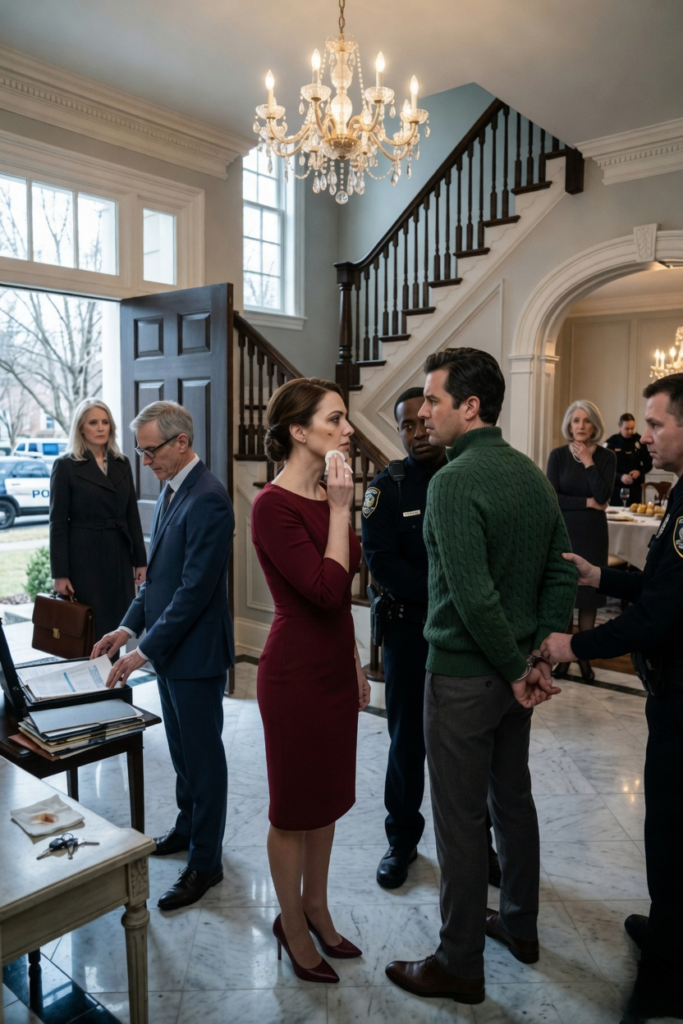
When the officer snapped the handcuffs onto my husband’s wrists, Richard looked at me the way he always did when I surprised him: like I was a lamp that had suddenly spoken.
“This is my house,” he said.
His voice was not loud. Richard Monroe rarely became loud in front of strangers. Loudness, in his family, was considered evidence of poor breeding, poor education, or poor control. He preferred quieter methods. A lowered voice. A locked jaw. A hand on the back of my neck that looked affectionate if you were standing far enough away. A sentence delivered across a dinner table with a smile that told me exactly how much worse things would become later if I embarrassed him now.
But in the marble foyer that Saturday afternoon, with two uniformed officers standing beside him, my attorney at the threshold, a forensic financial investigator calmly opening his document case, and his mother frozen near the dining room archway with one hand at her pearls, Richard finally sounded ordinary.
Afraid.
“This is my house,” he said again, as if saying it twice might make the walls remember incorrectly.
I stood beneath the chandelier, holding a makeup wipe between two fingers. The house was silent in a way it had never been silent before. Not peaceful. Waiting. The winter light coming through the tall front windows made the marble floor look cold enough to skate on.
I pressed the wipe to my cheekbone and dragged it down slowly.
The concealer came away in one pale streak.
Under it, the bruise bloomed into full view.
Purple, black, yellow at the edges, spreading from my cheekbone toward my eye like weather moving in over the coast. No one spoke. Not Officer Vowell. Not Officer Aruso. Not Saraphene Sterling, my attorney, who had seen the photographs that morning and still held her face perfectly still. Not Apprentice Gallow, who had spent months following money through shell companies and offshore accounts and now watched the room with the blank patience of a man who trusted paper more than panic.
Not Beatrice Monroe.
That silence was the first gift of the day.
I let it hold.
“I went to the clinic at 6:30 this morning,” I said. My voice sounded almost gentle. “Photographs. Medical report. Signed, witnessed, and filed with the precinct before nine.”
Richard stopped breathing.
It was very small, the change. His chest halted beneath his sweater. His eyes moved from my face to the officers, then to Saraphene, then back to me. He had always been handsome in a clean, severe way—dark hair, architectural jaw, a mouth built for disapproval. Even then, even with cuffs closing around his wrists, he looked like the kind of man committees trusted and restaurant hosts recognized.
I remember thinking how strange it was that I was not angry.
I should have been. Any reasonable person would have been. Anger would have made sense in that foyer, with my cheek uncovered and my husband’s mother staring at me as if I had personally vandalized civilization.
But I was not angry.
I had been angry months before, quietly, privately, in bathrooms and parked cars and the dark hours before dawn. I had been angry when Richard shoved a door closed too hard and then called me sensitive for flinching. I had been angry when Beatrice sat in my chair and discussed my studio as if it were already storage. I had been angry when my husband began describing my money as “our flexibility” and my boundaries as “female anxiety.”
Anger had done its work already.
It had burned itself down into calculation.
By that Saturday, I was not angry anymore.
I was finished.
I should start near the beginning. Not the first dinner, not the first kiss, not the first time Richard told me I had an old soul while looking at me like he had discovered something rare and quiet enough to own. Those beginnings are never as useful as people think. Anyone can be charming near the start. The beginning that mattered happened six months into the marriage, when I refused to legally change my last name.
“My name is Victoria Alane,” I told the county clerk, and then later, at home, I told Richard the same thing.
He smiled at me from the kitchen island, shirt sleeves rolled, wineglass in hand, looking amused in the way he looked amused when I said something he planned to tolerate temporarily.
“You know people will call you Mrs. Monroe anyway.”
“I know.”
“And that doesn’t bother you?”
“No.”
He studied me for a moment. “It bothers my mother.”
“I know that too.”
That was the first time I saw it clearly, though I did not yet know what I was seeing. A tiny tightening at the corner of his mouth. Not anger exactly. Correction delayed.
Richard Monroe believed the world had an appropriate shape. Families had hierarchies. Houses had heads. Wives had roles. Mothers had privileges. Money had a proper lineage. A woman could be intelligent, even interesting, as long as her intelligence did not disturb the structure that made him comfortable.
My name disturbed him.
So I kept it.
I had grown up with a father who taught me to keep things that mattered in my own name.
Emmett Alane was not wealthy in the Monroe sense. He did not inherit portraits or summer houses or a silver service that required a story every Thanksgiving. He was an engineer from Richmond who built, repaired, solved, and saved with the quiet stubbornness of a man who trusted load-bearing walls more than decorative columns. He believed in contracts. He believed in measuring twice. He believed anyone who told you not to worry about paperwork was exactly the person who made paperwork necessary.
When I was twelve, he gave me a lecture about bridges while fixing a sagging shelf in our garage.
“People look at the pretty part,” he said, tightening a screw. “They admire the span, the lights, the view. But the bridge stands because somebody respected the load. Remember that, Vick. The load-bearing pieces are the ones nobody bothers to look at until something collapses.”
I thought he was talking about bridges.
Years later, I understood he had been talking about life.
My father died seven years before I met Richard, and he left me more than grief. He left me a commercial property in Norfolk’s legal district, a careful trust, investment accounts structured with a privacy that felt excessive until I married into a family that treated other people’s assets like sleeping dogs worth testing.
He also left instructions in plain, practical language.
Never let anyone count your money for you.
I followed that rule.
Richard knew I had resources. He did not know how much. Beatrice assumed I had enough to buy tasteful dresses and donate quietly to charity boards, but not enough to matter. She used the phrase “comfortable little background” once at a luncheon, as if I came from a nice upholstered chair rather than a family.
She was wrong by nearly four million dollars.
But she did not know that.
Neither did Richard.
The house was mine before the marriage.
That sentence is simple now. It was anything but simple then.
The house sat in Ghent, not far from the Elizabeth River, a renovated brick Georgian with black shutters, a slate roof, a marble foyer Richard loved more than he admitted, and an east wing with three rooms, tall windows, and the soft northern light painters pray for. I bought it through my trust before I met him, after selling a smaller condo and deciding, for once, to let myself want space.
The east wing was my studio.
I painted badly at first, then less badly, then privately enough that quality no longer mattered. I liked the smell of linseed oil. I liked the scraped sound of a palette knife. I liked the way color could sit quietly until you put it beside another color and then suddenly confess what it was. No one in the Monroe family understood that. To them, art belonged on walls, in tax-advantaged charity events, and in conversation when someone wanted to sound cultivated.
Richard moved into the house after we married. He signed an occupancy agreement I had framed as insurance paperwork, which it partly was. He did not read it.
“Women’s paranoia,” he said, kissing the top of my head while signing where I pointed. “You and your legal documents.”
I smiled.
That became one of our household phrases.
Women’s paranoia.
It did a great deal of work in our house.
It covered the locked drawer in my desk where I kept copies of trust documents. It covered my refusal to merge accounts. It covered the separate credit card Richard found “unromantic.” It covered my insistence that Beatrice not have a key, which Richard ignored three months later by giving her one anyway and telling me not to be dramatic.
The first year was not awful in any way that would have sounded convincing if I had told someone.
That is important.
People like Richard do not usually become cruel all at once. They teach you to doubt the small things first.
He corrected my pronunciation of old family names in public, then laughed when I looked embarrassed. He touched the small of my back just a little too firmly when I spoke too long at dinners. He called me private as though it were a flaw. He described my studio as “Victoria’s little retreat,” even after I asked him not to make it sound childish. He told me I was sensitive so often that eventually I began sentences with “maybe I’m being sensitive, but…”
That was when I should have known.
Any marriage that makes you pre-apologize for noticing your own discomfort is already teaching you silence.
Beatrice Monroe née Callaway did not like me from the first handshake.
She was the kind of woman people called formidable because they had mistaken cruelty for discipline. Tall, thin, silver-haired, always dressed as if a photographer might appear from behind a column. Pearls for daytime. Diamonds for evening. Linen in summer. Cashmere in winter. A voice that never rose because it had never needed to.
She weaponized hospitality better than anyone I had ever met.
At her table, the food was exquisite and the conversation poisonous in such small doses that complaining made you seem unstable. She would ask whether my family “had people in town” and then smile when I said no. She would praise my dress by saying the color was “forgiving.” She would call me practical, then look at Richard as if practical were the kindest word one could use for unremarkable.
Richard never defended me.
Not directly. Not once.
If I mentioned it later, he sighed.
“She’s from another generation.”
“She didn’t mean it that way.”
“You’re reading into things.”
“You have to understand, she’s protective.”
That last one became a favorite.
Beatrice was always protective.
I was always overreacting.
Eight months into the marriage, the east wing became a subject.
Richard brought it up casually on a Sunday morning while I was cleaning brushes at the studio sink. He stood in the doorway, wearing a navy sweater and the expression of a man rehearsing spontaneity.
“Mother’s apartment is becoming difficult for her.”
I wiped blue paint from my thumb. “Difficult how?”
“Stairs. Noise. The neighbors. She says the building has changed.”
“Is she looking for another place?”
He leaned against the doorframe. “We have room.”
I remember the way the light hit the floor that morning. Pale and clean. I remember the smell of turpentine and coffee. I remember knowing, before he said the next sentence, where he was going.
“The east wing would be perfect.”
I turned slowly.
“For your mother?”
“She needs privacy. Her own sitting room, bedroom, bath. It would be elegant. And temporary, of course, until we decide what makes sense long term.”
“Long term?”
Richard smiled. “Don’t look like that.”
“Like what?”
“Territorial.”
The word landed softly and stayed.
“I use these rooms.”
“You paint in them,” he said. “That’s different.”
“Different from what?”
“Living.”
There it was. The hierarchy of value. Beatrice’s comfort was living. My work, my solitude, my inner life, my years of choosing and arranging and building this space—those were hobbies, atmosphere, something decorative enough to be moved.
“No,” I said.
Richard blinked.
It was not dramatic. Not a shout. Not even especially strong. Just no.
He straightened. “No?”
“No. Your mother cannot move into my studio.”
“Our studio?”
“My studio.”
His face changed.
Not a lot.
Enough.
“It’s our house,” he said.
“It’s my house.”
I had never said it like that before.
The room became very quiet.
Richard smiled, but his eyes did not. “That’s not how marriage works, Victoria.”
“Maybe not yours.”
The slap did not come that day.
That is how these things build. First comes the argument that ends with a door closed too hard. Then three days of chilly politeness. Then apology-adjacent gestures: flowers, dinner reservations, a hand on your shoulder at a charity event. Richard did not say he was sorry. He said, “I hate when we get like this,” as if we were weather.
But after that morning, I called Apprentice Gallow.
I had kept his card for seven years.
My father’s estate attorney introduced us after the funeral when everything felt like paperwork and fog. Apprentice was a forensic financial investigator who worked alongside law firms, private clients, and occasionally federal agencies, though he disliked being asked about the last category. He was fifty-three, wore plain gray suits in every season, and had the gift of making silence seem billable. He did not comfort. He clarified.
When I called, he answered on the third ring.
“Victoria Alane,” he said, as if he had expected me eventually.
“I need help quietly.”
“How quietly?”
“Absolute silence.”
“With what?”
“My husband. His mother. Possibly money.”
A pause. Papers shifted on his end.
“How much time do you need?”
“As long as it takes.”
“Good,” he said. “People in a hurry miss doors.”
We met two days later in the back corner of a coffee shop near the courthouse, the kind of place full of paralegals, bail bondsmen, interns, and people pretending not to listen to one another. Apprentice ordered black coffee and did not drink it.
I told him everything I knew and a great deal I only suspected.
The east wing. Beatrice’s pressure. Richard’s assumptions about the house. His vague questions about my trust. The charity Beatrice chaired, the Harwick Cultural Preservation Foundation, which raised money for art restoration, cultural education, and an annual gala at which Beatrice appeared in photographs beside governors, museum directors, and wealthy men who liked their names engraved on plaques.
Apprentice took notes in small, neat block letters.
At the end, he asked, “What do you want to know?”
“Whether they’re planning something.”
“They are.”
The speed of the answer startled me.
He lifted his coffee. “You didn’t hire me to tell you your instincts are wrong.”
I looked out the window at the courthouse steps. “Then I want to know what.”
He nodded. “Retainer upfront. Communication encrypted. Do not confront anyone with partial information. Do not threaten. Do not hint. Do not ask questions you don’t want answered falsely.”
“I know how to be patient.”
He studied me. “Do you know how to be patient while being insulted?”
I thought of Beatrice sitting in my chair.
“Yes.”
He accepted that.
Three weeks later, at 2:47 in the morning, he sent the first encrypted file.
I read it in bed beside Richard while he slept heavily and without concern.
The file was only fourteen pages, but it changed the temperature of my marriage.
The Harwick Cultural Preservation Foundation had a public set of accounts: donations, grants, restoration contracts, administrative costs. Beautifully presented. Impeccably worded. Boring in the way clean accounting should be.
Behind it was a second pattern.
Small payments disguised as vendor fees routed through an arts logistics company in Luxembourg, then through two additional entities, then into an account connected to Callaway Meridian Holdings in the Cayman Islands. Beneficial owner, after enough digging through filings designed to discourage exactly this sort of digging: Beatrice Callaway Monroe.
Not enormous sums at once.
That would have been vulgar.
Beatrice did not do vulgar.
The transfers were careful, consistent, quiet. Nine years. Thirty-seven transfers. Apprentice’s conservative estimate: $342,000.
I lay in the dark with the phone in my hand and listened to Richard breathe.
Beatrice had called me a comfortable nobody.
She had stolen from a preservation charity while lecturing me about class.
I should have been shocked. I was not.
I was learning that some people’s moral vocabulary existed entirely for other people’s behavior.
Two days later, I called Saraphene Sterling.
She was a family law attorney with a reputation whispered rather than advertised. The sort of lawyer other lawyers described carefully. Not flashy. Not theatrical. Precise. Devastating. My father’s estate attorney had once told me, “If you ever need someone who plays the long game, call Sterling before anyone knows there’s a game.”
Her office occupied the second floor of a restored building near the courthouse. No oversized desk. No dramatic view. Just clean lines, organized shelves, and one framed photograph of a sailboat in rough water.
Saraphene herself was forty-seven, Black, elegant, and calm enough to make panic feel immature. She wore a charcoal suit, no nonsense in her jewelry, and listened without interrupting for forty-eight minutes.
When I finished, she said, “The house?”
“Purchased through my blind trust before marriage. Richard is not on the deed. He signed an occupancy agreement.”
“Did he understand what he signed?”
“No.”
“Did you misrepresent it?”
“No. He didn’t read it.”
Her mouth moved slightly. It might have been almost a smile. “A recurring tragedy.”
“I presented it as related to insurance and property liability.”
“Which it was.”
“Yes.”
“Good.” She wrote something. “Recordings?”
I hesitated.
She looked up. “If you have them, say so now. If you do not, do not start without legal guidance.”
“I have some.”
“Virginia is a one-party consent state, and if you are a participant in the conversation, that can matter. But we will review each recording before use. Where are they stored?”
“In two encrypted drives. One with Apprentice. One in a safe.”
“What do they show?”
“Richard discussing my assets as if he has authority over them. Beatrice pressuring him to move her into the east wing. Both of them planning to dismiss my housekeeper. Richard implying I can be ‘handled’ if I refuse.”
Saraphene’s pen paused. “Handled?”
“Yes.”
Her face changed by a single degree. “Has he touched you in anger?”
The question was direct enough to make lying feel childish.
“He shoved me once.”
“When?”
“Six weeks ago.”
“Mark?”
“Faded.”
“Medical documentation?”
“No.”
“Witness?”
“No.”
She placed the pen down.
“Victoria, listen to me carefully. Financial coercion, property control, isolation from staff, pressure from family—these are not separate issues. They are a pattern. If physical violence enters the pattern, it often escalates when control is challenged.”
I looked at the sailboat photograph behind her.
“I know.”
“No,” she said gently. “You suspect. Knowing is different.”
Something in her tone reached me where warnings had not.
She was not trying to scare me.
She was trying to remove the romance from danger.
“What do I do?” I asked.
“Document. Quietly. Do not confront. Do not threaten divorce until we are ready. Do not reveal what you know about the charity. If he touches you again, you seek medical documentation immediately. If you are in danger, you leave immediately. Pride is not strategy.”
I almost laughed. “My father would have liked you.”
“Smart man?”
“Very.”
“Then honor him by surviving this cleanly.”
That became the plan.
Cleanly.
For the next three months, I became an actress in my own home.
I poured Beatrice’s wine to the precise line she preferred. I listened while Richard discussed “family transitions” and “reasonable accommodations.” I smiled when Beatrice referred to the east wing as “my future rooms” in front of guests, as if repetition could create law. I let Richard believe I was softening.
Meanwhile, Apprentice followed money.
Saraphene drafted filings.
I photographed documents.
I copied emails.
I recorded conversations in which I was present and Saraphene later reviewed. The small device sat beneath the carved sideboard behind Richard’s chair in the dining room, held with museum putty because I knew how to hang fragile things without leaving marks. Richard never noticed. Beatrice never looked beneath furniture. Women like her assumed foundations existed without requiring inspection.
My housekeeper, Margolain, noticed everything.
She had been with me for four years before the marriage, a compact woman in her late fifties with kind hands, sharp eyes, and the ability to express judgment through the placement of a coffee cup. She never asked direct questions. She simply began leaving tea outside my studio door after difficult dinners. Once, after Richard told me in front of his mother that Margolain was “too familiar with household decisions,” she placed his breakfast plate down the next morning with such perfect politeness that he did not realize the eggs were cold until she had left the room.
One afternoon, she found me in the pantry, one hand braced against the shelf, breathing through a panic I had not expected.
“Mrs. Alane,” she said.
No one else in the house called me that.
I looked up.
She held my gaze. “You have somewhere to go if you need?”
I nodded.
It was not entirely true. I had hotel arrangements through Saraphene, a safety plan, a packed bag in the trunk of my car. But emotionally, I had nowhere. The house was mine, yet it had begun to feel occupied by the expectation of my surrender.
Margolain stepped closer. “Good.”
That was all.
She did not offer advice. She did not ask for details. She gave me the dignity of assuming I knew my own life.
A week later, Richard announced that she would have to go.
“Mother is uncomfortable with staff who don’t respect boundaries,” he said.
We were in the dining room. Beatrice was not present, but her presence lived in the sentence.
I set down my fork. “Margolain has worked for me for years.”
“Us.”
“For me.”
His eyes cooled.
I knew immediately I had made a mistake—not because I was wrong, but because I had let the truth show before we were ready.
Richard folded his napkin carefully. “You have a habit of making everything into territory.”
“I have a habit of knowing what belongs to me.”
“That,” he said softly, “is exactly the problem.”
The first visible bruise happened on a Thursday.
It began, as so many terrible things do, with an ordinary conversation.
I was sitting at the vanity in our bedroom, removing earrings after a charity dinner I had endured beside Beatrice. She had spent the evening telling three women from the museum board that she was “so looking forward to simplifying life under one roof,” while Richard placed a hand on my knee beneath the table every time I might have corrected her.
When we got home, he was silent.
I knew that silence.
It had weather in it.
He removed his cufflinks and placed them in the small silver tray on his dresser. “Mother is moving in Saturday.”
I met his eyes in the mirror. “No.”
“She is.”
“No, Richard.”
His hands paused.
I stood. “This is my home. She is not moving into my studio. Margolain is not being dismissed. And I am done pretending this is a conversation.”
He turned toward me slowly.
“You’re done?”
“Yes.”
“I see.”
It was not the worst expression he had ever worn. That was what frightened me. He looked almost calm.
Then he struck me.
I will not dress it up. I will not make it more graphic than it needs to be. It was his hand against my face, hard enough to send me into the edge of the vanity, hard enough to make light burst behind one eye, hard enough to end one version of my life and begin the next.
For a few seconds, I was on one knee.
The room was very quiet.
Richard stood over me, breathing through his nose. He looked shocked, but not sorry. That distinction became important.
Then he straightened his shirt.
“You make everything so difficult,” he said.
He went to bed.
I stayed on the floor until his breathing changed.
Then I got up, walked into the bathroom, and looked at myself under the cold white light.
The cheek was already swelling. Heat spread beneath the skin. My ear rang faintly. My shoulder throbbed where I had hit the vanity.
I touched the bruise once.
Then I texted Saraphene one word.
Saturday.
She replied four minutes later.
Confirmed. Clinic at 6:30. Do not wash the area more than necessary. Bring the blue folder.
I slept in the guest room with a chair under the handle, though part of me understood how symbolic that was. If Richard wanted through the door, a chair would not stop him. But symbols have uses. That chair told my body I had chosen a side.
At 6:20 Friday morning, I was at Crestfield Medical Associates.
Dr. Oswaldo Ferrer was a small man with reading glasses on a chain and the unhurried manner of someone who had learned that calm is a form of mercy. He did not pity me. I appreciated that more than kindness.
He documented the bruise under three lighting conditions. He measured it. Noted coloration. Noted swelling. Noted secondary bruising at my shoulder consistent with impact against furniture or architectural edge. He asked what happened in a voice that did not push.
“My husband struck me,” I said.
He wrote it down.
He asked if I was safe.
“For two more days,” I said.
His eyes lifted briefly, then returned to the form. “Do you have counsel?”
“Yes.”
“Good.”
The report was signed, witnessed, notarized, and sealed before eight.
By nine, a copy was filed with the domestic crimes unit through the officers Saraphene had already contacted. By ten, Saraphene had submitted supplemental filings for a protective order. By eleven, Apprentice had sent the final financial packet on Beatrice.
At noon Saturday, Beatrice arrived for lunch.
Richard had come downstairs that morning as if Thursday night had been a private weather event already passed. He tossed a velvet makeup bag into my lap while I sat at the kitchen table.
“My mother is coming for lunch,” he said. “Cover all that up. Wear the blue dress. Smile.”
I looked at the bag.
Inside were concealers, powders, a small sponge.
Products he had never bought for me before.
He had thought it through.
That detail might have hurt if I had not already stepped beyond hurt into clarity.
“Of course, Richard,” I said.
And I smiled.
I wore the blue dress because he asked.
I covered the bruise because he asked.
I made roast chicken with lemon and herbs, wild rice, asparagus, and the pear tart Beatrice pretended not to love but always finished. I poured her Sauvignon Blanc to the preferred line. I let her kiss the air beside my cheek and tell me I looked tired.
“Thank you for coming,” I said.
She sat in my chair at the head of the dining table.
Not Richard’s chair.
Mine.
That, more than anything, confirmed she thought the house had already shifted.
“Richard tells me you’ve come to your senses,” Beatrice said, cutting into the chicken with delicate precision.
“Did he?”
“The movers can come Saturday. We’ll have the east wing cleared by then. I’ve already spoken to a decorator about adapting the light. That studio smell will have to go.”
Richard reached for my hand and placed his palm over mine.
“Mother is excited,” he said.
“I can see that.”
His fingers tightened once. Warning disguised as affection.
Beatrice sipped her wine. “And Margolain should be dismissed before I settle in. She has the manner of someone who thinks familiarity is loyalty. It is not.”
I kept my face pleasant. “What is it?”
Beatrice paused, as if surprised the furniture had spoken.
“Excuse me?”
“Familiarity. If not loyalty.”
Her eyes narrowed slightly.
Richard’s hand tightened harder.
Beatrice smiled. “Improper.”
I nodded, as if she had offered wisdom.
The recorder beneath the sideboard continued running.
By the second course, they relaxed.
That was the thing about people who believed they were winning. They became generous with themselves. Beatrice’s voice took on warmth as she described the east wing. Richard laughed when she suggested turning my smaller studio room into her “morning correspondence space.” They spoke around me, over me, through me.
“I told you she would fold,” Beatrice said eventually.
Richard cut into his chicken. “She needed time.”
“Girls from her background always do. Pretty little nobodies. They pretend at independence because no one has taught them where power actually lives.”
I set down the wine bottle.
The sound was small.
Both of them looked at me.
“Is that what you think I am?” I asked.
Richard’s face hardened. “Victoria.”
“A pretty little nobody.”
Beatrice smiled with practiced sadness. “Don’t make this dramatic.”
I lowered my eyes.
They relaxed again.
Good, I thought.
After lunch, Beatrice followed me into the kitchen.
She closed the door.
This was part of her ritual: public superiority first, private threat second. She believed the kitchen was a safe place for cruelty. Staff rooms and kitchens had always been places where women like Beatrice said the truest version of themselves, assuming the walls had no memory.
I stood at the sink, rinsing plates.
Her heels tapped on the tile.
“You are a clever girl,” she said.
In her mouth, clever meant inconvenient.
I kept washing.
“But you are not clever enough.”
Water ran hot over my hands.
“I have friends on every charity board, every museum committee, every preservation society, every room worth entering in this city. If I decide you are a problem, you will disappear socially before you understand what happened. No calls returned. No invitations. No influence. No name.”
I turned off the water.
Dried my hands slowly.
Then I turned and let her see my real face.
Not the agreeable daughter-in-law. Not the soft-eyed woman who poured wine correctly. Not the wife who lowered her gaze when Richard’s fingers tightened around hers.
Me.
For the first time in twenty-two months, Beatrice Monroe looked uncertain in my kitchen.
“Beatrice,” I said quietly. “A family can do that too.”
The doorbell rang.
Perfect timing is rarely accidental.
Saraphene had insisted on noon plus forty-seven minutes. Enough time for lunch. Enough time for conversation. Enough time for people who thought they had won to say useful things.
I walked past Beatrice and opened the front door.
Saraphene Sterling stood on the porch in a charcoal coat, a briefcase at her side, calm as winter.
Apprentice Gallow stood behind her in his gray suit, document case under one arm.
Officers Damaris Vowell and Kaden Aruso from the domestic crimes unit stood beside them.
Richard appeared behind me.
His face went white.
“Victoria,” he said. “What did you do?”
Saraphene stepped across the threshold. “Good afternoon, Mr. Monroe. I represent Victoria Alane.”
“Monroe,” Richard said automatically.
“No,” Saraphene said. “Alane.”
His eyes moved to me.
I took my phone from my pocket and pressed play.
Beatrice’s dining room voice filled the marble foyer.
Pretty little nobodies. No real power.
Richard turned toward the dining room as if the sideboard itself had betrayed him.
Then I played the second file.
The impact.
My breath.
Richard’s voice afterward.
You’re living in my house. You’re nothing.
The words hung beneath the chandelier.
Richard lunged for the phone.
Officer Aruso stepped between us with practiced calm. “Sir, step back.”
Richard stopped, chest heaving once.
“This is private,” he said. “This is my marriage.”
Officer Vowell’s expression did not change. “Turn around, sir.”
“You don’t understand.” He looked at Saraphene. “She set me up.”
I pressed the makeup wipe to my cheek and dragged it down.
The bruise appeared beneath the light.
No one moved.
“Medical report,” I said. “Crestfield Medical Associates. Dr. Oswaldo Ferrer. Filed this morning.”
Officer Vowell stepped forward with the cuffs.
Richard looked at me the way he had never looked at me before.
Not with love. Not with ownership. Not even with anger.
With astonishment.
Like I had become real at the most inconvenient possible moment.
“This is my house,” he said.
I placed the used makeup wipe on the side table.
“No, Richard. This house was purchased through my blind trust before we married. Your name is on no deed. You signed an occupancy agreement. You called reading legal documents women’s paranoia.”
Beatrice made a small sound behind him.
Saraphene turned to her.
“Mrs. Monroe, you have been named in a supplemental civil filing related to spousal financial coercion. Additionally, Mr. Gallow has filed a referral with financial crimes regarding the Harwick Cultural Preservation Foundation.”
Beatrice’s hand rose to her pearls.
Apprentice opened his document case.
“Thirty-seven transfers,” he said, as if reading a grocery list. “Nine years. Initial figure $342,000. Additional investigation may revise the total upward. Funds routed through foreign service entities and Callaway Meridian Holdings. Beneficial ownership confirmed.”
Richard turned toward his mother.
“Mother?”
It was almost a child’s voice.
Beatrice did not look at him.
She looked at me.
And there it was.
Fear.
Not social discomfort. Not embarrassment. Real fear.
For twenty-two months, she had mistaken my stillness for emptiness. My silence for surrender. My patience for lack of imagination. She had sat in my chair, eaten my food, planned the use of my rooms, and threatened my erasure without realizing I was building the record that would erase her certainty instead.
Officer Vowell guided Richard toward the door.
He did not resist. Not truly.
At the threshold, he turned back. “Victoria.”
I looked at him.
I think he expected something to happen then. Some old reflex. Some softening. Some proof that the woman he had diminished would still rescue him from the consequences of diminishing her.
I gave him nothing.
They placed him in the patrol car at 2:17 p.m.
Beatrice remained at my kitchen table for another hour with an officer nearby and her lawyer on the phone. She declined water. Declined tea. Declined to make any statement. Her hands stayed folded in her lap, but the pearls at her throat trembled.
I watched her from the doorway once.
Not for long.
There is a point after victory where looking too long becomes another kind of captivity.
Saraphene stayed until five.
We sat in the dining room with Richard’s chair pushed back, the table half-cleared, the pear tart untouched. She walked me through the next steps: protective order, property injunction, divorce filing, preservation of assets, cooperation with domestic crimes, separation from the financial crimes matter involving Beatrice. Apprentice gave me a summary of account freezes, referrals, and likely subpoenas. His voice remained flat throughout, which was comforting.
“Do not speak to Richard,” Saraphene said. “Do not answer texts. Do not answer his attorney without me. Do not discuss Beatrice with mutual acquaintances. Do not let anyone guilt you into informal resolution.”
“I won’t.”
She studied me. “People often believe that until the first emotional call.”
“I know.”
“Do you?”
I looked toward the foyer.
I could still see Richard standing beneath the chandelier, saying my house belonged to him.
“Yes,” I said. “I do.”
Saraphene shook my hand at the door.
“You were very patient,” she said.
“I had good reasons.”
After everyone left, the house became quiet.
For the first time, the quiet belonged to me.
I stood in the foyer beneath the chandelier and listened. No Richard in the study. No Beatrice’s voice from the dining room. No warning in the air. Just the heating system clicking softly and rain beginning again against the windows.
The house had never felt like mine while I was busy defending it.
That surprised me.
Ownership on paper was one thing. Ownership in the body was another. For nearly two years, I had moved through my own rooms as if I needed permission to remain. I had lowered my voice in my own dining room. Hidden documents in my own desk. Stored fear beneath my own ribs.
Now the walls seemed to exhale.
I went to the east wing.
The studio smelled faintly of dust, linseed oil, and disuse. The canvases still leaned against the wall in the order I had placed them months earlier. My brushes stood in jars, stiff and dry. A blue-gray canvas sat half-started on the easel, abandoned after the first conversation about Beatrice moving in.
I sat on the low stool.
My hands did not shake.
All the shaking had happened earlier. In the months of waiting. In the mornings after Richard’s silences. In the bathroom at Crestfield while Dr. Ferrer documented the bruise. In the car before calling Saraphene. In the quiet hours when I understood that building a case against your own husband is not empowerment the way magazines sell it. It is grief with receipts.
By the time the officers arrived, I had already mourned the marriage.
I touched my cheek gently.
The bruise was real.
Richard was gone.
The house was mine.
I picked up a brush.
The first stroke was ugly.
That made me laugh.
For the next few months, my life became paperwork.
People imagine escape as a door closing, a dramatic removal, a clean break. They do not talk enough about the administrative aftermath. Protective orders. Court dates. Statements. Insurance forms. Password changes. Bank notifications. Locksmiths. Security consultations. Depositions. Calls with attorneys. Calls with detectives. Calls with accountants. Calls with well-meaning acquaintances whose voices dripped concern and curiosity in equal measure.
Richard pleaded guilty to a domestic violence charge in March.
His attorney described him in the presentencing statement as “a man of previously excellent standing in the community who had experienced significant personal stress.”
I read that line three times.
Significant personal stress.
I wondered how many men had been made smaller and softer by that phrase. How many actions had been wrapped in it and carried safely past accountability.
Saraphene told me not to dwell on it.
So, naturally, I dwelled.
Richard received probation, mandatory intervention programming, community service, and a restraining order that had already been in place for months. Some people thought that was not enough. Some thought it was too much. I had stopped organizing my peace around other people’s measurements.
The divorce was simpler than Richard expected and more humiliating than he feared.
The house was not marital property. The trust remained intact. The occupancy agreement removed any argument that he had an ownership interest. His attempts to claim contributions to household improvements collapsed when Saraphene produced records showing those improvements had been paid from my premarital trust account or by me directly.
At one hearing, Richard’s attorney tried to argue that Richard had “reasonably understood the residence to be the marital home.”
Saraphene stood and said, “Many people reasonably misunderstand documents they refuse to read. That does not create title.”
Even the judge looked down for a moment.
Beatrice’s case moved slowly.
Financial crimes cases do. They are not dramatic until they are. Apprentice’s initial referral became a formal investigation. The charity’s auditors discovered more irregularities. The total rose. Not spectacularly. Beatrice had been too careful for spectacular theft. But the pattern mattered more than the total. Thirty-seven transfers became forty-one. $342,000 became $389,000. Then $421,000 after administrative fees and related payments were traced.
She retained excellent counsel.
Of course she did.
She also began cooperating before Richard fully understood that cooperation might involve placing blame elsewhere.
That news reached me through Saraphene, who delivered it without pleasure.
“Beatrice is negotiating.”
“Against Richard?”
“Against anyone useful.”
I sat in her office, looking at the sailboat photograph. “That sounds like her.”
“Are you all right?”
It was the first time Saraphene asked me that without the question being legally relevant.
I considered lying.
“No,” I said.
She nodded. “Good.”
I looked at her.
“Good?”
“Better than pretending.”
That became another lesson.
Freedom was not happiness.
Not at first.
Freedom was waking at 4:00 a.m. because a car door closed outside and your body expected footsteps on the stairs. Freedom was eating dinner alone at the long dining table and realizing silence could feel like both mercy and accusation. Freedom was finding Richard’s cufflinks in a drawer and sitting on the floor for twenty minutes because your hands would not move. Freedom was taking up all the space you had fought for and discovering you did not yet know how to inhabit it.
Margolain came back on the first Monday after I called her.
She did not ask for the story.
She said, “What time do you need me?”
“Nine?”
“I’ll come at eight-thirty. This house needs a reset.”
It did.
She entered with rubber gloves, lemons, vinegar, two new mop heads, and the energy of a woman preparing for spiritual warfare through domestic order. She cleaned Richard’s study first. Not because I asked. Because she knew.
She packed his remaining belongings into labeled boxes with such ruthless efficiency that I began to feel sorry for the socks.
“Too much?” she asked when she caught me watching.
“No.”
“Good.”
The east wing came last.
She dusted shelves, washed windows, removed the faint outline of furniture Beatrice had mentally placed there but never physically touched. When she finished, she stood beside me in the studio and looked at the walls.
“Paint this room,” she said.
“I was thinking about it.”
“Blue.”
I laughed. “You say that like there’s only one blue.”
“For this room, there is.”
She was right.
I chose a blue-gray that looked different at every hour: cool in morning, quiet at noon, almost silver by dusk. I replaced the windows with better north-facing glass that cost more than I had budgeted and was worth every dollar. I bought new brushes. New linen canvases. A wooden taboret with drawers that slid smoothly and held nothing dangerous except color.
At first, I painted only shapes.
Not people. Not rooms. Not anything recognizable enough to accuse me of telling the truth too directly. Shapes underneath shapes. Pale surfaces scraped back to reveal darker structures. Lines like beams. Layers like walls.
One afternoon, Apprentice came by to drop off final documents related to the trust and paused in the studio doorway.
“You paint,” he said.
“I try.”
He looked at the canvas. “That one looks expensive.”
“It’s not for sale.”
“I didn’t ask.”
“No, but you priced it silently.”
He nodded once. “Occupational hazard.”
After a moment, he said, “Your father would have approved of the structure.”
I turned.
Apprentice rarely mentioned my father. When he did, it mattered.
“You knew him well?”
“Enough to know he disliked waste and admired preparation.”
“That sounds like him.”
“He also would have enjoyed what you did with the occupancy agreement.”
I smiled despite myself. “He taught me not to sign things unread.”
“And you married a man who did.”
“Briefly.”
The word felt good.
Briefly.
Not because twenty-two months were nothing. They were not. But because Richard had once seemed enormous inside my life, and now language could contain him in one word.
Eleven months after the arrest, on a Wednesday morning in November, I stood at the studio window holding a brush loaded with blue-black paint and realized I was free.
Not healed.
Not untouched.
Not triumphant in the simple way people want survivors to be triumphant.
Free.
Mine.
The restraining order remained. The divorce was final. Beatrice’s trial date had been set for the following spring. Richard had moved into a rented condo near the marina, though I knew this only because his attorney accidentally sent a document with the address visible and Saraphene scolded him so thoroughly by email that I printed it for morale.
I had no contact with him.
Sometimes I missed the man I thought he had been.
That embarrassed me until Janine, the therapist Saraphene recommended, told me mourning the illusion was not the same as wanting the reality back.
“You loved who he performed,” Janine said. “You survived who he was.”
That helped.
So did painting.
So did soup with fennel and preserved lemon.
So did changing the locks, then changing the curtains, then replacing the dining chairs because Beatrice had sat in one too often and I discovered furniture could hold memory like fabric held smoke.
The blue-gray studio became the center of the house.
The series began to take shape.
I called it Load-Bearing.
It grew into twelve large canvases: layered interiors, exposed beams, hidden supports, soft surfaces peeled back to reveal structure beneath. No faces. No obvious narrative. But everyone who saw them seemed to stand quieter after a while.
The first person to ask if they were for sale was the director of the same art restoration charity gala where I had met Richard.
I laughed so hard she looked concerned.
“No,” I said. “But I may donate one.”
I chose the largest canvas.
Blue-gray surface. Dark understructure. A thin line of gold running through the center—not decorative, not flashy, just present. A seam that had survived scraping.
At the gala, people who once greeted me as Richard Monroe’s wife now approached carefully.
Some apologized without admitting what they had known.
Some said they had “always sensed something.”
Some avoided me, which I preferred.
Beatrice was no longer chair of anything. Her name had vanished from programs with the quiet brutality of institutions protecting themselves. Richard did not attend. His world had grown smaller. Mine had not grown exactly larger. It had grown clearer.
Saraphene came to the gala.
So did Apprentice, who wore the same gray suit and looked pained by the presence of string quartet music. Margolain came too, in a deep green dress, and told three trustees the catering was under-seasoned. I adored her for it.
When the donated canvas sold at auction for more than I expected, the room applauded.
I stood near the wall, holding sparkling water, feeling strangely calm.
The director announced that the funds would support an independent audit and ethics program for small cultural charities.
Apprentice leaned close. “That was pointed.”
“Yes.”
“Subtle enough.”
“Thank you.”
He nodded. “Your father would have liked that too.”
I looked at the painting, at the gold line running through the scraped layers.
For the first time in years, thinking of my father did not hurt clean through.
It ached.
There is a difference.
After the gala, I drove home alone.
The house was lit when I arrived because I had finally stopped leaving it dark to prove no one was waiting. Warm light in the foyer. Warm light in the east wing. Rain tapping softly against the windows.
I stood beneath the chandelier where Richard had once insisted the house belonged to him.
The marble floor shone.
Nothing in the foyer remembered him unless I asked it to.
I did not ask.
I walked to the studio, changed out of my formal shoes, and stood barefoot on the paint-splattered drop cloth. A new canvas waited on the easel. Blank, which no longer frightened me.
For a long time, I had believed the story ended in the foyer with the wipe, the bruise, the officers, the handcuffs, the silence.
It did not.
That was only the door.
The real ending was quieter.
It was learning which rooms were mine again. It was saying no without explaining. It was signing checks from my own account and not feeling secretive. It was letting Margolain make soup in my kitchen while humming badly. It was sitting across from Saraphene months later and discussing not survival but tax implications. It was painting until afternoon light shifted and realizing I had gone three hours without thinking of Richard at all.
It was this:
A woman alone in her own studio, pressing a brush to canvas, no longer performing softness for people who fed on it.
I dipped the brush into blue-black paint.
The first stroke curved upward like a wall becoming a horizon.
I thought of Richard saying I did not understand my position.
He had been right.
I had understood it completely.
I was not the ornament.
I was not the guest.
I was not the pretty little nobody sitting quietly in the wrong chair.
I was the load-bearing wall.
And when I finally stepped aside, everything built on my silence collapsed.
I smiled, lifted the brush again, and began.
THE END.