The snow was falling in thick, relentless sheets as my armored government SUV navigated the winding, tree-lined driveway of my estate in Northern Virginia. It was Christmas Eve. The dashboard clock read exactly 16:15 hours. I had left the Pentagon early, managing to extricate myself from a high-level Joint Chiefs briefing specifically to surprise my family.
As a Major General in the United States Army, my life was dictated by schedules, deployments, and strategy. But tonight was supposed to be a civilian sanctuary. Balanced in my arms as I stepped out of the vehicle were three brightly wrapped gift boxes. Two contained expensive diamond jewelry for my wife, Vanessa, a woman who reveled in the prestige of being a general’s wife in Washington D.C. social circles. But the largest box, wrapped in simple, unadorned silver paper, contained the deed to a stunning, fully renovated coastal cottage in Connecticut. It was for my eighty-year-old mother, Margaret. It was her retirement, purchased with the royalties from my bestselling book on military leadership.
The heavy oak front door of my home clicked shut behind me, instantly muting the howling wind outside. I stamped the snow from my combat-issue boots, brushing snowflakes from the shoulders of my dress-blue overcoat, ready to call out a warm holiday greeting.
Before I could even draw a breath, a sound sliced through the quiet, disciplined elegance of my foyer.
It was a scream. Not of terror, but of pure, unrestrained rage.
“Eat it! You think I’m just going to stand by and let you steal from me?!”
It was Vanessa.
Decades of combat training kicked in instantly. My heart slammed against my ribs, but my mind went ice-cold. I dropped the gifts. They crashed onto the polished marble floor, the sharp sound echoing through the high ceilings. I sprinted toward the dining room, my wet boots slipping slightly on the stone, my muscles coiled for a physical threat.
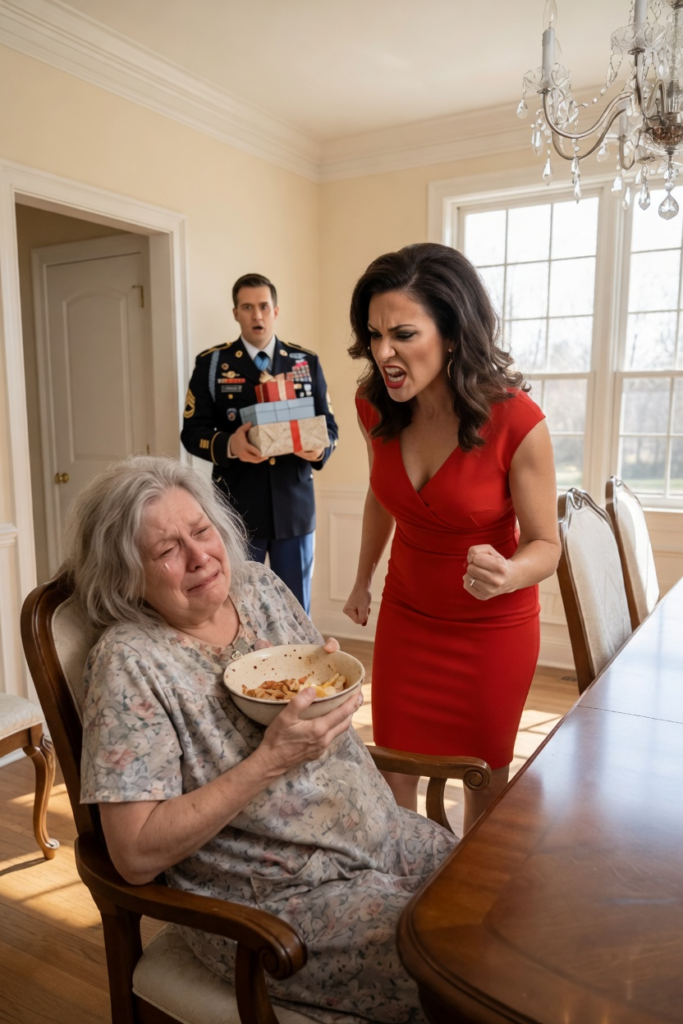
I rounded the corner and stopped dead. The scene before me froze the blood in my veins. It was worse than an enemy ambush. It was a betrayal inside the wire.
The dining room was a picture of holiday perfection. A massive Christmas tree glowed with soft, warm white lights in the corner. A silver angel watched from the top. Soft, classical carols drifted from the hidden surround-sound speakers.
But standing in the center of the room, destroying the peaceful illusion, was my wife.
Vanessa wore a fitted, crimson cocktail dress, her dark hair perfectly styled for the holiday gala we were supposed to attend later. But her beautiful face was twisted into an unrecognizable, ugly mask of fury. One of her perfectly manicured hands was gripping my eighty-year-old mother by the jaw, forcing her head back with terrifying strength.
With her other hand, Vanessa was violently shoving a heavy ceramic bowl toward my mother’s mouth.
Thick, brown liquid—it looked like spoiled stew—was dripping down my mother’s chin, soaking the collar of her faded floral house dress. Margaret’s frail, trembling hands were desperately trying to push the bowl away, tears spilling from her terrified, wide eyes.
“Vanessa, what the hell are you doing?!” My voice ripped through the room, a parade-ground roar that completely drowned out the carols.
Vanessa spun around, gasping. For one terrifying fraction of a second, she didn’t look like a high-society wife caught in an act of cruelty. She looked like a cornered insurgent, her dark eyes darting rapidly as she calculated her tactical retreat: whether to lie, run, or attack.
I rushed to my mother, violently slapping the bowl out of Vanessa’s hand. It shattered against the hardwood floor with a deafening crash. I dropped to my knees, pulling Margaret into my arms, shielding her with my body.
The smell hit me instantly.
It wasn’t just sour meat and old broth. There was a sharp, bitter chemical odor underneath it. It smelled like crushed pharmaceuticals. My stomach violently churned.
“Mom,” I asked, my voice shaking as I wiped the foul liquid from her chin with the sleeve of my uniform. “Did she try to make you eat this?”
Margaret couldn’t answer right away. She was gasping for air, her chest heaving, tears streaming through the deep lines of her weathered face. She looked at me, terrified, and gave one slow, agonizing nod.
I stood up slowly, squaring my shoulders, turning to face the woman I had married three years ago. “Explain yourself. Right now.”
Vanessa folded her arms across her chest, lifting her chin as if indignation could somehow shield her from a commanding officer’s wrath.
“You should ask her what she’s been doing behind your back, David,” Vanessa snapped, her voice shrill and defensive. “Ask her why you bought a massive piece of real estate without consulting your own wife. Ask her how long she’s been manipulating you.”
“Manipulating me?” I stared at her in utter disbelief. “She is an eighty-year-old woman, Vanessa!”
“She’s turning you against me!” Vanessa yelled, pointing a trembling finger at Margaret. “She lives here on this estate like some helpless saint while you pour your money into her life. First the luxury guest house, then the private medical care, and now I find documents for a multi-million-dollar house in Connecticut! Do you think I’m stupid, David? She’s taking what belongs to us!”
“Belongs to us?” I stepped toward her, the sheer force of my anger vibrating in the air between us. “She raised me. That house is a Christmas gift. It’s her safe haven.”
“A three-million-dollar gift!” Vanessa shot back, her face flushing red with greed. “For a woman who isn’t even your real mother!”
The room went completely, suffocatingly still. Even the carols seemed to fade away into nothingness.
My mother’s eyes widened in sheer horror. She reached out a trembling hand. “Vanessa… no. Please.”
But Vanessa was past caution now. She was drunk on anger, panic, and a desperate need to win the psychological high ground. She stepped closer to me, her voice shaking with cruel triumph.
“She never told you, did she, David?” Vanessa sneered, a wicked, triumphant smile playing on her lips. “You let her pin those stars on your shoulders, you let her stand at your promotion ceremonies, all while she was hiding the biggest lie of your life. Ask her, David. Ask her who left you in a cardboard box in an icy church parking lot in Ohio. Ask her why she kept the secret adoption papers locked in a safe.”
I looked from Vanessa’s triumphant face down to my mother. Margaret was weeping openly now, her hands covering her face in shame.
My pulse thundered in my ears like artillery fire. I had walked into my home expecting a warm holiday surprise. Instead, I found my wife force-feeding my mother, and a secret big enough to rip the very foundation of my identity apart.
Before I could speak, a horrifying sound broke the silence.
Margaret began to choke.
My mother’s hands flew to her throat. She pitched forward in her chair, gasping for air that simply wouldn’t come.
“Mom!” I dropped to my knees, catching her fragile frame before she slid out of the dining chair and hit the hardwood floor.
Thick, white foam was gathering at the corners of her mouth. Her breathing turned into a ragged, shallow rattle, like a failing engine. Her eyes rolled back, fluttering wildly in her skull.
“Call 911!” I screamed, looking up at Vanessa.
Vanessa didn’t move. She stood there, absolutely frozen, staring at the choking woman with an expression that held absolutely zero concern. Only cold, detached calculation.
I cursed under my breath, pulling my encrypted government phone from my pocket with shaking hands. I barked my address to the emergency dispatcher with the precision of calling in a medevac, demanding an ambulance immediately. Then, I yelled down the hallway for Maria, our housekeeper, to bring water and alert the estate’s private security detail.
Vanessa finally took a step back, shrinking into the shadows near the glowing Christmas tree, her arms still crossed over her chest.
Ten agonizing minutes later, paramedics burst through the front door. I rode in the back of the ambulance, holding my mother’s cold hand as the sirens wailed through the snowy Virginia night, tearing through the holiday traffic.
At the military hospital at Fort Belvoir, Margaret was immediately rushed through the double doors of the intensive treatment unit. I paced the waiting room in my dress uniform, my boots leaving wet, muddy tracks on the spotless linoleum.
An hour later, the attending emergency physician, an Army Colonel named Dr. Aris, walked out.
“General Sterling,” she said, her voice grave and professional. “We stabilized her, but it was dangerously close. She suffered from severe aspiration and acute chemical poisoning. We pumped her stomach. Someone mixed a massive, lethal dose of highly concentrated prescription sedatives into that food. If you had arrived even fifteen minutes later, her respiratory system would have shut down completely. This wasn’t an accident, sir.”
That single sentence changed something permanent inside me. A heavy, impenetrable steel door slammed shut over the love I once had for my wife. The man who had loved Vanessa died in that hallway. The commanding officer took over.
I walked out to the main lobby. Vanessa was sitting in a plastic chair, her red designer dress hidden beneath a cheap, gray hospital blanket. She stood up as I approached, her eyes wide, playing the part of the distraught, terrified military spouse.
“David, is she okay?” Vanessa asked, reaching out to touch the brass buttons on my coat.
I didn’t flinch. I just stared at her, my face a mask of stone. “She was poisoned, Vanessa.”
Vanessa immediately launched into a frantic, chaotic defense. “I just wanted to frighten her, David! I swear! My friend, Chloe, warned me. Chloe said Margaret was quietly taking control of your entire estate. Any wife would have panicked after finding property deeds hidden in a locked safe in your private study!”
I listened to her desperate, selfish excuses until she finally trailed off, dropping her gaze to the floor under the weight of my stare.
“She’s not even your biological mother, David,” Vanessa whispered, as if that technicality somehow absolved her of attempted murder.
I looked at her with a terrifying, absolute calm she had never seen from me before. “And you believe that justified poisoning an unarmed, elderly civilian in my home?”
Vanessa looked away, unable to meet my eyes.
By midnight, I couldn’t wait any longer. I needed answers to the secret Vanessa had tried to use as a weapon against me. I dispatched my personal security officer back to the estate to retrieve the locked metal box Margaret kept hidden under the floorboards of the guest cottage.
My security chief brought it to the hospital. I sat alone in a quiet, sterile waiting room and broke the padlock with a multi-tool.
Inside the rusted box were brittle hospital records, a tiny, faded infant hospital bracelet, yellowed newspaper clippings from thirty-seven years ago, and a sealed envelope containing a handwritten letter Margaret had written but never given me.
Just before dawn, an ICU nurse informed me Margaret was awake. I went into her room alone.
She looked so small, so incredibly fragile against the stark white hospital sheets. An oxygen tube was taped beneath her nose, and IV lines snaked into her bruised arms.
“David,” she whispered, her voice hoarse and broken. Tears immediately pooled in her eyes. “I wanted to tell you. I truly did. Every day I wanted to tell you. Just not… not like this.”
I sat in the chair beside her bed and gently took her fragile hand in mine. “Tell me now, Mom. Please. Give me your sit-rep.”
Margaret closed her eyes, the memories clearly painful. Thirty-seven years earlier, during a brutal, historic ice storm outside Toledo, Ohio, Margaret had been walking home from a night shift cleaning office buildings. She had recently buried her husband, a Vietnam veteran, and lost her own baby to a fever years before. She was alone, grieving, and barely able to afford rent.
As she passed Saint Matthew’s Church, she heard a faint cry coming from a cardboard box left near the dumpsters in the freezing, snow-covered parking lot.
Inside was a newborn baby boy, wrapped in a thin, dirty blanket, turning blue from the extreme cold.
“I brought you to the hospital,” Margaret whispered, squeezing my hand with surprising strength. “The authorities searched for your relatives for months. No one came. No one wanted you, David. So… I signed the papers. I brought you home to my tiny, freezing apartment. I named you David.”
Tears streamed down my face as I listened.
She told me how she had worked double, sometimes triple shifts just to afford formula and warm clothes. She had skipped her own meals so I could eat. She had sold her beloved wedding ring to buy me a winter coat. She had taught me to read using discarded books she found in the trash behind the local library.
When I earned an appointment to West Point, she hid her chronic back pain so I wouldn’t stay behind to take care of her. When I climbed the ranks and became a General, earning a substantial income and book deals, she accepted very little of it, terrified that I would feel burdened by the poverty she had endured when I was a child.
I sat by her hospital bed and cried silently. She had not given me life, but she had given me absolutely everything that made my life possible. She was my commanding officer, my hero, and my mother. She was more of a parent than anyone who shared my DNA.
Then, my encrypted phone buzzed. It was a secure message from my head of estate security.
He had pulled the internal security camera footage from the dining room and service kitchen.
I stepped out into the hallway and opened the video file. I watched my wife, Vanessa, walk into our service kitchen with a prescription medicine bottle in her hand. I watched her dismiss the kitchen staff early. I watched her methodically crush the pills, stir them into the spoiled food, and carry the bowl into the dining room, grabbing my elderly mother by the jaw when she refused to eat.
It was absolute, undeniable proof of a targeted strike.
I walked back into my mother’s room, kissed her forehead, and promised her she was safe under my watch. Then, I walked out to the lobby where Vanessa was still waiting, wrapped in her blanket.
It was time to initiate a scorched-earth protocol.
I didn’t confront Vanessa in the hospital lobby. I didn’t scream, and I didn’t demand an explanation. I simply looked at her, my face a mask of disciplined, lethal calm, and told her to go home.
“David, please,” she begged, clutching the cheap hospital blanket tightly around her shoulders. “Are you coming with me? We need to talk about this privately.”
“I am holding position here with my mother,” I replied, my voice chillingly flat. “Do not contact me.”
I watched her hail a cab, oblivious to the legal and social artillery strike I was about to call down on her coordinates.
At 08:00 hours on Christmas morning, while families across the nation were opening presents and singing carols, I was sitting in a sterile interrogation room at the local civilian police precinct in Virginia. I handed the lead detective a digital tablet containing the high-definition security footage from my home.
The detective, a seasoned veteran named Miller, watched the video in silence. When he finished, he looked up at me, his jaw set tightly.
“This isn’t just elder abuse, General Sterling,” Detective Miller said, tapping the tablet. “Given the massive dosage of the sedatives the military hospital found in her toxicology report, and the physical force used… we are looking at a clear-cut charge of attempted murder.”
“I know,” I said quietly. “Arrest her.”
I learned something else that morning after a long, encrypted phone call with my legal team. The prenuptial agreement Vanessa had eagerly signed three years ago—back when she was playing the role of the devoted, loving military fiancée—contained a very specific, ironclad Uniform Code of Military Justice (UCMJ) style morality and abuse clause. Any intentional physical abuse or criminal act committed against me, a dependent family member, or household staff completely voided her financial settlement.
If she was convicted, she wouldn’t see a single dime of my fortune, my pension, or my book royalties.
By noon on Christmas Day, the snow had stopped falling, leaving the world quiet, white, and frozen.
Vanessa was sitting in the grand living room of our estate, sipping expensive espresso and texting her friend Chloe, no doubt strategizing her next PR move to manipulate me and protect her status in D.C. society.
She didn’t hear the police cruisers pull up the long driveway because they approached tactically, with the sirens off.
My private security team let the detectives inside. They walked into the living room, their badges shining against their heavy winter coats.
Vanessa stood up, her espresso cup clattering onto the glass coffee table. “What is the meaning of this? Where is my husband? You cannot enter a General’s home without permission!”
Detective Miller stepped forward, pulling a pair of cold steel handcuffs from his belt. “Vanessa Sterling, you are under arrest for the attempted murder of Margaret Sterling. You have the right to remain silent…”
The arrest spread through our elite Washington D.C. social circles faster than classified intelligence.
By evening, Vanessa’s name was flashing across police scanners, buzzing in private group chats among politicians and military brass, and headlining local news sites. The polished, glamorous photographs she loved to post online—Vanessa in couture at Pentagon galas, Vanessa smiling under crystal chandeliers—were suddenly being broadcast side-by-side with a blurry security still of her violently grabbing an eighty-year-old woman by the jaw.
I did not go back to the empty, echoing mansion that night. I stayed at the hospital, sitting at attention in a hard plastic chair beside Margaret’s bed, listening to the steady beep of her heart monitor. For the first time in three years, my massive estate felt less like a command post and more like a crime scene.
On December 26th, local detectives executed a search warrant on the mansion.
They found the empty prescription sedative bottle hidden deep inside a sealed bag in Vanessa’s bathroom trash can. She had tried to wipe it clean with bleach, but forensics easily pulled her partial fingerprints from the cap.
But the most damning intelligence didn’t come from the trash. It came from her seized cell phone.
The police recovered hundreds of deleted text messages and voice notes between Vanessa and her best friend, Chloe. Chloe hadn’t ordered the attack outright, but she had provided the psychological ammunition. The voice notes were filled with toxic suspicion and strategy. Chloe had convinced Vanessa that generosity was a weakness, that gratitude was just manipulation, and that an old woman with no blood tie to a Major General had absolutely no right to my loyalty or my wealth.
In one recovered voice note, Chloe laughed coldly and said, “If you don’t remove the old bat now, Vanessa, you’ll spend your entire marriage competing with a saint. She’s taking the house that should belong to you. Make her look crazy. Make her sick.”
The police let me listen to the audio files once. I felt physically sick to my stomach. I never played them again.
Vanessa was denied bail. The judge cited the crystal-clear security footage, the physical evidence at the hospital, and the severe risk of flight or witness tampering, given her wealth and social connections.
From her cell in the county lockup, Vanessa called my personal cell phone repeatedly. I declined every single call, blocking the numbers as they came in.
Then, she sent a handwritten letter through her high-priced defense lawyer. The letter begged for my compassion. She claimed she had been suffering from immense stress, negative reactions to her own medication, and a deep, irrational fear of losing me to a woman who wasn’t even my real mother.
The letter ended with a manipulative, desperate line that might have saved a weaker marriage, or fooled a weaker man:
I did it because I was terrified. I still love you, David. I have always loved you.
I took a pen, turned the expensive stationery over, and wrote one single sentence on the back with surgical precision.
Love does not poison the helpless.
I handed it back to her lawyer and told him I never wanted to see her face outside of a courtroom again.
The divorce moved with brutal, unstoppable, military efficiency.
The prenup held firm against every desperate, flanking legal attack her lawyers mounted. Vanessa lost her claim to the financial settlement. She lost her claim to the Virginia estate. She lost access to the private trust I had generously created for her after our second anniversary, and she was entirely severed from my military pension.
The social fallout was absolute and devastating. Several prestigious military charities and officer spouses’ clubs quietly removed her from their public boards within days of her arrest. The luxury brands that once courted her as a D.C. influencer stopped returning her calls. She was radioactive.
Chloe, suddenly terrified of being charged as an accessory to attempted murder, eagerly gave a sworn statement to the police. She tried to minimize her role, painting Vanessa as a deeply unhinged, greedy woman who acted completely alone. But prosecutors were already studying their communications, building a secondary case for conspiracy and coercion. The insurgents were turning on each other.
Margaret recovered slowly. Her lungs remained fragile for weeks, requiring breathing treatments and careful monitoring from the military doctors. But by New Year’s Day, she was sitting up in her hospital bed, drinking warm chamomile tea, and scolding me for sleeping in a terrible plastic chair when I owned much better furniture at home.
I laughed out loud for the first time since that terrible Christmas Eve. It felt like a heavy rucksack had been lifted from my shoulders.
In late January, Margaret was finally cleared to leave the hospital. I didn’t take her back to the Virginia mansion. I loaded her carefully into my vehicle and drove her straight to the coastal town in Connecticut.
I pulled the car up to the beautiful, renovated bungalow overlooking the gray winter ocean. It was modest compared to the sprawling, cold mansion Vanessa had guarded so fiercely. But it was warm, filled with light, and completely safe.
I helped Margaret inside. She stood in the center of the beautiful kitchen, leaning heavily on her wooden cane, tears welling in her eyes as the winter sunlight spilled across the polished hardwood floors.
A large, hand-painted blue ceramic bowl sat on the granite counter. Propped against it was a welcome card I had written in my own hand.
Margaret picked it up with trembling fingers and read the words aloud, her voice breaking with emotion.
For the woman who chose me when no one else in the world wanted me.
Margaret pressed the card tightly against her chest. She looked up at me, a profound, unwavering love shining in her weathered eyes.
“You were always my son, David,” she whispered, reaching out to touch the brass stars on my uniform. “A piece of paper in an Ohio courthouse never had the power to change that.”
I moved her in two weeks later. I hired a private, live-in nurse that Margaret personally approved of to ensure she was always cared for while I was at the Pentagon or deployed. I visited every single Sunday without fail, leaving my phone in the car so nothing could interrupt our time.
I also took steps to legally reopen my sealed adoption records. Not because I doubted for a second who my real mother was, but because I no longer wanted any hidden truth left vulnerable to the enemy. I wanted no shadows left in my life for anyone to weaponize against us.
As for Vanessa, her criminal trial did not begin with a dramatic, tearful confession. It began with the brutal, undeniable truth.
I sat in the front row of the courtroom in my dress uniform as the prosecution played the security footage on a massive screen. The jury watched in horrified silence as an elderly woman pleaded for mercy, and a younger, wealthy woman chose violence over restraint. They watched Vanessa crush the pills. They watched her force the bowl to Margaret’s lips.
Vanessa sat at the defense table, looking pale and hollow, stripped of her designer gowns, her social status, and her arrogance. She was just a criminal waiting for sentencing.
By the time the guilty verdict was read three weeks later, it didn’t feel like a shocking twist or a dramatic victory. It felt like a necessary, heavy reckoning. Justice had been served.
Years later, people in the D.C. social circles still told the story wrong at high-society cocktail parties. They whispered that the General’s marriage ended because of a scandalous, secret adoption. They confidently claimed that his sudden wealth from his book deals ruined everything.
They were entirely wrong.
The marriage didn’t end because I was adopted. The marriage ended the exact moment greed convinced my wife that love was something you defend with violence, instead of something you honor with trust and loyalty.
I never remarried. But as I sat on the back porch of the Connecticut house, watching my mother tend to her blooming garden in the warm summer sun, I realized I had never been lacking love. I just needed to fiercely protect the love that had always been there.