The beach house was supposed to be my peaceful place.
Not grand. Not the sort of house people in glossy magazines point to and say, “Now that is wealth.” It was a simple Florida beach house with white siding, blue shutters, a narrow screened porch, and sand that found its way inside no matter how many times I swept.
My late husband Harold used to say the place smelled like salt, sunscreen, and second chances.
He was right.
Every time I opened the front door, even after he was gone, I could still feel him there. I could see him rinsing fishing rods by the outdoor shower. I could hear him humming in the kitchen while burning toast he swore was “perfectly golden.” I could picture him sitting on the porch in that old faded ball cap, holding coffee in both hands while the sun climbed over the dunes.
That house was not just property to me.
It was years.
It was packed lunches instead of restaurant dinners. It was used cars with stubborn air-conditioning. It was Harold taking overtime at the marine supply warehouse and me working double shifts at the school office during registration week. It was every vacation we did not take, every couch we did not replace, every Christmas when we told each other, “Next year, maybe.”
We did not inherit it.
We did not win it.
We bought it one month at a time until the bank finally stopped owning more of it than we did.
My name is Patricia Wells. I am sixty-nine years old, widowed, and for a long time, I believed if you gave your family enough love, they would at least know where the line was.
That was my mistake.
The trouble did not begin with shouting. Trouble in families rarely does. It begins with small things people pretend are not worth mentioning.
A mug moved from one cabinet to another.
A drawer cleaned out without asking.
A guest acting a little too comfortable in a house that is not theirs.
After Harold passed, I kept the beach house mostly as he left it. Some people told me that was unhealthy. My sister Diane said, “Patty, you can’t live in a museum.”
But it was not a museum. It was a place where grief had softened around the edges. Harold’s fishing hat still hung by the back door. His old paperback westerns leaned on the shelf by the porch. A glass bowl full of shells sat on the coffee table, each one collected on a different morning walk when our knees still worked better and we thought we had endless time.
Then my son Marcus called.
“Mom,” he said, sounding tired in that careful way adult children sound when they want something but do not want it to feel like asking. “Lauren and I are in a bind.”
Marcus was my only child. Forty-two years old, good-looking like his father had been, with the same dark hair and same habit of rubbing the back of his neck when he was uncomfortable. He worked in sales for a regional medical equipment company and had always been able to talk his way through a closed door.
His wife, Lauren, was harder to read.
She was polished. That was the word people used for her. Blonde hair always done. Nails always pale pink. Linen pants in colors I was too practical to buy. She spoke in a smooth, friendly voice that somehow made every sentence feel like a decision had already been made without you.
Their condo in Destin had water damage, Marcus said. A pipe had burst in the unit upstairs, and the repair company was dragging its feet.
“Could we stay at the beach house for a few weeks?” he asked. “Just until things are fixed.”
A few weeks.
That is what he said.
I was making chicken salad at my kitchen counter in Tallahassee, using Harold’s old mixing bowl, when he asked me. I remember looking out the window at my crepe myrtle tree and feeling a little relieved, honestly. The house had been quiet. Maybe too quiet. Maybe having family there would make it feel alive again.
“Of course,” I said.
“Really?”
“Marcus, it’s family. You don’t have to sound like you’re calling a bank.”
He laughed. “Thanks, Mom. We’ll take good care of it.”
I believed him because mothers are good at believing the version of their children they raised, even when life has already shown them a different one.
The first few weeks were fine.
Lauren sent pictures of sunsets from the porch. Marcus fixed the loose latch on the outdoor shower. I drove down twice with groceries and fresh towels, and Lauren hugged me at the door like I was a blessing.
“You saved us,” she said.
I smiled and told her it was no trouble.
Then little things changed.
I noticed the shell bowl moved from the coffee table to the bottom shelf of the bookcase. Harold’s paperbacks disappeared into a storage bin. The framed photo of him holding a redfish, the one I had kept on the side table near the front window, was moved to the guest room.
“It just looked less cluttered this way,” Lauren said when I asked.
I told myself not to be sensitive. People rearrange things when they stay somewhere. That did not mean anything.
Then she started calling it “our beach house.”
Not once. Not by accident.
All summer, whenever she spoke to friends on the phone, posted a photo, or chatted with neighbors walking by, I heard it.
“Our porch gets the prettiest light in the morning.”
“We’re still settling into our beach house.”
“Come down sometime. We love hosting.”
The first time, I corrected her gently.
“My beach house,” I said with a smile.
Lauren laughed as if I had told a sweet little joke.
Marcus heard me. He was standing near the kitchen island opening a bag of chips.
“Mom,” he said, “don’t make it weird. Lauren just loves the place.”
That should have bothered me more than it did.
But when you are a widow and your only son is standing in front of you, looking tired and asking you not to start trouble, you swallow things. You tell yourself peace is worth more than pride. You tell yourself young couples are different now, that maybe ownership means less to them, that maybe words are just words.
Words were not just words.
By September, Lauren had changed the curtains in the front bedroom without asking. The old ones were soft blue cotton, faded by sun, chosen by Harold because he said they looked “beachy but not fussy.” Lauren replaced them with stiff white panels that reminded me of a hotel lobby.
“They were dated,” she said.
I stood there holding the folded blue curtains in my arms, smelling faint traces of laundry soap and salt air.
“They were mine,” I said.
She blinked. “Of course. I saved them for you.”
For me.
As if I were a visiting aunt collecting things from a house she had outgrown.
Marcus was no help. He had developed a new way of looking at me during those months, a look that said, Please don’t force me to choose. It would have broken my heart less if he had simply chosen.
Instead, he hid behind discomfort.
In October, my neighbor Ruth called me.
Ruth lived three houses down and had known Harold and me for nearly twenty years. She was a retired nurse with sharp eyes, a soft voice, and a talent for knowing everyone’s business without ever seeming nosy.
“Patty,” she said, “I’m only calling because I’d want someone to tell me.”
My stomach tightened. “Tell you what?”
“There was a party last night.”
“A party?”
“At your house. Not wild, exactly. But big enough. Cars up and down the road. People on the porch. Music until after midnight.”
I sat down at my kitchen table.
“Marcus didn’t mention anything.”
“I didn’t think he would.”
There was a quiet pause.
Then Ruth added, “Lauren told someone they were thinking of doing ‘small luxury rentals’ next spring. I don’t know what that means, but I didn’t like the sound of it.”
I thanked her and hung up, but I did not call Marcus right away. I sat there with my hand on the phone, remembering the first time Harold and I had walked through that house with a realtor.
Back then, the porch screen had a tear in it. The kitchen linoleum was curling near the refrigerator. The air conditioner groaned like a tired dog. But Harold had stepped into the back room, looked out at the dunes, and said, “Patty, this is where we’re going to learn how to be old.”
We never got to be old there together.
He died at sixty-eight from a heart attack in the driveway of our Tallahassee home, one hand still holding the garden hose, the other pressed to his chest. One minute he was fussing over brown spots in the grass. The next, he was gone before the ambulance could do what ambulances are supposed to do.
For months after that, I could not enter the beach house without crying.
Then one morning, I drove there alone. I made coffee. I sat on the porch. I listened to the waves. And something inside me settled just enough to keep going.
That was what Lauren was treating like a backdrop for Instagram photos.
I called Marcus that evening.
He answered on speakerphone. I could hear Lauren in the background moving dishes around.
“Ruth said there was a party,” I said.
Marcus sighed. “Mom, it wasn’t a party. A few people came over.”
“Were they your people or Lauren’s?”
“Does it matter?”
“It matters because I wasn’t told.”
Lauren’s voice came through, bright and cool. “Patricia, we didn’t think we needed to report every dinner guest.”
Every dinner guest.
I looked at the wall where Harold’s photo hung in my kitchen, his smile crooked and kind.
“You are staying there because I allowed it,” I said. “That house is not a rental venue.”
“No one said it was,” Marcus replied too quickly.
“Good,” I said. “Then we understand each other.”
We did not.
By Thanksgiving, I could feel the shift. Marcus and Lauren still had not moved back to their condo, though I later learned the repairs had been finished weeks earlier. When I asked about it, Marcus said the insurance claim was complicated. Lauren said mold testing took time. Then she said the furniture delivery had been delayed. There was always another reason.
I should have driven down and ended it then.
But Thanksgiving came, and I wanted peace.
Families can make cowards of us when we confuse silence with love.
On Thanksgiving Day, Lauren hosted dinner at my beach house.
Hosted.
That was the word she used in the group text.
Patricia, we’d love to host Thanksgiving at the beach house this year. Less stress for you.
Less stress for me.
I brought sweet potato casserole, two pies, and Harold’s carving knife because Marcus liked using it. Lauren had set the table with beige cloth napkins I had never seen before. Her parents were there, along with her sister and brother-in-law. Everyone acted as if the house belonged to Lauren and Marcus.
Her mother, Celeste, walked through the living room holding a glass of chardonnay and said, “This place is charming. Lauren has done wonders with it.”
I was standing beside the coffee table.
Harold’s shell bowl was gone.
In its place sat a glossy white ceramic tray with fake lemons.
I heard myself say, “Where are the shells?”
Lauren did not even turn around. “Packed away. They didn’t match.”
They didn’t match.
That night, after everyone left, I found the glass bowl in the laundry room, wrapped in an old beach towel. Two shells were cracked.
I picked them up one by one and sat on the edge of the washer, crying so quietly nobody heard me.
Or maybe Marcus heard and pretended he did not.
After Thanksgiving, I asked them for a firm move-out date.
Marcus said, “After New Year’s.”
Lauren said, “We’ll revisit it.”
Revisit it.
As though my home were a committee topic.
That was when I called my attorney, Rebecca Marsh.
Rebecca had handled Harold’s estate. She was in her early fifties, tidy, direct, and not easily impressed by family drama. Her office smelled like paper, coffee, and lemon cleaner. She had known Harold well enough to respect him and me well enough not to baby me.
I brought her the old leather folder Harold had kept in the top drawer of his desk.
Inside were the deed, insurance records, tax bills, estate documents, and a separate agreement Harold had insisted on years earlier after seeing a cousin nearly lose access to a family cabin because of a handshake arrangement gone sour.
At the time, I thought Harold was being dramatic.
“Patty,” he had said, tapping the paper with his finger, “family is family until property is involved. Then everyone suddenly remembers things differently.”
The paper was simple but strong. Any family member permitted to use the beach house was a temporary guest unless Patricia Wells gave written approval otherwise. No guest, relative, invitee, or spouse of any relative could claim ownership, residency, tenancy, or control over the property through use, storage of belongings, payment of utilities, decorating, entertaining, or verbal statements. Permission could be ended at Patricia’s sole discretion.
Harold had made Marcus sign a copy years earlier when Marcus used the house for a month after college.
At the time, Marcus laughed and said, “Dad, seriously?”
Harold had said, “Seriously.”
I had forgotten about that signed page until Rebecca pulled it from the folder and laid it on her desk.
“Your husband was a careful man,” she said.
“He was a stubborn man.”
“Sometimes that’s the same thing.”
Rebecca reviewed everything, then looked at me over her reading glasses.
“Do Marcus and Lauren have another legal residence?”
“Yes. Their condo.”
“Do they pay you rent?”
“No.”
“Do they have a lease?”
“No.”
“Have you ever given them written permission to live there permanently?”
“No.”
“Have they changed locks or alarm access?”
“Not that I know of.”
Rebecca’s expression sharpened. “If they do, call me immediately.”
I almost laughed. “They wouldn’t go that far.”
Rebecca did not smile.
“Patricia, people go as far as they are allowed to go.”
Those words stayed with me.
By December, I had started to dread phone calls from my own son.
Lauren stopped asking before making changes. She had a landscaper trim the sea oats near the dune line, which could have caused trouble with the county if Ruth’s husband had not stopped them. She ordered new porch chairs and put Harold’s old wooden rockers in the garage. She asked Marcus whether they should “open up the kitchen wall eventually,” as if eventually belonged to her.
When I told Marcus this had gone too far, he said, “Mom, I know you’re emotional about the house.”
Emotional.
That is the word people use when they want to make your boundaries sound like symptoms.
“I’m not emotional,” I said. “I’m clear.”
He went quiet.
Then he said, “Lauren feels like you don’t respect our space.”
I gripped the phone so hard my knuckles hurt.
“Your space is your condo. My house is my house.”
“See?” he said, voice tightening. “That’s what I mean. You make it sound like we’re strangers.”
“No, Marcus. I make it sound like I still exist.”
He had no answer for that.
Three days later, Lauren posted a photo online.
I did not use social media much, but Diane sent me a screenshot with the message: Please tell me you approved this.
The photo showed my screened porch at sunset, glowing gold and soft. On the table sat wine glasses, a cheese board, and those stiff white napkins Lauren liked. The caption read:
First Christmas in our beach home. New traditions begin where old energy ends.
Old energy.
I stared at those words until they blurred.
I could forgive young people for being careless. I could forgive taste I did not share. I could even forgive Marcus for being weak, though it cut deep.
But I could not forgive my husband being erased.
Not by a woman wearing my kindness like a key.
That Thursday, I packed a small overnight bag, stopped at Publix for groceries, and drove down Highway 98 toward the coast.
The drive was familiar enough that my body knew the curves before my mind did. Gas stations with faded signs. Seafood shacks with hand-painted specials. Snowbirds in rental cars driving too slowly. The flash of water between buildings. Palm trees bending in the wind like they had gossip to share.
I bought the things I always bought for a family weekend. Coffee creamer Marcus liked. The cinnamon rolls Lauren pretended not to eat but always did. Fresh shrimp. A bag of oranges. A pecan pie from the bakery because Harold had loved pecan pie, and I still bought it sometimes as if he might walk in late and ask for a small piece.
The house came into view just after four.
White siding. Blue shutters. Porch facing the dunes.
For one moment, I felt the old relief.
Then I saw the new wreath on the front door. Huge, expensive, covered in gold ribbon. Pretty, yes. But too much. Like Lauren.
I carried two grocery bags to the front door and typed in the alarm code.
Red light.
I paused.
Maybe I had hit the wrong number.
I typed it again.
Red light.
A strange coldness moved through me. Not fear. Not yet. Something cleaner and sharper.
I tried the old backup code Harold and I had used for years.
Red light.
Then the door opened.
Lauren stood there wearing sunglasses on top of her head and my white linen shirt over her swimsuit.
My shirt.
From my closet.
Not borrowed. Not asked for. Taken.
“Oh,” she said. “We changed the code.”
Behind her, I saw my living room and felt my stomach twist.
The couch had new pillows. Pale beige with blue piping. Her candles sat on my side table. A large framed photo of Lauren and Marcus on the beach now occupied the place where Harold’s picture had been. The fake lemons were still there. My shell bowl was not.
I stood in my own doorway holding grocery bags like a delivery woman.
“Why would you change the code to my house?” I asked.
Lauren smiled.
It was not a big smile. That was the ugly part. It was small and calm and practiced, the kind of smile a person gives when she believes the hard part is already over.
“Patricia, we just need boundaries,” she said. “You can visit after we approve it.”
For a second, the world narrowed.
The waves were behind the house, but I could not hear them. A gull cried somewhere over the dunes, but it sounded far away. I could smell sunscreen, candle wax, and the shrimp thawing in one of the grocery bags.
“You can visit after we approve it.”
That sentence did something inside me.
It did not break me.
It finished something.
Then Marcus appeared behind her in the hallway.
He saw me. He saw the groceries. He saw his wife wearing my shirt. He saw the red light still glowing on the alarm panel.
And he looked away.
Not shocked.
Not confused.
Ashamed, maybe.
But not surprised.
That hurt more than anything Lauren had said.
Because he knew.
He knew whose house it was.
He knew who had paid the mortgage. He knew whose name was on the tax bill, whose signature was on the insurance policy, whose husband’s ashes had been scattered from the dune walkover one windy morning while he held my elbow and cried.
He knew.
And he still stood behind her.
I could have yelled. A younger version of me might have. Maybe the version of me before widowhood, before hospital rooms and probate forms and quiet dinners for one, would have pushed past Lauren and demanded my house back right then.
But grief had taught me the value of silence.
So had Harold.
Harold, who once told me, “Never argue with a person who thinks volume is ownership. Let the paper talk when the room gets stupid.”
I looked at Marcus.
His face was pale, but he said nothing.
I set the grocery bags gently on the porch.
“Alright,” I said. “Enjoy the evening.”
Lauren looked pleased.
Marcus looked relieved.
That told me everything.
I turned around, walked back to my car, and drove away without looking in the rearview mirror.
I did not go home.
I drove ten minutes down Highway 98 to a motel with blue doors, thin towels, and an air conditioner loud enough to rattle the window. The sign outside flickered between VACANCY and VACANC, which felt about right.
The young man at the desk called me ma’am three times and gave me a room near the ice machine.
Inside, the bedspread had a tropical pattern so faded it looked tired of pretending. The lamp leaned slightly. The bathroom smelled like bleach. Somewhere next door, a television laugh track played through the wall.
I sat on the edge of the bed with my purse in my lap and finally let my hands shake.
Not because I was helpless.
Because I had almost allowed them to make me believe I was.
There is a difference.
I opened my tote bag and took out the leather folder.
Harold’s folder.
Brown, scratched, soft at the corners from years of being pulled from drawers and put back. He had labeled it in black marker: BEACH HOUSE — DO NOT LOSE.
I used to tease him about that.
“Harold, if the house is on the beach, I doubt I’ll forget where we put it.”
He always said, “Laugh all you want. One day this folder will save somebody a headache.”
I laid the papers across the motel bedspread.
The deed.
The tax records.
The insurance policy.
The estate documents.
The letter from Rebecca.
And the signed agreement.
Marcus’s signature looked young. Looser than it was now. Careless in the way twenty-two-year-olds write their names when they think paperwork is something older people worry about.
I read the key line three times.
Permission to use the property is temporary, personal, revocable, and creates no ownership, tenancy, or control.
There it was.
Plain as sunrise.
I thought of Lauren saying, “You can visit after we approve it.”
Then I thought of Harold.
Not as a ghost. I never liked when people said that. He was not haunting me. He had loved me too well for that.
But I could feel the old steadiness he left behind.
I took out my phone and called Rebecca.
She answered on the third ring.
“Patricia?”
“They changed the alarm code,” I said. My voice sounded calmer than I felt. “Lauren told me I can visit after they approve it.”
Rebecca was quiet for one second.
Then she said, “Are you safe?”
“Yes.”
“Where are you?”
“At a motel off Highway 98.”
“Good. Don’t go back there alone tonight.”
“I wasn’t planning to.”
“Do you have the folder?”
“Yes.”
“Send me photos of the alarm panel if you have them.”
“I didn’t take any.”
“That’s okay. Tell me exactly what happened.”
So I did.
I told her about the code. The shirt. The photo moved from the table. The sentence. Marcus looking away.
Rebecca listened without interrupting.
When I finished, she said, “I’m going to prepare a notice tonight. In the morning, you’ll call the alarm company, the insurance agent, and the county sheriff’s non-emergency line. Not 911. You’ll request a civil standby. I’ll be available by phone.”
“Can they really be removed by lunch?” I asked.
“They are not tenants if the facts are what you’ve told me and what the documents show. They have a separate residence, no lease, no rent, and signed temporary permission. Lauren has no signed permission at all. The deputy will not be your moving crew, but he can keep the peace while you regain access and end their permission to remain.”
“What if Marcus refuses?”
“Then he can explain to a judge why he changed access to property he does not own after signing an agreement saying he never had control.”
I looked at the signed page on the bed.
For the first time all day, I took a full breath.
Rebecca’s voice softened.
“Patricia, I know this is your son. I’m sorry.”
That nearly undid me.
Not the legal part. Not the house.
That one sentence.
I pressed my fingers to my eyes.
“I don’t want to hurt him.”
“I know,” she said. “But he has helped hurt you.”
Outside, a truck rolled past the motel, headlights flashing through the curtain.
“I keep thinking Harold would be ashamed,” I whispered.
“Of you?”
“Of all this.”
“No,” Rebecca said firmly. “A man who put that agreement in writing was trying to protect you from exactly this. Let him.”
After we hung up, I sat in the motel room until the air conditioner clicked off and the silence pressed in.
Then my phone buzzed.
Marcus.
I let it ring.
He called again.
Then a text appeared.
Mom, Lauren feels like you left angry. Can we talk tomorrow when everyone is calm?
Everyone.
As if I had been the storm.
A minute later, another text came.
Please don’t make this bigger than it needs to be.
I almost answered.
I almost typed, You let your wife lock me out of my own house.
But I had spent sixty-nine years explaining myself to people who benefited from misunderstanding me. I did not owe him one more paragraph.
I turned off the lamp and lay awake in the dark, listening to the ice machine clatter outside my door.
I slept maybe four hours.
At six-thirty in the morning, I washed my face with motel soap that smelled like paper and stood in front of the mirror.
I looked older than I had the day before.
But not smaller.
At seven exactly, I called the alarm company.
The representative asked for my security phrase, my billing address, and the last four digits of the account holder’s Social Security number. Mine.
Not Marcus’s.
Not Lauren’s.
Mine.
“Yes, Mrs. Wells,” the woman said after verifying everything. “I see the code was changed two weeks ago through a keypad entry. We do not have a written authorization request on file from you.”
“Can you reset it?”
“Absolutely. Would you like to remove any temporary codes?”
“All of them.”
There was a pause.
“All temporary user codes have been removed. I can create a new master code for you now.”
I wrote it down on motel stationery.
Then I called my insurance agent, a man named Paul who had sent me Christmas cards for twelve years and always wrote little notes about his grandkids.
When I explained what had happened, his friendly voice became businesslike.
“Patricia, are they operating any business out of the home? Rental? Events?”
“I heard the word rental from a neighbor, but nothing approved.”
“Good that you called. Do not allow any short-term rental activity without a policy review. And if someone changed access without your authorization, document it.”
“I am.”
“Want me to email a copy of the current policy showing you as named insured?”
“Yes, please.”
Then I called the sheriff’s non-emergency line.
The dispatcher was polite, patient, and very used to people sounding shaky while trying to sound calm.
By eight-fifteen, Rebecca had emailed me the notice terminating permission to occupy, use, access, host guests, alter security systems, or represent control of the property.
By nine, I had printed it at the motel office while the same young man from the front desk pretended not to read the top line.
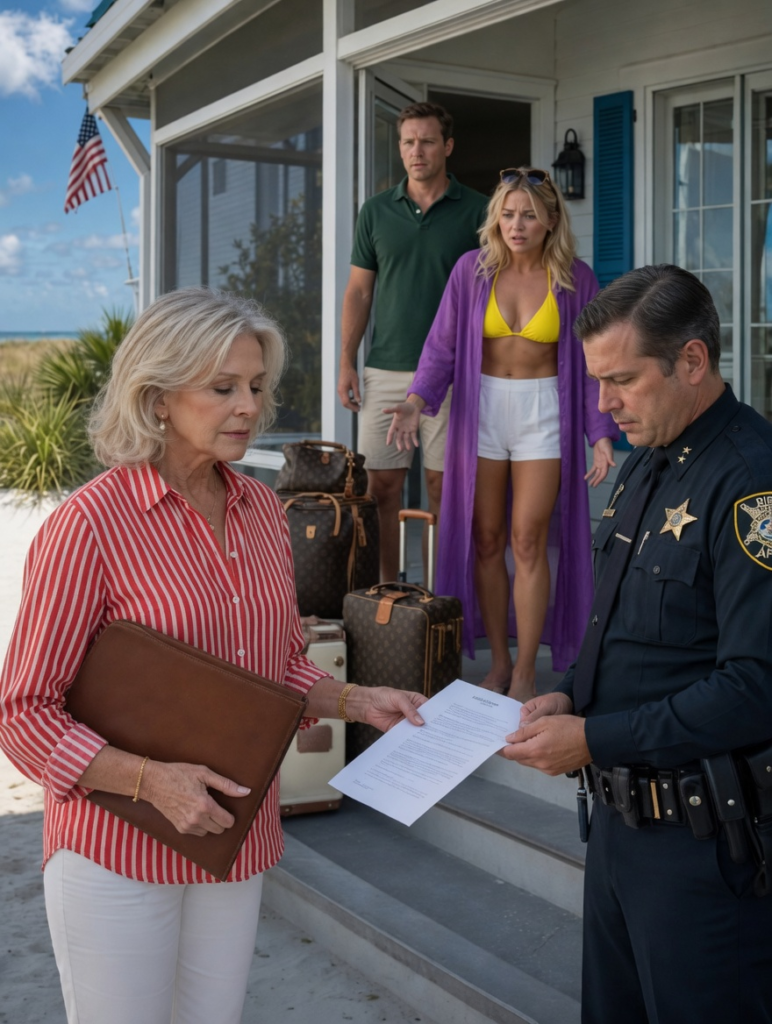
By ten-thirty, I pulled into my own driveway behind a marked sheriff’s vehicle.
The deputy who stepped out was a broad-shouldered man in his fifties named Deputy Calhoun. He had a calm face, a sun-reddened neck, and the kind of steady manner that made the air around him less chaotic.
“Mrs. Wells?” he asked.
“Yes.”
He looked at the folder in my hands. “Your attorney briefed our office. I’ll review what you have, then we’ll keep things peaceful while you serve notice and regain access. I’m not here to settle a family argument.”
“I understand.”
He nodded. “Good. Family arguments are above my pay grade.”
Under different circumstances, I might have laughed.
Rebecca was already on speakerphone when we walked to the front door. My new code worked on the first try.
Green light.
Such a small thing.
Such a powerful thing.
The front door opened before I touched the handle.
Lauren stood there barefoot, wearing a white sundress and an expression of offended disbelief.
Behind her, I saw three open suitcases in the living room.
Not because she was leaving.
Because she had been unpacking more.
A framed photo leaned against the wall. A new mirror sat in cardboard near the hallway. Two large shopping bags from an expensive home store rested on my couch.
She looked from me to the deputy.
Then she smiled.
Not as confident this time.
“Patricia,” she said, voice sweetening. “What is this?”
“This is Deputy Calhoun,” I said. “He’s here while I end your permission to stay in my house.”
Lauren blinked once.
Then her face hardened.
“You can’t be serious.”
“I am.”
Marcus came from the kitchen holding a coffee mug.
Harold’s mug.
The blue one with the chipped handle.
His eyes went straight to the deputy, then to me.
“Mom,” he said quietly, “what are you doing?”
I looked at the mug in his hand and felt a grief so old it had become part of my bones.
“I’m taking back my home.”
Lauren laughed, sharp and disbelieving.
“Your home? We live here.”
Deputy Calhoun unfolded the notice Rebecca had prepared. “Ma’am, my understanding is you were allowed to stay here temporarily.”
Lauren turned to him. “We’ve been here for months.”
“Yes, ma’am,” he said. “That doesn’t necessarily make it yours.”
Marcus set the mug down too hard on the counter. Coffee jumped over the rim.
“Mom, this is insane. We could have talked.”
I looked at him.
“You had all night to call and apologize.”
His mouth opened, then closed.
Lauren stepped forward. “We changed the alarm code because Patricia kept coming in without warning.”
“That’s not true,” I said.
“She made us uncomfortable,” Lauren said to the deputy, her voice rising. “We deserve privacy.”
Deputy Calhoun remained calm. “Do you own the property, ma’am?”
Lauren hesitated.
Marcus said, “No, but—”
“Do you have a lease?”
“No, but she said we could stay.”
Deputy Calhoun looked at the paper again. “Permission can be ended.”
Lauren’s face flushed. “This is a family matter.”
“Yes, ma’am,” he said. “And right now the owner of the property has asked you to gather necessary belongings and leave peacefully.”
That word owner moved through the room like a door opening.
Lauren heard it.
Marcus heard it.
I heard it too, though I had always known.
Lauren crossed her arms.
“I’m not leaving because of some emotional overreaction.”
Rebecca’s voice came from my phone, crisp and clear.
“Mrs. Wells has terminated your permission in writing. Continued refusal will create additional legal problems. I would strongly suggest you cooperate.”
Lauren stared at the phone as though it had insulted her personally.
“Who is that?”
“My attorney,” I said.
For the first time, Lauren looked uncertain.
Marcus looked worse.
He rubbed the back of his neck the way he had as a boy when Harold caught him lying about a broken window.
“Mom,” he said softly, “you brought a lawyer into this?”
“No, Marcus. You brought a lock into it.”
That silenced him.
Lauren turned on him.
“You signed something?” she demanded.
Marcus’s face drained.
I opened the folder.
It felt strange how peaceful my hands were. The night before, they had trembled on a motel bed. Now they were steady.
I pulled out the agreement and handed it to Deputy Calhoun, who glanced at it, then passed it to Marcus.
Marcus did not need to read far.
He knew.
He had probably forgotten, or convinced himself it did not matter, but his signature sat there at the bottom like a witness that had waited patiently for years.
Lauren grabbed the paper from him.
“Let me see.”
She scanned it quickly, her eyes moving faster and faster until they landed on the line Harold had insisted on adding.
No guest, relative, invitee, or spouse of any relative shall acquire ownership, residency, tenancy, or control through occupancy, use, storage of personal property, decoration, maintenance, hosting, verbal representation, or family relationship.
Her face changed.
Not dramatically. Not like in movies. No gasp. No hand to the chest.
The color simply left her cheeks.
That was when I knew she had planned on more than comfort.
Lauren had not merely been careless. She had been building a story. A slow one. A public one. Our beach house. Our porch. Our first Christmas. Our renovations. Old energy ends.
She had been trying to turn repetition into reality.
Marcus sank into one of the dining chairs.
“Lauren,” he whispered, “you told me that didn’t matter.”
The room went still.
There it was.
Not the whole truth, maybe.
But enough.
Lauren whipped around. “Don’t.”
I looked at my son.
“What did she tell you didn’t matter?”
Marcus pressed both hands to his face.
“Mom, I didn’t think it would go this far.”
“What did she tell you?”
Lauren’s voice sharpened. “Marcus.”
He lowered his hands. He looked awful. Not like a villain. Worse, in some ways. Like a man who had allowed himself to be led into doing something ugly and now wanted credit for feeling bad about it.
“She said if we stayed long enough,” he said, barely above a whisper, “if we made improvements and used it as our main home, it would be harder for you to force us out.”
The room seemed to tilt.
I heard Rebecca inhale softly through the phone.
Deputy Calhoun’s jaw tightened, but he said nothing.
Lauren’s eyes flashed.
“That is not what I said.”
Marcus laughed once, without humor.
“Yes, it is.”
She looked at me, then at the deputy, then back at Marcus.
“You’re really going to do this now? In front of them?”
He stared down at the floor.
I thought I would feel satisfaction.
I did not.
I felt tired.
Deeply, bitterly tired.
Because there is a special grief in discovering that someone did not misunderstand your kindness. They understood it perfectly and counted on it.
“How much of this was your idea?” I asked Marcus.
He swallowed.
“I should have stopped it.”
“That is not what I asked.”
His eyes filled, but I did not soften. Not yet.
“I liked being here,” he said. “I liked feeling like we had something beautiful. Lauren kept saying Dad would want me to have it someday.”
I closed my eyes for one second.
Harold had loved Marcus. Loved him fiercely. Coached his Little League team even though he hated baseball. Built him a desk when he went to college. Drove six hours once because Marcus’s car died in a gas station parking lot.
But Harold would never have wanted our son to steal peace from his mother.
When I opened my eyes, Marcus looked like a boy again.
“Your father wanted you to be a good man,” I said. “That would have been enough.”
Lauren made a frustrated sound.
“Oh, please. This is ridiculous. It’s a house. She barely uses it.”
That did it.
Not because it was cruel. Lauren had been cruel plenty.
Because it was honest.
I looked at her, really looked.
The polished hair. The expensive watch. The bare feet on my hardwood floor. My white linen shirt draped over a chair behind her because apparently even that had become hers the moment she touched it.
“You’re right,” I said.
Lauren blinked, thrown off.
“I don’t use it every day. I don’t fill every room with noise. I don’t host parties or post sunsets or move furniture just to prove I can. Sometimes I come here and sit on the porch with coffee. Sometimes I cry. Sometimes I talk to my husband because this is the last place where I can still hear him clearly.”
Marcus looked down.
I kept my eyes on Lauren.
“You saw an empty house. I saw thirty-six years of marriage. That is the difference between us.”
For once, she had no smooth answer.
Deputy Calhoun cleared his throat gently.
“Mrs. Wells, how would you like to proceed?”
The practical question steadied me.
“They can take clothing, personal documents, medication, work equipment, and anything that clearly belongs to them today. Larger items can be scheduled through my attorney. They are not to remove furniture, fixtures, housewares, family items, photographs, tools, or anything that was here before they arrived.”
Lauren snapped, “You can’t keep our things.”
“I don’t want your things,” I said. “I want mine left alone.”
For the next two hours, the house became a strange, quiet operation.
Lauren moved fast and angrily, dragging clothes from the front bedroom closet, slamming drawers, muttering under her breath. Deputy Calhoun stood near the porch, close enough to hear but not hovering. Rebecca stayed on the phone for the first forty minutes, then told me to call back if anything escalated.
Marcus packed slower.
He took his laptop. His clothes. A toiletry bag. A stack of mail.
At one point, he paused beside the back door and touched Harold’s fishing hat.
“Leave it,” I said.
He pulled his hand back as if burned.
“I wasn’t going to take it.”
“I know. I just wanted to hear myself say it.”
He nodded.
Lauren came out of the hallway carrying my shell bowl.
I saw it immediately.
“Put that down.”
She froze.
“It was in the laundry room,” she said.
“I know where it was.”
“I thought it was decorative.”
“It is not yours.”
Her lips pressed together. For a second I thought she might throw it. Deputy Calhoun shifted his weight, just slightly.
Lauren set the bowl on the dining table.
A few shells clicked against the glass.
The sound went through me.
When she turned away, I picked up the bowl and held it against my chest.
There were new cracks in two shells, but most were whole.
Like me, I thought.
Not untouched.
Whole enough.
By noon, Lauren’s designer suitcases were lined along the porch. Three of them. Beige, hard-sided, expensive little things with gold zippers. Marcus carried out two duffel bags and a cardboard box.
Lauren stood in the driveway with her phone in her hand, furious and embarrassed.
“This is humiliating,” she said.
I looked at the house behind her.
“Yes,” I said. “It is.”
She glared. “You’re enjoying this.”
“No. That’s another difference between us.”
Marcus flinched.
A neighbor’s curtain moved across the street. Ruth, probably. Maybe half the block knew by now. In a beach community, privacy is mostly an idea people pretend to respect while watching through blinds.
Lauren hated that part most.
Not losing the house.
Being seen losing it.
She turned to Deputy Calhoun. “Can she just put us out like this with nowhere to go?”
He said, “Mrs. Wells provided documentation showing you have another residence and temporary permission only. This is a civil matter, and you’re being allowed to gather belongings peacefully. I’d suggest you contact your own attorney if you disagree.”
Lauren looked at Marcus. “Say something.”
He looked at her, then at me.
For a moment, I saw the fight inside him. Wife against mother. Pride against truth. Comfort against character.
Then he said, “We should go.”
Lauren stared at him as though he had betrayed her.
Maybe he had.
But not before betraying me first.
They loaded the suitcases into Marcus’s SUV. Lauren refused to look at me. Marcus came back once, alone, and stood at the edge of the porch.
“Mom,” he said.
I held the shell bowl in both hands.
He glanced at Deputy Calhoun, then lowered his voice.
“I’m sorry.”
Two words.
Small words.
Too small for what had happened, but not meaningless.
I studied his face. He looked tired. Ashamed. Older than he had yesterday.
“I believe you’re sorry this ended badly,” I said.
Pain crossed his face.
“That’s not fair.”
“No,” I said. “It is accurate. Fair would have been you opening the door yesterday and telling your wife she had lost her mind. Fair would have been you handing me the new code before I had to ask. Fair would have been remembering I am your mother before remembering you are her husband.”
His eyes reddened.
“I don’t know how to fix this.”
“Start by not asking me to make it easy for you.”
He nodded slowly.
“I love you,” he whispered.
That was the hardest part.
Because I loved him too.
Even then.
Even standing in the driveway after he had helped turn my own home against me.
“I love you,” I said. “But love is not a deed. It does not give you the right to take what grief left me.”
He covered his mouth with one hand, nodded again, and walked to the SUV.
Lauren slammed her door.
Marcus did not.
That was the last small mercy of that morning.
When they drove away, the house seemed to exhale.
Deputy Calhoun waited until the SUV turned onto the main road.
“You okay, Mrs. Wells?”
People ask that when they know the answer is no.
“I will be,” I said.
He looked toward the porch. “Need anything else from us today?”
“No. Thank you.”
He handed me his card. “If they come back and refuse to leave, call. If they threaten you, call. If they try to enter without permission, call. Don’t handle it alone.”
“I won’t.”
After he left, I stood in the driveway for a long time.
The sun was high. The air smelled of salt and hot pavement. Somewhere down the street, someone was mowing. Ordinary life had the nerve to continue.
Inside, the house looked both familiar and wounded.
Lauren’s candles were still on the table. Her pillows sat on my couch. The fake lemons gleamed stupidly in their white tray. Harold’s photograph was in the guest room, leaning against a lamp, dusty along the top edge.
I picked it up.
In the picture, Harold stood on the beach holding that redfish, grinning like a man who had just outsmarted the ocean.
“Well,” I said to him, my voice breaking, “you were right about the folder.”
I carried his picture back to the front window.
Then I spent the afternoon undoing Lauren.
Not angrily.
Carefully.
I took her pillows off the couch and stacked them by the door for Marcus to collect later. I threw away the fake lemons. I removed the stiff white curtains and washed Harold’s blue ones before hanging them back up. I opened windows. I cleaned the kitchen. I changed the bed linens. I found my white linen shirt in the laundry basket, washed it twice, then folded it and put it in my suitcase. I was not sure I would ever wear it again.
In the garage, I found Harold’s wooden porch rockers behind two boxes of Lauren’s home décor. One rocker had a scratch down the arm, but it was not broken. I dragged both back to the screened porch, sweating and muttering at my knees.
By sunset, the porch looked almost like itself.
Almost.
I made coffee even though it was too late in the day for coffee. Harold had never cared about that rule, and neither did I anymore.
I sat in his rocker, held the warm mug in both hands, and watched the sky turn pink over the dunes.
For the first time in months, the house was quiet in the right way.
Not empty.
Peaceful.
My phone buzzed around seven.
A message from Lauren.
You have no idea what you’ve done to this family.
I looked at it for a long moment.
Then I blocked her number.
A minute later, Marcus called.
I let it go to voicemail.
Then, after a while, I listened.
His voice sounded rough.
“Mom. I’m at the condo. Lauren’s furious. I know you probably don’t want to talk. I just… I found Dad’s mug in my bag by accident. I didn’t mean to pack it. I’ll bring it back whenever you say. I’m sorry.”
There was a pause.
Then he added, quieter, “I don’t know when I became this person.”
I saved the voicemail.
Not because it fixed anything.
Because one day he might need to hear the moment he told the truth.
The next week was not easy.
Family never lets a boundary stand without sending inspectors.
My sister Diane called first, already fully informed because Ruth had apparently called her “out of concern,” which is Southern for “with details.”
“Patty,” Diane said, “I am proud of you.”
I cried then, because I had expected caution or questions. Instead, my sister gave me exactly what I needed.
Then Marcus called again.
I answered on the third day.
“Hi, Mom,” he said.
“Hello, Marcus.”
That little formality hurt us both.
He came by the beach house alone that Saturday to return Harold’s mug. He looked thinner. Tired. He wore jeans and an old Florida State sweatshirt, not the crisp shirts Lauren liked him in.
He handed me the mug at the door like it was a peace offering from a defeated country.
“I washed it,” he said.
“Thank you.”
I let him in, but I did not make coffee. Not yet.
He noticed.
His eyes moved around the living room, taking in the restored curtains, the shell bowl, Harold’s photo.
“It looks like it used to,” he said.
“No,” I said. “It looks like mine again.”
He nodded.
We sat at the dining table. The same table where Lauren had set beige napkins and accepted compliments for a life she had not earned.
Marcus stared at his hands.
“Lauren and I are staying at the condo,” he said.
“That sounds appropriate.”
“She’s angry.”
“I assumed.”
“She says you ruined her reputation.”
I almost laughed.
“Reputation is what people think you are. Character is what you do when someone trusts you with a key.”
He looked up.
“That sounds like Dad.”
“It is.”
Marcus swallowed.
“I let her convince me you were holding on too tightly.”
“I was holding on to my own home.”
“I know that now.”
“No,” I said gently, “you knew it then. That is why this hurts.”
He closed his eyes.
For a while, neither of us spoke.
Outside, wind moved against the porch screen.
Finally, he said, “She wanted us to talk to an attorney after New Year’s.”
My hand tightened around the edge of the table.
“For what?”
He looked ashamed.
“She said there might be options. Since we had been living here. Since we made improvements. Since I was your only child.”
My stomach turned, but my face stayed calm.
“What improvements?”
“The curtains. Some furniture. The alarm system. She kept receipts.”
Of course she did.
Receipts. Photos. Captions. Parties. New traditions begin where old energy ends.
It had been a campaign, not a misunderstanding.
I thought of Harold’s warning.
Family is family until property is involved.
“Did you know that was wrong?” I asked.
“Yes.”
“Then why did you go along with it?”
His answer came slowly.
“Because it felt good to imagine having something I didn’t earn.”
That was the first honest thing he had said in months.
I leaned back in my chair.
“And?”
He looked confused.
“And because Lauren made it sound like you owed me,” he said. “Like you and Dad had everything, and I was struggling, and it wasn’t fair for you to sit on a house we could use.”
I nodded.
“That kind of thinking is easy when you leave out the years it took to get the thing you want.”
His eyes filled again.
“I’m ashamed.”
“Good,” I said.
He looked startled.
“Good?”
“Shame can be useful if it teaches you not to do the thing again. It becomes useless only when you ask other people to carry it for you.”
He let out a breath that almost sounded like a laugh.
“Dad really did teach you how to end a sentence.”
“No. Your father taught me how to survive one.”
That broke something open between us.
Not forgiveness.
Not yet.
But truth had finally entered the room, and truth changes the air.
Before he left, Marcus asked if he could walk out to the dunes.
I hesitated.
Then I said, “Ten minutes.”
He nodded, accepting the limit.
That mattered.
I watched from the porch as he walked toward the dune path. For a moment, I saw him at twelve years old, running barefoot with a bucket, Harold calling after him not to step on the sea oats.
Then I saw him as he was.
A grown man who had hurt me.
Both were true.
That is the hard part about children. They carry every age they ever were, and mothers are cursed with seeing all of them at once.
Lauren did not come back.
She sent one letter through an attorney two weeks later, full of phrases like emotional distress, family understanding, contribution to property value, and unlawful exclusion. Rebecca answered it with six pages of documents and one sentence I read three times because it sounded exactly like something Harold would have framed:
Your client’s disappointment is not a property interest.
We never heard from Lauren’s attorney again.
In January, Marcus told me he and Lauren were separating.
I did not cheer. I did not say I told you so. Older women are often accused of waiting for moments like that, but the truth is uglier. There is no joy in watching your child climb out of a hole he helped dig.
He moved into a small apartment near his office and started counseling. He came by my Tallahassee house every other Sunday at first, always asking before bringing anything, always leaving when I said I was tired. He learned to knock again. That sounds small, but it was not.
Boundaries are built from small things.
One afternoon in March, he asked if he could help me at the beach house.
“What kind of help?” I asked.
“Repairs. Cleaning. Whatever you want. Not moving in. Not staying over. Just helping.”
I looked at him for a long moment.
“You can come Saturday. Nine to noon.”
He smiled a little. “That specific?”
“Yes.”
“I’ll be there at nine.”
He was there at eight-fifty-five with work gloves, a toolbox, and two coffees from the gas station Harold used to like.
He fixed the porch screen. Repaired the loose cabinet hinge. Hauled Lauren’s last boxes from the garage after Rebecca arranged a pickup through her attorney. He did not complain. He did not reminisce too much. He did not touch Harold’s things unless I told him to.
At noon, he packed up.
“Thank you,” I said.
He looked surprised.
“You’re welcome.”
Then he glanced at the porch.
“Can I sit for a minute?”
I considered it.
“One minute,” I said.
He smiled sadly. “I’ll take it.”
We sat side by side facing the dunes, not speaking.
After a while, he said, “Dad loved this place.”
“Yes.”
“He loved you more.”
My throat tightened.
“Yes,” I said. “He did.”
Marcus wiped his eyes quickly, like a man embarrassed by his own heart.
“I’m sorry I forgot that.”
I looked at him then.
“You didn’t forget,” I said. “You looked away. There’s a difference.”
He nodded.
“I’m trying not to anymore.”
That was the closest thing to a beginning I could accept.
Spring came slowly, with warmer mornings and tourists returning to the beach. Ruth brought over lemon bars and pretended she just happened to bake too many. Diane visited for a weekend and declared the house “rescued from beige prison.” I laughed harder than I had in months.
In April, I did something that surprised everyone, including myself.
I hosted Easter lunch.
Not a large thing. Just Diane, Ruth and her husband, Marcus, and two widowed friends from church who understood quiet houses too well. We ate ham, deviled eggs, green beans, and a coconut cake from Publix because I had finally accepted that not every cake needed to be made from scratch to be loved.
Marcus arrived with flowers.
He stood at the door and said, “May I come in?”
I stepped aside.
“Yes.”
He did not bring Lauren. He did not bring excuses. He brought flowers, helped set the table, and washed dishes after lunch without being asked.
After everyone left, he lingered by the back door.
“Mom?”
“Yes?”
“I know I may never get to use this place the way I did before.”
“No,” I said. “You won’t.”
He took that in.
“But maybe someday,” he said, “I could bring kids here. If I have them. With you here. With your permission.”
There was no demand in his voice.
No entitlement.
Just hope, carefully held.
I looked around the kitchen.
At Harold’s mug drying in the rack. At the shell bowl back on the coffee table. At the sunlight lying across the floor.
“Maybe someday,” I said.
His face softened with gratitude, and for once, he did not try to turn maybe into yes.
That was how I knew he had learned something.
By summer, I had changed the house in ways I chose.
Not to erase Harold.
To make room for the woman who had survived losing him.
I bought a new blue rug for the living room. Replaced the old porch fan. Planted rosemary in a pot by the steps because Harold hated rosemary and I loved it, and marriage, even a good one, is still full of tiny compromises you can reclaim later.
I kept the shell bowl.
I kept his fishing hat.
I kept the photo by the window.
But I also put a picture of myself on the mantel, taken by Diane on Easter. In it, I am standing on the porch, hair blown sideways, laughing at something Ruth said. For a long time after Harold died, I had not liked photos of myself alone. I thought they made the loneliness too visible.
Now I saw something else.
A woman still standing in her own life.
One evening in late June, Marcus came by with takeout from a seafood place on the highway. He brought fried shrimp, hush puppies, coleslaw, and two slices of key lime pie.
He asked first.
I said yes.
We ate on the porch while the sky darkened and the air smelled like rain.
“I signed the divorce papers today,” he said.
I set down my fork.
“I’m sorry.”
“I am too,” he said. “And I’m not.”
That was honest enough.
He looked out toward the dunes.
“Lauren said I chose you over my marriage.”
I said nothing.
He turned the plastic fork between his fingers.
“I told her I should have chosen right over wrong before it got that far.”
I looked at him then.
There are moments when a mother sees the man inside her son step forward. Not perfect. Not healed. But present.
“Your father would have been proud of that sentence,” I said.
Marcus’s mouth trembled.
“Do you think he’d forgive me?”
I watched a line of pelicans move low over the water.
“Your father was softer than people knew,” I said. “He would forgive you. But he would also make you fix what you broke.”
Marcus nodded.
“I’m trying.”
“I know.”
We finished eating as rain began ticking against the porch screen.
Not hard. Just enough to cool the air.
After dinner, Marcus washed the plastic containers even though I told him they could be thrown away. That made me smile because Harold used to do the same thing.
When he left, he hugged me at the door.
It was careful at first. Then real.
“I love you, Mom,” he said.
“I love you too.”
This time, the words did not feel like a bandage over a wound.
They felt like two people standing on opposite sides of damage, deciding to build a bridge slowly and properly.
After he drove away, I reset the alarm.
My code.
My house.
My choice.
Then I walked to the porch and sat in Harold’s rocker.
The beach was dark except for moonlight on the water. Somewhere down the road, a family laughed on a deck. A dog barked once. The porch fan hummed overhead.
For months, I had thought taking back the house would be the victory.
It was not.
The victory was quieter.
It was opening my own front door without asking permission.
It was seeing Harold’s photo where it belonged.
It was hearing my son say please and mean it.
It was learning that a peaceful woman does not have to be a permissive one.
People like Lauren count on older women being too polite to defend what is theirs. They mistake grief for weakness, generosity for surrender, and family love for a blank check they can cash forever.
But they forget something.
Women my age have buried husbands, raised children, balanced checkbooks during lean years, sat in hospital rooms, signed legal papers with shaking hands, and kept going when the world expected us to fold.
We may speak softly.
We may smile at the door.
We may even sleep one night in a cheap motel with thin towels and a flickering sign.
But that does not mean we have surrendered.
Sometimes it only means we are done arguing.
And by morning, the paperwork is ready.