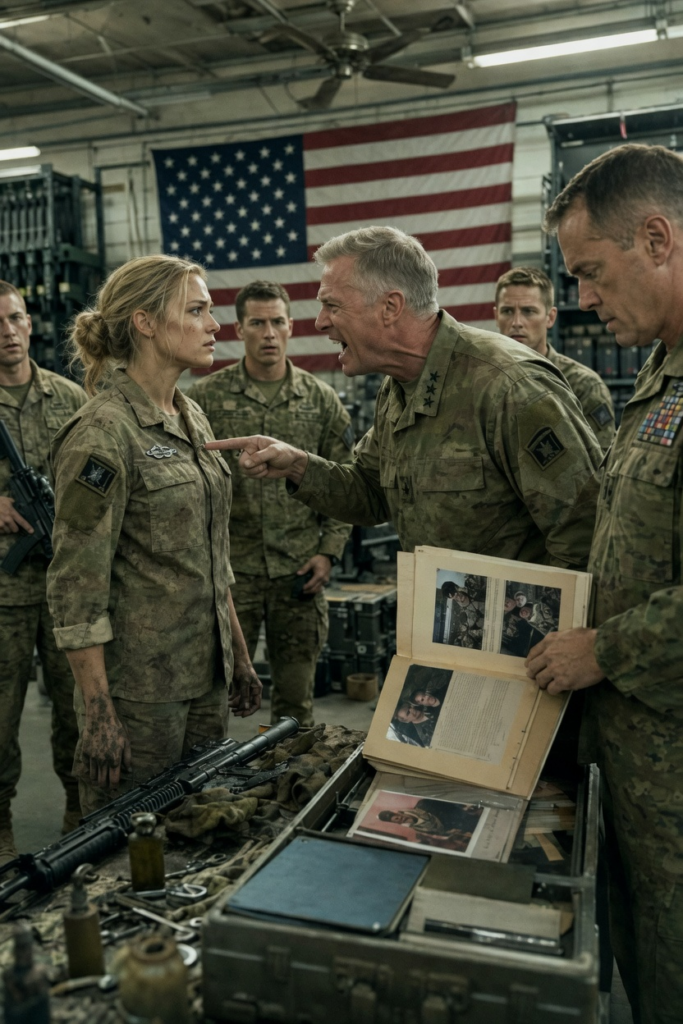
“You’re wearing a lie on your chest, Sergeant.”
That was the first thing General William Matthews said to me in the armory, loud enough for every soldier in the room to hear.
The entire place went silent.
Oil rags froze in hands. Rifles stopped clicking. Even the old ceiling fan seemed to slow down.
He was staring at the small black badge above my left pocket.
3,200 METERS — CONFIRMED.
To him, I was just some quiet woman cleaning a Barrett in the corner.
To the men laughing behind him, I was a joke.
None of them knew what I had buried to earn that number.
PART 1 — The Badge He Called a Lie
“You’re either a fraud, Sergeant, or somebody in this base has been handing out fairy tales as decorations.”
General Matthews said it like a verdict.
Not a question.
Not a concern.
A public execution.
I kept my hands on the Barrett M82A1 spread out in front of me, the bolt carrier half-cleaned, the barrel laid on a padded cloth, every piece in the exact order I had been taught years ago by men who no longer had names on any roster.
The armory at Camp Liberty was packed that afternoon.
It smelled like gun oil, dust, coffee, sweat, and metal.
A dozen soldiers were working along the benches. Two specialists near the ammo cage had been whispering about weekend leave. A young private was trying not to drop a cleaning rod. Someone’s country playlist was playing softly from a phone until the general’s voice cut through it.
Then everything stopped.
I looked up.
General William Matthews stood in front of my bench with his aide, Lieutenant Colonel Harrison, beside him holding a tablet. Matthews was tall, polished, silver-haired, and built like every poster the Army ever printed about authority. His uniform looked untouched by weather, mud, fear, or regret.
Mine did not.
My sleeves were rolled. My hands were stained with carbon. My hair was pulled back tight. I had a faint scar under my jaw from a mission no one here had clearance to ask about.
And above my left pocket sat the badge that had ruined my peace for the last five years.
3,200 METERS — CONFIRMED.
The general leaned closer.
“No one,” he said, “has made a shot at that distance.”
One of the younger soldiers behind him coughed to hide a laugh.
Another muttered, “Here we go.”
I heard him.
I heard everything.
That was what people never understood about quiet women.
We were not weak.
We were recording.
“Sir,” I said, calm enough that it bothered him, “the engagement was confirmed by multiple observers and recorded by mission command.”
Matthews’ eyes narrowed.
“Don’t insult me.”
The armory got colder.
I folded the oil rag once. Then again. Perfect square.
“I’m not insulting you, sir.”
“You expect me to believe a staff sergeant did something most world-class snipers couldn’t do?”
“No, sir.”
That answer finally made him blink.
I met his eyes.
“I don’t expect you to believe anything. I expect the record to speak when properly accessed.”
A few soldiers exchanged looks.
The laughers stopped laughing.
Lieutenant Colonel Harrison cleared his throat. “General, I can pull her basic personnel file.”
“Do it,” Matthews snapped.
Harrison tapped the tablet.
I returned to the Barrett.
That made Matthews angrier.
Men like him did not like being ignored, especially by women they had already decided were beneath the story.
“Staff Sergeant Valdez,” Harrison began, reading from the screen. “Luna M. Valdez. Army Sniper School graduate. Highest marksmanship score in her class. Advanced reconnaissance. Long-range precision programs. Multiple deployments with Ranger support elements. Several classified attachments…”
He paused.
His face changed.
Matthews noticed. “Continue.”
Harrison swallowed. “Sir, there are multiple sections locked. Special access required. Some assignments don’t list unit names.”
Matthews looked back at me.
For the first time, he studied me like a person instead of a mistake.
“Valdez,” he said. “Explain the badge.”
I picked up the bolt carrier again.
“It was awarded after an operation.”
“What operation?”
“Classified.”
“Where?”
“Classified.”
“Who authorized it?”
“Classified.”
His jaw tightened. “Convenient.”
That word hit harder than it should have.
Not because I cared what he thought.
Because I remembered a mountainside at dawn.
I remembered cold so sharp it felt like teeth.
I remembered four hostages inside a compound below us, one of them a little American girl wearing pink sneakers.
I remembered mission command saying, “Ghost, there is no second chance.”
I remembered breathing once.
Only once.
Then changing the rest of my life.
But General Matthews did not see any of that.
He saw a woman in the corner and a number he didn’t like.
“Sir,” I said, “with respect, my complete record is above this room.”
A red-faced major standing behind him smirked. “Above the room? That’s a nice way to say imaginary.”
I looked at him.
Just once.
His smirk faded.
Matthews heard him but did not correct him.
That told me enough.
He turned to Harrison. “Request full access.”
“Sir, that could take days.”
“Then start now.”
Harrison nodded quickly.
Matthews turned back to me. “Until then, Sergeant, I want that badge removed.”
The room went dead.
I slowly set the part down.
“Sir?”
“You heard me.”
My heartbeat stayed steady.
My voice did too.
“That badge was awarded through official channels.”
“And I am ordering you to remove it until its validity is confirmed.”
I stared at him.
Not angry.
Not broken.
Just still.
That kind of stillness made people nervous.
“General,” I said, “you can question my file. You can question my clearance. You can question why my record is sealed. But you cannot order me to remove an authorized award because it makes you uncomfortable.”
Harrison looked like he wanted the floor to swallow him.
The major whispered, “Oh, she’s done.”
Matthews stepped closer.
“Careful, Sergeant.”
I rose from the bench.
I was not tall. I was not loud. I was not built to intimidate a room.
But every soldier there felt the shift.
Some people carried rank.
Some people carried history.
“Sir,” I said, “I am careful. That is why I’m still alive.”
For three seconds, no one moved.
Then the general smiled.
It was not friendly.
“Fine. You want the record to speak? We’ll make it speak. Two days from now, range demonstration. Twelve hundred meters. Your rifle. Your math. Your hands.”
He turned toward the room.
“And everyone here is invited to watch.”
The major grinned.
A few soldiers looked excited.
Others looked worried.
Matthews looked at me like he had just built my gallows.
I nodded once.
“Yes, sir.”
He started to walk away, then stopped.
“One more thing, Sergeant.”
I waited.
“If you embarrass this command with a fake legend, I’ll make sure every base from here to Fort Bragg knows your name.”
I looked down at the Barrett.
Then back at him.
“General,” I said softly, “people who know my name usually don’t say it twice.”
That was the moment the armory stopped seeing me as quiet.
And started wondering what else I had survived.
PART 2 — The Range Was Supposed to Humiliate Me
“Miss this shot, Sergeant, and I’ll personally recommend your badge be stripped before dinner.”
General Matthews said it in front of thirty-two witnesses.
That was his first mistake.
His second was allowing cameras.
The demonstration range at Camp Liberty sat beyond a flat stretch of scrubland, concrete barriers, faded target boards, and heat shimmer. By ten in the morning, half the command staff had arrived. Officers stood in sunglasses with coffee cups. Soldiers leaned against trucks pretending they weren’t there for a spectacle.
They wanted to see the woman in the corner fail.
Not all of them.
But enough.
The red-faced major from the armory was there too. Major Blake. I had learned his name because men like him always made sure you heard it.
He walked past my table and laughed.
“Need a prayer, Valdez?”
I checked my scope mount.
“No.”
“Need a miracle?”
I looked up.
“I brought one.”
A few soldiers nearby snorted.
Major Blake’s face tightened.
Matthews stood under a canopy with Harrison and three other officers. Range control had placed the target at exactly 1,200 meters. Far enough to impress normal people. Short enough for Matthews to think the demonstration could trap me.
But that morning, the air was clear.
The wind was light.
And I had slept four hours without dreams.
That was rare.
I laid out my equipment with the same order I used before every mission: rifle, optics, data book, weather meter, spare magazine, gloves, small laminated photo tucked inside the back cover of my notebook.
The photo was old.
A little girl in pink sneakers.
No one here knew about her.
No one needed to.
Harrison approached quietly.
“Sergeant Valdez.”
“Sir.”
He looked uncomfortable. “For what it’s worth, I read what I could.”
I kept adjusting the rifle.
“And?”
“And the general may not understand what he’s poking.”
I looked at him.
Harrison lowered his voice. “Your file has flags I’ve only seen twice in my career.”
“Then you know this demonstration is unnecessary.”
“I know.” He glanced toward Matthews. “But he doesn’t like being challenged.”
“No,” I said. “He doesn’t like being wrong.”
Before Harrison could answer, Matthews called out.
“Sergeant! Walk us through your process.”
I stepped behind the rifle.
“No, sir.”
The crowd shifted.
Matthews frowned. “Excuse me?”
“I will not provide technical instruction in front of an open group.”
Major Blake laughed. “Convenient again.”
I turned my head slightly.
“I will demonstrate capability. I will not teach it.”
The range safety officer nodded, like he understood before anyone else did.
Matthews hesitated. He wanted to argue. But too many people were watching now, and refusing safety discipline would make him look reckless.
“Proceed,” he said.
I settled into position.
The world narrowed.
Noise softened.
Heat. Dust. Breathing. Pressure.
People think precision shooting is about pulling a trigger.
It is not.
It is about refusing to rush the moment everyone else wants finished.
My cheek found the stock. My shoulder set. My breathing slowed.
The rifle was not just weight against me.
It was memory.
It was Afghanistan dust under my fingernails.
It was a radio whispering, “Ghost, you are the only option.”
It was a little girl crying in a language I did not know while a man used her as a shield.
I blinked once.
The target waited.
My finger moved.
The Barrett roared.
Even with hearing protection, the sound punched the range.
Dust jumped.
The target crew’s radio crackled.
“Impact. Center mass.”
Murmurs rippled through the crowd.
Major Blake stopped smiling.
Matthews took the binoculars from Harrison and looked for himself.
I did not move.
“Again,” Matthews said.
Of course.
I reset.
The second shot landed less than two inches from the first.
The murmurs became silence.
Matthews lowered the binoculars.
“Again.”
Harrison looked at him. “Sir—”
“Again.”
I fired a third time.
The radio crackled.
“Impact. Same group.”
This time no one spoke at all.
I sat up slowly and cleared the rifle.
The range officer walked back with the target sheet twenty minutes later. The group was tight enough to make several officers lean forward.
One captain whispered, “That’s not luck.”
Major Blake snapped, “At twelve hundred? Maybe not. But twelve hundred isn’t thirty-two hundred.”
I stood.
“No one said it was.”
Matthews stepped closer to the target sheet.
He was no longer amused.
But he still wanted control.
“Impressive,” he said. “But you and I both know that badge claims something three times farther.”
“It does.”
“And I still don’t believe it.”
I nodded.
That seemed to irritate him more than arguing would have.
“Why are you so calm?” he demanded.
I wiped dust from my sleeve.
“Because belief is not evidence.”
At that exact moment, Harrison’s tablet chimed.
He looked down.
Then froze.
I saw his face drain first.
Matthews noticed. “What?”
Harrison looked at me.
Then back at him.
“Sir… the access request came through.”
Major Blake stepped forward.
“Already?”
Harrison did not answer him.
He walked to Matthews and showed him the tablet.
The general read for five seconds.
Then ten.
His face changed.
It was small, but I saw it.
The hard certainty cracked.
“What is this?” he said.
Harrison lowered his voice. “Sir, it’s the classified summary.”
Matthews scrolled.
His thumb stopped.
He read the same line twice.
I already knew which one.
OPERATION GLASS MOUNTAIN — EXTREME RANGE ENGAGEMENT CONFIRMED BY OVERWATCH TEAM, DRONE RECORDING, MISSION COMMAND, AND POST-OP REVIEW BOARD.
Matthews looked up at me.
For the first time, he did not look angry.
He looked disturbed.
Major Blake tried to see the screen. “Sir?”
Matthews snapped the tablet away.
“Stand down, Major.”
Blake blinked. “Sir, I was just—”
“I said stand down.”
That was the first crack in his little kingdom.
But not the last.
Because the file Harrison had opened did not only confirm the badge.
It showed who had tried to bury it.
And when Matthews saw the signature attached to the suppression memo, the entire range went quiet again.
Because the name on that document belonged to someone standing right beside him.
PART 3 — The Man Laughing at Me Had Signed the Cover-Up
“Major Blake,” General Matthews said, his voice colder than the rifle on the table, “why is your signature on a restricted memo about Sergeant Valdez?”
The whole range turned.
Major Blake went pale so fast it looked painful.
“My signature?”
Harrison’s eyes were locked on the tablet.
“Yes,” Matthews said. “Your signature.”
Blake forced a laugh. “There must be a mistake.”
I watched him carefully.
His left hand twitched.
People lie with their mouths first.
Then their hands confess.
Matthews read aloud, slow and sharp.
“Recommendation: Valdez’s extreme-range engagement should remain omitted from public commendation due to morale concerns among senior male personnel in precision units.”
Nobody breathed.
Blake’s face hardened.
“Sir, that memo was taken out of context.”
“Morale concerns?” Matthews repeated. “Explain that.”
Blake looked at me with open hatred now.
There he was.
The man behind the smirk.
The man who had called my record convenient.
The man who had spent years making sure my name stayed whispered instead of recognized.
He straightened like arrogance could save him.
“Sir, at the time, there was concern that exaggerating one soldier’s accomplishment would create unrealistic expectations.”
“Exaggerating?” Harrison said. “The file says confirmed.”
Blake ignored him.
“Also,” Blake added, “there were questions about her emotional stability after the operation.”
That one landed.
Not because it was true.
Because it was familiar.
When men wanted to erase a woman’s competence, they always reached for emotion.
Too cold.
Too angry.
Too unstable.
Too damaged.
Never too good.
Matthews turned slowly toward me.
“Sergeant Valdez. Were you aware of this memo?”
“Yes, sir.”
That surprised him.
“You knew?”
“I found out two years ago.”
“And you said nothing?”
I looked at Blake.
He looked away first.
“I filed three formal requests for review. All disappeared.”
Harrison’s jaw tightened.
“Disappeared how?”
I reached into my data book and removed a folded envelope.
Major Blake saw it and whispered, “No.”
That whisper was worth every quiet year.
I handed the envelope to Harrison.
Inside were copies.
Not originals. I was quiet, not stupid.
Three complaint receipts. Two emails. One response from a legal officer who retired unexpectedly six days later. A printed screenshot of an internal message sent by Major Blake to another officer.
Harrison read the message out loud before Matthews could stop him.
“Keep Ghost in the corner. Last thing we need is command turning her into a poster girl and making the rest of us look obsolete.”
A sound moved through the soldiers like wind through dry grass.
Major Blake lunged forward. “That’s private correspondence!”
I almost smiled.
“Not anymore.”
Matthews’ face had gone red, but not with embarrassment.
With fury.
“Major Blake, did you interfere with official recognition of a confirmed combat action?”
Blake pointed at me.
“She’s manipulating this. She always has. Ask anyone. She walks around like she’s better than everybody.”
I looked at the soldiers.
Some watched Blake.
Some watched me.
I said nothing.
Silence is a mirror.
It lets people see exactly who is ugly.
Blake kept talking because guilty people often mistake noise for escape.
“She doesn’t belong in strategic operations. She doesn’t follow normal channels. Her whole career is sealed so nobody can challenge her. And now we’re supposed to bow because she has some classified bedtime story?”
Matthews stepped forward.
“Major.”
Blake ignored him.
“She got lucky once, and command turned it into legend.”
The word “lucky” moved through me like a blade.
For one second, I was back on the mountain.
Four hours without moving.
Ice in my sleeves.
Blood from my nose freezing at my lip.
A radio voice saying the assault team could not move.
A child in pink sneakers dragged to a doorway.
A target no one else could reach.
Luck?
No.
Luck was what people called your skill when their pride could not survive the truth.
I opened my data book.
From the back pocket, I removed the laminated photo.
The little girl.
I placed it on the table.
Every eye followed it.
“This is Emily Parker,” I said.
My voice was quiet.
That made it carry.
“She was seven years old during Operation Glass Mountain. Her father was a civilian contractor. Her mother was a nurse from Ohio. Emily was taken with three others and held in a mountain compound for sixteen hours.”
Blake stopped breathing normally.
I continued.
“The hostage rescue team was pinned down. Air support was denied because of civilian risk. Negotiators lost contact. The target moved Emily to the east doorway at 0630.”
Matthews’ eyes dropped to the photo.
I tapped it once.
“She was wearing pink sneakers.”
No one moved.
“The engagement was not about a record. It was not about a badge. It was not about making anyone look obsolete.”
I looked at Blake.
“It was about bringing her home.”
A young private near the back lowered his head.
Harrison looked like he had forgotten how to blink.
Matthews spoke slowly.
“Where is Emily Parker now?”
“Colorado. Alive. High school freshman. She sends a Christmas card every year through a chaplain.”
That broke something in the room.
Not loudly.
But completely.
Major Blake tried one last time.
“Emotional storytelling doesn’t change procedure.”
“No,” I said. “Evidence does.”
I nodded toward Harrison.
“There is one more file.”
Harrison looked confused, then checked the tablet again.
A new attachment had unlocked under the special access authorization.
Drone footage transcript.
Mission command confirmation.
Post-operation review.
And an audio file.
Matthews pressed play.
Static filled the range.
Then a voice came through.
My voice.
Younger. Colder. Almost unrecognizable.
“Command, this is Ghost. I have one solution. Confirm authorization.”
Another voice.
“Ghost, authorization confirmed. Hostage visible. No secondary option. Take the shot when ready.”
Then silence.
Long silence.
Too long for the impatient.
Perfect for the necessary.
Then the report.
Then a voice screaming, “Hostage moving! Hostage moving! She’s alive!”
The audio cut.
No one spoke.
Even the wind seemed ashamed.
Matthews closed the tablet.
Major Blake looked smaller than he had five minutes before.
The general turned to two military police standing near the range gate.
“Major Blake is relieved pending formal investigation.”
Blake’s mouth fell open.
“Sir, you can’t—”
“I can.”
“Over a badge?”
Matthews stepped close enough that Blake finally shut up.
“No. Over suppression of official records, retaliation, misuse of authority, and lying to my face.”
The MPs moved in.
Blake pointed at me as they took his arms.
“You think this makes you special?”
I picked up the little photo.
“No,” I said. “It makes me still here.”
They walked him past the same soldiers he had tried to impress.
No one defended him.
That is the thing about arrogance.
It feels powerful until the evidence arrives.
Matthews stood in front of me for a long moment.
Then, in front of the entire range, he removed his cap.
“Staff Sergeant Valdez,” he said, “I owe you an apology.”
The soldiers went still again.
A general apologizing was rarer than a clean barracks inspection.
“I questioned your honor publicly,” he said. “I was wrong.”
I held his gaze.
“Yes, sir. You were.”
Harrison inhaled sharply.
Matthews nodded once.
He accepted it.
That mattered more than the apology.
But the day was not over.
Because later that evening, when I returned to the armory, there was an envelope taped to my locker.
No name.
No return.
Inside was a single printed message.
Blake wasn’t the only one who buried your file. Stop digging, Ghost.
I stared at it for a long time.
Then I folded it neatly.
And for the first time in years, I decided I was done staying in the corner.
PART 4 — I Let Them Think I Was Alone
“They told me to stop digging, so I brought a shovel big enough for the whole command.”
That was what I told General Matthews the next morning.
He stared at the anonymous threat on his desk.
Harrison stood beside him, reading it for the third time.
Outside the office window, Camp Liberty looked normal. Soldiers crossed the pavement with folders and coffee. Trucks rolled past. A flag snapped hard in the dry wind. Somewhere, a bugle call echoed across the base like history pretending it was order.
But inside that office, order was already cracking.
Matthews looked up.
“Do you know who sent this?”
“No, sir.”
“Do you suspect anyone?”
“Yes.”
He waited.
I did not answer.
Not yet.
Because I had learned the hard way that truth without timing could be buried.
Truth with evidence could bury them back.
I placed a small flash drive on his desk.
Harrison looked at it. “What’s that?”
“The shovel.”
Matthews did not touch it.
“What’s on it?”
“Copies of emails. Assignment changes. Denied commendation packets. Bank records tied to a defense consulting firm. A private contract. And names.”
Harrison’s expression sharpened. “Bank records?”
“Not stolen,” I said. “Provided.”
“By whom?”
I opened my notebook and slid forward a signed statement.
“Captain Renee Shaw. Former operations clerk. She processed the first version of my award packet after Glass Mountain.”
Matthews read the name and went very still.
“I remember Shaw.”
“You should. She resigned after reporting irregularities.”
Harrison said quietly, “Her report was dismissed.”
“Yes,” I said. “By Blake.”
Matthews plugged in the flash drive.
File after file opened.
A pattern appeared.
Not one mistake.
Not one misunderstanding.
A network.
After Operation Glass Mountain, my confirmed engagement had been marked for strategic review. A commendation packet had been drafted. Public details would remain classified, but my service record was supposed to reflect the award clearly.
Then Major Blake and two senior officers buried it.
Why?
Because one of them had a private training contract with a defense company selling “elite long-range instruction” to allied units.
Their marketing depended on the idea that their male-led program represented the top of American precision capability.
A young Latina staff sergeant nicknamed Ghost, making a confirmed 3,200-meter engagement under classified conditions, did not fit their brochure.
So they kept the badge small.
They kept my record sealed.
They kept me moving from base to base.
Quietly useful.
Officially invisible.
And whenever I asked questions, my psychological fitness was “reviewed.”
My assignments changed.
My promotion packets stalled.
My name disappeared from briefings.
They did not destroy my career.
They did something smarter.
They used it while denying it existed.
Matthews read for nearly thirty minutes.
No one interrupted him.
Finally, he leaned back.
His face looked older.
“This goes above Blake.”
“Yes, sir.”
“How long have you had this?”
“Pieces of it? Years.”
“Why bring it now?”
I looked through the window at the flag.
“Because yesterday you made them nervous enough to threaten me.”
Harrison muttered, “Which confirms they’re still active.”
“Yes, sir.”
Matthews stood.
“Then we go to CID.”
“We go higher,” I said.
He looked at me.
I slid one final document across the desk.
It was a letter.
Official.
Stamped.
Signed.
Scheduled for delivery only if I formally requested outside review or if I died during active assignment.
Matthews read the signature.
His eyes widened.
“General Patricia Stone?”
“Yes, sir.”
Harrison whispered, “Deputy Strategic Operations.”
The room shifted again.
General Stone was not the kind of person officers ignored.
The letter was brief.
It confirmed that my engagement was real, my badge was valid, my record had been improperly obstructed, and any retaliation against me was to be investigated at command level immediately.
Matthews lowered the page.
“You had this the entire time?”
“No, sir. She sent it after my third complaint vanished.”
“Why didn’t you use it?”
I thought about that.
About pride.
About exhaustion.
About being told over and over that pushing harder would make me difficult.
About every woman in uniform who learned to calculate the cost of being right.
“Because I still believed the system would correct itself.”
My voice did not break.
“But systems don’t correct themselves. People do.”
By noon, the base changed.
Quietly at first.
CID arrived.
Then legal.
Then an outside review team.
Major Blake’s office was sealed. Two computers were removed. A captain from logistics suddenly remembered a meeting off base and was stopped at the gate. A colonel who had ignored my complaints for two years was ordered to surrender his access card.
By evening, everyone knew something was happening.
By the next morning, they knew it was about Ghost.
And by Friday, the command auditorium was full.
General Matthews stood at the podium under the American flag.
I sat in the front row, uniform pressed, badge in place, hands folded.
Major Blake was not there.
Neither were the officers who had protected him.
Their empty seats spoke loudly.
Matthews began without drama.
“Three days ago, I publicly questioned the integrity of Staff Sergeant Luna Valdez.”
The auditorium went silent.
“I was wrong.”
No one moved.
He continued.
“An internal review has confirmed that Staff Sergeant Valdez’s 3,200-meter engagement was authentic, documented, and properly awarded. It has also revealed misconduct by personnel who attempted to suppress her recognition and retaliate against her for pursuing correction.”
A ripple moved through the room.
Matthews looked directly at me.
“Staff Sergeant Valdez represents the highest standard of discipline, restraint, precision, and service.”
I heard the words.
But I did not let them own me.
Praise could become another cage if you needed it too badly.
Then General Stone entered through the side door.
That was the moment everyone understood how serious it was.
She walked with two aides and stopped beside Matthews.
Silver hair. Sharp eyes. Calm power.
She took the podium.
“Some soldiers make noise,” she said. “Some make history.”
Her gaze moved across the room.
“And sometimes the institution fails the quiet ones because they do not demand applause.”
I felt every eye on me.
Stone opened a folder.
“Today, Staff Sergeant Luna Valdez’s record will be corrected. Her commendation will be restored. Her stalled promotion review will be reopened. Her retaliation complaints will be attached to the disciplinary actions now underway.”
She paused.
“And her badge will remain exactly where it belongs.”
The auditorium rose.
Not all at once.
First Harrison.
Then the range safety officer.
Then the young private from the armory.
Then row after row until the room was standing.
I stayed seated for one breath longer.
Not because I was ungrateful.
Because I needed to remember the silence that came before the applause.
Then I stood.
General Stone called me forward.
As I walked, I saw faces I recognized.
Some ashamed.
Some proud.
Some afraid.
Good.
Fear was useful when placed in the right people.
Stone shook my hand.
“Ghost,” she said softly, only for me, “you should have come to me sooner.”
I answered just as quietly.
“I know, ma’am.”
“No more corners.”
“No, ma’am.”
After the ceremony, I went back to the armory.
Not because I had to.
Because I wanted to.
The Barrett was waiting on the bench.
The same bench.
The same corner.
But nothing felt the same.
A young female specialist stood nearby pretending to clean a rifle she had already cleaned twice.
When I looked over, she stiffened.
“Sergeant?”
“Yeah?”
She swallowed. “Is it true you waited four hours for one shot?”
I picked up my oil rag.
“Yes.”
“Were you scared?”
I thought of Emily Parker.
I thought of Blake being walked past the soldiers in handcuffs.
I thought of Matthews taking off his cap.
I thought of every document that had nearly stayed buried.
“Yes,” I said. “But fear doesn’t get to give orders.”
She nodded like she would remember that.
I returned to the rifle.
Methodical.
Careful.
Quiet.
But not invisible.
A week later, Major Blake lost his position, his pension review opened, and his consulting connections became part of a federal investigation. The colonel who buried my complaints retired early, which sounded gentle until his security clearance was suspended before he could cash in on private contracts.
The defense firm lost its program.
The officers who had laughed in the armory stopped laughing when legal asked for their statements.
General Matthews changed too.
He did not become soft.
He became better.
He started reading the quiet files.
He started asking why certain names never appeared in briefings.
He started noticing the soldiers in corners.
As for me, I was promoted after review.
Not as a gift.
As a correction.
There is a difference.
Months later, I received another Christmas card from Emily Parker.
She was taller in the photo, standing in front of a school gym with a volleyball under one arm. Still smiling. Still alive.
Inside, she had written one sentence.
My mom says heroes don’t always wear capes. Sometimes they wear quiet faces.
I sat on the edge of my bunk and read it twice.
Then I tucked it into my notebook behind the old photo.
The badge stayed on my uniform.
Not because it proved I was special.
Because it proved they had failed to erase me.
And every time someone glanced at it and froze, I let them.
Because some numbers are not bragging.
Some numbers are graves avoided.
Some are children brought home.
Some are warnings.
And mine said this:
You can walk past a woman in the corner.
You can doubt her.
You can mock her.
You can even try to bury her name.
But if she is patient enough, disciplined enough, and quiet enough to survive you—
She may be the one holding the evidence when the whole room finally turns around.