The Eighteen-Year-Old Who Wouldn’t Let Them Be Split Apart
Harper Lacey was eighteen years old when her mother left before sunrise with a small suitcase, a new phone, and no promise that sounded real.
The house was still dark when Harper heard the front door click shut.
At first, she thought her mother was going to the gas station before work. Then she saw the bedroom drawers pulled open, the missing coat from the hallway hook, and the empty space where her mother’s purse usually sat.
By six in the morning, the baby was crying.
By seven, the twins were asking for cereal.
By eight, Harper understood something no eighteen-year-old should ever have to understand.
Her mother was not coming back.
She stood in the kitchen of their small rental duplex outside Dayton, Ohio, with baby Caleb pressed against her shoulder and six younger siblings staring at her like she was the only wall still standing between them and the rest of the world.
Her twelve-year-old brother, Rowan, asked in a thin voice, “Harper… what do we do now?”
Harper looked at the empty refrigerator, the stack of bills on the counter, and the little faces waiting for her answer.
Then she swallowed her fear and said, “We get through today first.”
The Lies Rowan Learned to Tell
Rowan became good at lying before he became good at algebra.
When teachers asked where his mother was, he said, “She’s working late.”
When neighbors asked why Harper was always the one carrying groceries, he said, “Mom’s schedule changed.”
When his little sister Millie cried at night and asked when their mother would come home, Rowan whispered, “Soon.”
But he knew “soon” was just a word adults used when they did not want to tell the truth.
Harper worked nights cleaning offices downtown. She came home before dawn with tired eyes, the smell of disinfectant on her sweatshirt, and just enough strength to make oatmeal, pack lunches, and braid Millie’s hair before school.
She watered down milk to make it last longer.
She cut one sandwich into four pieces and pretended she had already eaten.
She learned which church pantry opened on Wednesdays, which teacher kept extra snacks in her drawer, and which bus driver would wait an extra thirty seconds when the twins couldn’t find their shoes.
At night, after everyone slept, Harper sat on the bathroom floor with the faucet running so nobody would hear her cry.
Then she would wipe her face, stand up, and begin again.
The Neighbor Who Saw Too Much
Mrs. Evelyn Price lived next door and noticed things other people missed.
She noticed Harper leaving the house at midnight and returning before sunrise.
She noticed Rowan carrying trash bags that were too heavy for him.
She noticed Millie wearing the same purple sweater three days in a row.
One afternoon, Mrs. Price found Rowan sweeping the porch while the younger children played quietly inside.
She leaned on the fence and asked gently, “Honey, where is your mama?”
Rowan gripped the broom handle.
The lie came to his mouth, but it did not come out.
His shoulders dropped.
“She left,” he whispered. “Harper’s been taking care of us.”
Mrs. Price went still.
“All of you?”
Rowan nodded.
“There are seven of us,” he said. “Harper doesn’t sleep much anymore.”
That evening, Mrs. Price came to the door with soup, bread, diapers, peanut butter, and tears in her eyes.
Harper tried to refuse at first.
Mrs. Price stepped inside anyway.
“Child,” she said softly, “you are not supposed to carry a whole family by yourself.”
Harper looked down at baby Caleb in her arms.
“I know,” she whispered. “But if I put them down, I’m scared nobody else will pick them up together.”
When CPS Arrived
Two mornings later, a white county vehicle pulled up outside the duplex.
Harper knew before they knocked.
She had been expecting this kind of sound since the first day her mother left.
Two social workers stood on the porch with folders in their hands and careful expressions on their faces.
One of them, a woman named Ms. Whitaker, spoke kindly.
“Harper, we received a call of concern. We need to make sure the children are safe.”
Harper nodded.
Her hands were shaking, but she opened the door wider.
“They’re safe,” she said. “They’re fed. They go to school. I’m working. Mrs. Price helps us.”
The second social worker looked around the small living room, at the folded blankets on the couch, the children’s backpacks lined against the wall, and the baby bottles drying beside the sink.
“You are eighteen,” he said. “That is a lot of responsibility.”
Harper’s jaw tightened.
“I didn’t ask for it.”
The room went quiet.
Then Ms. Whitaker said the words that made every child freeze.
“There is a possibility the children may need temporary foster placements while Family Court reviews the situation.”
Millie began to cry.
The twins grabbed each other’s hands.
Rowan moved in front of the little ones like he could block the whole system with his body.
Harper pulled Caleb closer.
“Please don’t split them up,” she said. “They already lost their mother. Don’t make them lose each other too.”
The Mother Who Came Back for the Wrong Reason
That afternoon, just when the house had gone quiet, a black SUV stopped at the curb.
Harper stepped onto the porch and felt her whole body turn cold.
Her mother, Janelle Lacey, got out wearing sunglasses, a cream-colored coat, and an expression that looked more annoyed than ashamed.
A man waited behind the wheel.
Janelle smoothed her hair and glanced at the neighbors’ windows.
“I came to get some of my things,” she said.
Harper stared at her.
For a moment, she was not eighteen.
She was a little girl again, wishing her mother would choose her.
Then Caleb shifted in her arms, and the moment passed.
“You came back for clothes?” Harper asked.
Janelle looked away.
“Don’t start drama, Harper.”
Rowan stepped onto the porch behind his sister.
His voice was small, but steady.
“You left us.”
Janelle’s face hardened.
“I knew Harper would manage.”
The words landed harder than a shout.
Mrs. Price, who had been watching from her yard, walked over slowly.
“You knew your daughter would manage seven children alone?”
Janelle lifted her chin.
“This is a family matter.”
Harper’s eyes filled with tears, but she did not let them fall.
“No,” she said. “It became everybody’s matter when you left children behind and expected me to become their mother.”
The Street Began to Speak
People came outside.
Mr. Dawson from the repair shop.
Mrs. Price from next door.
A school counselor who had driven over after hearing what happened.
Pastor Graham from the small church at the corner.
Nobody yelled at first.
They simply stood there, watching a mother return too late with no groceries, no apology, and no plan.
Then Mr. Dawson spoke.
“That girl cleaned my office after hours so she could buy diapers.”
The school counselor added, “The children have been coming to school tired, but Harper has made sure they show up every day.”
Mrs. Price said, “She has gone hungry so the younger ones could eat.”
Janelle shook her head.
“You people are making me sound like a monster.”
Rowan disappeared into the house and came back with an empty cereal box, two overdue notices, and a small notebook Harper used to track every dollar.
He held them out.
“This is what she had,” he said. “This is what you left.”
No one moved.
Even the man in the SUV stopped looking impatient.
For the first time, Janelle seemed to understand that the story was no longer hers to control.
The Video That Traveled Too Far
Someone recorded part of it.
Not the whole argument.
Not the worst details.
Just Harper standing on the porch with Caleb asleep against her shoulder, saying through tears, “They are not boxes to be moved from house to house. They are my brothers and sisters.”
By the next morning, the video was everywhere.
First on Facebook.
Then TikTok.
Then local news.
The headline was simple:
Eighteen-Year-Old Fights to Keep Seven Siblings Together After Mother Leaves Home.
People argued in the comments.
Some said Harper was too young.
Some said the state needed to step in.
Others asked why help always arrived as a threat before it arrived as support.
A morning show producer called Harper and offered an interview.
She declined.
“My siblings are not content,” she said.
That sentence spread almost as fast as the video.
To strangers, Harper became a symbol.
To the children in the duplex, she was still the person making oatmeal before sunrise.
The Hardest Night
The attention helped, but it also hurt.
Donations arrived.
So did cruel comments.
People who had never met Harper said she wanted sympathy.
Others said she was keeping the children together for money.
Some said the kids would be better off separated.
Harper read too much of it one night after the children had gone to bed.
Rowan found her sitting on the kitchen floor, phone in her hand, tears running down her face.
“Maybe they’re right,” she whispered.
Rowan knelt in front of her.
“They’re not.”
Harper shook her head.
“What if I’m not enough?”
Rowan looked toward the hallway where the younger children were sleeping.
Then he looked back at his sister.
“You were enough when there was no food.”
His voice cracked.
“You were enough when Caleb had a fever.”
He wiped his face with his sleeve.
“You were enough when Mom left and nobody else came.”
Harper covered her mouth and cried harder.
For once, she let someone hold her.
Family Court
The hearing happened one week later.
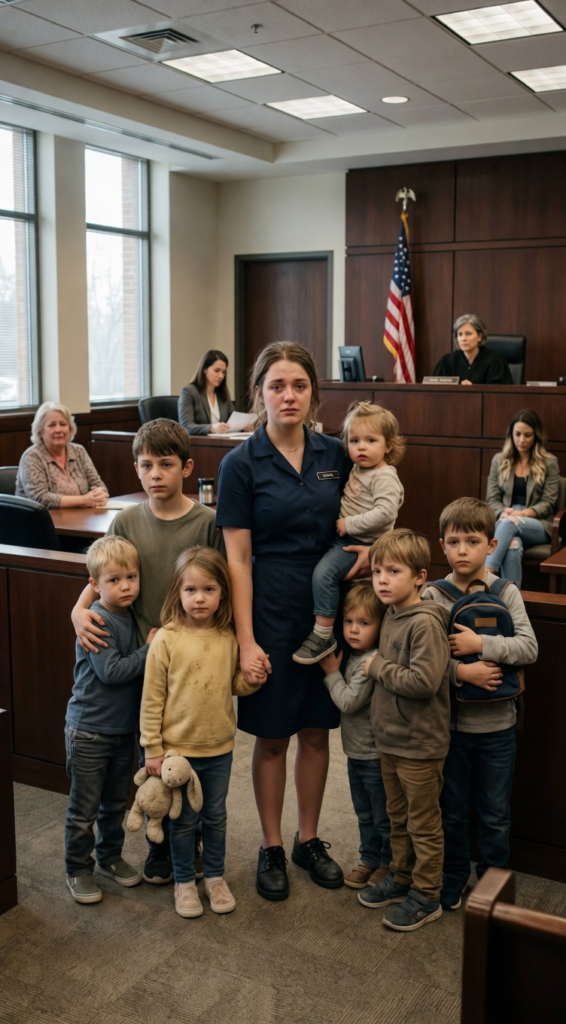
Harper wore a borrowed navy dress from the church donation closet. The sleeves were a little too long, and the shoes hurt her feet, but she stood straight when her name was called.
Janelle arrived polished and quiet.
She looked like someone prepared for a meeting, not a mother trying to explain why her children had been left behind.
The judge listened to the social workers first.
Then the school counselor.
Then Mrs. Price.
Then a child advocate who had spent time with the younger children.
Finally, the judge asked Rowan if he wanted to speak.
Harper reached for his hand, but he stepped forward on his own.
His knees trembled.
His voice did not.
“My mom left,” he said. “Harper stayed.”
The judge leaned forward.
“Do you understand that life with your sister may still be difficult?”
Rowan nodded.
“Yes, ma’am.”
“Then why do you want to stay together?”
Rowan looked back at his siblings.
Millie was holding the twins’ hands. Caleb was asleep in Mrs. Price’s arms.
“Because hard is not what scares us,” Rowan said. “Being separated does.”
No one in the courtroom spoke for several seconds.
Then the judge turned to Janelle.
“Why did you leave?”
Janelle’s lips parted, then closed again.
At last, she said quietly, “I needed to start over.”
The judge’s face did not change.
“And your children?”
Janelle looked down.
“I thought Harper could handle them.”
Harper closed her eyes.
There it was.
The truth, finally spoken out loud.
The Decision That Let Them Breathe
The judge did not make the story simple.
She did not pretend love was a legal plan.
She ordered supervision, counseling, housing support, food assistance, school monitoring, and a formal guardianship review.
But she also made one decision that changed the air in the room.
The children would remain together while the court built a safe support plan around them.
Millie burst into tears.
The twins hugged each other.
Rowan covered his face.
Harper stood frozen until Mrs. Price touched her shoulder.
“Breathe, baby,” she whispered. “You can breathe now.”
Outside the courthouse, people waited with signs, stuffed animals, and grocery cards.
Harper did not know what to do with all that kindness.
So she knelt in front of her siblings and said the only thing that mattered.
“We’re going home together.”
The Home That Changed Slowly
Life did not become perfect.
Perfect was too big a word for a house still full of bills, tired mornings, and children who woke up scared someone might disappear again.
But it became steadier.
The church helped with meals.
The school arranged counseling.
Mrs. Price came over every morning with coffee for Harper and fruit for the kids.
Mr. Dawson fixed the broken heater for free.
A local nonprofit helped Harper start the process of becoming a licensed kinship caregiver.
For the first time in weeks, the refrigerator had food in it.
For the first time in months, Harper slept for five hours without waking in panic.
One evening, she found an old family photo in the back of a drawer.
Her mother was smiling in it.
All the children were younger.
The house looked brighter than Harper remembered.
Rowan saw the photo in her hand.
“Do you miss her?” he asked.
Harper stared at the picture for a long time.
Then she said softly, “I miss the mother she was before she decided we were too much to carry.”
Rowan sat beside her.
He did not tell her not to cry.
He only stayed.
And sometimes, staying is the kindest thing anyone can do.
The Girl Who Never Asked to Be Strong
Months later, people still talked about Harper.
Some called her brave.
Some called her inspiring.
Some called her a hero.
But Harper never liked that word.
Heroes chose danger in stories.
Harper had not chosen any of this.
She had only woken up one morning and realized that if she did not stand in the doorway, seven children might lose the only home they had left.
So she stayed.
She made breakfast.
She signed school forms.
She learned court words she never wanted to know.
She answered questions from people who had no idea how heavy survival could feel.
And every night, when the house finally quieted, she checked each bedroom before turning off the lights.
Caleb in his crib.
Millie with her stuffed rabbit.
The twins tangled in blankets.
Rowan pretending to be asleep but always listening.
Harper would stand there for a moment, tired beyond words, and remind herself that love did not have to be perfect to be real.
Sometimes love was oatmeal in the morning.
Sometimes it was a borrowed dress in court.
Sometimes it was a neighbor with soup.
Sometimes it was an eighteen-year-old girl whispering to frightened children, “I’m still here.”
And for those seven kids, that was the sentence that saved them.
Some young people are called strong not because they were born fearless, but because life placed too much on their shoulders and they kept walking anyway.
A child should never have to become the safety net for an entire family, yet many do it quietly every day without cameras, applause, or anyone asking if they are okay.
Harper’s courage was not loud or dramatic; it lived in the small moments when she made breakfast, packed school bags, and stayed awake so her siblings could sleep.
When children lose stability, the most important thing is not always a perfect house, but a steady person who keeps showing up when everyone else becomes uncertain.
Systems are meant to protect children, but protection must also recognize love, connection, and the deep emotional cost of separating siblings who have already lost so much.
A community does not need wealth to change a family’s future; sometimes a bowl of soup, a ride to school, and one honest voice can become the beginning of hope.
The most painful part of abandonment is not only being left behind, but realizing someone believed you were strong enough to carry the pain they refused to face.
Harper did not become important because the internet noticed her; she was already important every morning she chose her siblings over her own exhaustion.
True family is not always proven by who shares your last name, but by who stays when the house is quiet, the bills are unpaid, and the children are afraid.
In the end, this story is not about a girl who wanted to be a hero; it is about a sister who never asked for the role, yet became the reason seven children still had a home to return to.