The law firm conference room was cold enough to make my fingers ache.
That was the first thing I remember, even before the will, even before my mother laughed, even before my sister found out she was richer than she had ever bothered to deserve.
Cold air on my damp sleeves.
Lemon polish on the table.
Burnt coffee in a silver carafe nobody had touched.
My grandfather, Arthur Vance, had been gone six days, and my family had already dressed for his money like it was a holiday.
My father, Richard, wore the navy suit he saved for funerals and business dinners.
My mother, Helen, wore pearls and a cream sweater that made her look gentle if you did not know her mouth.
My sister Chloe wore black, but her phone screen was bright against the table, flashing vacation rentals and designer bags while the attorney arranged the estate file.
I sat at the far end because nobody had saved me a place near the family.
That was not new.
In my family, I was useful more often than I was loved.
For the last three years of Grandpa’s life, I had been the one who drove him to appointments, signed hospital intake forms, argued with the pharmacy, changed oxygen tanks, and learned how to hear the difference between normal breathing and the kind that meant I needed to sit up straight.
Grandpa used to apologize for that.
He would lie in his recliner under the blue blanket with the frayed edge and say, “Maya, you should be out somewhere making trouble.”
I would smile and tell him I was too tired for trouble.
He would laugh until the laugh turned into a cough, and then I would hold the cup to his mouth while he pretended not to hate needing help.
Arthur Vance was not a soft man to the world.
He had built a small manufacturing business from nothing, sold it at the right time, bought land, paid debts nobody knew about, and still remembered which waitress at the diner had a son in community college.
But inside our family, he was the only person who looked at me and saw more than what I could carry.
My mother saw errands.
My father saw inconvenience.
Chloe saw competition, which was ridiculous because nobody had ever made her compete for anything.
At 10:07 a.m. that Friday, Mr. Sterling opened the probate folder.
He had a careful face, the kind attorneys get after spending years watching people turn grief into math.
On the table in front of him were the Last Will and Testament, the Vanguard Trust summary, the estate inventory, a medical reimbursement ledger, and a caregiver log with my handwriting on the last page.
I looked at that log too long.
7:40 p.m. Medication taken.
9:15 p.m. Oxygen checked.
1:32 a.m. Restless.
3:18 a.m. Coughing spell.
The handwriting leaned left because I had written most of it half-asleep.
Those pages were not dramatic.
They were not pretty.
They were what love looks like when nobody is clapping.
Mr. Sterling adjusted his glasses and began.
“To my son Richard Vance and his wife Helen, I leave the primary residential estate and all associated liquid asset accounts.”
My mother made a sound that was almost holy.
It was not grief.
It was possession.
My father squeezed her hand, but his eyes stayed on the folder.
The primary residential estate meant the house, the land, the furniture, the cars, and the accounts attached to the property.
It meant the life they had been circling for years while calling it concern.
Chloe did not even look up.
She was waiting for her line.
“To my granddaughter Chloe Lawson,” Mr. Sterling continued, “I leave the entirety of the Vanguard Trust, currently valued at approximately 6.9 million dollars.”
Chloe squealed.
The sound bounced off the glass wall and made my stomach twist.
Six point nine million dollars.
She covered her mouth after the squeal, as if pretending she had been overcome by emotion instead of excitement.
“Oh my God,” she whispered.
My mother leaned over to kiss her hair.
My father said, “Your grandfather always believed in you.”
That was when I learned pain can be quiet.
It can sit in your chest like a sealed room.
It can listen while people rewrite a dead man in real time.
Grandpa had believed in Chloe the way people believe in weather.
It was simply there, loud and visible and impossible to avoid.
He had loved her, I think, but he had not trusted her with a houseplant.
Then Mr. Sterling turned the page.
The paper scraped softly against the polished wood.
“And to my granddaughter Maya Lawson,” he read, “who was by my side as my primary caregiver until the very end, I leave the sum of exactly one dollar.”
For three seconds, nobody moved.
The fluorescent light hummed overhead.
Somewhere outside the conference room, a copier started and stopped.
Then my mother laughed.
Not a shocked laugh.
Not an awkward laugh.
A full, bright, cruel laugh that seemed to give everyone else permission.
“One dollar,” she said, pressing her fingers under her pearls. “Oh, Maya.”
I stared at the table.
“You wasted your youth scrubbing his bedpans, and he still knew you were fake,” she said.
My father did not stop her.
That part matters.
People like to imagine cruelty is always the person speaking, but sometimes it is the person sitting close enough to touch their sleeve and choosing not to.
Chloe leaned toward me with that same white smile she used in photos.
“No one’s on your side,” she said. “You’re pathetic. Maybe I’ll hire you someday if you get desperate enough.”
Mr. Sterling slid the dollar bill across the table.
It was crisp.
Too crisp.
For one second, I wanted to tear it in half.
I wanted to ask my father how many times he had visited Grandpa without checking his watch.
I wanted to ask my mother why she could remember the square footage of the house but not the way Grandpa liked his soup.
I wanted to ask Chloe if she knew the trust she was celebrating had been funded by a man whose hand she had not held once in the last month.
Instead, I folded the dollar once.
Then twice.
Rage only helps people who can afford consequences.
I had rent due, a car with a check-engine light, and a job that had already warned me I had missed too many shifts for family emergencies.
So I stood up carefully.
I thanked Mr. Sterling because manners had been beaten into me so deeply they still came out when my heart was breaking.
My mother shook her head as if I had embarrassed her by existing.
The drive back to my parents’ house took twenty-two minutes.
Nobody spoke to me.
Chloe sat in the passenger seat of my father’s SUV and texted the whole way.
My mother kept turning her wedding ring around her finger, already planning which rooms she would change first.
I sat in the back with the folded dollar in my palm.
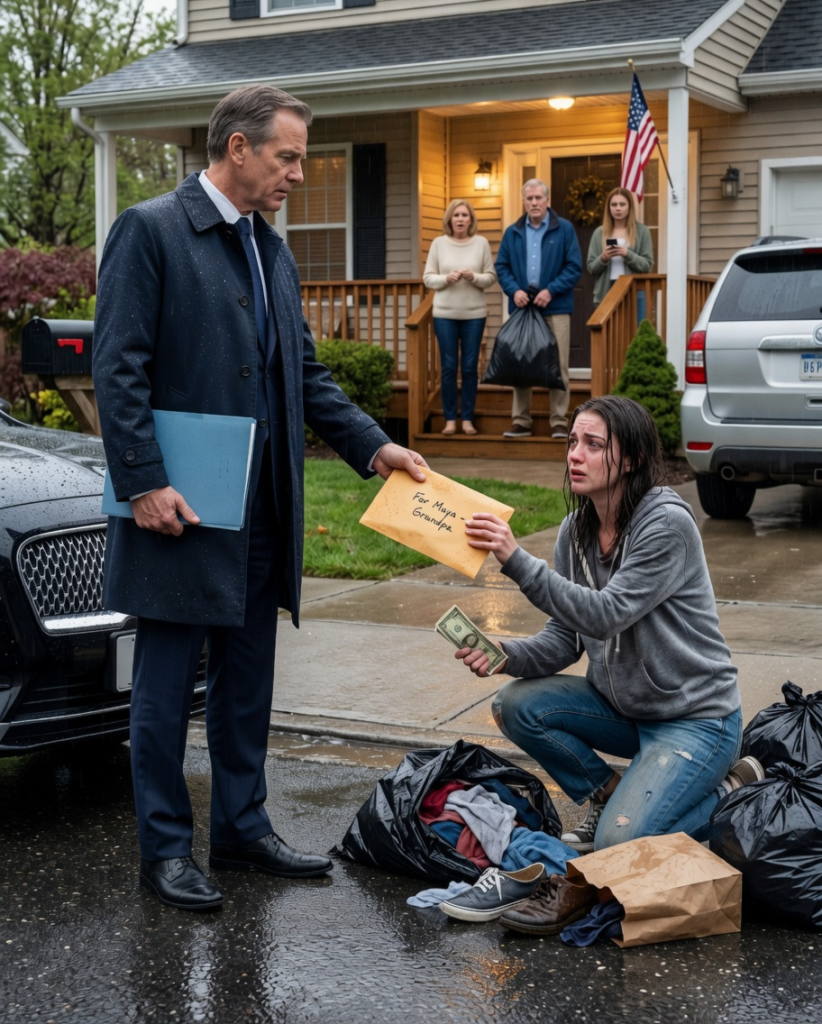
By 11:26 a.m., my belongings were on the curb.
They did not even pretend to wait.
My father carried out black trash bags from the laundry room, the garage, and the little spare bedroom where I had slept between Grandpa’s bad nights.
My mother stood on the porch under the small American flag Grandpa used to straighten every Memorial Day.
Chloe filmed from the top step.
“Careful,” I said when my father dropped the bag with my work shoes.
He looked at me like I had asked for the house.
“You heard the will,” my mother said. “Arthur made his choice.”
Rain started then, thin and cold.
It darkened the driveway and soaked through the paper grocery bag where I had packed my toiletries.
My hoodie slipped halfway out of a torn trash bag.
A framed photo of Grandpa and me hit the pavement face down.
I stepped toward it, but Chloe’s laugh stopped me.
“You should post that,” she said. “Maya Lawson, professional caregiver, paid one dollar.”
I bent anyway.
For one ugly heartbeat, I pictured throwing that broken frame straight through the front window.
Then I picked it up, wiped the glass on my sleeve, and set it carefully on top of the least wet bag.
That was the last gift Grandpa had taught me.
Do not break your own hands on people who would enjoy watching you bleed.
The black town car arrived while my mother was still smiling.
It rolled to the curb so smoothly it looked out of place beside the trash bags.
Mr. Sterling stepped out without an umbrella, and the rain dotted his shoulders before he even closed the door.
He looked at the bags.
He looked at me.
Then he looked at my family on the porch.
Something changed in his face.
“Maya,” he said, “the reading for the vultures is over.”
My mother’s smile tightened.
“What did you just say?”
Mr. Sterling ignored her and reached inside his coat.
He pulled out a sealed manila envelope.
My grandfather’s handwriting was across the front.
For Maya, when they show you.
My knees went weak.
Not because of the money.
Because I knew that handwriting.
The shaky slope of the M.
The too-hard period after my name.
The stubbornness in every letter.
Mr. Sterling held the envelope between us.
“Do you know why your grandfather left you exactly one dollar?” he asked.
I shook my head.
Behind him, my mother came down one porch step.
Chloe stopped recording.
My father looked suddenly tired.
“Because Arthur needed you named, not forgotten,” Mr. Sterling said.
My mother snapped, “What is that supposed to mean?”
“It means,” he said, “that your father knew exactly what this family was.”
The street felt quieter after that.
Even the rain seemed to soften.
Mr. Sterling gave me the envelope, but before I opened it, he pulled out a thin blue folder with a yellow tab.
The tab read PRIVATE LETTER OF INSTRUCTION.
There was a probate clerk’s file stamp in the corner and Grandpa’s signature across the bottom.
My father sat down on the porch step.
It was not graceful.
It was the way a man sits when his body has found out something before his mind will admit it.
“Helen,” he whispered.
My mother did not look at him.
She looked at the folder the way Chloe had looked at the trust summary.
Hungry, but scared.
Mr. Sterling said, “Arthur signed this forty-two days before he died. He was examined that morning by his physician and found competent to execute legal instructions. The medical certification is attached.”
My mother’s face drained.
“He had dementia,” she said.
“He had pain medication,” Mr. Sterling replied. “Not dementia. You know the difference.”
Chloe whispered, “Mom?”
My mother slapped the air with one hand.
“Be quiet.”
I opened the envelope.
The paper inside smelled faintly like Grandpa’s desk drawer, cedar and dust and peppermint wrappers.
The first line nearly dropped me.
If Helen is screaming, then my granddaughter has finally seen what I had to let them reveal.
I read it aloud because Mr. Sterling asked me to.
My voice shook, but it held.
My mother made a sound I had never heard from her before.
Not anger.
Panic.
I kept reading.
Maya, I am sorry for the dollar.
I am sorrier that I had to let you sit through it.
But a person who is truly loved is protected in ways that do not always look kind at first.
Your mother would have fought any will that favored you.
Your father would have called you manipulative.
Chloe would have cried on camera.
They would have said you worked on me when I was sick.
They would have said you took advantage.
They would have dragged your name through every room I ever built.
My throat closed.
Mr. Sterling waited.
I breathed once and continued.
So I gave them the stage.
I gave them numbers big enough to make them honest.
I gave them a room where greed could speak before caution got in its way.
And I left you one dollar because I wanted the record to show that you were remembered, named, and deliberately placed where I needed you.
Chloe had gone pale.
My mother lunged for the paper.
Mr. Sterling stepped between us so fast his polished shoe slid on the wet sidewalk.
“Do not touch her,” he said.
It was the first time I had heard real steel in his voice.
My father put both hands over his mouth.
I kept reading.
The residential estate is not free of condition.
The liquid accounts attached to it are not free of review.
The Vanguard Trust is not beyond oversight.
Article Nine of the trust amendment authorizes my attorney and trustee to suspend distributions upon documented elder neglect, coercion, harassment of a named beneficiary, or retaliatory eviction from the family residence within thirty days of my death.
My mother screamed.
There it was.
The sound from the hook of the rest of my life.
She screamed like the porch had caught fire.
“That is not real,” she said.
Mr. Sterling opened the blue folder wider.
“It is real.”
He handed my father a copy, not my mother.
My father took it with wet fingers.
The pages shook.
“Read the next paragraph, Richard,” Mr. Sterling said.
My father’s lips moved before sound came out.
“Should any beneficiary participate in the humiliation, displacement, or financial coercion of Maya Lawson following my death, the trustee may initiate immediate suspension of disbursement pending review.”
Chloe’s phone slipped from her hand and hit the porch boards.
The crack was small.
The silence after it was not.
My mother turned on me.
“You did this.”
I almost laughed.
I had slept on hospital chairs for three years.
I had cleaned feeding tubes, tracked pill bottles, filed insurance forms, and learned how to smile at doctors so they would explain things twice.
But in her mind, my greatest talent was still somehow theft.
Mr. Sterling said, “Maya did not do this. Arthur did.”
Then he looked at Chloe.
“And Miss Lawson, before you assume the Vanguard Trust is already yours, you should know the first scheduled distribution is subject to trustee confirmation. Your grandfather was very clear about that.”
Chloe stared at him.
“You said it was mine.”
“I read what the will says,” he replied. “Now I am explaining what the trust amendment controls.”
My mother shouted over him.
“No. No. She gets nothing. She got her dollar. That is what he wanted.”
I looked down at the dollar in my palm.
It was damp now.
Soft at the corners.
Grandpa had known she would say that.
He had known the exact shape of the cruelty because he had lived with it longer than I had.
Mr. Sterling turned back to me.
“There is more.”
I did not know how there could be more.
He reached into the folder and removed a smaller envelope.
This one had no legal stamp.
Only my name.
Inside was a key.
A brass key, old and heavy, tied to a paper tag.
Lake house.
I covered my mouth.
Grandpa’s lake house had not been mentioned in the reading.
Nobody had lived there since Grandma died.
I remembered the screened porch, the green chairs, the smell of pine cleaner, the little dock where Grandpa taught me to bait a hook and then apologized when I cried over the worm.
My mother saw the key and went still.
Mr. Sterling said, “The lake house was transferred into the Arthur Vance Caregiver Trust seven months ago. Maya is the sole beneficiary.”
Chloe whispered, “That place is worth a fortune.”
My mother snapped, “It is family property.”
“No,” Mr. Sterling said. “It is trust property.”
My father lowered his head.
For the first time that day, he looked ashamed.
Not enough to save me earlier.
Not enough to stop the bags.
But enough to understand the door had closed.
Mr. Sterling continued, “There is also a two-year living stipend funded separately, a vehicle transfer, and reimbursement for documented caregiving costs. Arthur kept copies of every expense Maya paid from her own account.”
I thought of the pharmacy receipts in my glove compartment.
The gas station charges.
The medical tape.
The soup.
The soft socks Grandpa liked because seams hurt his toes.
Tiny expenses.
Invisible expenses.
The kind nobody counts when a woman is expected to care for free.
My mother had counted every acre but not one sock.
“Why would he do this to us?” Chloe cried.
That was when I finally looked at her.
Rain ran down my face, and for once I did not wipe it away.
“He did not do this to you,” I said. “He watched what you did to me.”
Nobody answered.
A neighbor across the street had come out onto her porch.
She did not speak.
She just stood there with one hand over her mouth, witnessing what my family had always preferred to do indoors.
Mr. Sterling told me I did not have to stay.
That sentence almost broke me.
I did not have to stay.
After years of staying because Grandpa needed water, because medication was due, because my mother had plans, because my father forgot, because Chloe was busy, because someone had to be the decent one, a man in a wet suit looked at me and said I could leave.
So I did.
Not dramatically.
Not with a speech.
I picked up the photo of Grandpa and me.
I picked up my work shoes.
I left the rest of the bags for my father to put into Mr. Sterling’s trunk because the attorney asked him to, and for some reason Richard obeyed.
My mother stood on the porch trembling.
Chloe cried into her cracked phone.
The American flag above them flicked in the rain, small and ordinary, the way it always had when Grandpa fixed it with his own hands.
I sat in the back of the town car with the envelope in my lap and the key pressed into my palm.
Mr. Sterling handed me a paper coffee cup from the cup holder.
It was lukewarm.
It was the first thing anyone had handed me that day without asking me to earn it.
We drove to the lake house before sunset.
The sky cleared halfway there, leaving everything washed and shining.
When we pulled into the gravel drive, I saw that Grandpa had paid someone to clean the porch.
There was a new lock on the door.
A stack of firewood under a tarp.
A small note taped inside the kitchen cabinet where he used to hide peppermint candy.
I found you a door they cannot throw you out of.
That was the sentence that finally made me sit on the floor and cry.
Not because I had won.
Winning is too small a word for what it feels like when the cage opens.
I cried because the man I had fed soup to with shaking hands had spent his last clear strength building a way for me to survive the people who called themselves my family.
Over the next two weeks, Mr. Sterling filed the trustee review.
The probate record included the will, the trust amendment, the medical certification, the caregiver logs, photos of my belongings on the curb, and Chloe’s own video before she deleted it.
She had forgotten cloud backups existed.
My father called first.
He did not apologize.
He explained.
There is a difference.
He said things had gotten emotional.
He said my mother was devastated.
He said Chloe was young, which was funny because Chloe was twenty-nine and old enough to price villas before Grandpa was buried.
I listened until he ran out of ways to avoid the sentence I needed.
Then I said, “Dad, I have to go.”
He said, “Maya, please.”
I hung up gently.
That was new for me.
Not the gentleness.
The ending.
My mother left voicemails for three days.
On the fourth day, she sent one text.
You destroyed this family.
I looked at it while standing in Grandpa’s kitchen, wearing his old flannel over my pajamas, the lake silver through the window.
Then I typed back one sentence.
No, Mom. I stopped carrying what was already broken.
I blocked her after that.
The trustee suspended Chloe’s first distribution pending review.
My parents’ access to the liquid accounts was frozen until the estate conditions were examined.
The house did not disappear from them overnight, and no courtroom lightning bolt struck anyone down.
Real consequences are slower than stories make them sound.
They come in certified letters.
They come in required signatures.
They come in polite emails from attorneys who use words like pending, documented, and pursuant.
But they came.
By the end of the month, the family that had laughed at my one dollar was asking Mr. Sterling whether mediation was possible.
He forwarded me the request.
I said no.
Not because I hated them.
Because I finally understood that peace built on my silence had never been peace at all.
I kept the dollar.
It dried with a faint blue ink stain near the edge.
I put it in a cheap frame beside Grandpa’s letter, not as a reminder that I was valued at one dollar, but as proof that he had known exactly how to make the truth stand up in a room full of liars.
Sometimes care is not rewarded in the moment.
Sometimes it is mocked, dismissed, laughed at, and thrown to the curb in the rain.
And sometimes the person you cared for has already left a door open, a key waiting, and a final letter sharp enough to cut through every lie.
The law firm conference room had taught me what my family thought I was worth.
Grandpa’s letter taught me what he had known all along.
I was never the forgotten one.
I was the one he trusted with the truth.