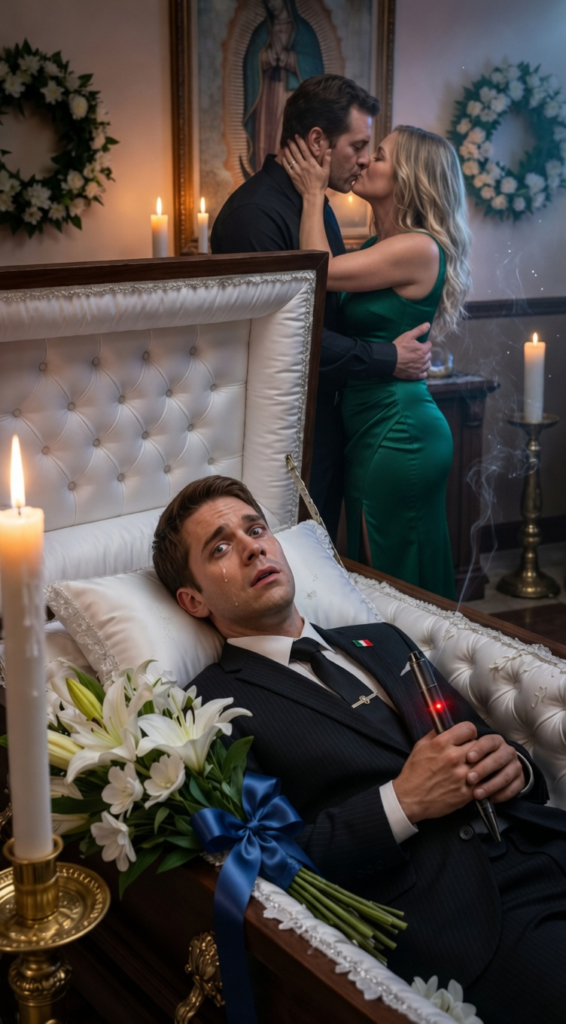
I woke to the smell of polished mahogany and the suffocating, powdery sweetness of lilies pressing against my lungs.
At first, I did not open my eyes. It wasn’t because I didn’t want to, but because some invisible, terrifying force held my eyelids shut as if they had been welded together with lead. I tried to twitch my fingers. Nothing. I tried to curl my toes. Nothing. I tried to move my tongue, to wet my dry lips, to make even the softest sound. Nothing. My body was a cold, unyielding statue, but my mind was violently awake, screaming inside a flesh prison that wholly refused to answer my commands.
Then, I heard the prayers.
A low, trembling voice recited scripture somewhere nearby. Soft shoes shuffled over marble floors. A woman sniffled delicately. A man cleared his throat and whispered, “Only forty-five. Massive heart attack. A terrible thing for the Pendleton family.”
Terror sliced through my consciousness like jagged ice.
I was not in a hospital bed. I was not in the sprawling master bedroom of my Kentucky estate. The darkness around me was absolute, airless, and the space was so incredibly narrow that my shoulders were tightly pressed against both sides.
I was inside a box.
My own coffin.
I, Arthur Pendleton, the sole heir and CEO of **Pendleton Reserve**, one of Kentucky’s oldest and most ruthless bourbon dynasties, was being mourned alive inside a luxury funeral home in Louisville.
My mind clawed backward through the fog of memory, desperate for an anchor. The night before, at the estate outside Lexington, I had felt that familiar, creeping weakness again. For three weeks, my body had betrayed me in strange, subtle ways—a sudden numbness in my fingertips, an unnatural heaviness in my chest, blinding waves of dizziness during board meetings. My wife, Victoria, fifteen years my junior and beautiful in a careful, flawlessly expensive way, had brought me a cup of tea right before bed.
“Drink it, sweetheart,” she had murmured, her cool fingers brushing the hair away from my sweating forehead. “Dr. Vance said this herbal blend will calm your heart rate and finally help you sleep.”
Dr. Harrison Vance.
My lead cardiologist. My fraternity brother. My best friend since our days at Yale.
I had trusted him implicitly. I had trusted her.
So, I drank the bitter tea. Then came the heavy dizziness. Then, the suffocating dark.
Now, trapped inside the velvet-lined coffin, I felt a pair of hands smooth the lapels of my tailored suit. Victoria’s signature perfume—a custom blend of bergamot and vanilla—slipped through the tiny space around my face, sweet and nauseating.
“Almost over, my love,” she whispered.
There was no grief in her voice. There was only a chilling, absolute satisfaction.
“Soon, we’ll finally be rid of you.”
Another voice answered her, pitched low and masculine. Harrison.
“The paralytic worked perfectly. No one questions a respected, board-certified cardiologist when he signs off on a sudden cardiac arrest in a chronically stressed executive. Especially not one with Arthur’s relentless workload.”
Victoria gave a soft, breathy laugh that made my paralyzed blood run cold. “What time is the cremation?”
“Six o’clock sharp,” Harrison replied smoothly. “Once he’s ash, there’s nothing left to examine. No toxicology report. The distilleries, the Swiss accounts, the Nashville penthouse, the life insurance payout—it all becomes entirely manageable.”
*Cremation.*
The word echoed in the dark chamber of my skull. They were going to burn me alive.
I tried to scream. I threw every ounce of my willpower into tearing open my own throat, trying to force even a single vocal cord to vibrate. I tried to force one finger to scratch against the satin lining.
Nothing moved. I was a ghost haunting my own corpse.
The funeral continued around me like a grotesque, macabre performance. I listened as Victoria accepted condolences. I heard her fake tears when the board members came near the casket. She played the shattered, fragile widow flawlessly, standing guard over the living man she had conspired to murder.
Then, the murmurs died down. The heavy coffin lid began to close.
Darkness swallowed me completely.
*Click.* The first metal latch locked into place.
*Click.* The second.
*Click.* The third.
The air instantly thickened, growing stale and hot. My paralyzed body was being lifted. I felt the swaying motion of the casket on a rolling cart. I was being carried toward the fire, wide awake in the dark, with absolutely no way out.
I couldn’t know it then, while I lay suffocating beneath layers of mahogany and silk, but a seemingly insignificant mistake in the kitchen trash back at my estate had just put the very first crack in my wife’s perfect murder.
That morning, my younger brother, Declan Pendleton, had arrived uncharacteristically early to the estate.
Declan had not been allowed to see me before the funeral home removed my body. Victoria had smoothly insisted it was “too traumatic” for the family. Harrison had assured everyone that the heart attack had been sudden but entirely peaceful. The private night nurse had mysteriously been sent home early the night before because Victoria wanted “quiet, uninterrupted time” with her ailing husband.
None of it sat right with Declan.
Declan and I had not always been close. The Pendleton family had entirely too much money and too many generational secrets for brotherhood to remain a simple thing. I had inherited the iron-fisted leadership of **Pendleton Reserve**, while Declan had spent his adult years being dismissed by the board as the reckless younger son who preferred restoring vintage motorcycles and making bad investments.
But beneath the corporate warfare and the holiday dinners spent on opposite sides of long tables, Declan knew me.
He knew Arthur Pendleton did not die easily. I did not surrender to stress. I did not ignore glaring physical symptoms for weeks without ordering an army of specialists to run tests. I certainly did not let my body collapse quietly while sitting beside my wife and her favorite doctor.
I would later learn that Declan walked through the mansion that morning with a kind of quiet, radiating anger that made the estate staff actively avoid his eyes. The house looked entirely too clean. Too perfectly arranged for a sudden tragedy. Fresh white floral arrangements had already replaced the ones in my master bedroom. The bedsheets had been entirely stripped and bleached. The tea tray was completely gone.
Almost gone.
In the massive catering kitchen, an older housekeeper named Mrs. Gable stood beside the marble sink, nervously twisting a dish towel in her weathered hands.
Declan stopped in the doorway. “What is it, Mrs. Gable?”
She looked fearfully toward the hallway before speaking. “Mr. Declan, I really don’t want any trouble.”
“That usually means trouble already exists,” he replied, stepping closer.
Her eyes filled with conflicted tears. “Your brother was asking for you last week.”
Declan’s posture stiffened. “He was?”
“He pulled me aside in the study. He told me if anything ever happened to him, I should call you first. Before the lawyers. Before his wife.”
Declan went completely still. “Why didn’t you?”
“Mrs. Pendleton confiscated his phone yesterday afternoon. She said he needed absolute screen-free rest. Dr. Vance told the entire staff not to disturb him under any circumstances.”
Declan’s jaw hardened.
Mrs. Gable lowered her voice to a terrified whisper. “And… there was something in the trash this morning. In the service pantry. I thought it was odd.”
Declan didn’t wait. He bypassed her and walked straight to the service pantry, where the large industrial kitchen trash bag had not yet been taken out by the groundskeepers. He pulled on a pair of yellow dish gloves and tore the bag open.
At first, there was nothing unusual. Gourmet coffee grounds. Soiled paper towels. Empty floral packaging. A broken porcelain teacup wrapped in the morning newspaper.
Then, Declan saw it.
A small, amber glass vial. It had no obvious medical branding. At the bottom of the bag was a torn pharmacy sticker, wet from spilled herbal tea but still partially readable.
*Vecur—*
Declan stared at it. He knew very little about prescription medicine, but he knew enough about the world to understand that ordinary sleep herbs did not come in hidden glass vials with aggressively torn labels.
He took out his phone and called the one person he trusted more than any corporate attorney on the Pendleton payroll: Dr. Meredith Collins.
Meredith was a brilliant senior toxicologist at the University of Kentucky Medical Center. She had dated Declan for two volatile years, ended it because she claimed he was “emotionally allergic to adulthood,” and somehow remained the only person on earth who could call him an idiot without making him throw a punch.
She answered on the third ring. “Declan, unless you are actively bleeding, under arrest, or finally apologizing for Thanksgiving, this is a bad time.”
“I found a medical vial in Arthur’s kitchen trash,” he interrupted, his voice tight. “The partial label says *Vecur*-something.”
The line went dead silent.
“Spell exactly what you see,” Meredith demanded.
He did.
Meredith’s tone shifted from annoyed to clinical ice. “Vecuronium?”
“What is that?”
“It’s a high-grade paralytic.”
Declan’s blood went cold. “What kind of paralytic?”
“The kind used during major surgical anesthesia to completely stop all muscle movement. It does not make you unconscious by itself, Declan. It paralyzes the respiratory system and the skeletal muscles. You’re completely awake, but you look dead.”
Declan looked slowly toward the mansion’s grand foyer. At the ornate funeral program resting on the console table. At the elegant, embossed words: *Private Cremation Service, 6:00 p.m.*
“Declan,” Meredith said sharply, panic bleeding into her voice. “Why are you asking me about this?”
He could barely draw breath into his lungs. “Because my brother is being cremated in less than an hour.”
For half a second, there was only the static of the cellular connection.
Then Meredith screamed into the phone. “Stop it! Stop the cremation right now!”
Inside the box, the temperature was rising.
I felt the subtle shift in the environment as the rolling cart transitioned from the carpeted viewing room to the concrete floors of the crematorium wing. The air around me grew stifling. Sweat pooled in my collar, but my body refused to shiver or gasp. The absolute sensory deprivation was maddening. My brain fired frantic, electric signals to my limbs—*Move! Thrash! Kick!*—but the vecuronium held my nervous system hostage.
I heard the heavy, industrial hum of the cremation furnace powering up. The low vibration rattled through the wheels of the cart and straight into my spine.
I was going to burn. I was going to feel the flames consume my skin, my clothes, my flesh, and I wouldn’t be able to make a single sound.
Outside the box, in the hallway leading to the incinerator, Victoria stood near the entrance, dressed in immaculate black silk, one hand pressed delicately to her chest while Pendleton executives murmured their final condolences. Harrison stood securely by her side, projecting the image of a dignified, grieving friend.
Then, the heavy double doors of the funeral home crashed open.
Even through the thick mahogany of my casket, I heard the commotion.
“Stop the cremation!” a voice roared.
*Declan.*
My heart, beating at a slow, chemically suppressed rhythm, seemed to scream in my chest.
Victoria’s voice drifted through the wood, flashing with sharp irritation before perfectly masking itself in grief. “Declan, please. This is highly inappropriate. This is not the time.”
“Get out of my way, Victoria,” Declan snarled. I heard the scuffle of shoes. Two funeral attendants tried to physically block him.
“Sir, you can’t go back there!” one of them shouted.
“My brother might be alive!” Declan bellowed.
The muffled acoustics of the room erupted into sheer chaos. I heard the collective gasp of the mourners.
Harrison moved first, his voice dripping with condescending medical authority. “Declan, listen to me. You’re in a state of severe shock. This is the bargaining stage of grief.”
I heard the sickening thud of Declan shoving Harrison against the wall. “What exactly does vecuronium do, Harrison?”
Silence fell over the room like an anvil.
Though I couldn’t see it, I knew Harrison had frozen. That fraction of a second of hesitation was all Declan needed.
The funeral director’s frantic voice cut through the tension. “Mr. Pendleton, I assure you, the cremation sequence has not officially begun, but we cannot have this disruption—”
“Open the coffin,” Declan ordered.
Victoria stepped forward, her heels clicking aggressively on the floor. “Absolutely not. My husband deserves peace and dignity. I am his next of kin, and I forbid it.”
“If he’s dead, his dignity can wait five minutes,” Declan said, his voice dropping to a terrifying, deadly calm. “If he’s alive, so can your massive inheritance.”
Harrison tried to grab Declan’s arm. “You are making a hysterical scene.”
“Then call the damn police,” Declan shot back. “Call the police and explain to them exactly why you’re so terrified of opening a wooden box.”
That sentence broke the room. The executives who had been whispering abruptly stopped. The funeral director, clearly sweating now, looked from Victoria to Declan. “I need legal authorization…”
“I have a senior toxicologist on an open line, a suspicious unlabelled vial retrieved from the estate, and a cremation scheduled within mere hours of an unsigned, bypassed autopsy,” Declan stated clearly. “You will open it right now, or I swear to God I will burn this entire facility to the ground before I let you turn that furnace on.”
“This is utter insanity!” Victoria shrieked, her perfect composure finally cracking.
“No,” Declan said. “Insanity was thinking I wouldn’t check the garbage.”
Through the wood, I heard the funeral director give a shaky nod to his staff. The wheels of my cart squeaked as I was pulled backward, away from the roaring hum of the incinerator, back into the viewing room.
Victoria tried to bolt for the exit.
“Don’t let her leave!” Declan snapped.
Harrison scrambled for his phone, but I heard a heavy security guard step squarely in his path.
Then came the sounds that would haunt my dreams for the rest of my life.
*Click.* The first latch.
*Click.* The second latch.
*Click.* The third latch.
The heavy mahogany lid lifted. Brilliant, blinding fluorescent light pierced the absolute darkness, stabbing into my unblinking, dilated pupils.
I lay there, pale, stiff, and perfectly still.
For one agonizing second, nothing happened. I was screaming at my lungs to move, screaming at my eyes to blink, but the chemical chains held tight.
Then, Meredith’s voice barked from the speakerphone in Declan’s hand. “Check his pupils! Check for a pulse! Put a mirror right under his nose. Do it now!”
A trembling funeral attendant stepped forward and held a small, polished metal cosmetic tray a millimeter beneath my nostrils.
Nothing.
I felt Declan lean over the casket, his presence radiating a desperate, crumbling hope. My lungs burned. The oxygen in my blood was completely depleted. With every fiber of my being, with a rage that defied chemistry, I forced my diaphragm to twitch.
A microscopic breath pushed past my lips.
The polished metal tray fogged. Just barely.
A woman in the back of the room screamed.
Declan grabbed the padded edge of the coffin, his knuckles turning white. “Arthur?”
I could hear him. For the first time since I woke up in this nightmare, a sound reached me that felt like salvation. I tried to look at him. I tried to show him anything.
The sheer emotional force of hearing his voice shattered a tiny piece of the paralysis. A single tear broke surface, pooling in the corner of my right eye, and slid slowly down my temple into my hairline.
Declan saw it.
“He’s alive,” Declan whispered, his voice cracking. Then he turned to the room and roared, “He is alive!”
The funeral home immediately exploded into absolute bedlam.
Someone shouted for 911. A board member fainted, crashing into a row of folding chairs. Victoria backed away in sheer horror, colliding with a massive stand of white roses and sending them scattering across the marble floor like broken bones. Harrison’s face morphed from arrogant concern to naked, visceral panic.
Paramedics surged into the room within minutes.
Meredith stayed on the line, dictating commands to the EMTs through Declan’s phone until they recognized the severe symptoms of the paralytic and initiated emergency respiratory support. I felt the brutal, invasive shove of a plastic tube sliding down my throat. I was manually ventilated, strapped to a gurney, and rushed to the hospital under heavy police escort.
Victoria, ever the actress, tried to climb into the back of the ambulance.
Declan physically blocked the doors. “You don’t get within ten feet of him.”
She slapped him across the face, a sharp, resounding crack.
Declan didn’t even flinch. He just stared at her with dead eyes. A police officer witnessed the assault and immediately stepped between them, grabbing Victoria by the elbow. “Ma’am, you need to step back and come with us.”
Harrison attempted to quietly disappear through a side hallway near the restrooms. He didn’t make it past the exit before two patrol officers slammed him against the glass doors.
By midnight, I was lying alive in the Intensive Care Unit.
Barely.
The vecuronium had nearly killed me by entirely suppressing my autonomic ability to breathe. But because Harrison had meticulously calculated the dose to mimic a natural cardiac event rather than cause immediate catastrophic organ failure, and because my cremation had been delayed by a margin of minutes, my brain had survived the hypoxia. I remained heavily sedated on a ventilator while the chemical slowly cleared from my nervous system.
Declan sat in a rigid plastic chair beside my bed all night.
I drifted in and out of a terrifying twilight consciousness, feeling the rhythmic push of the machine breathing for me. I looked at my brother, exhausted and disheveled, and I violently hated every petty argument we had ever wasted our years on. The brutal inheritance fights. The boardroom insults. The holidays spent icing each other out. All of it felt deeply obscene now.
At 3:17 a.m., the paralysis finally began to break. My right index finger twitched against the bedsheet.
Declan stood up so fast his chair flipped over backward with a loud crash. “Arthur?”
My eyelids fluttered, feeling like sandpaper. A nurse rushed into the room, checking the monitors. My eyes opened slowly, the bright hospital lights unfocused at first, before settling on my brother’s terrified face.
The plastic tube in my throat prevented me from speaking. I choked on it slightly, panic rising.
Declan leaned over me, gripping the bedrail. “You’re safe. You’re in the ICU. They didn’t burn you, Arthur. You’re safe.”
My eyes instantly filled with hot tears. I moved my hand, a weak, trembling gesture across the mattress.
Declan grabbed it in both of his.
For years, neither of us had known how to say the word ‘love’ without burying it under layers of sarcasm and corporate armor. But in that sterile room, with the smell of the coffin still phantom-clinging to my skin, Declan bowed his head over our joined hands and wept.
“I found the vial,” he whispered, his voice broken. “I found it in the trash, Arthur. I got you out.”
I closed my eyes, squeezing his hand as hard as my returning strength would allow.
The police investigation moved much faster than Victoria had ever anticipated. She had relied entirely on speed and prestige. A heart attack diagnosis from a top-tier doctor. An immediate, unquestioned cremation. A grieving, wealthy widow wielding unchecked power.
But once I drew breath inside that coffin, her dark curtain of privacy was shredded.
Detective Sarah Mitchell of the Louisville Metro Police took absolute control of the case. She was sharp, relentless, and completely unimpressed by the Pendleton name or the zeros in our bank accounts.
I later learned that when Victoria sat in the interrogation room, wearing her designer mourning clothes and insisting she was far too traumatized to answer questions, Detective Mitchell simply dropped the amber vial in a clear plastic evidence bag onto the metal table.
“Then let’s start by talking about this,” Mitchell said flatly.
Victoria stared at the vial. I was told her perfect porcelain mask cracked right down the middle.
But it was Dr. Harrison Vance who broke first.
Doctors are rarely good criminals. They are accustomed to supreme authority, to being blindly believed, to speaking in complex medical jargon that makes ordinary people nod in submission. But interrogation rooms do not worship medical degrees. Evidence does not care about your Ivy League credentials.
The torn pharmacy label led Mitchell’s team directly to a supply chain discrepancy at Harrison’s hospital. Security footage from three weeks prior showed Harrison accessing a restricted medication cabinet at 2:00 a.m. His forged signature appeared on altered inventory logs.
Then, the police executed a warrant on their digital devices.
Sitting in my hospital bed a week later, breathing on my own, Detective Mitchell handed me a printed transcript of their recovered text messages.
*Harrison: He suspects something. Should I increase the dose?*
*Victoria: No. Too much and the coroner will see respiratory arrest patterns. We need a slow cardiac collapse.*
*Victoria: The cremation must happen fast. I do not want his brother asking questions. Declan is a wildcard.*
I read those lines, staring at the exact moment my wife priced out my life, and a cold, terrible hollow opened up inside my chest.
I spent eleven agonizing days tethered to machines in the intensive care unit. When the ventilator tube was finally extracted from my throat, the very first word that tore through my ruined vocal cords was my brother’s name. Declan was asleep in a rigid plastic chair beside my bed, looking entirely wrecked.
“You scared the absolute hell out of me,” he rasped, instantly awake and at my side.
“I was awake,” I whispered, the memory of the coffin’s suffocating velvet choking me all over again. “I heard them, Declan. Victoria. Harrison. The cremation schedule. I heard it all.”
Declan’s face twisted into an ugly knot of grief and pure rage. He confessed he had reached the crematorium a mere three minutes before the industrial incinerator was fired. I stared at the man who had always been a stubborn thorn in my corporate side, realizing a deeply humiliating truth. All my vast wealth, my legal teams, and my pristine security had been useless. My reckless little brother, digging through kitchen garbage with yellow dish gloves, was my sole savior.
Victoria’s arrest detonated like a bomb across the international press. Bourbon Heiress Accused of Cremating Billionaire Husband Alive. My corporate board panicked, begging me to retreat to a private island until the scandal faded. Instead, three weeks later, leaning heavily on a silver-handled cane, I recorded a public statement from my mahogany study. Declan stood fiercely by my side.
“My wife and my primary physician conspired to murder me,” I declared into the camera lens, ensuring the world knew that no family dynasty or medical degree could successfully bury the truth.
Nine months later, the criminal trial commenced. I had regained my physical strength, though the mere scent of funeral lilies still made me violently ill. Victoria entered the courtroom looking less like a fragile, grieving widow and more like a cornered, venomous viper. Dr. Harrison Vance looked utterly shattered, his hands trembling as he aggressively avoided my gaze.
The prosecution dismantled their flawless crime with surgical precision. They exposed the eighteen-month affair, the forged hospital logs, and the chilling, deleted text messages projecting my imminent demise. But the massive courtroom held its collective breath when I finally took the witness stand.
“Mr. Pendleton, what did you hear inside the coffin?” the prosecutor asked gently.
I locked eyes with my wife. “I heard them celebrate. I heard the exact sound of profound betrayal.”
The final nail in their proverbial coffin was a recovered, deleted voicemail from Harrison’s cloud storage. Victoria’s sharp, demanding voice echoed through the silent room, threatening to completely ruin Harrison’s life if he didn’t prescribe the paralytic drug that night. Harrison sobbed openly at the defense table. Victoria turned to ice.
The jury deliberated for a mere four hours. Guilty on all counts.
At sentencing, I stood tall before the judge. “Victoria,” I said, my voice echoing off the wood-paneled walls, “you married the gilded doors my last name opened. Harrison, you forged the sacred oath of medicine into a murder weapon. I ask that you lock them away until they forget what the sun looks like.”
The judge complied without hesitation. Victoria received forty-five years; Harrison, fifty-two.
As the armed bailiffs moved in with the heavy steel cuffs, Victoria stopped and sneered, “You’ll never really know if I loved you in the beginning, Arthur.”
I looked at the woman who had gladly condemned me to the dark. “Victoria,” I answered softly, “the dead don’t care.”
She flinched as if physically struck, and the guards dragged her away. But as the heavy oak doors slammed shut behind her, my eyes met Declan’s across the crowded gallery. A cold, dreadful realization washed over me. My attempted murderers were caged, but as I noticed the predatory glints in the eyes of the rival executives sitting in the back row, I knew this nightmare wasn’t completely over. The true, bloody war for the soul of Pendleton Reserve had only just begun.
In the quiet, brutal months following the trial, I ruthlessly dismantled the gilded life I had known. I ordered the sprawling Louisville mansion bulldozed to the dirt, donating the empty acreage to the city. I stepped down from the grinding daily operations of the company, actively cleaning house and firing every sycophantic relative who treated our stock portfolio like a divine birthright.
Then, I did the unthinkable. I named Declan Pendleton as the full Co-Chairman of the Pendleton Family Trust.
The board of directors instantly revolted. My corporate attorneys practically hyperventilated in my office. Declan himself stormed into my temporary downtown headquarters, aggressively slamming the legal folder onto my desk.
“Are you completely insane?” he demanded. “I fix vintage Indian motorcycles, Arthur. I am not Trust Co-Chair material!”
I didn’t blink. “You found a microscopic, unlabelled paralytic vial in a trash bag. That intuition is a hell of a lot better than the MBAs those corporate vipers possess.”
He paced the length of the floor. “I don’t want your trauma-induced pity promotion.”
“It isn’t pity, Declan,” I said softly, leaning forward. “It’s trust. With my actual life.”
He froze, the weight of the word striking him significantly harder than any childhood insult I had ever hurled. He stared out the glass window for a long time, swallowing hard before giving a single, reluctant nod.
A year later, at our annual Founder’s Dinner inside a beautifully restored Bardstown barrelhouse, the decor was strictly devoid of mahogany and lilies. My honored VIPs were not politicians or billionaires; they were Declan, Mrs. Gable the housekeeper, the frantic toxicologist, and the relentless homicide detective.
I raised my crystal glass of twenty-year reserve to the cavernous room. “To the people who demanded they open the box. Sometimes, true family isn’t the person wearing your diamond ring. It’s the stubborn brother willing to dig through the garbage because his gut tells him you’re in grave danger.”
Declan stared aggressively at his porcelain plate, but I saw the tears shining in his eyes.
Five years later, the sensational story still circulated in true-crime podcasts—a cinematic horror of paralytics and mahogany coffins. I ignored them all. Victoria sent desperate, manipulative letters from her concrete cell for the entire first year. I left every single one unopened. Harrison sent one; I threw it straight into my study’s blazing fireplace. I didn’t burn it in anger. I burned it in profound, utter freedom.
On the exact sixth anniversary of the day I was scheduled to be incinerated, Declan and I walked through the oldest, dustiest barrelhouse on our sprawling land. Late afternoon sunlight cut through the wooden rafters, illuminating the floating dust and the endless rows of aging bourbon.
Declan ran a calloused hand over a charred oak barrel. “Do you ever think about what would’ve happened if I hadn’t looked inside that trash bag?”
“Every single day,” I answered honestly. “But I think significantly more about what happened because you did. Thank you, Declan.”
He shifted uncomfortably, clearing his throat loudly. “You’re welcome, Artie.”
For most brothers, those two words were impossibly small. For us, they were an iron bridge meticulously rebuilt over two decades of foolish pride and almost certain death.
Outside, the Kentucky hills rolled bright green beneath a limitless, unsealed blue sky. I stood in the warm sunlight and took a massive, deep breath into my lungs, simply because I could. Money and prestige had nearly buried the horrifying truth under expensive flowers and a forged death certificate. But I lived long enough to learn the most vital lesson of all: the people who truly love you are never the ones standing politely beside your casket. They are the ones willing to tear the wood apart with their bare hands to hear your silent screams.