My brother stole my ATM card on a Thursday, and for most of that day, I had no idea my life was being quietly dismantled behind my back.
I woke before sunrise in my parents’ house in Columbus, Ohio, with my alarm vibrating against the nightstand and my body aching before my feet touched the floor.
I was twenty-nine, working as a respiratory therapist at a hospital that always seemed short on people and full of crisis.
That week had been especially brutal.
Two double shifts.
Too many patients.
Too many families waiting outside rooms with their hands clasped, begging with their eyes for good news I could not always give.
I pulled on my blue scrub top in the dark and checked the small zipper pocket of my work bag out of habit.
My badge was there.
My keys were there.
My wallet felt like it was there, though I did not pull it out.
I was already late, and my mother hated hearing me rush through the kitchen before dawn.
The house was quiet when I left.
My father’s truck was in the driveway.
My brother Jason’s car sat at the curb, even though he had told everyone he had an early job interview that morning.
I noticed it, but I was too tired to think about it.
I had lived there for almost two years, after my aunt Denise died and left behind a complicated estate, a grieving family, and one savings account with my name attached to it.
My parents had insisted I stay with them instead of renting an apartment.
Save your money, my mother had said.
Graduate school is expensive.
Family helps family.
At first, I believed her.
Then family started needing little things.
Groceries when Dad’s hours were cut.
Car insurance when Mom forgot the due date.
Jason’s phone bill when he was between jobs again.
A repair on the furnace.
A medical copay.
None of it was called rent.
None of it was called repayment.
It was just expected, wrapped in guilt, delivered with a smile.
I paid because I wanted peace.
I paid because I had spent my whole life trying to earn a softer version of my mother’s love.
I paid because every time I said no, Jason acted wounded, Dad acted disappointed, and Mom acted like I had become a stranger.
Still, I protected one account more carefully than anything else.
It held nearly $38,000, money I had saved for graduate school and money connected to Aunt Denise’s estate.
Not all of it was freely mine.
After Aunt Denise died, the probate court had placed restrictions on part of the funds because she had written instructions for my education and future licensing.
The estate attorney had explained it twice, slowly, across a polished desk.
You can use this money for approved education and related expenses, Emily.
Keep records.
Do not treat it like cash.
Every major movement is documented.
I understood.
I respected it.
To me, that money was not a prize.
It was a promise.
By nine that Thursday night, I had forgotten all of that for a few minutes.
I was too exhausted to think beyond a shower and leftovers.
My feet throbbed inside my hospital shoes.
My head pounded from fluorescent lights and alarms.
I pulled into the driveway, noticed the kitchen lights glowing, and hoped no one would want to talk.
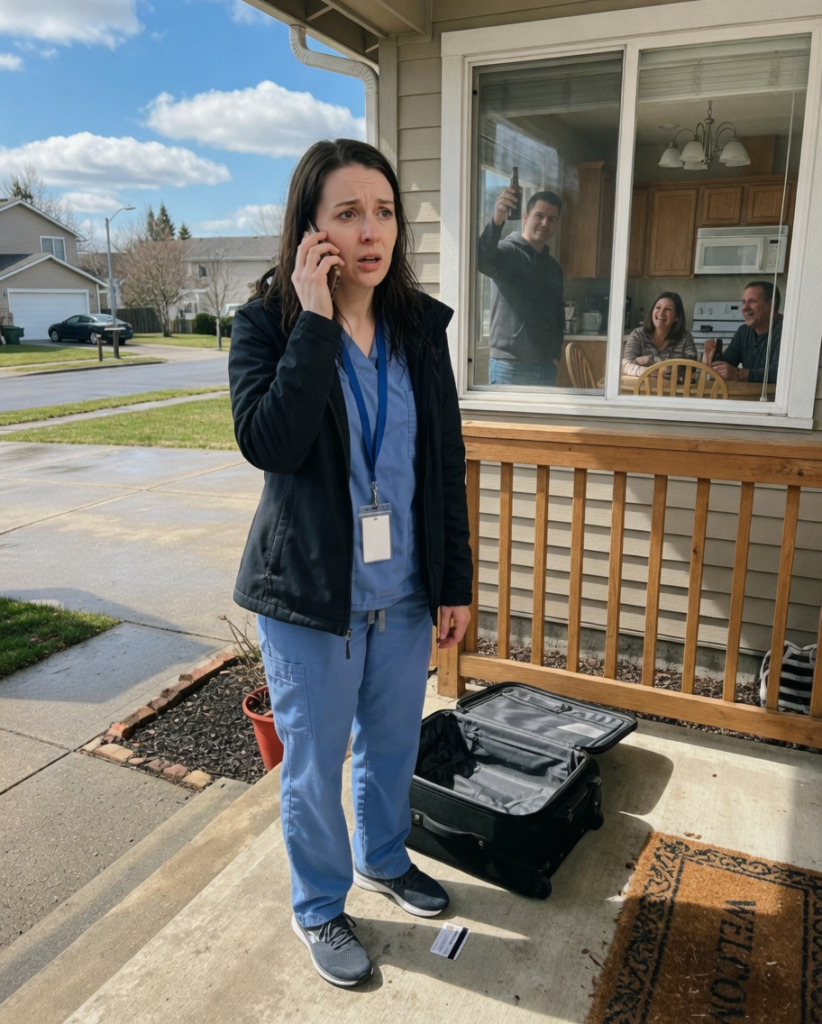
Then I opened the front door and saw my suitcase sitting beside it.
For a second, my brain refused to understand the scene.
My black suitcase belonged in the hallway closet behind winter coats and old Christmas decorations.
Instead, it stood upright near the welcome mat, handle raised, one wheel crooked.
My gray hoodie was folded across the top.
My toiletries were zipped inside a clear plastic bag.
My laptop charger stuck out of a side pocket.
Someone had packed me.
The kitchen erupted in laughter.
I walked toward it slowly, feeling the shift before I understood it.
My mother sat at the table with her hands wrapped around a coffee mug, though I could smell beer.
My father leaned back in his chair, relaxed in a way he only looked when someone else was about to suffer.
Jason sat between them with one of Dad’s heavy glass mugs in his hand and a grin that made my stomach go cold.
“Oh, you’re home,” my mother said.
Her tone was casual.
Almost cheerful.
I pointed behind me.
“Why is my suitcase by the door?”
Jason leaned back, stretching his legs like he owned the room.
“Your work is finished,” he said.
“We got what we wanted.
Don’t look back at us now.”
I stared at him.
“What are you talking about?”
Dad chuckled.
“Don’t act confused, Emily.”
That was when Jason reached into his pocket and placed my ATM card on the table.
I recognized the worn corner immediately.
The little scratch across the silver logo.
The card I had used the night before to buy gas after leaving the hospital.
My mouth went dry.
“Why do you have that?”
Jason tapped it once with his finger.
“You should be more careful with your things.”
“You stole it.”
“Borrowed,” he said.
“Then emptied the account.”
For a moment, every sound in the room disappeared except the rush of blood in my ears.
I lunged for the card, but Jason covered it with his palm and laughed.
“Relax.
It’s family money anyway.”
“No,” I said.
“It is not.”
Mom sighed, as if I were making a scene at a restaurant.
“It was a good decision.
You have been hoarding money while living under this roof.”
“Hoarding?” My voice shook.
“I have been saving for school.”
“You have been eating our food,” Dad said.
“I bought groceries last week.”
“You use electricity.”
“I paid the utility bill in January.”
Jason rolled his eyes.
“Here she goes.
Always the victim.
Always with receipts.”
I grabbed my phone from my bag.
My fingers were clumsy from panic, and it took me two tries to open the banking app.
I kept hoping he was lying.
Jason lied the way some people breathed.
He exaggerated to scare people, to control them, to make himself feel powerful.
But the screen loaded.
Savings: $0.43.
Checking: $12.11.
I clicked into the transaction history.
Cash withdrawals, one after another, from two ATMs across town.
Hundreds at a time.
Then more.
Then a wire transfer that made my knees weak.
Nearly $38,000 was gone.
I looked up at my family.
Not one of them looked ashamed.
“That was my graduate school money,” I whispered.
Jason stood.
He was taller than me, broad-shouldered, and he had spent our whole childhood using his size as a warning.
He did not have to raise a hand.
He just had to step close enough for me to remember every door he had slammed, every wall he had punched beside my head, every time my parents said I provoked him.
“Not anymore,” he said.
“Give it back.”
“No.”
Dad rose beside him and crossed his arms.
“Your mother and I discussed it.
You have stayed here almost two years.
Food, bills, wear and tear on the house.
This balances things out.”
I turned to my mother.
“You told me to stay.
You told me not to rent.
You said I should save.”
She looked away for one second, then hardened again.
“We should not have had to ask our own daughter to contribute.”
“I did contribute.”
Jason laughed.
“Not enough.”
The words landed with a clarity that almost steadied me.
They had never wanted me to save.
They had wanted me close enough to use.
They had watched me drag myself home from the hospital night after night, too tired to eat, and decided the money I was saving looked better in their hands.
“What did you do with it?” I asked.
Jason’s smile flickered.
“None of your business.”
“It came from my account.”
“It came from this family.”
“No,” I said, louder this time.
“Some of it came from Aunt Denise.”
My mother’s eyes sharpened.
There it was.
The first crack.
Jason did not notice.
“Aunt Denise is dead.”
“And the court is not,” I said.
The room went quiet for half a breath, but Dad covered it with another chuckle.
“You always were dramatic.”
Jason grabbed my suitcase and dragged it toward the door.
“Enough.
You can go now.”
He opened the front door and shoved the suitcase onto the porch.
Cold March wind swept into the hallway, carrying the smell of rain and wet pavement.
I stood there in my thin scrubs, still wearing my hospital badge, feeling like a stranger in the house where my baby pictures hung on the wall.
My mother followed us only far enough to watch.
“Mom,” I said, hating the way the word broke.
“You are really doing this?”
She lifted her chin.
“It was a good decision.”
Dad nodded from the kitchen.
“Best for everyone.”
Jason picked up my ATM card and flicked it toward my feet.
“Keep it.
There’s nothing left.”
Then he shut the door.
I stood on the porch with my suitcase leaning against my leg, my hands freezing, and my whole body trembling with shock.
Through the front window, I could see Jason raising his glass like he was making a toast.
My parents laughed with him.
My phone buzzed.
The caller ID said unknown.
I almost ignored it.
I had no strength left for another voice, another demand, another person needing something from me.
But the phone buzzed again.
I answered because some part of me still believed responsible people answered calls, even after their families threw them into the cold.
“Am I speaking with Emily Carter?” a woman asked.
“Yes.”
“This is Marlene Brooks with First Ohio Bank’s fraud department.
We have been trying to reach you regarding unusual activity on an account ending
in 4419.”
My knees nearly buckled.
“Yes,” I whispered.
“That’s my account.”
“Before I ask anything else, are you alone and safe?”
I looked through the window at my family celebrating.
“I am outside the house.”
“Did you authorize multiple ATM withdrawals and a wire transfer today?”
“No.”
“Did you give anyone your card or PIN?”
“No.”
“Do you know who accessed the card?”
I swallowed.
My throat felt raw.
“My brother.
Jason Carter.”
Marlene was quiet for a moment.
When she spoke again, her voice became precise and calm in a way that made the situation feel even more serious.
“Emily, the account your brother accessed is flagged as partially restricted under a probate arrangement.
That means certain funds are connected to your aunt’s estate and are monitored.
A suspicious activity alert was generated before the final transfer cleared.
We have already frozen the receiving account.”
I closed my eyes.
For the first time that night, I breathed.
“He thinks he got away with it,” I said.
“He has not,” Marlene replied.
“Do not warn him.
Do not go back inside.
I am transferring you to the estate attorney’s emergency line, and I strongly recommend that you file a police report tonight.”
The word police made my stomach twist.
My family had trained me to fear making things official.
Family problems stay in the family.
Do not embarrass us.
Do not air dirty laundry.
But they had thrown me out after stealing nearly every dollar I had.
So I said, “Transfer me.”
Within an hour, I was sitting in the lobby of a small police station with my suitcase beside me and a paper cup of water shaking in my hand.
A night officer named Alvarez listened without interrupting as I explained everything.
I showed the transaction history.
I showed the ATM card.
I gave him Jason’s name, my parents’ names, the address, the timeline.
When I mentioned the court-restricted estate funds, his expression changed.
“That is going to matter,” he said.
The estate attorney, Mr.
Bell, joined by phone.
His voice was older, tired, and furious in a controlled way.
“Emily,” he said, “your aunt put those protections in place because she was worried your family would pressure you.”
The sentence hurt more than I expected.
Aunt Denise had been my mother’s younger sister, the only adult in my childhood who noticed when I went quiet.
She used to take me for pancakes when Jason broke my things and my parents told me to stop provoking him.
She always said, You do not owe love to people who only love what they can take.
I had thought she was being dramatic too.
By midnight, the bank had reversed the wire transfer before Jason could move it again.
The ATM withdrawals were not fully recoverable yet, but the bank had camera footage, location records, and time stamps.
Jason had not even tried to hide his face.
At one ATM, he had looked directly into the camera while holding my card.
The next morning, he called me sixteen times.
I did not answer.
Then Mom called.
I answered that one from a motel room paid for with an emergency advance Mr.
Bell arranged from the unrestricted portion of the estate.
“How could you?” she hissed.
For a moment, I thought she meant the theft.
I thought maybe shame had finally arrived.
Then she said, “Police came to the house.”
I sat on the edge of the motel bed.
My scrubs from the night before were folded in a plastic laundry bag.
My eyes burned from no sleep.
“You stole from me,” I said.
“We are your family.”
“You kicked me out.”
“You embarrassed us.”
“You laughed while Jason threw my suitcase outside.”
She lowered her voice.
“Your brother could be charged.”
“Yes.”
“He made one mistake.”
I almost laughed, but nothing about it was funny.
“He made dozens of withdrawals, a wire transfer, and a plan to throw me out before I noticed.”
“You do not understand what he is going through.”
“No,” I said.
“You do not understand what I am done going through.”
Dad called next.
He tried anger first.
Then guilt.
Then a strange, trembling version of tenderness I had wanted from him my whole life.
“Come home,” he said.
“We will talk like adults.”
“I do not live there anymore.”
“That is your mother talking.
She was upset.”
“No.
That was all of you.”
He went silent.
Then he said, “If Jason goes to jail, that is on you.”
“No,” I said.
“It is on the person who stole court-monitored money.”
Jason was arrested two days later after admitting to police that he took the card from my work bag while I slept.
He claimed I had given him permission, but the bank footage, the fraud alerts, and my immediate report destroyed that lie.
My parents tried to say the money was owed to them for household expenses, but there was no rental agreement, no written debt, no permission, and no legal right to touch the account.
The part that stunned everyone came from the wire transfer.
Jason had not sent the money to pay bills.
He had sent it to a new account he opened with his girlfriend, planning to put a down payment on a truck and move out of my parents’ house himself.
My parents had believed he was taking the money for them.
Jason had played them too.
When Mom found out, she came to the motel.
I saw her through the peephole, standing in the hallway with swollen eyes and a paper bag in her hand.
For years, that sight would have cracked me open.
My mother upset.
My mother needing me.
My mother holding food like an apology because words were too expensive.
I did not open the door.
“Emily,” she said through the wood.
“I made your favorite soup.”
I leaned my forehead against the door and cried silently.
Then I said, “You laughed.”
She did not answer.
“You watched him throw me out.”
“I did not know he was keeping the money from us,” she whispered.
That was the apology she chose.
Not that she had helped steal from me.
Not that she had decided my work, my savings, my future, and my trust belonged to her.
Only that Jason had betrayed her too.
I stepped back from the door.
“Go home, Mom.”
The legal process took months.
Jason accepted a plea agreement after the bank records made trial a terrible gamble.
He was ordered to repay the unrecovered cash withdrawals, complete probation, and stay away from me. My parents were not criminally charged, but the estate attorney made sure they understood that any further attempt to access or pressure me over the account would be documented and handled through the court.
I moved into a small apartment near the hospital.
The first night there, I slept on an air mattress with my suitcase open beside me.
The place smelled like fresh paint and dust.
The radiator clanked every hour.
There was no kitchen laughter, no footsteps outside my door, no one asking how much was in my account.
The silence felt strange.
Then it felt like safety.
Six months later, I submitted my graduate school application.
I used the restored funds exactly as Aunt Denise intended, with receipts, approvals, and a quiet thank-you whispered into the dark when I mailed the final form.
My parents sent letters.
Some were angry.
Some were sad.
One from my father simply said, We went too far.
My mother wrote three pages about family, forgiveness, and how lonely the house felt without me.
I kept the letters in a drawer, unread after the first few lines.
I did not hate them.
That surprised me.
Hate would have kept me tied to them, checking the old wound every morning to make sure it still hurt.
What I felt was grief.
Not for the family I lost, but for the family I had spent years pretending I had.
On the anniversary of Aunt Denise’s death, I visited her grave with a small bunch of yellow flowers.
I told her I had gotten into the program.
I told her I was safe.
I told her she had been right about protecting the money, though I wished she had been wrong about why.
The wind moved softly through the cemetery trees.
For the first time in years, I did not feel like someone’s unpaid debt.
I felt like a person with a future.
Sometimes people ask whether I regret calling the bank back, filing the report, or refusing to open the motel door for my mother.
The truth is, I regret only one thing: how long I believed love was supposed to feel like being used.
Jason stole my card, but my family had been withdrawing from me for years.
The account simply made it visible.