Chapter 1: The Broken Vessel
“A man needs a true legacy, Audrey, not a broken vessel.”
My husband, Richard, delivered the death blow with the casual indifference of a man ordering a dry martini. His custom-tailored Brioni suit remained perfectly immaculate, not a single crease betraying the violence of what he was doing, as he physically stepped over my shattered form on the floor.
We were in the nursery. Or rather, the aggressively empty, meticulously decorated room that was supposed to be a nursery. For months, I had spent my afternoons painstakingly painting a mural of a sprawling oak tree across the primary wall, imagining a child sleeping beneath its painted canopy. Now, it was just a monument to my biological failures.
The morning had begun in the sterile, aggressively bright purgatory of the Crestview Fertility Institute. The smell of rubbing alcohol and bleached linen still clung to my skin, mingling with the phantom ache of another round of hormone injections. My body was a bruised canvas of needle marks and desperation. When the doctor delivered the news—another negative, another chemical pregnancy that simply refused to anchor—the air had rushed out of my lungs. I wept until my throat tasted like copper.
Richard hadn’t held my hand. He hadn’t even looked at me. I vividly remember the sharp, metallic click of his Rolex as he checked the time, completely disconnected from the quiet devastation unraveling on the examination table beside him. He didn’t view me as a partner in pain. I was a failed investment. A depreciating asset.
And now, here we were in our echoing, cavernous mansion—a sprawling architectural marvel in the hills that felt more like a marble mausoleum for unborn dreams than a sanctuary.
Richard stood in the doorway, flanked by two heavy, oxblood leather suitcases. His suitcases.
“I’ve filed the papers, Audrey,” he said, his voice entirely devoid of modulation. “It’s an ambush, I know, but efficiency is necessary. Camilla is four months along. With a boy.”
The name hit me like a physical strike. Camilla. His twenty-six-year-old executive assistant. The one with the blinding smile and the collagen-plumped lips who always ordered his coffees. She wasn’t just a mistress; she was a vessel that worked.
“My firm requires an heir,” Richard continued, tossing a thick, manila envelope onto the mattress of the empty crib. It landed with a dull, sickening thud. “And my bloodline requires a mother who actually functions. You get the house. It’s fitting, really. It’s as massive and empty as your future.”
He turned on his heel. He didn’t look back. Not once. I lay there on the plush wool rug, my fingernails digging into the fibers, listening to the heavy thud of his footsteps descending the grand staircase. The heavy oak front door slammed shut, vibrating through the floorboards, followed by the low, guttural roar of his Aston Martin speeding down the driveway. The echo of his departure was the loudest sound I had ever heard.
I was entirely hollowed out, stripped of my dignity, my marriage, and my perceived purpose. The silence of the mansion pressed down on me, suffocating and absolute. I clutched the cold, stiff divorce papers to my chest, letting the tears blur the ink.
Then, shattering the suffocating quiet, my cell phone began to ring from my coat pocket.
Through blurred, swollen eyes, I pulled it out and stared at the glowing caller ID. It was the State Department of Child and Family Services—the secretive foster agency I had applied to six months ago, desperately, behind Richard’s back. My thumb hovered over the glowing green button. Answering this call would either be the lifeline that pulled me from the wreckage, or the anchor that dragged me straight to the bottom of the sea.
Chapter 2: The Chaos of Cultivation
Two years evaporated, though the days themselves often felt like crawling through wet cement.
While I was rebuilding my shattered reality, Richard was busy purchasing his. The society pages of every major publication were plastered with his lavish, highly publicized wedding to Camilla in Lake Como. Shortly after, the extravagant christening of his biological son, Gregory, graced the cover of Forbes Life. Richard had meticulously sculpted a media narrative around himself as the ultimate “family man,” a titan of industry whose genetic legacy was now secure.
My reality, however, was entirely devoid of glossy magazine covers.
When I answered that phone call on the floor of the nursery, I hadn’t just accepted a child; I had embraced a hurricane. I took in four foster siblings deemed “unadoptable” by the state due to the profound severity of their early childhood trauma. There was Silas, nine years old, fiercely protective and tragically parentified; Harper, seven, who communicated entirely through dismantled electronics and silence; Rowan, five, a whirlwind of anxious energy who hoarded food in his socks; and Clara, a three-year-old whose night terrors could wake the dead.
I sold the hollow mausoleum of a mansion within a month of the divorce finalizing. I used the settlement funds to buy a modest, sprawling farmhouse on the edge of the city, and I poured every ounce of my remaining energy into starting a grassroots educational consulting firm to keep us afloat.
The early days were unglamorous, raw, and brutally exhausting. Motherhood wasn’t the serene, pastel-painted fantasy I had imagined in that nursery. It was shattered ceramic plates on the kitchen tile. It was screaming matches over putting on shoes. It was sitting awake at 3:00 AM, rocking Clara as she thrashed against invisible demons, my own eyes burning with sheer physical exhaustion. But slowly, the weeping, discarded wife that Richard left behind calcified into a fierce, unyielding matriarch.
It was a rainy Tuesday evening in late November. The farmhouse smelled faintly of wet wool and baked ziti. I was covered in sticky, purple grape juice, balancing on one hip while trying to comfort a wailing Clara, simultaneously helping Silas decode a complex algebra problem at the kitchen island.
The mail sat in a damp pile on the counter. Among the bills was a thick, glossy envelope. Inside was a gold-embossed Christmas card.
I froze, Clara’s cries fading into white noise. It was a professional photoshoot. Richard, looking distinguished with a touch of silver at his temples, stood beside a slimmed-down Camilla and a toddler Gregory, posed in front of a massive, roaring fireplace that looked like it belonged in a hunting lodge.
On the back, written in Richard’s sharp, slashing handwriting, was a note: Hope you found some peace in your quiet, solitary life. Best, Richard.
A cold dread coiled in my gut, but it lasted only a fraction of a second. I looked up from the heavy card stock. Silas was gently wiping the juice from Clara’s chin, making her giggle. Rowan was showing Harper how to build a fortress out of mashed potatoes. The living room was chaotic, loud, messy, and vibrating with an intense, chaotic love. These four broken children finally felt safe enough to call me Mom.
I calmly walked over to the garbage disposal and dropped Richard’s glossy legacy down the drain, flipping the switch. I pulled all four of my children into a massive, tangled hug right there in the kitchen, the scent of them filling my lungs. My true empire wasn’t a biological echo; it was right here in my arms.
Later that night, after the house had finally settled into a peaceful silence, I sat at the kitchen table, nursing a cold cup of coffee. I opened my laptop to review my consulting firm’s dwindling accounts. My heart dropped. Sitting in my inbox was an ominous, aggressively worded email from the legal department of a predatory corporate conglomerate. They were attempting a hostile, forced buyout of my struggling business. I scrolled down to the bottom of the digital letterhead, my blood turning to ice as I read the name of the parent company’s CEO.
It was Richard.
Chapter 3: The Vanguard Assembles
Seventeen years is a lifetime in the corporate world. It’s also exactly enough time to forge a weapon.
By the time I reached my late fifties, Richard’s carefully curated world had begun to rot from the inside out. He was now the aging, increasingly desperate CEO of a declining real estate and tech empire. His precious biological heir, Gregory, was a spoiled, deeply incompetent twenty-something whose only real talent was secretly draining the company’s liquidity to fuel a crippling baccarat addiction. Camilla, realizing the vault was running dry, had become entirely detached, living mostly in their Paris apartment and communicating with Richard exclusively through her lawyers.
To save his sinking ship, Richard had engineered one final, desperate play: an opulent, high-society Charity Gala at the city’s grandest museum, designed entirely to woo a mysterious, aggressive new private equity firm known only as The Vanguard Group. For the past year, Vanguard had been quietly, ruthlessly buying up Richard’s debt, positioning themselves as his only potential saviors.
What Richard didn’t know was that The Vanguard Group didn’t exist to save him.
Inside the sleek, glass-walled boardroom of Vanguard’s penthouse headquarters, the city lights twinkled like scattered diamonds far below. Silas, now twenty-six and a terrifyingly ruthless corporate attorney, tossed a thick, black dossier onto the polished mahogany table.
“He’s bleeding capital, Mom,” Silas said, his jaw set. “Gregory just dropped another two million at the tables in Macau over the weekend. Richard is secretly mortgaging the downtown headquarters to cover the margin calls. The Gala tonight is his last stand.”
I sat at the head of the table. I wore a stunning, impeccably tailored ivory pantsuit, my silver-streaked hair pulled back into a sharp, elegant twist. I picked up the gold-foiled Gala invitation addressed simply to The Vanguard Partners.
I looked around the room at the four “faces” of Vanguard.
There was Harper, twenty-four, a quiet tech genius whose software developments had revolutionized data encryption. Beside her sat Rowan, twenty-two, a financial prodigy who could read market trends like most people read the morning paper. And lounging by the window was Clara, twenty, who had leveraged her early charisma into controlling a massive, heavily syndicated media and PR empire.
I had never nurtured their immense talents out of a desire for revenge. I raised them for excellence, to ensure they would never be discarded the way I had been. But three years ago, when Silas uncovered the truth of my divorce and Richard’s subsequent attempt to bankrupt my small business out of sheer spite, the narrative shifted. The children had meticulously, obsessively engineered this trap. I was merely the silent, elegant mastermind pulling the strings they handed me.
“He wanted an heir to build an empire,” I said softly, tracing the embossed gold lettering of Richard’s name on the invitation. A sharp, cold smile touched my lips. “Let’s show him what a real empire looks like when it comes to collect.”
As the clock struck eight, the heavy mahogany doors of the museum’s grand ballroom remained shut. Inside, Richard stood at the entrance, straightening his silk bowtie, his palms slick with sweat as he awaited the arrival of his corporate saviors, completely unaware that the doors were about to open to reveal the ghost of his past, flanked by the four executioners of his future. And Clara had just texted me a single word: Showtime.
Chapter 4: The Harvest
The Gala was a sickening display of borrowed wealth. The air was thick with the scent of white lilies and expensive perfume, the low murmur of the city’s elite echoing off the marble pillars. Waiters wove through the crowd carrying towering trays of champagne.
Richard was on the grand stage, the spotlight reflecting off his unnaturally white teeth. He was delivering a pompous, utterly hollow speech about “family values,” “building for the next generation,” and “leaving a biological legacy.” The sheer hypocrisy of it tasted like ash in my mouth.
Then, the heavy doors at the back of the ballroom were thrown open.
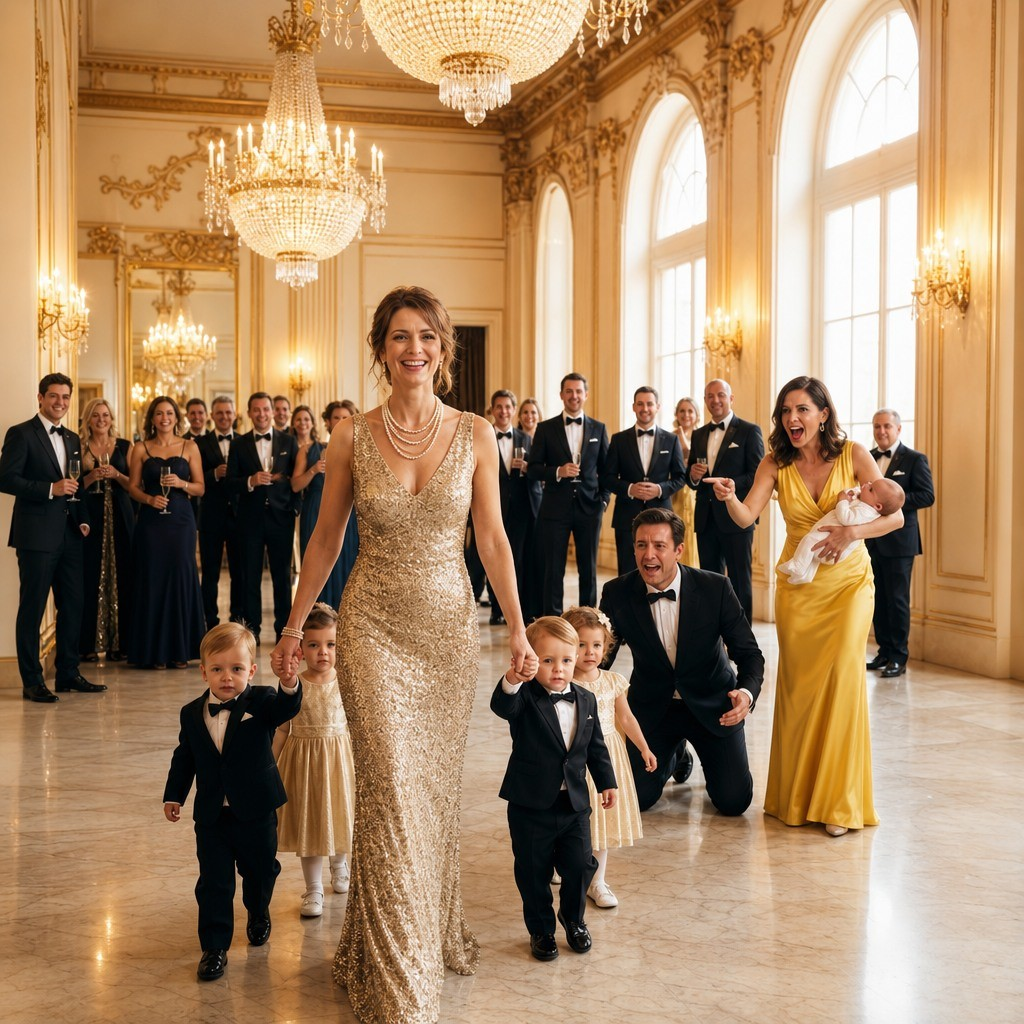
The choreography was flawless. Silas, Harper, Rowan, and Clara entered first. They were striking, imposing, radiating a quiet, dangerous power that immediately sucked the oxygen out of the room. They moved in perfect synchronization down the center aisle, parting the sea of billionaires and socialites effortlessly.
Richard’s speech faltered. He stepped down from the podium, plastering on his most charismatic, desperate smile, rushing forward to greet the elusive Vanguard investors he believed would save him.
That was when I stepped out from the shadows of the vestibule, following directly behind my children.
I was no longer the broken, weeping vessel he had left on the floor of an empty nursery. I walked with the unbothered, terrifying calm of a woman who owned the ground she stepped on.
As I approached the light, the realization slowly dawned on Richard’s face. The practiced smile melted off his features, replaced by a twitching confusion, then profound horror.
“Audrey?” he breathed, his voice cracking. He glanced nervously at the surrounding crowd, trying to maintain control. “What are you doing here? This is an exclusive, private event for Vanguard partners. You need to leave before I have security—”
“Security works for us now, Richard,” Silas interrupted. His voice wasn’t loud, but it cut through the sudden, suffocating silence of the ballroom like a scythe.
Silas stepped forward, dwarfing Richard, and handed him a sleek black folder.
“I’m Silas Vanguard, head of acquisitions,” Silas stated smoothly. He gestured to his right. “This is Harper, who just legally seized your offshore accounts due to a rather glaring breach in your fiduciary covenants. Rowan, who successfully bought out the remaining members of your board at 4:00 PM this afternoon. And Clara, who is currently broadcasting your son’s embezzlement records, complete with casino receipts, to every major financial news outlet on the eastern seaboard.”
Richard turned deathly pale. He looked as though the floor had vanished beneath him. His eyes darted frantically, wild like a cornered animal, from the four imposing titans back to me.
I stepped forward, taking a flute of champagne from a paralyzed waiter nearby. I took a slow, deliberate sip, my eyes locking onto his terrified gaze.
“You left me because I couldn’t give you a legacy, Richard,” I said, my voice carrying clearly in the dead silent room. “So, I built one myself. And tonight, my legacy just bought yours for pennies on the dollar.”
The room erupted. Paparazzi flashes began to strobe like lightning. Panicked whispers tore through the crowd as cell phones began buzzing universally with breaking news alerts. A devastated, hyperventilating Richard spun around and grabbed his biological son, Gregory, roughly by the lapels, begging him to call their defense lawyers.
Gregory’s eyes were wide with terror. He violently shoved his father away. “I can’t!” Gregory screamed over the din of the crowd. “I struck an immunity deal with the FBI this morning! I gave them everything, Dad! I’m sorry!”
Richard stumbled back, utterly alone, grasping his chest. But before he could even process the ultimate betrayal of his own bloodline, the heavy brass doors of the ballroom slammed open once more, and a squad of men in dark windbreakers emblazoned with ‘FBI’ marched purposefully down the aisle, their eyes locked dead on him.
Chapter 5: Pie and Penance
The disintegration of Richard’s life over the next forty-eight hours was absolute and terrifyingly swift. It was a masterclass in ruin.
His assets were immediately frozen by federal mandate. The morning papers were plastered with humiliating, high-definition paparazzi photos of Camilla at JFK airport, frantically trying to board a flight to Geneva with a duffel bag stuffed entirely with unappraised jewelry. By Tuesday afternoon, Richard’s beloved mansion—the mausoleum he had traded me for—was foreclosed upon, the doors padlocked by the bank. It was a poetic, cold parallel to the empty nursery he had left me in.
While Richard sat shivering in a sterile, windowless police interrogation room, stripped of his Brioni suit, his shoelaces, and his dignity as federal agents meticulously laid out his own son’s damning testimony against him, I was miles away, bathed in neon light.
We were at a gritty, late-night diner on the outskirts of the city. The linoleum tables were sticky, and the air smelled of burnt coffee and frying grease. It was perfect.
I was squeezed into a cramped, semi-circular booth, squished happily between Rowan and Clara. Across the table, Silas and Harper, two of the most feared corporate minds in the country, were arguing playfully over who had the rightful claim to the last slice of cherry pie.
“You seized a multinational conglomerate yesterday, Harper, let me have the pie,” Silas grumbled, stabbing his fork toward her plate.
I watched them, a profound, anchoring peace settling over my chest. We had unimaginable wealth and power now, but this—this petty argument over diner food—was the truth of who we were. Our bond was rooted in the mud and the trenches of survival, in love and patience, not just corporate dominance.
I didn’t gloat over Richard’s destruction. In fact, as I took a sip of my terrible coffee, I felt a brief, fleeting flicker of pity for him. He had spent his entire life chasing a genetic mirror, a biological duplicate to feed his own narcissism, entirely missing the point of what it meant to connect with another human soul. I let the thought of him go, exhaling him completely from my spirit.
Silas stopped fighting for the pie. He put his fork down and looked across the table at me, his sharp features softening into a look of deep, overwhelming reverence.
“We did it, Mom,” Silas said quietly, the weight of the past two decades in his voice. “Nobody will ever look down on you again.”
I reached across the sticky table, covering his large hand with mine. Clara rested her head on my shoulder.
“They never could, sweetheart,” I whispered, my vision blurring slightly with tears I didn’t try to hide. “Because every time I looked at the four of you, even on the hardest days, I knew I was the richest woman in the world.”
We left the diner an hour later, laughing loud enough to echo down the empty street, bathed in the amber glow of the streetlights. As I walked to the car, my phone buzzed in my purse. I pulled it out. It was an urgent email from the director of the original state adoption agency. They were facing a massive budget crisis; they had a severely underfunded facility housing hundreds of children, and they were desperately asking if I could help. I smiled, typing a single word in reply: Yes. But before I could hit send, my phone screen shifted to an incoming call from an unknown, encrypted number, a number Silas had warned me only top-tier government officials used.
Chapter 6: The Forest
A year later, the dust hadn’t just settled; we had paved over it.
Richard was officially serving a twenty-year sentence in a federal penitentiary upstate, his name entirely scrubbed from the high-society circles he had once worshipped as a god.
I stood in the crisp autumn air, the flashbulbs of a hundred cameras popping like firecrackers. I was holding a pair of heavy, oversized golden scissors, framed by a massive silk ribbon. Behind me stood the newly minted Vanguard Youth Foundation—a sprawling, state-of-the-art youth center and orphanage, fully funded and endowed in perpetuity by our firm.
The air smelled of fresh paint and possibility. I looked out at the massive crowd of reporters, politicians, and community members. But my eyes immediately sought out the front row, where my four children stood together, looking up at me with fierce, unwavering pride.
I leaned into the microphone, the feedback whining for a brief second before falling silent. I took a deep breath, reflecting on the agonizing pain of my past. I finally understood that the worst day of my life—the day I was discarded on a nursery floor—was actually the universe violently clearing the path for my true destiny.
“Seventeen years ago,” I began, my voice steady and echoing across the courtyard, “I was told I was barren. I was told I was a broken vessel, incapable of contributing to the future. But standing here today, looking at this facility, and looking at the extraordinary lives we have built from the ashes of rejection… I know the truth.”
I looked directly at Silas, Harper, Rowan, and Clara.
“Blood makes you related,” I declared, my voice rising with absolute conviction. “But loyalty, sacrifice, and unconditional love make you a mother. They said I couldn’t grow a single branch. So instead… I cultivated a forest.”
The crowd erupted. It was a deafening roar, a standing ovation that shook the ground beneath my feet. I brought the golden scissors down, slicing through the ribbon, severing the last tie to my past and opening the doors to the future.
I stepped off the stage, enveloped immediately in a tangle of arms as my children crushed me into a group hug.
As the reporters swarmed, Clara leaned in close to my ear, her media-trained smile never faltering for the cameras.
“Mom,” she whispered, her voice tight with a sudden, thrilling tension. “That encrypted call from last year? He’s here. The Senator is waiting in the private VIP lounge inside. He wants to discuss that ‘mutually beneficial arrangement’ regarding the upcoming federal zoning laws.”
I pulled back, smoothing my jacket, my eyes locking onto the dark tinted windows of the VIP lounge on the second floor. A slow, dangerous smile crept onto my face. Richard’s chapter had finally closed. But the reign of Audrey’s empire had only just begun.