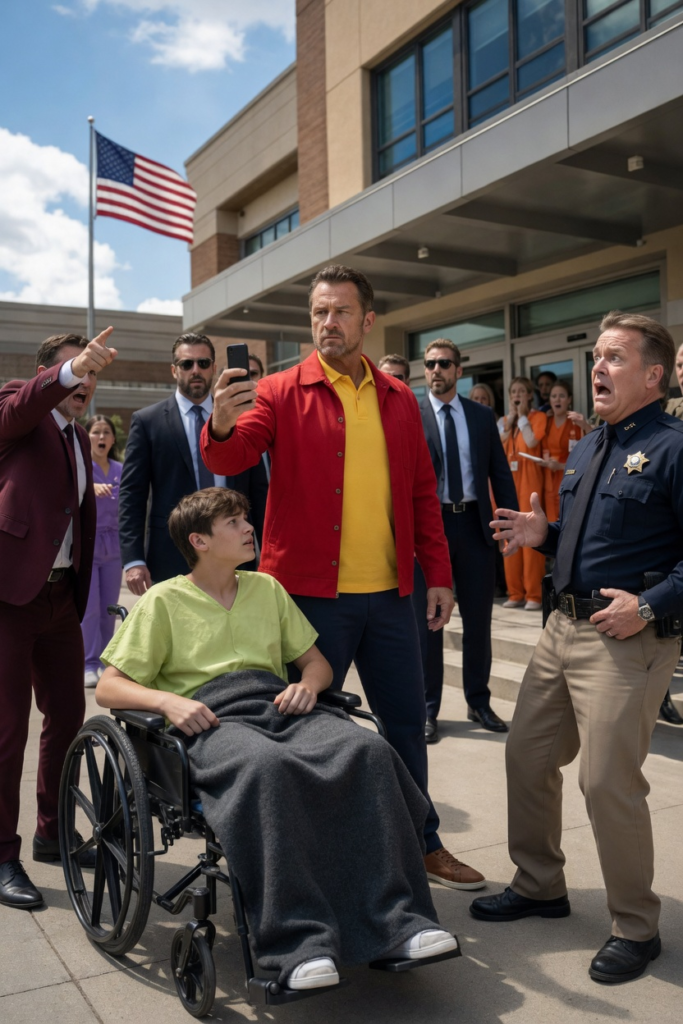
A Sheriff Shot My 17-Year-Old Son’s Kneecaps, Both Shattered, Laughing As Tyler Screamed. “Shouldn’t Have Looked At Me Wrong, Boy,” He Spat. My Son Writhed, Bone Fragments Everywhere. “Dad, I’ll Never Walk Again,” He Wept Pre-Surgery. Eight Operations. Wheelchair Bound. The Union Protected Him. Sheriff Barnes Had No Idea My Janitor Job Covered 18 Years Leading SEAL Team Six With 200 Confirmed Kills. I Just Made One Call To My Old Team.
### Part 1
I was mopping the courthouse lobby when my old life came looking for me.
The floor was white marble, polished so hard it reflected the fluorescent lights in long, sickly strips. At night, after the lawyers went home and the clerks shut their doors, the whole building smelled like lemon cleaner, dust, and old coffee. I liked it that way. Quiet places suited me. Quiet work suited me even better.
Most people in Livingston County knew me as Dennis Irwin, the night janitor. Gray hair. Worn boots. A man who nodded more than he talked. If they noticed me at all, it was only to step around my mop bucket.
That was exactly how I wanted it.
Seventeen years earlier, men had called me Reaper in places that never made the news. I had led teams into rooms where the wrong breath could get you killed. I had watched dawn break over desert walls with my finger still locked around a rifle. Then I came home, married Sarah, raised our son, Tyler, and buried that man so deep I thought even God would have trouble finding him.
My phone buzzed in my pocket.
Sarah.
She never called during my shift unless something was wrong.
I answered with my shoulder pinning the phone to my ear. “Hey.”
For one second, all I heard was breathing. Then my wife made a sound I had only heard once before, the night her mother died.
“Dennis,” she said. “It’s Tyler.”
The mop handle slipped out of my hand and cracked against the marble.
“What happened?”
“There’s been a shooting.”
The courthouse lights hummed above me. Somewhere behind a closed office door, a printer clicked, spat out a page, and went silent again.
“Where?”
“Mercy General. Dennis, hurry.”
I do not remember driving there. I remember red lights. I remember the smell of my own sweat. I remember gripping the steering wheel so hard my fingers hurt.
Mercy General sat on a hill above town, all glass and brick and bad memories. I burst through the emergency entrance still wearing my janitor uniform. The antiseptic smell hit first, sharp enough to burn the back of my throat. Then came the noise: wheels squeaking, nurses calling names, a child crying somewhere behind a curtain.
Sarah stood outside Trauma Bay Three.
Mascara had run down her cheeks in black tracks. Her hands were shaking so badly she had wrapped them around a paper cup just to give them something to hold.
“Where is he?” I asked.
She pointed through the glass.
My son was on a gurney.
Tyler had been six pounds when I first held him. At seventeen, he was six feet tall, all elbows and long legs, captain of the basketball team, always leaving orange peels on the kitchen counter and sneakers in the hallway. He could smile his way out of anything with his mother.
Now his face was pale as wet paper.
Both legs were wrapped from thigh to shin. Blood had soaked through in dark, spreading patches. His shoes were gone. His basketball shorts had been cut away. One hand hung off the side of the gurney, fingers twitching like he was trying to grab something that was not there.
A nurse leaned over him, her brown hair coming loose from a clip. Her badge read Olivia Meyer. She moved fast, but her eyes were angry. Not scared. Angry.
A doctor came out of the bay, pulling off gloves.
For a second, I forgot where I was.
“Harold?”
Dr. Harold Donnelly froze.
He had more lines in his face than the last time I saw him, and his hair had gone silver at the temples, but I knew him. I had dragged that man out of a blown doorway in Kandahar with shrapnel in both our arms. He had left the teams, gone to medical school, and vanished into civilian life.
Now he was standing between me and my son.
“Dennis,” he said quietly.
“How bad?”
Harold looked at Sarah, then back at me. “Both kneecaps are destroyed.”
Sarah made a small choking sound.
“Not cracked,” Harold continued. “Destroyed. There are fragments everywhere. He needs surgery tonight, then more after that. A lot more.”
My chest went cold.
“Who shot him?”
Sarah answered before Harold could.
“Sheriff Barnes.”
The name landed in my head with the weight of a stone.
Stuart Barnes. Fifty-two. Big man. Bigger badge. A sheriff who liked being feared and made sure the whole county remembered why.
“What happened?” I asked.
Sarah swallowed. “Tyler was leaving the basketball court. Brooke was with him. Barnes pulled up. Said Tyler looked at him wrong.”
I stared at her.
“He tried to apologize,” she said. “He didn’t even know what he’d done.”
Inside the trauma bay, Tyler’s eyes opened.
He saw me through the glass.
Something in his face changed. It was not relief. It was shame, panic, and pain all tangled together. My strong boy looked suddenly five years old again.
I went in.
His hand shot out and clamped around my wrist.
“Dad,” he whispered.
“I’m here.”
His lips trembled. “I’ll never walk again, will I?”
I wanted to lie. God help me, I wanted to lie.
Instead, I leaned close so he could see my face. “I don’t know yet. But I know this. We fight.”
Tears rolled sideways into his hair.
“He laughed,” Tyler said. “After he shot me, he laughed.”
The room narrowed.
Every sound faded except my son’s broken breathing.
“What did he say?”
Tyler’s eyes squeezed shut.
“He said, ‘Shouldn’t have looked at me wrong, boy.’”
The buried man inside me opened his eyes.
### Part 2
Tyler’s first surgery lasted nine hours.
There are certain rooms where time does not move right. Hospital waiting rooms are one of them. The clock above the vending machines clicked every minute, but the hands barely shifted. The coffee tasted burnt. The carpet smelled like rainwater and old shoes. Sarah sat beside me with her head against my shoulder, her fingers locked around mine so tightly our knuckles turned white.
I did not pray. I had never been good at asking heaven for favors after the things I had done under open skies. But I stared at those double doors and made bargains anyway.
Take my legs. Take my hands. Take whatever is left of me.
Just let my boy come back.
At 4:12 in the morning, Harold came out.
He had blood on one sleeve and exhaustion pressed deep under his eyes.
“He made it through,” he said.
Sarah covered her mouth.
“But?” I asked, because Harold’s face had a “but” written all over it.
“But this is only the beginning. We stabilized both knees. We saved blood flow. There will be reconstructive surgeries. Months of therapy. Pain. Infection risk. Hardware. Maybe braces.”
“Basketball?” Sarah whispered.
Harold looked down.
That was answer enough.
Sarah folded forward as if something inside her had snapped. I put my arm around her and held on. My grief sat in my chest like a block of ice. I could not afford to melt yet.
“Who saw it?” I asked.
Harold glanced down the hallway. “Four kids. Maybe five. Most of them are already scared silent.”
“Scared of Barnes?”
“Everyone is scared of Barnes.”
He led me to the hospital cafeteria, where the lights buzzed and a woman in scrubs was sleeping with her forehead on a table. Harold bought two coffees. I did not drink mine.
“Tell me,” I said.
He rubbed his face. “Dennis, Stuart Barnes has been getting worse for years. Complaints vanish. Witnesses change their stories. Evidence gets misplaced. The department investigates itself and finds nothing.”
“Who protects him?”
“Deputy Thomas Davidson backed him tonight. Claimed Tyler acted aggressive.”
“My son had a basketball.”
“I know.”
“Who else?”
Harold lowered his voice. “Rob Dixon. Barnes’s brother, though they use different last names. He runs the deputy crew like a private gang. And Carol Lindsay, the union rep. She buries everything.”
“She?”
“Carol’s been in the union office twelve years. Smart. Mean. Loyal to whoever keeps her powerful.”
I watched steam curl from the coffee.
“How many victims?”
Harold looked away. “More than I can prove.”
“How many, Harold?”
“Dozens of complaints. Three shootings before Tyler. Kids. Young men. One ended up with nerve damage. Another still walks with a limp.”
I felt my jaw tighten.
Harold saw it. He knew that look.
“Dennis,” he said, “do not do what I think you’re thinking.”
“I’m thinking I need to see the witnesses.”
His face changed. He knew I had not answered him.
At dawn, Tyler’s girlfriend Brooke met me in the parking lot.
She was eighteen, small, blonde, and shaking inside a gray hoodie two sizes too big. Her eyes were red from crying. She held her phone like it weighed ten pounds.
“Mr. Irwin,” she said, “I’m sorry.”
“You called 911?”
She nodded.
“You stayed with him?”
“I tried. Barnes told me to move back or he’d arrest me.”
The cold morning air smelled like wet asphalt and pine. A helicopter thudded somewhere far off over the hills.
Brooke unlocked her phone. “I didn’t get the shooting. It happened too fast. But I got after.”
The video was shaky. Tyler lay on the pavement under the basketball court lights, screaming. Barnes stood over him with his gun still out, his mouth twisted into something close to a smile.
“Shouldn’t have looked at me wrong, boy,” Barnes said in the video. “Maybe next time you’ll show respect.”
Then Deputy Davidson stepped into frame.
“Clear self-defense, Sheriff,” he said. “I saw it.”
The video ended.
Brooke wiped her nose with her sleeve. “I gave it to the deputies. They said the file was corrupted.”
“But you kept this copy.”
She nodded.
“Good girl.”
Her eyes filled again. “What are you going to do?”
I looked toward the hospital windows. Somewhere up there, my son was waking up to a life he had not chosen.
“I’m going to talk to Sheriff Barnes.”
Brooke grabbed my sleeve. “He’ll hurt you.”
I almost smiled.
“No,” I said. “He won’t.”
I found Barnes at the Riverside Diner at 8:30 that morning.
He sat in the corner booth with Davidson and two other deputies, eating eggs and laughing like it was any other day. He was thick through the chest, gray at the temples, with a face built for sneering. His uniform shirt strained at the buttons. His badge caught the light every time he moved.
I walked up to the booth.
The deputies noticed me first. Their hands shifted toward their belts.
Barnes looked me over. Janitor uniform. Tired eyes. Old jacket.
He dismissed me before I opened my mouth.
“Help you?” he asked.
“You shot my son.”
The booth went quiet.
Barnes chewed slowly, swallowed, and wiped his mouth with a napkin.
“Your boy got aggressive with a peace officer.”
“He is seventeen.”
“Old enough to learn respect.”
“He was unarmed.”
Barnes leaned back and smiled. “You want to file a complaint, Mr. Irwin? County office is three blocks over. Ask for Carol Lindsay. She’ll give you the right form.”
Davidson laughed under his breath.
There was a time in my life when Barnes would have been dead before his coffee cooled.
Three seconds. Maybe less.
But killing him would have been easy, and easy was not the same as justice.
I nodded once.
“You’re right,” I said. “I’ll file a complaint.”
Barnes’s smile widened. He thought I was leaving because I was weak.
I walked out into the cold and pulled an old burner phone from the glove box of my truck.
The number was still in my head after all these years.
It rang three times.
A rough voice answered. “Who is this?”
“It’s Reaper.”
Silence.
Then, very softly, “Jesus Christ.”
I looked through the diner window at Barnes laughing over his eggs.
“I need the team,” I said.
And for the first time in seventeen years, the past answered back.
### Part 3
Troy Moses arrived in Montana forty-six hours later.
He came in a black SUV with Virginia plates and a cracked windshield, because subtlety had never been his strongest talent. He stepped out wearing jeans, a canvas jacket, and the same expression he used to wear before kicking down doors on the far side of the world.
His hair had gone mostly gray. His shoulders had not gotten any smaller.
“Dennis,” he said.
“Troy.”
We hugged once, hard, without slapping backs or pretending it was casual.
Two more men got out behind him.
Brad Zuniga, call sign Ghost, looked like a biker who had accidentally wandered into a library and decided to read every book. Lean, tattooed, quiet eyes. He used to disappear in cities where white men should not have been able to disappear.
Morris Rice, Hammer, was six-foot-four and built like a courthouse pillar. He had hands like catcher’s mitts and a scar running from his left ear into his beard.
The last time all four of us had been together, we were standing on a ship deck under a black sky, saying goodbye without calling it goodbye.
Now we stood outside a hunting cabin thirty miles from town, breathing pine and woodsmoke.
“Where’s your boy?” Morris asked.
“Hospital.”
“How bad?”
I told them.
No one spoke for a while.
Troy looked toward the trees. “Name.”
“Sheriff Stuart Barnes.”
Brad spat into the dirt. “A sheriff.”
“Protected sheriff,” I said. “Brother in the department. Union rep. Deputy who lied on scene. Complaints buried. Witnesses intimidated.”
Troy nodded slowly. “So not a man. A system.”
“That’s why I called.”
Inside the cabin, the air smelled like cedar, old ashes, and gun oil left from whoever owned it before. I spread papers across the kitchen table. Photos. Names. Timelines. Everything I had learned from Harold, Brooke, and a few careful conversations.
I put Barnes’s picture in the center.
“This is not a hit,” I said.
Morris’s eyebrow rose.
“I mean it. We are not killing him. We are not beating him. We are not doing anything that puts my family in more danger or turns us into the thing we’re fighting.”
Brad sat back. “Then why call us?”
“Because men like Barnes survive by making people feel alone. I need him to understand my son is not alone. I need witnesses protected. Evidence preserved. Patterns found. Pressure applied from every legal angle. And if Barnes tries to retaliate, I need to know before he gets close.”
Troy studied me. “You’re asking operators to do investigator work.”
“I’m asking brothers to help me dismantle a monster carefully.”
“That sounds less fun.”
“It is.”
He smiled then, but it did not reach his eyes. “Good. Fun gets messy.”
Brad opened his laptop. “I have a private investigator license in two states and a security company with federal contracts. I can pull public records, property records, business filings, civil complaints, social media, court indexes. Anything legal.”
“Keep it clean,” I said.
“Clean enough for a courtroom?”
“Clean enough for my son to live with it.”
Morris tapped Barnes’s photo with one thick finger. “And if he comes at your house?”
“Then we document it and call state police.”
Morris looked disappointed.
“Tough,” I said.
Troy laughed once. “Still giving orders like we’re in the sand.”
“I never stopped.”
For the next six hours, we built the map.
Not a tactical map. A human one.
Barnes at the center. Davidson attached by loyalty and fear. Rob Dixon attached by blood and money. Carol Lindsay attached by power. Prior victims circled around them like bruises that had never healed.
I wrote each name on a yellow legal pad.
Alejandro George. Broken ribs.
Franklin Sears. Broken jaw.
Sammy Parish. Shot in the leg.
Trevor Mendoza. Shot in the shoulder.
Israel Hall. Shot in the abdomen.
Tyler Irwin. Both knees.
By midnight, the cabin was silent except for Brad’s keys clicking and the stove ticking as it cooled.
Troy stood at the window, watching snow drift through the dark.
“You know what bothers me?” he said.
“What?”
“Barnes didn’t just get lucky for twenty-eight years. Somebody taught him the system would always bend.”
“Then we find who bent it.”
Brad looked up from his laptop.
“I may have just found the first bend.”
He turned the screen toward us.
County contracts. Security payments. A company owned by Rob Dixon. Annual approvals through the sheriff’s office. Numbers that looked neat until you knew how to read them.
I leaned over the table.
Barnes was not just violent.
He was profitable.
And money, unlike fear, left footprints.
### Part 4
By morning, the cabin table looked like a storm had hit a courthouse records room.
There were printouts, maps, coffee cups, scribbled notes, and a half-eaten bag of gas station donuts Morris had bought because he said revenge worked better with sugar. The windows were fogged from our breath. Outside, the pines stood black against a gray Montana dawn.
Brad had been awake all night.
“Start with Rob Dixon,” he said, tapping a spreadsheet. “He owns High Ridge Security. County contracts for prisoner transport, courthouse security overflow, parking enforcement, event security. Two million a year, give or take.”
“Approved by?” Troy asked.
“Sheriff’s office.”
I looked at the numbers. “Barnes.”
“Barnes signs. County rubber-stamps. Rob invoices. Money flows.”
“Kickbacks?” Morris asked.
Brad shook his head. “Not on paper. But Rob’s company pays consulting fees to a shell LLC. That LLC is registered to an address Barnes used to own under his mother’s maiden name.”
Troy whistled softly. “That’s a crooked little song.”
“Twenty thousand a month,” Brad said. “For years.”
I felt no surprise. Men like Barnes always had a second appetite.
“What about Carol Lindsay?”
Brad slid another page across. “She owns a minority stake in High Ridge Security through a retirement trust.”
I stared at the page.
“So the union rep protecting Barnes makes money as long as Barnes keeps the contract machine running.”
“Exactly.”
Morris leaned back in his chair. “And Davidson?”
“Not money,” Troy said. “Fear.”
He had spent the night calling old contacts, then retired deputies, then one former dispatcher who still hated Barnes enough to talk.
“Davidson started honest,” Troy said. “Then Barnes caught him covering up a domestic complaint involving his brother. Not enough to ruin him alone, maybe, but enough to keep him obedient.”
“Barnes keeps dirt,” I said.
“Looks that way.”
I thought of Barnes smiling down at Tyler.
A man did not become that confident by accident.
At ten in the morning, I went to see Jack Joseph.
His office sat above a hardware store on Main Street. The stairs smelled like sawdust and old varnish. His waiting room had two chairs, one dying plant, and a framed law degree hanging slightly crooked.
Joseph was forty-something, sharp-eyed, with a loosened tie and sleeves rolled to the forearms. He looked like a man who had slept in his office more than once.
When I introduced myself, he did not ask why I was there.
“Tyler Irwin’s father,” he said. “I was wondering when you’d come.”
“You know Barnes.”
“I know Barnes the way a man knows a toothache.” He gestured to a chair. “Sit.”
I set the folder on his desk.
He opened it with the tired patience of a lawyer expecting disappointment.
Then he stopped being tired.
His eyes moved faster. His mouth tightened. He flipped pages, went back, checked names, dates, amounts.
“Where did you get this?”
“Public records. Witnesses. People who are done being afraid.”
He looked up. “Some of this can start a fire.”
“That’s why I brought it to you.”
Joseph leaned back. The old chair creaked under him.
“Civil rights lawsuit,” he said. “Pattern of abuse. Failure to supervise. Conspiracy to conceal. Corruption angle for state auditors. Federal attention if we push hard enough.”
“Will it work?”
“Work?” He laughed once, bitterly. “Against Barnes? Nothing has ever worked. But this is different.”
“How?”
“You have a living victim people can recognize. A good kid. A video. Prior victims. Money trail. And Barnes is arrogant enough to keep making mistakes.”
I nodded. “He will.”
Joseph’s eyes narrowed. “You say that like you know.”
“I know men.”
He looked at me for a long second. “You’re not just a janitor.”
“I am now.”
“Were you military?”
I did not answer.
He smiled without warmth. “Fine. Keep your ghosts. But listen carefully. If you go outside the law, Barnes becomes the victim. If that happens, your son loses twice.”
Those words landed harder than I expected.
I saw Tyler on that gurney. I saw my own hands, younger and steadier, doing things that never belonged in a hospital waiting room.
“I don’t want Barnes dead,” I said. “I want him exposed.”
Joseph nodded. “Then we do this right.”
As I stood to leave, my phone buzzed.
Unknown number.
The message had one line.
This is Olivia Meyer. Your son’s video isn’t the only one.
Attached was a blurry still from a security camera.
Barnes in uniform.
His hand around a young woman’s arm.
His face twisted with the same ugly pleasure I had seen in Brooke’s video.
And behind him, reflected in a bar mirror, was Carol Lindsay watching and doing nothing.
### Part 5
Olivia Meyer met me behind the hospital laundry entrance after sunset.
The back of Mercy General was all loading docks, humming vents, and yellow security lights. Steam drifted from a pipe near the wall, carrying the smell of detergent and wet cotton. Olivia stood under the awning in a navy coat, arms crossed, hair tucked under a knit cap.
“You’re taking a risk,” I said.
She looked me straight in the eye. “So did your son when he survived.”
There was something about Olivia that reminded me of battlefield medics. Small frame, steady hands, a quiet anger that did not waste itself.
“You’re a nurse,” I said. “How are you getting bar footage?”
“I’m also a freelance reporter. Nights, weekends, whenever my student loans need feeding.” She handed me a drive. “Murphy’s Bar. Elk Lodge. Two diners. One gas station. Barnes thinks people delete things because he tells them to. Most people just hide backups.”
“Why help us?”
She looked toward the hospital windows. “Because I treated Sammy Parish. Then Trevor Mendoza. Then Israel Hall. Then Tyler. Every time, Barnes walked away. I got tired of washing blood off kids while grown-ups pretended not to know where it came from.”
I closed my hand around the drive.
“What’s on it?”
“Enough to make the county sick.”
Back at the cabin, Brad reviewed the files while the rest of us watched.
Barnes drunk in uniform, stumbling from Murphy’s Bar at two in the afternoon.
Barnes shoving a young man against a jukebox.
Barnes grabbing a waitress’s wrist hard enough to make her knees buckle.
Barnes and Carol Lindsay in a corner booth, heads close together, papers between them.
Barnes taking an envelope from Rob Dixon outside the Elk Lodge.
No single clip was the whole case.
Together, they were a pattern.
Troy sat back. “This goes public, they’ll claim edited footage.”
“We keep originals,” Brad said. “Metadata intact. Chain of custody. Olivia can testify where it came from if the businesses agree.”
“Will they?” Morris asked.
I thought about the way fear settled over a town. Not all at once. More like dust. Day after day, until people stopped noticing how hard it was to breathe.
“They might,” I said, “if they see they’re not alone.”
The next two days were phone calls, meetings, and careful promises.
Jack Joseph contacted victims. Olivia contacted business owners. Troy arranged private security for families willing to speak. Morris drove people to the lawyer’s office in his big borrowed truck, sitting in silence while they decided whether courage was worth the cost.
Some said no.
I did not blame them.
But seven said yes.
Alejandro George came with his mother. She clutched a rosary and kept looking at the door.
Franklin Sears came with a metal plate in his jaw and a voice that clicked when he spoke.
Sammy Parish limped.
Trevor Mendoza could not fully lift his right arm.
Israel Hall wore a loose shirt over scars he did not want anyone to see.
Brooke brought the video.
And Sarah brought a framed picture of Tyler in his basketball uniform because he could not leave the hospital yet.
The press conference was set for noon the next day on the courthouse steps.
That night, I sat beside Tyler’s bed.
He was awake, pale, and angry in the way only the injured can be angry. Not loud. Not dramatic. Just full of heat with nowhere to put it.
“Mom says people are going to talk tomorrow,” he said.
“Yes.”
“About me?”
“About Barnes.”
“But my name will be in it.”
“Yes.”
He stared at the ceiling. The room smelled like plastic tubing, clean sheets, and the vanilla lotion Sarah rubbed on his hands when he couldn’t sleep.
“What if everyone looks at me different?”
“They will.”
His eyes cut to mine.
“I won’t lie to you,” I said. “Some people will pity you. Some will use your pain to make themselves feel righteous for a day. Some will say ugly things because ugly people always find a microphone.”
His throat moved.
“But some,” I continued, “will see you standing even while you’re lying in that bed. They’ll see you refused to disappear.”
A tear slid into his ear.
“I hate him,” Tyler whispered.
“I know.”
“I hate that he’s walking around.”
“I know.”
“Do you hate him?”
I looked at my son’s bandaged legs.
“Yes.”
Tyler turned his face toward me. “Then don’t forgive him for me.”
“I won’t.”
He closed his eyes, and I thought he was done talking.
Then he said, “Dad?”
“Yeah.”
“When I was on the ground, before Brooke got to me, Barnes bent down. He said something else.”
My body went still.
“What?”
Tyler swallowed.
“He said, ‘Your daddy can mop this up too.’”
The room tilted.
Barnes had known exactly who I was.
Or worse.
He thought he did.
### Part 6
Noon came cold and bright.
The courthouse steps were wet from melting snow, and the wind pushed microphone wires across the concrete like black snakes. Reporters stood shoulder to shoulder. Local news vans lined the curb. People gathered across the street, some with phones raised, some with arms folded, some looking like they were afraid Barnes might appear behind them if they breathed too loud.
I stood at the edge of the crowd in a plain coat and ball cap.
Invisible again.
That had always been my best talent.
Jack Joseph stepped to the microphones first.
“For years,” he said, “citizens of this county have reported abuse by Sheriff Stuart Barnes and the deputies who protected him. Their complaints were ignored, buried, or punished. Today, they speak together.”
Alejandro George went first.
His voice shook so badly his mother reached for his arm.
“I was nineteen,” he said. “I asked why I was being pulled over. Sheriff Barnes pulled me from my car, threw me down, and kept hitting me after I stopped moving. I had broken ribs and a punctured lung.”
A murmur passed through the crowd.
Franklin Sears leaned toward the microphone next.
“I was drunk,” he said. “I admit that. But I was sitting on the curb with my hands visible. Barnes broke my jaw anyway.”
Then Sammy. Trevor. Israel.
Each story was different.
Each story was the same.
A young man. A question. A look. A tone. A badge. A body broken and a report rewritten.
Brooke stood last.
Her hands shook around her phone, but her voice did not.
“Tyler Irwin is seventeen,” she said. “He had a basketball in his hands. He did not threaten Sheriff Barnes. He tried to apologize. Sheriff Barnes shot him twice.”
Olivia’s news station played the video on a monitor beside the microphones.
My son screamed from that little speaker.
Barnes stood above him, smiling.
“Shouldn’t have looked at me wrong, boy.”
The crowd went dead silent.
Then the courthouse doors opened.
Barnes came out like a bull released from a chute.
He wore his uniform. His hat was tucked under one arm. Carol Lindsay hurried beside him, her red coat snapping in the wind. Davidson and Rob Dixon followed close behind.
Barnes’s face was dark with rage.
“This is a witch hunt!” he shouted.
Cameras swung toward him.
Jack Joseph raised one hand. “Sheriff Barnes, this is a press conference for victims.”
“Victims?” Barnes barked. “Criminals and liars.”
Brooke stepped forward before anyone could stop her.
“You shot Tyler because he looked at you.”
Barnes’s eyes landed on her.
I saw the shift. The flash of old habit. He was used to scared people stepping back when he looked at them like that.
Brooke did not step back.
“You destroyed him,” she said.
Barnes pointed at her. “That boy got what happens when kids think they can mouth off to law enforcement.”
Every microphone caught it.
Carol grabbed his sleeve. “Stuart.”
He shook her off.
“Ask his father,” Barnes shouted, scanning the crowd. “Ask that janitor hiding somewhere. He knows discipline. He just forgot to teach it at home.”
My hands curled inside my coat pockets.
Troy appeared beside me without a sound.
“Steady,” he murmured.
Barnes’s right hand twitched toward his duty weapon.
The crowd saw it.
The cameras saw it.
Jack Joseph saw it and stepped between Barnes and Brooke.
“Sheriff,” Joseph said clearly, “are you threatening a witness at a press conference?”
For one second, the whole county held its breath.
Barnes’s fingers hovered near his holster.
Then Carol Lindsay put both hands on his arm and hissed something into his ear. Davidson looked pale. Rob Dixon had already started backing toward the courthouse doors.
Barnes forced a smile.
It was terrible to watch.
“I will be vindicated,” he said. “This community knows who I am.”
“Yes,” Olivia said from behind a camera. “That’s the point.”
By sundown, the clip of Barnes reaching for his gun had spread beyond Montana. By nine, national outlets were calling Jack. By midnight, the state attorney general announced a preliminary review.
I should have felt relief.
Instead, I sat in my truck outside the hospital and watched snow collect on the windshield.
Barnes had said my son got what happened to kids who mouthed off.
He had said it in front of cameras.
But he had also said something else.
Ask that janitor hiding somewhere.
Barnes wanted me angry.
A desperate man makes mistakes.
A cornered man sets traps.
At 1:17 in the morning, my burner phone buzzed.
Morris: Barnes just left Murphy’s. Drunk. Armed. Driving.
Brad: His cruiser is heading your direction.
Then Troy called.
“Dennis,” he said, “he’s going to your house.”
Sarah was at the hospital.
Tyler was helpless in a bed.
And my house, for the first time in seventeen years, was about to become a battlefield again.
### Part 7
I beat Barnes to my street by two minutes.
I parked three houses down with the lights off and stepped into the cold. Snow crunched under my boots. The neighborhood was dark except for porch lights and the blue glow of televisions behind curtains. Somewhere, a dog barked once and then thought better of it.
My house sat at the end of the block.
Small porch. White siding. One maple tree in the front yard where Tyler had broken his arm at eight trying to jump from the lowest branch because Brooke dared him.
The house was empty.
That mattered.
Barnes’s cruiser turned the corner too fast, tires sliding. It jumped the curb, corrected, and stopped crooked in my driveway with the engine still running. His emergency lights flashed once, twice, then went dark.
He got out with a bottle-shaped stagger.
Even from down the street, I could see his hand near his weapon.
Morris emerged from the shadow beside a parked truck.
Troy’s voice came through my earpiece. “State police notified. Recording?”
“Running,” Brad whispered.
We had three cameras. One in Morris’s jacket. One across the street with Troy. One in my hand, phone low against my leg. Nothing fancy. Nothing illegal. Just a man documenting another man’s choices.
Barnes climbed my porch steps and pounded on the door.
“Irwin!” he shouted. “Open up!”
He hit the door again.
“You think you can ruin me? You think I don’t know what you are?”
That stopped me.
What I was.
Not who.
He tried the handle. Locked.
Then he drew his baton and smashed the small window beside the door.
Glass spilled onto the porch with a sound like ice breaking.
That was enough.
I stepped into the wash of the porch light.
“Sheriff Barnes.”
He spun.
His face was red. His eyes were wet and wild. His uniform shirt was half untucked, and his breath clouded white in the cold.
“You,” he said.
“You’re trespassing.”
“You did this.”
“You did this.”
He pointed at me. “You dug up lies. Turned rats against me. Made me look weak.”
“You made yourself look exactly like what you are.”
His hand moved.
The gun cleared leather.
Troy shifted somewhere in the dark.
I lifted one hand slowly. “Bad idea.”
Barnes laughed, but it cracked halfway through. “I could shoot you right here. Say you came at me. Say I feared for my life.”
“Like Tyler?”
“Your boy should’ve kept his eyes down.”
There it was again.
That ugly certainty. That belief that the world owed him bowed heads.
I took one step closer.
“Say it louder.”
His eyes narrowed. “What?”
“Say what you said to my son.”
“Go to hell.”
“You laughed while he screamed.”
Barnes aimed the gun at my chest.
I felt my pulse slow.
Not because I was brave. Because old training is cruel that way. It takes over before fear gets a vote.
“You don’t scare me,” Barnes said.
“No,” I answered. “But the truth does.”
Red and blue lights flooded the street.
State police cruisers came in from both ends of the block. Doors opened. Voices shouted.
“Sheriff Barnes! Put the weapon down!”
Barnes jerked toward the sound.
For one second, I saw the calculation on his face. Shoot me. Shoot them. Run. Lie. Demand respect. Demand fear.
But cameras were watching.
Neighbors were at windows.
State police had guns drawn.
Morris stood visible now, hands raised, a witness. Troy too. Brad across the street, phone up, calm as a statue.
Barnes lowered the weapon slowly.
Two troopers took him down on the porch. Not rough. Professional. His cheek hit the boards near my welcome mat while they cuffed him.
“You set me up,” he snarled.
“No,” I said. “I opened a door. You chose to break the window.”
They hauled him upright.
He looked past the troopers at me, and in his eyes I saw something I did not expect.
Not fear.
Not yet.
A smile.
Small. Crooked. Poisoned.
“You don’t know what I’ve got,” he said.
Then they put him in the back of the cruiser.
By morning, every station in the state had the headline.
Sheriff Arrested at Victim’s Home After Armed Threat.
Barnes was suspended. Davidson was placed on administrative leave. Rob Dixon vanished behind a lawyer. Carol Lindsay released a statement calling the matter “deeply concerning” and pretending she had not spent years holding the broom.
People started talking.
Real talking.
The bartender from Murphy’s gave Olivia footage. The waitress Barnes had grabbed gave a sworn statement. Two retired deputies called Jack Joseph. A former records clerk admitted complaints had been altered.
But Barnes’s smile stayed with me.
You don’t know what I’ve got.
Three days later, Jack called me into his office.
He looked older than he had the week before.
“We have a problem,” he said.
He slid a photocopy across the desk.
It was an old county memo.
Subject line: Dennis Irwin.
My name.
My address.
My wife’s workplace.
My son’s school schedule.
And at the bottom, in Barnes’s handwriting:
Use family pressure if needed.
### Part 8
I read the memo three times before the words made sense.
Use family pressure if needed.
The paper was old, creased at the corners, copied from something that had spent years folded in a file. My address was wrong by one digit, an old typo from when we first bought the house. Sarah’s workplace was listed as the dental office she had left two years earlier. Tyler’s school schedule was from sophomore year.
“This isn’t recent,” I said.
“No,” Jack replied. “Three years old.”
The office heater rattled under the window. Downstairs, someone in the hardware store dropped a box of nails, and the sound rolled up through the floorboards like tiny bones scattering.
“Why did Barnes have a file on me three years ago?”
Jack rubbed both eyes. “That’s what I need to ask you.”
“I’m a janitor.”
His look said he was done pretending.
“I was Navy,” I said.
“How Navy?”
I looked at the wall behind him. Framed newspaper clippings. Lawsuit wins. A photo of Jack shaking hands with some governor I had never voted for.
“Enough.”
Jack leaned forward. “Did Barnes know?”
“He shouldn’t.”
“But could he?”
“Anything is possible if someone looks hard enough.”
Jack tapped the memo. “This came from a retired records clerk named Marlene Voss. She says Barnes kept personal leverage files. Not official. Private. Some on judges. Some on business owners. Some on deputies. Some on citizens he thought might become problems.”
“Why me?”
“She doesn’t know.”
I took a breath through my nose.
There are moments when rage wants a shape. A face. A place to go. Mine wanted Barnes’s throat, but I held it still.
“Where is Marlene now?”
“Terrified.”
“Of Barnes?”
“Of Carol Lindsay.”
That turned my head.
Jack nodded. “Marlene says Carol was not just burying complaints. She managed the leverage files. She knew which witnesses to pressure and which families to scare. Barnes was the fist. Carol was the office that mailed the warning letters.”
“Can Marlene testify?”
“She might. But she disappeared after calling me.”
The words settled between us.
“When?”
“Last night.”
I stood.
Jack raised both hands. “I already called state police.”
“And?”
“They’re looking.”
I walked to the window. Main Street was bright under winter sun. People moved in and out of shops carrying bags, coffee, mail. Normal lives. Normal errands. That was the lie people counted on: that evil looked different enough to spot before it touched you.
My phone buzzed.
Sarah.
“Dennis,” she said, and I knew from her voice the day was getting worse.
“What happened?”
“There’s someone at the hospital asking about Tyler.”
“Who?”
“A woman. Red coat. She says she’s from the union office.”
Carol Lindsay.
“Do not let her in.”
“I didn’t. Harold stopped her. She smiled at me, Dennis. Like she knew something.”
“I’m coming.”
I hung up and called Troy on the way down the stairs.
“Hospital,” I said. “Now.”
By the time I arrived, Carol was gone.
Sarah stood outside Tyler’s room with Harold beside her. My wife looked angry, which scared me more than tears ever did.
“She said she wanted to offer support,” Sarah said. “Then she asked whether Tyler was prepared for ‘public scrutiny.’”
Harold’s voice was low. “She also asked what medications he was on. I told her to leave before I called security.”
I looked through the window.
Tyler was asleep, one hand on top of the blanket, his hair messy against the pillow. He looked young. Too young for court filings and reporters and union threats.
“She’s trying to intimidate us,” Sarah said.
“Yes.”
“Is it working?”
“No.”
She studied my face. “Dennis.”
“What?”
“That is not true.”
She was right.
It was working in the way a winter wind works. It did not knock you down at first. It slipped into every seam and made your bones ache.
Troy arrived with Olivia five minutes later. Olivia had a camera bag over one shoulder and fury in both eyes.
“Carol showed up here?” she asked.
“Yes.”
“Good.”
We all looked at her.
She pulled out her phone. “Because she also showed up at Marlene Voss’s house last night. Marlene’s neighbor has a doorbell camera.”
The footage was grainy.
Carol’s red coat under a porch light. Marlene opening the door. Carol stepping inside without being invited. Twenty minutes later, Marlene leaving with a suitcase, crying.
Then a county sedan pulling away from the curb.
Troy leaned close. “Plate?”
Olivia smiled without humor. “Rob Dixon’s.”
The missing witness had not vanished.
She had been moved.
And for the first time, Barnes’s network was not just protecting old crimes.
It was committing new ones while the whole world watched.
### Part 9
We found Marlene Voss in a motel outside Bozeman.
Not because we were magic. Because people who are scared make human choices. They use the same credit card at a gas station. They call their sister from a motel lobby phone. They park under a light because darkness feels worse after someone has threatened you.
Troy found the gas station receipt through a contact who owed him nothing but liked hating corrupt cops. Jack made the proper calls. State police were notified. Everything had to be clean now. Cleaner than clean.
Still, I drove there myself.
The motel sat beside the highway, a low strip of beige doors and buzzing lights. Trucks hissed past in the dark. Snowbanks along the lot had turned gray from exhaust. Room 12 had the curtain drawn, but a thin line of yellow light showed at the bottom.
A state trooper knocked first.
“Marlene Voss? State police.”
No answer.
Jack stood beside me, coat collar up against the wind. “Let them handle it.”
“I am.”
“You look like you’re about to handle the door off its hinges.”
“I’m standing still.”
“That’s what worries me.”
The trooper knocked again.
A small voice came from inside. “Go away.”
“Marlene,” Jack called, “it’s Jack Joseph. I brought Dennis Irwin. Tyler’s father.”
Silence.
Then the chain scraped.
Marlene Voss opened the door three inches.
She was in her sixties, thin, with short white hair and eyes that had not slept. She looked at me the way people look at storms on the horizon.
“I’m sorry about your boy,” she said.
“May we come in?”
Her fingers tightened on the door.
“Carol said if I talked, my grandson’s probation would get reviewed. She said Rob knew people. She said Barnes still had friends.”
“She’s losing them,” Jack said.
Marlene gave a bitter little laugh. “People like Carol don’t lose friends. They change rooms.”
I understood that kind of fear. It had a memory of its own.
I took out my wallet and showed her Tyler’s school photo. Senior year. Blue background. Hair too long because Sarah loved it and I pretended not to.
“He wanted to study engineering,” I said. “Then basketball. Then maybe coaching if his knees got old someday. He made plans like pain was something that happened to other people.”
Marlene stared at the picture.
I did not ask again.
After a long moment, she opened the door.
The room smelled like stale coffee, carpet cleaner, and panic. Two suitcases lay open on the bed. A rosary hung from the lamp, though Marlene did not look Catholic. Fear borrows whatever symbols are nearby.
She sat at the small table and folded her hands.
“I kept copies,” she said.
Jack went very still. “Of what?”
“Everything I could.”
She pulled a manila envelope from inside a pillowcase.
Complaints. Internal memos. Edited reports with original versions stapled behind them. Notes in Carol’s handwriting. Lists of witnesses with pressure points written in the margins.
Immigration status.
Custody dispute.
Unpaid taxes.
Affair.
Drinking problem.
Son on probation.
My stomach turned.
Then Marlene handed me a separate sheet.
“This was yours.”
I already knew before I saw it.
Dennis Irwin.
Navy background unclear. Courthouse access. Quiet. Potential problem if family involved.
At the bottom, Carol’s handwriting:
Wife emotional. Son visible target.
My hand tightened around the paper.
“When was this written?” I asked.
Marlene looked at the carpet.
“After Sarah came to complain.”
The room went silent.
“My wife?”
Marlene nodded. “Three years ago. Barnes stopped Tyler near the school parking lot. Grabbed him by the shirt. Said he needed to learn how to lower his eyes. Sarah came in furious. Carol took the complaint.”
I felt the floor shift.
Sarah had never told me.
Marlene’s voice trembled. “Carol buried it. Then she opened the file.”
I drove back to Livingston without speaking.
Jack sat in the passenger seat holding the envelope like it might explode. Outside, the highway disappeared under our headlights and reappeared one white stripe at a time.
When I reached the hospital, Sarah was in the hallway, arms crossed.
One look at my face and she knew.
“You found out,” she said.
“Three years,” I answered.
Her eyes filled, but she did not look away.
“I was trying to keep you from becoming him again.”
Behind the glass, Tyler slept.
Between us, all the old ghosts woke up.
### Part 10
Sarah and I did not argue in the hallway.
We had been married long enough to understand the mercy of closed doors. We walked to the little family chapel near the elevators, a quiet room with four pews, a wooden cross, and stained-glass windows that turned the snow outside blue.
The air smelled faintly of candle wax, though no candles were lit.
Sarah sat in the front pew.
I remained standing.
“Tell me,” I said.
She looked down at her hands. “Tyler was fourteen. Barnes stopped him after practice because he and some boys were laughing near the parking lot. He said Tyler laughed at him.”
“Did he hurt him?”
“He grabbed his shirt. Shoved him against the cruiser. Scared him badly enough he threw up when he got home.”
I closed my eyes.
“Why didn’t you tell me?”
“Because I knew what you would do.”
“You don’t know that.”
Her head snapped up. “Dennis.”
One word. My name. But inside it was every night she had watched me wake from dreams I would not explain. Every time a car backfired and I was already between her and the window. Every silence after the news mentioned places I had once been.
She knew me.
That was the problem.
“I filed a complaint,” she said. “Carol smiled. She said she would look into it. Two days later, a deputy followed Tyler home. Then someone left a warning ticket on my car for parking in our own driveway. Then Barnes drove slowly past the house three nights in a row.”
“And you still didn’t tell me?”
“I almost did.” Her voice broke. “But Tyler begged me not to. He said, ‘Dad will go back to being gone even if he’s standing here.’”
That hit harder than anything Barnes had done.
I sat beside her.
Sarah wiped her face with the heel of her hand. “I thought if we stayed quiet, he would forget us.”
“Predators don’t forget.”
“I know that now.”
We sat without speaking while a hospital announcement crackled faintly through the ceiling.
Then Sarah said, “What are you going to do with Marlene’s files?”
“Give them to Jack. State police. FBI if they’ll take them.”
“And after that?”
I knew what she was really asking.
After the legal work.
After the cameras.
After the righteous words.
What would I do if justice moved too slowly?
“I don’t know,” I said.
She looked at me then, and disappointment hurt worse than anger.
“You do know. You just haven’t decided whether to lie to me.”
I leaned forward, elbows on knees.
“I wanted him afraid,” I admitted. “Not courtroom afraid. Real afraid. The kind Tyler felt on the pavement.”
Sarah’s voice softened. “And would that heal Tyler?”
“No.”
“Would it heal you?”
I almost answered yes.
That frightened me enough to keep quiet.
The chapel door opened.
Tyler stood there.
Not stood. Not really.
He was in a wheelchair, pale, wrapped in a hospital robe, with an IV pole beside him. Harold stood behind him, looking like a man who had lost an argument with a determined seventeen-year-old.
Tyler’s eyes moved between us.
“I heard enough,” he said.
Sarah rose. “Honey, you shouldn’t—”
“Please don’t.”
She stopped.
Tyler looked at me. “Dad, I want him punished. I want him in prison. I want everybody to know what he did.”
“He will be.”
“But I don’t want you to become something I have to be scared of too.”
The words emptied the room.
I walked to him and crouched in front of the wheelchair.
“You are not scared of me.”
His chin trembled.
“I’m scared for you,” he said. “There’s a difference.”
I put my hands on the wheels of his chair.
For years, I had believed I protected my family by burying the past. Then I believed I could protect them by digging it back up. Both ideas had one thing in common: me deciding alone.
“I hear you,” I said.
“No, Dad. Promise me.”
I looked at Sarah.
Then at Tyler.
“I promise,” I said. “No revenge that costs us ourselves.”
Tyler’s shoulders dropped like he had been holding up the ceiling.
The next morning, Jack called.
“The FBI wants to talk,” he said. “Civil rights division. Public corruption.”
“That’s good.”
“It is. But they asked a question.”
“What question?”
Jack sighed.
“They want to know who the men in your cabin are.”
I looked through the hospital window at my son.
The law was finally waking up.
And now it was looking at me too.
### Part 11
The FBI agents arrived in plain suits and rented sedans.
There were two of them: Agent Carla Reeves, who spoke softly and missed nothing, and Agent Mark Feld, who looked at every room like he was checking exits. They met us in Jack Joseph’s office on a gray Thursday morning while snow tapped against the windows.
Troy came with me.
Not because I needed protection, but because hiding him would make everything worse.
Agent Reeves opened a notebook. “Mr. Irwin, we’re investigating possible civil rights violations, public corruption, witness intimidation, and obstruction involving Sheriff Barnes and associated personnel.”
“I understand.”
“We appreciate the evidence provided through Mr. Joseph and Ms. Meyer. But we need to establish origin, chain of custody, and whether anyone obtained material unlawfully.”
“That’s fair.”
Her eyes flicked to Troy. “And your associates?”
Troy smiled. “I run a licensed security consulting firm. I helped coordinate witness transportation and personal safety at Mr. Irwin’s request.”
“Former military?”
“Yes, ma’am.”
“All of you?”
“Most of us.”
Agent Feld leaned back. “SEALs?”
Troy’s smile faded.
I answered. “Yes.”
The room changed, though no one moved.
Agent Reeves looked at me with new caution. “Mr. Irwin, were you part of Naval Special Warfare Development Group?”
Jack glanced at me.
I had spent seventeen years being nobody. One sentence could undo it.
“Yes,” I said.
“And your role?”
“I led men.”
“How many of the men assisting you served under your command?”
“Three.”
Agent Feld’s pen paused.
Reeves did not react. “Have any of you threatened Sheriff Barnes, Deputy Davidson, Rob Dixon, Carol Lindsay, or any witnesses?”
“No.”
“Have any of you trespassed, hacked private systems, planted evidence, coerced testimony, or used force outside lawful defense?”
“No.”
She studied me.
“Mr. Irwin, you understand how this looks.”
“I do.”
“A former special operations commander gathers a team after his son is shot by a sheriff. Evidence appears. Witnesses become brave. The sheriff is arrested at your house.”
“Barnes came armed to my home while intoxicated. State police arrested him. Everything was recorded.”
“Convenient.”
“Yes.”
Troy’s jaw tightened, but I held up one hand.
Agent Reeves was doing her job. I respected that.
“Agent Reeves,” I said, “if I wanted Stuart Barnes dead, we would not be having this conversation.”
Jack closed his eyes like I had kicked him under the table.
Reeves stared at me.
“That is not as comforting as you think.”
“It was not meant to comfort you. It was meant to be clear. I had the ability to choose violence. I did not. My son asked me not to become the worst thing that happened to him. I am honoring that.”
For the first time, her expression shifted.
Not softened.
Shifted.
“Then help us keep this clean,” she said.
So we did.
Brad turned over original files, download logs, contact sheets, and affidavits from business owners who had provided footage voluntarily. Olivia gave statements. Marlene entered protective custody. Jack coordinated everything through proper channels. Troy’s company filed reports for each witness escort. Morris hated paperwork but filled it out like his soul depended on it.
And Barnes’s network began to fall.
Davidson flipped first.
His lawyer must have shown him the math: perjury, obstruction, civil rights conspiracy. Prison time with Barnes or cooperation without him. He chose himself, as weak men usually do.
He admitted Tyler had never threatened Barnes.
He admitted Barnes told him what to write.
He admitted Carol edited prior complaints.
Rob Dixon lasted four days longer before auditors found enough contract fraud to turn his fancy house into evidence.
Carol Lindsay was harder.
She did not panic. She did not shout. She hired a real lawyer from Helena and issued cold statements about process. But Marlene’s files had her handwriting. Olivia had video. Davidson had emails. Money tied her to Rob’s company.
Her walls were thick.
Not thick enough.
Meanwhile, Tyler fought his own war.
Surgery. Fever scares. Physical therapy. Nights when he woke sweating, hearing Barnes laugh. Days when he refused to eat because anger filled him first. Sarah sat with him. Brooke visited with homework and bad jokes. I showed up every morning and every night, still in my janitor uniform sometimes, because ordinary things mattered.
One evening, I found Tyler staring at his old basketball shoes.
They sat on the windowsill where Brooke had placed them without thinking.
“I can’t even look at them,” he said.
I picked them up.
For a second, he looked like he might yell.
Instead, he whispered, “Don’t throw them away.”
“I wasn’t going to.”
“What do I do with them?”
I set them beside his bed. “You decide when you’re ready.”
He looked at me. “What if I’m never ready?”
“Then they wait.”
Three months later, Barnes was indicted.
Civil rights violations. Assault. Obstruction. Witness intimidation. Fraud-related conspiracy. Official misconduct. More charges than the local news anchors could list without taking a breath.
His trial became the biggest thing our county had ever seen.
On the first day, he walked into court in a suit that did not fit and glared at the room like he could still make it shrink.
His lawyer’s opening statement was exactly what I expected.
Tyler was aggressive.
The witnesses were criminals.
The videos lacked context.
And Dennis Irwin, former SEAL Team Six commander, had used military friends to manufacture a vendetta.
By lunchtime, half the courtroom was looking at me like I was the one on trial.
Then Barnes leaned over to his lawyer and whispered something.
He smiled.
And I realized his last defense was not innocence.
It was making the jury afraid of me.
### Part 12
I took the stand on the fourth day.
The courtroom smelled like old wood, paper, and winter coats drying too close together. Every bench was full. Reporters lined the back wall. Barnes sat at the defense table with his hands folded, trying to look like a wronged public servant instead of a man who had built his life on other people’s fear.
Tyler was not in the courtroom.
That was my decision and his. He had already given recorded testimony from the hospital. He did not need to sit ten feet from Barnes and bleed for strangers all over again.
Sarah sat in the front row.
Brooke beside her.
Troy, Brad, and Morris were scattered through the room, ordinary men in ordinary jackets, though no one who knew what to look for would ever call them ordinary.
Jack Joseph questioned me first.
“Mr. Irwin, where were you when you learned your son had been shot?”
“Mopping the courthouse lobby.”
“And what did you do?”
“Went to the hospital.”
He walked me through it slowly. The call. The emergency room. Tyler’s injuries. Brooke’s video. The complaint history. My decision to contact people I trusted.
“Did you instruct anyone to harm Sheriff Barnes?”
“No.”
“Did you plant evidence?”
“No.”
“Did you threaten witnesses?”
“No.”
“Did you seek justice for your son?”
“Yes.”
Then Barnes’s lawyer stood.
His name was Ellery, and he had the polished sadness of a man paid too much to defend what he did not respect.
“Mr. Irwin,” he began, “you were not merely in the Navy, correct?”
“No.”
“You served in an elite special operations unit.”
“Yes.”
“You led combat missions.”
“Yes.”
“You are trained in surveillance, intimidation, psychological pressure, and lethal force.”
Jack stood. “Objection.”
The judge allowed some of it.
Ellery stepped closer. “Isn’t it true that people called you Reaper?”
The courtroom shifted.
Sarah’s face went pale.
I kept my eyes on the lawyer. “Some did.”
“And after Sheriff Barnes shot your son, you called former members of your team.”
“Yes.”
“Men trained to kill.”
“Men trained to serve.”
“But capable of killing.”
“Most adults are capable of killing, counselor. Character is what decides whether they do.”
A few people murmured.
Ellery’s mouth tightened.
“Isn’t it true you wanted Sheriff Barnes to suffer?”
“Yes.”
The room went still.
Jack’s pen stopped moving.
Ellery smiled slightly. “No further—”
“But,” I said.
The judge looked at me. “Answer only the question asked, Mr. Irwin.”
“Your Honor,” Jack said, standing, “may we redirect?”
The judge allowed it.
Jack approached.
“Mr. Irwin, you said you wanted Sheriff Barnes to suffer. What did you mean?”
I looked at the jury.
“I meant I wanted him to face consequences. Real ones. The kind he denied every person he hurt. I wanted him to sit in a courtroom and hear people say his name without whispering. I wanted his badge taken. I wanted his lies answered. I wanted him to learn that power does not make pain disappear. It only postpones the bill.”
Jack nodded. “Did your son ask you for anything?”
I swallowed.
“He asked me not to become something he had to be scared of.”
“And did you honor that?”
“Yes.”
When I stepped down, Barnes was staring at me.
For the first time, there was no smile.
The trial turned after Davidson testified.
He looked smaller without the uniform. He admitted he had lied. Admitted Barnes told him to call it self-defense. Admitted Tyler had been crying and apologizing when Barnes fired. Davidson cried on the stand. I did not care.
Then Marlene testified.
She described the files. Carol’s handwriting. Pressure points. Warnings. The quiet machinery that turned victims into liars.
Carol Lindsay stared at the table as if the wood grain had become fascinating.
Olivia testified with the calm precision of a nurse counting instruments after surgery.
Harold testified about Tyler’s injuries.
Brooke testified last.
Barnes watched her walk to the stand, and I saw the old reflex flicker in him. The stare. The silent command to lower her eyes.
Brooke lifted her chin.
“He was laughing,” she said. “Tyler was screaming, and Sheriff Barnes was laughing.”
Ellery tried to rattle her.
She did not break.
On the eighth day, Barnes made his final mistake.
The prosecutor played Brooke’s video one more time. Tyler’s cries filled the courtroom. Barnes stared at the screen, jaw working.
Then he slammed his palm on the table.
“He should’ve shown respect!” he shouted.
His lawyer grabbed his sleeve.
Barnes shook him off.
“All of them should have! You let these kids run wild, and then you blame men like me for teaching them order!”
No one moved.
No one breathed.
The prosecutor slowly turned.
“Sheriff Barnes,” she said, “are you saying Tyler Irwin deserved to be shot?”
Barnes’s face changed.
He understood too late.
But pride is a stupid animal. It runs even after the trap closes.
“I’m saying,” he spat, “if he had lowered his eyes when I told him to, he’d still have his knees.”
The courtroom went silent enough to hear Sarah start crying.
And in that silence, Stuart Barnes convicted himself.
### Part 13
The jury took six hours.
People always say “only” six hours when they talk about verdicts, as if six hours cannot become a lifetime. Sarah and I sat in a side room with Tyler on speakerphone. Brooke held Sarah’s hand. Harold paced. Troy stood by the window. Morris ate vending machine pretzels like chewing was the only thing keeping him from punching a wall.
When the bailiff came for us, Tyler’s voice crackled through my phone.
“Dad?”
“I’m here.”
“Whatever happens, don’t let Mom fall.”
“I won’t.”
We entered the courtroom.
Barnes stood at the defense table. His suit was wrinkled. His face looked gray. Carol Lindsay sat two rows behind him with her lawyer, awaiting her own turn in the system she had trusted for too long.
The foreman stood.
Guilty.
Guilty.
Guilty.
Again and again, the word landed.
By the fifth count, Sarah was crying into both hands. By the eighth, Brooke had her face pressed against Sarah’s shoulder. By the last, even Jack Joseph had to remove his glasses.
Barnes did not move.
Men like him expect the world to bend until the moment it breaks instead.
Sentencing came six weeks later.
Tyler insisted on being there.
He entered the courtroom on forearm crutches, moving slowly, each step measured and painful. The whole room watched him. Not with pity this time. With respect.
Barnes watched too.
His face did something complicated when he saw Tyler upright.
Maybe surprise.
Maybe hatred.
Maybe the first ugly splinter of shame.
Tyler gave his statement standing.
Sarah wanted him seated. Harold warned him not to push too hard. I said nothing because I knew the look in my son’s eyes. He needed that moment to belong to him.
“My name is Tyler Irwin,” he said. “I was seventeen when Sheriff Barnes shot me. I used to think my future was basketball. I had a scholarship path. I had plans. I had a body I trusted.”
His voice shook, then steadied.
“He took that from me because he wanted me afraid. For a long time, it worked. I was afraid of sleeping. Afraid of pain. Afraid of seeing him again. Afraid my dad would disappear into anger because of what happened to me.”
He looked at Barnes.
“But I’m still here. You don’t get to be the end of my story.”
Barnes lowered his eyes first.
I will remember that until I die.
The judge sentenced Barnes to eighteen years.
Rob Dixon took a plea and lost his company, his house, and his freedom. Davidson served time and would never wear a badge again. Carol Lindsay was convicted later for obstruction and conspiracy. The county paid settlements to Tyler and the other victims. The sheriff’s department was rebuilt under outside supervision. It was not perfect. Nothing run by humans ever is.
But the old machine was gone.
Spring came slowly that year.
Snow melted from the gutters. Mud took over the yard. Tyler came home with scars, braces, crutches, and a temper that flared whenever pain cornered him. Some days were ugly. Some nights he woke shouting. Some mornings he refused help he needed and demanded space he could not yet handle.
We learned a new life one inch at a time.
He did not go to Montana State for basketball.
Instead, he accepted an academic scholarship to the University of Montana for computer science. He said machines made more sense than people. I told him people were mostly bad code with better hair. He laughed for the first time in months.
On graduation day, the high school gym smelled like floor wax, flowers, and cheap perfume. Families packed the bleachers. Balloons bobbed. Cameras flashed. The band played too loud and slightly off-key.
Tyler crossed the stage with crutches.
Slow.
Painful.
Upright.
When they called his name, the applause started politely, then grew, and grew, until the whole gym was standing.
I looked at Sarah. She was crying again, but this time it was different.
Brooke screamed loud enough to embarrass him.
Harold clapped with both hands over his head.
Troy, Brad, and Morris stood at the back wall, trying and failing to look like normal uncles.
Tyler took his diploma, turned, and found me in the crowd.
He smiled.
Not the old smile. Not untouched. Not easy.
Better.
Earned.
That night, after the party, Tyler and I sat on the porch. The air smelled like cut grass and barbecue smoke from a neighbor’s yard. His crutches leaned against the railing. His old basketball shoes sat beside him. He had brought them out himself.
“Dad,” he said, “did Barnes ever apologize to you?”
“His lawyer sent a statement.”
“That’s not an apology.”
“No.”
“What would you have said if he did?”
I watched a moth bump against the porch light.
“I would have told him no.”
Tyler looked at me.
“No forgiveness?”
“Not from me. Not for what he did to you. Not for what he did to those families. Some people think forgiveness is owed because time passes. I don’t. Late remorse doesn’t erase deliberate cruelty.”
He nodded slowly.
“I don’t forgive him either.”
“You don’t have to.”
“Will that make me bitter?”
“Not if you build something bigger than him.”
Tyler picked up one of the shoes and turned it in his hands. The sole was worn flat at the toe from all those jump shots in our driveway.
“I think I want to coach someday,” he said. “Not now. Maybe later. Kids who got hurt. Kids who think their bodies betrayed them.”
I felt something in my chest loosen.
“That sounds like a good dream.”
He leaned back, looking out at the dark street.
“What about you?”
“What about me?”
“Are you going back to being invisible?”
I smiled a little.
“Mostly.”
“Mostly?”
“There are still people who need help knowing they’re not alone.”
He looked at me for a long time.
Then he said, “Just come home after.”
“I will.”
For seventeen years, I thought peace meant burying the man I used to be.
I was wrong.
Peace meant choosing when not to use him.
Stuart Barnes spent the next eighteen years looking over his shoulder in prison, waiting for some shadow from my past to step out and finish what the courts had started.
No one ever came.
That was the punishment.
He had built his life on fear, and fear became the only home he had left.
As for me, I went back to the courthouse the next Monday. I put on my gray uniform. I filled the mop bucket. I pushed it across the marble floor while judges, deputies, lawyers, and clerks walked around me without looking twice.
Invisible as furniture.
Quiet as dust.
But not empty.
Never again empty.
Because upstairs, in a file room Barnes once thought he owned, his name was no longer whispered.
And at home, my son was learning how to stand.
THE END!
Disclaimer: Our stories are inspired by real-life events but are carefully rewritten for entertainment. Any resemblance to actual people or situations is purely coincidental.