The hallway outside the family courtroom smelled like wet wool, floor polish, and burnt coffee from a paper cup someone had abandoned on the window ledge.
Maya Sterling noticed all of it because noticing things was how she had stayed alive in places where people did not give second chances.
She noticed the shine of the marble.
She noticed the low buzz of fluorescent lights.
She noticed the way her combat boots sounded too loud in a hallway full of lawyers who believed power should arrive in leather dress shoes.
She also noticed the way people stared.
A woman in a gray coat looked at the ballistic helmet tucked under Maya’s arm, then at the dusty camouflage, then quickly down at her phone.
A young father holding a stack of child support forms pulled his little girl closer.
Two attorneys stopped talking in front of a vending machine.
Maya did not blame them.
She knew exactly what she looked like.
She looked like she had walked out of one kind of danger and straight into another.
The designer suit her mother had demanded she wear was still hanging in a garment bag in the back of the transport van.
There had been no time to change.
At 6:12 that morning, her unit had been released from an overnight training operation after an equipment delay, and at 6:19, Maya had checked her phone and found three messages from Toby.
The first said, “They moved the hearing up.”
The second said, “Dad says I don’t need to talk.”
The third said, “Maya, please come.”
That was all it took.
Maya had been raised in a house where money solved appearances and silence solved everything else.
Her father, David Sterling, built a private investment business that made him look generous in public and unreachable at home.
Her mother, Elaine, treated embarrassment like a medical emergency.
They had never known what to do with a daughter who did not flatter donors, smile at dinner parties, or understand why a family name mattered more than the people trapped inside it.
When Maya left for the Navy, her parents called it rebellion.
When she stayed, they called it abandonment.
When she kept sending birthday gifts to Toby from wherever she was stationed, they called it unnecessary.
But Toby called her every time a school form needed signing and nobody else was available.
He called when he made varsity soccer.
He called when he failed geometry.
He called when he found the old fishing line in the garage and wanted to know how to tie the knot Maya had taught him in the driveway.
He was fourteen now, too old to be treated like a child and still too young to carry the kind of fear adults put in a room when money was involved.
The custody petition said David and Elaine wanted to provide stability after a “period of emotional disruption.”
Maya had read those words at 7:03 a.m. while standing beside a courthouse security desk with the smell of cold metal and printer toner in the air.
She had read the trust accounting notice clipped behind it at 7:05.
That was when the whole shape of the morning changed.
Toby’s trust was supposed to be protected until he turned twenty-five.
It came from their late grandfather, a man Maya barely remembered except for his tobacco smell, quiet hands, and one strange act of decency toward the youngest grandchild.
David had never forgiven the trust for skipping him.
Elaine had never forgiven the paperwork for making that fact visible.
The petition was not only about custody.
It was about access.
Maya signed the security log, answered every question the deputies asked, and waited while the cleared weapon was inspected, flagged, and noted.
The orange chamber flag looked almost childish against the matte black metal.
That bright piece of plastic became the difference between appearance and fact.
Facts mattered to Maya.
Facts were the only things her parents could not charm into changing.
When the heavy oak doors opened, the courtroom went still.
Judge Margaret Henderson was already on the bench.
Her courtroom was wood, marble, glass, and contained impatience.
The American flag stood behind her left shoulder, still as a held breath.
Maya walked in with her helmet low, her vest tight, and dust on the sleeves of her camouflage.
The aisle felt longer than it should have.
At the front table, David Sterling turned around first.
The smile came slowly, as if he had been waiting for a gift.
Then he laughed.
Not loudly.
Worse than loudly.
It was a short, private sound meant to tell everyone else how to interpret her.
Elaine covered her mouth.
Her eyes flashed over Maya’s uniform, the chest rig, the boots, the flagged rifle, and then away, as if her own daughter had arrived carrying a stain.
Toby sat two rows back, half-hidden behind a woman with a court badge clipped to her blazer.
He looked smaller than Maya remembered.
His hands were folded so tightly his knuckles had gone pale.
Maya gave him one brief nod.
His shoulders lowered by a fraction.
That was the only greeting they got.
Bradley Vance rose before Maya reached the witness stand.
He was the kind of lawyer who looked freshly pressed even under bad lights.
Charcoal suit.
Silver tie.
Perfect hair.
A cologne sharp enough to announce itself three feet ahead of him.
He positioned himself in the aisle like a gate.
“Your Honor,” he said, turning toward the bench with practiced outrage, “this is an absolute circus.”
The word landed exactly where he wanted it to land.
A few people shifted.
David’s smile widened.
Elaine stared at the table like the wood grain might forgive her.
“This woman is bringing weapons and military theater into a sacred custody hearing,” Vance continued. “It is an insult to the court and a transparent attempt to intimidate my clients.”
Maya stood still.
She had learned a long time ago that men like Vance needed motion from you.
A flinch.
A glare.
A raised voice.
Anything they could label later.
Judge Henderson did not speak right away.
Her eyes moved to the orange flag.
Then to Maya’s hands.
Then to Vance.
“Counselor,” the judge said, “step aside and let the witness approach.”
Vance did not step aside.
Instead, he turned back to Maya with a smile that belonged at a country club bar, not in a courtroom where a child’s life was being divided into filings.
“Take the costume off, little girl,” he said quietly enough that it felt personal and loudly enough that the room could hear. “You’re in the real world now.”
Maya’s pulse did not change.
She had been insulted by better men and worse men.
She had been underestimated in rooms without flags, without windows, without anyone recording the rules.
She knew the difference between danger and theater.
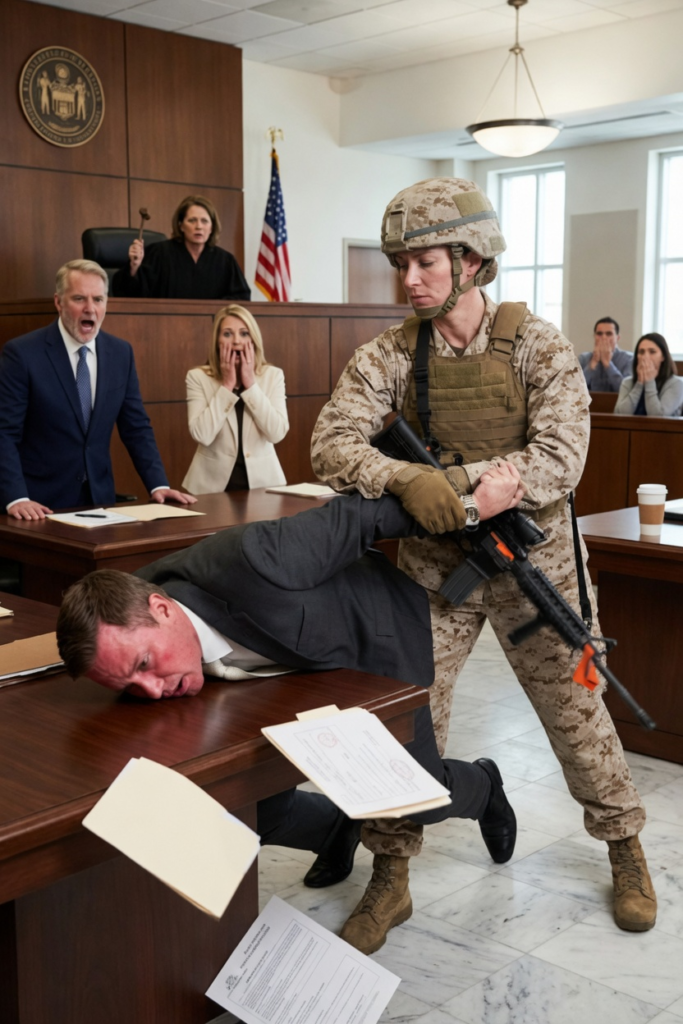
Then Vance put his hand on her.
It was not a tap.
It was not an accidental brush.
His fingers closed around her arm and shoved against the ballistic plate as if he had the right to move her body.
That was the moment the courtroom became very simple.
Maya did not touch the rifle.
She did not lunge.
She did not strike.
She took his wrist, turned with the pressure he had given her, and folded him down into a controlled joint-lock before his expression had time to catch up.
His briefcase hit the floor with a slap.
Folders burst open.
Custody affidavits skidded across the defense table.
Vance’s cheek pressed against the polished wood, his mouth open in shock, one hand spread wide beside a document stamped that morning.
The whole room froze.
A clerk stopped typing.
A paper coffee cup trembled in someone’s hand.
David shot to his feet so fast his chair scraped backward.
Elaine made a small, strangled sound behind her fingers.
Toby did not move at all.
He just stared at Maya like he was watching a locked door open.
Judge Henderson’s gavel came down hard.
“Lieutenant Commander Sterling!”
The crack of wood on wood snapped through the room.
Maya released Vance immediately and took one step back, palms visible.
Vance staggered upright, red-faced and furious, but he did not move toward her again.
“Your Honor,” David shouted, “you see? You see what she is? This is exactly why she has no business near my son.”
“My brother,” Maya said.
The room shifted toward her voice.
It was quiet, but it cut.
David turned as if she had slapped him.
Judge Henderson lifted one hand before he could answer.
“Enough,” she said.
Vance was brushing at his suit, trying to recover his dignity with both hands.
His cheek was red where the table had pressed it, but he was otherwise fine.
Maya had made sure of that.
Control is not the absence of force.
It is the discipline to use only what the moment requires.
“Commander Sterling,” Judge Henderson said, “you have thirty seconds to explain why you entered my courtroom dressed for a war zone and why counsel was just on my table.”
Maya looked at the bench.
Then she looked at Toby.
Then she looked at the manila folder near the clerk’s station.
“My gear was logged by courthouse security at 7:18 a.m.,” she said. “The weapon is cleared and flagged. I came directly from duty because this hearing was moved with less than twenty-four hours’ notice, and because my brother believed he would not be allowed to speak.”
Vance opened his mouth.
Judge Henderson pointed one finger at him without looking.
“Do not.”
He closed it.
Maya continued.
“The petition before the court is not only a custody petition. It is tied to a trust access request submitted before this hearing began.”
David’s face changed.
It was small.
Almost nothing.
But Maya had watched faces for a living, and she saw it.
The smugness drained first.
Then the calculation appeared.
Elaine whispered, “David.”
He did not answer her.
Judge Henderson turned to the clerk.
“Bring me the folder.”
The clerk carried it forward.
The room seemed to make space for her steps.
Inside were the petition, the stamped supplement, Toby’s school attendance printout, and the trust accounting notice Maya had clipped on top after Toby handed it to her outside the building with shaking fingers.
Judge Henderson read the first page.
Then the second.
Then her mouth tightened.
“Mr. Vance,” she said, “were you aware that a request to alter guardian access to the trust was submitted at 7:46 this morning?”
Vance blinked too fast.
“Your Honor, financial administration is separate from custody—”
“That was not my question.”
The silence afterward had weight.
David sat down slowly.
Elaine kept staring at the folder.
Maya watched Toby watching them.
Children learn the truth about adults in pieces.
A missed pickup here.
A cold dinner there.
A door closed during an argument.
Then one day the pieces form a picture, and the child realizes the problem was never that they were hard to love.
The problem was that someone found them useful.
Judge Henderson asked Toby to stand.
The woman beside him touched his elbow gently, then withdrew her hand.
Toby rose.
His legs looked unsteady, but he did not sit back down.
“Did you give this notice to your sister?” the judge asked.
“Yes, Your Honor.”
“Why?”
Toby swallowed.
Maya could see his throat work from across the room.
“Because Dad said after court there would be papers for me to sign,” he said. “He said it was just adult stuff and I didn’t need to read all of it. But the account name was mine.”
Elaine put both hands flat on the table.
David turned halfway around.
“Toby,” he said, in a voice that tried to be warning and fatherly at the same time.
Judge Henderson’s head snapped toward him.
“Mr. Sterling, if you speak to that child again before I finish, I will have you removed.”
David faced forward.
For the first time in Maya’s memory, he obeyed someone immediately.
Vance tried a different angle.
“Your Honor, Commander Sterling has clearly influenced this minor against his parents.”
Maya almost laughed.
Not because anything was funny.
Because there it was.
The old family trick, dressed in legal language.
If Toby was afraid, Maya must have taught him fear.
If Toby spoke, Maya must have put words in his mouth.
If Toby resisted, someone must have corrupted the natural order where David Sterling made decisions and everyone else thanked him for the privilege.
Judge Henderson looked at Vance for a long moment.
“Counselor, your client’s minor son just testified that he was told to sign financial documents after a custody proceeding concerning control of his person. Choose your next sentence carefully.”
Vance’s jaw tightened.
Elaine’s eyes filled with tears, but they did not fall.
Maya knew those tears.
They were not grief yet.
They were embarrassment.
There is a difference.
Grief reaches outward.
Embarrassment checks who is watching.
The judge called a recess, but nobody moved quickly.
Vance gathered papers with hands that had lost their smoothness.
David bent close to him and hissed something Maya could not hear.
Elaine stared at Toby, and for a heartbeat Maya thought her mother might say his name like a mother should.
Instead, Elaine whispered, “How could you do this to us?”
Toby flinched.
That was the moment Maya nearly lost the cool she had carried into the room.
Not when Vance grabbed her.
Not when her father laughed.
That.
A mother looking at a scared child and treating his fear like betrayal.
Maya took one step toward Toby.
Judge Henderson saw it and spoke before anyone else could.
“Commander Sterling, you may stand near your brother.”
Maya crossed the aisle.
Toby held himself together until she reached him.
Then his face crumpled.
He did not sob loudly.
He just leaned his shoulder into her vest like he was exhausted from standing upright.
The Kevlar was hard.
Maya wished she had changed after all.
She wished she had softness to offer him.
But Toby pressed closer anyway.
Sometimes protection does not feel gentle.
Sometimes it feels like the first solid thing in a room full of people trying to move you.
When court resumed, Judge Henderson had reviewed the filings with the clerk and called the trust administrator by speaker from chambers.
She did not announce everything she learned.
She did not need to.
The questions told the room enough.
Why had the access change been prepared before custody was granted?
Who requested the amended guardian authority?
Why did the request reference an anticipated ruling that had not yet been made?
Why had Toby’s name been typed on an acknowledgment line?
Each question landed on David with the force of a door closing.
Vance objected twice.
The judge overruled him twice.
The third time, she simply looked over her glasses until he sat down.
Then she addressed Toby.
“No one in this courtroom is going to require you to sign any financial document today,” she said. “Do you understand me?”
Toby nodded.
“I need an answer for the record.”
“Yes, Your Honor.”
“And do you wish to speak privately with the court-appointed officer before any temporary custody order is entered?”
“Yes.”
David’s hand curled into a fist on the table.
Maya saw it.
So did the judge.
“Mr. Sterling,” Judge Henderson said, “open your hand.”
The humiliation of that instruction did more to him than any accusation could have done.
He opened it.
Slowly.
The hearing did not end with a dramatic speech.
Real consequences rarely arrive like speeches.
They arrive as orders.
The judge suspended the trust access request pending independent review.
She ordered that Toby be interviewed outside the presence of both parents.
She directed the clerk to preserve the morning’s filings.
She warned Vance that his physical contact with a witness would be noted in the record.
She set a temporary arrangement that kept Toby away from any pressure to sign financial documents until the review was complete.
David looked like a man watching a machine he owned refuse his card.
Elaine cried then, finally, but still quietly enough to be admired.
Vance kept his head down.
When the judge asked Maya whether she understood the boundaries of the temporary order, Maya answered every question plainly.
No speeches.
No revenge.
No victory lap.
“Yes, Your Honor.”
“I understand.”
“I will comply.”
Toby watched her with both hands wrapped around the sleeves of his hoodie.
Outside the courtroom, David tried one last time.
He stepped into the hallway with his tie loosened and his face pale under the courthouse lights.
“You think this makes you his mother now?” he asked.
Maya looked at him.
For years, that question would have found the softest place in her.
For years, she had let her parents define every act of care as overstepping.
She had believed them when they said she was too hard, too distant, too military, too much.
Now Toby stood behind her, silent and shaking, and the answer was suddenly very simple.
“No,” Maya said. “It makes me the person who showed up.”
David’s mouth opened.
Nothing came out.
Elaine stood beside him clutching her purse with both hands.
Maya almost wanted her to say something kind.
A mother can disappoint you for years, and some part of you will still wait for her to become brave at the perfect moment.
Elaine looked at Toby.
Then she looked away.
That was her answer.
Toby stepped closer to Maya.
The movement was small, but everyone saw it.
On the ride away from the courthouse, he sat in the passenger seat of a plain government sedan and stared through the window at Chicago traffic moving under a gray sky.
For ten minutes, he said nothing.
Maya let him have the silence.
Then he asked, “Did I ruin everything?”
Maya kept both hands on her knees so he would not see them tighten.
“No,” she said. “You told the truth.”
“It didn’t feel like enough.”
“It usually doesn’t at first.”
He looked down at his hands.
“They laughed when you came in.”
“I noticed.”
“I hated that.”
Maya looked at the orange safety tag still clipped to her gear bag on the floor.
Then she looked at her brother.
“They thought the uniform was the story,” she said. “It wasn’t.”
“What was?”
“You.”
He turned his face toward the window fast, but not before she saw his eyes fill.
Weeks later, the independent review found enough irregularities to keep the trust locked down while the court sorted through the filings.
The final custody decision did not happen in one perfect scene.
There were interviews, follow-up hearings, school records, and more papers than Toby ever wanted to see again.
Maya changed into suits for those.
Plain ones.
Navy, gray, black.
No medals.
No theater.
She did not need any of it.
The courtroom had already learned what her parents had spent years refusing to understand.
Discipline was not the absence of feeling.
It was love with a spine.
Toby started sleeping through the night again at Maya’s townhouse.
He taped his soccer schedule to her refrigerator.
He left cereal bowls in the sink.
He complained when she made him finish homework before video games.
Normal life returned in small, unglamorous ways, which is the only way it ever really returns.
One evening, months after the hearing, Toby found the suit Maya had meant to wear that day still sealed in the garment bag.
“You would’ve looked weird in that,” he said.
Maya smiled.
“Probably.”
“I’m glad you came like you did.”
She looked over at him.
He was taller now, or maybe he just stood differently.
“Why?”
He shrugged, embarrassed by his own honesty.
“Because when you walked in, everybody looked scared of you. But I wasn’t.”
Maya did not answer right away.
The memory came back in pieces.
The marble floor.
The gavel.
Her father’s laugh.
Vance’s hand on her arm.
Toby’s pale knuckles in the back row.
The moment you stop bowing, they call it disrespect.
But that morning, Toby learned something better.
He learned that a person can walk into a room full of money, lawyers, shame, and polished lies, and still refuse to bow.
Maya hung the suit back in the closet.
Then she went to the kitchen, where Toby had left two bowls on the counter and exactly zero spoons in the dishwasher.
It was ordinary.
It was messy.
It was theirs.
And for the first time in a long time, nobody in that house had to earn the right to be protected.