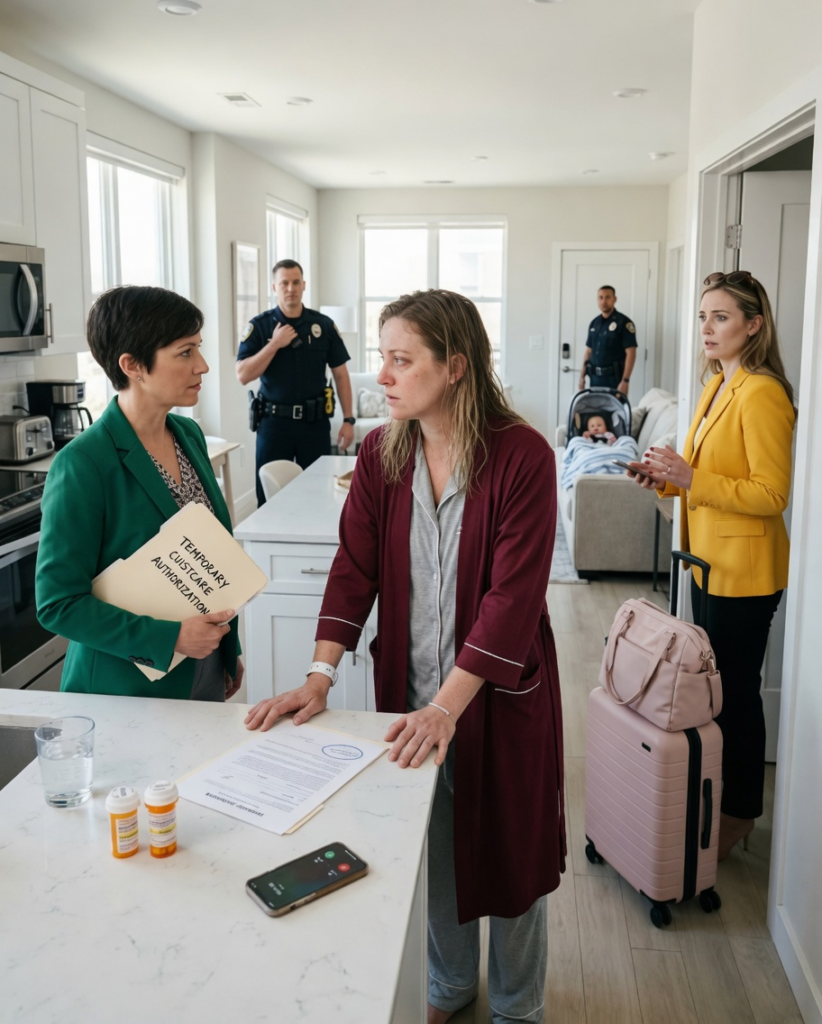
Three days after I came home from the hospital, I learned that some people only believe a boundary is real when someone in uniform is standing beside it.
The kidney infection had taken more out of me than I wanted to admit.
It started as a dull ache in my lower back, then became fever, chills, and a weakness that made the hallway outside my bedroom feel like a mile.
By the time I was discharged, the nurse had gone over the same instructions twice because I kept staring at the paper like it belonged to someone else.
Rest.
Fluids.
No lifting.
Return immediately if fever comes back.
The discharge papers went on my nightstand under a sweating glass of water, beside orange pill bottles that made my whole room smell like medicine.
Kayla knew all of this.
She had visited me once in the hospital, leaned near my bed for a selfie, posted that she was “checking on my girl,” and left after twelve minutes because parking was expensive.
My mother later called that “showing up.”
That was how my family worked.
Kayla did the smallest possible thing, and everyone praised her for surviving the inconvenience.
I did the actual work, and everyone treated it like the air in the room.
When Mason was born, I was the one who ordered diapers to her apartment at midnight, learned which formula settled his stomach, and answered her panicked texts when he cried too long.
I loved that baby.
Kayla knew it.
That was the access she had to me, and access is a kind of key when someone decides to misuse it.
On the morning everything happened, I had barely made it from my bed to the bathroom.
My legs were watery and unreliable, and I had to grip the doorframe while I brushed my teeth.
That was when my mother called.
She did not ask how I felt.
She said Kayla was at the airport, her flight to Paris left in four hours, and the babysitter had fallen through.
“Mason is easy,” she said.
Mason was eight months old, teething, curious, and nearly twenty pounds.
The doctor had told me not to lift more than ten.
“I can’t,” I said.
My mother sighed like I was choosing to be difficult.
“You’re home anyway.”
I looked at the hospital band still around my wrist and felt something in me harden.
“I said no,” I told her. “Do not bring him here.”
Twenty minutes later, Kayla knocked once and opened the door with the spare key I had given her after Mason was born.
She rolled a pale pink suitcase into my apartment, sunglasses pushed into her hair, perfume cutting through the stale smell of antibiotics and sleep.
Mason was on her hip, heavy and warm, fussing into her shoulder.
The diaper bag hung from her other arm.
“Okay,” she said, walking past me, “he eats at two and again at five.”
“Kayla, I told Mom no.”
She set Mason on my couch and smiled too quickly.
“It’s only a few hours. You’re sitting down anyway.”
Then she pulled a typed page from the diaper bag and slid it across my kitchen counter.
Temporary Childcare Authorization.
My name was already filled in.
My signature line was circled in blue pen.
That small circle told me this had not been panic.
Not confusion.
Not desperation.
Paperwork.
She had planned around my refusal before she even walked through the door.
My hands started shaking, and this time it was not only the infection.
“You want me to sign medical permission for a baby I physically cannot lift?” I asked.
“If something happens, you’ll need it,” she said.
“If something happens, I can’t carry him.”
“Then don’t lift him unless you have to.”
Mason whimpered.
My first instinct was to go to him, and that was exactly what made me furious.
Kayla had counted on that instinct.
She knew I would hurt myself before I let him cry.
My mother was still on speakerphone, because of course she was.
“Stop being dramatic,” she snapped.
That was the moment everything went still.
To them, my body was not injured if it could still be useful.
To them, my no was not a boundary if they could shame me through it.
I picked up my phone and walked to the kitchen corner, where the counter was close enough to catch me if my knees buckled.
Then I called Child Protective Services.
My voice shook, but I kept it clear.
I said my sister was attempting to leave her eight-month-old infant with a medically unfit caregiver against that caregiver’s consent.
I said I had been discharged three days earlier after a severe kidney infection.
I said my discharge papers ordered rest, fluids, no lifting, and immediate return if fever came back.
I gave Kayla’s full name.
I gave the departure airport.
I gave the four-hour flight window.
Kayla lunged one step toward me, then froze when I said, “This call is being documented.”
My mother screamed through the speaker.
Mason started crying harder, startled by the noise.
I leaned against the counter and read the title of the form aloud.
Temporary Childcare Authorization.
The operator told me not to sign anything.
She also told me that if Kayla left Mason after I had refused, I should call emergency services immediately.
Kayla grabbed the diaper bag and called me insane.
“No,” I said. “I am refusing to be your alibi.”
She left angry, but she left without the form.
That was her second mistake.
I photographed the discharge papers.
I photographed the hospital wristband.
I photographed the unsigned authorization form, my typed name, and the blue circle around my signature line.
I took a screenshot of the call log.
The facts steadied me.
They made the room less about Kayla’s volume and more about what could be proven.
Ten minutes later, airport police called me before Kayla even reached the freeway.
The officer asked whether I had agreed to provide care.
No.
He asked whether I was medically able to provide care.
No.
He asked whether the child’s mother had been told that before arriving.
Yes.
By late afternoon, a social worker called and asked whether I would speak in person if Kayla returned with Mason.
I said yes, but only with officers present.
At 5:47 p.m., the first officer knocked.
Then another.
Then the social worker, a calm woman with silver-streaked hair and a navy folder under one arm.
She looked at my face before she looked at the paperwork.
“Do you need medical assistance right now?” she asked.
That question almost broke me, because it was the first one all day that treated my condition as real.
I said no and sat down before answering anything else.
She reviewed the documents one at a time at my kitchen table.
Discharge papers.
Temporary childcare authorization.
Call log.
Hospital wristband.
She did not gasp or perform outrage.
She wrote everything down.
Six hours after Kayla first walked into my apartment like my refusal was decorative, she opened my door again.
This time, she stopped.
Two officers were standing inside.
The social worker sat at the table.
Mason’s diaper bag was on a chair.
The papers Kayla thought I would hide out of embarrassment were laid out under the bright kitchen light.
She looked at the form first.
Then at me.
Then at the officers.
“What is this?” she asked.
The social worker turned the authorization form toward her.
“What exactly were you planning to do if she collapsed?”
Kayla opened her mouth, but nothing came out.
My mother was on Kayla’s phone again, loud enough for everyone to hear until the officer asked her to stop interrupting.
For once, my mother went quiet.
Kayla tried to say I had agreed earlier.
I played the voicemail my mother had left at 11:08 that morning.
“She’ll complain,” my mother’s recorded voice said, “but just leave him. She won’t actually call anyone.”
Nobody moved.
That was the truth.
They had not misunderstood me.
They had counted on my silence.
The social worker asked Kayla to write a statement explaining why she believed a woman on strict bed rest after surgery could safely care for an eight-month-old baby.
Kayla stared at the blank line.
For the first time all day, she looked less angry than afraid.
The officers did not arrest her that night.
That was not the point of what happened.
The social worker completed a safety plan requiring Kayla to list approved caregivers who had actually consented and were physically able to care for Mason.
My name was not on that list.
My mother’s name was added only after she admitted she had not asked to see my discharge papers, because she had assumed I was exaggerating.
Kayla missed her flight.
Her boyfriend went to Paris without her.
She shouted that in my hallway like the real tragedy was a hotel reservation instead of the fact that she had tried to leave her baby with someone who could barely stand.
Before she left, the officer asked for the spare key.
Kayla handed it over with shaking fingers.
He placed it on my counter beside the hospital wristband.
That little key looked harmless, but I could not stop staring at it.
It had been access.
It had been trust.
It had been the thing she used to walk past my no.
After everyone left, I locked the door, locked the chain, and sat on the floor because my legs were trembling too badly to carry me back to bed.
I cried then.
Not because I regretted calling.
Because I loved Mason, and Kayla had used that love like leverage.
My mother texted, “I hope you’re happy.”
For once, I did not answer.
The next morning, the hospital called to check on my recovery.
When the nurse asked whether I had been resting, I almost laughed.
Then I told the truth.
She reminded me that stress could trigger setbacks and told me to return immediately if my fever came back.
I looked at the discharge papers again.
They no longer felt like instructions.
They felt like evidence I should never have needed.
Over the next week, relatives called.
Some wanted details.
Some wanted me to smooth things over.
One aunt said Kayla was embarrassed.
I said embarrassment was not an emergency.
Another cousin said Mason needed family.
I said Mason needed adults who did not gamble with his safety.
My mother did not apologize at first.
She sent paragraphs about how I had always been stronger than I thought.
That word made me put the phone down.
Strong had become the name they gave my willingness to be used.
Strong meant no one had to check on me.
Strong meant I could be handed more weight because I had carried it before.
So I stopped negotiating.
I changed my lock.
I sent Kayla one message.
“You cannot enter my apartment again. You cannot list me as childcare. You cannot leave Mason with me unless I clearly agree in writing beforehand.”
She called me cold.
I thought about Mason crying while adults screamed over him.
I thought about the blue circle around my signature line.
Then I blocked her for a while.
The social worker followed up two days later.
She said Mason was safe, and that Kayla had been required to update her childcare plan.
She could not tell me everything, and she did not need to.
“You did the right thing by calling,” she said.
Those words landed somewhere my family had trained me not to trust.
For days, I kept hearing my mother’s recorded voice.
She’ll complain, but just leave him.
They thought I would suffer quietly because I had done it before.
They thought love meant I would absorb the danger and call it help.
They were wrong.
I said no again and again, and when they tried to turn that no into background noise, I made sure someone official heard it.
My recovery took longer than expected, but it did happen.
I drank water until I hated it.
I took the antibiotics on schedule.
I slept with my phone on silent.
The first day I walked to the mailbox without gripping the railing, I stood outside in the sun for an extra minute and let myself feel proud.
Not dramatic.
Not selfish.
Alive.
Mason is still my nephew, and I still love him.
That is why I refused to become an unsafe caregiver just to protect Kayla from consequences.
Love does not mean saying yes when your body is telling you no.
Family does not mean handing a baby to someone who can barely stand and calling it loyalty.
And a boundary is not cruelty just because the person crossing it starts to cry.
I kept the hospital wristband on my desk for a while.
It reminded me of the day my no finally had witnesses.
Then one morning, I threw it away.
I did not need it anymore.
I had the truth.
I had the lock changed.
I had my own voice back.