The first thing Lydia Whitmore ever said about my Army uniform was that it made me look severe.
She said it at a Sunday brunch with her pearl earrings catching the lake light and her smile laid neatly across her face.
The lake house smelled like lemon oil, warm coffee, and expensive flowers that had probably been arranged by someone who was told not to touch anything else.
The windows looked over water so bright I had to blink every time I turned my head.
The silverware was heavy enough to feel like a decision.
Graham sat beside me with one hand near mine under the table, quiet in the way people are quiet when they hope a moment will pass before they have to choose a side.
Lydia looked me over and said, “Army green is a little severe on you, dear.”
Everyone heard it.
Nobody treated it like an insult.
That was the Whitmore way.
They could make a cut sound like advice.
My name is Riley James.
At the time, I was engaged to Graham Whitmore, a man I had loved long enough to mistake his discomfort for kindness.
He was good at soft apologies after the damage was already done.
He would squeeze my hand in the car after his mother said something sharp.
He would tell me, “She doesn’t mean it like that,” while looking embarrassed enough for both of us and brave enough for neither.
I let that count for too long.
At brunch, Lydia introduced me as “Graham’s fiancée, Riley. She works in an Army medical unit.”
That was all.
Not Captain James.
Not officer.
Not trauma lead.
Not the woman who had spent nights inside a Black Hawk with red light washing over gloves and gauze while the aircraft shook so hard the metal floor rattled under my boots.
Army medical unit.
Aunt Vivian lifted her mimosa and asked, “Are you planning to go back to school eventually?”
“I already did,” I said.
“For nursing?” she asked.
I could have corrected her.
I could have given my rank, my training, my deployment record, my trauma certifications, the number of patients whose names I still remembered years after everyone else had turned them into paperwork.
Instead, I looked at Graham.
He looked at his plate.
“Something like that,” I said.
Tessa, Graham’s cousin, leaned in with a smile that had been sharpened by practice.
“So you carry bandages and boots?”
There was a little laugh around the table.
Not loud.
The Whitmores did not believe in being loud unless they were applauding themselves.
But it was enough.
It told me where they thought I belonged.
Useful.
Practical.
A little rough around the edges.
Temporary.
Lydia began discussing Marissa’s wedding after that, like the insult had simply been a napkin folded back into place.
Cream linen.
Sage ribbons.
Soft florals.
Vineyard elegance.
Romantic, but understated.
Then she turned to me.
“Riley, dear, I do think it would be best if you didn’t wear your uniform. Military green might clash with the palette. Maybe something neutral. Flowy. Less attention-grabbing.”
My fork paused halfway to my plate.
Graham heard her.
He did not lift his head.
I had learned calm in places where calm was not a personality trait.
Calm was a tool.
Calm was how you read vitals while someone screamed.
Calm was how you kept your hands steady while blood made the floor slick and a monitor went thin and desperate beside you.
So I used that tool at a lake house table while a woman in pearls reduced my life to a color problem.
“Of course,” I said.
At 11:42 a.m., my secure phone pulsed against my thigh.
Not a regular text.
Not a calendar reminder.
One short vibration from a channel I had been trained never to ignore.
I glanced down beneath the table and saw the notification.
Stand by, Captain.
I did not open it there.
I slid the phone back under my napkin.
Graham noticed anyway.
“Everything okay?”
“Work,” I said.
He smiled toward his mother as if my job had interrupted brunch by chewing too loudly.
“She gets these alerts.”
Lydia’s brows lifted.
“On a Sunday?”
“Emergencies don’t check calendars,” I said.
The silence that followed was thin enough to tear.
Then Conrad asked about the wine list for the rehearsal dinner, and the room moved on without me.
That was another Whitmore gift.
They could erase you while sitting right beside you.
For the next few months, the comments kept coming.
Graham’s father said my Army life would probably “settle down” once we were married.
Brooke asked if I would wear boots under my wedding dress.
Parker told Graham he was brave for marrying someone who could probably “field-dress a deer and run a blood drive before breakfast.”
Lydia said I was independent in the same tone other people used for inconvenient.
Every time, Graham heard it.
Every time, he gave me a look afterward that said he wished the world were easier.
He never made it easier.
Three days before Marissa’s wedding, I packed at 7:08 p.m. in the bedroom Graham and I had not yet learned to call ours without hesitation.
One gray travel dress.
One pair of low shoes.
One garment bag.
One small duffel.
And the black field pouch I carried everywhere.
Tourniquet.
Trauma shears.
Compressed gauze.
Gloves.
Penlight.
Airway kit.
Protein bars.
Extra socks.
Inventory card folded into the front pocket.
White tape across the side with my name in block letters.
CAPT. R. JAMES.
Graham watched me zip it shut.
“Do you really need that for a wedding?”
“I hope not,” I said.
“That’s not what I asked.”
“Then ask better.”
He rubbed a hand down his face.
“I just want one weekend where my family doesn’t feel like they’re competing with the Army.”
I stared at him for a long second.
“They’re not competing with the Army, Graham. They’re competing with the version of me they made up.”
He looked hurt.
That used to be enough to make me soften.
That night, it only made me tired.
Some men do not betray you in one dramatic moment.
They do it in inches.
A missed correction.
A nervous laugh.
A hand squeeze under the table when what you needed was a voice.
By the time you notice, you are not standing beside him anymore.
You are standing alone while he asks why you moved.
The wedding weekend began at the lake house, where two black SUVs waited in the circular drive.
The air smelled like clipped grass and perfume.
The driveway gravel was so white it looked swept.
A small American flag near the front porch barely moved in the warm air.
Lydia looked at my gray dress and said, “Lovely,” with the satisfaction of a warning obeyed.
The first SUV filled quickly.
Lydia.
Graham’s father.
Tessa.
Brooke.
Parker.
Graham slid in beside his parents.
Then he noticed there was no seat left for me.
He paused.
That pause said he knew.
Parker grinned from the back.
“Riley can ride with the bags. She’s probably used to cargo transport.”
There was laughter.
Graham opened his mouth.
Then he closed it.
I watched him through the tinted window while the driver loaded garment bags into the second SUV.
For one second, shame crossed his face.
Not enough to make him get out.
So I rode with the luggage.
My knees pressed against centerpiece boxes.
Welcome bags tied with cream ribbon slid against my shoes.
Brooke tossed a duffel into my lap before shutting the hatch.
“Oops,” she said. “Sorry, Army girl. You’re good with gear, right?”
“It’s fine,” I said.
But I took a picture of where my field pouch landed, half-buried under garment bags and tissue paper.
Not because I thought I would need proof.
Because part of me had started documenting what the rest of me was finally willing to see.
The vineyard was beautiful the next afternoon.
Money can make almost anything beautiful if no one asks what it cost.
White gravel paths curved between rows of green.
Cream chairs faced a flower arch woven with roses and damp greenery.
The quartet tuned softly under a blue sky.
Servers moved with trays of water glasses and champagne flutes.
Near the property gate, a small American flag was fixed beside the valet table, the only thing in sight that had not been chosen to match the ribbons.
I sat beside Graham in the second row.
He looked handsome in his navy suit.
He also looked far away.
I wondered how many years I would have spent trying to reach him from across that same distance if the helicopter had not come.
Marissa stepped into view at 3:16 p.m.
Her dress shimmered when the light hit it.
The guests turned.
The quartet began to play.
For a few minutes, everything looked exactly the way Lydia had designed it.
Soft.
Polished.
Controlled.
Then I heard the sound under the music.
Low at first.
Almost like thunder behind the hills.
My fingers tightened around the cream clutch Lydia had insisted matched my dress.
The sound deepened.
Rotors.
I knew that sound in my bones before the guests even understood what they were hearing.
People began to look around.
A program lifted off someone’s lap and skidded across the grass.
A bridesmaid reached up to hold her hair.
The flower arch trembled once.
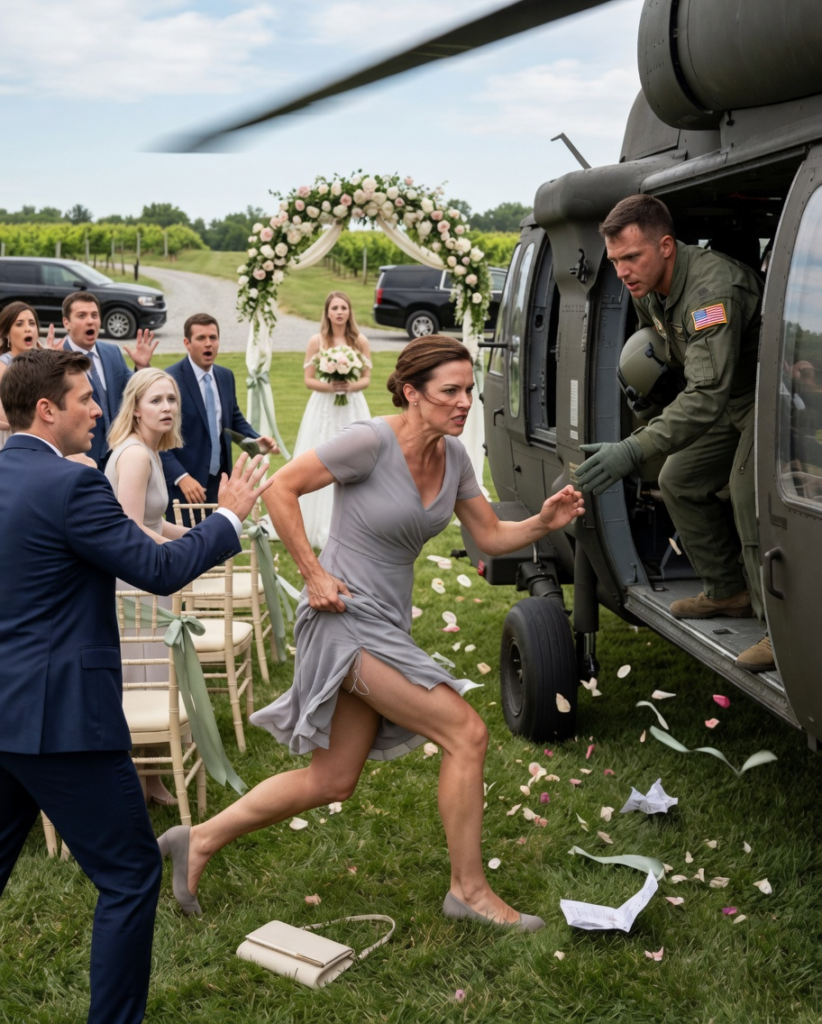
Then the Black Hawk came over the tree line.
Dark against the blue sky.
Too low for a flyover.
Too direct to be a mistake.
The quartet broke apart note by note.
The cello stopped first.
Then the violin.
Then everything was rotor wash and gasps.
Lydia whispered, “What on earth?”
The aircraft dropped toward the open field beside the ceremony lawn.
Grass flattened in wide waves.
Petals tore loose from the aisle.
Champagne glasses shook on the service table.
The officiant clutched his binder against his chest.
I saw the marking beneath the cockpit.
My body moved before my mind finished the thought.
I stood.
Graham grabbed my wrist.
“Riley?”
I pulled free.
The Black Hawk hit the grass hard, and the side door slid open before the blades had fully slowed.
A crew chief jumped out in full flight gear.
Helmet under one arm.
Dust on his face.
Sweat darkening the edge of his collar.
American flag patch bright on his sleeve.
He ran past Marissa.
Past the groomsmen.
Past Lydia’s cream-and-sage perfection.
Straight toward me.
“Captain James!” he shouted.
The whole lawn changed shape around those words.
Captain.
Not nurse.
Not Army girl.
Not Graham’s quiet fiancée who had been told to wear something flowy and less attention-grabbing.
Captain James.
The crew chief stopped in front of me, breathing hard.
“Ma’am, mass casualty event on I-90. Civilian transport collision. Multiple critical. Flight surgeon is down. Command says you’re in sector.”
For a second, I heard nothing but the blades.
Then every other detail sharpened.
Graham’s hand still in the air.
Lydia’s white face.
Parker’s smile gone.
Tessa frozen with one hand at her throat.
The bride gripping her bouquet so tightly her knuckles looked pale.
The crew chief leaned closer.
“We’ve got three kids crashing. If we don’t lift in ten, they die.”
There are moments that strip a room clean.
Money, manners, old family names, seating charts, pearl earrings, clever jokes at someone else’s expense.
All of it falls away.
Only the useful things remain.
Training.
Hands.
Time.
The black field pouch in the second SUV.
I dropped the cream clutch.
It landed in the grass at my feet.
Then I gripped the side seam of the gray dress Lydia had approved and tore it up to my thigh.
The sound of fabric ripping cut through the rotor thunder.
Somebody gasped.
I did not look to see who.
The crew chief said, “Ma’am, your trauma pouch.”
I pointed toward the valet area.
“Second SUV. Rear compartment. Black pouch. White tape.”
Graham was still staring at me.
I turned on him.
“Move.”
That one word did what months of silence had not.
He ran.
Parker ran too, not because he was brave, but because shame had finally found his legs.
The valet driver threw the rear hatch open.
Cream welcome bags spilled onto the gravel.
A box of centerpieces tipped over.
Sage ribbon tangled around someone’s shoe.
The field pouch was wedged under garment bags where Brooke had dropped it.
For a moment, Graham froze with both hands on it.
He saw the tape.
CAPT. R. JAMES.
TRAUMA LEAD.
He had seen that pouch before.
He had joked about it.
He had asked why I needed it.
Now three children were losing time while his family’s decorations sat on top of it.
He brought it to me like an offering.
His face had gone gray.
“I’m sorry,” he said.
I took the pouch.
“No,” I said. “You’re late.”
Marissa began crying under the flower arch.
Her groom put a hand on her shoulder, but she kept staring at me as if the wedding had split open and shown her something more important than the ceremony.
Lydia stepped forward.
“Riley, I didn’t know.”
I snapped the strap across my body.
“You didn’t ask.”
The crew chief turned back toward the aircraft.
I followed.
Rotor wash hit my face and filled my mouth with dust and cut grass.
The torn dress whipped around my legs.
Behind me, Graham called my name.
I did not turn around.
Inside the Black Hawk, the familiar world took over.
Harness.
Headset.
Kit open.
Gloves on.
The crew chief handed me the incident summary printed from command dispatch.
I-90.
Multiple vehicles.
Civilian transport.
Pediatric criticals.
Flight surgeon down.
Estimated lift window: ten minutes.
We lifted in six.
Through the open side, the vineyard dropped away beneath us.
For one strange second, I could see the entire wedding from above.
The rows of chairs.
The ruined ribbons.
The guests scattered across the grass.
The gray tear of my dress like a mark left behind.
Graham stood alone near the aisle with both hands at his sides.
Lydia stood beside him, very small under all that sky.
Then the helicopter banked, and they were gone.
The scene on I-90 was worse than the dispatch had room to describe.
It always is.
Dispatch turns disaster into clean language because panic does not fit on a line.
Civilian transport collision.
Multiple critical.
Three kids crashing.
On the ground, there was glass everywhere.
A paramedic shouted vitals over the engine noise.
A firefighter waved us toward the triage point.
The flight surgeon had been moved aside with a neck brace and an oxygen mask, conscious but unable to work.
He saw me and tried to lift his hand.
I leaned close enough to hear him.
“Kids first,” he said.
“I know.”
After that, there was no vineyard.
No Lydia.
No Graham.
No jokes about boots.
There was only airway, bleeding, pressure, pulse, sequence, lift.
One child had a pulse so thin it felt like thread under wet skin.
One kept trying to ask where his sister was.
One had stopped making sound at all, which scared me more than screaming ever did.
I gave orders until my voice went rough.
I packed gauze.
I cut fabric.
I held pressure.
I told a terrified EMT to look at me and breathe before his hands started shaking too hard to help.
At the hospital intake desk, they took the first child through trauma bay two.
The second went straight to imaging.
The third was met by a pediatric team who had already been warned by the radio report.
I signed the transfer log at 4:37 p.m.
My handwriting looked steadier than I felt.
That is the strange thing about training.
Your hands may save a life while your heart catches up ten minutes later in a hallway.
By 5:12 p.m., all three children had pulses that held.
Not safe.
Not fixed.
But held.
That was enough for the next breath.
Enough for the next team.
Enough to keep fighting.
I washed my hands in a staff bathroom where the mirror had a crack in one corner.
Dust streaked my face.
My hair had come loose from its pins.
The gray dress hung torn down one side.
There was a smear of something on my forearm I did not want to identify until I had soap under my nails.
My phone had twelve missed calls from Graham.
Three from Lydia.
One text from Marissa.
I am so sorry. Thank you. Please be safe.
That was the only one I answered.
I wrote back, I hope your day becomes happy again someday.
Then I sat on a plastic chair in a hospital corridor with my black pouch between my boots and let the shaking come.
It lasted less than a minute.
Then I stood up.
A nurse passing by offered me a paper coffee cup.
“You the captain from the chopper?” she asked.
“Yes, ma’am.”
She nodded toward the trauma doors.
“They’re still here because of you.”
I looked down at the cup in my hands.
It smelled burnt and wonderful.
“Because a lot of people did their jobs,” I said.
She smiled.
“Sure. But you did yours in a wedding dress.”
I almost laughed.
Almost.
Graham found me at 6:03 p.m.
He looked like he had aged since the vineyard.
His tie was gone.
His suit jacket had grass stains at one knee.
He held my cream clutch in both hands.
For a moment, neither of us spoke.
The hospital hallway hummed around us.
Rolling carts.
Distant monitors.
Soft shoes on tile.
A family crying somewhere behind a closed door.
Graham held out the clutch.
“You dropped this.”
I took it.
“Thank you.”
His eyes moved to the torn dress, then the pouch at my feet.
“I didn’t know,” he said.
I looked at him.
“You knew enough.”
He flinched.
That was fair.
“I should have defended you.”
“Yes.”
“I should have gotten out of the SUV.”
“Yes.”
“I should have told them who you were.”
I shook my head.
“No, Graham. You should have understood that I didn’t need your family to know who I was for you to treat me like I mattered.”
His mouth opened.
Nothing came out.
That was the first honest thing he had given me all day.
Lydia arrived ten minutes later.
She did not sweep in the way she usually did.
She entered the hallway slowly, like a woman approaching a room where she could no longer control the lighting.
Her pearls were still on.
Her hair was still perfect.
But her face had lost its polished certainty.
“Captain James,” she said.
The title sounded strange in her mouth.
Too new.
Too late.
I stood.
“Mrs. Whitmore.”
Her hands twisted together once.
“I owe you an apology.”
“You owe me several.”
Her eyes dropped.
Graham stared at the floor.
Lydia swallowed.
“I was dismissive. Cruel, at times. I treated your work like an inconvenience.”
“At times?” I asked.
The words were not loud.
They did not need to be.
She nodded once, and the old Lydia would have found a graceful exit there.
This Lydia did not.
“I was cruel,” she said.
A doctor stepped out of the trauma wing before I could answer.
He spoke to a waiting family first.
A mother collapsed against a man’s chest when she heard the words stable enough for surgery.
Stable enough.
Not safe.
Not healed.
But enough for the next door to open.
The mother turned blindly, saw me, and somehow seemed to understand.
Maybe it was the torn dress.
Maybe the boots.
Maybe the pouch.
She grabbed my hand with both of hers.
“Were you with him?”
“Yes.”
“Was he alone?”
“No,” I said. “He was not alone.”
She cried then.
Not gracefully.
Not quietly.
She cried with her whole body, and I held her hands until somebody from the hospital staff guided her toward the consultation room.
When I turned back, Lydia was crying too.
I had never seen her do anything that uncontrolled.
But her tears were not the center of the room.
They were only a consequence.
Graham whispered, “Riley, please. Let me fix this.”
I looked at the man I had planned to marry.
I remembered the brunch.
The fork pausing in my hand.
The cargo joke.
The way his mouth opened and closed while I rode with the luggage.
The way he grabbed my wrist when I stood, not because he understood the alert, but because I was breaking the shape his family had made for me.
“You can’t fix it by being sorry after other people hear my rank,” I said.
He looked up at me.
“You can fix yourself. But I can’t marry the version of you who needed a helicopter to believe me.”
His face folded.
Lydia covered her mouth.
Nobody spoke.
The hospital lights were bright and plain.
No sage ribbons.
No flower arch.
No curated elegance.
Just a hallway where truth did not have to match a palette.
I removed my engagement ring.
For a second, I held it in my palm.
It looked smaller than I remembered.
That surprised me.
I placed it in Graham’s hand.
He closed his fingers around it like it hurt.
Maybe it did.
“I loved you,” he said.
“I know,” I said. “But love that looks away still leaves a person standing alone.”
That was the part I wished I had understood sooner.
Not all abandonment happens when someone walks out.
Sometimes it happens while they sit right beside you, smiling at the table, letting other people make you smaller.
Graham left first.
Lydia stayed.
I expected one more speech, one more polished apology, one more attempt to arrange the wreckage into something socially acceptable.
Instead, she looked down the hall toward the trauma doors.
“Were they all children?”
“Yes.”
She pressed her lips together.
“My granddaughter is six,” she said.
It was the first sentence she had said all day that did not sound rehearsed.
I nodded.
She looked back at me.
“I am ashamed.”
I did not comfort her.
That was not my job.
A week later, a package arrived at my apartment.
No return argument.
No dramatic letter.
Inside was my field pouch.
The Army had cleaned and returned it through the proper channel, but tucked beside the inventory card was a handwritten note from Marissa.
I didn’t know what they had been doing to you because I didn’t want to see what was happening in my own family. I am sorry. I should have moved when you were made to ride with the bags.
There was another envelope under it.
A printed photo from the wedding photographer.
Not the ceremony.
Not the kiss.
Not the flowers.
The photo showed the moment the Black Hawk sat in the field and every guest stared as the crew chief ran toward me.
My gray dress was still intact in the photo.
My hand was just beginning to release the clutch.
Graham’s hand was still lifted where he had grabbed my wrist.
Lydia’s face had already started to change.
On the back, Marissa had written one sentence.
They were only meeting you for the first time.
I kept that photo.
Not because I wanted to remember their shame.
Because I wanted to remember the second before I stopped shrinking.
The three children from I-90 survived.
I learned that through the official channels first, then through a card delivered to the unit weeks later with three messy signatures and one drawing of a helicopter that looked more like a beetle with wings.
I pinned the drawing above my desk.
Not the wedding photo.
The drawing.
That was the part worth keeping.
Months later, Graham sent one more message.
He said he had started therapy.
He said he had moved out of the house his parents helped pay for.
He said he finally understood that silence was not peace.
I believed him.
I also did not go back.
Some apologies are real and still arrive after the door has closed.
At the next formal event I attended, I wore my uniform.
No one called it severe.
No one called it attention-grabbing.
No one asked if I was planning to go back to school.
And if they had, I would have corrected them.
Not gently.
Not angrily.
Clearly.
Because the day a Black Hawk landed in the middle of Lydia Whitmore’s perfect vineyard wedding, everyone froze when they heard my name.
But I was not becoming someone else in that moment.
I was done apologizing for the person I had been all along.