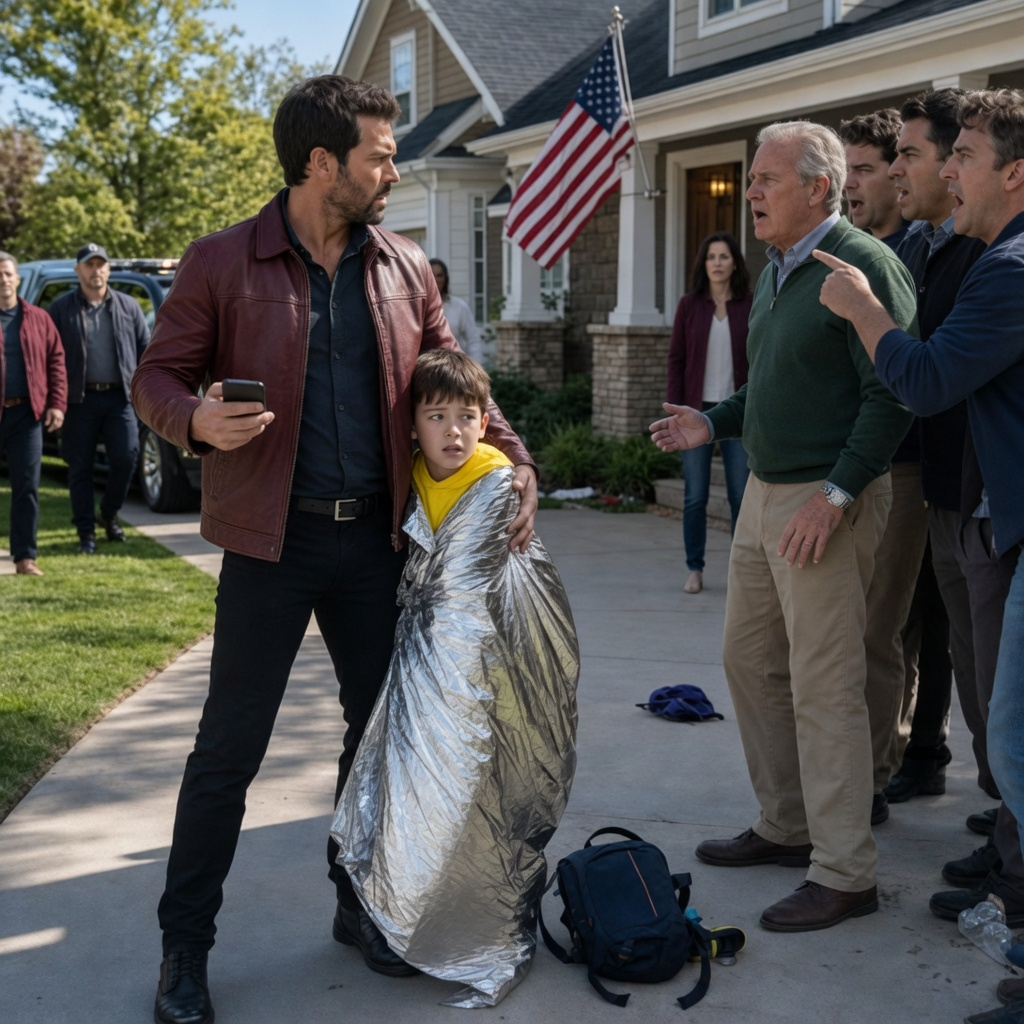
My Son Was Screaming For Help When My Father-In-Law Slammed His Head Into The Concrete Driveway. “Your Daddy’s Not Here To Protect You,” He Laughed, While My Wife’s Brothers Held Him Down. I Was Across Town. I Didn’t Call The Police. I Made One Encrypted Call. My Father-In-Law Had No Idea He Just Assaulted The Son Of The Man Who Commands The Black Ops Unit That Erases Problems Like Him From Existence. Now… He Had 90 Minutes Left To Breathe.
### Part 1
The first thing I remember from that night was the hum of the hospital lights.
Not the doctor’s voice. Not the smell of disinfectant. Not even the sight of my eight-year-old son lying behind a curtain with half his face swollen.
It was the lights.
They buzzed above me like angry insects while I sat in the emergency waiting room with my elbows on my knees and my hands clasped so tight my knuckles looked white. The floor beneath my boots was old linoleum, scuffed by years of rushing feet, spilled coffee, and bad news. Somewhere down the hall, a child was crying. Somewhere closer, a vending machine clicked and dropped a soda can with a hollow metallic thud.
My phone vibrated again.
Christine.
I watched her name flash across the screen until the call died.
That made eight missed calls.
Eight calls from my wife, who had taken our son Jake to her father’s house that afternoon for what she called “family time.” Eight calls from the woman who had not shown up at the hospital. Eight calls from the woman who, according to Mrs. Patterson, was still at the Mallister house when Jake stumbled three houses down the sidewalk with blood near his ear and one shoe missing.
The doctor had said concussion.
Maybe worse.
They were running scans.
I had heard all the words, but they floated around me like they belonged to someone else’s life. My life had PTA meetings, grocery lists, soccer cleats by the back door, and Jake leaving Lego pieces in places designed to destroy bare feet. My life did not have nurses saying “head trauma.” My life did not have my son whispering nonsense about Grandpa Edmund and Uncle Carl and Uncle Hugh holding him down on the driveway.
The double doors opened.
A doctor stepped out, peeling off blue gloves. She had tired eyes and the soft, careful expression people use when they are trying not to scare you.
“Mr. Frank?”
I stood so fast the chair legs scraped behind me.
“How is he?”
“He’s awake,” she said. “He’s confused, but responsive. We’re still waiting on the final imaging, but right now it appears to be a moderate concussion. The swelling is significant. We’re watching for complications.”
“Can I see him?”
She hesitated just long enough for my stomach to drop.
“He’s asking for you.”
I followed her through a hallway that smelled like bleach and warm plastic. My boots felt too loud. Every step made me think of Jake’s small sneakers, the ones with green laces he insisted made him run faster.
Then I saw him.
He looked too small in the bed.
Jake’s right temple was purple and swollen, the color spreading under the skin like storm clouds. A scratch ran along his cheek. One arm had a hospital band around it. His dark hair, usually sticking up in every direction, was flattened on one side.
His eyes found mine.
“Dad.”
That single word broke something inside me.
I crossed the room and took his hand gently. His fingers curled around mine with weak pressure.
“I’m here, buddy,” I said. “I’m right here.”
His chin trembled. “I tried to get away.”
“You don’t have to talk yet.”
But children do that sometimes. When they’re scared enough, they talk because silence feels even worse.
“Grandpa was mad,” he whispered. “He said you think you’re better than them.”
The doctor looked at me. I did not look away from my son.
“He was yelling,” Jake said. “Uncle Carl grabbed my arms. Uncle Hugh grabbed my legs.”
My mouth went dry.
“Jake…”
“He said you weren’t there.” My son’s eyes filled. “He said Daddy’s not here.”
The room tilted.
I had heard men threaten me before. I had heard bullets hit concrete, doors break off hinges, and grown men beg in languages I barely understood. I had trained myself long ago to stay calm when the world turned ugly.
But nothing in my life had prepared me for my son saying those words.
The doctor stepped forward softly. “Mr. Frank, I need to check him again. Just a few minutes.”
I kissed Jake’s forehead, avoiding the swollen side.
“I’ll be right outside,” I told him.
In the hallway, my phone vibrated again.
Christine.
This time I answered.
“Calvin!” Her voice was breathless. “Where are you? Dad said Jake ran off. Is he with you?”
I stared at the blank hospital wall.
“He’s in the emergency room.”
“What? What happened?”
I closed my eyes.
That was when I knew something was wrong.
Not because she sounded scared.
Because she sounded like she was performing scared.
And as I listened to my wife breathe on the other end of the line, I remembered the old locked drawer in my office. The one I had not opened since Jake was born.
The one with the phone inside.
### Part 2
“Calvin, answer me,” Christine said. “What hospital?”
I could hear voices behind her. Male voices. One of them laughed, low and rough, like gravel being shaken in a tin can.
I knew that laugh.
Edmund Mallister had laughed like that the first time I met him, when he squeezed my hand too hard across his kitchen table and said, “So you’re the real estate boy.”
I was thirty-one then, engaged to his daughter, still trying to be the kind of man who did not react to bait. I smiled, let him squeeze, and watched his eyes narrow when I did not flinch.
Now, nine years later, his grandson was in a hospital bed.
“Sacred Heart,” I said.
Christine sucked in a breath. “I’ll come right now.”
“No,” I said.
Silence.
“What do you mean, no?”
“I mean put your father on the phone.”
“Calvin, this isn’t—”
“Put him on the phone.”
There was muffled arguing. A chair scraped. Someone said, “Give me that.”
Then Edmund’s voice came on, thick with arrogance.
“Listen here, Calvin. That boy got himself worked up. Kids fall. Don’t make this into something it ain’t.”
My hand tightened around the phone.
“Jake says you dragged him outside.”
Edmund snorted. “Jake says a lot of things. Kid’s dramatic. Gets that from your side, I guess.”
“He says Carl and Hugh held him down.”
Another laugh, shorter this time. Meaner.
“You know what your problem is? You let that boy talk like he’s grown. He mouthed off in my house.”
“He’s eight.”
“He’s old enough to learn respect.”
The hallway seemed to narrow. The buzz of the fluorescent lights sharpened until it was almost a ringing in my ears.
“What did you do to my son?”
“Careful,” Edmund said. “You’re talking like a man who can do something about it.”
Behind him, I heard Carl say, “Ask him if he’s gonna call a lawyer.”
Hugh laughed.
Edmund came back closer to the phone.
“You weren’t there, Calvin. Remember that. Boy called for you, and you weren’t there.”
For a moment, I saw Jake’s face again. The swelling. The fear. His little hand gripping mine.
Then Edmund said the last stupid thing he would ever say to me.
“Maybe next time, he’ll remember who the real men are.”
I hung up.
I did not throw the phone. I did not punch the wall. I did not shout.
I had learned a long time ago that real anger does not always look loud. Sometimes it goes quiet. Sometimes it turns clean and cold. Sometimes it organizes itself.
I walked to the end of the hallway, past the nurses’ station, past a man sleeping upright in a chair with his mouth open, past a vending machine glowing blue in the dim corridor. I found a stairwell. Concrete walls. No cameras visible. No one nearby.
Old habits.
I stood there for several seconds, breathing slowly, fighting the pull of a life I had buried.
When Jake was born, I promised myself I would never open that door again. I would be Calvin Frank, commercial developer. Calvin Frank, husband. Calvin Frank, father who packed lunches and knew the names of cartoon dinosaurs.
Not the other Calvin.
Not the one my father had built.
I took my keys from my pocket and went out to my truck.
The winter air hit my face like water. Across the parking lot, the city moved on as if my world had not split down the middle. A woman in scrubs smoked beside a dumpster. A teenager helped an old man out of a sedan. Somewhere, a siren rose and faded.
In the glove compartment was a small metal key taped beneath the manual.
At home, that key opened the drawer.
But I did not need the drawer tonight.
Because some men who leave dangerous lives behind still keep one thing close.
I reached under the driver’s seat and pulled out a slim black case.
Inside was a phone.
No apps. No photos. No family contacts. Just one secure channel that had not been used in years.
My thumb hovered over the power button.
I thought of Christine’s voice. Edmund’s laugh. Jake saying, “He said Daddy’s not here.”
Then I turned the phone on.
It took seventeen seconds to connect.
A voice answered without greeting.
“This line is only for emergencies.”
I looked through the windshield at the hospital entrance, where automatic doors opened and closed under hard white light.
“It’s me,” I said.
The voice went still.
“Calvin?”
“Dad,” I said. “They hurt Jake.”
There was no gasp. No curse. No dramatic reaction.
My father, Merl Frank, had never been that kind of man.
He only asked one question.
“Who?”
And when I told him the names, the silence that followed felt heavier than any threat.
### Part 3
My father did not ask me to repeat myself.
That was how I knew he believed me.
Merl Frank had spent most of his life listening to men lie under pressure. He could hear hesitation, invention, panic, guilt. When I told him what Jake said, he went quiet in a way I remembered from childhood.
Not angry quiet.
Operational quiet.
“Is Jake stable?” he asked.
“For now. They’re checking for bleeding and fractures.”
“Where is Christine?”
“At her father’s house. Or she was.”
“Did she see it happen?”
“I don’t know.”
“Find out,” he said. “But do not confront her alone until we know what she’s protecting.”
I leaned back against my truck and watched my breath cloud in the cold air.
“She sounded like she was covering.”
“Maybe for them. Maybe for herself.”
That sentence landed harder than I expected.
Christine and I had not been perfect, but we had been solid. At least, I thought we had. We had a mortgage, inside jokes, a son with my eyes and her stubborn chin. She knew I hated going to her father’s house, knew I swallowed every insult because she asked me to.
“They’re rough,” she used to say. “But they’re family.”
Family.
That word had excused a lot.
My father’s voice cut through my thoughts.
“I have people near you.”
“No.”
“Calvin.”
“I’m not asking you to drag me back into that world.”
“You called this line.”
I closed my eyes.
He was right.
“I don’t want Jake growing up around this,” I said.
“Then protect him from it.”
“That’s what I’m trying to do.”
“No,” my father said. “You’re trying to stay clean while dirty men stand over your son and laugh.”
I hated him for saying it because I knew exactly where the sentence came from. Merl had raised me with rules most boys never learned. How to read exits. How to spot a tail. How to stay calm when panic would get you killed. He had taught me violence as a language, then watched me spend adulthood pretending I was mute.
“I’m not doing anything stupid,” I said.
“Good. Neither am I. There is already a federal file on Edmund Mallister.”
That made me straighten.
“What?”
“Union money missing. Dock contracts manipulated. Witnesses scared into silence. Local police too cozy with him, so the case has been moving quietly. Your father-in-law has enemies he never noticed because he was too busy bullying people beneath him.”
The cold inside me shifted.
“Why didn’t you tell me?”
“Because you asked me to stay out of your life.”
I had. More than once.
“Tonight changes that,” he said.
A car pulled into the hospital lot nearby. For half a second, my body tensed.
Just an old couple.
“I can have Vince at Jake’s room within twenty minutes,” my father continued. “You remember Vince.”
Everyone remembered Vince Wheeler. Big shoulders. Kind eyes. The kind of man who could hold a baby like glass and clear a room like weather.
“He stays with Jake,” Merl said. “You meet my people. We do this legally, but we do it fast. Evidence first. Charges second. Custody third.”
“Custody?”
“If Christine knew and failed to protect him, you need to be ready.”
The word “custody” felt like someone had put a blade between my ribs.
“Dad.”
“I’m not saying she did. I’m saying the truth does not care how much you love her.”
I pressed the heel of my hand to my eye.
Through the windshield, I saw a nurse wheel an empty chair past the entrance. Its rubber wheels squeaked against the tile.
“Vince comes first,” I said. “No one gets near Jake unless I approve.”
“Already moving.”
“And Edmund?”
My father’s voice cooled.
“Edmund is going to learn the difference between frightening children and facing men who keep records.”
The call ended.
Twenty-three minutes later, Vince Wheeler walked into Jake’s hospital room carrying a deck of cards and a stuffed tiger from the gift shop. He wore jeans, a gray jacket, and the same calm expression I remembered from years ago.
Jake looked up, groggy.
“Who are you?”
Vince smiled. “A friend of your grandpa Merl. I heard you might need someone to beat at Go Fish.”
Jake managed a tiny smile.
I bent over and kissed his forehead.
“I have to take care of something,” I told him.
His eyes searched mine. “Are you going to Grandpa Edmund?”
I did not lie to my son.
“I’m going to make sure he can’t hurt you again.”
Jake’s lower lip trembled, but he nodded.
Outside the room, Vince put a hand on my shoulder.
“Cal,” he said quietly, “your dad wants you steady.”
“I am steady.”
“No,” Vince said. “You’re cold. That’s different.”
I walked away before I could answer.
My truck was still parked under the flickering lot light. My phone buzzed with an address near the waterfront and three words from an unknown number.
Come alone first.
I started the engine, but before I pulled out, a message came through from Christine.
Please don’t make this worse.
I stared at those five words until the screen went dark.
She had not asked how Jake was.
### Part 4
The waterfront at night smelled like diesel, river mud, and old rust.
I had not been down there in years. The warehouses stood in rows like tired giants, their windows boarded, their brick walls tagged with faded graffiti. A train horn moaned somewhere beyond the cranes. Sodium lights cast everything in a sick orange glow.
I parked beside a building with no sign.
Two men stood near a black SUV.
I recognized one immediately.
Taylor Rhodes had been younger when I knew him, but time had not softened him. He still had the posture of a man who expected trouble and did not mind meeting it halfway. Beside him stood a woman in a dark coat holding a tablet. She had sharp eyes and a federal badge clipped inside her jacket.
“Calvin,” Taylor said.
“Taylor.”
We shook hands. His grip was firm, brief, professional.
The woman stepped forward. “Agent Mara Ellison. Financial Crimes and Public Corruption Task Force.”
Federal. Good.
Also not good.
Because if my father had sent a federal agent to meet me in an abandoned warehouse, the ground beneath the Mallisters was already cracking.
“Where’s my father?” I asked.
“In the air,” Taylor said. “He’ll land within the hour.”
Agent Ellison turned the tablet toward me.
The screen showed a map of Edmund Mallister’s neighborhood, then photos: Edmund shaking hands with dock officials, Carl loading equipment into a private storage unit, Hugh passing envelopes in a parking lot. Nothing flashy. Nothing cinematic. Just the dull, greedy routine of men who thought no one was watching.
“We’ve been building this for fourteen months,” Ellison said. “Your son’s assault changes the timeline.”
I swallowed the anger that rose at the phrase.
Assault.
A clean word for an ugly thing.
“What do you have on Jake?” I asked.
Taylor’s expression tightened.
“We pulled nearby camera footage. Doorbell cams. Traffic cam at the corner. Mrs. Patterson’s statement. Hospital report pending.”
“Show me.”
Ellison hesitated. “You should understand, it’s difficult to watch.”
“Show me.”
She tapped the tablet.
The footage was grainy and angled from across the street, but I knew my son’s red hoodie. I had bought it for him two weeks earlier because he said it made him look like a superhero.
The video had no sound.
That somehow made it worse.
I saw Edmund come out of the house fast, one hand gripping Jake’s sleeve. Jake stumbled. Carl and Hugh followed. Christine appeared in the doorway.
My breath stopped.
The camera angle was too far to show everything clearly, but I saw Jake pull back. Saw Carl catch him. Saw Hugh move in. Saw Edmund bend over him.
Agent Ellison paused the video before the worst of it.
I did not tell her to continue.
I already knew.
Christine remained in the doorway.
A shadow. A shape. A woman with one hand over her mouth.
“She saw,” I said.
“We can’t confirm from this angle what she saw,” Ellison replied carefully. “But she was present outside or at the threshold during part of the incident.”
Part of the incident.
Another clean phrase.
Taylor looked away.
My stomach turned, not from the violence, but from the stillness. Christine had stood there.
My wife had stood there while my son was on the ground.
“Why didn’t she call an ambulance?” I asked.
Neither of them answered.
That was answer enough.
Ellison slid to another screen. “We have enough for emergency warrants if the judge accepts the child endangerment angle alongside the existing corruption file. Your father’s attorney is pushing the affidavit now.”
“My father’s attorney?”
Taylor gave me a look. “Cal, your dad has attorneys the way other men have golf clubs.”
Despite everything, a bitter laugh almost escaped me.
Almost.
“What do you need from me?”
“Your statement,” Ellison said. “Your son’s statement when medically appropriate. And discipline.”
I looked at her.
She did not blink.
“I know who your father is,” she said. “I know pieces of who you were. But tonight cannot become some family revenge fantasy. If we move, we move clean. Warrants. Arrests. Evidence. Chain of custody. You want these men gone from your son’s life? Then don’t give their lawyers a gift.”
Her words irritated me because they were right.
Taylor handed me a bottle of water. I had not realized my hands were shaking until I took it.
My phone buzzed again.
Christine.
This time, a voicemail appeared.
I put it on speaker.
Her voice came through thin and strained.
“Calvin, Dad says people might ask questions. Please just say Jake fell. We can talk later. I know you’re angry, but don’t destroy my family over one mistake.”
The message ended.
For a few seconds, the warehouse was silent except for the drip of water somewhere in the dark.
Then Agent Ellison quietly took the phone from my hand.
“That,” she said, “was helpful.”
I stared at the blank screen.
One mistake.
My son was in a hospital bed, and my wife had called it one mistake.
And before I could process that, Taylor’s earpiece crackled.
He listened, then looked at me.
“Judge signed it,” he said. “We move in ten.”
### Part 5
They did not let me go in first.
That was probably wise.
I sat in the third vehicle with Taylor while marked federal units stayed two blocks out and unmarked ones rolled quiet through the neighborhood. The Mallister house sat at the corner beneath a porch light that flickered every few seconds. A plastic Santa still leaned drunkenly beside the steps even though Christmas had passed weeks ago.
Normal street. Normal houses. Normal trash bins at the curb.
And inside one of them, three grown men had hurt a child and laughed.
Agent Ellison’s voice came through the radio.
“Team set.”
Taylor glanced at me. “Stay in the vehicle until we clear it.”
I looked at the house.
“Cal.”
“I heard you.”
The front door opened before the agents reached it.
Edmund Mallister stepped onto the porch in a white undershirt, jeans, and work boots. His face was flushed. He held a bottle in one hand like he had been interrupted during a celebration.
Then he saw the badges.
His posture changed.
Bullies are easy to recognize when authority finally arrives. They do not become humble first. They become offended.
“What the hell is this?” he shouted.
“Federal agents,” Ellison called. “Edmund Mallister, we have warrants for your arrest and search of the premises.”
Edmund laughed.
Actually laughed.
“You people got the wrong house.”
Carl appeared behind him, broad and thick-necked. Hugh came next, phone in hand, eyes darting.
The next thirty seconds were messy but controlled. Edmund refused to put the bottle down until an agent took it. Carl cursed and tried to retreat inside. Hugh began shouting for someone named Tommy at the local police department.
No one hit them.
No one needed to.
The men who had felt powerful holding down an eight-year-old looked very different with their wrists cuffed and their living room full of federal agents.
I watched from the SUV until Edmund spotted me.
Even from the curb, I saw recognition flash across his face.
Then contempt.
“You,” he barked. “You did this?”
Taylor muttered, “Don’t engage.”
But Edmund kept going.
“You think badges make you tough? You hiding behind them now?”
I opened the door.
Taylor caught my arm.
I looked at his hand. He let go.
I walked across the lawn slowly. The grass was damp, and my shoes sank slightly into the mud. Agent Ellison saw me coming and shifted, ready to intervene.
I stopped at the edge of the porch.
Edmund stood cuffed between two agents, chest heaving, face red.
“You told my son I wasn’t there to protect him,” I said.
His mouth curled. “You weren’t.”
“No,” I said. “I wasn’t.”
For the first time, his expression flickered. He had expected shouting. Men like Edmund knew what to do with shouting. They fed on it.
I stepped closer.
“But I’m here now.”
Behind him, agents carried out boxes. A laptop. A ledger. A lockbox. A stained towel sealed in a clear evidence bag.
My throat tightened when I saw the towel.
Agent Ellison followed my gaze and quietly moved it out of sight.
Edmund saw it too.
His arrogance slipped for half a second.
Then a patrol car rolled up fast at the curb.
A heavy man in a sheriff’s jacket stepped out, hand near his belt, face already annoyed.
“Hold up,” he called. “What’s going on here?”
Hugh, cuffed beside the doorway, lit up with desperate hope.
“Tommy! Tell these people!”
The sheriff looked from Hugh to Edmund to the federal agents.
Agent Ellison walked down the steps and held up paperwork.
“Federal warrant. You can observe from the sidewalk.”
“This is my jurisdiction,” the sheriff said.
“Not tonight.”
The air tightened.
I watched the sheriff read the page. Watched him realize he was either too late or too small.
He stepped back.
Carl began to curse. Hugh started crying. Edmund stared at me like he wanted to peel my skin off with his teeth.
Then a woman’s voice came from inside the house.
“Calvin?”
Christine stood in the hallway.
She had told me she was at a motel.
Her eyes found mine, then dropped to the evidence bag in Ellison’s hand.
And in that instant, I understood something I had been refusing to understand all night.
Christine had not just failed to come to the hospital.
She had gone back to help clean up.
### Part 6
I did not speak to Christine at the house.
If I had, I might have said things Jake would someday hear in court transcripts. So I let Agent Ellison guide her to a separate vehicle while Edmund shouted at her to keep her mouth shut.
That was the part that stayed with me.
Not his fear. Not his rage.
His instruction.
Keep your mouth shut.
As if my wife was still his daughter before she was Jake’s mother.
By the time I returned to Sacred Heart, dawn had begun to gray the edges of the sky. The hospital windows reflected a pale version of me as I walked through the automatic doors: unshaven, hollow-eyed, still wearing the same shirt from the day before.
Vince stood when I entered Jake’s room.
“How’d it go?”
“Clean.”
He studied my face. “That’s not the same as good.”
“No.”
Jake was asleep, one cheek pressed into the pillow, his mouth slightly open. The swelling looked worse in morning light. Purple had deepened to blue around his temple.
I sat beside him and took his hand.
Vince slipped out without another word.
For almost an hour, I watched my son sleep.
I thought about all the times I had told him monsters were not real. The closet was empty. The hallway shadows were just shadows. Thunder was only weather.
What do you tell a child when the monster has a familiar face?
Around seven, Jake woke with a small groan.
“Dad?”
“I’m here.”
“My head hurts.”
“I know, buddy. The doctor’s bringing medicine.”
He blinked slowly, trying to focus. “Is Mom here?”
The question hurt more than I expected.
“She’s coming.”
His face changed.
Not relief.
Worry.
“Do I have to talk to Grandpa?”
“No. Never again.”
His eyes filled. “Mom said I shouldn’t make him mad.”
My grip tightened before I could stop it.
“When did she say that?”
Jake looked toward the door, like she might appear.
“Before. In the kitchen. Grandpa was yelling about you. I said you weren’t weak. He got mad. Mom told me to stop talking back.”
I kept my voice gentle. “Then what?”
Jake swallowed. Tears slid sideways into his hair.
“After… after the driveway… Mom was crying. She told me to get up. I couldn’t. Grandpa said I was fine. Mom said we should call someone, but Grandpa yelled. Then she told me if people asked, I should say I fell.”
The room went very still.
My son had no reason to understand the bomb he had just dropped into our lives.
“Did she call an ambulance?”
He shook his head.
“Mrs. Patterson helped me.”
I leaned forward and pressed my lips to his hand.
“I’m sorry,” I whispered.
Jake’s voice got smaller. “Is Mom in trouble?”
I wanted to say no.
I wanted to give him the simple comfort children deserve.
Instead, I said, “Mom made some very bad choices. Grown-up choices. The kind grown-ups have to answer for.”
He stared at the blanket.
“She didn’t stop him.”
“No,” I said. “She didn’t.”
Jake turned his face toward the window.
That was how Christine found us twenty minutes later.
She came in wearing the same sweater from the video, her hair pulled into a messy knot, eyes red. She stopped when she saw Jake awake.
“Baby,” she whispered.
Jake did not turn.
Christine looked at me.
“Can we talk outside?”
“No.”
“Calvin, please.”
“No more hallway conversations. No more private explanations. Anything you want to say, say it where the nurse can hear you.”
Her face tightened. “You’re treating me like a criminal.”
I looked at Jake.
Then back at her.
“You told our injured son to lie.”
She flinched.
“I was scared.”
“So was he.”
“My father was out of control.”
“And you chose him.”
“I didn’t choose him.”
“You left Jake bleeding and came back to clean the house.”
Her mouth opened.
Closed.
The monitor beside Jake’s bed beeped steadily, indifferent to our marriage collapsing under fluorescent light.
Christine lowered her voice.
“You don’t understand what my father does when people cross him.”
For the first time since she entered, I stepped closer.
“No,” I said. “Christine, he doesn’t understand what happens when someone crosses me.”
Her eyes changed then.
Because she had known me for nine years and suddenly realized there was a room in me she had never entered.
Before she could answer, Agent Ellison appeared in the doorway with two hospital security officers.
“Christine Mallister Frank,” she said, “we need to speak with you regarding child endangerment, obstruction, and witness intimidation.”
Jake finally turned his head.
“Dad?” he whispered.
Christine looked at me like I had betrayed her.
But the only person in that room who had been betrayed was lying in a hospital bed.
And this time, I did not look away.
### Part 7
They did not arrest Christine in front of Jake.
Agent Ellison was better than that.
She asked Christine to step into a family consultation room down the hall. Christine looked at me, waiting for me to save her from the humiliation. Once, I might have. Once, I would have taken her elbow, softened the room, translated consequences into something easier for her to swallow.
Not that morning.
That morning, I stayed beside my son.
By noon, Jake was cleared to go home with strict instructions: rest, low light, no screens for a while, watch for vomiting, dizziness, confusion. The nurse went over the papers twice because I kept staring at the line that said head injury precautions.
Head injury.
Not family misunderstanding.
Not accident.
Not one mistake.
Vince drove us home. I sat in the back with Jake, who leaned against my side and slept most of the way. The city looked ordinary through the window. People walked dogs. A mail truck idled at a curb. A woman in pink sneakers jogged past a coffee shop.
I hated them for a second.
Not because they had done anything wrong.
Because their lives had continued.
Mine had not.
At home, I carried Jake inside. The house smelled faintly of laundry detergent and the cinnamon candle Christine liked to burn in the kitchen. Her shoes were by the door. Her mug sat in the sink with dried tea at the bottom.
Evidence of a life that had existed yesterday.
I settled Jake on the couch with pillows and a blanket. Vince checked the locks without asking. Then he stood near the window, big arms crossed, pretending not to guard us.
“Grandpa Merl coming?” Jake asked.
“Soon.”
“Is Mom coming?”
I paused.
“Not today.”
He nodded like he had expected that, which hurt in a new way.
My father arrived just after sunset.
He came in a dark sedan, not a helicopter, not a convoy, nothing dramatic. He wore a navy coat and carried a paper bag from Jake’s favorite burger place. At seventy-two, Merl Frank still moved like every floor might become a battlefield, but when he saw Jake, his face softened.
“There’s my boy.”
“Grandpa.”
Merl sat beside the couch and placed the bag on the coffee table. “I brought fries. Doctor-approved? Probably not. Grandfather-approved? Absolutely.”
Jake smiled for the first time that day.
I stood in the kitchen and watched them talk. Merl asked about school, about dinosaurs, about whether Jake still believed ketchup counted as a vegetable. He did not mention Edmund. He did not mention the hospital. He gave Jake normal because normal had become rare.
Later, when Jake fell asleep, my father joined me at the kitchen table.
For a while, neither of us spoke.
Then he slid a folder toward me.
“What is this?”
“Christine’s statement.”
I did not touch it.
“She gave one?”
“Partial. Defensive. She claims she intended to take Jake to urgent care after things calmed down.”
My laugh sounded dead.
“After things calmed down.”
“She also claims you have a violent background and may be using federal contacts to punish her family.”
I looked at him.
“There it is.”
Merl’s face did not change. “Her attorney filed for emergency temporary custody this afternoon.”
For a moment, I genuinely could not understand the words.
“Custody?”
“She alleges you are unstable, connected to dangerous people, and likely to retaliate.”
I stood so fast the chair legs banged against the tile.
“Jake is injured because of her family.”
“Yes.”
“She told him to lie.”
“Yes.”
“And she’s trying to take him from me?”
My father’s eyes were steady.
“People who choose the wrong side often try to rewrite the battlefield.”
I pressed both hands to the counter and breathed through the sudden roar in my head.
Merl continued, “Hearing is tomorrow morning. Agent Ellison will testify. So will the doctor, if subpoenaed. Mrs. Patterson gave a statement. The footage helps. But Christine’s attorney is going to come after your past.”
“My past is sealed.”
“Parts of it.”
I turned to him.
He looked older in my kitchen light. Not weak. Never weak. But tired in a way I had not noticed before.
“There’s something else,” he said.
“What?”
“Christine recorded part of the aftermath on her phone.”
“Why would she do that?”
“To protect herself, probably. Or her father. Hard to know.”
He opened the folder.
“But she forgot cloud backups exist.”
The folder contained a transcript.
I read the first three lines.
Then I had to sit down.
Because my wife had not just seen what happened.
She had argued about whether my son was worth saving.
### Part 8
I read the transcript three times before the words became real.
Christine: He’s bleeding.
Edmund: He’s fine.
Christine: Dad, he might be seriously hurt.
Carl: Stop making it a thing.
Edmund: The boy needs to learn.
Then Jake’s voice, small in the background.
Dad.
Just one word.
Dad.
My hand shook so badly the paper rattled.
Merl reached for it, but I pulled it back. I made myself keep reading because fathers do not get to look away from pain just because it is unbearable.
Christine: We should call Calvin.
Edmund: You call him and this family is done with you.
Christine: He’ll never forgive me.
Edmund: Then choose.
There was a long gap in the transcript.
Then Christine said, “Jake, listen to me. You fell. Do you understand? You fell.”
I put the paper down.
The kitchen around me looked suddenly strange. Same cabinets. Same refrigerator magnets. Same crooked family photo from our beach trip last summer, Jake grinning with sand on his chin while Christine kissed the top of his head.
How do people become two versions of themselves?
How does a woman kiss her child goodnight and then tell him to lie while he is bleeding?
“I want her out of this house,” I said.
“She already is,” Merl replied. “Agent Ellison advised her not to return without counsel.”
“She filed for custody.”
“And tomorrow, we answer.”
I looked toward the living room, where Jake slept under a dinosaur blanket. His small chest rose and fell. Every few minutes, he twitched like his dreams had teeth.
“What if the judge believes her?”
“She won’t.”
“You don’t know that.”
“No,” my father said. “But I know preparation.”
That was Merl’s religion. Not hope. Preparation.
By eight the next morning, I was in family court wearing the same navy suit I wore to bank meetings. It felt ridiculous to dress like a professional while my life burned down, but my attorney said judges notice composure.
Christine sat across the aisle with her lawyer.
She looked pale and fragile, which made me angry because it worked. People always wanted fragile women to be innocent. She wore no makeup. Her hair was down. She held a tissue in both hands.
When she looked at me, her eyes filled.
I looked away.
Not because I felt nothing.
Because I felt too much.
The hearing began with her attorney painting a picture of me as a man with hidden connections, a secretive past, and a temper controlled only by discipline. He said Christine had been frightened. He said her family had mishandled a difficult moment, but that I had escalated it into a federal spectacle. He said Jake needed stability, not a father “drawn to extreme responses.”
Extreme responses.
My son’s head had hit concrete.
I kept my hands folded.
Then my attorney stood.
She was a small woman named Denise Alvarez with silver glasses and a voice like a locked door.
“Your Honor,” she said, “we will not be arguing impressions today. We will be presenting medical records, video footage, witness statements, and an audio transcript recorded by Mrs. Frank herself.”
Christine’s lawyer stiffened.
Christine closed her eyes.
Agent Ellison testified first. Calm. Precise. Devastating. She explained the federal warrants, the existing investigation, the footage, the evidence collected from the Mallister home.
The doctor testified next by video. Moderate concussion. Facial trauma. Injury inconsistent with a simple fall down porch steps.
Then Mrs. Patterson took the stand.
She was seventy-six, wore a lavender cardigan, and looked like she should be offering cookies instead of testimony. Her voice trembled when she described finding Jake.
“He was trying to be brave,” she said. “But he kept saying, ‘I need my dad.’”
I stared at the table until the wood grain blurred.
Then came the recording.
The courtroom was silent as my wife’s voice filled the speakers.
You fell. Do you understand? You fell.
The judge’s face changed.
Not dramatically.
Just enough.
When Christine took the stand, she cried. She said she panicked. She said she had grown up afraid of her father. She said she loved Jake more than anything.
My attorney asked one question.
“After your son was injured, did you call emergency services?”
Christine whispered, “No.”
“Did you call his father?”
“No.”
“Did you instruct your injured child to lie?”
Christine sobbed.
“Yes.”
That was it.
That was the whole marriage in one word.
The judge granted me temporary sole custody, issued a protective order barring Christine from unsupervised contact, and ordered a full custody evaluation.
I should have felt relief.
Instead, I felt hollow.
Outside the courthouse, Christine ran after me.
“Calvin, please. I was scared.”
I turned.
“So was Jake.”
Her face crumpled.
“I’m his mother.”
“No,” I said quietly. “You were supposed to be.”
That was when her expression changed from grief to something sharper.
And she said, “You have no idea what my father already put in motion.”
### Part 9
I almost asked what she meant.
That was the husband in me.
The man who had shared a bed with her, built a nursery with her, held her hand through eighteen hours of labor. That man wanted to understand, even now. He wanted to believe there was one more explanation that could make the nightmare smaller.
But the father in me was stronger.
I stepped back and let my attorney move between us.
“Do not speak to my client,” Denise said.
Christine wiped her face. The fragile look was gone now. Her eyes were red, but cold.
“You think you won,” she said to me. “You don’t know my family.”
I looked at the courthouse steps behind her, at the reporters waiting near the federal entrance for Edmund’s first appearance.
“I know enough.”
“No,” she said. “You know what Dad wanted you to know.”
Then she walked away.
Denise touched my arm. “We need to document that.”
“We need to get Jake somewhere safe.”
“Both.”
For the next week, my life became a pattern of locks, lawyers, doctors, and nightmares.
Jake slept in my room because he woke up crying if he was alone. He did not want the hallway light off. He flinched when trucks rumbled past the house. Once, when I dropped a pan in the kitchen, he crawled behind the couch before I could reach him.
Every time, I sat on the floor nearby and waited.
I did not tell him to be brave.
I did not tell him it was over.
I just said, “I’m here.”
Because that was the promise that mattered.
Meanwhile, the Mallister story spread.
Local news called it a “federal corruption scandal.” Edmund’s union tried to distance itself. Carl’s storage units produced enough stolen equipment to fill two trucks. Hugh’s side business, described carefully in public documents as “distribution of controlled contraband,” brought in another agency.
But none of that made me feel safer.
Men like Edmund did not build little kingdoms alone. They collected favors. They held secrets. They knew which officers drank at which bars, which inspectors took envelopes, which neighbors could be scared silent.
My father knew it too.
He stationed Vince near the house without making a show of it. A retired federal marshal checked our alarm system. Agent Ellison gave me a direct number and told me to report anything unusual.
On the seventh night, unusual arrived.
It was 10:42 p.m. Jake was asleep upstairs. I was sitting at the kitchen table reviewing custody documents when something hit the front door.
Not a knock.
A thud.
Vince moved before I did. He crossed the living room, looked through the side window, and signaled for me to stay back.
No one outside.
On the porch sat a small cardboard box.
My name was written on it in black marker.
Vince brought it in only after checking the street. He opened it with gloves while I stood beside him, heart pounding in my throat.
Inside was Jake’s missing green-laced shoe.
The one he had lost outside Edmund’s house.
For a second, I could not breathe.
Beneath the shoe was a folded note.
Boys fall all the time.
Vince swore under his breath.
I called Agent Ellison.
Within twenty minutes, federal agents were at my house. They bagged the box, photographed the porch, checked traffic cameras. Jake slept through all of it, thank God.
At midnight, Ellison stood in my kitchen with her coat still on.
“Only a few people knew the shoe was missing,” she said.
“Mallisters. Investigators. Christine.”
Ellison did not answer.
She did not need to.
My phone buzzed.
Unknown number.
I answered on speaker.
For three seconds, there was only breathing.
Then Christine’s voice whispered, “I didn’t know they’d use the shoe.”
My entire body went cold.
“Christine,” Agent Ellison said, stepping closer to the phone, “where are you?”
Christine began to cry.
“I just wanted him to understand,” she said. “I wanted Calvin to stop.”
“Stop what?” I asked.
“Stop destroying us.”
I stared at Jake’s shoe in the evidence bag.
“You gave them our address,” I said.
“It was my home too.”
“No,” I said. “Not anymore.”
Christine sobbed harder.
Then a man’s voice sounded behind her.
“Hang up, Chrissy.”
It was Edmund.
Calling from somewhere he should not have been able to call.
And suddenly, the case was no longer just about the past.
It was about who could still reach us from inside a cage.
### Part 10
Agent Ellison moved fast.
She muted my phone, grabbed her own, and started issuing orders in a voice so calm it made the room feel colder. Trace the call. Check detention logs. Pull visitor records. Lock down communications. Notify the U.S. Marshals.
Vince stood by the front window, watching the street.
I stood in my own kitchen holding a phone that still had my wife’s breathing on the other end.
When Ellison unmuted it, Christine was crying so hard her words broke apart.
“I can’t do this anymore.”
“Where are you?” Ellison asked.
No answer.
“Christine,” I said, “where are you?”
A pause.
Then, very softly, “I’m sorry.”
The line went dead.
By sunrise, they found her in a motel two counties over with one of Edmund’s old union friends. Not harmed. Not kidnapped. Hiding. The man had driven her there after she delivered the shoe to a cousin, who delivered it to my porch.
A chain of cowards.
That was what struck me most.
Nobody wanted to be the villain. They only wanted to help the villain a little.
Christine was taken into custody for violating the protective order, witness intimidation, and obstruction. Her lawyer tried to spin it as emotional distress. Agent Ellison called it what it was.
A threat against a child victim.
When I told Jake his mother would not be visiting for a while, he stared at his cereal until it went soggy.
“Because of Grandpa?”
“Because of choices she made.”
He pushed one loop of cereal with his spoon.
“Did she choose him again?”
I sat across from him.
“Yes.”
Jake nodded once.
He did not cry.
That scared me more than tears.
The federal case against Edmund hardened after the shoe incident. Prosecutors love clean facts, and threatening a child witness is the kind of fact even complicated juries understand. Edmund tried to claim he knew nothing. Then agents found call records, coded messages, and a deputy willing to trade testimony for mercy.
The sheriff who had shown up at Edmund’s house resigned two days later.
Three dock supervisors flipped.
A bookkeeper produced ledgers.
A frightened man from the union office came forward and admitted Edmund had been stealing from pension accounts for years, skimming little amounts from men who trusted him because he slapped their backs and called them brothers.
The empire did not explode.
It rotted open.
Still, none of it fixed Jake’s nightmares.
That was the part people do not understand about justice. It can punish. It can expose. It can lock doors from the outside. But it does not come home at 2:00 a.m. and sit with your son when he wakes up shaking.
I did.
Every night.
Sometimes Jake talked. Sometimes he did not. Once, he asked if being strong meant hurting people first.
I thought about Edmund. About my father. About myself.
“No,” I said. “Being strong means protecting people who need you. And stopping yourself from becoming the people who hurt them.”
“Did Grandpa Merl hurt people?”
I smiled sadly.
“Grandpa Merl lived a hard life.”
“That’s not an answer.”
“No,” I admitted. “It isn’t.”
Jake considered that.
“Did you?”
I looked at my son, at the healing bruise near his hairline, at the innocence nobody had the right to take from him.
“A long time ago,” I said. “I did things I’m not proud of. But I’m proud of protecting you.”
He leaned against me.
“I don’t want to be like Grandpa Edmund.”
“You won’t be.”
“How do you know?”
“Because you’re asking that question.”
The plea hearings came three months after the assault.
Edmund refused every deal until prosecutors added the witness intimidation count. Carl folded first. Hugh followed. Edmund held out until the pension evidence became impossible to deny.
On the morning of sentencing, I found a letter in my mailbox.
No return address.
Inside was one sentence.
You think prison is the end of family?
I did not show Jake.
I did not show my father either.
I handed it to Agent Ellison and watched her bag it.
But that night, after Jake fell asleep, I sat in the dark living room and realized something that made my skin crawl.
Edmund still believed family meant ownership.
And men like that do not let go just because a judge tells them to.
### Part 11
The sentencing hearing drew reporters.
Not national reporters. Edmund was not important enough for that. But local cameras lined the courthouse steps, hungry for footage of a fallen union boss, his sons, and the daughter who had tried to protect them until she became part of the case herself.
I brought Jake only because he asked to come.
His therapist and Denise both said he should not be forced, but if he wanted to see the ending, we could prepare him. So we did. We talked about the courtroom. The judge. The fact that he would not have to speak unless he changed his mind.
He wore a blue button-down shirt and held my hand from the parking garage to the courthouse doors.
His palm was sweaty.
So was mine.
Merl met us inside. He wore a gray suit and carried himself like security even when he was just being a grandfather.
Jake hugged him.
“You okay, champ?” Merl asked.
Jake nodded. “I want to see him go away.”
Merl’s jaw tightened for half a second.
“Then we’ll stand with you.”
Christine was there with her lawyer.
She looked smaller than I remembered. Jail and fear had taken something from her face. When she saw Jake, she covered her mouth and started crying.
Jake stepped closer to me.
She did not approach. The order did not allow it.
Good.
Inside the courtroom, Edmund sat in an orange jumpsuit with shackles at his wrists. Carl and Hugh sat behind him, both pale, both avoiding everyone’s eyes. They looked less like dangerous men now and more like boys who had followed a cruel father too far and discovered the road ended in concrete walls.
Edmund turned when we entered.
His eyes went to Jake.
I moved slightly in front of my son.
Edmund smiled.
It was small. Quick. Ugly.
Merl saw it too.
So did Agent Ellison.
The prosecutor spoke for a long time. Financial crimes. Conspiracy. Obstruction. Assault. Witness intimidation. Restitution. Betrayal of working men whose retirements had been treated like Edmund’s private wallet.
Then Denise read my victim statement because I did not trust myself to stand that close to Edmund and speak.
She read about Jake waking up at night. About how he stopped wearing hoodies because his red one reminded him of the driveway. About the way he asked whether mothers could be afraid and still be mothers. About how one violent act had cracked not just his skull’s safety, but his sense of family.
Christine sobbed silently.
I did not look at her.
Then, to my surprise, Jake tugged my sleeve.
“I want to say something.”
The room seemed to hold its breath.
I knelt. “You don’t have to.”
“I know.”
Denise asked the judge. The judge softened and allowed it, reminding everyone Jake could stop anytime.
My son walked to the front with me beside him.
He did not look at Edmund.
He looked at the judge.
“My grandpa hurt me,” Jake said, voice shaking but clear. “My uncles helped. My mom told me to lie. I used to think family meant safe. Now I know family is who protects you.”
My throat closed.
Jake swallowed.
“I don’t forgive them.”
Christine made a sound like something breaking.
Jake continued.
“I hope they learn not to hurt kids. But I don’t want them near me ever again.”
He reached for my hand.
“I’m done.”
The judge took off her glasses.
No one spoke for several seconds.
When sentence came, it was heavy.
Edmund received twenty-two years.
Carl received twelve.
Hugh received fourteen.
Christine, in a separate agreement finalized later that day, accepted charges that brought probation after time served, mandatory treatment, and no unsupervised contact with Jake unless a court and therapist approved it. Her parental rights were not fully terminated, but custody remained with me. Practically, legally, emotionally, the life we had built was over.
As deputies led Edmund away, he turned once.
Not to me.
To Jake.
But Jake did not hide.
He looked back.
And when Edmund disappeared through the side door, my son exhaled like he had been holding his breath for months.
Outside, cameras flashed.
Christine called my name.
I kept walking.
“Calvin, please,” she cried. “Don’t shut me out forever.”
I stopped at the courthouse steps and turned.
“You shut yourself out when you chose them over him.”
“I was afraid.”
“I know,” I said. “And I hope someday you become braver. But not in my house. Not with my son. Not at his expense.”
Then I walked away.
For the first time since the hospital, revenge did not feel like fire.
It felt like air.
### Part 12
Six months later, Jake turned nine in our backyard.
There were balloons tied to the fence, a crooked banner Vince helped me hang, and a cake shaped like a T. rex because Jake had entered a dinosaur phase so intense I could now identify fossils against my will.
Kids ran across the grass with paper plates in their hands. Someone spilled lemonade near the patio. A little girl from Jake’s class declared that the frosting tasted “like happiness.” For two hours, our house sounded almost normal.
Almost.
I watched Jake laugh with his friends, and every laugh felt like a small victory.
He still had hard nights. He still saw a therapist. He still did not like driveways much, which was the kind of detail that could break your heart if you let it. But he was healing. Not quickly. Not magically. But honestly.
Merl came with a remote-control helicopter and strict orders from me not to tell any stories involving explosions.
He told one about a goat stealing his passport in Turkey.
I doubted every word.
Jake loved it.
Vince manned the grill like it was a checkpoint. Mrs. Patterson came over with a casserole and cried when Jake hugged her. Agent Ellison even stopped by for ten minutes, wearing jeans and carrying a book about prehistoric sea creatures.
“You didn’t have to,” I told her.
She looked across the yard at Jake.
“Yes,” she said. “I did.”
Christine sent a card.
It arrived two days before the party. No return address, but I knew her handwriting. I did not open it alone. Jake’s therapist had prepared us for this possibility.
I showed Jake the envelope.
“You can read it, throw it away, save it for later, or ask me to read it first,” I said.
He touched the corner of the envelope.
“Does she say sorry?”
“I don’t know.”
He thought about it.
“Read it first.”
So I did.
Christine wrote that she was in treatment, that she understood more now, that fear had made her cruel, that she hoped someday Jake would allow her to apologize in person. She did not ask for forgiveness. That was the only reason I did not throw it away immediately.
I gave Jake the choice.
He asked me to put it in a box in the closet.
“Not yet,” he said.
That became our phrase for many things.
Not yet.
Not never.
Not yes.
Just a door he controlled.
After the party, when the last child had gone home and the backyard was littered with napkins, Merl found me on the deck.
The sky had gone purple, and the first stars were showing. Inside, Jake was asleep on the couch with frosting on his sleeve.
“You did good,” my father said.
I leaned on the railing. “I didn’t do it alone.”
“No one worth anything does.”
For a while, we listened to crickets.
Then he said, “I heard Edmund tried to start trouble inside.”
I looked at him.
Merl shrugged. “He discovered prison has men who don’t care who he used to be.”
“I don’t want to know.”
“Good.”
He sounded proud of that too.
“I mean it,” I said. “I’m not going back to your world.”
My father nodded slowly.
“I know.”
“Do you?”
“Yes.” He looked through the sliding door at Jake. “You built something better. I’m glad you did.”
That was probably the closest Merl Frank would ever come to apologizing for the childhood he gave me.
I accepted it because I had learned not every healing moment announces itself loudly. Some arrive quietly on a summer deck while your son sleeps safely inside.
After Merl left, I cleaned the yard alone. I folded chairs. Picked up cups. Threw away torn wrapping paper. Ordinary work. Good work.
Near the fence, I found Jake’s old green-laced shoe.
Not the one from the box. That one remained in evidence.
This was its pair, the one left behind in the closet months ago.
I held it for a long time.
Then I walked to the trash can.
Stopped.
Changed my mind.
I took it inside, washed the dirt from the sole, and placed it on the shelf in my office. Not as a shrine. Not as a wound.
As a reminder.
There are people who think kindness is weakness because they have never seen what love will do when cornered.
Edmund Mallister thought he was teaching my son a lesson.
He did.
Just not the one he intended.
Jake learned that family is not blood without courage. He learned that adults can fail, but the right ones will stand back up and fight for him. He learned that telling the truth can shake an entire house until the rotten beams fall.
And me?
I learned that leaving darkness behind does not mean pretending it never existed. It means choosing, every day, not to become it unless there is no other way to shield the innocent.
I never forgave Edmund.
I never forgave Carl or Hugh.
I did not take Christine back.
Late love, late regret, late apologies—sometimes they arrive after the bridge has already burned, carrying flowers to ashes.
But Jake and I built a new life from what remained.
A quieter one.
A safer one.
A real one.
That night, before I went to bed, I checked the locks, turned off the kitchen light, and paused outside Jake’s room. He was asleep with one arm hanging off the bed, his dinosaur blanket twisted around his legs.
I whispered the same promise I had made in the hospital.
“I’m here.”
This time, no machines beeped. No fluorescent lights hummed. No one laughed in the distance.
Only my son breathing.
Safe.
Home.
Protected.
THE END!