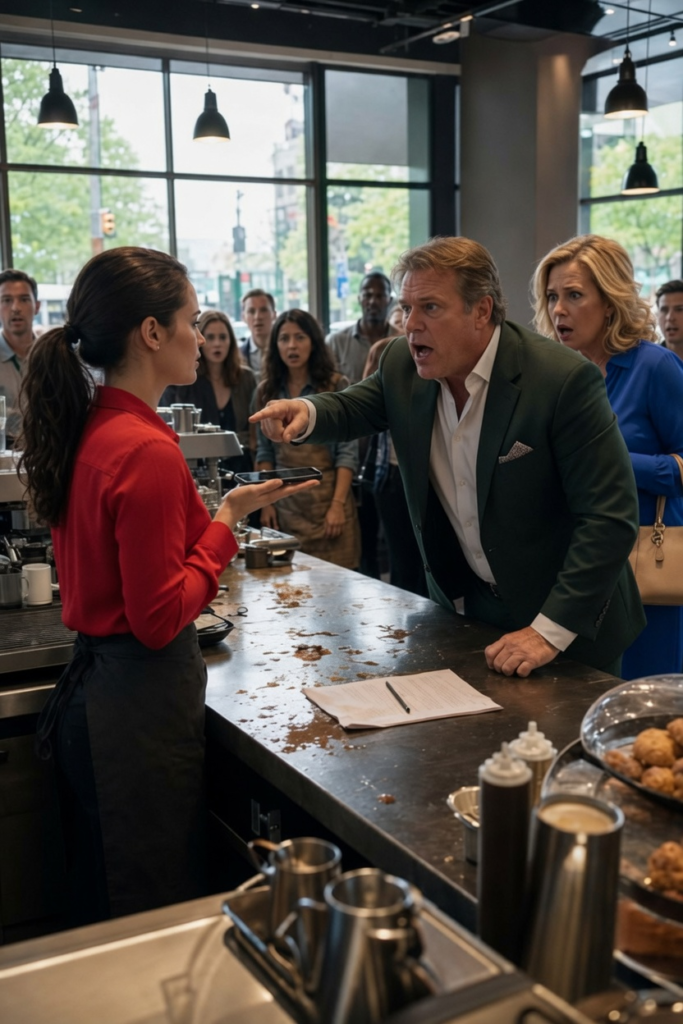
My Parents Cut Me Off For 4 Years Like I Didn’t Exist. Then They Walked Into My Coffee Shop Uninvited, Loud, Smiling At Customers Like They Owned It. My Dad Slammed A Contract Down And Hissed, “Sign Over 15%… Or I Call Your Landlord Tonight.” My Mom Smirked. I Stayed Calm And Said, “Sure—Let’s Call Him.” When He Answered, I Put It On Speaker. Landlord: “Who Told You I’d Evict Her?”
### Part 1
My parents cut me off for four years like I had died and they did not want to pay for the funeral.
No calls. No Christmas cards. No birthday texts pretending to be polite. No “how are you holding up?” from my mother, who used to cry if I did not answer her within ten minutes. No voicemail from my father saying my name in that stiff, disappointed way that made me feel nine years old even when I was thirty.
Just silence.
Clean, cruel, intentional silence.
And honestly, after the first year, I stopped mistaking it for grief. It was punishment. My father did not lose people. He exiled them. He made the whole family pretend you had walked out of the room on your own, even when everyone saw him shove you toward the door.
The reason was simple.
I said no.
Back then, “no” had been one small word at a family dinner, spoken over a cooling plate of roast chicken while my younger sister Layla scrolled on her phone and my mother folded a napkin into nervous little squares. My father wanted me to sign something. He always wanted someone to sign something. A loan. A guarantee. A “family investment agreement.” His words were always polished, but the meaning was always the same.
Give me control, and call it love.
I refused.
He stared at me from the head of the table, his silver fork resting beside his plate, and said, “Then you’re on your own.”
My mother did not look at me. Layla whispered, “Mara, don’t be dramatic.”
So I stopped being dramatic.
I got up, put my coat on, and walked out with my hands shaking inside my pockets.
Four years later, my hands did not shake anymore.
At least not where anyone could see.
I owned a coffee shop on Alder Street, a narrow corner unit wedged between a florist and a shoe repair place that smelled like polish, wet leather, and old rain. When I first leased it, the front window was cracked, the floor slanted near the register, and the old ceiling fan made a clicking sound like a loose tooth. The first winter, cold air came through the doorframe so sharply that I kept a towel rolled against it during closing.
But I loved that ugly little space.
I painted the walls myself. I bought used stools from a diner auction three towns over. I found our first espresso machine in a restaurant liquidation warehouse, dented on the left side but stubborn enough to survive the morning rush. I rewrote the chalkboard menu every day because it made the place feel alive. Cappuccino. Honey oat latte. Brown sugar cold brew. Blueberry scones from Lila Mae’s bakery down the block.
By the time Riverside Coffee turned two, regulars knew which corner table had the best outlet, which barista made the prettiest foam art, and which hour of the afternoon the sun hit the front window just right.
That Tuesday started like any other.
The sky was pale and cold. The sidewalk outside still held little dark patches from overnight rain. Inside, the shop smelled like espresso, cinnamon, and toasted bagels. Nina, my barista, was wiping the steam wand with one hip leaned against the counter, humming under the music. Grant, one of our regulars, had already claimed the window table with his laptop and his ridiculous noise-canceling headphones.
I was pouring milk into a pitcher when the bell above the glass door rang.
At first, I did not look up. Bells rang all morning. Customers came in with wet shoes and tired faces, asking for caffeine like it was a legal right.
Then I heard my mother laugh.
Not a big laugh. Not even a real one. A soft, airy little sound she used when she wanted strangers to think she was kind.
My fingers tightened around the milk pitcher.
I looked up.
My father walked in first.
Daniel Pierce still had the same broad shoulders, the same expensive coat, the same steady stare that used to make waiters apologize for things they had not done. My mother came in beside him, blonde hair swept neatly under a cream wool hat, mouth curved into a bright smile that did not reach her eyes.
Behind them came Layla.
She held her phone at chest height.
Filming.
For a second, my shop seemed to shrink around them. The lights felt too warm. The music too soft. The hiss from the espresso machine sounded suddenly far away, like steam escaping from another room.
They did not stop at the line.
They did not look at the menu.
They moved straight toward the counter, smiling at my customers like they had arrived for a ribbon-cutting.
My father looked around and said loudly, “Well, isn’t this a cute little place?”
Grant lifted one side of his headphones.
My mother touched the edge of the counter like she was checking for dust. “It’s charming,” she said. “Our Mara has always been so entrepreneurial.”
Our Mara.
Four years of silence, and now she said our like she had misplaced me in a drawer and just found me again.
I set the milk pitcher down.
“Can I help you?” I asked.
My father’s smile disappeared so quickly it was almost satisfying.
He reached into his leather portfolio, pulled out a stapled packet, and slapped it onto my counter hard enough to make the pen cup rattle.
“Sign this,” he said.
I glanced down.
The top page had my business name typed in clean black letters.
Riverside Coffee LLC.
Below it, my name.
And below that, three words that made the air turn colder.
Membership Interest Transfer.
My father leaned in, lowering his voice just enough to make it feel like a threat pretending to be private.
“Fifteen percent,” he said. “That’s the family tax.”
I looked at the packet.
Then at him.
Then at Layla’s phone, still pointed at my face.
And for the first time that morning, I understood they had not come to reconnect.
They had come to collect.
### Part 2
I did not touch the papers.
That mattered.
My father had taught me that without meaning to. He loved documents because documents looked clean even when the hands behind them were dirty. A signature turned pressure into permission. A stapled packet made theft look administrative. A folder made greed look prepared.
So I kept my hands on my side of the counter.
“Why would I sign over fifteen percent of my business to you?” I asked.
My voice came out calm. Not warm. Not angry. Calm in the way locked doors are calm.
My father’s eyes narrowed. He had expected surprise. Maybe tears. Maybe that old flinch I used to give him when he leaned forward at the dinner table and made the whole room wait for my surrender.
He did not get it.
“Because,” he said, “you still don’t understand how the real world works.”
My mother gave a soft sigh, the kind she used to release in church when she wanted people to know she was suffering beautifully.
“Mara,” she said, “your father is trying to help you.”
Layla shifted a step to the side, adjusting the angle of her phone. I could see the reflection of my face on her screen. I looked pale, but not broken. That probably annoyed her.
“Help me?” I repeated.
My father tapped the packet with two fingers. Tap. Tap. Tap. “Fifteen percent is generous. We could ask for more.”
A laugh almost came out of me, but I swallowed it. “For what?”
“For family support,” my mother said.
“You cut me off for four years.”
My mother’s smile twitched. “You needed space.”
“No,” I said. “You gave me silence because I wouldn’t sign Dad’s paperwork.”
A man in line pretended to study the pastry case with intense interest. Grant had removed both sides of his headphones now. Nina was still beside the espresso machine, but her hands had stopped moving.
My father noticed the audience and changed his face.
It was almost impressive how quickly he could do it. The hard mouth softened. The eyes warmed by a few degrees. His shoulders relaxed as if he were a reasonable man dealing with a difficult daughter.
“We’re proud of you,” he said, louder. “We really are. But businesses need structure. They need guidance. You’ve done well for yourself, but you’re renting a little storefront. One bad inspection, one complaint, one lease issue, and all of this disappears.”
There it was.
The first knife.
I picked up a towel and wiped a clean spot on the counter that did not need wiping.
“What lease issue?” I asked.
His smile returned, thin and private.
“You think your landlord knows everything you’re doing here?”
The old Mara would have answered too fast. She would have defended herself, explained every permit, every inspection, every receipt. She would have opened her life like a folder and begged him to believe she had done things correctly.
I was not that woman anymore.
I folded the towel.
“What exactly do you plan to tell him?”
My father’s gaze sharpened. “I’ll tell him you’re violating your lease.”
“With what?”
“Unapproved food service. Unsafe wiring. Unauthorized modifications. Maybe subletting.”
My mother tilted her head. “You don’t own this building, sweetheart. You’re just renting.”
She said just like it was a stain.
The shop went very still.
Outside, a bus groaned past the corner. The front window trembled faintly in its frame. Someone’s spoon clicked against a ceramic cup.
I looked at my father and said, “So your plan is to lie to my landlord unless I sign over part of my company.”
Layla’s phone dipped.
Only for half a second.
My father’s jaw moved. “Don’t twist this.”
“I’m clarifying.”
“You always did love playing victim.”
I slid the packet back toward him using the edge of a napkin. I did not want my fingerprints on it yet.
“No,” I said.
The word landed softly, but it hit him harder than shouting would have.
His face went flat.
My mother inhaled through her nose. Layla’s eyebrows rose like she had just captured the moment she wanted.
My father picked up his phone.
“Then I call him.”
“Sure,” I said.
He paused.
I looked at the phone in his hand. “Call him.”
My father blinked once. He had not expected that.
I leaned slightly forward. “Put it on speaker.”
His eyes flashed.
For one second, the whole shop seemed to lean with us. Customers stopped pretending not to listen. Nina slowly set down a metal pitcher. Grant closed his laptop halfway.
My father looked around and realized he had trapped himself. If he refused, he lost the performance. If he agreed, he created a record.
People like my father hate records unless they control them.
He tapped his phone hard, scrolled, then hit a contact.
The ringtone filled the quiet shop.
One ring.
Two.
Three.
Then a gravelly voice answered.
“Yeah?”
My father’s smile returned like a curtain being pulled over a broken window.
“Ray,” he said warmly. “It’s Daniel Pierce. We need to talk about your tenant.”
I waited.
My father looked at me while he said it, enjoying every syllable.
“The coffee shop,” he continued. “Riverside Coffee. I’m her father, and I need to inform you—”
I leaned toward the phone.
“Hi, Ray,” I said. “It’s Mara.”
The silence on the line changed shape.
Then Ray said, “Mara? Hey. What’s going on?”
Hey.
One small word.
Familiar. Concerned. Not confused.
My father’s smile cracked.
My mother’s eyes flicked from his phone to my face.
Ray was not speaking to me like a landlord caught off guard by a problem tenant.
He was speaking to me like someone who already knew exactly who I was.
And my father heard it too.
### Part 3
My father tightened his grip around the phone until his knuckles paled.
“Ray,” he said, forcing his voice back into that smooth business tone. “As I was saying, I’m calling because there are serious issues with your tenant’s use of the premises.”
Ray did not respond immediately.
That pause felt better than applause.
Then he said, “Who is this again?”
My father’s nostrils flared. “Daniel Pierce. Mara’s father.”
Another pause.
“I don’t deal with fathers,” Ray said. “I deal with my tenant.”
The shop went so quiet I could hear the refrigerator behind the pastry case hum.
My mother’s smile faltered.
Layla’s phone lowered a fraction, then rose again, like muscle memory.
Ray’s voice came through the speaker, rough and steady. “Mara, are you okay?”
I looked directly at my father.
“I’m fine,” I said. “They walked into my shop and threatened to call you unless I signed over fifteen percent of my business. I wanted you to hear it directly.”
My father snapped, “That is not—”
Ray cut him off.
“Daniel, are you still on speaker?”
My father’s mouth tightened. “Yes.”
“Good. Then listen carefully. You do not get to threaten my tenant. You do not get to call me about her lease unless you are her attorney with written authorization. And you definitely do not get to walk into her business and demand ownership.”
My mother’s cheeks flushed pink.
My father tried to laugh. It came out dry. “Ray, I own multiple properties. I know how leases work.”
“You don’t know how this lease works,” Ray said, “because I wrote it.”
That hit.
I saw it in my father’s eyes.
For the first time since he walked in, he was not performing. He was calculating.
Ray continued, “The coffee shop use is approved. The electrical work was inspected. The permits are filed. Any modifications were documented. Mara’s lease is in good standing.”
My father opened his mouth, but Ray kept going.
“And if you call me again to harass her, I’ll treat it as interference with contract and hand it to my attorney.”
My mother’s lips parted slightly.
Layla’s phone trembled.
My father recovered with the speed of a man who had spent his whole life turning blocked roads into new threats.
“You don’t understand the family situation,” he said. “Mara has always been impulsive. We’re trying to protect her from making reckless decisions.”
Ray laughed once.
It was not a friendly laugh.
“Protect her by extorting fifteen percent of her business?”
My father’s face hardened.
“You’re using an ugly word.”
“It fits.”
For a moment, I wanted to close my eyes.
Not because I was weak.
Because hearing an outsider name the thing my family had spent years disguising felt like stepping into sunlight after living under fluorescent bulbs.
Extortion.
There it was.
Plain. Ugly. Accurate.
Ray’s voice softened only when he spoke to me. “Mara, do you want me to come down there?”
“No,” I said. “I want a record.”
“You’ve got it. I’m texting you right now that your lease is secure and that I do not recognize calls, claims, or complaints from them. Save everything.”
“Thank you.”
“And Mara?”
“Yes?”
“If they’re threatening you, call the police. Not me.”
My father slammed his palm lightly against the counter, not enough to look violent, enough to remind everyone he wanted to be.
“This is ridiculous,” he said. “It’s a family matter.”
Ray’s answer was immediate.
“Family matters don’t include extortion.”
Then the call ended.
The speaker went dead.
For a few seconds, nobody moved.
Steam hissed from the espresso machine. A cup clinked somewhere near the window. Outside, tires whispered over wet pavement.
My father stared at his phone like the device had betrayed him.
Then he looked at me.
What I saw on his face was worse than rage.
Rage burns hot. It spends itself.
This was colder.
This was calculation.
“Cute,” he said softly. “You think you’re safe because your landlord likes you.”
My mother’s smile came back thin and bitter. “You always find a man to hide behind.”
I did not explain Ray was not a man I hid behind. Ray was a contract. A file. A paper trail. A professional relationship built on inspections, signatures, and payments made on time.
My father tapped the packet again.
“Sign.”
“No.”
“Or we do this another way.”
I rested both palms on the counter.
“What other way?”
He leaned closer. His cologne hit me then, sharp and expensive, the same cold cedar smell that used to linger in our hallway after he left for work.
“You’re running this under an LLC,” he said. “Riverside Coffee. I know your filings. I know your registered agent. I know enough to make your life difficult.”
My stomach tightened.
Not because he had power.
Because he had been watching.
Four years of silence, and somehow he knew my business structure.
“You haven’t been in my life,” I said. “How do you know anything about my filings?”
My mother glanced toward Layla.
It was quick.
Too quick for anyone else, maybe.
But I saw it.
Layla’s thumb shifted on her phone.
My father smiled. “You posted your grand opening. You tagged your business page. Don’t act invisible when you advertise yourself.”
That sounded reasonable.
Too reasonable.
A red herring wrapped around something dirtier.
He lowered his voice.
“I can file things too, Mara. I can trigger reviews. I can make your merchant processor nervous. I can call your suppliers. I can make every boring little office you depend on start asking questions.”
I looked at him for a long second.
Behind him, Grant’s face had gone still. Nina had one hand under the counter, near the silent security button we had installed after someone smashed the side window last winter.
My father had made one mistake already.
He thought witnesses belonged to the loudest person.
But witnesses belong to whoever has proof.
“So,” I said, “you came here to extort me, and now you’re threatening fraud.”
My father smiled.
“I came to claim what’s owed.”
My phone buzzed against the shelf beneath the register.
A new notification lit the screen.
Registered Agent Portal: Urgent Activity Detected.
I looked down.
Then back at Layla.
Her phone was no longer filming.
She was typing.
### Part 4
I did not pick up my phone right away.
That was the hardest part.
Every instinct in my body wanted to grab it, open the notification, and see how deep the knife had gone. But my father was watching me. My mother was watching me. Layla was watching me from behind a curtain of fake innocence, thumbs hovering over her screen.
So I moved slowly.
I turned to Nina first.
“Can you remake table six’s latte?” I asked. “I think the foam sat too long.”
Nina looked at me for half a beat, then understood.
“Of course.”
Normal words.
Normal movement.
The kind of normal that made panic feel rude.
My father scoffed. “Still pretending you’re in control?”
I picked up my phone from the shelf.
“I’m checking something.”
My mother gave a brittle laugh. “Your little app won’t help you.”
I opened the registered agent portal.
The urgent alert sat at the top with a red flag icon.
Attempted Change Request Detected.
My fingers did not shake, but I felt my pulse in each fingertip.
I tapped it.
The page loaded slowly. Too slowly. The spinning circle turned while my father leaned on the counter like he owned the seconds too.
Then the details appeared.
Entity: Riverside Coffee LLC.
Request type: registered agent change and executive control update.
Status: pending owner verification.
Submission source: Riverside Coffee Guest Wi-Fi.
My eyes lifted.
Layla looked down too fast.
There it was.
Not proof of everything, not yet. But enough to change the temperature in the room.
My father saw my face and smiled.
“What?” he asked. “Something wrong?”
I turned the screen slightly, not toward him yet. Toward myself. I kept reading.
Submitted name: Daniel Pierce.
Submitted email: d.pierce—
I stopped before saying the rest out loud.
Not because I was protecting him.
Because I wanted him to walk further into his own trap.
“When did you file it?” I asked.
My father’s eyebrows rose. “File what?”
My mother’s head snapped toward him.
Layla whispered, “Dad.”
It was tiny.
Almost nothing.
But Officer Chen would later describe it as the first crack in their alignment. At that moment, I only felt the cold confirmation of what my gut already knew.
“You said you can file things,” I said. “I’m asking when.”
My father’s mouth tightened. “This morning.”
“Before or after you walked into my shop?”
He smiled again. “Does it matter?”
“Yes.”
His eyes narrowed. “Before.”
I looked down at the timestamp.
9:12 a.m.
It was now 9:18.
They had not filed before coming in.
They had filed while standing in front of me.
From my guest Wi-Fi.
With Layla’s phone.
I placed my phone flat on the counter, screen up.
The customers nearest the register could see enough to understand there was a red warning, a business name, a timestamp.
My father’s face changed.
“Turn that off,” he said.
“No.”
“Mara.”
“No.”
He reached toward the phone.
I did not move it.
I only lifted my eyes to the small black dome camera above the corner of the counter.
My father followed my gaze.
For the first time since entering my shop, he noticed the cameras.
Not decorative. Not fake. Real cameras, installed after a break-in attempt, angled to cover the register, pastry case, front door, and counter.
Nina, still near the espresso machine, slid her hand beneath the counter.
I gave her one small nod.
She pressed the silent security button.
No siren. No flashing lights. No drama.
Just a signal.
My father sensed something shift. He always sensed resistance, the way dogs sense storms.
“What did you do?” he asked.
I kept my voice even. “I preserved the moment.”
My mother leaned closer to me, her perfume sweet and powdery, suffocating in the coffee-scented air.
“Mara,” she said softly, “stop this now before you embarrass yourself.”
I almost smiled.
Embarrassment had been my mother’s favorite leash.
Don’t embarrass us.
Don’t make a scene.
Don’t tell people private things.
Don’t react where others can see.
It had taken me years to understand that privacy, in my family, meant secrecy for the powerful and silence for everyone else.
“You walked into my business,” I said, “demanded ownership, threatened my lease, and attempted a filing from my Wi-Fi. I’m not the one embarrassing myself.”
My father’s eyes hardened.
“You think that alert means anything? It’s pending. Nothing happened.”
“Then you won’t mind if I keep the record.”
“Delete it.”
“I can’t. It’s not just on my phone.”
That was not entirely a bluff. The portal generated server records. My registered agent would preserve the alert. The Wi-Fi router kept logs. The cameras had timestamps. The silent alarm would create another.
A web.
My father hated webs he did not spin.
Layla’s face had gone pale. Her phone was now held low against her coat. She looked younger than twenty-six for the first time in years, like the little girl who used to hide broken things behind sofa cushions and cry only when someone found them.
“Dad,” she whispered again. “Maybe we should go.”
My father did not look at her.
“We are not going anywhere.”
The bell above the door rang.
Every head turned.
A man stepped inside wearing a charcoal suit that did not belong to Alder Street before noon. He carried a clipboard against his ribs and scanned the room once. Counter. Cameras. Customers. Me.
Then my father.
He walked forward with calm, official steps.
“Daniel Pierce?” he asked.
My father straightened. “Who wants to know?”
The man opened a badge-style ID on a lanyard.
“My name is Elliot Crane. Business Filings Compliance. I’m here regarding an urgent attempted change of control filing connected to Riverside Coffee LLC.”
My mother’s mouth opened.
Layla stopped breathing.
And my father, for the first time that morning, looked afraid.
### Part 5
Elliot Crane did not raise his voice.
That made him more frightening.
My father understood raised voices. He knew how to meet them, overpower them, turn them into family drama. A calm man with a clipboard was different. A calm man with official language and a reference number was a locked door with no handle.
Elliot looked past him and met my eyes.
“Are you Mara Pierce?”
“Yes.”
“I need to verify whether the attempted filing was authorized by the owner of record.”
My father stepped between us slightly. “This is private.”
Elliot did not move. “Sir, the filing is not private once it triggers a fraud review.”
My mother gave a quick, nervous laugh. “Fraud review? That sounds dramatic. We’re family.”
Elliot looked at her. “Family is not filing authority.”
Grant made a sound from the window table that might have been a cough or might have been a swallowed laugh. My father shot him a look. Grant lifted his coffee cup and stared calmly back.
Elliot placed the clipboard on the counter, angled toward me.
I saw the printed details.
Entity name.
Timestamp.
Submission source.
Submitted party.
Pending verification.
My father’s name sat there in neat black letters.
Daniel Pierce.
There was something almost beautiful about it. Not joyful. Not satisfying exactly. Beautiful the way a photograph can be beautiful when it captures a storm hitting shore. Proof does not soften damage, but it gives damage a shape.
Elliot tapped the reference line. “This filing attempt originated from this location’s guest network. The portal’s automated review flagged it because owner verification did not match the requested control change.”
My father folded his arms. “You people overcomplicate everything.”
“Sir, did you submit the request?”
“No.”
Layla’s face jerked toward him.
My mother closed her eyes briefly.
Elliot wrote something down.
My father added, “I may have reviewed paperwork.”
“Did you submit a control change request for Riverside Coffee LLC?”
“I said no.”
I watched Layla’s throat move as she swallowed. Her phone screen had gone dark, but she held it like it might still save her.
Elliot turned to me. “Ms. Pierce, was this filing authorized?”
“No.”
“Do you wish to file a formal fraud affidavit?”
My father snapped, “Don’t you dare.”
The old command hit the room like a glass thrown against tile.
For one second, I was back at my parents’ dining table, twenty-nine years old and still somehow a child, listening to my father say, “You sign where I tell you to sign.” My mother staring at her napkin. Layla mouthing sorry without meaning it.
Then the espresso machine hissed behind me.
My shop.
My counter.
My name on the permits.
My choice.
“Yes,” I said. “I want everything preserved.”
Elliot nodded. “Then I’ll initiate the affidavit packet and include a preservation request for submission logs, authentication attempts, and any relevant CCTV time window.”
My father’s face darkened. “You’re threatening me.”
“I’m documenting you.”
The front doorbell rang again.
Two uniformed officers entered.
Officer Ramirez came in first, compact and focused, dark hair pulled back, eyes scanning the shop quickly. Officer Chen followed, taller, one hand near his radio.
The customers went completely silent.
Ramirez looked at me. “Ma’am, we received a silent alarm. Are you the owner?”
“Yes.”
“Are you safe?”
“I’m safe,” I said. “They’re my family. They came in and threatened extortion if I didn’t sign over fifteen percent of my business. Then an unauthorized filing attempt was made from my guest Wi-Fi.”
Officer Ramirez’s gaze moved to my father.
“Sir, step back from the counter.”
My father lifted his chin. “This is a family conversation.”
Officer Chen said, “Step back.”
My father hesitated.
That hesitation told the truth better than any confession. He was not deciding whether to obey. He was deciding whether he could still dominate the room.
He stepped back.
Officer Ramirez looked at Elliot. “And you are?”
Elliot showed his ID. “Business Filings Compliance. I responded to a fraud trigger associated with Riverside Coffee LLC.”
Ramirez nodded once, like the puzzle pieces had started forming a picture.
She turned back to me. “Do you want them trespassed?”
My mother gasped. “Mara.”
I did not look at her.
“Yes,” I said. “All three of them.”
Layla’s face crumpled.
For one second, I felt it. Not guilt. Not enough to stop. But the ghost of being sisters. The memory of us eating cereal on the kitchen floor during summer storms. Her small hand in mine on the first day of middle school. Her crying after prom because a boy humiliated her, and me driving across town with ice cream melting in the passenger seat.
Then I remembered her phone.
Her filming.
Her typing.
The way she had walked into my shop behind them, not pulled by a leash, but carrying a camera.
Officer Chen took out a notebook.
“What exactly was the threat?” he asked.
“My father told me to sign over fifteen percent or he would call my landlord and claim lease violations. When that failed, he threatened compliance complaints, suppliers, merchant processing, and filings. Then the portal flagged an unauthorized change request from this Wi-Fi network.”
My father barked a laugh. “Listen to her. She rehearsed this.”
“No,” I said. “I documented it.”
Officer Ramirez looked up at the cameras. “Those record audio?”
“Video only at the counter,” I said. “But there are witnesses. And the phone call to Ray was on speaker.”
Grant raised one hand slightly from his table. “I heard it.”
So did the man near the pastry case. So did the woman with the stroller. So did Nina, whose face had gone fierce.
My father looked around and realized the room had turned against him.
Not emotionally.
Factually.
That was worse.
Officer Chen asked for identification.
My father refused at first, then produced his wallet with theatrical disgust. My mother handed hers over with trembling fingers. Layla tried to say she had left hers in the car.
Officer Ramirez only looked at her.
Layla found it.
Chen copied their names.
Then he stopped.
His pen hovered.
He frowned at my father’s ID, checked something on his device, and looked at Ramirez.
“Ramirez,” he said quietly. “You need to see this.”
My stomach tightened.
Ramirez stepped closer. Chen angled the screen away from the customers and murmured something too low for most people to hear.
But I heard two words.
Same pattern.
Officer Chen looked at me, his expression careful now.
“Ma’am,” he said, “there’s an active report attached to your father’s name from another address.”
My father went still.
I looked at Chen.
“What kind of report?”
His eyes held mine.
“Filing interference,” he said. “Attempted control.”
The room seemed to tilt.
Because suddenly, this was not just my father trying to steal from me.
It was my father getting caught doing what he had already done before.
### Part 6
I asked Officer Chen if we could speak in the back.
Not because I wanted privacy for my father’s sake. That instinct was dead. I wanted my customers out of the blast radius. People came to Riverside Coffee for caffeine, warmth, and a place to breathe between problems. They did not come to watch a family rot in public.
Nina took over the counter.
Her face was pale, but her voice stayed steady. “I’ll handle drinks.”
I nodded once. “Thank you.”
Elliot followed me into the small office behind the register. Officer Chen came in after him. Ramirez stayed near the front with my family, issuing the trespass warning and keeping my father from turning the sidewalk into a courtroom.
My office was barely bigger than a pantry. Two shelves, a dented filing cabinet, a desk I bought secondhand from a retired dentist, and a tiny window facing the alley. It smelled like printer paper, coffee beans, and the peppermint hand lotion Nina kept stealing from me.
I closed the door.
The café noise became muffled: milk steaming, chairs scraping, the low murmur of customers pretending not to discuss my life.
Officer Chen spoke first.
“There’s an earlier complaint involving your father. Different business. Similar facts.”
“What business?”
“A boutique across town. Owner reported pressure to sign over an ownership interest. When she refused, an unauthorized filing attempt was detected through the state portal.”
Elliot’s expression sharpened. “Public network?”
Chen glanced at him. “That’s what the report says. Coffee shop nearby.”
A cold thread pulled through my chest.
Not fear exactly.
Recognition.
My father had not walked into my shop desperate and emotional. He had walked in with a method.
Percentage demand. Public pressure. Filing attempt. Confusion. Exhaustion. Make the victim spend money defending something that should never have been threatened.
He had turned bureaucracy into a weapon.
“How long ago?” I asked.
“Three months.”
I thought of my parents’ silence during those months. The absence I had almost started calling peace.
“What happened to the boutique owner?”
Chen’s face softened slightly. “She caught it early. The filing didn’t go through. But there wasn’t enough tied to a person at the scene. Mostly network data and emails. Today is different.”
“Because he came here.”
“Because he came here,” Chen said. “Because you have cameras, witnesses, a silent alarm timestamp, and a live compliance response.”
Elliot tapped his clipboard. “And because the submission data names him.”
I leaned against the edge of my desk.
The wood pressed into my palms.
For years, my father had been a shadow over my life. A voice in my head. A threat that did not need to appear to work. Now he had a reference number.
It was strange how much smaller monsters became when they fit inside a case file.
Officer Chen said, “I need to ask you something. Has he done this before? To you or anyone in your family?”
I almost laughed.
Where would I start?
The college savings account he called “family-managed.” The car title he kept in his name after I paid him back. The “temporary” credit card he opened when I was twenty-two because he said it would help my score. The contract he wanted me to sign four years ago, the one that would have made me personally responsible for one of his failed projects.
Not illegal enough to arrest. Not clean enough to forget.
“My father likes signatures,” I said. “He likes control. Four years ago, he tried to make me sign a guarantee for one of his investments. I refused. That’s when they cut me off.”
Chen wrote that down.
Elliot asked, “Do you still have a copy?”
“Yes.”
The answer surprised even me.
I had not looked at that old folder in years. It lived in a plastic storage bin at home under winter blankets and a box of Christmas ornaments I never used. I kept it because some part of me had always known silence was not the same as safety.
Chen said, “Preserve it. Don’t alter anything. Your attorney will know what to do.”
The word attorney made something in my stomach settle.
I had one now.
Not because I was rich. Because after my first year in business, after one too many vendor contracts written in language designed to trap small owners, I paid a local business attorney for a consultation. Her name was Priya Desai. She wore bright lipstick, drank black coffee, and once told me, “Paperwork is not scary. Unread paperwork is scary.”
I had listened.
That was one reason my father was failing today.
I pulled my phone out and texted Priya with one hand.
Need you. Parents attempted control filing. Police here. Compliance here. Evidence preserved.
She responded in less than a minute.
Do not speak privately with them. Do not sign anything. Send me portal screenshots. I’m on my way.
I showed Chen the text.
He nodded. “Good.”
A sharp knock hit the office door.
Before I could answer, my mother’s voice came through, muffled but poisonous.
“Mara, open this door. Now.”
Officer Chen stepped forward and opened it himself.
My mother stood there with Ramirez behind her. My father was visible over her shoulder, furious and flushed. Layla hovered near the front door, crying silently.
My mother’s eyes locked on me.
“You’re making a mistake,” she said. “You have no idea what he knows.”
The office went still.
Officer Ramirez said, “Ma’am, step back.”
But I had already heard it.
Not what he can do.
What he knows.
My father’s face changed before my mother could hide hers.
There was another secret.
And this time, I was not the only target.
### Part 7
My mother realized her mistake too late.
Her mouth closed so fast her teeth clicked.
My father’s eyes cut toward her with the kind of rage that never needed volume. Layla looked between them, confused, then scared, then something worse.
Guilty.
Officer Ramirez guided my mother back toward the front. “You’ve been asked to leave. The trespass warning is being issued. Do not interfere.”
My mother tried to look dignified while being moved three steps backward. She failed.
My father did not.
He gathered himself like a man putting on a clean jacket over blood.
“Mara,” he said, voice low. “You want to know why we came today?”
“No,” I said. “I know why. Money.”
He smiled.
It was a horrible smile because it almost looked sad.
“You still think too small.”
I felt Chen beside me, alert but quiet. Elliot stood with his clipboard against his chest, observing like every word was another brick in a wall.
My father continued, “Your little coffee shop isn’t the prize.”
My pulse slowed.
That sounds impossible, but it happened. In moments of real danger, my body did not speed up anymore. It narrowed. Everything unnecessary fell away. The room, the witnesses, even my mother’s perfume faded.
“What is?” I asked.
His eyes flicked around the shop.
The slanted morning light on the wood tables. The pastry case glowing warm. The chalkboard menu. The exposed brick wall I had uncovered myself after three nights of scraping old plaster with a putty knife.
Then his gaze settled on the ceiling, the windows, the walls.
The building.
I kept my face empty.
He did not know.
Not fully.
He suspected. Maybe my mother had heard something from a cousin who knew someone at the county office. Maybe Layla had stalked business pages and property records and misunderstood what she found. Maybe my father had seen enough to smell ownership the way sharks smell blood.
But he did not know everything.
So I gave him nothing.
Officer Ramirez said, “Sir, it’s time to leave.”
My father ignored her.
“You think I don’t know about the property transfer?”
There it was.
My mother’s face tightened.
Layla looked at me with wet, panicked eyes.
Elliot turned slightly toward me. Not surprised. Just attentive.
I walked back to the counter, opened the locked drawer beneath the register, and removed a thin black binder.
My father watched it like a weapon.
In a way, it was.
Not dramatic. Not labeled revenge. Just tabs. Lease. Permits. Insurance. Vendor contracts. Property.
I set it on the counter.
My father’s gaze dropped.
“What is that?”
“My paper trail.”
He hated that.
I opened to the property tab, but not to the page that revealed everything. Not yet. I pulled out an authorization letter and placed it in front of him.
Ray’s name appeared on it.
So did a legal entity.
My father leaned in, reading fast.
His eyebrows pinched.
“This doesn’t mean anything.”
“It means Ray is authorized to manage the property.”
“So?”
“So when you threatened to call my landlord, you were already speaking to the person authorized to answer.”
My father’s mouth twitched. “Authorized by whom?”
I turned one more page.
Not the deed summary yet.
A right-of-first-refusal notice. Old. Dated eighteen months earlier. It had been issued when the previous owner decided to sell the Alder Street building to a developer who wanted to gut the row and replace our block with polished retail no small business could afford.
I remembered that month with physical pain.
The sleepless nights. The spreadsheet open until 2 a.m. The smell of burnt coffee because I kept reheating the same mug. Ray, who managed the property and owned a minority stake, telling me, “If you can pull together financing, we can stop the sale.” My hands around the phone. My laugh because I thought he was joking.
He had not been joking.
I did not have rich parents. I did not have a trust. I had four years of silence, two years of profit, obsessive records, a community lender willing to consider character when the numbers were tight, and a landlord who preferred stable tenants over quick developers.
I had time.
I had discipline.
I had every receipt.
My father read the right-of-first-refusal notice and went very still.
My mother whispered, “Daniel.”
He ignored her.
“You bought into the building.”
I did not answer.
Not directly.
He looked up. “With what money?”
I held his gaze.
“With the money I didn’t spend trying to earn your approval.”
His face hardened.
That hit deeper than the paperwork.
My mother’s eyes filled, but I knew better than to trust tears that arrived only when control failed.
Layla whispered, “Mara, we didn’t know.”
That made me look at her.
“You filmed me.”
Her lips trembled. “I thought Dad was just—”
“Just what?”
She had no answer.
Because there was no innocent version of walking into someone’s business with a camera while your father demanded ownership.
My father recovered again, but now his voice had lost its easy arrogance.
“If you have a stake in this building, then you can afford to settle this privately.”
I almost admired him.
Cornered from one side, he immediately tried another.
“No.”
His eyes flashed. “You don’t know what refusing me will cost.”
Officer Ramirez stepped forward. “Sir, this is your final warning. Leave now.”
My father leaned slightly toward me.
“Ask your mother what I know,” he whispered.
My mother went pale.
Layla made a small sound.
My father straightened, satisfied that he had planted something.
Then Ramirez moved between us and pointed toward the door.
He finally walked out.
My mother followed, but at the threshold she turned back. Her eyes found mine, desperate now in a way I had never seen before.
“Mara,” she said. “Don’t dig.”
Then the bell rang above the door as they stepped onto the sidewalk.
And for the first time all morning, I wondered whether my father had come to steal from me.
Or to stop me from finding something he had already stolen.
### Part 8
Priya arrived twenty minutes later wearing a navy coat, red lipstick, and the expression of a woman who billed in six-minute increments but had chosen anger for free.
She entered without looking at the menu.
“Office,” she said.
I pointed.
She disappeared into the back with Elliot and Officer Chen. I stayed at the counter long enough to help Nina clear the rush that had somehow continued around the wreckage of my life. People are strange that way. Someone can threaten your entire future at 9:15, and by 9:40 another person still wants oat milk and asks whether the blueberry scones are fresh.
Maybe that was comforting.
Maybe it was awful.
Grant approached the counter after the line thinned.
“You okay?” he asked.
Grant was a software engineer, I thought, or a designer, or possibly someone paid to sit in coffee shops and sigh at spreadsheets. I had known him two years and still wasn’t sure. He always tipped two dollars, never took phone calls inside, and once fixed our Wi-Fi router because he “couldn’t watch suffering happen in real time.”
“I will be,” I said.
He nodded toward the door. “I heard everything.”
“I’m sorry.”
“Don’t apologize to witnesses.”
That made me smile despite myself.
Then he added, “Also, your dad is terrifying in the way men are terrifying when they think the world is a customer service desk.”
I almost laughed.
“Accurate.”
His face softened. “Need anything?”
“Keep drinking coffee.”
“I can do that.”
When I finally stepped into the office, Priya had already turned my cramped desk into a war room. My portal screenshots were printed. Elliot’s reference sheet was clipped to a folder. Officer Chen had taken my initial statement. Ramirez had issued the trespass warning outside and returned with body camera notes.
Priya looked at me. “You did well.”
Two words.
I had not realized how badly I needed them until my throat tightened.
“I didn’t know they would come here.”
“No one expects family to behave like hostile corporate actors,” she said. “Unfortunately, yours brought paperwork.”
Elliot said, “The attempted filing is frozen. It won’t process without owner verification.”
Priya nodded. “Good. We’ll send preservation letters today. Portal provider, Secretary of State, Wi-Fi logs, cameras, landlord management entity, payment processor, and anyone else he threatened to contact.”
Officer Chen closed his notebook. “Given the earlier complaint, this may be referred for investigation beyond a trespass issue.”
Priya looked at me carefully. “Mara, I need to ask something. Has your father ever had access to your identity documents? Social Security card, birth certificate, old bank accounts, anything like that?”
A cold, familiar discomfort slid under my ribs.
“My parents had everything when I was younger.”
“Did you ever check your credit after you left?”
“Yes. Four years ago. There was one old card I didn’t recognize, but it had been closed. I disputed it.”
Priya’s eyes sharpened. “Do you have records?”
“At home.”
“Get them.”
Officer Chen said, “Don’t go alone if you think they might show up.”
“They don’t know where I live now,” I said.
Priya did not look comforted. “Keep it that way.”
I thought of my mother at the door.
Don’t dig.
The words felt like a hand around my wrist.
After the officers left and Elliot promised to send the formal packet, Priya stayed behind. She sat across from me in the office, knees angled because there was not enough room for two adults and all that evidence.
“What aren’t you telling me?” she asked.
I looked at the wall calendar above her shoulder. A coffee bean supplier delivery circled in green. Payroll marked in blue. Normal things. Safe things.
“My father said the coffee shop wasn’t the prize,” I said. “Then he mentioned the building. Then he told me to ask my mother what he knows.”
Priya’s face did not change much, but her pen stopped moving.
“Do you think he knows about your ownership interest?”
“Part of it, maybe.”
“Not all?”
I shook my head.
Because there was something my father had not seen in the public records yet.
Or maybe he had seen it and misunderstood it.
The building was held by Alder Row Holdings LLC, formed by Ray, me, and two small investors from the neighborhood association. At first, I was a minority member. Then six months ago, one investor retired and sold her interest.
I bought it.
Quietly.
Legally.
Painfully.
That made me managing member.
Not Ray.
Me.
The paperwork was filed. The public updates lagged. The county records showed enough to make a predator curious but not enough to show the whole structure cleanly unless you knew where to look.
My father had walked in thinking I was still just a tenant with a cute coffee shop.
Then he realized there was property.
Now he wanted in.
Priya leaned back. “We need to assume he will search everything.”
“I already assumed that.”
“Good. Then we prepare faster than he spirals.”
I looked at the stack of papers.
The old feeling rose in me again—not fear, exactly, but that childhood exhaustion of trying to predict which version of my father would come through the door.
Only now, I had a door with cameras.
And locks.
And people who answered when I called.
Priya gathered the papers. “Go home. Get the old documents. Anything tied to your father and signatures. Bring them to my office tonight.”
I nodded.
But when I got home that evening, the hallway outside my apartment smelled faintly of cedar cologne.
My father’s cologne.
And tucked under my door was an envelope with my name written in my mother’s handwriting.
Inside was one sentence.
You were not the first.
### Part 9
I stood in my apartment hallway holding that envelope while the motion light above me buzzed faintly like an insect trapped in glass.
My first thought was not fear.
It was annoyance.
Deep, hot annoyance that even after four years, even after being trespassed, even after police and compliance officers and lawyers, my family still believed they had the right to cross thresholds I had not opened.
My second thought came colder.
They knew where I lived.
I stepped inside quickly, locked the door, slid the chain into place, and stood still long enough to listen.
The apartment was quiet.
No footsteps in the stairwell. No whispering outside. No engine idling below. Just my refrigerator humming, rain ticking against the kitchen window, and my own breathing, too loud in my ears.
I set the envelope on the table like it might stain the wood.
My mother’s handwriting was unmistakable. Tall letters, careful loops, every line slightly tilted upward as if optimism could be forged by penmanship.
You were not the first.
No signature.
No explanation.
No apology.
Of course not.
I took a photo of the envelope, the note, the door, the hallway. Then I texted Priya.
They found my apartment. Note under door. Sending pictures.
Her reply came fast.
Do not call them. Do not respond. Pack what you need and go somewhere else tonight. I’m updating the report.
I stared at the message.
Some part of me wanted to argue. This was my home. I had chosen the cheap second-floor apartment with the noisy pipes because the morning light in the kitchen was beautiful and the landlord allowed me to paint the cabinets sage green. I had assembled the bookshelf myself. I had bought the blue rug after my first profitable quarter. I had slept here after sixteen-hour days when my feet throbbed and my hair smelled like espresso.
I hated that they could make even my home feel borrowed.
But hatred was not strategy.
I packed a bag.
Laptop. Charger. Documents from the storage bin. The old folder from four years ago. A change of clothes. Toothbrush. My grandmother’s ring, the only family object I still kept, not because it was expensive but because she had given it to me before she died and whispered, “Don’t let your father make you small.”
I almost left the Christmas ornaments.
Then I took those too.
Not for sentimental reasons.
Because I had bought them myself.
On the way to Priya’s office, I kept checking my mirrors. Every pair of headlights looked too familiar. Every turn felt like a test. Rain smeared the windshield, turning traffic lights into red and green wounds.
Priya’s office sat above a bakery on Mercer Avenue. By the time I arrived, the bakery was closed, but the stairwell still smelled like butter and sugar. Priya met me at the door in jeans and a sweater, hair tied back, lipstick gone.
That scared me more than the legal folders.
Lawyer Priya wore lipstick.
Emergency Priya did not.
She led me into a conference room where a lamp glowed warmly over the table. A manila folder sat beside two paper cups of coffee.
“I pulled the earlier boutique complaint,” she said.
“You can do that?”
“I called someone who could call someone. It’s not complete, but it’s enough.”
I sat down.
Priya opened the folder.
“The boutique owner’s name is Elise Warren. She inherited a small commercial space from her aunt. Your father approached her through a consultant, offered ‘business development support,’ then pressured her to sign over a minority interest. When she refused, someone attempted to file a management change.”
“Was my mother involved?”
“Not in the complaint.”
“Layla?”
“No.”
I looked at the note again.
You were not the first.
Maybe my mother meant Elise.
Maybe she meant someone else.
Priya watched my face. “There’s more.”
Of course there was.
She slid another page across the table.
It was not from the boutique complaint.
It was an old civil filing. Seven years earlier. A dispute involving my father’s company and a former partner named Thomas Bell. Allegations of unauthorized signatures, misuse of authority, pressure to transfer ownership.
The case had settled.
Confidentially.
My stomach went hollow.
“I remember Tom,” I said slowly. “He came to our house once. He brought my sister a stuffed penguin because she had a cold.”
Priya tapped the page. “He accused your father of forcing him out of a property deal.”
“What property?”
Priya’s silence gave me the answer before she spoke.
“Alder Street area.”
The room went soft around the edges.
“What?”
“The records are messy. Different entity names. Transfers. Dissolutions. But one parcel in that dispute was part of the same row your shop is in now.”
I stared at her.
Rain ticked against the office window.
Four years ago, my father had cut me off because I refused to guarantee his investment.
Two years ago, I opened Riverside Coffee.
Eighteen months ago, Ray helped me stop a developer from buying the building.
Six months ago, I became managing member.
And now my father had walked into my shop demanding fifteen percent.
Not because I had built something cute.
Because without knowing it, I had built my life on a piece of ground he had lost once before.
Priya said my name softly.
“Mara.”
I looked down at the old folder in my hands.
The one from four years ago.
For the first time, I wondered whether the papers my father tried to make me sign back then had not been about helping him invest.
Maybe they had been about pulling me into a mess he already knew would surface.
I opened the folder.
The first page still smelled faintly of dust and old toner.
And there, buried in the language I had been too scared to fully understand four years ago, was the name of the same dissolved entity from Thomas Bell’s lawsuit.
### Part 10
I read the page three times.
Each time, the words rearranged themselves into something uglier.
Personal guarantee.
Successor liability.
Indemnification.
Asset claims.
Four years ago, those terms had felt like fog. I had known enough to be afraid but not enough to name the shape of the trap. My father had told me it was standard. My mother had told me not to embarrass him. Layla had told me to sign so everyone could enjoy dinner.
Now, sitting under Priya’s conference room lamp, I understood.
My father had not asked me to support a fresh investment.
He had tried to make me absorb risk from an old one.
Priya read silently, her pen moving across a yellow legal pad. The longer she read, the colder her expression became.
“This is not standard,” she said.
“I know that now.”
“No, I mean this is aggressively not standard. This would have made you responsible for obligations tied to entities you didn’t own.”
I laughed once, but there was no humor in it. “He said it was a family opportunity.”
“It was a family shield,” she said. “With you as the shield.”
My hands curled around the edge of the table.
I remembered that dinner too clearly.
The roast chicken drying under warm lights. My father’s gold watch beside his plate because he said the clasp annoyed him. My mother refilling my wine though I had not asked. Layla taking a picture of dessert for Instagram while I read the first page with my heart pounding.
When I said I wanted a lawyer to review it, my father’s face had changed.
Not anger first.
Surprise.
Like a tool had spoken.
Then came the exile.
Priya leaned back. “Mara, did he know you were looking at Alder Street before you leased?”
“No. I found it myself.”
“Did he know Ray?”
“Not through me.”
“Did Ray know your father?”
I hesitated.
Ray was steady. Ray was blunt. Ray had been kind to me in the practical way that mattered: answering calls, approving repairs, telling me when contractors were overcharging, showing me how to read property tax notices without panicking.
But I had never asked him why he seemed unsurprised by complicated men.
“I don’t know,” I said.
Priya checked the time. “Call him.”
It was late, but Ray answered on the second ring.
“Mara?”
“I’m with my attorney.”
“Good.”
Priya leaned closer. I put the phone on speaker.
“Ray,” I said, “did you know my father before today?”
A pause.
Then a slow exhale.
“I knew of him.”
That answer landed heavy.
“How?”
Ray’s voice roughened. “Daniel Pierce was involved in an old fight over this block. Years before you leased your unit. He and another investor tried to roll up properties on Alder Street. It got ugly. Lawsuits. Settlements. People lost money.”
“Thomas Bell?”
Another pause.
“Yeah.”
Priya wrote the name down.
I swallowed. “Why didn’t you tell me?”
“Because when you first came to me, you were a tenant with a dream and a spreadsheet. Your father wasn’t part of the deal. I wasn’t going to poison your fresh start with old dirt unless it became relevant.”
“It’s relevant now.”
“I know.”
Ray sounded tired.
Older than usual.
He continued, “When the previous owner tried to sell, I suspected Daniel might hear about it eventually. Property records are public. But by then you had earned your place. You weren’t some kid playing café. You were the reason the building had value. The lenders saw that. The neighborhood saw that. I saw that.”
My throat tightened.
Ray added, “And for what it’s worth, I pushed for you to be managing member because I trusted you more than anyone else in that deal.”
Priya’s eyes flicked to mine.
My father would hate that sentence most of all.
“Ray,” Priya said, introducing herself quickly, “do you have records from the old dispute?”
“Some.”
“We need them preserved.”
“They already are.”
I closed my eyes briefly.
Of course they were.
Paper people survive paper predators by keeping copies.
Ray said, “Mara, listen to me. Daniel doesn’t just want money. He wants leverage. If he can create enough confusion around ownership, financing, or old claims, he may try to force a settlement. Don’t meet him. Don’t talk. Let counsel handle it.”
“I know.”
“Good. And don’t underestimate your mother.”
That made my eyes open.
“What do you mean?”
Ray’s voice lowered. “Back then, your mother carried messages. Friendly ones. Soft ones. She could get people to open doors after Daniel had scared them.”
I looked at the note on the table.
You were not the first.
My mother had not written that as a confession.
Maybe she had written it as a warning.
Or maybe as bait.
After we hung up, Priya and I sat in silence.
The bakery downstairs had gone dark. The street outside glistened under the lamps. My coffee had cooled untouched.
Priya finally said, “Your father may be trying to scare you into signing before you realize you have more leverage than he does.”
“What leverage?”
She tapped the old guarantee. “Pattern. Prior dispute. Today’s attempt. Earlier boutique complaint. Your mother’s note. Property connection.”
I looked at the stack.
For years, I had thought my family’s silence was a wall.
Now I saw it had been a cover.
Priya started organizing papers. “We file for a protective order. We notify investigators. We lock down your business accounts. We review property records. And tomorrow, we ask your mother—through counsel—what she meant.”
I shook my head.
“No.”
Priya looked up.
“She’ll twist it,” I said. “She’ll cry. She’ll say she was scared. She’ll make herself the victim before she gives one clean answer.”
“Then what do you want to do?”
I picked up the note.
The ink had pressed hard into the paper.
Not hurried. Not panicked.
Deliberate.
“I want to know who else my father hurt.”
Priya studied me. “That road may get ugly.”
“It started ugly.”
On my phone, a new message appeared from an unknown number.
For a second, I thought it was my mother.
It was not.
The message said:
This is Elise Warren. We need to talk before Daniel gets to you too.
### Part 11
Elise Warren did not want to meet at my shop.
“I like coffee,” she said over the phone, “but not enough to walk into a crime scene with pastries.”
I liked her immediately.
We met the next morning at a public library in a glass-walled study room that smelled faintly of dust, toner, and wet wool coats. Priya came with me. So did a folder full of copies. Officer Chen knew about the meeting. Ray knew too. For the first time in my life, I was not carrying family secrets alone in a plastic grocery bag of shame.
Elise arrived five minutes early.
She was in her late forties, maybe early fifties, with dark curls pulled into a loose knot and reading glasses hanging from a chain around her neck. She wore a green coat with one missing button and carried a tote bag that said Support Local Artists.
She looked tired in the way small business owners look tired. Not fragile. Sanded down.
“You’re Mara,” she said.
“Yes.”
She studied my face. “You look like someone who didn’t sign.”
“I didn’t.”
“Good.”
She sat across from me and took a folder from her tote.
No small talk.
No “how are you holding up?”
Just paper.
I respected that.
Elise owned a boutique called Thread & Thorn. Her aunt had left her the shop and the two-story building above it. For a year, everything went well. Then a consultant approached her with an offer to “scale her retail footprint.” He had smooth emails, clean proposals, references that seemed legitimate, and language that made taking money sound like joining a family.
“Then Daniel appeared,” Elise said. “Not at first. Men like him send softer people first.”
“My mother,” I said.
Elise looked at me.
“You know about that?”
“Ray warned me.”
Elise opened her folder and slid out a printed email.
From my mother.
Not her personal email. A community charity address I recognized from years of watching her organize fundraisers where rich women wore cream sweaters and congratulated themselves for donating winter coats.
Dear Elise, I’ve heard such lovely things about your shop…
My stomach turned.
The email was friendly. Warm. Full of compliments. My mother said she loved supporting women in business. She invited Elise to lunch. She mentioned “trusted advisors” who could help protect independent owners from market pressure.
Soft doors.
That was what Ray had meant.
My mother opened soft doors.
My father walked through them holding contracts.
Elise watched me read. “I’m sorry.”
I shook my head. “Don’t apologize for showing me the truth.”
“She made me feel seen,” Elise said quietly. “That was the trick. My aunt had just died. I was overwhelmed. Your mother listened. She brought soup once. Soup.”
I closed my eyes.
Of course she did.
My mother weaponized soup.
Elise continued, “By the time your father came in, I thought he was connected to someone safe.”
“What did he want?”
“Twenty percent at first. Then thirty. He said it was for capital access. When I refused, filings started. Then supplier calls. Anonymous complaints. A fake review campaign. Nothing dramatic enough by itself. Just enough to exhaust me.”
Priya asked, “Do you have records?”
Elise gave a dry smile. “I have everything.”
She pushed the folder forward.
There were screenshots, emails, call logs, complaint notices, a copy of the unauthorized filing alert, and a photo of my father standing inside Thread & Thorn near a rack of linen dresses, smiling like a man browsing while holding someone’s throat.
My chest tightened.
Not because I was surprised.
Because I was not.
Elise said, “I reported it, but without more victims, it looked like a business dispute.”
“It’s not,” I said.
“No. It’s a pattern.”
The word sat between us.
Pattern.
It was cleaner than “my father is a predator” and somehow more damning.
Elise leaned back. “There was another person before me. Thomas Bell.”
Priya nodded. “We found the civil filing.”
“He settled because he was sick,” Elise said. “Cancer. Daniel waited until he was weak. That’s what he does. He waits for pressure points.”
I thought of my four years of silence.
Maybe he had been waiting for mine.
Waiting until the shop grew. Until the building mattered. Until I had something visible enough to threaten.
“What does my mother get out of it?” I asked.
The question came out rougher than I intended.
Elise’s expression softened.
“I don’t know,” she said. “But I can tell you what she said to me when I finally confronted her.”
I braced myself.
Elise looked down at her hands. “She said, ‘Daniel only becomes cruel when people force him to be.’”
I stared at the table.
There it was.
My mother’s entire religion in one sentence.
My father acted.
Other people caused it.
Priya gathered the documents carefully. “Elise, would you be willing to give a formal statement?”
“I already called Officer Chen.”
For the first time that day, something like relief moved through me.
Elise looked at me again. “There’s something else.”
I almost laughed.
Every time someone said that lately, another floor disappeared.
“What?”
“Your sister contacted me last night.”
My mouth went dry.
“Layla?”
Elise nodded. “She sent a message from a new account. Asked if I still had emails from your mother. Asked if I would delete them.”
Priya went very still.
“Do you have the message?”
Elise smiled without humor.
“Of course.”
She slid her phone across the table.
The message was short.
Please. My mom can’t be tied to this. You don’t understand what he’ll do if this comes out.
I read it twice.
Not what Dad did.
What he’ll do.
Layla was scared of him.
But she was still protecting the wrong person.
A new message appeared on my own phone before I could speak.
This time, it was from Layla.
Mara, please don’t give them Mom’s name. Meet me alone. I’ll tell you everything.
### Part 12
I did not meet Layla alone.
Four years ago, I might have.
Four years ago, the word sister still had enough power to override common sense. I would have driven somewhere quiet, parked under a broken streetlight, and listened while Layla cried just long enough to make me feel responsible for saving everyone.
Not anymore.
I sent her one reply.
You can speak to my attorney.
She answered immediately.
No. Just you.
I put the phone face down.
Priya smiled faintly. “Good.”
We arranged the meeting anyway, but not on Layla’s terms. Priya’s office. Conference room. Door open. Recording disclosed. Elise’s documents already copied. Officer Chen notified that Layla might provide information relevant to an active complaint.
Layla arrived that afternoon wearing a beige sweater, no makeup, hair pulled back in a messy knot. She looked smaller without the phone held up between us.
For half a second, I saw my little sister.
Then she opened her mouth.
“You’re taking this too far.”
And the little sister vanished.
I sat across from her with Priya beside me.
“No,” I said. “Dad did that.”
Layla’s eyes filled. “You don’t understand.”
“I understand he used your phone in my shop.”
“He didn’t use my phone.”
Priya clicked her pen once. “Then who submitted the filing?”
Layla looked at her, then at me. “I did.”
The room went silent.
My breath stopped halfway in.
Priya leaned forward. “You understand this meeting is being recorded with your consent?”
Layla nodded, crying now. “Yes.”
“Say that again clearly.”
Layla wiped her face with her sleeve. “I submitted the filing request from my phone. Dad told me what to enter. I didn’t think it would go through. He said it was just to scare Mara into signing so we could fix everything privately.”
A dull ache opened behind my ribs.
Not surprise.
Grief.
There is a specific pain in hearing someone admit they betrayed you and realizing they are mainly upset that betrayal became inconvenient.
“You filmed me,” I said.
Layla looked down. “Dad said if you freaked out, we’d have proof you were unstable.”
Priya’s face turned to stone.
I almost stood up. Instead, I pressed my fingertips lightly against the table and counted the grain lines in the wood.
One. Two. Three. Four.
“Mom knew?” I asked.
Layla nodded.
“Mom sent the note?”
Another nod.
“Why?”
Layla swallowed. “Because Dad was furious after the shop. He said if you pushed charges, he would make sure Mom went down too. She panicked. She wanted you to know there were others so you’d understand it wasn’t personal.”
I laughed once.
Layla flinched.
“Not personal?” I said. “He walked into my business.”
“I know.”
“You helped him.”
“I know.”
“You tried to make me look unstable in front of my customers.”
“I’m sorry.”
The apology landed like a napkin thrown over a broken window.
Not enough.
Priya asked, “Why did you contact Elise Warren and ask her to delete emails?”
Layla’s hands twisted in her lap. “Because Mom’s name is on them.”
“Why protect your mother?”
“She’s trapped.”
“No,” I said.
Layla looked at me.
I felt something old and final settle in my chest.
“No, Layla. She is not trapped in the way you want her to be. She is comfortable until consequences arrive. Then suddenly she’s trapped.”
Layla started crying harder. “You don’t know what it was like after you left.”
I held her gaze.
“You’re right. I don’t. Because none of you called me.”
Her face crumpled.
For a second, I saw the cost of that sentence hit her. Good. Some truths should bruise.
Layla whispered, “Dad said you abandoned us.”
“Dad lies.”
“I know that now.”
“No,” I said. “You know it today. That’s different.”
Priya asked more questions. Dates. Emails. Who drafted what. Who called whom. Which consultant domains were my father’s. Which accounts my mother used. Layla answered some things and avoided others until Priya repeated the question in that calm lawyer voice that makes dodging feel childish.
By the end, we had enough.
Not everything.
Enough.
Layla signed a written statement. Priya made copies. Layla looked at me as if paperwork might turn into forgiveness if she stared long enough.
“Mara,” she whispered. “Can we fix this?”
I thought of us as children again.
Rainstorms. Cereal bowls. Her hand in mine.
Then I thought of her phone pointed at my face.
“No.”
She inhaled sharply.
“I’ll cooperate,” she said. “I’ll tell them what Dad did. I’ll tell them Mom knew. I’ll do whatever you want.”
“That’s not for me,” I said. “That’s for the truth.”
“But after?”
I stood.
“There is no after where we go back.”
Layla’s tears spilled over again. “So you’re cutting me off?”
I looked at her for a long moment.
Four years ago, they had cut me off to punish me.
This was not punishment.
This was a boundary.
“No,” I said. “I’m closing the door you helped them kick open.”
I left before she could answer.
Outside Priya’s office, evening had settled over Mercer Avenue. The bakery downstairs had turned its lights on, golden and soft. People walked by carrying bread, flowers, groceries, ordinary little pieces of life.
My phone buzzed again.
Unknown number.
One message.
This ends when you sign.
My father was done pretending.
### Part 13
The protective order came three days later.
Temporary at first, then extended after the hearing.
My father wore a charcoal suit to court and looked offended by the furniture. My mother wore pearls and cried quietly into a tissue she folded with perfect corners. Layla sat behind them, pale and hollow-eyed, twisting her hands together like she was trying to wring the guilt out of them.
I sat with Priya.
I wore a black blazer, flat shoes, and the small ring my grandmother had given me. My hands rested on the table. They did not shake.
My father’s attorney tried to make it sound like a family misunderstanding.
Priya made it sound like what it was.
A demand for ownership. A threat against my lease. An attempted unauthorized filing. A prior boutique complaint. A witness statement from Elise Warren. A note from my mother. A statement from Layla. Portal logs. Camera footage. Body camera documentation. The old guarantee from four years ago. The property dispute history.
Not drama.
Pattern.
My father hated that word.
I saw it every time Priya said it. His jaw flexed. His eyes narrowed. His hand tightened around his pen.
Pattern made him ordinary.
Not a misunderstood patriarch. Not a strong father. Not a businessman protecting family interests.
Just a man with a method.
The judge issued an order barring him from my business, my building, my home, and direct contact with me. It included language about interference with business operations and administrative control attempts.
When the judge read that part, my father’s face went dark.
He hated being described accurately.
My mother tried to catch my eye outside the courtroom.
“Mara,” she said, voice trembling. “Please. We need to talk as a family.”
I stopped walking.
Priya paused beside me but did not interrupt.
For years, I had imagined this kind of moment. My mother reaching for me. My father exposed. Layla sorry. Some broken, hungry part of me had once wanted an apology so badly I would have accepted a cheap imitation.
But standing in that courthouse hallway, under fluorescent lights, with my mother’s perfume drifting toward me like a memory I no longer wanted, I felt nothing soft enough to rescue.
“No,” I said.
Her mouth trembled. “I’m your mother.”
“I know.”
That was all.
Not I forgive you.
Not I hate you.
Not maybe someday.
Just I know.
Because biology was a fact, not a debt.
Layla stood behind her, crying silently. “Mara…”
I looked at my sister.
“You should keep cooperating,” I said. “Not for me. For every person he tried to corner.”
She nodded, tears falling.
“Will you ever answer if I call?”
“No.”
The word hurt her.
It did not hurt me the way I expected.
Maybe because the worst had already happened years ago. Maybe because grief has limits, and mine had been reached somewhere between my father’s contract hitting my counter and my sister admitting she filmed me to make me look unstable.
My father spoke then, low and venomous.
“You think this makes you free?”
I turned toward him.
For once, he was the one standing behind a boundary someone else had drawn.
“No,” I said. “I was free the day I said no at dinner. This just makes it official.”
His face twisted.
Priya gently touched my elbow. “Let’s go.”
So we did.
The investigation did not turn into a movie ending. No dramatic arrest in front of a crowd. No single gavel strike that fixed every old wound. Real consequences move slower than revenge stories, but they move. My father’s attempted filing was linked to Elise’s complaint. The consultant domain was traced. My mother’s emails became part of the record. Layla’s statement made it harder for them to pretend innocence.
There were hearings. Interviews. Legal letters. Long phone calls. Expensive invoices. Nights when I sat on my kitchen floor surrounded by folders and wondered how many lives my father had touched with clean paperwork and dirty intentions.
But my shop survived.
More than survived.
It grew.
Customers came back. Some because they liked the coffee. Some because they had heard the story. Some because Grant, without asking me, told half the neighborhood, “That place is owned by a woman who stared down extortion and still served lattes.”
I pretended to be annoyed.
I was not annoyed.
Elise started coming in every Thursday. She sat near the window and drank lavender tea, which I kept on the menu even though almost nobody else ordered it. Ray stopped by sometimes, grumbling about city permits and pretending he did not like our cinnamon rolls. Nina became manager six months later, after I opened a second register station and finally admitted I could not do everything myself.
One afternoon, nearly a year after my family walked into my shop, I found a note tucked under the tip jar.
Thank you for showing me that calm is not weakness.
I placed it in the binder.
Not the evidence binder anymore.
A new one.
I labeled it Proof of Life.
Inside were things my father could not file against. The first dollar Riverside Coffee earned. A photo of Nina laughing with foam on her apron. A thank-you card from Elise. A copy of the building ownership documents with my name clean and permanent. The protective order. My grandmother’s old recipe for lemon cake. The note from the customer.
And the first chalkboard menu I had written after the court hearing.
At the top, in my slightly crooked handwriting, I had written:
Today’s special: Peace.
My parents disappeared again after the legal pressure tightened. No calls. No holidays. No messages that reached me, because everything went through attorneys until even that stopped.
But this silence was different.
The first silence had been a punishment.
This one was space.
Space I owned.
On the fourth anniversary of Riverside Coffee’s opening, I unlocked the front door before sunrise. The street was blue and quiet. Alder Street smelled like rain, bread from the bakery, and the first bitter pull of espresso. I turned on the warm lights, tied my apron, and stood behind the counter where my father had once slapped down a contract like my life was something he could invoice.
The bell above the door rang.
Grant came in first, holding a ridiculous bouquet of grocery-store flowers. Nina followed behind him carrying a cake box. Elise arrived with a card. Ray came last, pretending he had only stopped by to check the roofline.
They filled the shop with noise.
Real noise.
Kind noise.
The kind that did not demand ownership.
Later, after the rush, I stepped outside with a cup of coffee and watched sunlight slide across the windows. My reflection looked back at me from the glass.
Not my father’s daughter.
Not my mother’s shame.
Not Layla’s villain.
Just me.
Mara Pierce.
Owner.
Builder.
Free.
And when I thought of my family, I did not wonder whether I should forgive them.
Some doors are not closed because of bitterness.
Some doors are closed because the house is finally safe.
THE END!