The thing I remember most about that Thanksgiving is not the turkey.
It is not the shouting.
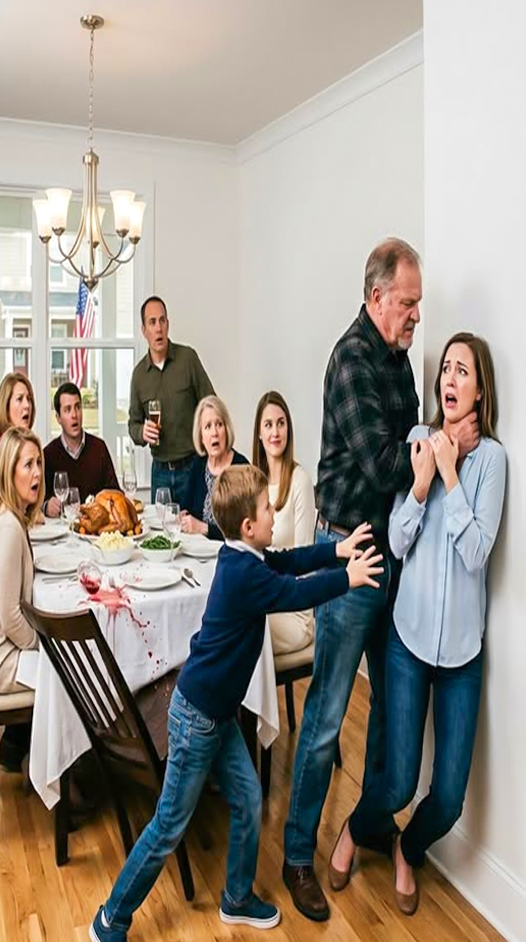
It is not even the feeling of my father’s hand closing around my throat while the framed family photos rattled behind my head.
It is my son’s face after he hit the floor.
Tyler was eight years old, and he had worn a navy sweater because he wanted to look grown-up for dinner.
Megan, my ten-year-old daughter, had helped him comb his hair before we left, both of them laughing because he looked so serious.
Two hours later, he was curled on my parents’ dining room floor, one arm around his ribs, trying not to cry too loudly.
All because I refused to pay my sister Natalie’s rent.
Natalie’s apartment cost $5,000 a month.
It was the kind of luxury downtown place with shiny floors, a lobby that smelled like candles, and neighbors who treated takeout bags like room service.
She could not afford it.
She would not leave it.
Somehow, my parents had decided that made it my problem.
Natalie was thirty-four, employed, childless, and treated by my parents like a wounded bird every time a bill came due.
If she overdrew her account, she was anxious.
If she quit another job, she was burned out.
If she needed money, the entire family was supposed to rearrange itself around her feelings.
I was a single mother with a mortgage, two children, school fees, groceries, medical copays, and a car that made a tired grinding sound when the weather turned cold.
My mother called that normal responsibility.
Natalie’s responsibility was always somebody else’s emergency.
That was the family math.
Dinner started with the kind of false peace my family was good at making.
My mother’s dining room looked polished and cold.
The white tablecloth was pressed.
The crystal glasses were lined up perfectly.
The good china was out.
The turkey sat in the center, golden enough for a magazine, and the house smelled like butter, cinnamon, and perfume layered over something old and sour.
My mother, Elaine, moved around correcting napkins and straightening forks no one had touched.
My father, Richard, sat at the head of the table with a beer in his hand.
Uncle Warren was already loud.
Aunt Linda complained about her knee.
Cousin Michael kept checking his phone.
Uncle James and Aunt Susan smiled politely at everything, because politeness had always been their favorite hiding place.
Natalie arrived late in a cream dress and glossy heels, carrying nothing but a sigh.
‘I almost didn’t make it,’ she announced.
My mother touched her arm like Natalie had survived a disaster.
‘Oh, sweetheart.’
Tyler leaned close to me and whispered, ‘Is Aunt Natalie sick?’
‘No,’ I whispered back.
I should have said, ‘No, honey, she is just very good at making other people feel responsible for her.’
But I had spent too many years believing peace was something I could earn by staying quiet.
For the first hour, the room behaved itself.
People passed plates.
My uncle made jokes nobody wanted to answer.
Megan complimented the pie crust, and my mother did not even look at her.
Tyler tried to tell Richard about his school science project, but my father interrupted him to ask Natalie whether her apartment building still had the rooftop lounge.
Then my mother cleared her throat.
Every adult child of a controlling parent knows that sound.
It is not a cough.
It is a gavel.
‘We need to discuss Natalie’s financial situation,’ she said.
The table went quiet.
Natalie looked down at her plate with the wounded expression she always wore before anyone had actually hurt her.
Richard set his beer down slowly.
‘Your sister needs help with rent,’ he said, looking at me. ‘Five thousand a month. You’re going to cover it.’
I blinked at him.
‘I’m sorry?’
‘Don’t make me repeat myself.’
My mother leaned forward.
‘Natalie cannot be expected to move right now. She is under tremendous stress.’
‘She lives in a luxury apartment downtown,’ I said. ‘If she can’t afford it, she needs to move.’
Natalie’s eyes filled immediately.
‘See? I told you she would say that. She doesn’t care if I end up homeless.’
‘Homeless?’ I said. ‘Natalie, you could rent somewhere affordable tomorrow. You just don’t want to.’
My mother’s face tightened.
‘You have a house.’
‘I have a mortgage.’
‘You have stability.’
‘I worked for it.’
‘You have children,’ Natalie snapped, as if Tyler and Megan were prizes I had won instead of lives I was responsible for every second of every day.
‘People feel sorry for single mothers. Everyone helps you.’
Nobody helped me when Tyler had a fever and I had to leave work early.
Nobody sat in the emergency room when Megan split her chin on the playground.
Nobody paid the water bill the month my car needed repairs.
But Natalie had always believed my burdens were attention.
‘I am not paying your rent,’ I said.
There are moments when a sentence is just a sentence.
There are other moments when it becomes a door closing.
My mother heard that door.
‘You will not embarrass this family by letting your sister struggle,’ she said.
‘Mom, her rent is more than my mortgage.’
‘Then budget better.’
‘I have two children.’
‘And Natalie is my child.’
There it was.
The truth sitting in the middle of the table beside the cranberry sauce.
I looked at Natalie.
‘Move somewhere you can afford.’
Something changed in her face.
The tears disappeared first.
Then the helplessness.
‘You always thought you were better than me,’ she said. ‘Good grades, scholarships, your little house, your perfect responsible act. You act like you earned everything.’
‘I did earn it.’
My father’s fist slammed into the table.
The glasses jumped.
The room froze.
Forks hovered in the air.
A candle flickered hard and steadied itself.
A spoonful of gravy slid from the serving spoon and stained the white cloth while everyone stared anywhere except at me.
Nobody moved.
Richard stood, his chair scraping backward across the hardwood.
‘Your mother asked you to help your sister.’
‘No,’ I said, quieter now. ‘She demanded I pay for Natalie’s choices.’
I saw his hand move before I believed it.
Then his fingers closed around my throat.
My shoulder hit the wall first.
The back of my head struck a framed family picture, and the glass rattled behind me.
Air vanished.
The chandelier blurred into yellow circles.
I clawed at his wrist and felt the tendons flex under his skin.
‘Useless daughter,’ he hissed. ‘After everything we did for you, this is how you repay us?’
Megan screamed.
My mother said, ‘Maybe now she’ll listen.’
Natalie made a sound that was almost a laugh.
For one ugly second, rage opened inside me so hot it scared me.
I could see the crystal glass near my hand.
I could imagine it breaking.
Then Tyler’s chair scraped back.
‘Let her go!’ my son shouted. ‘You’re hurting my mom!’
Richard released me.
I dropped to the floor, coughing and grabbing at my throat.
Tyler ran at him with both hands out, brave in the way children are brave before they understand that adults can choose cruelty on purpose.
My father turned.
Then he kicked my son in the ribs.
Tyler folded instantly.
The sound he made was small.
That was what made it unbearable.
‘Stay down,’ Richard said.
Megan ran toward her brother, crying, and my mother caught her arm.
The slap cracked across Megan’s face so cleanly that the whole dining room seemed to stop breathing.
Her head snapped sideways.
Cranberry juice spilled across the table where her glass tipped over, red spreading through the white cloth.
‘Your mother is selfish,’ Elaine shouted. ‘She has money for her nice house but won’t help family.’
Uncle Warren threw beer at me while I crawled toward Tyler.
It was cold in my hair, cold down my neck, cold against the collar of my blouse.
Ice cubes bounced on the hardwood.
‘Pay up or get out,’ he barked.
I looked around that table.
Aunt Linda stared at her napkin.
Cousin Michael looked back down at his phone.
Uncle James and Aunt Susan looked uncomfortable but did not stand.
Nobody asked if Tyler could breathe.
Nobody told my mother not to touch Megan.
Nobody said my father’s name with the word that belonged beside it.
Natalie sat there smiling.
‘Finally,’ she said. ‘Someone is making you understand.’
I do not remember deciding to leave.
I remember lifting Tyler under one arm even though he whimpered when he straightened.
I remember pulling Megan against my side while she pressed one hand to her cheek.
Behind us, they shouted the words they had always kept ready.
Selfish.
Ungrateful.
Bad daughter.
Bad mother.
The cold November air hit my face when we stepped outside.
The neighborhood looked normal, and that almost made it worse.
Porch lights glowed.
Cars lined the curb.
A small American flag on my parents’ front porch moved gently in the dark like nothing inside that house had just happened.
I helped Tyler into the back seat first.
Megan climbed in beside him, holding the frozen bag of peas I had grabbed from my mother’s freezer against her cheek.
I sat in the driver’s seat for several seconds with both hands on the wheel.
I could not remember how to leave.
Then Megan whispered, ‘Mom?’
That one word put me back inside my body.
The drive home took forty minutes, but I remember it in pieces.
My throat hurt every time I swallowed.
In the rearview mirror, Tyler sat hunched over, silent tears sliding down his face.
Megan stared out the window with the peas pressed to her cheek.
When we reached our little colonial, the porch light looked like the only honest place left in the world.
Inside, Megan collapsed in the bathroom while I cleaned her face.
‘I didn’t do anything,’ she sobbed. ‘I just wanted to help Tyler.’
‘I know,’ I told her. ‘You did nothing wrong.’
The mark on her cheek was swelling.
There was a small cut near her eye where my mother’s ring had caught her skin.
Then I checked Tyler.
He said he was fine.
He was not fine.
When he lifted his shirt, the bruise across his ribs was already darkening.
‘Am I in trouble?’ he asked.
‘No, baby,’ I said. ‘Never.’
‘We can’t tell,’ he whispered. ‘Grandpa will get mad.’
That was the sentence that got me into the car again.
At 10:47 p.m., we were under the bright lights of the local emergency room.
A nurse at the intake desk asked what happened.
I lied first.
I said Tyler fell.
I said Megan bumped her face.
I said I choked on food and that was why my throat looked red.
The nurse did not believe me.
The doctor did not believe me either.
They were both too careful with their questions.
They noted Tyler’s bruised ribs.
They cleaned the cut near Megan’s eye.
They checked my throat and lip.
There were X-rays, ice packs, discharge instructions, and a hospital intake form with boxes I could not stop looking at.
One box said assault history.
Another said injury description.
The time printed at the top was 10:47 p.m.
The nurse held her pen over the paper and asked softly, ‘Do you want to tell me what really happened?’
For years, I had protected the wrong people because I thought keeping the peace meant keeping the family.
That night, I finally understood the price.
Peace that requires your children to be afraid is not peace.
It is training.
I told the truth.
Not all at once.
Not elegantly.
I cried before I finished the first sentence.
But I told the nurse my father had grabbed my throat.
I told the doctor my father had kicked Tyler.
I told them my mother had slapped Megan.
I told them my uncle threw beer on me while my sister smiled.
The nurse wrote it down.
The doctor added notes.
The discharge packet came with instructions, phone numbers, and copies I was told to keep somewhere safe.
The next morning, I took pictures.
I photographed Tyler’s ribs in the bathroom light.
I photographed Megan’s cheek.
I photographed my throat, my lip, the beer-stained blouse, and the scratch on my shoulder where the picture frame had caught me.
I saved every image with the date and time.
Then I made breakfast.
I packed lunches.
I hugged both kids longer than usual before school.
‘Everything is going to be okay,’ I told them.
This time, I was not offering an empty sentence.
This time, I had a folder.
At 9:12 a.m., I called the hospital records office and asked how to get copies of the intake notes, discharge summary, and X-ray report.
At 11:30 a.m., I sat in my car outside the police station with a paper coffee cup I never drank from and the folder on the passenger seat.
At 11:41 a.m., I walked inside.
My hands were shaking so badly I had to put the folder on the counter before I could speak.
‘I need to file a report,’ I said.
I gave names.
I gave times.
I gave the address.
I gave the list of witnesses who had sat around that Thanksgiving table and pretended my children were not being hurt in front of them.
When I left, I had a police report number written on a small card.
It was not justice yet.
It was proof.
There is power in a document when you have lived too long inside a family that survives by denying what everyone saw.
A document does not care who cries first.
It does not care who was the favorite child.
It only asks what happened.
By that afternoon, my phone was full of messages.
My mother wrote, ‘You are destroying this family over a misunderstanding.’
My father wrote, ‘You better think carefully before you make this worse.’
Natalie wrote, ‘So you’re still refusing to help with rent?’
That was when I almost laughed.
Not because it was funny.
Because even after my father had put his hands on me and my children had been hurt, Natalie still believed the emergency was her $5,000 apartment.
I took screenshots.
I added them to the folder.
The next week, I filled out protective order paperwork at the county clerk’s counter.
I did not invent details.
I did not exaggerate.
I attached the hospital records, the photographs, the police report number, and the messages they were foolish enough to put in writing.
When the hearing date came, my parents arrived looking offended rather than ashamed.
My mother wore pearls.
My father wore a dark jacket.
Natalie came too, clutching tissues like she was the injured party.
My mother tried to approach me in the hallway.
‘Please,’ she whispered. ‘Don’t do this in front of strangers.’
I thought about Megan whispering that she had not done anything wrong.
‘You did it in front of my children,’ I said.
She stopped.
For the first time in my life, I watched her run out of words.
The order did not fix everything.
Paper never does.
It gave me distance.
It gave the school a copy of who could not pick up my children.
It gave me a way to call for help if they came to my house.
It gave Tyler and Megan something visible they could understand.
A line had been drawn.
The downfall was not dramatic in the way movies make downfall look.
No one was dragged away from the Thanksgiving table.
No courtroom gasped at a final speech.
It was quieter than that.
Relatives who had laughed suddenly did not want their names in a police report.
Uncle Warren apologized only after he realized throwing beer at me was written down in black ink.
Aunt Linda claimed she had not seen the slap.
Cousin Michael said he had been looking at his phone, as if that made him innocent instead of useful.
My parents stopped hosting family dinners because people did not know where to look anymore.
Natalie’s rent did not get paid.
The luxury apartment she had treated like a birthright became the first thing she could not force me to save.
My mother blamed me for that too.
She said I had humiliated Natalie.
I said, ‘No. I stopped funding the lie.’
For weeks, Tyler slept with his bedroom light on.
Megan asked whether Grandma could come to school.
I met with the school office and gave them the paperwork.
I spoke to a counselor.
I learned how to answer questions without making my children carry adult details.
No, they were not in trouble.
No, they did not cause it.
No, being related to someone did not give that person the right to hurt them.
The following year, we stayed home for Thanksgiving.
Tyler wore sweatpants instead of a navy sweater.
Megan helped me make mashed potatoes, and she put too much butter in them because she said we deserved it.
The turkey was smaller.
The tablecloth was just the one I used on regular Sundays.
There were no crystal glasses.
There was no polished performance.
Our porch light was on.
The house smelled like warm bread, cinnamon, and safety.
Before we ate, Tyler said, ‘I’m thankful nobody can make us go there.’
Megan nodded.
I cried in the kitchen afterward, quietly, with the faucet running so they would not hear me.
Not because I regretted anything.
Because my children should never have had to learn exactly how cruel blood can be before they learned how safe home could feel.
But they learned the second part.
They learned that a mother can be scared and still drive to the emergency room.
They learned that a lie can end when somebody finally writes the truth down.
They learned that family is not the people who demand your money while watching your children hurt.
Family is the place where you are protected without having to beg.
My parents lost control of me that Thanksgiving.
Natalie lost her favorite rescue plan.
The relatives lost the comfort of pretending they had not seen.
And my children gained the one thing I should have given them years earlier.
A door that locked.
A home that stayed quiet.
A mother who finally stopped protecting everyone except them.