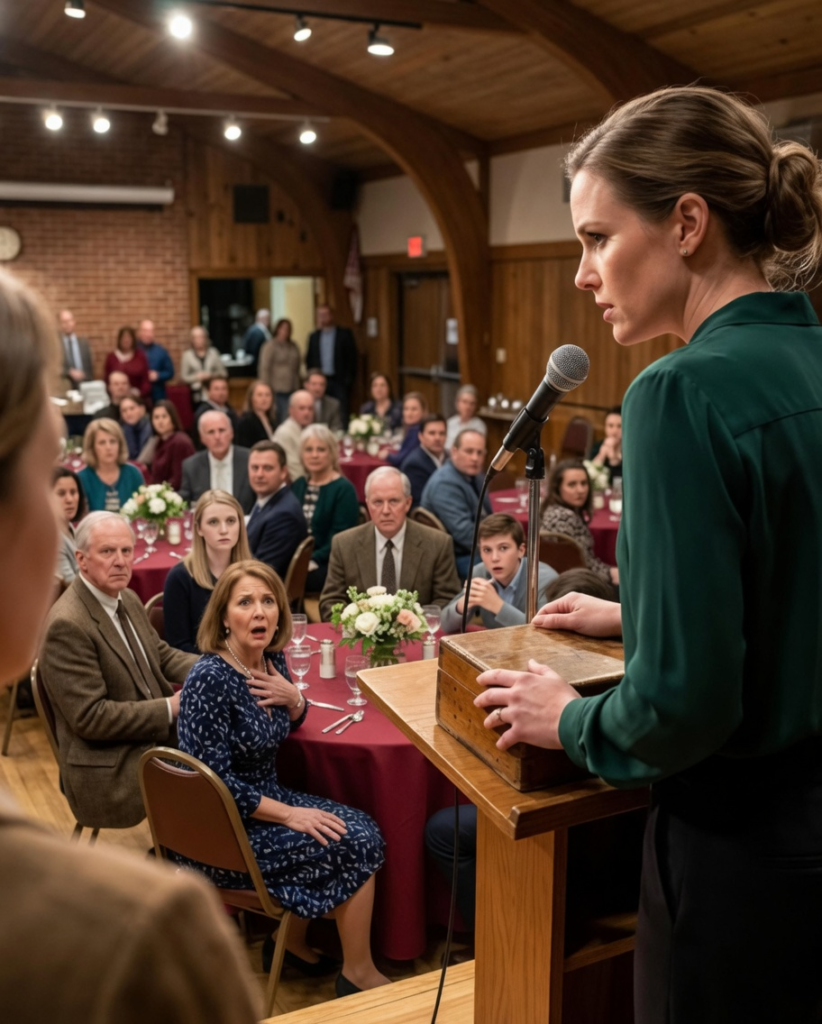
Seven years after Alice Parker left Brier Glenn with two hundred dollars, one suitcase, and a reputation her mother had carefully ruined, she came back through the front doors of the Maple Avenue Community Center in a black dress, low heels, and a calm expression no one in that town had ever seen on her before.
Outside, the November air carried the same sharp cold she remembered from the night she left.
Inside, everything was warm and polished.
White tablecloths covered the round tables.
Battery candles glowed in glass holders.
A local jazz trio was finishing a soft instrumental near the stage.
Volunteers in matching navy scarves moved from table to table with auction sheets and donation envelopes.
At the center of it all sat Margaret Parker, committee chair, hostess, and queen of every room that needed an audience.
Alice saw her before her mother saw her.
Margaret was laughing at something a banker from the next town had said, fingertips resting lightly on her water glass, face arranged into the same serene expression that had convinced half of Brier Glenn she was patient, charitable, and burdened by a difficult daughter.
Thomas Parker sat beside her, shoulders squared, mouth tight.
Lauren was on her other side, polished and expensive-looking in a cream dress that suggested stability.
Ethan lounged at the table like he was above the whole thing.
They had no idea Alice was already there.
She stood behind the curtain with Pastor Grant and the event coordinator while he finished praising her credentials.
Chief Operating Officer.
Strategic leader.
National speaker.
A hometown success story.
The phrase almost made her laugh.
A hometown success story implied a hometown had helped.
When Pastor Grant finally said her name, Alice stepped into the light.
The applause rose instantly.
Warm, surprised, admiring.
Margaret turned toward the stage with a bright smile already prepared for the public moment, and Alice watched it disappear.
It did not melt.
It dropped.
Her mother’s face emptied so completely it looked, for one split second, honest.
Lauren’s mouth opened.
Ethan sat up too fast.
Thomas went still in the eerie way guilty people do when they know movement might draw attention.
Alice walked to the podium without hurrying.
She set a slim folder on the lectern, then placed a small wooden box beside it.
The box had once belonged to Eleanor Parker.
Grandma Eleanor, who had made peach jam in summer, corrected bad grammar without apology, and once told Alice at sixteen, “The family will survive your truth.
What it can’t survive is everyone pretending.”
Alice had not understood then how important those words would become.
She looked at the room.
Old neighbors.
Former teachers.
Women from church committees.
Men who had discussed other people’s children over hardware store counters.
People who had known her since pigtails and spelling bees.
People who had accepted her disappearance because Margaret Parker gave them a story that felt tidy enough to repeat.
Alice leaned toward the microphone.
“Thank you for inviting me back,” she said.
“Before I speak about leadership or resilience or community, there’s something I need to say first.
Seven years ago, I did not leave this town because I was unstable.
I left because I found out money my grandmother left for my education had been taken from me and given to someone else.”
The room froze.
A fork hit a plate somewhere near the back.
Margaret stood up so abruptly her chair scraped the floor.
“Alice,” she said, smiling too hard.
“This is neither the time nor the place.”
Alice turned to look at her.
“It became the time and place when you put my name on the program.”
A ripple moved across the tables.
Margaret’s smile vanished.
“You are confused.”
“No,” Alice said.
“I was confused at twenty-three.
I’m not confused anymore.”
She opened the wooden box.
Inside were recipe cards, two photographs, a silver brooch wrapped in tissue, and a sealed document Alice had read so many times the folds had softened.
When she lifted it out, Lauren’s face lost color.
“My grandmother gave me this box the summer before she died,” Alice said.
“I didn’t open everything in it that night.
I just took it and left.
Months later, in Seattle, I found a copy of the notarized letter she kept with her will.”
She unfolded it carefully.
“I also found a note in her handwriting.
She wrote that twelve thousand dollars was to be held for my education, and if there was ever any dispute, this copy existed because she worried someone might decide I didn’t deserve it.”
The room erupted into whispers.
Pastor Grant, still near the stage steps, looked stunned.
The banker at Margaret’s table slowly lowered his wineglass.
Aunt Linda, seated two tables over, closed her eyes like a woman watching a storm finally hit the house everybody swore was fine.
Margaret’s voice sharpened.
“This is outrageous.
You disappeared.
You cut us off.
We were trying to help you.”
Alice almost admired the speed of the lie.
Almost.
“Did I disappear,” she asked, “or did I leave after you called me unstable in front of fifteen relatives instead of answering a direct question?”
Margaret took one step forward.
“You were emotional.
You’ve always been emotional.”
“And you’ve always depended on everyone confusing emotion with dishonesty.”
That landed.
Alice could feel it.
For years, her mother’s power had rested on tone.
Calm tone versus upset tone.
Controlled voice versus trembling voice.
Whoever looked composed got believed.
Tonight, for the first time, Alice stood at ease while Margaret looked frayed.
Alice set the letter on the podium and lifted her phone.
“Three weeks ago,” she said, “my sister searched my name online because she needed a co-signer.
Within hours, I had forty-three voicemails.
Not one asked how I’d been.
Not one apologized.
They all wanted something.”
She tapped the screen, and the AV volunteer at the side of the stage, after a quick glance from Alice, mirrored the image to the projection screen overhead.
One message after another appeared.
Lauren: Hey, I know it’s been forever, but maybe we can help each other.
Margaret: After everything this family has done for you, I expect a response.
Ethan’s social media post about people forgetting where they came from.
The LinkedIn message.
The work email.
Timestamps.
Names.
The neat digital trail of people who had stayed silent until money was involved.
A gasp moved through the room.
Thomas put his head in his hands.
Margaret looked around as if searching for an ally, but public sympathy is a fragile currency.
It disappears the moment proof enters the room.
“I invited Alice because this fundraiser is about second chances,” Pastor Grant said weakly, as though he was trying to remind the evening what it had once intended to be.
Alice looked at him kindly.
“Then perhaps it still is.”
She reached into the box again and pulled out one final paper.
“My grandmother’s note also said something else,” she said.
“It said if I ever found my own footing, I should use it to become the person no one had been for me.”
She let the words settle.
“So tonight, I’m making a donation.
Fifty thousand dollars to establish the Eleanor Parker Scholarship Fund for students in this county who have family obstacles no one wants to talk about.
The board will be administered by the community college and an outside financial manager.
No family oversight.
No private decisions.
No disappearing funds.”
This time the applause did not begin politely.
It broke out in a rush, emotional and relieved and almost hungry, as if the room had been waiting years for someone to name what everyone had sensed but never challenged.
Margaret sat down slowly.
Lauren stared at the tablecloth.
Ethan looked furious, but fury without leverage is just noise.
Thomas remained motionless.
Alice finished her prepared remarks after that, though few people would later remember the exact phrasing.
They remembered the shape of it: that survival is not the same thing as being loved, that work can become dignity, that chosen mentors can alter the course of a life, and that truth told late is still truth.
When she ended, the room stood.
Not everyone.
But enough.
After the program, people formed a line to speak to her.
Her former English teacher cried.
A woman from church whispered that she had always wondered.
A man who had once hired her for a summer filing job told her he was sorry for believing rumors.
Aunt Linda hugged her and said, “Your grandmother would have loved that scholarship.”
Margaret waited until the line thinned.
Then she approached.
Up close, she looked older than Alice remembered.
Not softer.
Just worn around the edges, as if years of controlling every narrative had finally demanded payment.
“You humiliated me,” Margaret said quietly.
Alice held her gaze.
“No.
I corrected you.”
Margaret’s jaw tightened.
“Families make hard choices.”
“You stole from one daughter to decorate another and called it judgment.”
Lauren appeared at her mother’s shoulder then, eyes red, voice shaky.
“I didn’t know at first,” she said.
Alice turned to her.
“Maybe not at first.
But you knew later.”
Lauren looked down.
That was answer enough.
Thomas stepped forward next.
For a second Alice saw the outline of the father she had once wanted—the man who might have stood up, once, just once, and changed everything.
But longing does not make a person brave.
“I should have said something,” he murmured.
“Yes,” Alice said.
He nodded like a man receiving a sentence already earned.
Ethan never apologized.
He muttered something about airing private business in public and walked away before anyone could ask him why private cruelty had been acceptable while public truth was not.
By the end of the night, the event board had quietly asked Margaret to step down as committee chair pending a review of donor handling procedures.
It was not because anyone had proof she mishandled fundraiser money.
It was because once a person is revealed as careless with one kind of trust, people start wondering about the rest.
Alice left the community center with Rachel on speakerphone and the cold Pennsylvania air in her lungs.
“Well?” Rachel asked.
Alice looked back at the building where she had once imagined everyone inside knew who she was and had judged her correctly.
“They heard me,” she said.
“Is that enough?”
Alice thought about the scholarship fund, the wooden box under her arm, her mother’s expression when the lie failed, and the long years she had spent building a life no one there had given her.
“It’s not everything,” she said.
“But it’s true.
And true is enough to build on.”
The legal follow-up was quick once the documents surfaced.
The family attorney who had handled Eleanor’s estate had retired, but his records had not vanished.
Within two months, the paperwork confirmed that the twelve thousand dollars had indeed been designated for Alice.
There were no criminal charges; too much time had passed, and too many signatures sat in gray, compromised territory.
But Margaret was forced to repay the amount, with interest, into the new scholarship fund under a settlement arranged quietly through civil counsel.
Lauren contributed too.
Voluntarily, at least on paper.
The first Eleanor Parker Scholarship went to a nursing student named Marisol whose parents had emptied her savings to cover a brother’s legal fees.
When Alice met her at the award luncheon the following spring, Marisol cried, then laughed at herself for crying, and said, “I thought I had to become impossible before anyone would finally believe I needed help.”
Alice knew that feeling exactly.
She never moved back to Brier Glenn.
She did, however, come back once a year for the scholarship review meeting and sometimes for coffee with Aunt Linda.
The town looked smaller each time, but less haunted.
As for Margaret, people still greeted her in stores, but differently.
Polite.
Careful.
The old effortless admiration had gone missing.
Thomas started volunteering at the food pantry.
Whether it was guilt or growth, Alice honestly couldn’t tell.
Lauren sent one handwritten apology nearly a year later.
It was the closest thing to honest she had ever been, and still not enough to make them sisters in the old sense.
Some bridges do not collapse in one dramatic second.
They rot for years, and when they finally give way, rebuilding them means admitting who ignored the damage.
Alice kept Grandma Eleanor’s wooden box on a shelf in her office in Seattle.
Not as a relic of betrayal.
As evidence.
Of warning, yes.
But also of witness.
One person had seen her clearly before she could save herself.
Sometimes that is the first inheritance that really matters.
And if there was a final sting in the whole story, it was this: the daughter called unstable had built a future sturdy enough to save strangers, while the family who called themselves practical had nearly destroyed their own standing for twelve thousand dollars and a convenient lie.
People in Brier Glenn still argued over what had been worst—the theft, the silence, or the years spent protecting the wrong person.
Alice no longer needed to decide.
She had already learned the only answer that changed anything: when truth finally enters a room, the people who fear it most usually tell you exactly who they are.