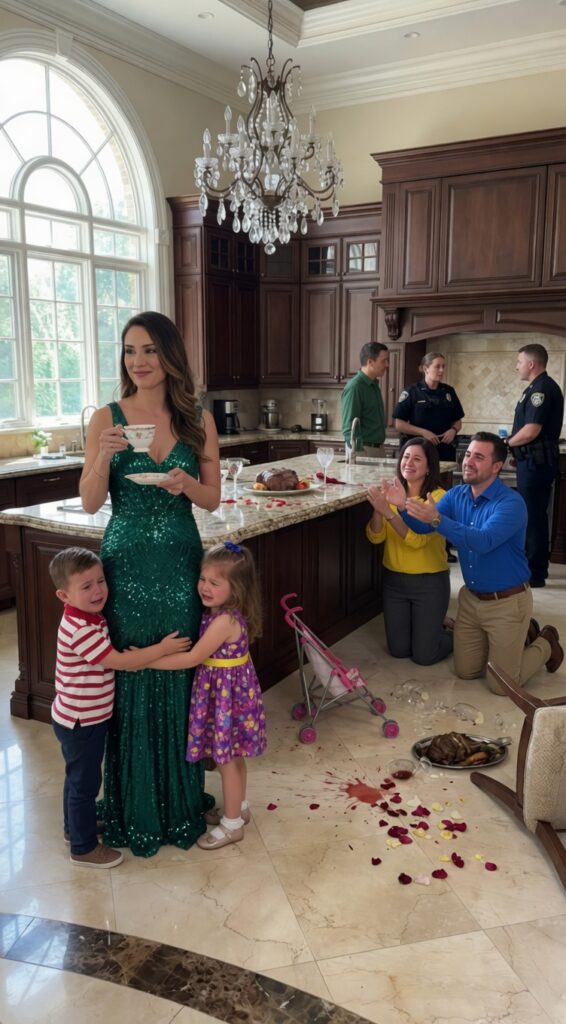
The Architecture of Betrayal
Chapter 1: The Parasite in the Kitchen
The moment I realized my own home was no longer mine, my mother was standing in the kitchen with her arms folded like a woman who had rehearsed her cruelty until it was polished to a lethal shine. She did not ease into the conversation. She did not offer a cushion for the blow. She simply looked at me across the granite island—the same island I had paid to have resealed only six months prior—and told me my brother was coming to stay with his three children.
“And Naomi,” she added, her voice as flat as a dial tone, “you’ll need to be out by the weekend.”
For a heartbeat, I genuinely believed I was the victim of a poorly timed joke. I even let out a short, breathless laugh. “You’re joking, right?”
She laughed too, but hers was a chilling, crystalline sound that didn’t reach her eyes. “No,” she said. “I’m entirely serious. Derek needs the stability. He has children to think about. You’re just… here.”
Then she used the word that felt like a physical strike to the throat. She called me a parasite.
It was as if the last three years of my life had been erased by a single, vitriolic breath. As if I hadn’t been the one keeping the Oak Ridge Estate from crumbling into the dirt after my father’s heart gave out. As if I hadn’t been the one filling her prescriptions, paying the back-taxes, and abandoning my own career trajectory to ensure she never had to face the silence of that house alone.
I didn’t scream. I didn’t give her the satisfaction of seeing me shatter. I just stood there, staring at the woman I had rearranged my entire existence for, and realized she had already gutted my room in her mind to make space for the son who hadn’t shown up for the funeral.
I walked away without another word. The silence of the hallway felt like an asphyxiation. I went to bed in a house that felt like a hostile country, and when I woke up the next morning, my phone was vibrating off the nightstand.
Fifty-three missed calls.
That was when I knew the “stunt” I had pulled in the middle of the night had hit its mark. They hadn’t seen it coming. They thought I was a parasite; they forgot that I was actually the host.
Chapter 2: The Three-Year Debt
Before anyone called me a parasite, I was Naomi Carter, a thirty-year-old with a burgeoning career as an operations coordinator for Lumina Medical Supplies. I had a one-bedroom apartment with floor-to-ceiling windows, a savings account that promised a future, and a side-hustle plan to launch a financial organizing service for women. I was building a life that was quiet, stable, and entirely mine.
Then, time split into Before and After.
My father died on a Tuesday. One week, he was lecturing me about the tire pressure in my Honda; the next, I was watching my mother, Eleanor Carter, wither into a shadow of herself. The house, a sprawling colonial that required constant attention, began to fail alongside her.
Derek, my older brother, called twice. He said he was “devastated.” He said things were “complicated” with his ex-wife. Then he vanished into the ether of his own irresponsibility.
I was the one who stayed. I broke my lease, hauled my life into storage, and moved back into my childhood bedroom. I told myself it would be six months. Maybe a year. Just until she was stable.
That was the grand delusion.
For three years, I was the architect of her survival. I woke up at 5:00 AM to ensure she ate before her medication. I managed the grocery lists, the utility transfers, and the labyrinthine insurance paperwork. When the furnace died in the dead of a glacial January, I was the one who swiped my credit card for the four-thousand-dollar replacement. When the county mailed a final notice in red ink for property taxes, I emptied my “Future Fund” to keep the roof over our heads.
I said no to a promotion that would have moved me to Chicago. I said no to weekend trips with friends. I lived a life of beige sacrifice, convinced that love was a ledger where my deposits would eventually earn me a permanent place in the family heart.
We grew closer, or so I thought. We shared takeout on Fridays. We watched documentaries while folding laundry. She would look at me with tears in her eyes and whisper, “I don’t know what I would have done without you, Naomi.”
I believed her. I believed I was earning my keep. I didn’t realize I was merely a placeholder until the “prodigal son” decided he was hungry again.
Chapter 3: The Secret Architecture of Removal
The betrayal didn’t actually start at the dinner table. Looking back, the cracks were visible months ago, hidden under the mundane routine of our shared life.
Derek had always been my mother’s “fragile genius.” He was charming when he needed a loan and a ghost when the bill came due. He drifted through cities and relationships like a storm, leaving wreckage in his wake, yet my mother treated him like a saint who just couldn’t find the right pedestal.
Then came Ron Mercer.
Ron was a “friend” from her church group who began appearing at the house with the frequency of a bad habit. He was a man who wore smugness like a cologne. He’d sit at our table, eating the food I paid for, and ask me with a condescending tilt of his head, “Don’t you ever miss having your own space, Naomi? It must be such a relief to have this safety net.”
I noticed my mother changing under his influence. She became sharper. The kitchen I spent my Sunday nights scrubbing was suddenly “filthy.” The groceries I hauled in were “the wrong brands.”
Then, the physical evidence of my replacement began to manifest. Enrollment forms for the local elementary school appeared on the hall table and vanished the moment I entered the room. Three twin mattresses were delivered to the garage while I was at work. When I confronted her, she told me they were for a “church donation drive.”
The splinter that finally festered was an overheard phone call. I was in the laundry room when I heard my mother laughing softly in the kitchen.
“No, Ron,” she whispered. “She still has no idea. We’ll tell her when the timing is right. Derek needs to be settled before the winter.”
She still has no idea.
I stood among the piles of her towels and felt a cold dread coil in my gut. I called my best friend, Maya, that night.
“Naomi,” Maya said, her voice heavy with concern, “you’re acting like a woman who sees the hurricane on the radar and is still trying to decide what to cook for dinner. Get out now.”
“She wouldn’t,” I argued. “Not after everything I’ve done.”
But even as I said it, I noticed two boxes of my winter coats had been taped shut and moved to the basement stairs. My mother told me she was just “helping me declutter.”
The final confirmation came when she asked me, with a terrifyingly casual tone, if I could “clear out my closet” because she needed storage for “guests.”
I realized then that in the house I was paying for, I had been demoted from daughter to guest, and now, I was being demoted to nuisance.
Chapter 4: The Pot Roast Execution
The night of the “execution” started with pot roast.
It was my father’s favorite meal, and my mother only made it when she wanted to soften a blow or manipulate a memory. The good china was out. A bottle of expensive Merlot sat breathing on the counter. Ron was there, hovering in the corner like a vulture in a polo shirt.
The atmosphere was so staged it felt like a theatre production. We sat, and for ten minutes, my mother performed a monologue of artificial small talk. Then, she put her fork down with a deliberate clack.
“Derek is coming home, Naomi,” she said. “His situation in Seattle has become… untenable. He needs the house. He needs the family.”
“I’m happy for him,” I said, trying to keep my voice steady. “We can make the guest room work, and maybe the office—”
“No,” she interrupted. “The children need their own space. And Derek needs to feel like the head of a household again. You’re thirty-three, Naomi. You have a job. You’ve been living off my kindness for three years. It’s time for you to move on. By the weekend.”
The room seemed to shrink. I looked at Ron, who was leaning back, picking at his teeth. “Maybe this is the push you needed to finally build your own life,” he added with a wink.
The vitriol rose in my throat. I reminded her of the furnace. I reminded her of the tax liens. I reminded her of the three years I spent as her nurse, her chauffeur, and her banker.
She didn’t flinch. “You act like helping your family bought you ownership of this house. It didn’t. You’re a parasite, Naomi. You’ve been clinging to your father’s memory and this house because you’re too afraid to live in the real world.”
Parasite.
The word was a tectonic shift. Every ounce of guilt I had ever felt about “leaving her” died in that kitchen.
“I see,” I said. My voice was no longer shaking. It was a cold, hard thing. “You want the house to feel like ‘family’ again. And in your version of family, I’m the one who pays the bills but doesn’t get a seat at the table.”
“Don’t be dramatic,” she snapped. “We can discuss the logistics of your move tomorrow.”
I stood up. I didn’t finish the roast. I didn’t look at Ron. I walked out, got into my car, and drove until the streetlights of Oak Ridge were nothing but a blur in my rearview mirror.
I parked in a grocery store lot and sat in the dark. I didn’t cry. I opened my laptop and logged into the shared household email account my mother used.
There it was. An email thread titled Room Setup.
Just make sure Naomi is out before the kids arrive, Derek had written. I don’t want them around all that tension. Tell her she’s being selfish if she complains.
My mother’s reply: Don’t worry, Derek. Once she’s finally out, the house can feel like family again. I’ve already started packing her things.
I closed the laptop. My brain, usually reserved for medical supply logistics, began to build a different kind of system. A system of consequences.
Chapter 5: The Friday Coup
The next morning, I didn’t go to work. I went to the office of Sophie Lane, an old college friend who specialized in property law and tenant disputes.
I laid the evidence on her desk: three years of mortgage transfers, the invoice for the furnace, the tax receipts, and the printout of the “Room Setup” emails.
Sophie leaned back, a grim smile on her face. “Naomi, they think they’re evicting a daughter. They don’t realize they’re trying to illegally remove a tenant who has established equitable interest through significant financial contribution to the property’s maintenance.”
“I don’t want the house,” I told her. “I just want my life back. And I want them to feel the weight of what they’re doing.”
“Then we don’t just leave,” Sophie said. “We exit.”
The rest of the week was a masterclass in silent efficiency. I found an apartment—a small, sun-drenched loft above a duplex. It was overpriced and the lighting was terrible, but the lease had only my name on it. I signed it with a trembling hand that grew steadier with every stroke of the pen.
I packed in secret. I moved my sentimental items and documents to the loft during my “lunch breaks.” At home, I played the part of the defeated daughter. I let my mother believe I was overwhelmed and passive.
On Friday morning, the trap was set.
My mother left at 9:00 AM to pick up Derek and the kids from the airport. Ron was going to meet them there for a “welcome home” lunch.
The second her Buick cleared the driveway, I moved.
I had hired a locksmith. By 10:30 AM, every exterior lock on the Oak Ridge Estate had been replaced.
While the locksmith worked, Maya and a few colleagues helped me clear the rest of my furniture. I didn’t touch a single thing that belonged to my mother, but I took every item I had purchased—the microwave, the television, the patio set, and even the high-end coffee maker.
Then, I performed the final act of accounting.
I called the utility companies. I didn’t shut them off—that would be illegal—but I removed my name and my credit card from the accounts. I transferred the billing back to my mother’s name, effective immediately. The same went for the trash service and the internet.
On the kitchen island, where the “parasite” comment had been birthed, I left a professional-grade manila folder. Inside were copies of every receipt, every bank transfer, and a formal letter from Sophie Lane outlining my legal residency and a demand for reimbursement for the four-thousand-dollar furnace and the tax payments.
I left a sticky note on the front: Since I was good enough to pay for this house, I assume you’re good enough to handle the bills now. Lawfully yours, Naomi.
By 12:15 PM, I was in my new loft, sitting on a packing box, eating an apple.
At 12:38 PM, the first call came.
By 1:00 PM, my phone was a strobe light of missed calls and vitriolic texts.
Chapter 6: Fifty-Three Calls and One Truth
I didn’t answer. I wanted the silence to do the heavy lifting.
I eventually listened to the voicemails. My mother’s voice evolved from confusion to a screeching, panicked rage. “Naomi! The keys won’t work! We’re standing here with the children in the heat! What kind of sick stunt is this?”
Derek’s message was a symphony of profanity. “You crazy b—! Open this door! The kids are crying! You have no right!”
No right. The irony was delicious.
At 2:00 PM, I drove back to the house. I parked across the street and watched the scene.
It was a tableau of domestic failure. Derek was pacing the porch, looking like a man who had realized the “free ride” had a very high entrance fee. My mother was sitting on a suitcase, red-faced and weeping. Ron was trying to shoulder the door open, looking ridiculous in his pressed khakis.
I got out of the car and walked toward them.
“Naomi!” my mother shrieked, stumbling toward me. “Give me the keys! How dare you lock us out of my house!”
“I didn’t lock you out of your house, Mother,” I said, my voice projecting clearly enough for the neighbors—who were watching with rapt interest—to hear every syllable. “I secured my residence. And since you told me I don’t belong here, I’ve moved out. But according to the law, you failed to give me thirty days’ notice. I’ve changed the locks to protect my remaining property.”
“We have children here!” Derek yelled, stepping toward me.
I didn’t flinch. “Then you should have considered their comfort before you plotted to throw your sister onto the street without a dime of the money she spent saving this roof. You want to be the ‘head of the family’ again, Derek? Start by calling a locksmith. And while you’re at it, call the electric company. The bill is no longer being auto-paid by my ‘parasitic’ bank account.”
Ron tried to intervene. “This is low, Naomi. Humiliating your mother in public?”
“What’s low, Ron, is a man who encourages a widow to discard her daughter because she’s no longer useful. You want her house? You pay for it.”
I handed my mother one—and only one—new key.
“You can go inside,” I said. “But the folder on the table explains the rest. I’ve documented every cent I’ve put into this place. You have thirty days to pay back the furnace and the tax lien, or Sophie Lane will be seeing you in small claims court. Consider it ‘logistics.’”
I turned my back on them. I heard Derek swearing, heard my mother’s wailing, heard the children asking why Auntie Naomi was leaving.
I didn’t stop. I got in my car and drove away. For the first time in three years, the air in my lungs didn’t feel like it belonged to someone else.
Chapter 7: The Host Survives
Six months later, my loft still has terrible kitchen lighting, but I’ve never loved a space more.
My business, Carter Financial Organizing, is officially launched. I help women untangle their lives from debt and manipulative family structures. My first client was a woman who had been told she was “useless” for twenty years. When we finished her first budget, she cried. I cried with her.
I accepted the promotion at Lumina. I travel to Chicago once a month now. I’ve seen the lake in the winter, and it’s beautiful.
As for the house on Oak Ridge, the “family” didn’t last long.
Without my invisible labor and financial cushion, the cracks widened. Derek didn’t become a “fragile genius.” He became a burden. He couldn’t keep a job at the local warehouse, and he certainly didn’t pay the utilities.
Ron Mercer vanished the moment the “safety net” was gone and my mother started asking him for money to cover the mortgage. It turns out he was only interested in the throne when the treasury was full.
I heard through a neighbor that the house is being listed. My mother can’t afford the upkeep, and Derek has moved into a two-bedroom apartment with his kids, blaming everyone but himself for the “downfall.”
I saw my mother one last time, a month ago, at a pharmacy. She looked tired. She looked like a woman who had finally realized that when you kill the host, the parasite dies, but when you discard the daughter who saved you, you’re left with nothing but the silence of your own choices.
She tried to apologize. “Naomi, your father would have been proud of how independent you’ve become.”
I looked at her, and for the first time, I didn’t feel the need to fix her expression or her life.
“My father was proud of me before I left, Mother,” I said. “The difference is, now I’m proud of me, too.”
I walked away. I didn’t look back. I had spent three years proving I was a good daughter. I spent one day proving I was a formidable woman.
The architecture of my life is no longer built on sacrifice. It’s built on boundaries. And the view from here is spectacular.
Like and share this post if you find it interesting and believe that love should never be a one-way street!