The first time I heard the word sold, I was standing in the center of our family acreage with grit on my skin and a sharp autumn gale tearing through the stalks like a frantic animal. The wind came low at first, pressing through the harvest in long, whistling breaths, before rising to move across the field in waves that made the dry husks shiver.
It was a sound I had known since infancy, one that usually signaled a thunderstorm rolling in from the plains or my grandfather walking the perimeter to check the fencing. That day, however, the air tasted like a bitter warning.
My father did not try to soften the blow or offer a gentle explanation for what he was about to do. He spoke with a flat, practical tone, as if he were reading a dull report about a drop in local temperatures.
“We sold the ranch,” he announced. He said it loudly enough for the laborers near the machine shed to pause their work, and for the stranger in the crisp suit standing by the truck to hear every syllable.
“To a construction firm,” he added, his voice hardening. “The deal is finalized.”
My mother stood beside him with her arms tightly crossed, wearing a thin, satisfied smirk that felt like a sharp blade. She was a woman who never wasted a grand gesture when a precise, cruel expression could inflict more damage on her audience.
Behind them, a man in polished leather boots and a stiff blue shirt clutched a leather folder against his ribs. He kept checking his silver watch as if our heritage were nothing more than a tedious appointment on his midday calendar.
I did not scream or fall apart, which seemed to catch my mother off guard. I saw a flash of anticipation in her eyes, as if she had already scripted her next move around my expected emotional breakdown.
“You sold it while Grandpa’s estate is still caught in legal limbo,” I said, my voice cutting through the rustle of the dry corn. My father’s eyes narrowed, not because I had insulted his character, but because I had dared to introduce a fact into his performance.
“Your grandfather is in the ground,” he snapped, stepping closer. “This property was always ours to manage, and you should show some gratitude that we are even informing you.”
I felt my stomach tighten, but I refused to let my composure slip in front of the man in the blue shirt. “If it is yours to handle, then show me the formal probate case number for the transfer.”
My mother let out a soft, mocking laugh that sounded like glass breaking. “Listen to her, acting like she’s a high-court justice again,” she said, glancing at the stranger for approval.
I looked past her and locked eyes with the man holding the folder. “Who are you exactly?” I asked.
He hesitated for a heartbeat, clearly surprised that I was asking for a process instead of weeping. “Grant Miller,” he replied, adjusting his collar. “Oak Valley Partners. We are bringing modern housing and infrastructure to this county.”
He spoke about progress and growth in a language that had no mud on it, a language that ignored the roots being torn up. My father suddenly shoved a thick stack of papers toward my chest, forcing me to take a step back.
“Sign the acknowledgment,” he commanded. “Stop acting like you have a say in this.”
I did not reach for the documents, letting them flutter in the wind between us for a long, tense moment. “Sign what?” I asked calmly.
“It’s a consent form for the title company,” he growled. “You don’t own a single blade of grass here, but this makes the closing process move faster.”
My mother leaned in, her voice becoming a sweet, sharp whisper. “You own nothing here,” she repeated, as if she wanted the sentence to sink into the very soil.
I remembered the summer I returned from university and found my grandfather on the porch with a weathered manila envelope. He had tapped that envelope with his knuckles and told me that people act differently once land is converted into cash.
“I am not signing anything on the hood of a truck,” I told them. “If this transaction is legitimate, it will survive the scrutiny of an official records search.”
My father’s face flushed a deep, angry red. “Don’t do this, Tessa,” he warned, using my full name to try and regain his fading authority.
Grant Miller cleared his throat, trying to stay out of the family crossfire. “Ms. Cooper, we have a signed purchase agreement and a survey crew arriving at dawn tomorrow.”
“Which title firm is handling the escrow?” I asked, turning my focus back to the professional. His mouth opened and shut quickly, and I caught my mother’s eyes flicking toward him in a brief moment of panic.
“That doesn’t concern you,” my father interrupted, grabbing the papers back. “Go play detective if you want, but you’ll come back and apologize when you realize you aren’t in charge.”
I took the papers from him this time because I knew that ink always left a trail. I scanned the first page and felt a chill when I saw no case numbers, only vague language meant to trick me into waiving my rights.
“No,” I said, handing the prop back to him. My father’s jaw set hard as he told me I could watch the bulldozers roll in from the road.
I walked to my vehicle without saying another word, ignoring my mother’s whispered insults about my solitary life. I drove straight to the county administration building, a low brick structure that smelled of old paper and industrial cleaner.
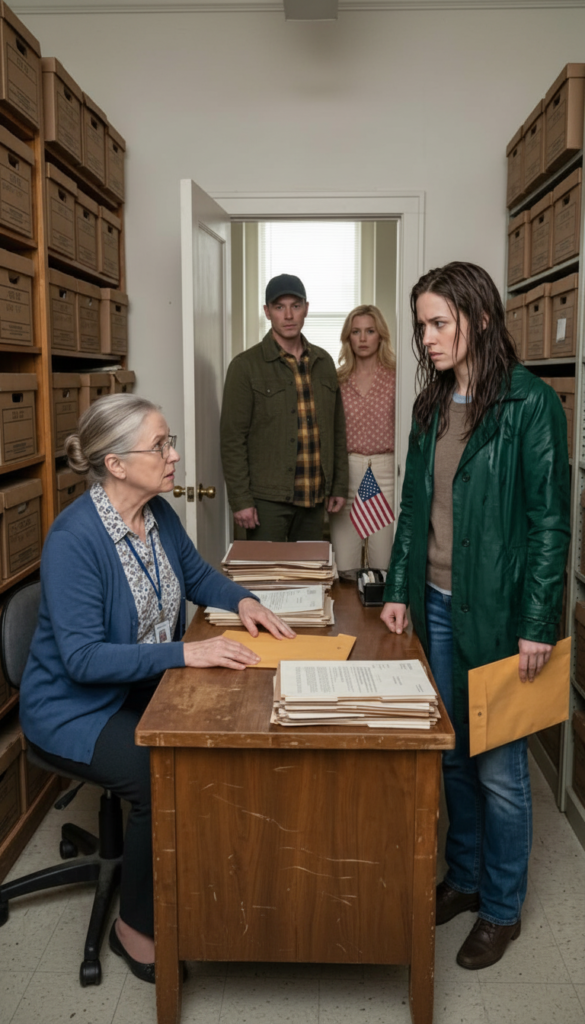
Inside, the lighting was harsh and honest, reflecting off the waxed floors. I approached the records desk where a woman with tired eyes and reading glasses sat behind a glass partition.
“I need the deed history for the Cooper ranch and any probate files for Joseph Cooper,” I told her. The clerk, whose nameplate read Sheila, typed into her system while the loud clicks of her keyboard echoed in the silent lobby.
She paused, her expression shifting from boredom to genuine confusion. “What is your relationship to Joseph Cooper?” she asked.
“I’m his granddaughter,” I replied. She stood up, retrieved a thin folder from a back shelf, and set it on the counter with unexpected care.
“The parcel shows a transfer that was recorded just yesterday,” Sheila said slowly. “But there is a major discrepancy.”
“What is the issue?” I asked, leaning closer to the glass. She scrolled through her monitor, her brow furrowing as she checked the internal logs.
“There is no active probate case filed in this county for Joseph Cooper,” she explained. “However, there is a scanned packet for a deposited will that was never officially opened.”
My heart didn’t race; it became cold and focused. “How did they transfer the estate property without an open probate case?”
Sheila clicked on a folder icon labeled Will Packet and her face turned pale. “Ms. Cooper, this document changes the legal ownership of that ranch entirely.”
“Print a certified copy,” I said. She hesitated for a second, checking the system’s access history before reaching for the printer.
“Before I do, you should know that this file was accessed yesterday morning,” Sheila whispered. “By a user named Beverly Cooper.”
My mother had been here, standing in this very lobby, less than an hour before the fraudulent transfer was recorded. She had looked at the truth and then walked out to sign a lie.
A supervisor named Mr. Henderson came out from the back office to oversee the printing. He stamped the pages with a heavy, rhythmic thud, certifying them as true copies of the deposited records.I turned the first page of the will and saw my grandfather’s precise legal descriptions. Then I reached the line that changed the temperature of my blood.
He had left the entire ranch to me, naming me as the sole executor and the only heir to the land. I felt a hand on my shoulder and turned to see my partner, Owen, who had rushed over after my frantic phone call.
“He gave it to you,” Owen whispered, reading the text over my shoulder. “Everything.”
Sheila pointed to a secondary clause in the packet. “There is also a no-contest provision,” she noted. “It’s designed to disinherit anyone who interferes with your inheritance.”
I looked at Mr. Henderson. “How did the recorder’s office accept a transfer yesterday if this will was sitting in your files?”
“We record what is presented to us,” he replied. “Your parents filed an affidavit of heirship claiming Joseph died without a will.”
They had lied under oath to the government, using a cheap legal shortcut to bypass the truth they had already discovered. I requested certified copies of every document, including the log that proved my mother had viewed the will.
I called a local attorney named Sarah Vance, a woman known for her aggressive stance on property fraud. “Sarah, they used a fake affidavit to sell the ranch to Oak Valley Partners,” I told her, my voice shaking with cold fury.
“Open probate immediately at the window next to you,” Sarah instructed. “I’m filing a notice of pending action to cloud that title so they can’t move a single inch of dirt.”
I filled out the emergency petition at the probate counter, writing my name as the proposed executor with a steady hand. The clerk stamped the packet and handed me a fresh case number, which felt like the ground finally stabilizing beneath my feet.
“The case is in the system now,” the clerk said. “Any title search will now show a legal dispute.”
I walked back to the recording desk and filed the notice Sarah had emailed me. “It’s public now,” Sheila said, handing me the receipts. “They have been warned.”
I stepped into the hallway and dialed the number for Oak Valley Partners. A man named Mr. Stark, their lead counsel, answered with a guarded, professional tone.
“The Cooper ranch is now under a contested probate,” I informed him. “A will has been filed, and your title is officially clouded.”
There was a long silence on the other end of the line. “If your parents misrepresented their authority,” Mr. Stark said, “then our firm will be seeking damages for fraud.”
I hung up just as a text message arrived from my father. Don’t be difficult, Tessa. The surveyors will be there at sunrise. Just sign the papers and walk away.
I didn’t reply because I knew the law was already moving. I drove back to the ranch as the sun began to dip, casting long, golden shadows across the fields.
Fresh wooden stakes with bright orange ribbons had been hammered into the dirt near the entrance. A brand-new sign was wired to the gate that read: PRIVATE PROPERTY – AUTHORIZED ENTRY ONLY.
My father was standing by the gate, looking like he had finally conquered the world. “You’re back,” he said, smirking. “Are you ready to be a team player?”
I held up the certified court receipts instead of a pen. “There is a probate case now,” I told him. “Your affidavit was a lie, and the county has proof you knew about the will.”
My mother’s smirk didn’t vanish; it turned into something jagged. “That won’t stop the crew tomorrow,” she said. “The Sheriff is escorting them to ensure you don’t interfere.”
“The Sheriff won’t protect a fraud,” I countered. She laughed, but I could see her hands trembling slightly as she gripped her coat.
I took out my phone and began photographing the stakes and the new signage. A patrol vehicle pulled up a few minutes later, its tires crunching on the gravel.
Deputy Miller stepped out, looking between me and my parents with a neutral expression. “I received a trespass complaint from Beverly Cooper,” he said.
“They are claiming I’m trespassing on land they sold through a fraudulent affidavit,” I explained. I handed him the certified will and the notice of pending action.
The deputy read the documents, then stepped to his radio to confirm the filings with dispatch. “The title is flagged for a legal dispute,” the radio crackled back.
Deputy Miller looked at my father. “I’m not removing her,” he stated firmly. “This is a civil matter with active court filings, and the title is not clear.”
My father turned a dark shade of purple. “She’s harassing us on our own land!” he shouted.
“Actually,” the deputy said, “the records suggest she is the owner. If you call in another false trespass report, there will be consequences.”
The deputy photographed the scene and told everyone to stay away from each other until the court hearing. After he drove away, my mother hissed that I hadn’t won yet.
I drove to Sarah’s office, where she was waiting with a printed copy of a handwritten note found at the bottom of the will packet. It was a codicil my grandfather had written years after the original will.
“If my children ever attempt to sell this heritage,” Sarah read aloud, “they are to be immediately disinherited of all other assets.”
The judge heard our emergency motion over a video call that night. He looked at the receipt proving my mother had bought a copy of the will just before lying about its existence.
“I am issuing a temporary restraining order,” the judge declared. “No construction, no surveying, and no entry by the developers.”
The next morning, the survey crew arrived only to be turned away by the Sheriff’s department. My father was so enraged that he began ripping the stakes out of the ground in front of the deputies.
“Sir, stop immediately,” the deputy warned. When my father refused, the metallic click of handcuffs echoed across the quiet field.
My mother screamed that it was all a mistake, but the deputies ignored her. They had seen the access logs, the receipts, and the forged affidavit.
Months later, the court officially restored the title to my name and referred my parents to the district attorney for perjury. My father served a brief sentence, and my mother was ordered to pay massive restitution to the development firm.
One evening, I stood on the porch and watched the wind move through the autumn harvest. The land felt peaceful now, protected by the very papers my grandfather had hidden for me.
I realized then that I wasn’t standing there because my parents had failed. I was standing there because a man who loved the soil had seen the future and made sure the truth was written down.
THE END.