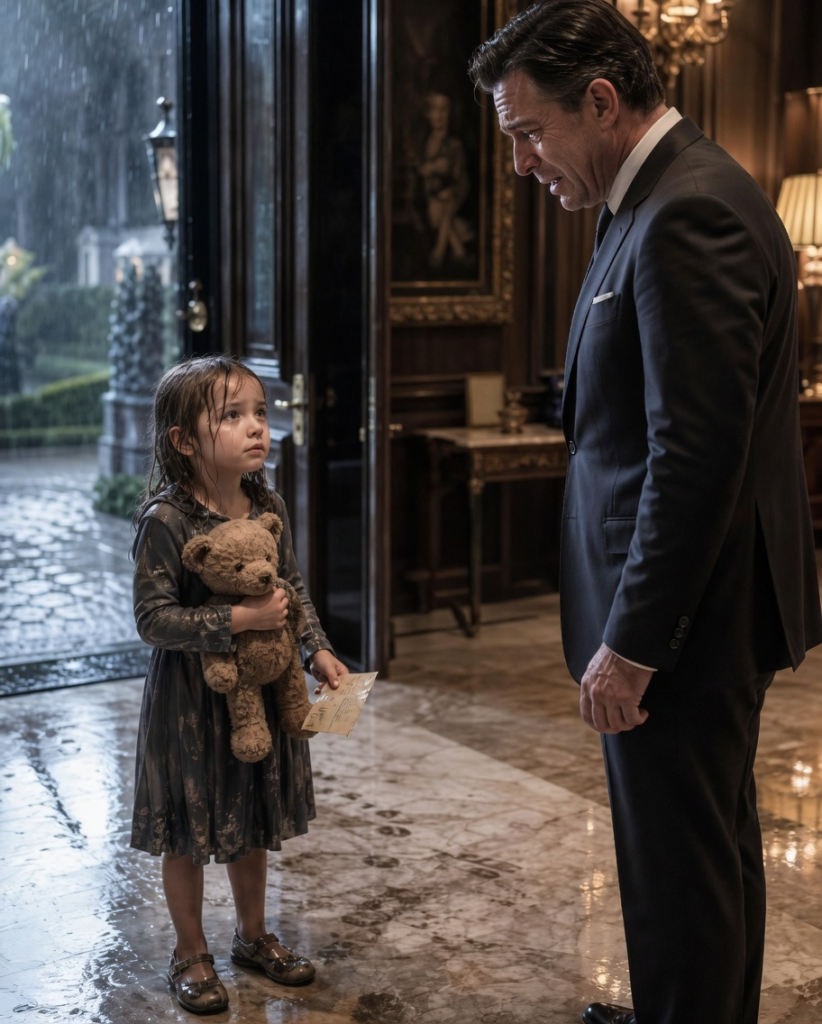
You find Emilia standing at the end of the hallway with bare feet, wet hair, and that ruined teddy bear pressed against her chest like it is the last piece of the world that still belongs to her.
For one second, nobody moves.
Marcos stops speaking mid-sentence. The guards lower their eyes. Even the rain against the windows seems to soften, as if the house itself understands that the child has heard too much.
You look at her, and something old and painful opens inside your chest.
—How much did you hear? —you ask.
Emilia does not blink.
—Enough.
Her voice is small, but it does not shake. That is what frightens you most. A six-year-old child should cry when she learns that someone murdered her mother. She should scream. She should collapse.
But Emilia only looks at you with those green eyes and asks:
—Is the bad man coming for me too?
Marcos turns away.
One of the younger guards curses under his breath.
You walk toward her slowly, not because you are afraid of her, but because you are afraid of becoming the kind of man who speaks too loudly to a child who has already lost everything.
You kneel in front of her.
People in your world do not see you kneel.
Men have begged in your office. Politicians have lowered their voices when you entered rooms. Enemies have crossed streets rather than meet your eyes.
But here you are, kneeling on cold marble in front of Elena Saldaña’s daughter.
—Not while I’m breathing, —you say.
Emilia studies your face as if trying to decide whether adults still deserve belief.
—My mamá said you were dangerous.
A bitter smile touches your mouth.
—She was right.
Emilia hugs the bear tighter.
—She also said dangerous men can still choose who they protect.
That sentence hits harder than any bullet ever did.
Because it sounds exactly like Elena
Eight years ago, Elena Saldaña had found you bleeding behind a shuttered clinic on the east side, half-dead from a betrayal you never saw coming. She had every reason to leave you there. Men like you brought trouble, and everyone knew it.
But Elena did not ask who you were running from.
She dragged you inside, stitched you with shaking hands, hid you in a storage room, and lied to armed men who came searching for you before sunrise. When you offered her money afterward, she threw the envelope back at your chest.
—One day, you’ll owe me something real, Damián Rivas.
Now that debt stands in front of you wearing soaked pajamas and holding a teddy bear.
You rise and turn to Marcos.
—Double the perimeter. Pull every camera within ten blocks of Elena’s apartment, the crash site, and the road to this house. Nobody gets close without my approval.
Marcos nods immediately.
—And Víctor?
You look back at Emilia.
She is watching every adult in the room with terrifying attention.
—Víctor Montalvo does not know where she is yet, —you say. —Let’s make sure he regrets looking
That night, you do not sleep.
You sit in your office with the lights low while Emilia sleeps upstairs with a lamp on, two guards outside the door, and a nurse beside her in case the shock finally breaks through. You should be planning revenge. You should be calling men who owe you favors, moving money, tightening the city around Víctor’s throat.
Instead, you keep seeing Elena’s face.
Not the face from eight years ago.
The face you imagine from three days ago, knowing she was being chased with her daughter in the back seat.
You wonder if she thought of you before she died.
You wonder if she believed you would come
That thought does something terrible to you.
Because Elena had been one of the few people in your life who never wanted power from you. She did not want protection. She did not want money. She did not want your name attached to hers.
She only kept one promise in reserve.
And when she finally used it, she was already gone.
At 4:12 a.m., Marcos returns with the first file.
He looks exhausted.
That tells you the news is bad.
—Elena’s car was forced off the road outside the industrial district, —he says. —Police report says wet pavement. Witnesses say black SUV. No plates. Two impact points on the rear bumper.
You stare at the photographs.
Twisted metal.
Broken glass.
A child’s booster seat in the back.
A smear of blood on the driver’s side.
Your hand tightens around the edge of the desk until your knuckles pale.
—And Víctor?
Marcos places another photo down.
Grainy security footage from a gas station half a mile from the crash.
A black SUV.
A man stepping out.
Tall. Gray coat. Silver ring on his right hand shaped like a wolf’s head.
You know that ring.
Raúl Sanz.
Víctor Montalvo’s personal dog.
—He was there, —Marcos says.
You lean back.
Your voice stays calm because if you let it rise, the room may not survive it.
—Why would Víctor send Raúl after Elena?
Marcos hesitates.
—We found something else.
He places a plastic evidence bag on the desk.
Inside is the rain-damaged paper Emilia brought to your gate. You thought it was only an address, maybe a desperate instruction from Elena. But under light and careful drying, more writing has appeared.
Not just your name.
Numbers.
Initials.
A date.
And one phrase in Elena’s handwriting:
If I die, the proof is with the bear.
You stand so fast the chair hits the wall behind you.
—Where is the bear?
Marcos’s face changes.
—With the girl.
You are moving before he finishes speaking.
Upstairs, Emilia is awake.
Of course she is.
She sits in the center of the guest bed, knees pulled to her chest, teddy bear tucked under one arm. The nurse sleeps lightly in the chair, but Emilia’s eyes go straight to you the moment you open the door.
—You found the note, —she says.
You step inside carefully.
—Your mother wrote something about the bear.
Emilia looks down at it.
For the first time since she arrived, her face cracks.
—She told me never to let anyone take Bruno.
Bruno.
The bear has a name.
That almost breaks you.
You sit on the edge of the bed, leaving enough space so she does not feel trapped.
—Emilia, I need to look inside him.
Her small arms tighten around the bear.
—No.
You nod slowly.
—Okay.
She seems surprised.
Adults have probably been taking things from her for days. Her home. Her mother. Her safety. Maybe she expected you to take this too.
You soften your voice.
—But your mamá may have hidden something in him. Something that could help us understand why those men hurt her.
Emilia looks at Bruno.
Her lower lip trembles.
—Will it hurt him?
You swallow.
You are Damián Rivas, a man feared by judges, gang leaders, and men who carry guns without shaking. But you have no training for answering a grieving child about surgery on a teddy bear.
—We’ll be careful, —you say. —I promise.
She studies you again.
—Mamá said promises are expensive.
A strange pain moves through you.
—Then I’ll pay.
Emilia holds Bruno out with both hands.
You take him like he is something sacred.
Downstairs, Marcos brings a seamstress who works for your housekeeper. She opens the old stitching along Bruno’s back with the care of a surgeon. Emilia stands beside you the entire time, silent and pale.
Inside the bear is a small flash drive wrapped in plastic.
And a silver locket.
Emilia gasps when she sees it.
—That was Mamá’s.
She reaches for the locket first.
You give it to her without question.
The flash drive goes to Marcos, who immediately takes it to your secure computer. You keep Emilia beside you, because whatever is on it belongs to her mother before it belongs to your war.
The first file opens.
It is a video.
Elena appears on screen, tired, afraid, but steady. She is sitting in what looks like a clinic storage room. Her hair is pulled back. There is a bruise on her cheek.
Your chest tightens.
—Damián, —she says in the recording. —If you are watching this, then I failed to run far enough.
Emilia makes a small sound.
You almost stop the video.
But she grips your sleeve.
—No. I want to hear her.
So you let it play.
Elena explains everything.
For two years, she worked part-time as a nurse for a private medical service that treated wealthy clients who did not want hospital records. At first, it was legal enough: discreet home care, emergency stitches, medication oversight. Then she discovered Víctor Montalvo was using the service to hide injured men, launder payments, and pressure doctors into signing false records.
Elena copied files.
Names.
Payments.
Dates.
Police officers on Víctor’s payroll.
Judges.
A district attorney.
A shipping company connected to disappearances.
She planned to take it to the federal authorities, but someone found out. She ran with Emilia. She was heading to you because, in her words, “you are the only criminal in this city who hates Víctor more than he loves money.”
Marcos mutters something under his breath.
You do not move.
Then Elena says the sentence that empties the room of air.
—If they reach me before I reach you, protect my daughter. Do not raise her in your world. Do not make her pay for my choice. Just keep her alive long enough for the truth to matter.
The video ends.
No one speaks.
Emilia stands frozen beside you, the locket clutched in her tiny hand.
Then she asks:
—Was my mamá brave?
You crouch in front of her again.
This time, you do not hide your eyes.
—She was the bravest person in this city.
Emilia nods once, like she needed that answer filed somewhere inside her.
Then she whispers:
—I saw the man.
Every adult in the room turns.
You stay still.
—At the car? —you ask.
She nods.
Her breathing grows uneven.
—Mamá told me to stay down. I was on the floor behind the seat. The car stopped spinning, and I heard rain. Then a man opened the door. He smelled like mint. He had a silver dog on his hand.
Raúl.
Your blood goes cold.
—What did he say?
Emilia squeezes the locket.
—He said, “Where is the drive?” Mamá said she didn’t know. Then he said, “Find the kid.”
The nurse covers her mouth.
Marcos turns away.
You keep your gaze on Emilia.
—How did you get out?
Her eyes fill with tears at last.
—Mamá pushed me through the other door before they came around. She told me to run to the lights. Then I ran and hid in a bus until the rain stopped. A lady gave me bread. Then I found the paper in Bruno’s shirt.
She looks at you like she is ashamed.
—I didn’t come fast enough.
Something inside you breaks cleanly.
You take her small shoulders gently.
—No. You survived. That is what your mother told you to do.
Her face crumples.
This time, she cries.
Not quietly.
Not bravely.
Like a child.
You pick her up before you think about it, and she clings to your shirt with both fists. You stand there in the middle of your office holding Elena Saldaña’s daughter while everyone looks away, giving her the dignity of not being watched.
That morning, you make three decisions.
First, Emilia will not leave your house until she is safe.
Second, Elena’s evidence will not disappear into the hands of corrupt officials.
Third, Víctor Montalvo will learn that some debts should never be collected by children.
You do not go to the police.
Not yet.
Elena’s files already name men inside the department. Sending the evidence blindly would be like throwing meat into a room full of wolves. Instead, you call the only federal prosecutor in the country who once tried to put you in prison and failed because you were not the worst man in that courtroom.
Her name is Rachel Monroe.
She hates you honestly.
That is why you trust her.
She answers on the fifth ring.
—If this is about your lawyer’s last filing, I don’t care.
—Elena Saldaña is dead, —you say.
The line changes.
Rachel knew Elena.
Of course she did.
Anyone who worked real cases in this city eventually crossed paths with the nurse who helped people others abandoned.
—What happened? —Rachel asks.
—Víctor Montalvo happened.
Silence.
Then:
—What do you have?
You look at Emilia through the glass office door. She is sitting with the housekeeper, eating toast in small bites, Bruno repaired in her lap.
—Enough to bury half the city, —you say. —But there’s a child involved.
Rachel’s voice sharpens.
—Where is the child?
—Safe.
—With you?
—Safe, —you repeat.
She exhales.
—Damián, listen to me carefully. If you turn this into one of your private wars, the evidence may become useless.
You almost smile.
—That’s why I called you.
By noon, Rachel Monroe arrives at your mansion with two federal agents and no patience.
She walks through your marble entryway like she is entering a disease. Her hair is pulled into a tight knot, her suit dark, her eyes sharp enough to make even Marcos stand straighter. She does not shake your hand.
Good.
You would have respected her less if she did.
She interviews Emilia gently, with a child advocate present. You watch from behind the glass because Emilia asked you not to go far. Rachel notices that.
She notices everything.
Afterward, she steps into the hallway with a face carved from stone.
—She is the only living witness placing Raúl Sanz at the scene.
—And the drive?
—The drive is worse, —Rachel says. —If this is authentic, Víctor has protected people in law enforcement, finance, immigration, shipping, and city hall. Elena copied more than medical records. She copied payment chains.
—Can you move on it?
Rachel looks at you.
—Not if Víctor knows we have it.
That is when the front gate explodes.
Not literally.
A black SUV slams into the outer barrier hard enough to bend steel. Alarms scream through the house. Guards run. Marcos draws his weapon and shouts orders into his radio.
You do not move toward the window.
You move toward Emilia.
She is already standing.
Her face has gone white.
—It’s him, —she whispers.
You take her hand.
—Not past the gate.
But the phone in your pocket rings before you can take another step.
Unknown number.
You answer.
Víctor Montalvo’s voice is smooth, amused, almost warm.
—Damián. I hear you found something that belongs to me.
You look toward the security monitors.
The SUV is still at the gate, smoking. A message, not an attack. Víctor wants fear to enter before he does.
—You killed a nurse, —you say.
Víctor sighs.
—Elena was sentimental. Sentimental people make poor criminals.
—She wasn’t a criminal.
—Everyone is something when they’re useful, —he says. —Send me the girl and the drive. I’ll forget you interfered.
You glance at Emilia.
She is watching your face, not understanding the words, but understanding the danger.
—You want a six-year-old child?
Víctor laughs softly.
—I want loose ends handled. Don’t pretend you’re offended. We both know what kind of man you are.
You let the insult sit.
Because he is wrong in exactly one way that matters.
You know what kind of man you have been.
Tonight, you are deciding what kind of man you will be.
—I owe her mother a life, —you say.
Víctor’s voice cools.
—Then pay with yours.
The call ends.
Marcos appears in the doorway.
—We need to move her.
Rachel shakes her head.
—No. That’s what he wants. If she moves, he’ll hit the route.
You look at the monitors.
The city is already tightening. Víctor’s men will watch roads, hospitals, airports, safe houses. He knows your habits. He knows your network.
But he does not know Elena’s.
You turn to the housekeeper.
—Do you still have family at St. Agnes?
She nods.
—My sister runs the children’s wing.
Rachel frowns.
—A hospital?
—An old convent hospital, —you say. —Underground service tunnels, private chapel entrance, medical staff who hate Víctor because he tried to buy them years ago.
Rachel studies you.
—You’re using nuns as tactical cover?
—They owe Elena too.
For the first time, Rachel almost smiles.
The plan is simple because complicated plans collapse under fear.
At sunset, three vehicles leave your estate loudly. Armored. Visible. Predictable. Víctor’s watchers follow them immediately.
Emilia is not in any of them.
She leaves thirty minutes later wrapped in a laundry cart beneath clean sheets, rolled through the old service entrance by your housekeeper and a driver nobody outside your household knows. You walk beside the cart dressed as a maintenance worker, cap low, beard shadowed, no watch, no expensive coat, nothing that says Damián Rivas.
Emilia does not make a sound.
Inside the cart, her hand holds yours through the sheet.
That trust nearly destroys you.
At St. Agnes, Sister Margaret meets you in the basement corridor with a flashlight and a face like carved oak.
—Damián Rivas, —she says. —I hoped never to see you again.
—Likewise, Sister.
She looks at the cart.
—Is that Elena’s daughter?
You nod.
Her anger disappears into grief.
—Bring her in.
For three days, Emilia stays hidden in a small room behind the old chapel, with nurses, federal agents, and a rotating guard detail Rachel trusts with her own life. You sleep in a chair outside the door. Marcos handles your empire without asking questions.
The city begins to shake.
Rachel’s team verifies Elena’s files. Federal warrants are prepared quietly. Bank accounts are traced. Phones are tapped legally this time. Men who thought they were untouchable begin receiving calls from other men who are also afraid.
Víctor knows something is moving.
So he makes one final mistake.
He takes Marcos’s younger brother.
Not Marcos himself.
That would be war with a soldier.
He takes the weak point. A mechanic named Luis who has no part in your world except blood. Víctor sends a video: Luis tied to a chair, bruised, alive.
Then he sends a location.
Old train depot.
Midnight.
Bring the girl and the drive.
Rachel says no immediately.
—It’s a trap.
Marcos looks at you with the kind of pain only loyalty can create.
—I know what he is asking, boss.
You look at the video again.
Luis is terrified.
Emilia stands in the doorway behind you, hidden from the others.
—He took someone’s brother? —she asks.
Rachel curses softly.
You turn.
—You should be sleeping.
She steps inside.
Her face is small and serious beneath the chapel light.
—If you don’t go, will that man die?
No one answers.
That is answer enough.
Emilia walks to you and places Bruno on the table.
—Mamá said bad men count on good people being scared.
You stare at her.
—Your mamá said many inconvenient things.
—She said you would understand the important ones.
You look at Marcos.
Then Rachel.
Then the old teddy bear on the table.
And suddenly, you understand how to win.
Not by bringing Emilia.
Not by hiding forever.
By making Víctor believe he has forced you back into the man he understands.
The old train depot smells like rust, rain, and dead machinery.
You arrive at midnight with one car, one briefcase, and no visible backup. Víctor’s men search you at the entrance. They find the gun you intended them to find and the drive you intended them to believe was real.
They do not find the transmitter sewn into your collar.
They do not find Rachel’s federal team positioned in the dark warehouses across the tracks.
They do not find Marcos, who knows this depot because his father once worked there and because grief makes men remember exits.
Víctor waits under a broken skylight.
Raúl Sanz stands beside him wearing the wolf ring.
Luis is tied to a chair nearby, breathing hard, alive.
Víctor smiles when he sees you.
—Where is the girl?
You place the briefcase on the ground.
—Safe.
His smile fades.
—That was not the arrangement.
—You made an arrangement with your ego. I was not present.
Víctor laughs once.
—Still dramatic.
You look at Raúl.
The man who opened Elena’s car door.
The man who told his men to find the kid.
Raúl smiles when he notices you staring.
—The little rat run fast?
You feel your pulse slow.
Men like Raúl want rage. Rage makes people stupid. Rage makes them step too close, swing too wide, confess too little.
So you give him silence.
Víctor gestures to Luis.
—You know I can make this ugly.
—You already did.
—Then give me the real drive.
You tilt your head.
—Why? Elena already gave you everything you needed.
Víctor’s eyes narrow.
—What does that mean?
You take one step closer.
—She gave you time to run. Three days. You could have left the country. You could have burned your accounts. You could have disappeared.
You look toward the shadows above the depot.
—Instead, you chased a child.
Víctor understands one second too late.
Lights explode across the depot.
Federal agents flood every entrance.
Rachel Monroe’s voice booms through a loudspeaker.
—Federal agents! Hands where we can see them!
Chaos erupts.
Víctor’s men reach for weapons, but half of them drop before they can move. Not killed. Disabled. Overwhelmed. Rachel wanted arrests, testimony, paper trails.
You wanted Raúl.
He runs toward the side corridor.
Marcos appears from the dark like a ghost and hits him hard enough to send him sprawling across the wet concrete. The wolf ring scrapes against the floor. Raúl rolls, cursing, reaching for his ankle.
You get there first.
You step on his wrist.
He screams.
You crouch beside him.
—A little girl remembers your smell.
Raúl spits blood.
—You think that matters?
You lean closer.
—In court, yes.
His face changes.
Because he expected death.
He expected the old rules.
He expected you to be what Víctor said you were.
But Elena’s daughter is alive, and for once, the truth will outlive the violence.
Rachel’s agents pull Raúl up and cuff him.
Across the depot, Víctor is also in custody, face twisted with disbelief. He looks at you as if you have betrayed some ancient agreement between monsters.
—You handed me to them? —he snarls.
You meet his eyes.
—No. Elena did.
The federal case breaks the city open.
Víctor’s arrest becomes the first stone. Then Raúl talks because men like him are loyal only until prison becomes personal. Bankers resign. Two judges are suspended. A police captain vanishes for thirty-six hours before being found at the border with cash in his shoes.
Rachel Monroe becomes a national name.
Elena Saldaña becomes something better.
A headline calls her a whistleblower.
A nurse who risked everything.
A mother who hid the truth in a teddy bear.
You keep that article.
Not for yourself.
For Emilia.
The custody hearing happens two months later.
No father comes forward. No relatives prove safe. Elena’s small apartment was emptied by investigators and what little remained fit into six boxes: clothes, photographs, medical books, a cracked blue mug, Emilia’s drawings, and a birthday card Elena never had time to mail.
Rachel asks if you intend to petition for guardianship.
You say no at first.
It is automatic.
A man like you does not raise a child. A man like you teaches danger without trying. A man like you has enemies, habits, rooms full of secrets.
Then Emilia hears the conversation.
She stands in the doorway of your office, Bruno under one arm, locket around her neck.
—Are you sending me away?
The question hits like a blade.
You kneel again, because by now it has become the only honest way to speak to her.
—I don’t want to put you in danger.
She looks around your mansion.
The guards.
The cameras.
The thick windows.
The people who now smile when she enters rooms.
—Danger found me before I knew you, —she says.
You have no answer.
She steps closer.
—Mamá told me to come to you.
Your throat tightens.
—Your mamá also told me not to raise you in my world.
Emilia thinks about that.
Then she says:
—So don’t.
That night, you make the hardest decision of your life.
Not to fight.
Not to kill.
To change.
You sell two businesses that cannot survive daylight. You cut ties with men whose loyalty depends on fear. You move assets into legal structures Rachel’s office can examine without finding blood on the paper.
It costs you money.
It costs you power.
It costs you the kind of reputation that made rooms quiet when you entered.
Good.
That reputation would have taught Emilia the wrong things.
Six months after the night she arrived in the rain, Emilia moves into a smaller house with you near the edge of the city. Not a mansion. Not a fortress. A real home with a yellow kitchen, an old oak tree, and a bedroom Emilia paints lavender because Elena once promised her a purple room.
Marcos comes too, not as a guard at first, but as the man who checks every window before pretending he is only there for dinner.
Rachel visits once a month, officially to monitor transition arrangements.
Unofficially, because Emilia likes her.
You pretend not to notice.
Life becomes strange.
You learn that children ask questions at impossible times. Emilia asks about death while eating cereal. She asks whether bad men are born bad while coloring a picture of Bruno wearing sunglasses. She asks if her mother was scared, and you answer honestly.
—Yes. But she was brave at the same time.
Emilia considers that.
—Can people be both?
You nod.
—Most people are.
She looks at you.
—Are you?
You almost lie.
Then you remember Elena’s video.
—Yes.
Emilia goes back to coloring.
—Good. Brave without scared sounds fake.
You laugh for the first time in weeks.
A year later, Víctor Montalvo is sentenced to life in federal prison.
Raúl Sanz gets less time because he testifies, but not little enough to enjoy it. The men who protected them fall one by one. The city does not become clean overnight, because cities never do, but something rotten has been dragged into the light.
At the sentencing, Rachel asks whether Emilia wants to attend.
She says no.
You are proud of her.
Instead, she asks to visit her mother’s grave.
It is raining that day.
Softly this time.
No thunder.
No terror.
Just rain.
You stand beside Emilia as she places yellow flowers on Elena’s grave. Bruno is tucked under one arm, repaired but still worn. The locket rests against her small chest.
For a long time, she says nothing.
Then she whispers:
—I collected the debt, Mamá.
Your chest tightens.
She turns to you.
—Did I?
You look at the name carved into stone.
Elena Saldaña.
Nurse.
Mother.
The woman who saved you twice.
Once from death.
Once from becoming only the man people feared.
—Yes, —you say softly. —You did.
Emilia reaches for your hand.
You let her take it.
After a while, she asks:
—Do you think she knows I’m okay?
You look at the rain sliding down the flowers.
You do not know what you believe about heaven, or ghosts, or whether the dead can see the promises kept for them. But you know Elena. If anything of her remains anywhere, it would not leave this child unwatched.
—Yes, —you say. —I think she knows.
Emilia leans against your side.
You stand there until the rain soaks through your coat.
You do not move first.
Years pass.
Not easily.
No story like this becomes gentle just because the worst night ends.
Emilia has nightmares. She hates black SUVs. She panics at the smell of peppermint gum because Raúl smelled like mint in the rain. Some nights, she wakes and sits at the top of the stairs without calling for you because she still believes needing someone is dangerous.
You learn to hear her anyway.
You sit beside her on those nights and say nothing until she leans against your arm.
You do not tell her to forget.
You do not tell her she is safe as if words can erase memory.
You show her.
Door locked.
Hall light on.
Bruno nearby.
Breakfast waiting in the morning.
Safety, you discover, is not one heroic act.
It is repetition.
It is being there again and again until the body slowly accepts what the heart wants to believe.
On her tenth birthday, Emilia asks for a party with yellow balloons.
Not green.
Not purple.
Yellow, because her mother once told her yellow was the color of brave mornings.
Rachel comes. Marcos comes. Sister Margaret comes with a cake and pretends she is not emotional. Children from Emilia’s school run through the yard, laughing under the oak tree.
You stand on the porch watching her.
She is taller now.
Still serious sometimes.
Still older than she should be in quiet moments.
But when the cake comes out, she laughs like any child.
That laugh feels like victory.
Rachel steps beside you.
—You did better than I expected.
You glance at her.
—That almost sounded like a compliment.
—Don’t get used to it.
You both watch Emilia blow out the candles.
Rachel’s voice softens.
—Elena would be glad.
You swallow.
—Would she?
—Yes.
You do not answer.
Because sometimes mercy is harder to accept than blame.
That night, after the guests leave, Emilia finds you in the kitchen washing frosting from a plate.
—Can I ask something?
You dry your hands.
—Always.
She climbs onto a stool.
—Why did my mamá save you?
You lean against the counter.
You have wondered the same thing for years.
—Because she saw a man hurt and decided he was still alive enough to matter.
Emilia thinks about that.
—Were you good then?
The question is clean.
Children’s questions often are.
You do not insult her with an easy answer.
—No. Not really.
She looks at you carefully.
—Are you good now?
You look toward the window, where the oak tree moves gently in the night air.
—Better.
Emilia nods.
—Better counts.
Your throat tightens.
—Does it?
She slides off the stool and hugs you around the waist.
—Mamá said people can choose who they protect.
You place one hand gently on her hair.
—She was right.
Emilia looks up.
—You chose me.
You cannot speak for a moment.
Then you say:
—No, little one. Your mother chose me for you. I just finally became worthy of the choice.
She smiles.
Not sadly.
Not bravely.
Just like a child who believes she is loved.
And that is the ending Elena bought with her courage.
Not Víctor in prison.
Not your enemies falling.
Not the city whispering that Damián Rivas had changed because a little girl arrived in the rain.
The real ending is smaller.
A lavender bedroom.
A repaired teddy bear.
A yellow birthday cake.
A child sleeping through a storm without waking.
Years later, people will still tell the story wrong.
They will say the most feared man in the city took revenge because a little girl came to collect an old debt. They will say you destroyed Víctor Montalvo because Elena Saldaña once saved your life. They will say power shifted, names fell, and the city learned fear can change direction overnight.
They will not understand.
The debt was never revenge.
The debt was Emilia.
And every morning she wakes up safe, every time she laughs without looking over her shoulder, every year she grows further from the night that tried to swallow her, you pay Elena back a little more.
Not with blood.
Not with fear.
With a life protected.
With a promise kept.
With proof that even a dangerous man can be changed by a child standing in the rain, holding a teddy bear, and saying the words no one in your world expected to survive:
“I came to collect the debt you owe my mother.”