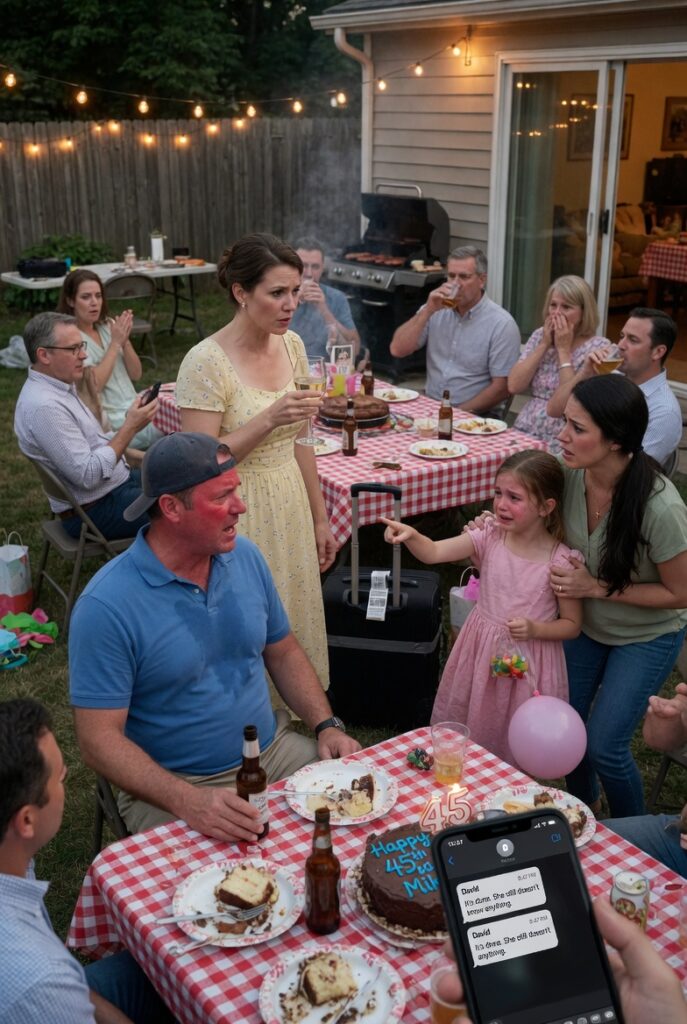
David’s message lay glowing on the table like a touchscreen bomb.
No one breathed. Not the country music on the speaker, not the cousins with their bourbon, not Mike’s mom with her hand over her mouth. Even the burgers seemed to have gone cold all at once.
Mike was the first to react. He lunged for the phone, but I got there first. I grabbed it. He froze, with the suitcase in one hand and his dignity dragging on the floor.
“Give me that,” he said.
He didn’t yell. That scared me more. Because Mike yelled when he felt strong. When he spoke softly, it was because he was calculating.
I looked at David. He was pale. Pale as if he had seen a dead man and the dead man had said hello.
“What is done, David?” I asked.
David swallowed hard. “It’s not what it looks like.”
Oh, that phrase. The favorite phrase of the unimaginative guilty.
Mike dropped the suitcase and took a step toward me. “Honey, don’t make a scene.”
I laughed. A dry, broken laugh—the kind that comes out when the body has no more tears and starts manufacturing sarcasm.
“A scene? Mike, you rented out the circus for seventeen years and now you’re annoyed that I’m turning on the lights.”
Madison hugged Sarah tighter. Sarah, my best friend, looked devastated. Not from guilt. From fear. And that confirmed something for me: she didn’t know either.
I unlocked the phone. Mike tried to snatch it from me. David stepped in the way.
“Don’t touch her.”
The phrase sounded loud. Too loud. Mike looked at him with pure hatred.
“Shut up, traitor.”
The word fell like a stone. Traitor. Not “meddler.” Not “friend.” Traitor.
My fingers trembled as I unlocked the screen. Mike, foolish as only men who think they’re invincible can be, never changed his passcode: Madison’s birthday. The very daughter he had just humiliated.
I opened the chat with David. There were messages from that week.
Mike: “I need you to sign as a witness. I don’t want Laura looking into anything.”
David: “This isn’t right.”
Mike: “Don’t be a boy scout. It’s just to temporarily move the house into my mom’s name.”
David: “Laura doesn’t know.”
Mike: “And she doesn’t need to. If she gets intense about the Sarah thing, I’ll leave her without a house before she even thinks about leaving me.”
I felt the noise of the world fade away. I read it again. “If she gets intense…” Intense. That’s what they call a woman when she stops being a doormat.
I leaned against the table. Sarah approached. “What’s going on?”
I couldn’t answer. I kept scrolling down.
Mike: “David, did you convince the notary?”
David: “He only agreed to review it because I told him it was urgent.”
Mike: “Laura signed power of attorney forms years ago. She doesn’t remember.”
David: “You told me she was on board.”
Mike: “Well, she’s on board with keeping her nice lifestyle, right?”
That’s when I looked up. I looked at David.
“You knew he wanted to take my house?”
David opened his mouth, but nothing came out.
“You knew?” I repeated.
“Not like that,” he finally said. “Mike told me you guys were restructuring assets for taxes. I… I started getting suspicious a few days ago.”
Mike let out a loud laugh. “Don’t play the saint. You helped out just fine.”
David clenched his fists. “Because you lied to me.”
“Because you have a thing for my wife.”
Silence fell again. But this time it wasn’t uncomfortable. It was brutal. David looked down. I felt like someone was scooping the air out of my lungs.
Mike smiled, dirty, triumphant, as if he had finally found a way to drag everyone down into the mud with him.
“See?” he said, looking at the family. “The poor humiliated wife had her little secret on the side too. David the hero. The polite man.”
“Shut up,” Sarah said.
Mike pointed a finger at her. “And don’t you even speak. Seventeen years playing the dignified friend, but you loved it when I flattered you.”
Sarah walked up to him slowly. For a moment I thought she was going to cry. But no. She slapped him so hard it echoed all the way to the kitchen. Just one. Perfect. With years of accumulated disgust.
“Never,” she said, her voice trembling. “I never liked it. I pitied you. And if I kept coming around, it was for her and Madison, not for you.”
Mike touched his cheek. “You’re all crazy.”
Madison took a step forward. “I’m not crazy, Dad.” Her voice was tiny, but it pierced through the whole house. “I did hear you when you said Mom was less than Aunt Sarah. I did hear when you said that if she were my mom, I’d be better. I heard everything.”
Mike’s face changed. Not from guilt. From public shame. Because hurting people didn’t bother Mike. People seeing him hurt people bothered him. He crouched down a bit, faking tenderness.
“My little girl, come here. You don’t understand adult things.”
Madison stepped back. “Don’t call me your little girl right now.”
I felt my heart break and put itself back together at the same time. My seven-year-old daughter had just set a boundary that took me seventeen years to learn.
Mike looked at his mom, looking for support. “Mom, tell them something.”
Martha, who always used to say, “that’s just how your husband is, sweetie, but he loves you,” stood up from her chair. She walked toward him. I thought she was going to defend him.
She took the beer out of his hand. “I raised you poorly,” she said.
Mike blinked. “What?”
“I laughed at your rudeness. I applauded your jokes. I let you believe that a woman puts up with it because she loves you. And look what you’ve become.” Her voice broke. “But I’m not going to applaud you today.”
Mike was left standing alone in the middle of all his people. And still, he didn’t apologize. Men like Mike don’t ask for forgiveness when they lose. They look for someone to blame.
“Perfect,” he spat. “Everyone against me. Is this what you wanted, Laura? To humiliate me on my birthday?”
I looked at him. Seventeen years. Seventeen years of laughing so no one would feel uncomfortable. Seventeen years of swallowing sentences like rocks. Seventeen years of thinking that maybe I was overreacting, that maybe I was too sensitive, that maybe marriage was just like this: a table full of people laughing while you bleed inside.
“No, Mike,” I said. “I didn’t want to humiliate you. I wanted you to be decent. But clearly, that was asking too much.”
He picked up his suitcase. “I’m leaving. But you’ll come begging for me.”
“No.”
“When you can’t pay for the house.”
“Still no.”
“When Madison asks for me.”
That’s when I stepped closer. “Madison is going to ask for her dad. Not for the man who made her feel inadequate. I hope someday you can manage to become the former.”
Mike opened the door. Before leaving, he turned to David. “And you, Judas, don’t even think you’re going to get to keep her.”
David didn’t answer. I did.
“I’m not a piece of furniture, Mike. No one gets to ‘keep’ me. I decide where I am.”
And I closed the door.
For the first time in years, the house was silent. Not at peace. Not yet. But silent. And sometimes silence is the first brick of a new life.
The guests trickled out. Some apologized to me for not saying anything sooner. Others looked down because they knew they had laughed. No one took any cake.
Sarah stayed. David did too, standing near the patio, as if awaiting sentencing.
I sent Madison to put her pajamas on. She didn’t want to let go of me, but Sarah convinced her by promising to sleep with her in the guest room. When my daughter went upstairs, I sat across from David.
“Explain.”
He rubbed his hands over his face. “Mike asked me for help two months ago. He said you guys were having issues with the IRS, that he wanted to protect the house in case something went wrong with his business. He asked me to recommend a notary. I introduced him to one.”
“Did you sign anything?”
“As a witness to a meeting. Nothing else. But later he sent me documents and I saw your name on old power of attorney forms. I started getting suspicious. Today I went to the notary and told him to put a hard stop on everything until I spoke with you.”
I remembered the message. “It’s done. She still doesn’t know anything.”
“So what was done?”
David pulled out his own phone and showed me the full chat.
David: “It’s done. The notary won’t move anything without Laura. She still doesn’t know anything.”
I closed my eyes. I felt relief. Then anger. Because the relief didn’t erase the fact that David had taken too long.
“Why didn’t you tell me from the beginning?”
David looked down. “Because I’m a coward.” The honesty disarmed me more than any excuse. “Because Mike has been my friend since college. Because I thought I was overreacting. Because I didn’t want to get in the middle of a marriage. Because…” he took a deep breath, “because I do care about you, and I was afraid you’d think I was doing it for that reason.”
Sarah spoke from the stairs: “Well, you made it worse.”
David nodded. “Yeah.”
I didn’t have the strength to forgive anyone that night. Not Mike. Not David. Not myself for letting my daughter learn to read my wounds before her schoolbooks.
“Leave, David,” I said.
He looked up. He didn’t protest. He didn’t play the victim. He just nodded. “I’ll send you all the documents tomorrow. And the contact info for a lawyer. She’s the best I know.”
“Send them to Sarah.”
“Okay.” He walked to the door. Before leaving, he stopped. “Laura… I’m sorry.”
I didn’t answer. Because that night the words “I’m sorry” fell short. Like a band-aid on a broken bone.
When the house was finally empty, I went up to Madison’s room. She was awake. Sarah was by her side, stroking her hair. My daughter looked at me.
“Is Dad gone?”
“Yes.”
“Is he coming back?”
I lay down next to her. “Not to live here.”
Madison swallowed hard. “Is it my fault?”
It hurt so much I had to take a breath before answering. “No, my love. Never. Your dad left because mom decided that in this house, we aren’t going to hurt people with jokes anymore.”
She thought about it. “So jokes can be mean too?”
“Yes. When they make someone cry and the other person keeps laughing, they aren’t jokes anymore.”
Madison snuggled into my chest. “I don’t want a dad who makes my mom cry.”
I hugged her. “And I don’t want a life where you think that’s normal.”
Sarah covered us with a blanket. And that night the three of us slept in the same bed, like survivors of a hurricane that had finally stopped knocking on the door.
The next day the war began.
Mike sent thirty-seven texts before 9 AM. “You’re overreacting.” “Madison needs her father.” “This is all David’s fault.” “I never wanted to take anything from you.” “Answer me, you’re acting immature.” Then voice memos. I didn’t listen to them. Sarah saved them.
The lawyer David recommended was named Emily Robbins. She arrived at my house in a gray suit, black glasses, and the face of a woman who ate abusive men for breakfast with a side of pastries. She reviewed documents, deeds, POAs, messages.
“Your husband tried to move the property using an old power of attorney,” she said. “He didn’t manage to do it, but the intent is documented.”
“Can I legally kick him out?”
“Yes. And we’re also going to request a restraining order so he can’t come near the house while the separation is resolved.”
I stayed quiet. Separation. The word sounded massive. Like a heavy door.
Emily looked at me. “Laura, what you experienced wasn’t humor. It was emotional abuse. And what he tried to do with the house was financial abuse.”
Abuse. Another massive word. I always thought abuse was a hit, a black eye, a broken door. I never imagined it could also be a table full of relatives laughing while your husband belittled you.
“And Madison?” I asked.
“We’re going to protect her.”
That was the only thing I needed to hear.
The following days were strange. The house smelled of absence. But not of sadness. Of cleanliness. Like when you move an old piece of furniture and find the wall is marked, but can still be painted over.
Madison started therapy. So did I. The first time the therapist asked me what I felt, I said “exhaustion” and cried for forty minutes. Not for Mike. For me. For the version of me that learned to smile with a mouth full of humiliation.
Sarah came over every day. She cooked, took Madison to school, scolded me when I wanted to check Mike’s social media “just to see.”
“Don’t stick your hand in the trash can just to confirm it stinks,” she’d tell me.
David sent the documents and then disappeared. He didn’t call me. He didn’t look for me. He didn’t try to play the hero. That, even though I hated to admit it, spoke better of him than any speech.
Mike, on the other hand, did what he did best: perform for an audience. He started telling the family that I was having an affair with David. That that’s why I kicked him out. That he was only joking around because “that’s how we joked.” That I was manipulating Madison.
But this time something had changed. People weren’t laughing anymore.
His own mother testified in my favor. His cousins handed over videos of parties where you could hear his “jokes.” Sarah wrote a letter detailing every time he made her uncomfortable, every uninvited hug, every comment disguised as a compliment, every time she tried to stop him and he put her on the spot even more.
And Madison, my brave little girl, told the therapist: “My dad made jokes that made the house sad.” That sentence ended up in the case file.
Mike lost the right to enter the house. Supervised visits were established. And when the lawyer managed to block any movement on the property, I felt like I could finally breathe without asking for permission.
A month later, Mike asked to see me. I agreed to meet at a coffee shop, with Emily at the next table and Sarah waiting outside in the car. He arrived with an ironed shirt and the face of a professional penitent.
“I miss you,” he said. He didn’t even order a coffee.
“You miss your house,” I replied.
“Don’t be cruel.”
“Cruel was telling a little girl that another woman would have been a better mom.”
His jaw trembled. “I didn’t think Madison would take it like that.”
“You didn’t think of Madison at all.”
He looked down. “I’m going to therapy.”
“That’s great.”
“I want my family back.”
I looked at him for a long time. There was a time when that phrase would have broken me. It would have made me imagine Sundays, forgiveness, promises, new photos to cover the old ones. But now I only saw a man who confused a family with an audience.
“Your family wasn’t a given, Mike. It was something you had to take care of.”
“And David?”
I laughed softly. There it was. His repentance had lasted exactly seven minutes.
“David has nothing to do with my decision.”
“Yes he does. He was always hovering.”
“Yes. And even so, you’re the one who lost me.”
He fell silent. “Did you ever love me?” he asked.
The question surprised me. Not because it was deep. But because it never occurred to him to ask it when it still mattered.
“Yes,” I said. “Very much. So much that I confused love with endurance.”
Mike cried. A tear rolled down his cheek. In the past, I would have reached across to wipe it away. Now, I just pushed a napkin toward him.
“I have to go pick up Madison,” I said.
“Can I see her today?”
“When it’s your day and as the lawyer ordered.”
“Laura…”
“Don’t say ‘Laura‘ in a funeral voice. I didn’t die.”
I stood up. And for the first time, Mike stayed in his seat watching me leave. Not as a wife. Not as a victim. As someone he could no longer reach.
Six months passed. Life didn’t become perfect. It became ours.
Madison started laughing out loud again. Sarah remained my sister for life, although there were hard days where we also had to talk about the damage her silence caused. She cried, apologized, and told me something I never forgot: “I thought defending you meant telling him to stop. Now I understand I also should have asked you why you were still there.” I hugged her. Because we women also learn things too late.
David returned to my life in the simplest way: he knocked on the door one Saturday with a box of missing documents and a bag of cookies for Madison.
“I’m not coming in to stay,” he said before I could speak. “I just brought this.”
Madison came running out. “Uncle David!”
He smiled, but looked at me for permission. I nodded. He sat in the living room, at a distance, respectfully. Madison told him about school. He listened as if every word was important. And that, after Mike, was almost revolutionary.
When he left, he left me a note.
“I don’t want to be your escape. If you ever let me be close, let it be because your life is already complete, not because you need someone to pick up the pieces.”
I kept the note. I didn’t reply. Not yet. Because I was busy doing something more urgent: getting to know myself.
I took a part-time job at a bakery. Then I started selling custom desserts. Mike’s birthday cake—the one no one ate—became a private inside joke and a signature recipe: dark chocolate with berry filling. I named it “I’m Not Laughing Anymore.” It sold out constantly. A customer asked me why the name. I told her: “Because there are flavors that wake you up.”
A year later, I signed the divorce papers.
Mike arrived at the courthouse looking older, even though only twelve months had passed. He didn’t make jokes anymore. He didn’t mention Sarah. He didn’t look at David, who was waiting outside with me, without coming in, without intruding.
When I signed, my hand didn’t shake. Mike held the pen longer than necessary.
“I hope someday you forgive me,” he said.
I looked at him. “I hope someday you understand what you did.”
He signed. And that’s how seventeen years ended. Not with shouting. Not with dramatic music. With black ink on white paper.
When I walked out, Madison was waiting for me with Sarah and David. She had a drawing in her hand: a house, three women holding hands, and a huge sun. David was drawn off to the side, next to a tree.
“And why is he over there?” I asked with a smile.
Madison shrugged. “Because he doesn’t push the door open. He knocks.”
David turned red. Sarah burst out laughing. I hugged my daughter and realized that kids don’t need perfect fairytales. They need safe truths.
That night we had dinner at the house. Not a party. A dinner. Hot chili, an “I’m Not Laughing Anymore” cake, and soft music.
Sarah raised her glass of sweet tea. “To Laura,” she said. “Who stopped laughing when it hurt.”
Madison raised hers. “To my mom, who really is a good mom.”
I felt my eyes fill with tears. David raised his glass too. “To homes where cruelty disguised as a joke is no longer allowed.”
I looked around. My table. My daughter. My friend. My life. It wasn’t the life I imagined when I married Mike. It was better, because it was no longer built on fear.
I raised my glass. “To us,” I said. “Because it took us a while, but we made it.”
Madison hugged me around the waist. “Mommy, are we happy now?”
I thought of all the times I pretended to be. I thought of every laugh I swallowed like a thorn. I thought of the black suitcase by the door, David’s text message, Sarah’s slap, the voice of my daughter saying “it’s your fault.” And I smiled. This time for real.
“Yes, my love,” I said. “But the best part is that now we know why.”
Outside, the world was exactly the same. Neighbors kept gossiping. Mike kept saying I left him for someone else, because some men prefer a lie that makes them a victim over a truth that holds them accountable.
But inside my house, there were no more cutting jokes. No more forced laughter. No more little girl wondering if her mom was less than. There was peace. An imperfect peace, with therapy on Tuesdays, bills to pay, desserts that sometimes burned, and a woman learning to look in the mirror without apologizing.
And if anyone asked me what was the hardest part of leaving, I wouldn’t say “leaving Mike.” The hardest part was leaving the Laura who believed that enduring was loving.
But the day my daughter asked me if I was a bad mom, that Laura died. And in her place, another was born. One who no longer laughs when she’s hurting. One who no longer confuses silence with patience. One who finally learned that when a man needs to humiliate you to feel big, he isn’t a husband, he isn’t a partner, he isn’t family.
He’s just noise. And I, after seventeen years, chose to turn it off.