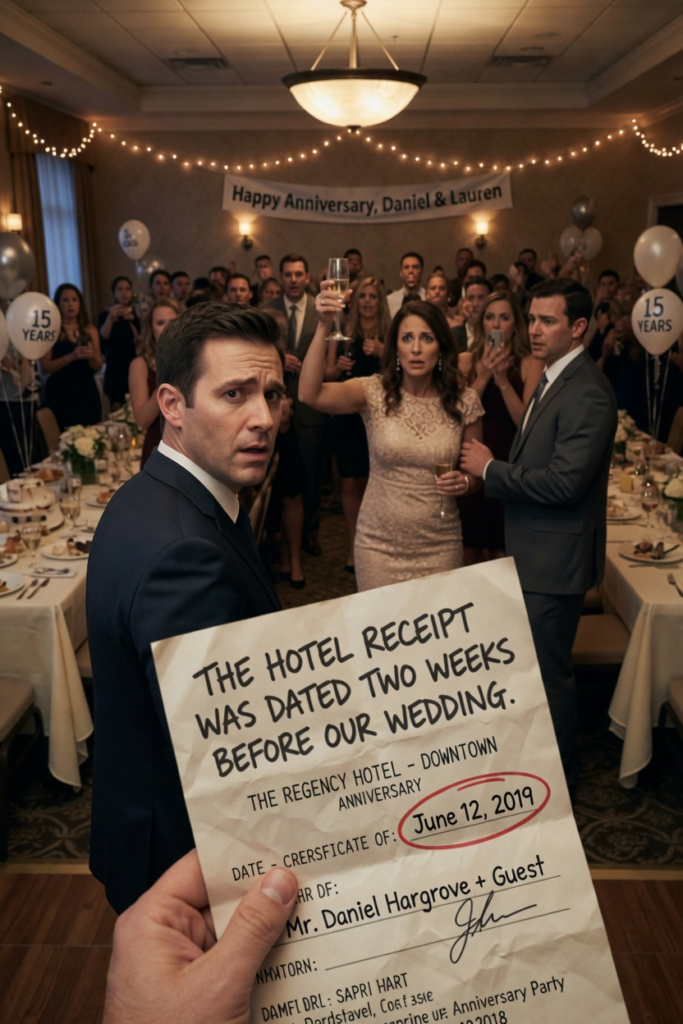
She smiled beside me in a designer dress while her parents toasted our “perfect love.”
She thought I was the clueless husband who would never know.
Then I picked up the microphone, turned on the screen behind us, and let her secret life play in front of everyone.
PART 1: THE BLUE LIGHT ON HER FACE
The first time I knew my wife was lying, the room was completely silent.
Not empty.
Not peaceful.
Silent in the way a house becomes when the truth is standing inside it and no one has said its name yet.
It was a Tuesday night in Chicago, cold enough for the windows of our brownstone on North Aster Street to fog around the edges. The city outside was wet with late autumn rain. Cars hissed past under the streetlights. Somewhere down the block, a dog barked twice and then stopped, as if even the neighborhood knew to lower its voice.
I was lying beside Sarah, staring at the ceiling, pretending to be asleep.
Her phone glowed in her hand.
Cold blue light stretched across her face, cutting her cheekbones into something unfamiliar. Her thumb moved quickly over the screen. She smiled.
Not a big smile.
Not the kind someone would notice from across a room.
Just a small, private curve of the lips.
But it hurt more than if she had laughed out loud.
Because I had not seen that smile directed at me in months.
My name is John Mercer. At the time, I was thirty-six, a commercial litigation consultant, the kind of man people described as steady because they did not know how much effort it took to keep my voice even. I believed in order. In receipts. In patterns. In the quiet truth numbers tell when people lie around them.
I also believed in marriage.
That was my first mistake.
Sarah and I had been married almost a year, but we had been together for three. From the outside, we looked like the kind of couple people envied without knowing enough to be kind. A restored brownstone. Two good careers. Matching winter coats in engagement photos. A wedding at a downtown venue with white orchids, gold chairs, and vows written on handmade paper because Sarah said printed vows felt “impersonal.”
She was beautiful in the way expensive women in Chicago become beautiful when ambition sharpens every detail.
Dark hair cut just below the shoulders.
Perfect posture.
A smile that could melt donors, clients, waiters, and my mother.
She worked at Ellison Vale Capital, a private wealth firm where people measured success in bonuses, country club invitations, and how casually they could discuss money most families would never see.
I had met her at a charity auction.
She was arguing with a man twice her age about affordable housing policy while wearing a black dress and a pair of pearl earrings. I remember thinking she was fearless.
Later, I would understand that fearless and shameless can look alike under the right lighting.
At first, she made me feel chosen.
That was the drug.
She listened when I spoke. She asked about my work. She laughed at my dry jokes. She held my hand in taxis. She left notes in my briefcase before big meetings. She made my quiet life feel suddenly cinematic.
When I proposed, she cried.
When we said our vows, her voice trembled.
When she promised to be faithful, I believed her because I had never imagined saying those words without meaning them.
Looking back, I think betrayal begins long before the act itself.
It begins the first time someone lets you explain away the coldness in their voice.
The first time they turn their phone over and you pretend not to notice.
The first time they make you feel guilty for asking a reasonable question.
For Sarah, the changes began before the wedding, though I did not have the courage to understand them then.
Late nights at the office.
Client dinners that stretched past midnight.
A sudden obsession with privacy.
Her phone, once abandoned on kitchen counters and couch cushions, became an extension of her body. She took it to the bathroom. Slept with it under her pillow. Turned the screen away when I entered a room.
The first hard clue was a receipt.
The Drake Hotel.
Cocktails and appetizers.
Tuesday afternoon.
Two weeks before our wedding.
I found it in the pocket of a camel coat she had asked me to pick up from the dry cleaner. The paper slipped out when I hung it in the closet. At first, I thought nothing of it. Sarah had meetings everywhere.
Then I saw the time.
2:17 p.m.
And the itemized order.
Two martinis.
Oysters.
Chocolate dessert.
I stood in the closet holding that receipt while Sarah called from the kitchen, “Did you find my coat?”
I folded the receipt into my palm.
When I asked her about it later, her eyes went cold so quickly it startled me.
“It was a client meeting, John.”
“Cocktails at two in the afternoon?”
“It’s wealth management. People drink at lunch.”
“You didn’t mention it.”
“I don’t report every meeting to you.”
“I’m not asking you to report. I’m asking why you got defensive.”
She laughed then.
Not warmly.
“Do you hear yourself?”
That was her gift.
Turning the question back into my character.
“Do you not trust me?”
The accusation came so fast I felt ashamed before I knew why.
I apologized.
That still humiliates me.
I apologized while holding the first thread of the lie.
After that, I became a man who noticed too much and said too little.
Another man’s cologne on her scarf.
A lipstick shade she wore only on days she said she had internal meetings.
A hotel valet ticket in her glove compartment.
A text preview that disappeared when I walked into the room.
Her body tensing when I touched her lower back, not because she disliked the touch, but because she seemed to be remembering whose hand she wished it was.
The name came later.
Mark Ellery.
Portfolio manager.
Newer at her firm, but already moving fast. Slick, handsome, sharp-suited, the kind of man who smiled like he had never been denied anything permanently. He had a wife. Two children. A house in Lake Forest. A reputation for making clients feel rich even when their portfolios were bleeding.
I had met him once at a holiday event.
He shook my hand too firmly and held Sarah’s gaze half a second too long.
I told myself I was being paranoid.
Paranoia is the word people use when they want instinct to feel embarrassed.
The night with the blue phone light, I lay beside Sarah and watched her smile at the screen.
“What are you smiling at?” I asked.
She flinched.
A tiny movement.
But enough.
“God, John.”
“I asked a question.”
She locked the phone.
“Work.”
“At midnight?”
“Yes.”
“What part of work is funny?”
She sat up.
“I’m not doing this.”
“Doing what?”
“This insecure interrogation.”
I turned toward her.
Her face was half in shadow now. The woman I loved was still there, but she seemed farther away, standing behind glass.
“I’m your husband.”
“And I am your wife, not your prisoner.”
The sentence was too large for the moment.
She had prepared it somewhere else.
I knew that then.
Not fully.
Enough.
She rolled away from me and pulled the blanket to her shoulder.
I stared at her back until the room became gray with morning.
The breakdown happened in a parking garage.
I wish I could say I hired an investigator before I followed her, that I behaved with discipline from the beginning. But the first time, I followed her myself. Pain makes amateurs of men who think they are rational.
Sarah had told me she had a client review near Millennium Park.
I believed her until she kissed me goodbye without meeting my eyes.
So I left work early.
Parked two blocks away.
Waited in a garage that smelled of wet concrete, exhaust, and old oil.
At 4:42 p.m., Sarah’s silver Audi pulled into the third level.
At 4:46, Mark Ellery appeared.
No briefcase.
No client files.
Just a dark coat, confident stride, and the smile of a man entering territory he thought was already his.
He got into her passenger seat.
I watched them through the windshield of my car.
Sarah laughed.
Head back.
Mouth open.
The laugh I used to hear in our kitchen when I burned breakfast or mispronounced the name of some wine she liked.
Then Mark leaned in.
The kiss was not tentative.
It was not new.
It was practiced.
Deep.
Hungry.
Familiar.
My hands tightened around the steering wheel until my knuckles went white.
I could not breathe.
There is a strange violence in seeing someone you love touch another person with ease.
It is not only jealousy.
It is disorientation.
The body says, That gesture is mine.
The eyes say, It never was.
I drove away before they saw me.
I do not remember the first ten minutes of the drive.
I remember the wipers moving across the windshield though it had stopped raining. I remember a horn blaring behind me at a green light. I remember pulling into a 24-hour diner in Wicker Park because my hands were shaking too hard to keep driving.
The diner smelled of burnt coffee, grease, and bleach.
A waitress with tired eyes filled my cup and did not ask why I sat there for three hours without touching the menu.
That was where the loyal husband died.
Not dramatically.
Not with rage.
With a cup of black coffee cooling between my hands and a parking-garage image burning behind my eyes.
By midnight, grief had become strategy.
I would not confront Sarah.
Not yet.
I would not beg.
I would not ask if she loved him.
I would not give her the gift of seeing how thoroughly she had broken me before I understood how far the lie went.
I called a private investigator the next morning.
His name was Frank Delgado.
Ex-cop.
Gray beard.
Bad knee.
Office above a pawn shop with a view of an alley and the smell of cigar smoke embedded in the curtains.
He listened to me without pity.
Pity would have made me leave.
When I finished, he asked, “You want truth or ammunition?”
“What’s the difference?”
“Truth tells you what happened. Ammunition decides what you can do with it.”
I looked at him.
“Both.”
He nodded.
“Then don’t confront her. Don’t threaten him. Don’t drink and text. Don’t try to catch them yourself. People like this love turning your pain into their safety.”
That was the first useful thing anyone said to me.
For six weeks, Frank documented everything.
Photos of Sarah and Mark entering boutique hotels in Lincoln Park.
A video of them leaving a restaurant through a side door, his hand inside her coat.
Credit card statements showing charges from our joint account for meals she claimed were client expenses.
A screenshot from Mark’s building lobby.
A phone record showing calls between them at 1:12 a.m., 2:03 a.m., 5:48 a.m.
Once, Frank sent me a photograph of Sarah standing on a sidewalk outside the Drake, laughing while Mark brushed hair from her face.
I stared at that photo longer than the others.
Because she looked young.
Not young in age.
Young in spirit.
Free of the weight she seemed to feel at home.
That is the insult that stays with you.
Not that they touch someone else.
That they become easier beside them.
At the same time, I hired a divorce attorney.
Vivian Cross.
The most terrifying woman I have ever met.
She wore black suits, red lipstick, and the expression of someone who had converted human weakness into billable hours decades ago.
Her office overlooked the river. Everything inside it was white, clean, sharp, and expensive enough to make dishonesty feel underdressed.
She reviewed Frank’s first file without speaking.
Then she looked up.
“How emotional do you want to be?”
“Not at all.”
“Good answer. Usually false.”
“It won’t be.”
She studied me.
“Your wife works in finance?”
“Yes.”
“Affair partner?”
“Same firm.”
“Company policies?”
“Strict fraternization disclosures. Especially if one party impacts client portfolios or expense approvals.”
Vivian smiled slightly.
It was not kind.
“Excellent.”
I should have felt ashamed of how much satisfaction that gave me.
I did not.
Vivian began arranging the legal side.
Separate assets.
Trust protection.
Documentation of marital funds spent on the affair.
Timeline.
Property valuation.
Debt exposure.
No confrontation.
No warning.
No sentimental emails.
“People who lie love preparation,” she told me. “So we will prepare better.”
Sarah noticed something.
Of course she did.
Liars are often highly sensitive to changes in the people they are deceiving.
One night, she came into my office while I was reviewing a fake spreadsheet I had opened just in case.
“You’ve been strange,” she said.
“Work.”
Her eyes narrowed.
“That’s my line.”
I looked at her.
She smiled, but it faded when I did not smile back.
“Are we okay?”
There it was.
The question cheaters ask when they want reassurance their stage remains stable.
I leaned back.
“Are we?”
Her face softened.
Almost beautifully.
She crossed the room and touched my shoulder.
“I know I’ve been distracted. After the anniversary party, maybe we should take a weekend somewhere.”
“Our anniversary party?”
“My parents already booked the venue. You know that.”
I did.
Her parents, Richard and Elaine Wexler, were pillars of their social world. Charity boards, university donors, country club dinners, people who believed reputation was a family heirloom. They adored Sarah because she had always known how to shine under chandeliers. They tolerated me because I was successful enough not to embarrass them but not so dazzling that I threatened their story of her.
The anniversary party was their idea.
One year of marriage.
A celebration.
A performance.
Perfect.
I placed my hand over Sarah’s.
“That sounds good.”
She smiled with visible relief.
She thought she had repaired something.
She had no idea I had just chosen the stage.
PART 2: THE ANNIVERSARY PARTY WHERE THE FIRST PHOTO APPEARED
The anniversary party was held at the Alden Club downtown, a private venue with high ceilings, velvet drapes, gold light, and waiters who moved like they had been trained not to hear rich people misbehave.
Sarah wore emerald silk.
It should have hurt that she looked beautiful.
It did.
The dress cut across one shoulder and shimmered when she moved. Her hair was swept back. Diamond earrings from her mother. Red lipstick. The same perfume she had worn on our wedding day.
She stood beside me greeting guests, one hand looped lightly through my arm.
Perfect wife.
Perfect daughter.
Perfect liar.
“Smile,” she whispered once, through her teeth, when she noticed my face had gone still.
I smiled.
For the room.
Not for her.
The guest list was a map of everything Sarah cared about.
Her parents’ friends.
Partners from Ellison Vale.
Her boss, CEO Daniel Roth, silver-haired and cold-eyed.
Colleagues.
Clients.
My parents, who looked delighted and oblivious.
Friends from college.
Mark Ellery arrived at 7:18 p.m. with his wife.
His wife.
Her name was Caroline.
She wore a navy dress, low heels, and the tired sweetness of a woman who had carried two small children through dinner, homework, birthday parties, and emotional labor while her husband spent afternoons at hotels with mine.
She shook Sarah’s hand.
Sarah smiled at her.
That almost made me lose control.
Not the affair.
The smile.
The ability to smile at the woman whose life you were helping dismantle.
Mark clasped my shoulder.
“John. Great to see you.”
His hand was warm.
Confident.
I wanted to break it.
Instead, I said, “Mark. Glad you could make it.”
His eyes flicked to Sarah.
Only half a second.
Too quick for anyone who did not already know.
I saw.
Frank had positioned two men at the venue.
Vivian sat near the back wearing a black dress and the expression of a woman attending theater with legal consequences.
At 8:45, Elaine tapped a glass and called everyone’s attention for toasts.
The room softened.
People gathered near the small stage.
Champagne glasses lifted.
Sarah stood beside me under warm light, her hand in mine, fingers cool.
Her father spoke first.
He talked about devotion.
Trust.
Commitment.
The blessing of watching his daughter find a man who honored her.
I watched Mark sip champagne beside Caroline.
Then Sarah’s mother spoke.
She cried prettily.
She called us “proof that old-fashioned love still exists.”
Vivian glanced at me from the back of the room.
I almost smiled.
Then it was my turn.
Sarah squeezed my hand.
A warning or affection.
Maybe both.
I took the microphone.
The room applauded softly.
I looked at the faces before me.
My parents, proud.
Her parents, glowing.
Daniel Roth, bored but polite.
Mark, relaxed.
Caroline, smiling faintly.
Sarah, radiant.
I waited for the applause to fade completely.
Silence gathered.
“A year ago,” I began, “I stood at an altar and promised to love and honor my wife.”
Sarah’s smile softened.
“I meant every word.”
The room warmed around that sentence.
People love the beginning of sentiment.
They never suspect the blade until it is already inside.
“I believed in our marriage,” I continued. “I believed in trust. I believed that when two people make vows, they are not merely speaking to each other. They are asking everyone who loves them to witness a truth.”
I turned slightly toward Sarah.
Her eyes flickered.
Something in my tone had reached her.
“I have learned,” I said, “that witnesses matter.”
A small murmur moved through the room.
I looked toward the technician near the screen.
He nodded.
My finger pressed the remote in my hand.
Behind us, the large screen lit up.
The first photo appeared.
Sarah and Mark.
Parking garage.
His mouth on hers.
Her hand gripping his coat.
The room went silent so fast it felt like a vacuum.
Sarah froze.
For one second, she did not turn.
Maybe she thought if she did not look, the image would not become real.
Then she turned.
Her face emptied.
The second photo appeared.
The Drake Hotel entrance.
Sarah and Mark walking inside.
Timestamp visible.
Two weeks before our wedding.
A sound came from my mother.
A gasp.
Or a prayer.
The third slide.
Hotel receipt.
Tuesday afternoon.
Cocktails.
Oysters.
Chocolate dessert.
Fourth slide.
Lincoln Park boutique hotel.
Fifth.
Restaurant bill from our joint account.
Sixth.
Phone logs.
Then the audio.
Vivian had warned me not to use it unless I was prepared to become merciless.
I was.
Sarah’s voice filled the room.
“I swear, Mark, he has no idea. Sometimes I feel guilty, but then he looks at me with that serious face and I just want to laugh. He thinks loyalty is a personality.”
Mark’s laugh followed.
A low, smug sound.
“He’s useful, though.”
Sarah again.
“Useful is not the same as exciting.”
The room absorbed it.
Every word.
Every knife.
Caroline turned toward her husband.
Mark’s face had gone gray.
Daniel Roth stood very still.
Sarah looked at me finally.
Her eyes were wide.
Pleading.
Not for forgiveness.
For privacy.
Too late.
I lifted the microphone again.
“I discovered the first receipt dated two weeks before we exchanged vows.”
A ripple moved through the room.
“My wife began her marriage with a secret life already in progress.”
Her father’s face turned purple with rage.
Her mother sat down hard in a chair.
Sarah whispered, “John, please.”
That word.
Please.
Where had it been when she kissed him?
When she laughed?
When she mocked me?
When she let her parents toast devotion while Mark stood ten feet away?
I looked at her.
“You brought him here.”
She shook her head.
“No.”
“You brought his wife here.”
Caroline covered her mouth.
That was the moment the room understood the full cruelty.
Not only betrayal.
Theater.
Sarah took one step back.
Her heel caught the edge of the stage rug.
She stumbled.
No one moved to catch her.
Mark tried to leave.
Vivian stood.
Two security staff blocked the side exit.
Not touching him.
Just present.
Daniel Roth walked toward him, face carved from stone.
“Mark,” he said, voice low. “Stay.”
Mark looked like a man realizing for the first time that arrogance was not immunity.
Sarah turned toward her father.
“Dad.”
Richard Wexler looked at her as if she were a stranger wearing his daughter’s skin.
“How long?” he asked.
She shook her head.
“How long?”
She could not answer.
I did it for her.
“At least fourteen months.”
The room erupted.
Not loudly at first.
Shocked whispers.
Chairs scraping.
Caroline crying without sound.
Sarah’s mother saying, “No, no, no,” like repetition could reverse evidence.
Mark’s wife walked up to him and slapped him so hard the sound cracked across the room.
No one stopped her.
Then she removed her wedding ring and dropped it into his champagne glass.
The ring sank through the bubbles.
I still remember that.
Tiny.
Brutal.
Perfect.
Sarah collapsed then.
Not fainted.
Collapsed.
Her knees gave out. Emerald silk pooled around her like spilled poison. She covered her face with both hands and sobbed.
People moved around her, uncertain whether to help, condemn, or flee the contamination of public shame.
I stepped off the stage.
Vivian met me near the back.
“Efficient,” she said.
I looked at her.
“That sounded almost approving.”
“It was not meant to sound almost.”
I walked out of the Alden Club before dessert was served.
Outside, Chicago glittered in the cold.
I stood under the awning while rain began again.
Small drops at first.
Then harder.
I expected triumph.
What I felt was silence.
Deep.
Chilling.
The kind that comes after a building collapses and all that remains is dust floating in light.
By morning, Sarah’s firm had requested an emergency meeting.
By afternoon, she and Mark were suspended.
By the next day, both were terminated for ethics violations, misuse of client entertainment funds, failure to disclose a relationship creating internal risk, and conduct damaging to the firm’s reputation.
Daniel Roth’s statement was short.
Ellison Vale Capital maintains strict standards of professional integrity.
Translation:
You embarrassed us publicly enough to become expensive.
Caroline filed against Mark within a week.
She took the children to her sister’s house and froze joint accounts after Vivian referred her to another attorney.
Sarah came to the brownstone three days after the party.
I had already changed the locks.
She stood on the front steps in a beige coat, eyes swollen, hair unwashed. She looked human in a way I had not seen in months.
That almost hurt.
Almost.
“John,” she said when I opened the door but kept the chain on.
“What do you want?”
“To talk.”
“No.”
“Please.”
“You said that already.”
Her face crumpled.
“I deserve that.”
“You deserve worse. This is restraint.”
She looked down.
“I lost my job.”
“I know.”
“My parents won’t take my calls.”
“I know.”
“Mark won’t answer either.”
That made me laugh.
She flinched.
Not because it was funny.
Because it was true in the most humiliating way.
“Of course he won’t,” I said. “You were never his escape plan. You were his entertainment.”
Her eyes filled.
“I loved him.”
“No,” I said. “You loved being someone else with him.”
That landed.
Her lips parted.
No answer came.
I continued.
“You married me while already betraying me.”
“I was confused.”
“No. You were greedy. You wanted safety and excitement. A husband and a secret. Vows and applause and hotel rooms.”
“John, please. I made a terrible mistake.”
“No, Sarah. You made a schedule.”
Her face went pale.
That was the line that ended the conversation.
I closed the door.
The divorce began like war.
Not because Sarah had power.
Because she had pride and parents who wanted the scandal contained without admitting their daughter had built it.
Vivian was ready.
Every dollar spent from joint accounts.
Every hotel charge.
Every gift.
Every dinner.
Every receipt.
The trust structure.
The timeline.
The recording.
The pre-wedding evidence.
Sarah’s attorney tried to frame the public exposure as cruelty.
Vivian smiled and called it “uncontrolled disclosure of already documented marital misconduct in a public setting arranged by Mrs. Mercer’s family.”
Even I admired that sentence.
The judge did not give me everything.
Stories exaggerate that part.
Law rarely delivers poetic justice.
But I kept the brownstone because most of the equity traced to my premarital assets and protected trust. Sarah took debt tied to her own cards. The joint charges connected to the affair were considered in settlement. Spousal support was denied.
Most importantly, the court record named the timeline.
Two weeks before the wedding.
That was the fact I needed preserved.
Not for revenge anymore.
For sanity.
Because betrayal that begins before vows makes the whole marriage feel like a forged document.
PART 3: THE RECEIPT DATED BEFORE THE VOWS
The first year after the divorce was quieter than people expected.
I did not celebrate.
I did not become the man at bars telling strangers how badly women could lie.
I did not sell the brownstone immediately, though everyone told me to.
Instead, I lived inside it like a caretaker after a fire.
I repainted the bedroom.
Threw away the sheets.
Changed the dining room light fixture because Sarah had chosen it and I suddenly hated the way it looked like frozen tears.
I kept the kitchen table.
That surprised me.
But the table had belonged to my grandmother before Sarah ever sat at it. Not every object deserved exile because a liar had touched it.
Frank Delgado sent one final invoice with a handwritten note.
Truth is expensive. Worth it anyway.
I framed that and placed it in a drawer.
Not on a wall.
Some truths do not need decoration.
Sarah disappeared from our social circles quickly.
Not geographically.
Socially.
Chicago can be cruel to women who embarrass the rooms that once praised them. Some of that cruelty was deserved. Some was misogyny dressed as morality. I had to learn the difference because rage, if left unattended, will make you agree with things that should disgust you.
Mark’s collapse was less poetic but more complete.
Caroline’s divorce filing exposed financial misconduct he had hidden inside family accounts. Ellison Vale cooperated with regulators to protect itself. Clients left him. Friends chose his wife. His children, I heard, refused to see him for months.
I did not pity him.
But I stopped thinking about him sooner than I expected.
The person who haunted me was not Mark.
It was Sarah before the wedding.
Sarah laughing under white orchids.
Sarah saying “I do” while a hotel receipt already existed.
Sarah dancing with my mother.
Sarah pressing cake to my lips.
Sarah whispering, “We did it,” as if we had begun something clean.
That version of her was the ghost.
A year after the anniversary party, I went back to the diner.
The one where I had sat after seeing the kiss in the parking garage.
It was still open.
Same cracked vinyl booths.
Same burnt coffee.
Same waitress? Maybe. Everyone in diners looks both familiar and exhausted under fluorescent lights.
I sat in the same booth.
Ordered black coffee.
This time, I drank it before it went cold.
Outside, Chicago lights shimmered in rain.
I had thought that night in the diner was where my old life ended and my revenge began.
Now I understood something more complicated.
It was where I chose control because grief had become too large to hold.
Control saved me in some ways.
It also kept me company too long.
I had exposed Sarah.
Ruined the performance.
Protected my assets.
Named the lie.
But after all that, I still had to live.
Revenge can clear a room.
It cannot furnish a life.
So I began.
Slowly.
Therapy first, though I resisted it with the arrogance of a man who believed self-awareness could be handled privately.
My therapist, Dr. Levin, listened to the entire story and said, “You speak about the evidence with more feeling than you speak about the grief.”
I hated him for that.
Then paid him for several more months.
He was right.
I could describe the hotel receipt in perfect detail.
The font.
The amount.
The timestamp.
I could describe the parking garage kiss, the audio recording, the slideshow, the legal filings.
But when he asked, “What did you lose besides trust?” I sat there for almost a full minute.
Then said, “My memory of being happy.”
That was the grief under the rage.
Betrayal does not only hurt the future.
It steals the past and demands you examine every joyful moment for fingerprints.
Two years after the party, I received a letter from Sarah.
Forwarded by her attorney, because Vivian had arranged boundaries even my emotions could not breach.
I left it unopened for a week.
Then another.
When I finally read it, it was shorter than I expected.
John,
I have written longer versions of this and destroyed them because they all sounded like excuses.
I did not love you honestly. I loved the life you gave me, the admiration of our friends, the safety of being married to a good man, and the thrill of betraying that safety with someone who made me feel reckless.
That is ugly, but it is true.
Mark did not ruin our marriage. I did.
You did not expose a mistake. You exposed a person I had been choosing to become for a long time.
I am sorry for marrying you while already lying to you. I am sorry for turning your trust into something I used. I am sorry for making you doubt the parts of yourself that were good.
I do not ask for forgiveness.
I only wanted, finally, to tell one truth without defending myself.
Sarah
I sat at the kitchen table with the letter in my hand while morning light moved across the floor.
The old anger rose.
Then lowered.
Not gone.
Changed.
There was no satisfaction in her clarity.
Only a sad acknowledgment that she had finally said what I had needed her to say before the screen, before the lawyers, before the court.
Before the vows.
I folded the letter and placed it in a file beside the Drake receipt.
Not because they were equal.
Because they belonged to the same story.
The beginning of the lie.
The beginning of truth.
Three years after the party, I sold the brownstone.
Not because I was running.
Because I was done preserving a crime scene.
The buyer was a young couple expecting their first child. They loved the brickwork, the kitchen, the small back garden Sarah never cared about and I had slowly brought back to life.
At closing, the woman asked if I had been happy there.
I looked at her.
Then around the room.
“Yes,” I said. “At times.”
That was the most honest answer.
Not no.
Not always.
At times.
I moved to a smaller condo near the river.
Fewer rooms.
More light.
No ghosts in the walls.
On the first night, I ate takeout on the floor and listened to the city.
No television.
No phone glowing beside another person’s face.
No woman turning away in bed.
Just the low hum of traffic and the quiet of a life no longer arranged around suspicion.
Months later, I met Caroline.
Not Mark’s Caroline.
Another Caroline.
A pediatric surgeon with blunt bangs, a terrible poker face, and no patience for men who spoke in riddles to seem deep. We met at a fundraiser Vivian forced me to attend because, according to her, “You cannot become emotionally feral in a condo.”
Caroline asked why I looked like I was searching for exits.
I said, “Habit.”
She said, “That’s not an answer. That’s a wound wearing a hat.”
I liked her immediately.
We did not move fast.
I told her about Sarah on the fourth date.
Not the dramatic version.
The honest one.
She listened.
Then asked, “Do you want revenge to still be part of your identity?”
The question annoyed me.
Good questions often do.
“No,” I said.
“Then don’t tell the story like it’s the best thing you ever did.”
I almost argued.
Then didn’t.
Because she was right.
Exposing Sarah had been necessary.
But it was not the best thing I ever did.
Surviving afterward was better.
Remaining capable of trust, cautiously and with evidence, was better.
Learning that I could love without becoming blind was better.
Years passed.
Chicago kept glittering indifferently.
The Alden Club remained open. The Drake kept serving overpriced cocktails. The parking garage near Millennium Park still smelled, I assume, like wet concrete and bad decisions.
Life does not care where your heart was broken.
It keeps issuing parking tickets.
One winter evening, I passed the Alden Club by accident.
A private event was happening inside. Through the window, I saw lights, flowers, people laughing, glasses raised.
For a second, I saw the screen.
Sarah’s face.
Mark’s panic.
Caroline’s ring sinking into champagne.
Then the memory passed.
Not vanished.
Passed.
Like weather.
I stood beneath the awning while snow began falling and realized I no longer needed anyone inside that room to know I had survived.
That was new.
ENDING
The Drake receipt is still in my file cabinet.
Not framed.
Not worshiped.
Not checked.
Just kept.
A small rectangle of paper dated two weeks before my wedding, proof that sometimes the end begins before the ceremony, before the vows, before anyone has the decency to tell you the truth.
I used to think that receipt was the ugliest thing I owned.
Now I think of it differently.
It was the first honest object in a dishonest marriage.
Paper did what love could not.
It told me something was wrong.
I wish I had listened sooner.
But I listen better now.
That is not cynicism.
It is maturity with scar tissue.
I trust differently now.
Not less.
Differently.
I do not confuse privacy with secrecy as easily. I do not apologize for reasonable questions. I do not let someone weaponize my fear of being controlling when my instincts are asking for truth.
And I do not believe revenge is healing.
Revenge is a door kicking open.
Healing is what you build after you stop standing in the doorway, waiting for the echo to make you whole.
Sarah became a chapter in my life that I no longer read every night.
I heard she moved to Boston. Changed firms. Started over in some quieter role. Maybe she became better. Maybe she only became more careful. That is no longer my investigation.
Mark remarried badly, according to gossip I did not ask for.
Caroline, his ex-wife, remarried well.
That did make me smile.
As for me, I still walk past that diner sometimes.
The windows fog in winter.
The coffee is still terrible.
The booths are still cracked.
But I no longer see it as the place my old life died.
I see it as the place where a shattered man sat with cold coffee and chose not to remain shattered forever.
He chose evidence first.
Then justice.
Then, much later, peace.
If there is one thing betrayal taught me, it is this:
The person who lies to you steals the truth.
But if you are careful, patient, and brave enough to look directly at what hurts, you can take it back.
Not all at once.
Not without scars.
But enough.
Enough to stand in a new home with clean walls.
Enough to love someone without handing them your blindness as proof.
Enough to remember that the first receipt was not the moment I lost everything.
It was the moment the lie finally began losing me.