In 1979, One Man Adopted Nine Orphaned Baby Girls — Decades Later the Richard Miller Adoption Story Still Amazes the World
The Richard Miller adoption story is not one you stumble upon every day. It’s not just about paperwork, laws, or social services—it’s about one man’s vow, one woman’s last words, and nine lives that might have been torn apart if not for a promise kept.
In 1979, Richard Miller was thirty-four years old, a widower living in a house that had grown too quiet. His wife, Anne, had passed away two years earlier after a long illness. Together they had dreamed of a family, but fate had stolen that chance. Richard’s evenings were marked by silence: a single kitchen bulb, peeling wallpaper, and the ticking clock reminding him of time he no longer wanted to measure.
Friends told him to move on, to remarry, to start fresh. But Richard carried Anne’s final request like a compass in his chest. On her hospital bed, voice fragile but resolute, she had whispered: “Don’t let love die with me. Give it somewhere to go.”
That sentence became the seed of what would grow into one of the most remarkable adoption stories in modern memory.
A Rainy Night, A Broken Truck, and Fate’s Intervention
One rainy night, fate staged its quiet ambush. Richard’s old pickup broke down on the edge of town near St. Mary’s Orphanage. Hoping to borrow a phone, he stepped inside, dripping wet. That’s when he heard it: the layered sound of crying—soft whimpers, sharp wails, and restless fussing.
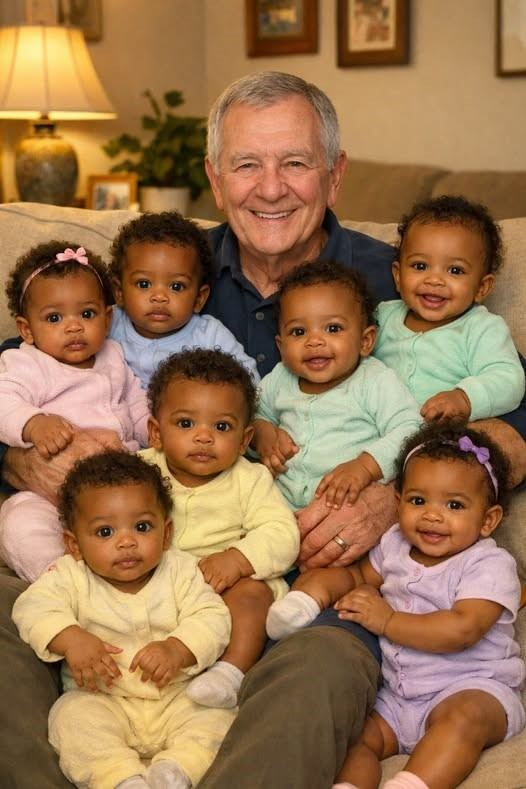
Curiosity tugged him down a dim hallway where he stumbled into a cramped room. Inside were nine cribs, lined side by side, each holding a tiny baby girl. They were all dark-skinned, all with big brown eyes, and all abandoned together on church steps in the middle of the night.
A nurse explained their story: “No names. No notes. Just one blanket. People might adopt one, maybe two. But nine? They’ll be separated soon.”
That word—separated—sliced through Richard like a blade. Anne’s words echoed: “Don’t let love die with me.”
A Promise Turns Into a Decision
Standing over those cribs, something inside Richard shifted. One baby studied him intently, another reached for his sleeve, a third smiled gummy and sweet. The emptiness inside him didn’t disappear—it transformed into something heavier: responsibility.
“I’ll take them,” he said.
The nurse blinked in disbelief. “All nine? Sir, that’s impossible. Alone? Without money? People will think you’ve lost your mind.”
And they did. Social workers called him reckless. Relatives called him foolish. Neighbors muttered: What’s a white man doing with nine black babies? Some voices were uglier. But Richard refused to waver.
Building a Family From Scratch
The Richard Miller adoption story was not easy. It wasn’t a fairy tale; it was grit, sweat, and sacrifice.
Richard sold what little he had—his truck, Anne’s jewelry, his tools—to buy formula, diapers, and cribs. He worked double shifts at the factory, patched roofs on weekends, and picked up night shifts at a diner. Every cent went to those nine girls.
He boiled bottles on the stove, strung laundry across the backyard, and built cribs with his own hands. He memorized each baby’s cry, each lullaby that worked, each favorite way of being held. He even taught himself to braid hair with clumsy fingers, determined that none of his daughters would feel neglected.
At night, exhaustion draped over him like a blanket, but he still lay awake counting nine tiny breaths in the dark, terrified of losing even one.
Facing Prejudice and Defying Expectations
The outside world didn’t cheer for him. They judged him. Mothers at school whispered suspicions. Shoppers at the grocery store stared. Once, a man spit at his feet, sneering: “You’ll regret this.”
But regret never came.
Instead came moments of pure magic: the first time all nine laughed at once, filling the house with a sound like music. Stormy nights when the power failed and he held them all close until sleep carried them off. Birthdays with lopsided cakes, Christmas mornings with gifts wrapped in old newspaper.
They became the “Miller Nine” to neighbors, a curiosity, almost folklore. To Richard, they were simply his daughters.
Nine Girls, Nine Unique Souls
As the girls grew, each carved her own path:
Sarah had the loudest laugh, bold and unshaken.
Ruth was quiet, clinging softly to her father’s shirt.
Naomi and Esther became mischievous partners in cookie raids.
Leah carried a gentleness that soothed everyone around her.
Mary was strong, steady, and reliable.
Hannah, Rachel, and Deborah were inseparable, a trio that filled the house with chatter.
Richard didn’t just provide food and shelter; he provided belonging. Even when the money ran dry and exhaustion pulled at his bones, love never wavered.
A House Full of Noise, Then Quiet Again
By the late 1990s, the Miller household had weathered years of chaos, laughter, and struggle. Richard’s hair had turned gray, his back bent with age, but he had watched nine little girls grow into nine extraordinary women.
One by one, they left for college, jobs, and families. The house grew quiet again, but this time, the silence was different. It wasn’t empty—it was full. It was the echo of a promise fulfilled.
On the night the last daughter moved out, Richard sat alone with a framed photo of nine toddlers lined up like pearls on a string. He whispered softly, “I kept my promise, Anne.”
From Doubted to Celebrated
Decades passed. The nine flourished—teachers, nurses, artists, mothers. They built lives, but always returned home for holidays, crowding the old house until the walls seemed to burst.
What once drew suspicion now drew admiration. The man neighbors once mocked was now a quiet legend, proof that family is not blood—it’s choice, sacrifice, and love.
The Circle Completed
By 2025, Richard was frail but proud, sitting in a large armchair while nine radiant women in cream-colored dresses surrounded him. Cameras clicked. Headlines declared: “In 1979, he adopted nine black girls. See them now.”
But for Richard, it was never about headlines. It was about the circle completed. The babies no one wanted had become women the world admired.
Grace leaned close, whispering, “Dad, you did it. You kept us together.”
Richard’s lips trembled into a smile. “No,” he whispered back. “We did it. Love did it.”
Tears slipped freely down his cheeks. The promise he once thought impossible had not only been kept—it had blossomed into a legacy.
The Legacy of the Richard Miller Adoption Story
The Richard Miller adoption story is more than an inspiring tale—it’s a blueprint for what love can accomplish in a world often divided by race, prejudice, and fear. Richard proved that family is not defined by appearance or DNA. It’s defined by commitment, by showing up, by love louder than doubt.
His nine daughters—once fragile infants facing separation—grew into women who carried his lessons forward. Their success was not just personal; it was collective proof that love can rewrite destiny.
Why This Story Still Matters Today
In a time when adoption processes are often reduced to legal jargon and checklists, Richard’s story is a reminder of the human core: the willingness to take responsibility for someone else’s future. It challenges stereotypes, defies prejudice, and calls us to expand our definition of family.
His journey wasn’t glamorous. It was back-breaking work, sleepless nights, and public criticism. But that’s what made it real. That’s what made it powerful.
And that’s why, nearly half a century later, people are still talking about the Richard Miller adoption story.
Conclusion
The Richard Miller adoption story is a testament to love’s enduring power. It began with grief, transformed through sacrifice, and blossomed into a legacy that touched not just nine lives, but countless others who hear it.
Richard Miller kept his promise. He didn’t let love die. He gave it somewhere to go—into the arms of nine daughters who grew up knowing, without a doubt, that they were chosen, cherished, and never alone.
This story draws inspiration from real-life people and events, but has been adapted with fictional elements for storytelling purposes. Names, characters, and specific details have been altered to respect individuals’ privacy and to enhance the narrative experience. Any similarities to actual persons, living or deceased, or real events are entirely coincidental and unintended.
The author and publisher do not guarantee the factual accuracy of the events or character portrayals, and accept no responsibility for any misinterpretations. The content is presented “as is,” and all views expressed belong solely to the fictional characters, not the author or publisher.