The Estate of a Living Ghost
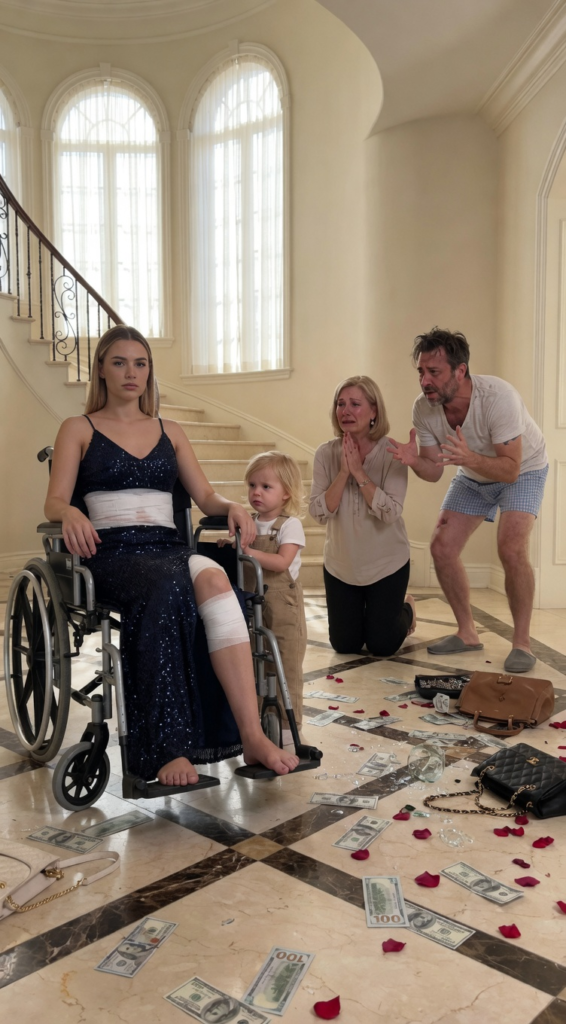
My name is Emily Carter, and at twenty-five, I discovered that a person’s entire existence can be dismantled without a single hand ever being laid upon their body.
I remember the sunlight hitting the hallway of my apartment building that Tuesday morning. It was too bright, too clinical. I had just been discharged from the hospital after a grueling emergency surgery that left me feeling like a hollowed-out shell. Every step from the car to my front door felt like a marathon. My breath was shallow, and I leaned heavily against the cool, painted drywall, clutching my discharge papers in one hand and my keys in the other. All I wanted—all I had dreamed of during those feverish nights in the recovery ward—was the sanctuary of my own bed, the familiar scent of my vanilla candles, and the quiet victory of the first home I had earned with my own sweat and late-night design drafts.
But when the lock clicked and the door swung open, the sanctuary was gone.
I stood frozen in the entryway. My brain, still foggy from anesthesia and exhaustion, flatly refused to process the image before me. It looked like a model unit that had been cleared out for a new tenant. The living room was a void. My custom-built work desk, the one I had assembled myself? Gone. The charcoal grey sofa I had spent six months saving for? Gone. Even the cheap, chipped kitchen plates I’d found on clearance were missing from the cabinets.
For a terrifying heartbeat, I thought I was in the wrong apartment. I actually turned around to check the number on the door. 4B. This was my home. Then I saw it: a pale, rectangular ghost on the wall where my grandmother’s framed photographs used to hang. My stomach dropped faster than it ever had in the hospital.
The silver locket. The handwritten letters from the 1950s. The childhood albums. My entire history had been wiped clean.
My hands shook so violently I nearly dropped my phone as I dialed my mother. She answered on the second ring, her voice calm, almost expectant.
“What happened to my apartment?” I whispered, my voice cracking.
She didn’t offer a word of concern for my health. She didn’t ask how my stitches were holding up. Instead, she let out a short, sharp laugh. “Honestly, Emily, you were playing independent. I just decided to clean up the fantasy.”
The room seemed to tilt. “Where is my stuff, Mom?”
“We’ve already sold most of it,” she said, her tone shifting to one of chilling practicality. “Your laptop, the furniture, the clothes… even that box of old junk from the closet. We needed to settle things. When we told your landlord you had passed away from surgical complications, he was more than happy to let us clear the unit.”
I couldn’t breathe. “You told him I died?”
“It made the paperwork easier,” she replied, and then the line went dead.
By the time I tried to call back, I was blocked. On everything. I was standing in the middle of a literal vacuum, a twenty-five-year-old woman who had been declared dead by the people who gave her life, and I had nothing left but the hospital bag in my hand.
But that was only the beginning of the nightmare. Three years later, when the phone rang at 5:00 AM, it wasn’t my mother’s cold laughter I heard. It was my brother, Ethan, sobbing so hard I could barely make out the words.
Chapter 1: The Weight of Silence
The first night I spent on Nora Bennett’s couch was a lesson in true poverty. Not just the lack of money, but the lack of self. I lay there under a borrowed blanket, my body fighting an infection that the stress was only making worse. Every time I moved, the stitches in my abdomen pulled, a sharp reminder that I was supposed to be resting.
I had one plastic bag. Inside were my discharge papers, a phone charger, and the clothes I had been wearing when I collapsed in my studio weeks prior. That was my entire net worth.
Nora was my only anchor. She sat at her small kitchen table, her face etched with a mixture of fury and pity as she watched me try to log into my client accounts from my phone. It was a disaster.
I was a freelance architectural renderer. My career wasn’t just a job; it was a digital ecosystem of high-powered software, massive project files, contracts, and years of trust. My computer wasn’t just “equipment.” It was my brain. It held the blueprints for three major downtown developments I was supposed to finish.
“They took the hard drives, Nora,” I whispered, the weight of the realization crushing my chest. “They didn’t just steal my sofa. They stole my reputation.”
The fallout was immediate. Within a week, I lost three major clients. One was sympathetic but couldn’t wait for me to rebuild from scratch. Another told me point-blank that I was unreliable. The third didn’t even reply; he just sent a formal notice of contract termination. I couldn’t even blame them. If I were them, I wouldn’t believe me either. Who tells a client their mother broke into their home and sold their livelihood because they ‘died’? It sounded like the frantic lie of a failing addict.
Then the digital ghosts started appearing.
A cousin I hadn’t seen in years sent a text: Emily? Is this really you?
When I called her, she was hysterical. Through her tears, she sent me screenshots of my mother’s Facebook page. There it was. A grainy photo of me from high school graduation, framed by digital lilies. The caption read: No parent should ever have to bury a child. Our beautiful Emily was taken from us far too soon. We are devastated and ask for privacy as we navigate this unbearable loss.
I stared at the screen, my heart hammering against my ribs. While I was struggling to sit up without vomiting in Nora’s spare room, my parents were collecting sympathy. My father, a man who built his career on “integrity” in mortgage lending, was accepting meals and condolences from neighbors in North Hills.
The neighborhood charity circle had even organized a memorial collection. People were donating money—hard-earned money—to help my “grieving” parents with the “unexpected expenses” of my passing.
“They’re making a profit on my funeral,” I realized, the coldness finally starting to settle into my bones. “I’m not just a daughter to them. I’m an asset to be liquidated.”
I spent the next forty-eight hours reaching out to relatives, trying to prove I was alive. Some blocked me, thinking I was a cruel hacker. Others panicked. But as the truth began to leak out, the story didn’t end. My parents simply changed the script.
Chapter 2: The Architecture of a Lie
“They’re telling people you’ve had a nervous breakdown,” Nora said, dropping a fresh pile of printed screenshots onto the coffee table.
She had been my legs when I couldn’t walk, driving me to the library to use their computers, taking me back to my empty apartment to photograph the barren rooms for evidence.
The landlord, a man named Mr. Henderson, had looked like he’d seen a poltergeist when I showed up at his office. He admitted my parents had shown him hospital papers—documents they had access to because they were still listed as my emergency contacts from my college years. They told him I had passed on the operating table. They cried in his office. He felt so bad for them that he let them take everything.
“I have my receipts,” I told him, my voice steady despite the tremor in my knees. “The lease is in my name. You allowed unauthorized people to remove my property.”
He started stammering about “family matters” and “good faith.” He didn’t want to be sued, but he also didn’t want to help.
For three months, I lived like a shadow. I wore Nora’s old clothes. I took low-paying, soul-crushing data entry jobs because my used laptop couldn’t handle the heavy rendering software I needed for my real career. I ate ramen and calculated every cent.
But I was also making a list.
Every plate. Every book. The price of the sofa. The replacement cost of my specialized workstation. But most importantly, I documented the things that had no price tag. My grandmother’s locket—the one she told me to keep as a reminder that I came from a long line of survivors. Her letters from the Korean War era. The photos of me as a baby.
My mother had sold those in a “bulk lot” on a local marketplace app. I found the buyer through a stroke of luck and a lot of digital detective work. A stranger told my lawyer that my mother had described it as an “estate cleanout.”
That was the moment my grief turned into a very specific, very sharp kind of weapon. I didn’t want my mother’s love anymore. I wanted her accountability.
Chapter 3: The Civil War
The police were a dead end. Officer Miller at the local precinct was polite, but his eyes were glazed with the boredom of a man who dealt with domestic disputes all day.
“Since they had a key and were listed as emergency contacts, and since you’ve lived at home recently, this looks like a civil matter, Ms. Carter,” he said, tapping his pen. “We can’t arrest your parents for a ‘misunderstanding’ over property.”
“It’s not a misunderstanding to tell people I’m dead,” I countered.
“That’s a lie, but it’s not necessarily a crime in this context,” he replied.
I walked out of that station and realized that the system wasn’t built to protect people from the cruelty of their own blood. If I wanted justice, I had to stop looking for a hero and start being a strategist.
Nora introduced me to Arthur Vance, a civil litigator who looked like he’d spent his entire life eating bullies for breakfast. He sat in his mahogany-row office, listened to my story for an hour, and then leaned back, tenting his fingers.
“They counted on you being too tired to fight,” Arthur said. “They figured you’d be so busy trying to survive that you wouldn’t have the energy to hold them to the fire. They’re using your recovery as their shield.”
“Can we win?” I asked.
“In a criminal court? It’s messy. In a civil court? If we can prove ownership and intent? We’ll take them for everything they’re worth.”
The lawsuit took two years. Two years of my parents trying to gaslight the world. Their lawyer argued that they were “concerned parents” who believed I was “unstable” and “unable to care for myself.” They claimed they were merely “storing” my belongings for my own protection.
Then we produced the screenshots of the online sales. We produced the witness statement from the man who bought my grandmother’s jewelry. We produced the bank statements showing I had paid for every single item in that apartment.
But the killing blow was the “Memorial Fund.”
Arthur Vance subpoenaed the records of the money they had accepted from the neighborhood. My father’s face went white when he realized we had the exact dollar amount of the donations they had pocketed while I was alive and struggling.
When the judge handed down the verdict, I didn’t feel the rush of joy I expected. I felt a profound, heavy silence.
Judgment: $41,600. For the value of the property, the loss of professional income, and emotional distress.
My mother wept in the courtroom, clutching a lace handkerchief, playing the martyr until the very end. My father just glared at me, his eyes full of a terrifying, cold resentment. To them, I wasn’t the victim. I was the person who had finally unmasked the monsters behind the North Hills curtains.
But winning the judgment was one thing. Collecting it was another. They ignored the court order for months, thinking I would eventually go away. They didn’t realize that the girl who survived an emergency surgery in an empty apartment had nothing left to lose.
Chapter 4: The 5 AM Call
I authorized the enforcement.
We placed a lien on their house in North Hills. We began the process of garnishing my father’s wages. We hit their bank accounts with the clinical precision of a surgeon.
And that’s when the “Family” started calling.
My Aunt Valerie called to tell me I was being “vindictive.” My Uncle Mark told me that “money isn’t worth a family’s soul.” I asked them where they were when I was sleeping on a couch with an infected incision. They didn’t have an answer.
Then, at 5:00 AM on a Tuesday, my phone screamed. It was Ethan.
“Emily, please,” he sobbed. “Make it stop. The lawyers won’t stop calling. Dad’s breaking down. Mom had a panic attack and they had to call an ambulance. The bank… they’re talking about foreclosure, Emily. You’re destroying us.”
I sat up in bed, the cool morning air hitting my face. I remembered the way my apartment had smelled the day I came home. The smell of nothing.
“Did you help them, Ethan?” I asked, my voice devoid of emotion.
“What?”
“The day they cleared my apartment. Did you help them carry the boxes?”
The silence on the other end of the line was the loudest thing I had ever heard.
“I… I didn’t know what was happening, Em. They said you were moving back home. They said it was for the best.”
“You saw my work equipment in the back of a truck, and you didn’t call me once?”
“I was confused!” he yelled. “But that doesn’t matter now! We’re going to lose the house! Is that what you want? To see your own family on the street?”
“I want what’s mine,” I said, and I hung up.
Chapter 5: The Performance at North Hills
Four days later, I agreed to meet them. Not at a lawyer’s office, but at the house in North Hills.
When I pulled into the driveway, the house looked perfect. The lawn was manicured. The seasonal wreath on the door was tasteful and expensive. It was a lie made of bricks and mortar.
Ethan opened the door. He looked haggard, his eyes rimmed with red. He led me into the living room, where my parents were sitting on the sofa like they were waiting for a death sentence. But they weren’t alone.
They had invited Mrs. Gable from the HOA and Mr. Sterling, a family friend.
“I thought it would be best to have neutral witnesses,” my father said, his voice regaining some of its old, commanding silkiness. “To ensure we can all move toward a place of healing.”
I looked at the witnesses. “Do you know why I’m here?” I asked them.
Mrs. Gable looked uncomfortable. “Well, John said there’s been a financial dispute…”
“It’s not a dispute,” I interrupted. “It’s a collection. My parents told my landlord I was dead so they could sell my furniture to pay off their credit card debts. They accepted money from you, didn’t they, Mrs. Gable? For my ‘memorial’?”
The color drained from the woman’s face. She looked at my mother.
“It was a misunderstanding!” my mother wailed, her hands trembling as she reached for a tea mug. “We were under so much pressure. The bills, the house… I just wanted to protect our image. I thought we could pay Emily back later.”
“You blocked my number,” I reminded her. “You told the world I was dead.”
My father stood up, his face darkening. “You’ve humiliated us enough, Emily. The garnishment, the lien… you’re making it impossible for me to do my job. If I lose my position at the firm, nobody gets anything. We need you to sign a waiver. We can work out a private payment plan.”
“A private plan?” I laughed, and the sound was jagged. “Like the private plan where you sold my grandmother’s letters for twenty dollars? Or the one where you left me with nothing but a hospital bag?”
I turned to Ethan. “Tell them what you told me on the phone. Tell them you watched them load my life into a truck.”
Ethan looked at the floor. “I helped them,” he whispered. “I unloaded the boxes into the garage. I saw the silver locket on the counter… Mom said it was ‘old junk’ that needed to be cleared.”
The silence in the room was absolute. Mr. Sterling stood up, grabbed his coat, and walked out without saying a word. Mrs. Gable followed him, her expression one of pure horror.
The audience was gone. The performance had failed.
“I’m not signing anything,” I said, walking toward the door. “The court decided what you owe me. The bank will decide what you owe them. I’m just the girl who didn’t die.”
Chapter 6: The Harvest
The end didn’t come with a bang. It came with a moving truck.
The foreclosure was finalized in the spring. Because of the lien and the garnishments, my parents couldn’t refinance. The “perfect” life in North Hills was dismantled, box by box, just as my apartment had been.
I drove by the house one last time on the day they had to leave. I saw my father carrying a lamp—the same father who used to talk about ‘legacy’ and ‘honor.’ I saw my mother standing on the porch, looking at the yard as if it had betrayed her.
Ethan saw me from across the street. He didn’t wave. He didn’t yell. He just looked at me with a profound, empty sadness. He had stayed with them until the end, and now he was moving into a cramped two-bedroom apartment with them in a part of town they used to scoff at.
My Aunt Valerie still sends me messages about “the holiday spirit” and “forgiveness.” I delete them.
I have a new apartment now. The furniture is different, but it’s mine. I have a new computer, a new workstation, and a business that is thriving because I worked twice as hard to prove I was reliable.
On my wall, there is only one photo. It’s a scan of the one childhood picture I managed to save—a digital copy a friend had kept. It’s me at five years old, sitting on my grandmother’s lap.
I never got the locket back. I never got the letters. Some things are gone forever, and no amount of money can recreate the history that was sold for a quick buck.
But as I sit in my quiet, well-lit studio, I realize that I didn’t destroy my family. I simply stopped holding up the walls of a house that was already rotting.
Some people only call it “family” when they need you to forgive what they chose to destroy. I call it justice when you finally stop letting them.
The truth is a heavy thing to carry, but it’s a lot lighter than a lie.
I want to know how far this story travels. Where are you watching from? What time is it there? Because no matter where you are, remember this: your life belongs to you. Don’t let anyone—not even the people who gave it to you—tell you otherwise.