You had searched for work all day, but every door closed the same way.
At one restaurant, they told you they were not hiring. At another, the manager looked at your wet shoes and said customers did not like seeing “people like you” near the entrance. By nightfall, your stomach was so empty it hurt more than the rain.
You ended up near Buenavista because train stations made you feel less alone. People came and went with somewhere to be, and if you sat still long enough, you could pretend you were also waiting for something instead of simply having nowhere to go. You hugged your backpack to your chest like it still contained a future.
Inside that backpack were the only things you refused to lose.
Your parents’ photo. Your math notebook. Your school certificates, wrinkled but still readable. And a letter your mother had written before she died, addressed to a foundation you never understood.
You had tried not to cry.
You had learned that crying on the street attracted the wrong kind of attention. Some people stared with pity. Some laughed. Some used sadness as permission to hurt you.
But that night, the rain covered your face, so you let yourself break.
You sat under the torn awning and whispered, “I’m sorry, Mamá.”
You apologized because you had not saved her. Because you had not saved your father. Because you were twenty years old and already tired in a way you thought only old men were allowed to be.
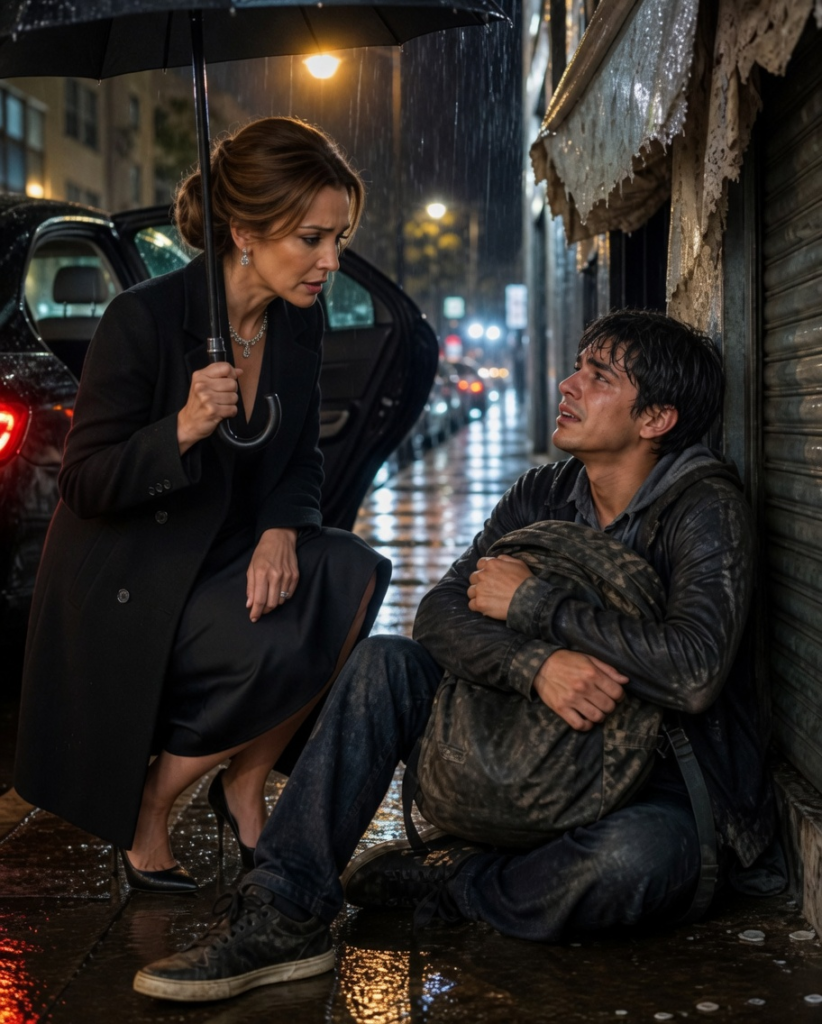
Then headlights slowed in front of you.
A black luxury SUV stopped at the curb.
You looked away immediately.
Cars like that did not stop for boys like you unless trouble was getting out.
But the back door opened, and a woman stepped into the rain beneath a large black umbrella. She wore a cream coat, pearl earrings, and the kind of shoes that had probably never touched mud. Her hair was silver at the temples, her face elegant and serious.
She looked at you like she had not meant to see you.
Then she looked again like she could not stop.
“Are you hurt?” she asked.
You shook your head.
“No, ma’am.”
Your voice sounded rough, embarrassed.
She took one step closer.
“You’re freezing.”
“I’m fine.”
It was automatic.
The lie poor people tell when they do not want to be moved, chased, or pitied.
She looked at your trembling hands and did not argue with the lie. Instead, she lowered herself slightly, careful not to make you feel trapped.
“What’s your name?”
You hesitated.
“Daniel.”
“Daniel what?”
“Herrera.”
Her expression changed, but only for a second.
You noticed because surviving on the street had taught you to notice small changes. The tightening of a jaw. The quick glance toward a guard. The pause before a person decides whether you are human or inconvenience.
The woman turned to her driver.
“Ramiro, bring the blanket.”
You sat straighter.
“No, ma’am. I don’t want trouble.”
“You are not in trouble.”
“I didn’t ask for anything.”
“I know.”
That answer stopped you.
Most people assumed need was a crime. She did not.
The driver returned with a thick gray blanket and a paper bag. The smell hit you first: bread, warm and buttery. Your stomach cramped so hard you nearly bent forward.
The woman saw that too.
“Eat,” she said gently.
You took the bag with both hands, ashamed of how badly you wanted it. Inside was a sandwich wrapped in foil and a small bottle of juice. You tried to eat slowly, but hunger betrayed you.
She waited under the umbrella while rain battered the sidewalk around both of you.
When you finished, she said, “Where are you sleeping tonight?”
You stared at the ground.
That was answer enough.
The woman exhaled quietly.
“My name is Mariana Soler. I have a guesthouse behind my home. You can sleep there tonight, shower, eat breakfast, and leave in the morning if you want.”
You almost laughed.
Not because it was funny.
Because offers like that belonged in movies, and movies never showed the part where trusting the wrong kindness could ruin you.
“I don’t know you,” you said.
“No,” she replied. “You don’t.”
“Then why would you help me?”
Her eyes moved to your backpack, then back to your face.
“Because once, a long time ago, nobody stopped for someone I loved.”
The sentence sat between you in the rain.
You did not understand it then.
But something in her voice told you she was not collecting gratitude. She was paying a debt to a ghost.
You should have said no.
Street rules said no.
But your body was shaking, your stomach was hollow, and your mother’s voice rose in your memory.
The poverty must not dirty your heart.
So you stood.
The mansion was in Lomas de Chapultepec, behind iron gates and walls taller than the room you used to rent. The driveway curved through trees that glistened under the rain. Warm lights glowed from enormous windows, and for a moment, you felt like a stain being carried toward something too clean.
Mariana did not take you into the main house at first.
She led you to a smaller building behind it, still larger than any home you had ever lived in. There was a bed with white sheets, a bathroom with towels folded like hotel art, and a small kitchen stocked with fruit, water, and crackers.
You stood in the doorway, afraid to touch anything.
Mariana noticed.
“The towels are for you,” she said. “The food too.”
You nodded.
“Thank you.”
She placed a hand on the doorframe.
“I’ll have clean clothes brought. Nothing fancy. Just dry.”
You looked up quickly.
“I’m not stealing.”
Her face softened.
“I didn’t say you were.”
“People usually think it.”
“I’m not people.”
You wanted to believe her.
But behind Mariana, near the path to the main house, a man watched you through the rain.
He was young, maybe mid-thirties, dressed in an expensive sweater and holding a phone. His hair was perfectly styled, his face handsome in a cold way. When he saw you notice him, he smiled.
It was not a kind smile.
Mariana followed your gaze.
“Andrés,” she called. “Come here.”
The man approached slowly, eyes sliding over your wet clothes, your backpack, your shoes.
“This is my nephew,” Mariana said. “Andrés Valdés. He helps manage parts of the foundation and some family accounts.”
Andrés held out his hand as if the gesture itself were charity.
You shook it.
His grip was firm, but his eyes were dismissive.
“Interesting,” he said. “You’re bringing people home now, Aunt Mariana?”
Mariana’s voice cooled.
“I’m helping someone stay alive through the night.”
“Of course,” Andrés said smoothly. “Very noble.”
The words were polite.
The contempt was not.
After Mariana left, you showered for the first time in days.
Hot water hit your skin, and you cried so quietly you barely heard yourself. Dirt ran down the drain, but grief stayed where it was. Your parents were still gone. You were still alone. A bed did not erase the street from your bones in one night.
When you came out, clean clothes waited folded on the chair.
Sweatpants. A T-shirt. Socks.
There was also a note in careful handwriting.
No questions tonight. Sleep first.
—M.S.
You read it three times.
Then you placed your backpack under the bed, lay down on the clean sheets, and slept like your body had been waiting for permission to stop surviving.
In the morning, you woke to sunlight.
For a moment, you did not remember where you were. Panic kicked through you, and you grabbed for your backpack before your eyes fully opened. It was still there.
That tiny mercy nearly made you cry again.
A woman named Carmen brought breakfast. She was the housekeeper, round-faced, sharp-eyed, and kind in a way that did not make a show of itself. She set down eggs, beans, fruit, and coffee.
“Eat before Señora Mariana comes,” she said.
You sat up carefully.
“Is she angry?”
Carmen snorted.
“Señora Mariana does not need anger. She has eyebrows.”
You almost smiled.
It felt strange on your face.
Mariana arrived thirty minutes later, wearing dark trousers and carrying a tablet. In daylight, she looked less like a fairy-tale millionaire and more like a woman who had built walls around herself brick by brick.
“Good morning, Daniel.”
“Good morning, ma’am.”
“Did you sleep?”
“Yes.”
“Did you eat?”
You nodded.
She sat at the small table, not too close.
“I won’t pretend this situation is simple. You can leave today if you wish. If you want help finding a shelter or job placement, I can arrange that. If you want to stay a few days while we figure out your documents and options, that is also possible.”
You stared at her.
“You’re not sending me to the police?”
“Why would I?”
“Because I was outside.”
“That is not a crime.”
You looked down.
“Sometimes people treat it like one.”
Mariana’s face tightened.
“I know.”
There it was again.
That shadow in her voice.
You did not ask.
Instead, you opened your backpack and pulled out your certificates. It felt foolish, like showing a palace guard a paper crown, but you needed her to know you had not always been rain and hunger.
“I finished high school,” you said. “I was good at math. I wanted to study administration.”
Mariana took the papers carefully.
Not like trash.
Like proof.
Her eyes moved across your grades, your awards, your teacher recommendations. Something in her expression shifted again when she saw your mother’s name listed as emergency contact.
“Your parents?”
“Dead.”
The word came out flat because if you gave it shape, it would cut you.
“I’m sorry,” she said.
You nodded.
People always said that.
No one ever knew what came after.
Mariana handed the papers back.
“Would you be willing to take an assessment? Basic math, reading, office skills. Not today if you’re tired. Tomorrow maybe.”
“For a job?”
“For a beginning.”
That word frightened you more than “job.”
Beginnings could be taken away.
But you said yes.
And that yes changed everything.
For three days, you stayed in the guesthouse.
You ate. Slept. Took tests. Filled out forms. Answered questions from Mariana’s staff, some kind, some suspicious. You helped Carmen carry groceries even though she scolded you for it.
Andrés appeared often.
Too often.
He watched you from doorways, asked questions that sounded friendly but felt like traps.
“So, Daniel, how did you meet my aunt again?”
“She stopped during the rain.”
“Lucky.”
You said nothing.
“Very lucky,” he repeated. “Some people wait their whole lives for a rich woman to rescue them.”
Your face burned.
“I didn’t ask her to.”
“No,” he said, smiling. “That’s the best kind of performance.”
You learned quickly not to be alone with him if you could avoid it.
But in a house that large, loneliness found corners.
On your fourth day, Mariana invited you into the main house for lunch.
The dining room table was long enough for twenty people, but only three places were set: Mariana, Andrés, and you. You wished Carmen could sit too, but you already understood invisible rules lived even in kind houses.
Andrés poured water into your glass.
“Careful,” he said softly. “Crystal breaks easily.”
You knew what he meant.
People like you break expensive things.
People like you are accidents waiting to happen.
Mariana heard him.
“Andrés,” she said.
He smiled.
“What? I’m being helpful.”
Lunch was tense.
Mariana asked about your studies, your work experience, your father’s taxi. Andrés asked whether you had ever been arrested, whether you used drugs, whether your documents were real. Each question was wrapped in concern and poisoned underneath.
You answered calmly because you had learned that anger makes poor people look guilty.
After lunch, Mariana led you to her library.
It was the most beautiful room you had ever seen.
Wall-to-wall books. A desk facing the garden. A leather chair that looked older than you. On one shelf sat a framed photo of a young man around your age, smiling with one arm around Mariana.
You stared before you could stop yourself.
Mariana saw.
“My son,” she said.
You looked away quickly.
“Sorry.”
“His name was Gabriel.”
Was.
The room changed around that word.
“He died six years ago,” she said. “He was twenty-one.”
You swallowed.
“I’m sorry.”
She smiled sadly.
“People always say that.”
You recognized your own thought from earlier and looked at her.
For a second, the mansion disappeared. There was only a mother without her son and a son without his mother standing in a library full of things money had not saved.
“How?” you asked softly.
Mariana looked at Gabriel’s photo.
“He was depressed. He hid it well. Or maybe I was too busy to see clearly. One night he called me. I was in New York closing a deal. I told him I would call back after dinner.”
Her voice thinned.
“I didn’t get the chance.”
You said nothing.
There were no useful words for that kind of regret.
She turned back to you.
“That is why I stopped in the rain.”
Now you understood.
She had not seen a stranger under the awning.
She had seen a missed call wearing your face.
The assessment results came back the next day.
Mariana looked almost amused.
“You scored higher than half the interns my company hires from private universities.”
You did not know whether to smile.
“Is that good?”
“That is very good.”
She offered you a temporary position in the foundation office. Data entry, filing, basic accounting support. Minimum salary, official contract, room in the guesthouse for ninety days while you stabilized.
You held the contract with both hands.
Your first legal job.
Your first safe bed.
Your first official step back into the world.
You signed carefully.
Andrés stood near the doorway watching.
His smile had disappeared.
Work gave your days structure.
You entered donations, organized receipts, scanned beneficiary applications, and checked expense reports. Numbers soothed you. They did not lie unless people forced them to.
Within two weeks, you noticed something strange.
Small transfers repeated under different project codes. Hospital aid payments marked as approved but not traceable to patient accounts. Vendor invoices with similar amounts from companies with different names but identical addresses.
At first, you assumed you were misunderstanding.
You were new. Poor. Lucky to be there.
You told yourself not to make trouble in the house that had saved you.
But one afternoon, while filing old foundation applications, you saw a name that stopped your heart.
Rosa Herrera.
Your mother.
You pulled the folder with shaking hands.
There it was.
Her application for emergency medical assistance.
Submitted two years earlier. Diagnosis attached. Hospital estimate included. Your father’s signature. Your own name listed as dependent son.
Across the top was a green stamp.
APPROVED.
You could not breathe.
Approved?
Approved meant help had existed.
Approved meant money had been assigned.
Approved meant someone, somewhere, had decided your mother was worth saving.
But no help ever came.
Your father had begged, borrowed, sold, waited. Your mother died believing the world had no room for her need.
You checked the disbursement page.
Payment released.
Recipient hospital account.
Amount large enough to cover the treatment she never received.
Your hands went numb.
You ran the hospital account number against other files.
It appeared again.
And again.
Different patients.
Different emergencies.
Same account.
You printed everything.
Then you did the bravest and most dangerous thing you had done since stepping into Mariana’s car.
You took the papers to her.
She was in the library, reading reports. When she saw your face, she stood immediately.
“Daniel?”
You placed the folder on her desk.
“My mother applied to your foundation.”
Her face went still.
“What?”
“She was approved.”
Mariana opened the folder.
You watched her read.
You watched color drain from her face.
“She never received help,” you said. “She died.”
Mariana gripped the edge of the desk.
“No.”
“Yes.”
Her eyes moved over the payment records.
Then you showed her the repeated account numbers.
The false vendors.
The matching transfers.
The pattern.
Mariana sat down slowly, not like a rich woman in shock, but like a mother being shown a grave she helped dig without knowing.
“Who processed these?” she whispered.
You did not answer.
You did not have to.
The department initials were on every page.
A.V.
Andrés Valdés.
Her nephew.
Her trusted manager.
The man who mocked you for being rescued had been stealing from the people who needed rescue most.
Mariana closed her eyes.
For a second, you thought she might cry.
Instead, she reached for the phone.
“Andrés. Library. Now.”
He arrived ten minutes later, annoyed.
“What’s so urgent?”
Then he saw the folder.
His face changed so fast you knew everything.
Mariana did too.
“Explain,” she said.
Andrés laughed.
It was small.
Dry.
Insulting.
“Explain what?”
“Why emergency medical funds approved for real patients were redirected to accounts connected to shell vendors.”
His eyes flicked to you.
There it was.
Hatred.
“You let him into foundation files?”
“He works there.”
“He’s a stray you brought home.”
Mariana stood.
“Choose your next words carefully.”
Andrés pointed at you.
“You think this little street rat found something my accountants missed?”
You felt the insult, but beneath it you heard fear.
Mariana’s voice became ice.
“Answer the question.”
Andrés dropped the act.
Not fully, but enough.
“You don’t understand how things work. Foundations leak money. Everyone takes a little. You sign checks and attend galas and feel holy. I kept the machine running.”
“You stole from sick people.”
“I borrowed from inefficiency.”
“My mother died,” you said.
The room went silent.
Andrés looked at you.
For one second, something like surprise crossed his face.
Then he shrugged.
That shrug destroyed whatever mercy might have existed.
“People die,” he said.
Mariana slapped him.
The sound cracked through the library.
Andrés stared at her, stunned.
She was trembling now.
Not from weakness.
From rage.
“You will leave this house,” she said. “You will be removed from every account by tonight. And tomorrow morning, my attorneys will deliver everything to the authorities.”
Andrés’s face twisted.
“You won’t do that. I’m family.”
Mariana looked at Gabriel’s photo.
Then at you.
“No,” she said. “You are blood. That is not the same thing.”
Andrés stepped toward her.
“You stupid old woman. You think this boy loves you? He loves your guilt. He found your weak spot and crawled right in.”
You moved before thinking.
Not to attack.
To stand between them.
Andrés smiled.
“Look at that. The stray thinks he’s a guard dog.”
Mariana pressed a security button under her desk.
Two guards arrived within seconds.
As they escorted Andrés out, he looked back at you.
“You’ll be back under that awning when she gets tired of playing saint.”
You said nothing.
But the words found their way inside you.
That night, you packed.
You did it quietly.
You folded the borrowed clothes. Put your certificates back into your backpack. Placed the guesthouse key on the table.
You owed Mariana gratitude.
But your mother was dead.
And the money that might have saved her had passed through Mariana’s foundation, under Mariana’s name, while Mariana was too far above the suffering to see who was stealing beneath her.
You did not hate her.
That would have been easier.
You just could not breathe under her roof anymore.
Carmen caught you at the door.
“Daniel.”
You froze.
She looked at the backpack, then at your face.
“You’re leaving.”
“I have to.”
“Señora Mariana will be heartbroken.”
You swallowed.
“My mother was heartbroken too.”
Carmen’s eyes filled.
She did not stop you.
She only handed you a bag of food.
“Then don’t leave hungry.”
That kindness nearly brought you to your knees.
You walked out before sunrise.
By noon, Mariana found you at Buenavista.
Of course she did.
You were sitting on a bench inside the station, not under the rain this time, but close enough to the place where she had first seen you. Your backpack sat between your feet. You had no plan beyond not going back.
She approached alone.
No driver.
No guards.
No expensive coat.
Just Mariana, pale and exhausted, holding your mother’s file.
“May I sit?” she asked.
You did not answer.
She sat anyway, leaving space between you.
For a long time, both of you watched people move through the station.
Then she said, “I failed your mother.”
You looked down.
“Yes.”
She did not defend herself.
That made it harder to hate her.
“I did not steal the money,” she said. “But I built a system where I could believe signing checks was the same as helping people. I let Andrés manage suffering because I did not want to look directly at it.”
Your throat tightened.
“My mother waited.”
“I know.”
“She thought nobody cared.”
Mariana’s voice broke.
“I know.”
You turned to her then.
“She died thinking help never came.”
Mariana’s eyes were wet now.
“I cannot repair that.”
“No.”
“I cannot ask you to forgive me.”
“No.”
She nodded.
“But I can make sure he pays. I can rebuild the foundation so no approved file disappears again. And I can give you every document you need if you want to sue us, expose us, leave us, or all three.”
You stared at her.
That was not what you expected.
People with power usually protected the institution first. The name first. The reputation first. Mariana was offering you the knife to cut her own legacy open.
“Why?” you asked.
She looked at the crowd.
“Because your mother deserved more than my guilt. And you deserve more than my charity.”
That sentence stayed with you.
You did not go back with her that day.
But you did not disappear either.
You stayed in a small room Mariana paid for through a public victim support program, not her personal account. You met with independent lawyers. You gave statements. You helped auditors trace the stolen accounts because numbers still spoke to you better than people did.
Andrés was arrested three weeks later.
The scandal was enormous.
Headlines called it a charity fraud scheme. Former patients came forward. Families cried on television. Some had lost children, parents, spouses. Some had survived but carried impossible debt because funds approved for them had vanished.
Mariana did not hide.
She held a press conference and told the truth.
Not all of it softened.
Not the clean version.
The real one.
“My foundation failed the people it was created to protect,” she said. “My nephew stole, but my distance allowed him to steal for too long. We will repay every stolen grant, cooperate with prosecution, and rebuild under independent oversight.”
A reporter shouted, “Are you only doing this because a homeless young man exposed it?”
Mariana looked into the cameras.
“Yes,” she said. “And I thank God he did.”
You watched from a small room behind the stage.
You cried where no one could see.
Not because everything was fixed.
Because for once, someone powerful did not bury the truth to save their image.
The trial took months.
Andrés’s lawyers tried to blame accountants, clerks, software, confusion, even you. They claimed you had manipulated documents because you wanted money from Mariana. They called you unstable, desperate, opportunistic.
You sat in court wearing the only suit you owned, hands folded, and let them throw every word at you.
Then the prosecutor showed the transfer trails.
Numbers do not care about insults.
Andrés was convicted of fraud, embezzlement, and falsifying charitable disbursements. The sentence was long. The restitution was massive. His face, once smug in Mariana’s garden, looked empty when the judge read the decision.
Before they took him away, he turned toward you.
“You still lost,” he said.
For a second, the courtroom disappeared.
Your mother’s hospital bed.
Your father’s taxi.
The rain.
The awning.
Then Mariana, seated behind you, whispered, “No, he didn’t.”
You did not turn around.
But you believed her.
After the trial, you returned to school.
Not immediately.
Healing did not move like a movie montage.
First you had nightmares. Then anger. Then days when you could not leave your room because the world felt too expensive to trust. You worked with a counselor paid through the restitution fund, and at first you hated needing help.
Then you remembered your mother’s words.
The poverty must not dirty your heart.
You decided grief should not be allowed to rot it either.
Mariana offered to pay for university.
You refused.
Then she offered a scholarship through the rebuilt foundation, reviewed by an independent board, with your name removed from the decision process. You still hesitated.
She smiled sadly.
“Daniel, refusing every hand is not the same as standing on your own.”
You hated how much that sounded like something your mother would say.
So you accepted.
You studied administration at night and worked during the day at the foundation’s new audit office. Not as a symbol. Not as Mariana’s rescued boy. As a paid employee with responsibilities, deadlines, and supervisors who were not allowed to treat gratitude as a salary.
You were good.
Better than good.
You built tracking systems that flagged duplicate accounts. You simplified application reviews. You insisted every approved patient receive direct confirmation, not through relatives or middlemen. You visited hospitals and looked families in the eye because you knew what waiting felt like.
The foundation changed its name.
Mariana asked your permission first.
You said no to naming it after your mother.
Her memory was not a brand.
Instead, you suggested something she once wanted.
Open Windows.
Because she used to say one day you would buy her a house with large windows.
The Open Windows Foundation began with emergency medical grants.
Then housing support for students who lost parents.
Then work placement for young adults aging out of shelters.
Every time you saw a young person clutching a backpack in a waiting room, you saw yourself.
But you also saw the possibility that their story might turn before the rain got too deep.
Years passed.
You moved out of the temporary room.
Then the guesthouse.
Then into a small apartment of your own with secondhand furniture, plants you kept forgetting to water, and a framed photo of your parents above your desk. The first night you slept there, you woke up at 3:00 a.m. and cried because the key was yours.
Not borrowed.
Not conditional.
Yours.
Mariana visited once with Carmen, who brought enough food to feed ten people.
Your apartment had only three chairs, so Mariana sat on an upside-down crate without complaint. Carmen scolded her for it. You laughed until your chest hurt.
That was when you realized the mansion no longer scared you because you no longer needed it.
You and Mariana became something neither of you knew how to name.
Not mother and son.
That would have insulted the parents you lost and the son she buried.
Not employer and employee.
That was too small.
Not charity.
Never that.
You became witnesses to each other’s second lives.
On Gabriel’s birthday, she took flowers to his grave, and one year she asked you to come. You stood beside her while she cried quietly, one hand on the stone. Afterward, she told you stories about him: how he hated mushrooms, how he loved old rock music, how he once tried to rescue a pigeon and ended up in the emergency room.
You told her about your mother’s cooking.
Your father’s terrible singing.
The way they danced in the kitchen when they thought you were asleep.
Grief did not shrink that day.
But it became less lonely.
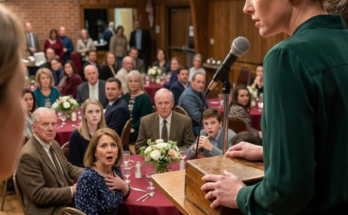
Five years after the rainy night, you stood on a stage at the opening of the first Open Windows residence.
It was a safe housing and education center for young adults who had lost parents, housing, or support. The building had wide windows on every floor. Real ones. Huge, bright, impossible to ignore.
Mariana sat in the front row.
Older now.
Softer in some ways.
Stronger in others.
Carmen sat beside her, crying before anyone even spoke. Martín, one of the first young men helped by the new program, adjusted the microphone for you and whispered, “Don’t mess this up. We practiced.”
You almost laughed into the microphone.
Then you looked at the crowd.
Students.
Donors.
Doctors.
Former patients.
Journalists.
And young people with backpacks.
So many backpacks.
You began with the truth.
“Years ago, I sat outside a closed store in the rain with nowhere to sleep and no reason to believe anyone would stop.”
The room went silent.
“A woman stopped. But this is not a story about a rich person saving a poor person. That version is too easy, and it is not true enough.”
Mariana lowered her eyes.
You continued.
“She gave me shelter. I gave her a reason to look closer. Together, we found a wound inside a system that was supposed to heal people.”
You saw some people wipe their eyes.
“My mother died waiting for help that had already been approved. My father died carrying grief he could not survive. I cannot bring them back. But I can make sure their story becomes a door someone else walks through before it is too late.”
Your voice trembled.
You let it.
“Open Windows exists because every young person deserves more than survival. They deserve a bed, a meal, a plan, a witness, and a future big enough to breathe in.”
The applause came slowly at first.
Then all at once.
You looked at Mariana.
She was crying openly.
Not with guilt this time.
With something closer to peace.
After the ceremony, she walked with you through the new building.
The rooms smelled like fresh paint and wood polish. Each bedroom had a desk, a lamp, clean sheets, and a window facing either trees or sky. In the common room, someone had placed a framed quote from your mother.
Poverty must never dirty the heart.
You stopped when you saw it.
“Who did that?” you asked.
Mariana looked guilty.
“Carmen.”
Carmen shouted from the hallway, “And I would do it again.”
You laughed.
Then cried.
Then laughed again, because healing often arrives badly dressed and at the wrong time.
That evening, after everyone left, you stood outside the building as rain began to fall.
Not a storm.
A gentle rain.
The kind that makes the city shine instead of drown.
Mariana came to stand beside you with an umbrella.
For a moment, neither of you spoke.
Then she said, “I almost didn’t stop that night.”
You looked at her.
“I know.”
“I was tired. I was sad. I told Ramiro to keep driving.”
Your chest tightened.
“But he slowed down,” she said. “He said, ‘Señora, that boy looks like he has no tomorrow.’”
You looked toward the street where the rain blurred the lights.
“I didn’t.”
Mariana’s voice broke.
“You do now.”
You nodded.
“Yes. I do.”
She handed you a small box.
Inside was your original math notebook.
The one from your backpack.
The cover had been carefully restored, pages protected, loose papers bound at the back. You opened it and saw your old calculations, your school notes, your messy plans for a business that would buy your mother a house with big windows.
At the back, Mariana had added a new page.
It was the deed to a small house outside the city.
Not a mansion.
Not a gift meant to trap you in gratitude.
A modest home with large windows, purchased in your name using court restitution assigned to your mother’s stolen grant and legally owed damages.
Your hands shook.
“Mariana…”
She shook her head.
“This is not charity. This is restitution. Your mother applied for help. She was approved. The money was stolen. This is part of what should have reached your family.”
You could not speak.
She touched your arm lightly.
“Let the window open, Daniel.”
That broke you.
You cried in the rain, holding the notebook like a child, like a man, like every version of yourself at once. Mariana cried too. Neither of you apologized for it.
The house had blue trim, white walls, and windows that caught morning light.
You moved in slowly.
A chair first.
Then books.
Then your parents’ photo.
Then a kitchen table where Carmen insisted real life begins. She brought pots, plates, spices, and one plant she said even you could not kill. You killed it in three months, but she forgave you eventually.
On the first morning, you made coffee and opened every window.
Sunlight poured in.
For a second, you could almost hear your mother laughing.
You placed her photo on the sill.
“I made it, Mamá,” you whispered. “Not all the way. But far enough to see sky.”
Years later, people would tell your story as if it were a miracle.
The millionaire saw a poor boy crying under the rain and saved him.
That was the easy version.
The pretty version.
But you knew the real story was harder and better.
A woman stopped because she carried a grief she had never healed. A young man accepted help because hunger was stronger than pride. A hidden file exposed a crime. A dead mother’s name forced a powerful family to answer for what it stole.
And from all that pain, something living grew.
One evening, long after Open Windows had expanded to three cities, you returned to Buenavista.
Not because you were lost.
Because the center was opening a small outreach office nearby, and you wanted the first box of supplies delivered yourself. The same corner was still there. The awning had been repaired. People rushed past with umbrellas, headphones, bags, destinations.
You stood where you had once sat with purple lips and an empty stomach.
Then you saw him.
A boy no older than eighteen, soaked through, sitting under the awning with a backpack hugged to his chest.
For a moment, time folded.
You saw your own hands.
Your own fear.
Your own almost-ending.
You walked toward him slowly, careful not to scare him.
“Are you hurt?” you asked.
He looked up, suspicious and ashamed.
“No.”
You knew that lie.
You had spoken it once.
So you sat on the wet sidewalk beside him, expensive suit and all, and placed a paper bag between you.
Inside was a sandwich and juice.
He stared at it.
“I didn’t ask for anything,” he said.
You smiled softly.
“I know.”
Rain fell around you, bright under the streetlights.
And somewhere in the city, windows were opening.