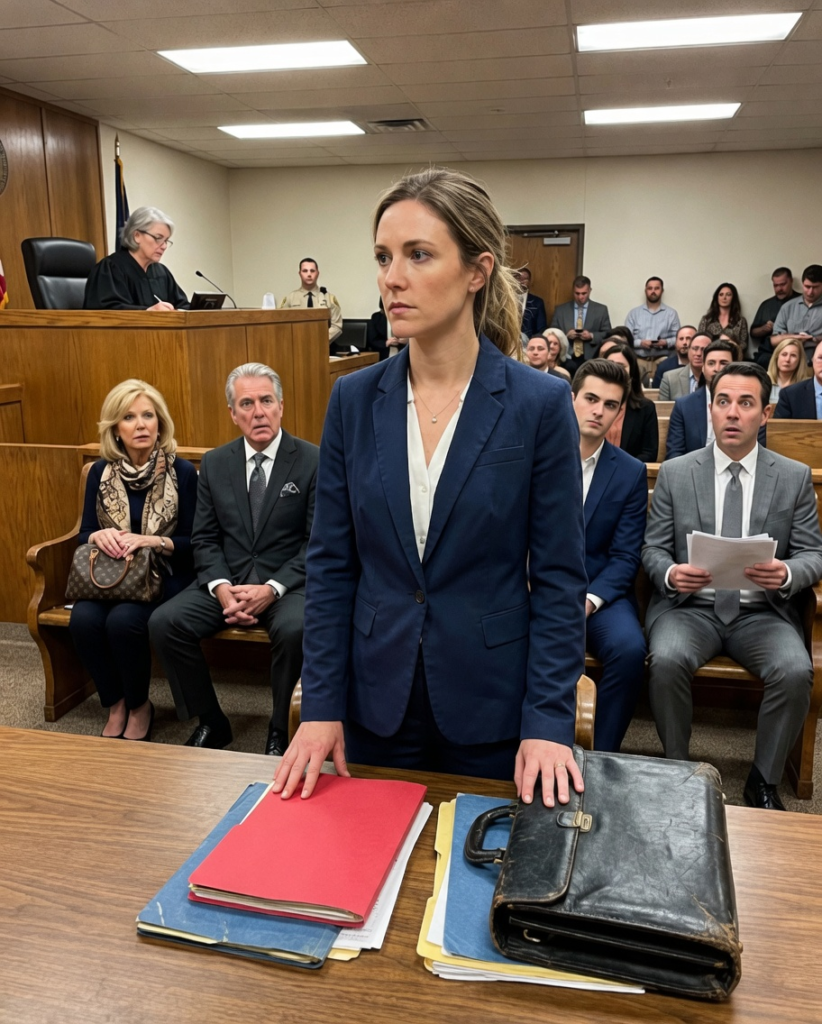
The courtroom door felt heavier than it should have.
Emily Whitmore stood in the hallway with one hand on the brass handle and the other gripping a scuffed black briefcase that had belonged to her grandfather.
The courthouse smelled like floor polish, old paper, and nervous people trying not to look nervous.
For a moment, she thought about turning around.
Not because she was unprepared.
She had not slept more than three hours, but every page in that briefcase had been checked, tabbed, indexed, and checked again.
She knew the petition.
She knew the law.
She knew the lies her parents had written in carefully measured language and submitted to the court as if a notarized signature could turn cruelty into truth.
Still, some part of her body remembered being eighteen, standing in her parents’ kitchen while her mother said, “You’re just not built for pressure, Emily.”
Some part of her remembered twenty-two, calling her father because her car battery had died and hearing him sigh before saying, “This is why no one trusts you with responsibility.”
Some part of her remembered thirty-two, reading the legal notice that said her own parents were asking a judge to declare her financially incompetent.
That part of her wanted to run.
Instead, Emily pushed the door open.
The room was already occupied.
Not crowded, exactly.
Probate court rarely looked like television, no packed gallery, no dramatic whispers, no rows of reporters waiting to catch someone’s downfall.
But every seat that mattered was filled.
Her mother sat in the front row in a cream coat that probably cost more than Emily had spent on clothes in the last year.
Linda Whitmore’s hair was blown out into soft waves, her lipstick a perfect muted rose, her diamond bracelet catching light each time she adjusted her sleeve.
Beside her, Robert Whitmore wore a tailored gray suit and the impatient expression of a man who expected public systems to run on his schedule.
Between them sat Emily’s brother, Derek, who had always managed to look relaxed in rooms where Emily felt like she was being measured.
He wore loafers without socks, a watch with a black face, and the same familiar smirk he used whenever their parents praised him for doing the bare minimum.
They looked like they were waiting for brunch.
Not like they had filed a petition to take control of their daughter’s life.
Not like they were trying to seize the $1.2 million her grandfather had left her outright, in his own name, with her initials written in careful blue ink beside the words, “For Emily alone.”
Linda saw her first.
Her eyes dropped to Emily’s shoes, then to the navy interview suit that pulled a little at the shoulders, then to the old briefcase.
Her mouth tightened into something close to pity, though there was no kindness in it.
She leaned toward Robert and whispered behind one manicured hand.
Robert looked up from his phone, glanced at Emily, and rolled his eyes.
Slowly.
Deliberately.
As if her presence were an inconvenience.
Derek smiled.
Emily felt that smile like a hand pressing between her shoulder blades, trying to bend her back into the shape they preferred.
Their attorney sat a few feet away, arranging papers inside a leather folio.
Richard Hale had a silver
head of hair, a crisp blue tie, and the relaxed face of a professional who had billed enough hours to confuse cost with competence.
Her father had called him “the best money can buy” in a voicemail Emily had saved.
That voicemail was in the yellow folder.
Emily walked down the aisle without looking away.
Her mother’s perfume followed her, expensive and sharp.
She took her place at the respondent’s table, set her briefcase down, and sat.
The chair was hard.
Her hands were cold.
She placed both palms flat on the table and counted silently.
One.
Two.
Three.
The briefcase lock clicked softly when she opened it.
Inside were three folders.
Blue.
Yellow.
Red.
The blue folder held her formal response to the petition.
Her parents had claimed she was unstable, irresponsible, impulsive with money, and vulnerable to exploitation.
They had attached medical records from a period of anxiety treatment eight years earlier, a late rent notice from when she was twenty-five, and a list of student loan balances as if debt were a mental disorder.
The yellow folder held financial records.
Actual ones.
Bank statements.
Tax returns.
Pay stubs.
Screenshots.
A spreadsheet showing exactly how she had survived the years her family publicly described as evidence of incompetence.
The red folder held the thing they had not expected her to find.
A copy of her grandfather’s handwritten letter.
Three notarized statements.
And a bank record that made the entire petition look less like concern and more like panic.
Emily touched the red folder with two fingers.
Her grandfather, Arthur Whitmore, had never been a sentimental man in obvious ways.
He did not hug easily.
He disliked holiday speeches.
He gave birthday cards with cash inside and one sentence written in block letters.
But he had noticed everything.
He noticed when Linda interrupted Emily at dinner.
He noticed when Robert praised Derek for “initiative” after he borrowed money and called Emily “chaotic” when she worked two jobs.
He noticed how Derek always seemed to need rescuing, and how Emily always seemed to be blamed for needing anything at all.
Three weeks before he died, he had called Emily to his house.
The memory came back as she waited for the judge.
Arthur had been sitting in his brown leather chair, thinner than she wanted him to be, a blanket over his knees and a glass of water untouched on the side table.
The old house smelled like lemon oil and coffee.
Afternoon light cut across the carpet in clean rectangles.
“I need you to listen,” he had said.
“Grandpa, you should rest.”
“I rested enough while everyone else talked over you.”
Emily had gone quiet.
Arthur had pointed toward the file cabinet in the corner.
“After I’m gone, they’ll come for it.”
“For what?”
“What I left you.”
She had tried to laugh then, because the thought embarrassed her.
“I don’t need anything.”
“That’s why it’s yours.”
He had given her a key that day.
Not to the house.
To a drawer in his desk.
He told her not to open it unless her parents tried to interfere.
When the will was read, her mother cried in a way that made no sound.
Robert went rigid.
Derek stared at the attorney as though someone had made a clerical error.
Arthur left smaller gifts to Linda, Robert, and Derek.
To Emily, he left $1.2 million in a trust that would distribute to her directly, provided she remained the sole beneficiary and no family member served in any controlling capacity.
The room had changed temperature.
For the first week, her parents called constantly.
They said they were happy for her.
Then they said it was a lot of responsibility.
Then they suggested a family financial meeting.
Then her father sent her a document appointing him as manager “temporarily.”
Emily refused.
Two weeks later, she was served.
Her mother’s petition said Emily had a “longstanding pattern of instability.” Her father’s affidavit said she had “demonstrated poor judgment under stress.” Derek’s supporting statement said she was “easily manipulated” and “not realistic about adult obligations.”
They wanted a conservatorship.
They wanted control.
They wanted the court to hand them the thing Arthur had protected from them.
“All rise,” the bailiff called.
Emily stood with everyone else.
The judge entered from the side door, a woman in her sixties with silver hair pulled back tightly and a face that did not waste expressions.
Judge Maren Ellis took her seat, adjusted her glasses, and opened the file.
“Be seated.”
Chairs scraped.
Bodies settled.
Emily looked straight ahead.
Judge Ellis reviewed the papers for several moments.
No one spoke.
Richard Hale tapped his fountain pen once against his folder.
Linda folded her hands in her lap.
Robert leaned back as if the matter was beneath his personal effort.
Then the judge looked over the rim of her glasses.
“We are here on the petition for conservatorship filed by Linda and Robert Whitmore regarding their adult daughter, Emily Whitmore.”
Linda’s chin lifted faintly.
Judge Ellis turned a page.
“I also see responsive filings and a counter-petition submitted by Ms.
Whitmore.”
Richard Hale shifted in his chair.
The judge’s eyes moved to Emily.
“Miss Whitmore, are you represented by counsel, or are you appearing on your own behalf?”
Emily stood.
Her chair legs made a small, clean sound against the floor.
For a second, she felt every eye in the room on the worn sleeve of her suit, the old briefcase, the fact that she had come alone.
Her mother smiled.
It was a small smile, but Emily saw it.
“Yes, Your Honor,” Emily said.
“I am represented by counsel.”
Judge Ellis glanced toward the gallery.
“And counsel is present?”
Emily opened the blue folder.
“Yes, Your Honor.
I am counsel of record.
I was admitted to the bar in January.
I am appearing on my own behalf.”
The silence was immediate.
It did not fall gradually.
It struck.
Linda’s smile disappeared.
Robert sat forward, his phone sliding down his palm.
Derek’s ankle dropped from his knee.
Richard Hale stopped tapping his pen.
Judge Ellis regarded Emily for a long moment.
“Very well, counselor.”
Counselor.
Emily had imagined hearing that word in a courtroom someday.
She had not imagined it would happen while her parents sat ten feet away trying to prove she could not be trusted with her own bank account.
Richard Hale rose halfway.
“Your Honor, my clients were not informed that Ms.
Whitmore had obtained legal credentials or intended to proceed in this manner.”
Judge Ellis did not look amused.
“Is there a rule requiring an opposing party to announce they passed the bar, Mr.
Hale?”
“No, Your Honor, but in a matter involving capacity—”
“In a matter involving capacity, I am especially interested in facts rather than assumptions.”
Richard sat down.
Emily kept her face still.
Judge Ellis looked back at her.
“Counselor, you may proceed.”
Emily lifted the red folder.
Her mother noticed.
Emily saw Linda’s eyes settle on it with a tiny flicker of unease.
Her mother had always known what colors meant in Emily’s life.
Blue was order.
Yellow was proof.
Red was danger.
“This is not merely a response to the petition,” Emily said.
“I am moving for immediate dismissal, sanctions, attorney fee shifting, and referral for investigation based on fraud upon the court.”
Richard Hale rose.
“Objection.”
Judge Ellis looked at him.
“To what?”
His mouth opened, then closed.
“To the characterization, Your Honor.”
“You may respond after I hear the basis.”
Emily handed the first document to the bailiff.
Her mother whispered, “Emily.”
It was soft, but Emily heard the warning inside it.
She did not turn around.
“The petition relies heavily on alleged financial irresponsibility,” Emily said.
“It states that I have been unable to maintain employment, that I am reckless with money, and that I am at risk of dissipating the inheritance left to me by Arthur Whitmore.”
She pulled a sheet from the yellow folder.
“In the last six years, I have maintained continuous employment, completed law school at night, passed the bar, and reduced my student loan balance by more than thirty percent.
My credit report, bank statements, and tax filings are included.”
Judge Ellis accepted the packet.
Her expression did not change, but she read carefully.
Emily continued.
“The petition also states that I am estranged from family due to paranoia and emotional instability.
That is false.
I reduced contact after repeated attempts by my parents to pressure me into signing over financial authority.”
Richard’s eyes flicked to Robert.
Robert’s jaw tightened.
Emily opened the yellow folder again and removed printed screenshots.
“These are text messages from my mother dated three days after the will was read.”
She read aloud.
“‘You need someone rational overseeing this.
Your father can make decisions until you are mature enough.’”
Linda closed her eyes for half a second.
Emily read the next one.
“‘Do not embarrass this family by acting like that money is really yours.’”
Derek shifted in his seat.
The judge’s pen moved across her notes.
Emily placed another page on top.
“This is a voicemail transcript from my father.
The audio file has been submitted with the filing.”
Judge Ellis looked toward Robert.
“Mr.
Whitmore, control your expression.”
Robert had been shaking his head.
He stopped.
Emily read the transcript anyway.
“‘You have no idea what you’re doing.
You will lose all of it, and when you do, don’t come crawling back.
Sign the authorization, Emily.
Stop pretending you’re competent.’”
The words sounded different in the courtroom.
At home, through a phone speaker, they had felt like shame.
Here, under fluorescent lights and before a judge, they sounded like what they were.
Pressure.
Coercion.
A paper trail.
Richard stood again.
“Your Honor, family communications can be emotional.
They do not prove bad faith.”
Emily looked at him.
“No.
But the red folder does.”
The room tightened.
Judge Ellis leaned back slightly.
“Proceed.”
Emily removed the handwritten letter first.
The paper was old and thick, folded once down the middle.
Arthur’s blocky handwriting filled the page.
Emily had read it so many times the words had begun to live under her skin.
She passed a copy to the court and another to Richard.
“This letter was written by Arthur Whitmore three weeks before his death.
It was found in a locked desk drawer to which he gave me the key.
The original is available for inspection.”
Judge Ellis read silently.
Richard read faster.
The color left his face first.
Then Linda leaned toward him.
“What is that?”
He did not answer.
Judge Ellis looked up.
“Read the highlighted portion into the record.”
Emily swallowed once.
“My daughter and son-in-law have asked me twice to name Robert as trustee over Emily’s share.
I refused.
I believe they intend to take control of any money left to her.
Emily is not incompetent.
She is tired.
There is a difference.
She has spent her life being told she is weak by people who benefit when she doubts herself.”
No one moved.
Emily continued, her voice thinner now but still steady.
“If Linda or Robert ever claim Emily cannot manage what I leave her, this letter should be treated as my direct statement that I considered that possibility and rejected it.
I leave this money to Emily because I trust her more than anyone in this family.”
The courtroom blurred for one second.
Emily blinked hard.
She would not cry.
Not yet.
Judge Ellis set the letter down with care.
Richard spoke softly.
“Your Honor, while touching, a letter is not dispositive of present capacity.”
“No,” Judge Ellis said.
“It is not.
But it is relevant to motive.”
Emily reached for the next document.
“This is where motive becomes action.”
She placed three bank records on the table.
“Two months before my grandfather died, Robert Whitmore contacted First Harbor Bank asking about the procedure for transferring assets from an inherited trust to a family-managed investment account.
The banker refused to discuss specifics without the beneficiary present.”
Robert’s face darkened.
“That is not what happened.”
Judge Ellis’s gaze snapped to him.
“Mr.
Whitmore, you are not testifying.”
He shut his mouth.
Emily added another page.
“One week after the will was read, my parents scheduled an appointment with the same bank, representing that I would attend to execute authority documents.
I did not know about that appointment.”
Linda whispered, “We were trying to help.”
Emily finally turned her head.
Her mother’s face was pale beneath the makeup.
“You told them I was overwhelmed and had agreed to let Dad handle everything,” Emily said.
Linda looked away.
Richard stood.
“Your Honor, I need a brief recess to confer with my clients.”
Judge Ellis did not grant it immediately.
She looked at Emily.
“Is there more?”
“Yes, Your Honor.”
Emily removed the final document from the red folder.
This one had kept her awake for two nights.
It was not from the bank.
It was from Richard Hale’s office.
A paralegal had accidentally emailed Emily a draft exhibit list two days before the hearing.
Attached to it was a medical summary from a psychologist Emily had seen eight years earlier.
But the version submitted to the court had been edited.
Not summarized.
Edited.
Lines were omitted.
Context removed.
A sentence about “temporary stress-related anxiety during academic and financial hardship” had been presented beside a petition claiming “longstanding impaired judgment.”
More importantly, the original report contained a conclusion her parents had not included.
No evidence of cognitive impairment.
No indication patient lacks decision-making capacity.
Emily handed both versions to the bailiff.
“The court filing contains a materially incomplete medical exhibit,” she said.
“The omitted conclusion directly contradicts the petitioners’ claim.”
Richard went still.
Judge Ellis read the two pages side by side.
The silence stretched.
Emily could hear Derek breathing through his nose.
Finally, the judge looked up.
“Mr.
Hale.”
Richard rose slowly.
“Your Honor, I would need to verify how that exhibit was prepared.”
“I expect you would.”
His face tightened.
Judge Ellis looked toward Linda and Robert.
“Did you provide this medical record to your attorney?”
Richard said quickly, “Your Honor, I would advise my clients not to answer without—”
“I am not asking them to incriminate themselves, Mr.
Hale.
I am asking whether the source of a court exhibit is known.”
Robert stared at the table.
Linda’s composure cracked first.
“She was always so sensitive,” Linda said, voice trembling now.
“You don’t understand what it was like.
Everything was difficult with her.
Every decision.
Every conversation.
Arthur made this dramatic gesture, and now she has more money than she knows how to handle.”
Emily felt the old reflex rise in her chest.
Apologize.
Soften it.
Make her mother less uncomfortable.
She let the feeling come.
Then she let it pass.
Judge Ellis said, “Mrs.
Whitmore, that is not an answer.”
Linda’s eyes filled, but no tears fell.
“We are her parents.”
Emily laughed once.
It came out quiet, almost disbelieving.
Her mother looked wounded by the sound.
“You tried to have me declared incompetent because Grandpa trusted me,” Emily said.
Robert leaned forward.
“You have no idea what that kind of money does to people.”
“I know what it did to you.”
The words landed before Emily had time to fear them.
Derek looked down at his hands.
For the first time all morning, he looked less bored than trapped.
Judge Ellis held up one hand.
“Enough.
This is a courtroom, not a family dining room.”
The room went quiet again.
Richard asked for a recess.
This time the judge granted ten minutes.
The second the judge left the bench, Linda turned around.
“Emily,” she hissed.
Emily began placing her papers back in order.
“Do not speak to me without your attorney present,” she said.
Her father made a hard sound in his throat.
“You think passing an exam makes you special?”
Emily looked at him.
“No,” she said.
“I think trying to steal from your daughter makes you desperate.”
Robert stood, but Richard caught his sleeve.
“Sit down,” the lawyer muttered.
That shook Emily more than her father’s anger.
Richard Hale no longer sounded like a man certain of victory.
He sounded like a man trying to keep the floor from collapsing under his own feet.
When court resumed, the change was visible.
Linda sat rigidly.
Robert would not look at the judge.
Derek’s face had gone gray around the mouth.
Richard stood with both hands on the table and requested permission to withdraw the petition without prejudice.
Emily stood before he finished.
“Opposed, Your Honor.”
Richard turned sharply.
“Ms.
Whitmore—”
“Counselor,” Judge Ellis corrected.
Emily kept her eyes on the bench.
“The petitioners initiated this proceeding with claims they either knew or should have known were false.
They submitted a distorted medical exhibit, concealed exculpatory language, and sought emergency authority over funds they had already attempted to access informally.
Withdrawal without prejudice would allow them to refile and continue harassment.”
Judge Ellis looked at Richard.
“Response?”
He had one.
Of course he did.
Lawyers always had words.
But not enough of them.
He spoke of concern, family history, misunderstanding, emotional communications, incomplete information.
He said his clients loved their daughter.
He said they feared she was vulnerable.
He said the court should not punish parents for imperfectly expressing worry.
Emily listened.
Her mother dabbed at the corner of one eye with a tissue.
For years, that tissue would have undone her.
Today, it looked like a prop.
When Richard finished, Judge Ellis folded her hands.
“I have reviewed the petition, the response, and the exhibits submitted today.
The petition before this court is not merely weak.
It appears to be built on selective facts and a troubling effort to reframe ordinary adult hardship as incapacity.”
Linda’s hand tightened around the tissue.
Judge Ellis continued.
“Debt is not incompetence.
Anxiety is not incompetence.
A strained relationship with controlling relatives is not incompetence.”
Emily stared at the table.
Those words moved through her like air entering a room that had been sealed for years.
“The petition for conservatorship is denied with prejudice.”
Robert’s head snapped up.
“With prejudice?” Richard asked.
“Yes, Mr.
Hale.
This matter will not be refiled on these grounds.”
Linda whispered, “No.”
Judge Ellis went on.
“The court is also ordering the petitioners to pay reasonable fees and costs incurred by Ms.
Whitmore in defending this action.
Given the allegations regarding altered or incomplete medical evidence and possible misrepresentation to financial institutions, I am referring the matter to the appropriate authorities for review.”
Derek muttered something under his breath.
Judge Ellis looked directly at him.
“Mr.
Whitmore, I strongly recommend silence.”
He obeyed.
Emily did not move.
She had imagined winning as something loud.
A gasp.
A collapse.
A dramatic apology.
Her parents finally exposed in a way that made the room turn against them.
Instead, it felt quiet.
Like a rope had been cut.
Judge Ellis looked at Emily one final time.
“Counselor, the court recognizes your preparation.
This could not have been easy.”
Emily’s throat tightened.
“No, Your Honor,” she said.
“It wasn’t.”
The judge nodded once.
“You are excused.”
The gavel came down.
Not hard.
It did not need to be.
When Emily stepped into the hallway, her parents followed.
For one strange second, they looked smaller outside the courtroom.
Her mother’s cream coat looked too bright under the hallway lights.
Her father’s expensive suit could not hide the sweat at his collar.
Derek hung back, avoiding her eyes.
Linda reached for Emily’s arm.
Emily stepped away before her mother could touch her.
“Don’t,” she said.
Linda’s face crumpled into outrage disguised as pain.
“After everything we did for you?”
Emily looked at the woman who had taught her to doubt every feeling she had, every choice she made, every success that did not come with family approval.
“You mean everything you did to me?”
Robert pointed a finger at her.
“Arthur poisoned you against us.”
“No,” Emily said.
“He named what I already knew.”
Derek finally spoke.
His voice was lower than usual.
“Em…”
She turned to him.
He looked ashamed, but not brave.
“I didn’t think it would go this far,” he said.
Emily studied him.
The brother who had signed the statement.
The brother who had sat smirking while she walked in alone.
The brother who had benefited from silence and now wanted credit for discomfort.
“You thought it would go far enough to work,” she said.
He had no answer.
That was answer enough.
In the weeks that followed, the referral became an investigation.
Richard Hale claimed he had relied on documents provided by his clients.
Linda and Robert claimed they misunderstood the medical report.
The bank confirmed that Robert had attempted to schedule authority paperwork without Emily’s consent.
The court ordered them to reimburse her filing costs, transcript fees, and every documented expense connected to the petition.
It was not the money that mattered most.
It was the record.
For the first time, the family story existed somewhere outside family control.
A judge had written it plainly.
Emily Whitmore was competent.
The petition was dismissed with prejudice.
The evidence suggested bad faith.
She framed none of it.
She did not need to.
She kept the order in the same briefcase that had carried the red folder into court.
Three months later, the inheritance transferred fully into her control.
She did not buy a mansion.
She did not quit her job in a blaze of revenge.
She paid off her student loans.
She moved into a quiet apartment with large windows and a lock that worked.
She funded a modest investment account with an advisor who spoke to her like an adult, not a problem.
Then she did something she had not told anyone about.
She created a small scholarship in Arthur Whitmore’s name for night students in law school who were working full time.
The first recipient wrote her a thank-you note on plain white paper.
Emily cried harder over that note than she had cried in court.
Her mother sent letters for a while.
Then emails.
Then messages through relatives.
The language changed with each attempt.
First anger.
Then grief.
Then denial.
Then a polished version of apology that still somehow made Emily responsible for the pain.
Robert never apologized.
Derek sent one text six months later.
I’m sorry.
I should have said no.
Emily stared at it for a long time before answering.
Yes, you should have.
She did not block him immediately.
She also did not forgive him just because guilt had finally found him.
That was the part nobody had prepared her for.
Winning in court did not erase the ache of knowing her family had sat together, signed papers together, hired a lawyer together, and walked into a courtroom believing she would break.
But it gave her something stronger than closure.
It gave her proof.
And sometimes proof is the first safe place a person ever gets to stand.
Years later, Emily would still remember the exact second the room went silent after she said, “I am counsel of record.” Not because it was the moment she humiliated them, but because it was the moment she finally heard her own voice without their doubt layered over it.
Some people thought she should have forgiven her parents because they were family.
Others thought the red folder was the kindest ending they deserved.
Emily never argued with either side.