My Stepmother Dragged Me By My Hair And Locked Me In A 38-Degree Downpour Over 1 Broken Plate.
Then, My Father Pulled Into The Driveway.
The cold did not reach me first.
Pain did.
It flashed across my scalp as Brenda’s acrylic nails sank into my hair, twisted hard, and pulled me backward with a force that made my eyes water before I even understood what was happening.
“You clumsy, ungrateful little brat,” she hissed.
Her voice was low.
Controlled.
hat was how I knew it was bad.
When Brenda screamed, she wanted the world to think she was overwhelmed.
When she whispered, she wanted me to know I was alone.
I was fourteen years old, barely a hundred pounds, barefoot in an oversized T-shirt and pajama shorts.
The kitchen floor beneath me was slick with soapy water because I had been washing the breakfast dishes she had left stacked in the sink.
I had been careful.
I always tried to be careful.
But my hands were wet, the plate was old, and when Brenda’s voice cracked across the kitchen behind me, I flinched.
“Don’t hold it like that.
Are you stupid?”
The plate slipped.
It hit the floor and shattered.
For one second, the whole house went silent.
Then Brenda saw what it was.
Not one of her white designer plates from Williams Sonoma.
Not one of the everyday bowls she could replace without blinking.
It was one of my mother’s plates, a blue-and-white vintage Spode dinner plate with tiny willow trees painted around the rim.
One of three left.
My real mother had bought that set before the cancer came back for the final time.
She used them only on holidays, and every Thanksgiving she would tell me the same thing while setting the table.
“Pretty things aren’t meant to stay in boxes, Emma.
You use them while you can.”
I used to think that meant dishes.
After she died, I understood she had been talking about time.
Brenda hated those plates.
She hated anything that made the house feel like my mother had existed before her.
She hated the framed wedding photo Dad kept in his office, even though he had moved it behind a stack of legal books after she complained.
She hated the perfume bottle still sitting on Mom’s old vanity in the guest room.
She hated the Christmas ornaments with my mother’s careful handwriting on the bottom.
And she hated me most of all.
Because I had my mother’s brown eyes.
Because my father’s face softened when he looked at me.
Because no matter how many expensive candles Brenda lit or how many rooms she redecorated in gray and cream, I was still living proof that she had not been first.
The moment the plate broke, I dropped to my knees.
“I’m sorry,” I said, already crying.
“Brenda, I’m so sorry.
It slipped.
I’ll clean it up.
I swear.”
Her face did not change.
That frightened me more than rage would have.
She stepped around the shards slowly, her wine-colored nails gleaming under the kitchen lights.
Her blonde hair was smooth, her makeup perfect, her cashmere sweater untouched by the mess on the floor.
“That belonged to her,” she said.
I nodded, trembling.
“I know.
I didn’t mean—”
Her hand shot out and grabbed my hair.
The pain stole my voice.
She yanked me backward so sharply my knees slammed into the linoleum.
I cried out, grabbing at her wrist, but her grip tightened.
“You break things,” she whispered.
“That’s what you do.
You break this family every time you breathe in it.”
“Please,” I sobbed.
“You’re hurting me.”
“Good.”
Then she dragged me.
Across the kitchen.
Past the marble island where she hosted brunches for women who called her elegant and said my father was lucky to have found love again.
My bare feet slipped in the water.
My hands scraped against the floor as I tried to push myself upright, but every time I moved, pain ripped through my scalp.
She pulled me through the dining room, where the table was polished so brightly it reflected the storm clouds outside.
She pulled me through the living room with its cream sofa, staged pillows, and family portrait over the fireplace.
In that portrait, Brenda stood beside my father with one hand on his chest.
I stood at the edge of the frame, smiling the way children smile when adults tell them to.
“Brenda, please,” I begged.
“It was an accident.
Please stop.”
She did not stop.
At the front door, she released my hair only long enough to grab my shoulder and shove me forward.
I stumbled over the welcome mat.
My knees hit the concrete porch.
The rain was already falling hard, slashing sideways across the steps.
t soaked my shirt in seconds.
I turned back, gasping.
“What are you doing?”
Brenda stood in the doorway, calm as a statue.
“Teaching you consequences.”
Then she shut the door.
The deadbolt clicked.
At first, I just stared at it.
There are sounds a person never forgets.
A monitor going flat in a hospital room.
Dirt hitting the top of a coffin.
A lock turning while you are on the wrong side of it.
That click went straight into me.
“Brenda?” I said, my voice small against the storm.
No answer.
I stood, slipping slightly because my feet were wet and numb already.
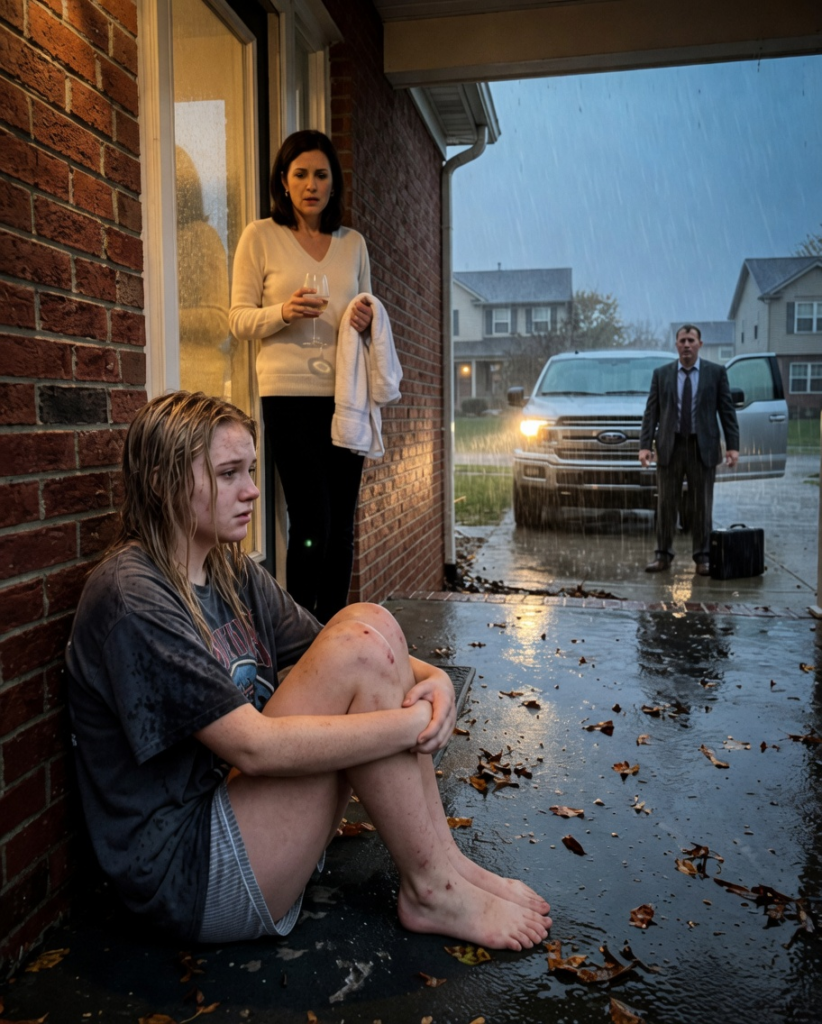
The temperature had dropped to 38 degrees that afternoon.
It was mid-November in Ohio, the kind of cold that did not feel dramatic until it touched bare skin and stayed there.
I pounded on the frosted glass with both palms.
“Brenda! Let me in!”
Through the glass, I could see her silhouette in the foyer.
She had not walked away.
She was watching.
The porch light turned on above me, bright and cruel, showing everything: my wet hair stuck to my cheeks, my scraped knees, my trembling hands, the thin cotton shorts clinging to my legs.
Inside, Brenda lifted a glass of Pinot Noir to her lips.
She took a slow sip.
That was when I understood this was not a punishment for a plate.
It was a performance.
She wanted to see me outside like something unwanted.
Something put out.
Something that did not belong in the house anymore.
“I’m sorry!” I screamed.
“Please, I’ll do anything!”
Her silhouette did not move.
Rain ran into my mouth when I cried.
It tasted metallic and cold.
I wrapped my arms around my chest, trying to hold in warmth that was already leaving me.
Oak Creek was the kind of neighborhood people described as safe.
Perfect lawns.
Stone mailboxes.
Seasonal wreaths.
Security cameras angled toward driveways.
Neighbors who reported suspicious cars within minutes and judged untrimmed hedges like moral failures.
But in that moment, the street was empty.
The storm had driven everyone indoors.
Everyone except Mrs.
Gable.
She lived next door in a brick colonial with white shutters and a birdbath shaped like an angel.
She was seventy, widowed, and alert to everyone else’s business.
She knew when my father left for work.
She knew when Brenda’s shopping bags came home.
She knew which neighbors drank too much at block parties.
I saw her at the bay window.
Her white shutters parted an inch.
Her face appeared in the gap.
For a second, hope hit me so hard I almost laughed.
I stepped toward her house, shivering violently.
“Mrs.
Gable!” I called, but the wind swallowed most of my voice.
She saw me.
I knew she saw me.
A fourteen-year-old girl, barefoot in a freezing downpour, locked outside her own home.
I pressed my palms together without thinking.
Help me, I mouthed.
Mrs.
Gable’s lips tightened.
Then the shutters snapped shut.
I stood there staring at the blank window, and something inside me went quiet.
Adults always tell children to find a trusted grown-up.
They never tell you what to do when the trusted grown-up closes the blinds.
The cold deepened.
It stopped feeling like weather and started feeling like a hand pressing against my bones.
My teeth chattered so hard my head hurt.
My fingers turned stiff.
My knees burned where the concrete had scraped them, but even that pain started fading under the numbness.
I backed against the brick wall beside the door because the small overhang did almost nothing against the sideways rain.
Water dripped from my hair onto my collarbone.
My shirt clung to me.
My legs shook uncontrollably.
I thought about running around to the back door.
Then I remembered Brenda had installed new locks after telling Dad she felt unsafe when he worked late.
I thought about breaking a window.
Then I imagined Brenda telling the police I was unstable.
Destructive.
Violent.
Another problem my grieving father did not know how to handle.
She had been building that story for years.
At first, she was sweet when Dad was around.
“Emma, honey, do you want more pasta?”
“David, she seems tired.
Maybe school is stressing her.”
“I’m trying so hard with her, but she shuts me out.”
The second his truck left the driveway, her voice changed.
She told me I was manipulative when I cried.
She told me my father needed peace.
She told me grief was not an excuse to be difficult.
Once, when I left a mug in the sink, she dumped cold coffee over my homework and told Dad I had spilled it myself.
Another time, she donated a box of my mother’s sweaters and said I had agreed it was time to move on.
I had not.
When I tried to tell Dad, he looked exhausted before I even finished speaking.
“Emma, Brenda is trying,” he said.
“This has been hard for all of us.”
For all of us.
That phrase became a locked door too.
So I stopped telling him.
I learned to be quiet.
Quiet girls survive longer in houses where nobody wants the truth.
On the porch, I slid down the wall until I was sitting on the wet concrete.
My bare knees folded against my chest.
I tucked my hands under my arms, but they felt like they belonged to someone else.
Dad would not be home until eight.
He was a senior partner at a corporate law firm downtown.
He left before breakfast most days, came home after dinner, and carried the smell of rain, coffee, and expensive paper in with him.
Since Mom died, he buried himself in work so completely that I sometimes wondered whether he knew how empty the house felt without him.
Brenda filled that emptiness with noise when he was home.
Music.
Laughter.
Dinner parties.
Renovation plans.
Stories about how hard she was trying to connect with me.
When he was gone, the house became something else.
A museum of things I was not allowed to touch.
A courtroom where Brenda was judge, witness, and jury.
I pressed my forehead to my knees and tried to breathe slowly, but the shivering made it impossible.
My thoughts started slipping.
I thought of my mother’s hands.
She had warm hands.
Even near the end, when the rest of her seemed to shrink into hospital sheets, her hands were warm when she held mine.
“Be kind,” she told me once.
I had tried.
I had tried so hard that I let people mistake kindness for permission.
A low rumble cut through the rain.
At first, I thought I imagined it.
Then headlights swept across the cul-de-sac.
Bright beams slid over wet pavement, mailboxes, the maple tree in our yard, and finally the porch.
I lifted my head.
A silver Ford F-150 turned into the driveway.
My father’s truck.
For a second, my mind refused to accept it.
It was only 4:30.
Dad was never home at 4:30.
Never.
The truck stopped abruptly.
The engine went quiet.
My father stepped out into the rain wearing his charcoal suit, white shirt, and dark tie.
He did not reach for an umbrella.
He did not even close the truck door behind him.
He just stared.
At me.
At my soaked clothes.
At my bare feet on the concrete.
At the way I was curled against the brick like a stray animal hoping not to be noticed.
His face changed slowly.
First confusion.
Then disbelief.
Then something I had never seen on him before.
Fear.
“Emma?”
His voice cracked on my name.
I tried to stand, but my legs would not cooperate.
My palms slipped against the wet brick.
Dad started toward me.
His leather briefcase slid from his hand and hit the driveway with a heavy thud.
That sound must have reached Brenda inside.
Behind me, the deadbolt turned.
Click.
The door opened.
Warm air rushed over my back.
Brenda stood there holding a folded towel in one hand and her wineglass in the other.
Her face had changed completely.
Gone was the woman who had watched me freeze.
Now she looked shocked.
Concerned.
Almost wounded.
“David,” she said, breathless.
“Thank God you’re home.
I didn’t know what else to do.
She locked herself out during one of her episodes.”
My father stopped halfway up the walk.
The rain ran down his face, soaking his suit jacket, but he did not seem to notice.
I looked at him, then at Brenda.
My body was shaking too hard to speak.
Brenda stepped onto the porch and draped the towel over my shoulders as if she had just discovered me there.
Her fingers pressed into my skin through the towel, a warning disguised as comfort.
“She broke one of the old plates,” Brenda said quickly.
“Then she became hysterical.
I was trying to calm her down, but she ran outside and slammed the door.
I was just getting the key.”
The lie came so easily.
So smoothly.
She even let her voice tremble.
Dad looked at her.
Then he looked at me.
For years, I had watched him choose the simpler explanation.
The one that let him keep working.
Keep grieving privately.
Keep believing his new wife and his daughter were just struggling to adjust.
I saw that habit rise in him now.
I saw him want the lie to be true because the truth would destroy everything.
Brenda must have seen it too, because she softened her face.
“David, she’s freezing,” she said.
“Help me get her inside.
We can talk when she calms down.”
My father climbed the steps.
He knelt in front of me.
Up close, I could see the tiny red veins in his eyes and the rain dripping from his eyelashes.
He reached toward my hair, then froze.
His expression shifted.
Very carefully, he moved the wet strands away from my temple.
I winced.
His hand stopped.
At the side of my scalp, where Brenda had grabbed me, there were angry red marks and tiny crescent-shaped scratches.
Dad looked at them for a long time.
Then he looked down.
My knees were scraped raw.
My palms were red.
My bare feet were almost blue.
The towel slipped from my shoulder, and I flinched when Brenda reached to fix it.
That flinch did what my words had never been able to do.
My father saw it.
Really saw it.
His face went still.
“Emma,” he said quietly, “did you lock yourself out?”
Brenda’s grip tightened on the towel.
I felt her nails through the fabric.
My throat closed.
I wanted to tell him everything.
I wanted to scream it so loudly the whole neighborhood would hear.
But Mrs.
Gable had seen me and closed her shutters.
Dad had ignored smaller truths for years.
Brenda was standing behind me, close enough that I could feel her breath.
So the first sound that came out of me was not words.
It was a sob.
Dad’s jaw clenched.
“Emma,” he said again.
“Look at me.
Did you lock yourself out?”
I shook my head.
Brenda exhaled sharply.
“David, don’t interrogate her in the rain.
She’s upset.
She doesn’t even know what she’s saying.”
My father did not look at her.
“Go inside,” he said.
Brenda blinked.
“What?”
“Go inside, Brenda.”
The quietness of his voice frightened even me.
She laughed once, brittle and offended.
“You cannot be serious.
I’m the one trying to help.
She had a tantrum over a plate, and now you’re looking at me like I—”
“Inside.”
For the first time since she entered our lives, Brenda looked uncertain.
She stepped back into the foyer, but she did not close
the door.
Dad lifted me carefully, one arm under my knees and the other around my back.
I was too cold to protest.
My head fell against his shoulder, and I smelled rainwater, wool, and the faint cologne he always wore to court.
“I’m sorry,” I whispered.
His arms tightened.
“No,” he said.
“Don’t you say that.”
He carried me inside.
The warmth hit so fast it hurt.
My skin prickled.
My teeth kept chattering.
Dad set me on the living room sofa, then stripped off his suit jacket and wrapped it around me over the towel.
Brenda hovered near the fireplace, arms crossed.
“This is ridiculous,” she said.
“She needs a hot shower and a conversation about responsibility.
That plate was your first wife’s, David.
I was upset too.”
Dad turned toward her slowly.
“Where are the pieces?”
The question caught her off guard.
“What?”
“The plate.
Where are the pieces?”
“In the kitchen.
I hadn’t had time to clean because she ran outside.”
Dad looked at me.
I whispered, “I was washing dishes.
It slipped.”
Brenda rolled her eyes.
“Exactly.
Careless.
And then she spiraled.”
Dad walked into the kitchen.
I heard his shoes stop on the tile.
Silence followed.
Then he came back holding something in his hand.
It was not a piece of the plate.
It was Brenda’s phone.
Her face drained.
“Why do you have that?” she demanded.
Dad looked at the screen.
“It was recording.”
The room went so quiet I could hear rain tapping the windows.
Brenda’s mouth opened, then closed.
Dad’s eyes lifted to hers.
“Why was your phone recording in the kitchen?”
For once, Brenda had no ready answer.
I stared at the phone, confused through the fog of cold and fear.
Then I remembered.
Earlier that afternoon, Brenda had propped her phone against the fruit bowl while filming herself arranging flowers for one of her social media posts.
She had been talking in that bright, fake voice about creating a peaceful home after loss.
She must have forgotten to stop recording.
Dad tapped the screen.
Brenda moved toward him.
“David, give me my phone.”
He stepped back.
Her voice sharpened.
“That is private.”
“Not anymore.”
The video played.
At first, there was Brenda smiling at the camera beside a vase of white tulips.
“A home should feel like healing,” she said in the recording.
Then she walked away.
For several minutes, the phone captured only the kitchen from a low angle.
My hands at the sink.
The plate.
Brenda entering behind me.
Her voice came through the speaker, crisp and cold.
“Don’t hold it like that.
Are you stupid?”
On the sofa, I closed my eyes.
The crash sounded louder in the recording than it had in real life.
Then my voice, panicked and small.
“I’m sorry.
Brenda, I’m so sorry.
It slipped.”
The phone shook slightly as footsteps approached.
Then Brenda’s recorded voice dropped into that whisper.
“You break things.
That’s what you do.
You break this family every time you breathe in it.”
Dad’s hand tightened around the phone.
The video did not show everything clearly, but it showed enough.
It showed me falling.
It showed Brenda’s arm yanking backward.
It captured my crying, my begging, the scrape of my knees across the floor.
It captured Brenda dragging me out of frame.
Then the front door opened somewhere beyond the kitchen.
My scream came faintly through the recording.
The door slammed.
The deadbolt clicked.
Then Brenda walked back into the kitchen alone.
She poured herself wine.
For almost a full minute, nobody in the living room breathed.
On the recording, she laughed softly.
Not loudly.
Not dramatically.
Just a small, satisfied sound.
That was the sound that broke my father.
He lowered the phone.
Brenda’s face crumpled into panic.
“David, listen to me.
I lost control for one second.
She provoked me.
You know how difficult she’s been.
You know I have tried everything.”
Dad stared at her like she had become a stranger in his house.
“She is a child.”
“She is not a normal child,” Brenda snapped, and the mask slipped completely.
“She has been poisoning this marriage since the day I moved in.
Every look, every silence, every little shrine to her dead mother—”
She stopped.
Because she heard herself.
Because Dad had heard her too.
His face hardened with a grief so deep it looked like anger from a distance.
“Get out,” he said.
Brenda blinked.
“Excuse me?”
“Get out of my house.”
“Your house?” she laughed, but her voice shook.
“David, we’re married.
You don’t get to just throw me out because your daughter had a meltdown.”
Dad held up the phone.
“I have the video.
I have her injuries.
I have a neighbor who saw her outside.
And I have enough legal experience to know exactly what happens next if you do not leave my daughter’s sight right now.”
For the first time, Brenda looked toward me not with hatred, but with fear.
That almost frightened me more.
She grabbed her purse from the console table, muttering that he was making a mistake, that I was manipulative, that he would regret choosing a troubled child over his wife.
Dad did not respond.
He stood between us until she walked out into the rain.
When the front door closed behind her, he locked it.
Then he turned back to me.
All the strength seemed to leave his body at once.
He crossed the room and knelt on the floor in front of the sofa, still in his soaked shirt and tie.
“Emma,” he said, and his voice broke.
“How long?”
I looked at him.
The question was too small for the answer.
So I told him.
Not everything at once.
I could not.
But enough.
The donated sweaters.
The ruined homework.
The locked pantry.
The insults whispered where cameras could not hear.
The way Brenda smiled when he walked in and turned cruel when he walked out.
With every sentence, my father’s face seemed to age.
He cried before I finished.
I had not seen him cry since my mother’s funeral.
An ambulance came because Dad called one, even though I kept saying I was fine.
The paramedics wrapped me in warm blankets and checked my temperature, my fingers, my scraped knees, the marks on my scalp.
A police officer arrived too.
Then another.
Mrs.
Gable came out only after the flashing lights painted the cul-de-sac red and blue.
She stood on her porch in a raincoat, pretending concern.
Dad saw her.
He walked across the lawn in the rain.
I could not hear every word from inside the ambulance, but I saw Mrs.
Gable’s face go pale when he asked why she had closed the shutters on a child begging for help.
She looked down.
That was answer enough.
Brenda did not come back that night.
She tried the next morning with a long message to my father about stress, grief, and misunderstanding.
He forwarded it to his attorney.
By the end of the week, he had filed for divorce.
By the end of the month, Brenda was gone from the house, from the accounts, from the smiling portraits on the wall.
The video changed everything.
Not because it made the truth real.
It had always been real.
It changed everything because, for once, an adult could not look away.
Dad took down the family portrait above the fireplace first.
Then he carried my mother’s photo back into his office and placed it where it used to be, not hidden behind books, not half-turned toward the wall.
One evening, he brought home a small box from an antique shop.
Inside was a single blue-and-white Spode plate.
It was not exactly the same pattern, but it was close.
He set it on the dining table between us.
“I know I can’t replace what was broken,” he said.
His voice was quiet.
“I know I can’t replace what I failed to see.”
I touched the rim of the plate.
For a long time, I said nothing.
Forgiveness did not arrive like it does in movies.
It did not wash over me in one warm moment.
It came slowly, in therapy appointments, in locked doors being removed, in Dad leaving work at five, in him believing me the first time I spoke.
Some things never went back to normal.
But some things became safer than normal had ever been.
That Thanksgiving, we used my mother’s two remaining plates and the new one Dad had found.
He made boxed mashed potatoes badly.
I burned the rolls.
We laughed once, awkwardly, then again for real.
The empty chair at the table still hurt.
So did the memory of the porch.
But Brenda was gone.
And when rain began tapping against the windows after dinner, my father looked at me from across the table.
“You’re safe,” he said, like a promise and an apology at the same time.
I wanted to believe him.
For the first time in years, I almost did.
People later said Brenda’s biggest mistake was forgetting her phone was recording.
But I think her real mistake was believing cruelty stays hidden just because a house looks beautiful from the street.
The harder question is whether my father should be remembered as the man who finally saved me, or the man who left me alone long enough to need saving.