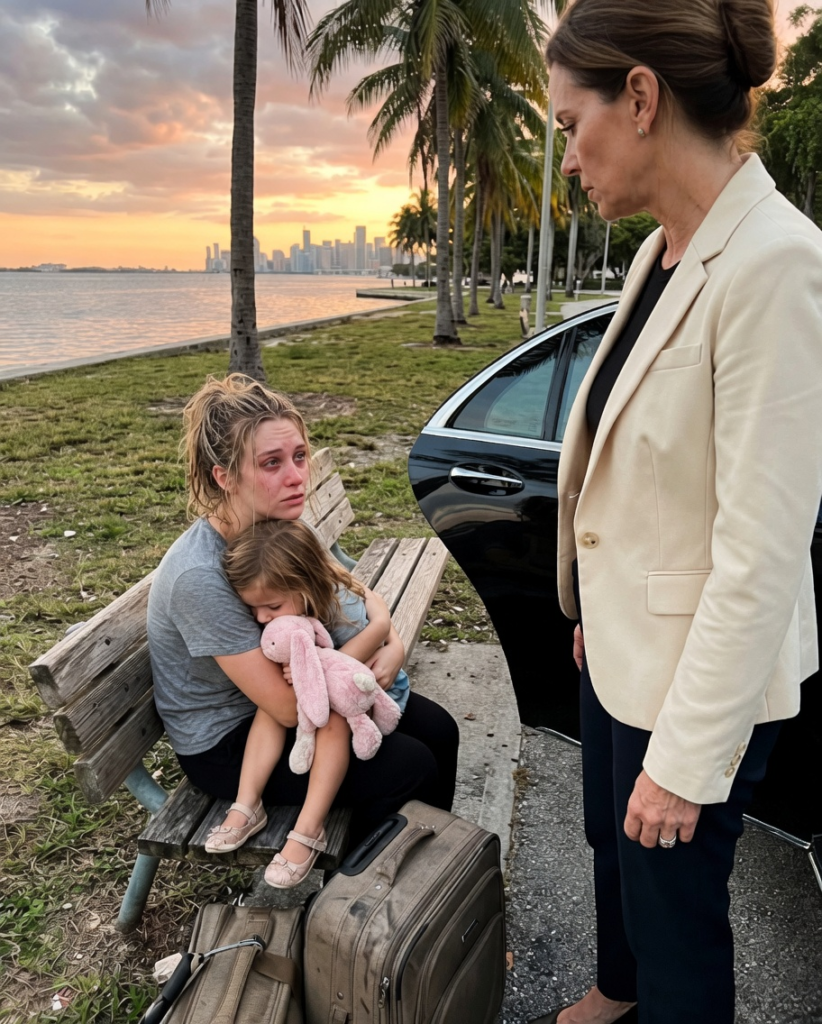
My daughter said, “My FIL told me to leave.
I don’t know what to do.”
She was sitting on a bench near Biscayne Bay when I found her, her little girl tucked against her side, two suitcases at her feet.
The late afternoon sun had turned the water gold, but Sophia looked as if the light could not reach her.
Ruby, my four-year-old granddaughter, held a pink stuffed rabbit under her chin.
Her curls had slipped loose from her ponytail.
Her shoes were on the wrong feet, which told me everything I needed to know about how quickly they had been pushed out.
My driver had barely stopped the black sedan before I opened my door.
Sophia looked up when she saw me.
She tried to pull herself together, because mothers do that even when their own bones feel hollow.
Her mouth lifted in the shape of a smile, but her eyes were red and frightened.
“Mom,” she whispered.
I kept my voice calm.
Not because I was calm, but because Ruby was watching.
“Why aren’t you at my company?”
Sophia’s hand tightened around the suitcase handle.
She glanced at Ruby, then lowered her voice.
“I got fired.”
The words were quiet.
The insult behind them was not.
“Who fired you?” I asked.
“Harrison.”
Harrison Westbrook.
Her father-in-law.
The man who smiled with all his teeth at charity dinners and treated waiters like furniture when he thought cameras were gone.
Sophia swallowed hard.
“He called me into the conference room this morning.
Said there were problems with reports I submitted.
But, Mom, I never touched those reports.
I don’t even have clearance for that department.”
Ruby looked up at me, confused.
“Grandma, are we going home?”
I crouched in front of her and brushed one curl away from her cheek.
“Soon, sweetheart.”
Sophia’s voice broke.
“Security walked me out.
In front of everyone.
They gave me a box with my things in it like I was some thief.”
I looked at the suitcases.
“And the bags?”
She pressed her lips together.
For a moment, I thought she would refuse to say it.
Then her shoulders caved.
“Adrien came home early.
He said his father had made a decision.
He said the accusations were serious and that I shouldn’t make things worse.”
The air shifted around me.
“He told you to leave?”
Sophia nodded.
“He said his family couldn’t keep protecting someone who didn’t fit the Westbrook name.”
Ruby squeezed the rabbit so tightly its little ears folded.
I stood very still.
There are moments in life when rage announces itself loudly.
Mine does not.
Mine gets quiet.
It stands up straight, fixes its lipstick, and begins making lists.
Sophia looked at me as if she expected me to call Adrien immediately, to demand answers, to beg for decency from people who had shown none.
I did not give Harrison Westbrook the gift of my shock.
I smiled.
“Get in the car.”
Sophia blinked.
“Mom, I don’t know where to go.”
“You’re coming with me.”
My driver was already at the suitcases.
He lifted them from the grass without a word, his jaw tight in a way I had rarely seen.
Ruby climbed into the back seat first, crawling across the leather with her rabbit tucked under one arm.
Sophia followed, moving like someone underwater.
I sat in the front passenger seat and gave my driver one instruction.
“Home.”
The ride to Coconut Grove took seventeen minutes.
No one spoke for the first ten.
Ruby leaned against Sophia and stared at the city sliding past the window.
Brickell’s glass towers caught the sunset.
Joggers moved along the water.
Couples laughed outside restaurants.
The ordinary world continued, shamelessly unaware that my daughter’s life had just been cracked open in a public park.
Sophia finally whispered, “I should have known.”
I turned slightly.
“Known what?”
“That they never really accepted me.”
Her voice was so small I almost did not recognize it.
“Harrison always made little comments,” she said.
“About my clothes.
My degree.
The apartment I had before Adrien.
He’d say it like a joke, so if I got upset, I looked sensitive.”
I had heard enough of those jokes over the years.
I had also watched Sophia defend Adrien, defend the marriage, defend the family dinners where she was complimented like a guest and judged like an intruder.
“And Adrien?” I asked.
She looked down at Ruby’s hair.
“He used to tell me to ignore it.
He said his father was old-fashioned.
Then he started saying I should try harder.”
That was the part that hurt.
Not Harrison’s cruelty.
Cruel men are predictable.
It was Adrien’s slow surrender that had done the most damage.
The gates to my house opened as we approached.
The palms along the driveway bent in the evening breeze, and the porch lights glowed over the white stone steps.
Ruby lifted her head.
“Is this a sleepover?” she asked.
I turned around and smiled at her.
“Yes, baby.
The safest kind.”
Inside, the house smelled faintly of lemon polish and jasmine from the courtyard.
My housekeeper, Elena, took one look at Sophia’s face and said nothing.
That was one of the reasons I loved her.
She brought warm milk for Ruby and tea for Sophia.
She set out pajamas from the emergency drawer I kept for my granddaughter, because every grandmother worth the title keeps one.
Upstairs, I showed them the garden suite.
The bed was made with fresh white sheets.
A small nightlight glowed near the closet.
Ruby set her rabbit on the pillow, then climbed up beside it.
Sophia stood near the bathroom door, still holding her phone.
“I should answer him,” she said.
The phone had buzzed six times since we left the park.
Adrien’s name flashed across the screen each time.
Not once had he texted, Are you safe? Not once had he asked about Ruby.
I held out my hand.
Sophia hesitated, then gave me the phone.
The latest message was short.
Don’t make this harder than it needs to be.
I looked at that sentence for a long moment.
Then I turned the phone face down on the dresser.
“You don’t need to answer anyone tonight,” I said.
“Tonight, you wash your face, put your daughter to bed, and breathe.”
“What if they say I took Ruby?”
“They can say whatever they want.
Saying things and proving them are different hobbies.”
She almost laughed.
Almost.
Ruby fell asleep within minutes, one hand still curled into Sophia’s sleeve.
Children know more than adults like to admit.
She did not understand corporate politics or family names, but she understood fear in her mother’s body.
Sophia sat on the edge of the bed, staring down at her daughter.
“Mom,” she whispered, “what if they take everything?”
I sat beside her and touched her hand.
“They won’t.”
“You don’t know that.”
I looked toward the window, where the last strip of sunset had faded into blue.
“Yes,” I said softly.
“I do.”
She looked at me then.
Really looked.
Some part of her remembered the mother I had been before I became merely Grandma in family photos and holiday dinners.
She remembered the woman who built companies from nothing, who sat in rooms full of men twice her size and never raised her voice because she never needed to.
I kissed Ruby’s forehead, then Sophia’s.
“Sleep if you can.”
Downstairs, I went straight to my office.
My office was at the back of the house, facing the garden.
The walls were lined with books, old case files, and framed photographs from years I rarely spoke about.
On the credenza sat a picture of Sophia at twelve, grinning with braces beside a much younger version of me on the day I signed my first acquisition.
I opened the bottom drawer of my desk and pulled out a file marked WESTBROOK.
It was thin.
Deliberately thin.
Power, real power, does not always look like a stack of paper.
Sometimes it looks like one signature in the right place, one clause no one bothered to read twice, one holding company buried under another until arrogant men mistake ownership for decoration.
Harrison Westbrook believed Coastal Cargo belonged to him.
He was wrong.
Years earlier, when the Westbrook family company had been drowning under debt and bad decisions, I had stepped in quietly through a private investment group.
Harrison never knew the money was mine.
He did not ask too many questions because desperate men rarely examine lifelines for fingerprints.
The agreement had allowed him to remain CEO, provided certain financial and ethical covenants were honored.
I held the controlling interest through a trust and a chain of companies so dull-looking that no one at cocktail parties ever asked about them.
I had let Harrison sit at the head of the table because I wanted to know who he was when he believed no one above him was watching.
Now I knew.
I called my auditor first.
He answered before the second ring.
“Margaret?”
“I need Coastal Cargo opened.”
There was a pause.
“How deep?”
“Every contract.
Every payment.
Every vendor.
Every internal report attached to Sophia’s name.
Four years back.”
His tone changed.
“Is this routine?”
“No.”
“Forty-eight hours?”
“Less, if they were sloppy.”
“They usually are when they feel untouchable.”
After I hung up, I called my attorney, Nadine Cole.
Nadine had defended me through two hostile board fights and one attempted smear campaign that ended with three resignations and a federal inquiry.
She did not scare easily.
“I need you in my office at seven,” I said.
“Employment retaliation, defamation, custody protection, and an emergency board action.”
“Who touched your family?” she asked.
“Harrison Westbrook.”
Nadine exhaled once.
“I’ll bring coffee.”
I sat at my desk long after midnight, not because I needed to work, but because I needed to remain still.
Anger begs for movement.
Wisdom waits for documents.
At 2:13 a.m., the first email arrived from my auditor.
Found irregularities in two vendor accounts.
At 2:19, another came.
Reports attributed to S.
Ellison were generated from H.
Westbrook’s executive login.
Sophia’s maiden name was Ellison.
Mine.
I opened the attachment.
The metadata was clear.
Harrison’s office had created the reports, inserted Sophia’s name into the approval chain, and flagged the discrepancies internally before calling her into the conference room.
At 2:34, a third message arrived.
This was not mismanagement.
It was a setup.
By sunrise, I had more than enough to call a meeting.
By seven, Nadine was in my office with a leather binder, two coffees, and the expression of a woman who had already sharpened every blade she owned.
Sophia came downstairs at 7:20 wearing one of my sweaters and the same stunned look she had carried from the park.
“Ruby is still asleep,” she said.
“Good.”
She looked at Nadine, then at the papers on my desk.
“What’s happening?”
I held her gaze.
“The truth is being organized.”
Her phone buzzed again from where it sat on the desk.
Adrien.
This time, I let it ring.
Then a message appeared.
My father says you need to return Ruby by noon or this gets ugly.
Sophia went pale.
Nadine reached for the phone before I could.
“Perfect,” she said calmly.
“He just documented intimidation.”
Sophia looked like she might be sick.
“Adrien would never take Ruby from me.”
I said nothing.
Sometimes silence is kinder than contradicting hope too early.
At eight-thirty, every director of Coastal Cargo received a mandatory board notice.
At nine, Harrison received his.
At nine-oh-six, his assistant called my office.
“Harrison Westbrook wants to know who authorized this meeting,” she said.
I smiled at the garden outside my window.
“Tell Mr.
Westbrook the controlling shareholder did.”
The silence on the other end lasted long enough to become satisfying.
The meeting was scheduled for eleven in Coastal Cargo’s main conference room.
I asked Sophia to stay home with Ruby, but she shook her head.
“No,” she said.
Her voice trembled, but her eyes did not.
“He walked me out in front of everyone.
I want to walk back in.”
For the first time since the park, I saw my daughter beneath the fear.
So we went together.
Coastal Cargo’s headquarters sat near the port, all mirrored glass and steel confidence.
The lobby guard recognized Sophia and immediately looked uncomfortable.
His eyes flicked to me, to Nadine, to the two auditors behind us carrying sealed folders.
“Mrs.
Westbrook is not authorized—” he began.
“She is with me,” I said.
He stepped aside.
People stared as we crossed the lobby.
Some looked shocked.
Some looked guilty.
One young woman from accounting pressed a hand to her mouth when she saw Sophia, then quickly turned away as Harrison’s chief of staff came striding toward us.
“Mrs.
Ellison,” he said, using my name like it tasted bad.
“Mr.
Westbrook is in a closed executive session.”
“Then he is early to my meeting.”
He blinked.
“Your meeting?”
Nadine smiled without warmth.
“You’ll want to move.”
The conference room doors were closed.
Through the glass, I could see Harrison at the head of the table, silver hair perfect, navy suit crisp, one hand wrapped around a coffee cup.
Adrien sat beside him, tense and pale.
Three board members occupied the far side, whispering among themselves.
When I opened the door, Harrison looked up with irritation first.
Then he saw Sophia.
Then he saw me.
“Margaret,” he said slowly.
“This is not a family matter you should involve yourself in.”
I walked to the opposite end of the table.
“That’s where you’re mistaken.”
Adrien stood halfway.
“Sophia, why are you here?”
Sophia’s eyes went to him, searching for the man she married.
“Because your father fired me and you put our daughter out of her home.”
Adrien flinched.
“I didn’t put Ruby out.
I said you should stay somewhere else until this was handled.”
“In a park?” Sophia asked.
The room went still.
Harrison set down his coffee cup.
“This emotional display is unnecessary.
Sophia was terminated for cause.
We have documentation.”
“So do I,” I said.
He smiled then, the patronizing smile I had wanted to wipe from his face for five years.
“With respect, Margaret, you may be successful in your own field, but Coastal Cargo is my company.”
I placed one folder on the table.
“No, Harrison.
It is not.”
Nadine opened her binder and began distributing documents.
The first page showed the ownership structure.
The second showed the controlling trust.
The third showed my signature.
Harrison’s smile faded.
One board member leaned forward.
Another removed his glasses.
“What is this?” Harrison snapped.
“The reason this meeting exists,” Nadine said.
“Mrs.
Ellison controls the majority interest in Coastal Cargo through Bayline Strategic Holdings.
Your authority as CEO is conditional and revocable.”
Adrien looked at his father.
“Dad?”
Harrison did not answer him.
His eyes were locked on mine.
“You hid behind a shell company,” he said.
“I invested through one,” I corrected.
“You survived because of it.”
His face reddened.
“You had no right.”
“I had every right.
You signed the agreement.”
The room heard that.
More importantly, Harrison heard it.
He reached for the ownership packet, flipping pages with fingers that were no longer steady.
Men like Harrison build their identities around the belief that the floor beneath them is permanent.
Watching them feel it move is a quiet education.
I opened the second folder.
“Now let’s discuss why you fabricated reports under my daughter’s name.”
Adrien turned sharply.
“Fabricated?”
Harrison’s jaw tightened.
“That is an outrageous accusation.”
My auditor stepped forward and connected his laptop to the conference screen.
One by one, the files appeared.
Creation timestamps.
Login records.
Approval chains.
Vendor payments routed through two consulting firms registered to Harrison’s golf partner and Adrien’s cousin.
Sophia stood beside me, silent, one hand gripping the back of a chair.
The report bearing her name had been created from Harrison’s executive login at 11:42 p.m.
three nights earlier.
Sophia had been at home with Ruby, recorded on the building’s entry system, ordering soup because Ruby had a fever.
Another file showed a fake approval attached to her employee ID.
“That ID was used after her access badge had already been disabled,” the auditor said.
Nadine slid one more page across the table.
“And this is the termination notice prepared before the alleged internal review was completed.”
The room breathed in all at once.
Adrien stared at the paper.
“Dad, what is this?”
Harrison’s eyes flashed.
“Be quiet.”
That was the first honest thing he had said all morning.
Sophia looked at Adrien, and something inside her changed.
It was not forgiveness.
It was not hatred.
It was the moment a woman stops waiting to be chosen by someone who keeps choosing comfort.
“You knew they were blaming me,” she said.
Adrien shook his head too quickly.
“I didn’t know about the reports.”
“But you knew I was being pushed out.”
He looked down.
The silence answered for him.
Sophia’s voice dropped.
“And you still told me to leave.”
Adrien rubbed his forehead.
“My father said if we didn’t distance ourselves, the company could collapse.
He said everything was temporary.”
“Our daughter cried herself to sleep in my mother’s guest room.”
His face crumpled, but not enough.
Harrison stood.
“This is absurd.
You are all overreacting to an internal matter.
Margaret, we can discuss a transition privately.”
“No.”
The word cut cleanly through the room.
I slid the final resolution across the table.
“As controlling shareholder, I am calling for immediate removal of Harrison Westbrook as CEO, suspension of all executive privileges pending forensic review, reinstatement of Sophia Ellison-Westbrook’s employment record, public correction of the termination notice, and referral of the financial irregularities to outside counsel.”
Harrison laughed once, but it came out wrong.
“You can’t do that.”
One board member cleared his throat.
“Actually, under Section 8.4, she can.”
Harrison turned on him.
“After everything I’ve done for this company?”
I leaned forward.
“You mean what you’ve done to it?”
His mouth opened.
No words came.
The vote took less than six minutes.
Harrison lost unanimously after the second board member saw the vendor transfers.
His access was revoked while he was still standing in the room.
Security arrived, not the lobby guard who had embarrassed Sophia, but two senior officers who addressed him as Mr.
Westbrook without apology and asked him to surrender his badge.
The color drained from his face.
Sophia watched him slide the badge across the table.
A day earlier, he had made her carry a cardboard box through the lobby while people stared.
Now he stood under the same fluorescent lights, suddenly smaller than his suit.
He looked at me with pure hatred.
“You planned this.”
“No, Harrison,” I said.
“You did.
I only kept the receipts.”
As security escorted him out, his eyes landed on Sophia.
“You ruined this family,” he spat.
Sophia did not flinch.
“No,” she said.
“I finally saw it clearly.”
Adrien moved toward her after his father was gone.
“Sophia, please.
I was scared.
He said I’d lose everything.”
She looked at him for a long, painful second.
“You were afraid of losing money,” she said.
“I was afraid of losing my child.”
He reached for her hand.
She stepped back.
That tiny movement said more than any speech could have.
By late afternoon, the company issued a formal correction.
Sophia had not been terminated for cause.
Her record was cleared.
The allegations attached to her name were withdrawn.
Harrison Westbrook was placed under investigation, and the board announced an interim leadership transition.
At home, Ruby ran into Sophia’s arms as soon as we walked through the door.
“Mommy, did the bad day go away?” she asked.
Sophia held her so tightly the rabbit was crushed between them.
“Some of it did,” she whispered.
That evening, Adrien came to my gate.
The security camera showed him standing outside in the same wrinkled shirt he had worn to the meeting, looking younger than his age and far less certain than his last name had ever allowed him to be.
Sophia watched the monitor beside me.
“He wants to talk,” I said.
“I know.”
“Do you want to?”
She was quiet for a long time.
Then she shook her head.
“Not tonight.
Tonight Ruby and I are staying where no one has to earn a name to be safe.”
I nodded and told security not to open the gate.
Adrien stood there for twelve minutes before walking back to his car.
Sophia did not cry when he left.
That was how I knew the deepest break had already happened before the park, before the suitcases, before the meeting.
Harrison had lit the match, but Adrien had spent years stacking the kindling.
Weeks later, the investigation uncovered enough to end Harrison’s career permanently.
He resigned from every board that had once welcomed his donations.
People who used to laugh too loudly at his jokes suddenly forgot to return his calls.
Sophia did not return to the office right away.
She took time with Ruby.
She met with Nadine.
She made decisions slowly, which is the only way to make decisions after someone tries to make them for you.
When she finally did go back, she did not enter through the side door.
She walked through the main lobby in a cream blouse, her head high, Ruby’s pink rabbit keychain clipped to her purse.
The same young woman from accounting who had turned away before now stepped forward.
“I’m sorry,” she whispered.
Sophia nodded.
“I know.”
There was grace in it.
Not absolution.
Grace.
As for Adrien, he asked for counseling.
He apologized.
He sent long messages.
He admitted he had been weak and afraid and too used to letting his father define what loyalty meant.
Sophia read every message.
She answered only one.
Ruby and I are safe.
That is my priority now.
Some people thought she should forgive him because he had not created the lie.
Others thought betrayal by silence was worse than betrayal by action.
Sophia never argued either side.
She simply carried on, one careful day at a time, building a life where her daughter would never have to wonder whether love came with a last name attached.
And every time I passed the guest suite, I remembered that evening by the bay: the suitcases, the rabbit, my daughter’s shaking voice.
Harrison thought he was protecting his family name.
In the end, he was the one who taught all of us exactly what it was worth.