“He Came Home Early—and Uncovered a Truth No Family Could Survive: A $79 Camera, A Hidden Note, and a Sentence That Broke Everything”
At 4:38 a.m., under fluorescent hospital lights, truth does not whisper—it exposes, burns, and refuses to be ignored.
That was the moment Miguel Torres realized his life had already split into a “before” and an “after.”
His newborn son’s breath came in uneven scratches, not cries, each inhale sounding like a fragile thread threatening to snap at any second.
Behind a thin hospital curtain, his wife lay unconscious, her silence louder than any scream he had ever heard.
And then came the sentence—the one that did not belong in any version of motherhood, family, or humanity.
“If she dies, at least she won’t separate you from your real family anymore.”
It wasn’t shouted.
It wasn’t whispered either.
It was delivered with a calm that made it infinitely more terrifying.
Because cruelty, when spoken casually, reveals something far deeper than anger—it reveals belief.
Miguel stood there, holding his seven-day-old son, and understood something that would haunt him forever.
This was not a misunderstanding.
This was not stress.
This was not postpartum tension spiraling out of control.
This was intention.
And intention leaves evidence.
Miguel had always believed he was doing the right thing.
He worked long hours managing warehouse operations, earning enough to keep stability within reach, even if comfort remained slightly out of grasp.
He believed responsibility meant sacrifice.
He believed providing financially was a form of protection.
He believed family meant trust.
All three beliefs collapsed within minutes that night.
Because while he was away fulfilling one role, another had been quietly dismantled behind his back.
The role of protector.
The role of husband.
The role of father.
Just days earlier, everything had still felt fragile but hopeful.
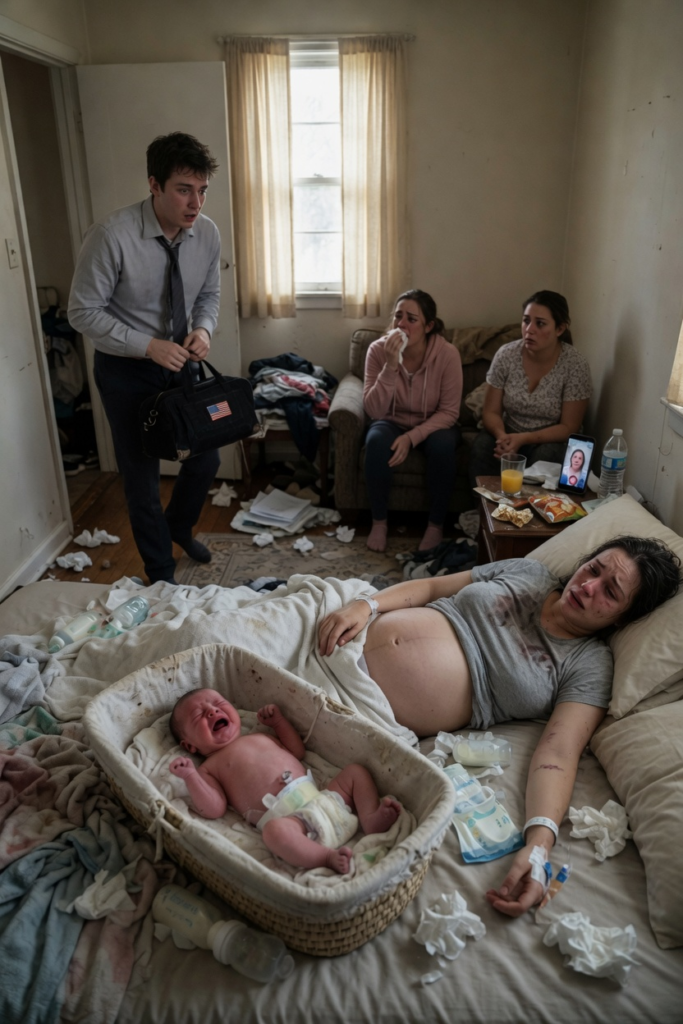
Valeria had given birth under exhaustion, her body stitched, swollen, and still adjusting to the shock of creating life.
She wasn’t glowing like social media promised.
She wasn’t radiant.
She was real.
And reality, as it turns out, makes people uncomfortable.
Especially those who prefer control over compassion.
“Promise me no one touches him wrong.”
Her voice had been barely audible when she said it.
But Miguel heard it clearly.
He promised without hesitation.
Because some promises feel impossible to break—until life arranges the exact circumstances that make breaking them almost inevitable.
When his boss asked him to travel, Miguel hesitated.
Instinct told him no.
Responsibility told him yes.
And then came reassurance—the kind that sounds supportive but carries something sharper beneath the surface.
“I raised you. I can handle a baby.”
His mother’s voice was steady, confident, and absolute.
Too absolute.
But hindsight always speaks with perfect clarity, while the present remains stubbornly blurred.
For three days, everything seemed fine—at least on the surface.
Calls were answered.
Updates were given.
Excuses were packaged as normal.
“She just had a baby.”
“She’s tired.”
“She’s resting.”
Each sentence sounded reasonable.
Each sentence also created distance.
And distance is where truth hides best.
Valeria appeared on video only twice.
Her eyes struggled to stay open.
Her lips looked dry, cracked, almost painfully stretched.
Miguel noticed—but he rationalized.
Because doubt is uncomfortable, and trust is easier.
Until it isn’t.
At 2:06 a.m., everything changed—not because of a dramatic event, but because of a decision.
He finished work early.
He chose to drive home.
He chose not to announce it.
And sometimes, the smallest choices expose the biggest lies.
The apartment door being slightly open was the first warning.
Cold air blasting through the space was the second.
Neglect is rarely loud—it shows itself in details.
Dirty bottles.
Unwashed dishes.
Food left out.
Comfort prioritized over care.
And then came the sound.
Not crying.
Not screaming.
Something weaker.
Something more dangerous.
A dry, scraping breath from a newborn who didn’t have the strength to protest anymore.
That sound cut through everything Miguel thought he understood about safety.
Because babies cry when something is wrong.
But when they stop crying, something is very wrong.
What he saw next didn’t feel real.
It felt staged, like a nightmare designed to test how much a person could process before breaking.
Valeria unmoving.
His son burning with fever.
Silence filling a room that should have been alive with care.
He said her name.
No response.
He touched his son.
Heat.
He looked around.
Indifference.
And then came denial.
“Don’t start drama.”
Few phrases are more dangerous than that one.
Because it doesn’t just dismiss a problem—it erases it.
It reframes harm as exaggeration.
It transforms concern into inconvenience.
Miguel didn’t argue.
He acted.
Because when reality becomes undeniable, action replaces conversation.
The hospital moved quickly.
Professionals don’t debate obvious danger—they respond to it.
And within minutes, what had been dismissed at home became documented concern.
Fever.
Dehydration.
Unconsciousness.
Bruising.
Patterns began forming.
And patterns tell stories that words often try to hide.
The bruises changed everything.
They weren’t random.
They weren’t accidental.
They were symmetrical.
Consistent.
Intentional.
When the doctor lowered her voice, it wasn’t hesitation—it was precision.
“This is not postpartum weakness.”
That sentence dismantled every excuse that had been carefully constructed over the past few days.
And then, as if truth hadn’t already done enough damage, came something even more chilling.
A justification.
Not for neglect.
But for disappearance.
“If she dies…”
The sentence didn’t finish in Miguel’s mind.
It didn’t need to.
Because the intention behind it was already complete.
What kind of person says that?
That question spread quickly—not just within that hospital room, but into a larger conversation that people are often uncomfortable having.
Because the truth is, harm doesn’t always come from strangers.
Sometimes it comes from those closest.
Sometimes it wears the face of family.
And then came the detail that shifted everything from suspicion to undeniable evidence.
A nursery camera.
Seventy-nine dollars.
Small.
Forgettable.
Overlooked.
But technology, unlike people, doesn’t justify.
It doesn’t reinterpret.
It doesn’t soften reality.
It records.
Exactly as things are.
Brenda’s reaction said more than any explanation could.
Shock.
Recognition.
Fear.
Because being seen is terrifying—especially when you’ve spent days believing no one was watching.
And then, something even more powerful than video appeared.
A note.
Hidden.
Sewn into fabric.
Protected by desperation.
Because when someone hides a message like that, they’re not hoping to be heard—they’re preparing for the possibility they won’t survive to speak.
The timestamp mattered.
Thursday.
9:41 p.m.
Not during chaos.
Not during crisis.
But during awareness.
That meant Valeria knew.
She understood what was happening around her.
She anticipated escalation.
And she prepared evidence.
That realization sparked a different kind of anger.
Not explosive.
Not loud.
But deep.
The kind of anger that comes from recognizing someone you love was afraid—and you weren’t there.
Now the question extends beyond Miguel.
It becomes collective.
Uncomfortable.
Divisive.
Necessary.
What would you have done first?
Call the police immediately?
Or confront them face to face?
It sounds simple.
But it isn’t.
Because emotion complicates logic.
Because betrayal distorts judgment.
Because family creates hesitation where there should be none.
This is where public opinion splits.
Some argue action should be immediate, procedural, detached.
Call authorities.
Secure evidence.
Protect victims.
Others argue confrontation is human.
Demand answers.
Look them in the eye.
Force acknowledgment.
Both reactions are real.
Both reactions are flawed.
Because in moments like these, there is no perfect response—only consequences.
What makes this story powerful isn’t just the events.
It’s the pattern.
The quiet dismissal.
The subtle control.
The gradual erosion of trust.
These things don’t happen overnight.
They build.
They normalize.
They hide behind familiarity.
And that is what makes them dangerous.
Because by the time they become visible, damage has already been done.
Social media thrives on stories like this—not because they are rare, but because they expose something people recognize but rarely articulate.
The idea that not all families are safe.
The idea that love can be conditional.
The idea that silence often protects the wrong people.
This is why stories like Miguel’s spread rapidly.
They provoke debate.
They trigger reflection.
They force people to ask uncomfortable questions about their own lives.
Who do you trust?
Who do you overlook?
What behaviors have you normalized that shouldn’t be?
These questions don’t come with easy answers.
But they matter.
Because the most dangerous environments are not the ones filled with obvious threats.
They are the ones where harm is disguised as normal.
The hidden note changes everything—but not just legally.
Emotionally.
Psychologically.
Socially.
It transforms suspicion into certainty.
It removes doubt.
It demands accountability.
And once accountability enters the picture, relationships don’t just fracture.
They collapse.
Miguel didn’t just lose trust that night.
He lost an entire version of reality.
The version where his family was safe.
The version where his mother was protective.
The version where absence didn’t equal risk.
And rebuilding from that kind of collapse isn’t straightforward.
Because you’re not just rebuilding trust in others.
You’re rebuilding trust in your own judgment.
This is where the conversation becomes bigger than one family.
It becomes about awareness.
Boundaries.
Accountability.
And the uncomfortable truth that sometimes, protection means distance—even from those you were taught to trust the most.
The story doesn’t end with the note.
It begins there.
Because whatever was written inside that piece of fabric will shape everything that follows.
Legal action.
Public reaction.
Personal healing.
All of it will trace back to that moment.
And maybe that’s the most unsettling part of all.
Not the sentence spoken in cruelty.
Not the bruises.
Not even the neglect.
But the fact that the truth was there—hidden, waiting, almost missed.
So the real question isn’t just what Miguel should have done first.
It’s this:
How many truths like this exist, unnoticed, until it’s almost too late?
And more importantly—
What are we willing to do when we finally see them?
The nurse didn’t read the note out loud immediately.
She hesitated, just for a second, but that second stretched long enough to change the air in the room.
Because everyone understood something at the same time—whatever was written there was not small.
It was not misunderstanding.
It was not exaggeration.
It was evidence.
Miguel felt his grip tighten around the edge of the counter as if letting go would mean losing control of reality entirely.
His mother stood still, her expression frozen somewhere between annoyance and calculation, like someone deciding which version of the truth to perform next.
Brenda didn’t speak.
She didn’t need to.
Silence, in that moment, became confession-shaped.
The nurse unfolded the paper carefully, as if it might break under the weight of what it carried.
And when she finally began to read, her voice shifted into something clinical, detached, but undeniably firm.
Valeria’s handwriting was uneven, but deliberate, like someone fighting against time, exhaustion, and fear all at once.
“She won’t let me feed him when he cries at night.”
Each word landed with a precision that no accusation could match.
“She says I’m weak and that I’ll spoil him.”
Miguel closed his eyes for a brief second, but the images only became clearer, not softer.
“I asked for water twice. She said I should learn to endure.”
Endure.
That word echoed longer than the others.
Because endurance, when forced, stops being strength and starts becoming harm.
The nurse continued.
“Brenda laughs when I ask for help.”
A pause.
Then the final line, written smaller, tighter, almost like it had been squeezed into the page with the last bit of energy left.
“If something happens to me, please check the camera.”
That was it.
No dramatic plea.
No long explanation.
Just a direction.
A quiet, precise instruction that assumed the worst and prepared for it anyway.
Miguel didn’t look at his mother this time.
He didn’t look at Brenda either.
Because whatever expressions they had, they no longer mattered as much as what had already been proven.
The doctor stepped forward, her voice no longer soft.
“We’re documenting everything.”
Not a threat.
A process.
And process is what turns moments into consequences.
His mother exhaled sharply, crossing her arms as if the situation had become an inconvenience rather than a crisis.
“You’re really going to believe that?”
That question revealed something critical.
Not denial of facts.
But disbelief in accountability.
As if truth required permission to exist.
Miguel finally spoke, and when he did, his voice didn’t shake.
“That camera is going to answer everything.”
Simple.
Direct.
Final.
For the first time, uncertainty shifted away from him and landed exactly where it belonged.
On them.
Because evidence does something arguments cannot.
It removes interpretation.
It replaces debate with reality.
And reality, once exposed, cannot be negotiated.
The conversation that followed would later divide everyone who heard it.
Some would argue he should have confronted them immediately, demanded explanations, forced apologies in that very room.
Others would insist silence was the strongest move, letting the law, the footage, and the note speak without interference.
But what most people missed was this—Miguel had already made the most important decision.
He chose not to protect the people who caused harm.
And that choice, more than any reaction, is what defines the outcome of situations like this.
Because too often, the first instinct is not justice.
It is preservation.
Preserving family image.
Preserving relationships.
Preserving comfort.
Even at the cost of truth.
Miguel didn’t do that.
And that is why this moment matters beyond one hospital room.
Because it challenges something deeply embedded in many cultures and communities.
The idea that family loyalty must come before accountability.
The idea that blood excuses behavior.
The idea that silence is protection.
Those ideas don’t just fail in moments like this.
They cause them.
Outside that hospital room, the world continued as normal.
Cars passed.
People slept.
Notifications lit up phones.
But inside, a different reality had already taken hold.
One where truth had surfaced, and nothing could return to what it was before.
The camera would be reviewed.
The timeline would be reconstructed.
Every moment Valeria lived through in those days would be seen, second by second, frame by frame.
And that is the part people often underestimate.
Truth is not just about what happened.
It is about witnessing it.
Fully.
Without interruption.
Without excuse.
And once seen, it demands a response.
Not emotion.
Not opinion.
Action.
So the question evolves again.
Not just what would you do first.
But what would you refuse to ignore once you knew the truth.
Because that is where real accountability begins.