My Elderly Neighbor Watched My Baby Every Day — Until I Heard Her Whisper, “She Didn’t Suspect Anything Today Either”
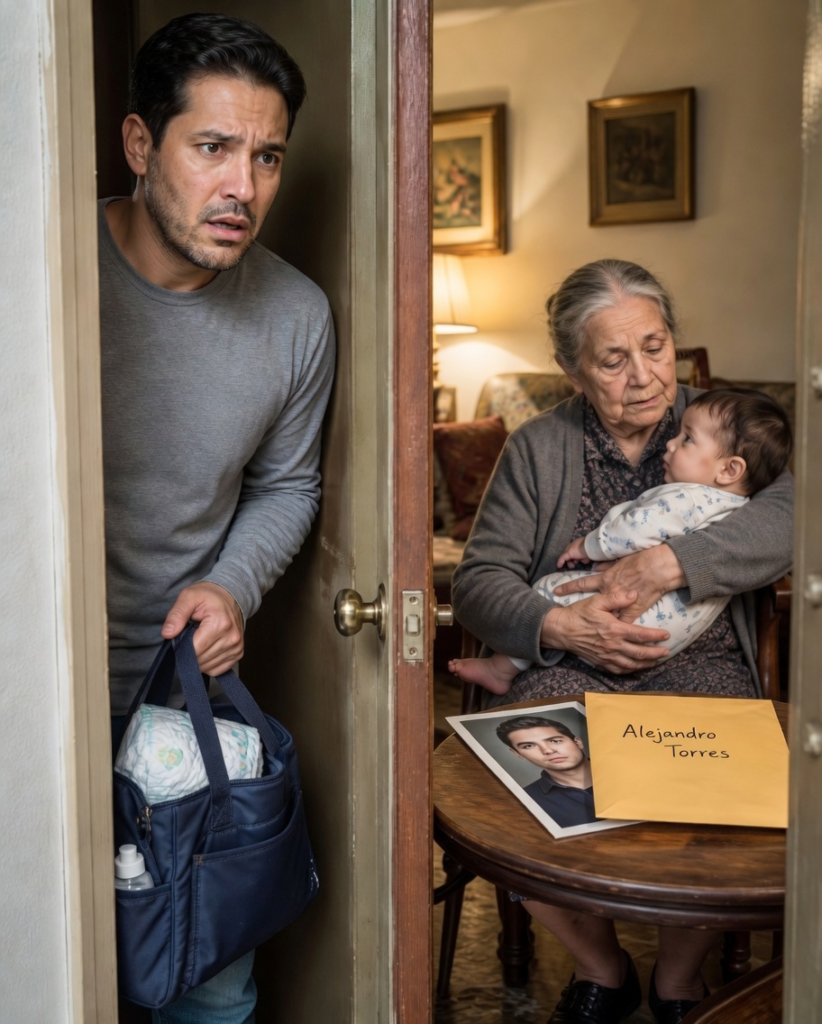
You stand in the doorway with a diaper in your hand and the kind of fear that makes your whole body forget how to move.
Mrs. Mercedes is sitting in her faded armchair by the window, holding Mateo against her chest. Your baby is asleep, one tiny fist resting near his cheek, peaceful in the arms of the woman you trusted because loneliness had made both of you desperate.
On the small table in front of her lies an old photograph.
A young man in his twenties.
Dark hair. Serious eyes. A crooked smile.
And beside the photo, a yellow envelope.
Your name is written across it in black ink.
Alejandro Torres.
Mrs. Mercedes looks up at you, and the color drains from her face.
“Alejandro,” she whispers.
You step inside without asking.
“Give me my son.”
Her arms tighten around Mateo for half a second.
Only half.
But you see it.
That half second becomes a knife.
“Give him to me,” you repeat, louder.
Mateo stirs, his face scrunching in his sleep. Mrs. Mercedes looks down at him with such pain that, for one confusing moment, she appears more heartbroken than guilty.
Then she rises slowly and places him into your arms.
You pull him against your chest, checking his face, his breathing, his hands, his blanket, as if fear itself might have left marks.
“What did you mean?” you ask. “Who didn’t suspect anything?”
Mrs. Mercedes opens her mouth, but no answer comes.
The apartment suddenly feels smaller than you remember. The old curtains. The smell of coffee. The crocheted blanket over the couch. The religious candle burning beneath a picture of the Virgin.
All those details used to comfort you.
Now they look like props in a lie.
You point at the yellow envelope.
“What is that?”
Her eyes fill.
“I was going to give it to you.”
“When?”
She looks away.
You laugh once, bitterly.
“When I didn’t suspect anything?”
She flinches.
A phone lies face up beside the envelope. The call is still connected. You can see the timer counting.
Someone is listening.
You grab the phone before she can stop you.
“Who is this?”
Silence.
Then breathing.
Female breathing.
Your blood turns cold.
“Who is this?” you demand.
A voice answers, low and broken.
“Is he okay?”
Your body goes rigid.
You know that voice.
Even after months.
Even through the thin speaker.
Mateo’s mother.
Lucía.
The woman who left a suitcase by the door and kissed your baby like she was saying goodbye to a room she rented by mistake.
You nearly drop the phone.
“Lucía?”
Mrs. Mercedes covers her mouth.
On the line, Lucía makes a sound like a sob.
“Alejandro.”
For months, you imagined what you would say if she ever called. You imagined rage. Questions. Cruelty. You imagined making her feel one fraction of what you felt at three in the morning with Mateo screaming and your shirt soaked in formula.
But now your son is in your arms, your neighbor has been lying, and Lucía is inside the room without being there.
Your anger has too many targets to choose one.
“You’ve been calling her?” you ask.
Mrs. Mercedes whispers, “Please let me explain.”
You look at the phone.
“You knew where he was.”
Lucía cries softly.
“Yes.”
“You knew I was raising him alone.”
“Yes.”
“You knew I thought you were gone.”
Silence.
That silence is worse than any excuse.
You press the phone harder to your ear.
“Where are you?”
Lucía does not answer.
“Where are you?”
Mrs. Mercedes steps forward. “Alejandro, please—”
You turn on her.
“You don’t get to please me right now.”
She stops.
Mateo wakes and begins to fuss. His tiny mouth opens, not fully crying yet, just searching for comfort. Your anger shifts immediately into fatherhood. You bounce him once, instinctively, pressing your lips to his forehead.
He smells like baby soap and Mercedes’s soup.
That almost breaks you.
Because whatever this is, he has been safe here.
Loved, even.
That makes it worse.
You look at the yellow envelope again.
“What is inside?”
Mercedes wipes her face with trembling fingers.
“The truth.”
You almost laugh.
People always call it that after lying long enough.
You keep Mateo in one arm and pick up the envelope with the other. It is thick, sealed but worn at the edges, as if someone has held it many times and almost opened it.
“Did she give you this?”
Mercedes nods.
“When?”
“The day she left.”
The room tilts.
You stare at her.
“The day she left me?”
Mercedes closes her eyes.
“She came here after leaving your apartment.”
You feel your chest tighten.
Lucía is crying on the phone, but she still says nothing.
You look at the photo on the table.
“And him?”
Mercedes follows your gaze.
“My son.”
The words come out like a wound reopening.
“His name was Daniel.”
You look at the young man in the photograph. The crooked smile. The serious eyes. Something about him feels familiar, but grief makes faces blur. Then Mateo makes a small sound in your arms and turns his head.
The angle is sudden.
Small.
Impossible.
You look from your baby to the picture.
Same curve of the eyebrow.
Same chin.
A cold thought moves through you.
“No.”
Mercedes understands immediately.
“No, Alejandro. No. Not like that.”
You step back.
“What does that mean?”
Lucía finally speaks through the phone.
“Daniel was my brother.”
The words enter the room and rearrange everything.
You look at the photo again.
Lucía’s brother.
Mrs. Mercedes’s son.
Your neighbor is Mateo’s grandmother.
Not by blood through you.
Through the woman who left.
You feel the air leave your lungs.
“You’re Lucía’s mother?”
Mercedes shakes her head quickly.
“No. I raised her after my Daniel died. She was his little sister. Their parents were gone. Daniel was all she had, and when he died, she came to me. She was seventeen.”
You turn toward the phone.
“You never told me you had anyone.”
Lucía’s voice is small.
“I didn’t know how.”
That answer is so weak you almost throw the phone.
“You didn’t know how to mention the woman living next door raised you?”
Mercedes whispers, “She asked me not to tell you.”
You stare at her.
“And you listened?”
“I was wrong.”
“Yes.”
“I know.”
“No,” you say. “You don’t. I left my baby with you every day because I thought you were lonely. I trusted you.”
“I was lonely,” she says, and her voice breaks. “And I love him.”
You look at Mateo.
He is fully awake now, blinking up at you, unaware that the adults around him are standing in the wreckage of his origin story.
“Love without truth is still a trap,” you say.
Mercedes bows her head.
This time, she does not defend herself.
You open the envelope.
Inside are papers.
A letter in Lucía’s handwriting.
Medical records.
A death certificate.
A photograph of Lucía at maybe seventeen, standing beside Daniel and Mercedes in this very apartment, all three of them smiling in front of the same curtains.
Your hand shakes.
The letter is addressed to you.
Alejandro, if you are reading this, it means I was too much of a coward to tell you myself.
You stop.
Your throat tightens.
You do not want to read it in front of them.
But you also cannot stop.
I did not leave because I don’t love Mateo. I left because I was afraid I would become dangerous to him. I know that sounds unforgivable. Maybe it is.
Mateo grabs the collar of your shirt.
You keep reading.
When my brother Daniel died, I was seventeen. He threw himself from the roof of a hospital after months of depression nobody named because in my family sadness was called weakness. I found him. Mercedes found me afterward, on the floor, unable to speak. She raised what was left of me.
Your anger falters.
Not gone.
Never gone.
But complicated now.
You read faster.
After Mateo was born, I started hearing him cry even when he was sleeping. I stopped sleeping. I saw Daniel in every shadow. I imagined dropping Mateo. I imagined walking out the window with him because at least then he would never be abandoned the way I was. I told myself these thoughts meant I was a monster.
Your fingers go numb.
You remember Lucía after Mateo’s birth.
Pale.
Quiet.
Staring at walls.
You had thought she was tired. You were tired too. You had said things like, “We’re all exhausted,” and “It’ll get better,” because men often mistake survival slogans for help.
You read the next line twice.
I tried to tell you once, but you said, “Please don’t fall apart too. I can’t do this alone.”
Your stomach drops.
You remember saying that.
Not cruelly.
Desperately.
You had been standing over the sink, washing bottles, running on two hours of sleep. Lucía had started crying and said, “Something is wrong with me.” You had rubbed your face and said those words.
Please don’t fall apart too.
I can’t do this alone.
You had forgotten.
She had not.
The letter continues.
So I left him with the person I trusted most in the world. Mercedes. I begged her to watch over him from nearby. I told her not to tell you because I was ashamed and because I thought you would hate me so much you would keep him from her too.
You lower the letter.
Mercedes is crying silently now.
Lucía is quiet on the phone.
You feel rage return, but it has changed shape.
It is no longer simple.
It is not just betrayal.
It is failure layered over fear, love twisted through secrecy, mental illness buried beneath shame until everyone made the worst possible choice and called it protection.
You lift the phone.
“Where are you, Lucía?”
This time, she answers.
“In Puebla.”
“What is in Puebla?”
“A clinic.”
Mercedes looks at you quickly.
“She checked herself in,” she says. “Four months ago.”
You stare at the phone.
“You’ve been in treatment?”
Lucía whispers, “Yes.”
“And nobody told me?”
“I wanted to get better first.”
You laugh, but it sounds broken.
“Better enough to what? Appear one day and say surprise?”
“No.”
“Then what?”
“To know if I deserved to see him.”
That stops you.
Because the answer is terrible.
And honest.
Mateo begins to cry.
Not loudly.
Hungry.
Overtired.
Done with adult ruin.
You tuck the phone under your chin and adjust him. Mercedes instinctively reaches for a bottle on the side table, then stops herself, as if remembering she has lost the right.
You notice.
So does she.
A silence passes between you.
Then you say, “Give it to me.”
Her hands tremble as she passes the bottle.
You feed Mateo while standing in the middle of her apartment, still holding the letter, still listening to the woman who left him breathe through a phone.
That is fatherhood, you think bitterly.
No matter how much the world collapses, the baby still needs milk.
When Mateo calms, you sit on the couch because your knees feel weak.
Mercedes remains standing.
Lucía whispers, “Can I hear him?”
Your grip tightens.
No.
That is the first answer.
The loudest answer.
The wounded answer.
But then Mateo makes a soft little satisfied sound around the bottle. A sound that belongs to no adult’s guilt. A sound that should not be used as punishment.
You hold the phone near him for three seconds.
Only three.
Lucía sobs.
You pull it back.
“That is all for today.”
“Thank you,” she whispers.
“Do not thank me.”
Silence.
Then, “Okay.”
You look at Mercedes.
“And you. No more secrets. Not one. If I ask something, you answer. If she calls, you tell me. If anything involves my son, I know first.”
Mercedes nods immediately.
“Yes.”
“I mean it.”
“I know.”
“No. You don’t. Because if I find out you hide one more thing, you will never see Mateo again.”
She flinches like you struck her.
You hate that it hurts you to say it.
But boundaries are not cruelty just because they cause pain.
Lucía speaks carefully.
“She only did what I asked.”
You turn cold.
“She is not a child, Lucía.”
“I know.”
“Neither are you.”
“I know.”
“Good.”
You end the call.
The room becomes unbearably quiet.
Mercedes sinks into her chair, suddenly looking every one of her seventy-something years.
You stand and gather Mateo’s things.
The diaper bag.
The bottle.
The blanket she bought him, blue with little moons.
When you pick it up, she whispers, “That one is his favorite.”
You stop.
You know it is.
That is the problem.
You do not want your son to lose another person who loves him. You also do not know how to keep someone in his life who lied to you every day.
You fold the blanket slowly.
“I’m taking him home.”
Mercedes nods, crying.
“Of course.”
“I need time.”
“Yes.”
You reach the door.
She says, “Alejandro.”
You turn.
She holds the photo of Daniel in both hands.
“I didn’t do it to steal him.”
You look at her.
“I know.”
Her face collapses with relief.
Then you add, “But you did steal the truth.”
She bows her head.
You leave.
In your apartment, the silence feels different.
For months, you had believed Mercedes was the kind neighbor who saved you from breaking. Now every object carries suspicion. The bottle she washed. The blanket she bought. The lullaby Mateo liked. The way she always seemed to know when he was teething before you did.
Because she was not just watching him.
She was reporting back.
He smiled today.
He ate well.
He slept badly.
He said ba.
He grabbed my necklace.
Don’t worry, today she didn’t suspect anything either.
You sit on the floor with Mateo in your arms and shake.
Not with fear now.
With delayed rage.
At Lucía.
At Mercedes.
At yourself.
At a world where a woman could be so sick she abandoned her child, an old woman could be so lonely she accepted secrecy as payment, and a father could be so exhausted he mistook convenience for trust.
Mateo pats your cheek with one damp hand.
You begin to cry.
He laughs.
Because babies are mercilessly alive.
That night, you do not sleep.
You read the letter three more times. You read the medical records. Severe postpartum depression. Intrusive thoughts. Hospitalization recommended. Patient declined initially. Later admitted voluntarily.
You search everything online until the words blur.
Postpartum depression.
Postpartum psychosis.
Intrusive thoughts.
Risk.
Treatment.
Recovery.
You learn enough to feel guilty, then angry at the guilt.
Because understanding Lucía’s illness does not erase what she did.
It only makes the wound less clean.
At 7:00 a.m., Mercedes knocks.
You freeze.
Mateo is asleep in his crib.
You look through the peephole.
She stands in the hallway holding a paper bag.
Not trying to enter.
Not calling your name.
Just standing.
You open the door halfway.
Her eyes are swollen.
“I brought his pacifier,” she says. “He left it.”
You take the bag.
Inside is the pacifier, washed and sealed in a small container. Also a notebook.
“What is this?”
Mercedes looks down.
“Everything.”
You open it.
Dates.
Times.
Notes.
Mateo ate at 2:15.
Mateo cried for ten minutes.
Mateo has a rash on his left leg.
Lucía called at 5:40.
Lucía cried.
Lucía asked if Mateo laughed.
Lucía asked if Alejandro looked tired.
Lucía asked if Alejandro hated her.
There are months of entries.
Your chest aches.
“You wrote all of this?”
Mercedes nods.
“I thought one day he might need to know he was loved.”
You grip the notebook.
“You mean by her?”
Mercedes shakes her head.
“By all of us.”
That almost breaks you.
Almost.
You keep your voice steady.
“I’m still angry.”
“You should be.”
“I don’t know if I can let you watch him again.”
Her eyes fill, but she nods.
“I understand.”
“I don’t want to punish him.”
“I know.”
“I also can’t pretend this is fine.”
“It isn’t.”
Her answers are simple.
No defense.
No pleading.
That helps more than you want it to.
She steps back.
“I will be next door if he needs me. Or if you need someone to sit in the hallway while he sleeps. I won’t enter unless you ask.”
You nod once.
Then close the door.
For the next week, you do not take Mateo to Mercedes.
You change your work schedule. You call in favors. You pay for a babysitter you cannot afford and dislike immediately because she checks her phone too much. You carry Mateo with you to the laundry room, the pharmacy, the bank.
You are exhausted.
More exhausted than before.
Because help exists next door, but trust does not.
Mercedes does not push.
Every morning, she leaves something small at your door.
A container of soup.
A clean baby bib.
A note that says, His cough sounded better yesterday through the wall. I hope he slept.
You hate that she can still hear him.
You hate that she is still right.
On Friday, Mateo spikes a fever.
Not high enough for an ambulance, high enough to scare a father who has been alone too long. You call the pediatrician, but the line is busy. Mateo cries until he coughs. You check his temperature six times.
At 1:00 a.m., someone knocks softly.
You open the door.
Mercedes stands in her robe.
“I heard him,” she says. “May I help?”
Every instinct says no.
Then Mateo coughs again.
You step aside.
She washes her hands first. Without being asked. She takes his temperature, listens to his breathing, asks what he ate, when he last peed, whether he pulled his ears. She does not take him from you until you hand him over.
“He is warm,” she says, “but not dangerous yet. We call again. Then we sponge him. You sleep thirty minutes after.”
“I’m not sleeping.”
“You will fall standing.”
“I said—”
“Alejandro,” she says gently, “being angry does not make you less tired.”
That sentence hits too close.
You want to snap.
Instead, you sit.
She helps you through the night.
No secrets.
No calls.
Her phone stays face up on the table. At one point, Lucía calls. Mercedes looks at you and does not touch it.
“You answer,” she says.
You stare at the ringing phone.
Then you pick it up.
Lucía’s voice is panicked.
“Is he sick?”
You close your eyes.
Of course she heard from silence. From pattern. From whatever invisible thread still ties her to the child she left.
“Fever,” you say. “Not serious yet.”
She cries quietly.
“What did the doctor say?”
“We’re waiting.”
“I know a trick with a wet cloth under the arms—”
“Mercedes is here.”
Silence.
Then, softly, “Good.”
You hate that her relief is justified.
“You don’t get to manage this from Puebla,” you say.
“I know.”
“But you can know he is okay.”
She breathes shakily.
“Thank you.”
You do not answer.
You hang up.
By dawn, Mateo’s fever breaks.
Mercedes is asleep upright in your chair, one hand still near the crib but not touching it. You watch her for a long time.
This woman lied.
This woman also stayed awake all night for your son.
Both things are true.
That becomes the hardest sentence of your life.
Both things are true.
Over the next month, you create rules.
Written rules.
Because emotion has failed everyone.
Lucía may call twice a week at scheduled times. You decide what she hears and when. Mercedes may visit only when you are home. No private reporting. No unsupervised babysitting until you decide otherwise. All medical or legal information goes through you.
Mercedes accepts every rule.
Lucía accepts them too.
At first.
Then one night, during a scheduled call, she asks to see Mateo on video.
Your body stiffens.
“He’s not ready.”
“He’s a baby.”
“I’m not ready.”
She goes quiet.
Then says, “Okay.”
That answer surprises you.
You almost wish she had argued.
Anger is easier when the other person keeps being selfish.
But treatment has changed something in her voice. She sounds thinner, sadder, less dramatic. Like someone learning not every feeling deserves action.
A month later, you allow video.
Mateo sits in your lap, chewing a toy giraffe. Lucía appears on the screen in a plain room with white walls, no makeup, hair tied back. She looks older than when she left.
When she sees Mateo, she covers her mouth.
“Hi, my love,” she whispers.
Mateo looks at the screen.
Then at you.
Then back at the screen.
“Who is that?” you say softly, not sure if you are asking him or yourself.
Lucía answers through tears.
“It’s Mommy.”
The word lands heavily.
Mateo does not understand.
You do.
You end the call after five minutes.
Then you sit in silence for twenty more.
Mercedes, sitting across the room with her hands folded, says nothing.
Good.
Months pass.
Lucía completes treatment and moves into a halfway apartment in Puebla. She gets a job at a bookstore. She sends records from her therapist because you require them before even discussing visits.
Your first reaction is disgust.
Paperwork for motherhood?
Then you remember she left.
Then you remember she sought help.
Then you remember Mateo has the right to safety more than Lucía has the right to redemption.
So paperwork it is.
The first in-person visit happens in a family therapy center.
You almost cancel three times.
Mercedes offers to go.
You say no.
This is not her repair to manage.
Lucía enters the room wearing jeans and a loose sweater. She stops when she sees Mateo, who is now crawling fast enough to terrorize electrical outlets and grown men alike.
He looks at her, then crawls toward a toy truck.
Lucía laughs and cries at the same time.
She does not grab him.
That matters.
The therapist says, “Let him lead.”
Lucía sits on the floor.
“Hi, Mateo.”
He bangs the truck.
She smiles.
“I’m your mom.”
He ignores her.
You watch her absorb that.
The pain.
The consequence.
She does not demand.
That matters too.
After twenty minutes, Mateo crawls toward her and puts the truck in her lap. She freezes, looking at you for permission.
You nod once.
She picks up the truck.
“Vroom,” she whispers.
Mateo laughs.
Lucía breaks.
She turns her face away, sobbing silently.
The therapist gently reminds her to breathe.
You look down at your hands.
They are shaking.
You thought the visit would make you angry.
Instead, it makes you grieve everything no one got to have the right way.
Afterward, outside the center, Lucía stands a few feet from you.
“Thank you,” she says.
You adjust Mateo on your hip.
“Don’t thank me yet.”
She nods.
“I know.”
“I’m still angry.”
“I know.”
“I don’t trust you.”
“You shouldn’t.”
That answer again.
No defense.
You hate how much it helps.
She looks at Mateo.
“I will follow whatever pace you decide.”
“No,” you say. “Whatever pace is safe for him.”
She lowers her head.
“You’re right.”
For the first time since she left, you see the outline of the woman you once loved.
Not the whole woman.
Not enough.
But the outline.
A year after the phone call at Mercedes’s door, the four of you sit in a park.
You, Mateo, Lucía, and Mercedes.
Not as a family exactly.
Not as strangers either.
Mateo is toddling between patches of grass, chasing pigeons with the serious determination of a tiny drunk businessman. Mercedes sits on a bench with snacks. Lucía walks a few steps behind Mateo, ready but not hovering.
You watch them.
Mercedes says, “You look sad.”
“I’m tired of things being complicated.”
She nods.
“Simple is rare.”
“You should put that on a mug.”
She smiles.
Then grows serious.
“I am sorry I kept her calls from you.”
“I know.”
“I wanted to keep one piece of Daniel alive. Then Lucía. Then Mateo. I confused being needed with doing right.”
You look at her.
That sentence is honest enough to hurt.
“I needed you,” you say.
Her eyes fill.
“I know.”
“That’s why it hurt.”
She nods.
“I know.”
You both watch Mateo fall onto his bottom, then laugh like the ground has told a joke.
Lucía helps him up.
He lets her.
That is new.
You feel something loosen in your chest.
Not forgiveness.
Something nearby.
When Mateo turns three, he calls Lucía “Mamá Lu.”
You are “Papá.”
Mercedes is “Meme.”
No one planned the names.
Children organize truth in their own language.
Lucía has moved back to Mexico City by then, in a small apartment fifteen minutes away. She works part time, attends therapy, and never misses a scheduled visit. Eventually, the visits become longer. Then unsupervised for short periods. Then weekend mornings.
You still have full custody.
Lucía does not contest it.
That is the reason you begin to trust her more.
People who truly change stop trying to force immediate rewards.
One evening, after dropping Mateo home, Lucía lingers at the door.
“I found Daniel’s old guitar,” she says. “Mercedes had it.”
You nod.
“She told me.”
“I thought maybe, when Mateo is older, he could have it.”
“That would be nice.”
She looks at you carefully.
“Alejandro, I know I broke something I can’t unbreak.”
You lean against the doorway.
“Yes.”
“I loved him. I was sick. I was ashamed. I was wrong. All of those are true.”
Both things are true.
You nod slowly.
“I’m learning that.”
She smiles sadly.
“Me too.”
You do not get back together.
People expect that part in stories.
They want illness healed, family restored, pain transformed into romance again. But life is not that neat, and children deserve more than adults chasing a poetic ending.
You and Lucía become co-parents.
Careful ones.
Sometimes awkward.
Sometimes tender.
Sometimes angry in old places.
But honest.
Mercedes remains next door until her knees get worse. Then, with your help and Lucía’s agreement, she moves into the apartment below yours when it becomes vacant. Close enough for soup. Far enough for boundaries.
She watches Mateo again eventually.
Not every day.
Not in secret.
When she does, she sends you pictures directly.
Mateo eating.
Mateo sleeping.
Mateo wearing a bowl as a hat.
No hidden calls.
No whispered reports.
If Lucía wants to know, she asks you.
Or later, she asks Mateo.
Years later, Mateo finds the yellow envelope.
He is ten.
Too smart, too curious, with Lucía’s expressive eyes and your habit of organizing Legos by color. He finds it in a locked box because you forgot to move the key, which is exactly the kind of mistake children are born to exploit.
“Dad,” he says, standing in your bedroom doorway. “What is this?”
You see the envelope in his hand and feel the past rise like floodwater.
You do not snatch it.
That matters.
You sit on the bed.
“That is part of the story from when you were a baby.”
He looks at the handwriting.
“Mom wrote it?”
“Yes.”
He sits beside you.
“Is it bad?”
You breathe slowly.
“It is sad.”
He thinks about that.
“Can I know?”
You want to say later.
But later is how adults build caves for secrets.
So you call Lucía.
Then Mercedes.
Not because they get to control the truth.
Because they are part of it.
That evening, the four of you sit at your kitchen table. Mateo listens while you tell him the child-sized version first, then the truer version because he keeps asking better questions.
Mom got very sick after you were born.
She left because she was afraid she would hurt you.
That was wrong, but it was also illness.
Mercedes knew and helped in secret.
That was wrong, but it was also love and fear.
Dad was overwhelmed and missed signs.
That was not your fault.
None of it was your fault.
Mateo is quiet for a long time.
Then he asks Lucía, “Did you not want me?”
Lucía’s face crumples.
She answers through tears.
“I wanted you so much that my sick brain turned love into terror. I thought you deserved someone better than me. I was wrong to leave you.”
He looks at Mercedes.
“You lied to Dad?”
Mercedes nods.
“Yes.”
“Why?”
“I was afraid if I told the truth, I would lose you.”
Mateo’s eyes fill.
“So everyone was scared?”
You nod.
“Yes.”
He looks at you.
“Were you scared too?”
“Very.”
“What did I do?”
You take his hand.
“You lived.”
He absorbs that.
Then, with the strange mercy of children, he says, “That sounds hard for everybody.”
Lucía sobs.
Mercedes covers her face.
You look at your son and wonder how children can carry clarity adults spend decades avoiding.
“It was,” you say.
Mateo does not forgive everyone in that instant.
He has nightmares for a while. He asks questions at random times. He gets angry at Lucía one afternoon and shouts, “You left me!” She sits on the floor and says, “Yes. I did. I’m sorry.” He throws a pillow, then cries in her lap.
Repair is not one conversation.
It is a thousand truthful ones.
At fifteen, Mateo becomes a volunteer at a youth mental health organization.
He says it is because schools need better counselors.
You know it is also because of the story.
He does not hide it, but he owns it carefully.
“My mom had postpartum depression,” he says once during a school presentation. “My family made mistakes because they were scared and ashamed. Secrets made everything worse. Help should not be treated like disgrace.”
You sit in the back row beside Lucía and Mercedes.
All three of you cry.
Mateo pretends not to notice because he is fifteen and public parental emotion is apparently a crime.
Afterward, he says, “You guys are embarrassing.”
Mercedes says, “We are old. It is our right.”
He hugs her.
She is much smaller now.
Slower.
Still smelling of coffee and soup.
When Mercedes dies two years later, Mateo plays Daniel’s old guitar at her memorial.
Badly.
Beautifully.
Lucía holds your hand through most of it, not romantically, but because grief has its own language after all those years.
At the memorial, Mateo speaks.
“Meme lied,” he says, and the room goes still.
Then he continues.
“She lied because she was afraid. But she also loved me. When I was little, I thought good people only did good things and bad people only did bad things. Now I think people are more complicated, but love has to become honest or it starts hurting people.”
You close your eyes.
Mercedes would have cried.
Then denied it.
After the service, Mateo places the old yellow envelope beside her photo.
Not as accusation.
Not as absolution.
As truth.
Years pass.
Mateo grows into a man who calls his mother when he is sad, calls you when he needs advice, and still says Mercedes made the best noodle soup in the world even though Lucía insists hers is better.
You never remarry.
Not because you are broken.
Because life became full in a shape you did not expect.
You and Lucía remain family, though not husband and wife. There are birthdays, graduations, hospital visits, arguments, holidays, and long silences that no longer frighten anyone because silence is not secrecy anymore.
One afternoon, when Mateo is twenty-two, he asks you about the day you heard Mercedes on the phone.
You are sitting in the old apartment in Portales, now renovated but still full of ghosts.
“What did you think was happening?” he asks.
You laugh.
“I thought she was selling you.”
He laughs too.
Then you grow serious.
“I thought I had trusted the wrong person.”
“Had you?”
You consider this.
“Yes,” you say. “And no.”
He nods slowly.
“Both things?”
“Both things.”
He smiles.
“Our family motto.”
Maybe it is.
Both things are true.
Lucía abandoned Mateo.
Lucía was sick.
Mercedes lied.
Mercedes loved him.
You were betrayed.
You were helped.
Mateo was hurt by the secrets.
Mateo was surrounded by people who eventually told the truth.
Life did not give you clean lines.
It gave you a child.
And the child deserved adults brave enough to stop hiding behind simple stories.
That evening, Mateo leaves for dinner with friends, and you stand alone in the hallway between your apartment and the one where Mercedes once lived.
For years, that hallway held the worst moment of your life.
A cracked door.
A whispered sentence.
She didn’t suspect anything today either.
Now, another family lives there. You can smell someone cooking onions. A child laughs behind the door. The building is still old, still creaking, still alive.
You think of yourself outside that door with a diaper in your hand, certain the world was about to become a horror story.
In some ways, it did.
But not the one you expected.
The monster was not an old woman.
The villain was not simply a mother who left.
The real enemy was shame.
Shame that told Lucía she was a monster instead of sick.
Shame that told Mercedes secrecy was the price of love.
Shame that told you needing help made you weak.
And shame almost stole the truth from your son.
You walk back into your apartment and see Daniel’s photo on the shelf now, beside pictures of Mateo at different ages. The young man with the crooked smile, the uncle Mateo never met, the loss that shaped everything before Mateo was even born.
You no longer hate that photo.
You understand it.
Not fully.
Enough.
On Mateo’s twenty-fifth birthday, he gathers everyone for dinner.
You, Lucía, Lucía’s therapist who somehow became a family friend, your sister, two cousins, and an empty chair with a small bowl of Mercedes’s soup recipe placed in front of it because Mateo has inherited everyone’s dramatic instincts.
Before dessert, he raises a glass.
“To the people who stayed,” he says.
Then he looks at Lucía.
“And to the people who came back the right way.”
Lucía cries.
You do too.
Mateo turns to you.
“And to Dad, who heard the worst sentence through a door and still chose to ask questions before burning everything down.”
You laugh.
“I considered burning everything down.”
“I know,” he says. “That’s why I said chose.”
Everyone laughs.
Later, after dinner, Lucía stands beside you at the sink, washing dishes like she used to before everything broke.
“You ever wonder what would have happened if I had told you the truth before leaving?” she asks.
“All the time.”
“And?”
You hand her a plate.
“I think we still would have suffered. But we might have suffered less alone.”
She nods.
“That sounds right.”
You dry the plate.
“I’m glad you lived.”
She looks at you.
The sentence lands between you with years inside it.
“I’m glad I did too,” she says.
That is enough.
People may ask later why you ever forgave them.
You never know how to answer because forgiveness is too small a word for what happened. It sounds like a door opening once, when really it was a house rebuilt brick by brick with inspections after every storm.
You did not forgive because the lies were harmless.
They were not.
You did not forgive because love erased the damage.
It did not.
You forgave, slowly and imperfectly, because Mateo deserved a life larger than everyone’s worst decision.
And because the truth, once spoken fully, gave all of you a chance to become more than the secrets.
Years after Mercedes is gone, you still sometimes hear sounds through the wall.
A baby crying in the new neighbor’s apartment.
A woman singing softly.
A chair scraping.
Life continuing.
Whenever you hear a baby cry, you remember those months when you handed Mateo to Mrs. Mercedes because you were afraid he would die alone in your arms while you fell apart beside him.
You thought you were giving him to a lonely neighbor.
You were actually placing him into the hands of a hidden grandmother, a grieving woman, a liar, a protector, a witness, and a person who loved him badly until she learned to love him honestly.
Both things.
Always both things.
And when you think of that terrible sentence—She didn’t suspect anything today either—it no longer freezes your blood the same way.
Because in the end, you did suspect.
You opened the door.
You demanded the truth.
And once the truth entered the room, no one was allowed to love Mateo from the shadows again.