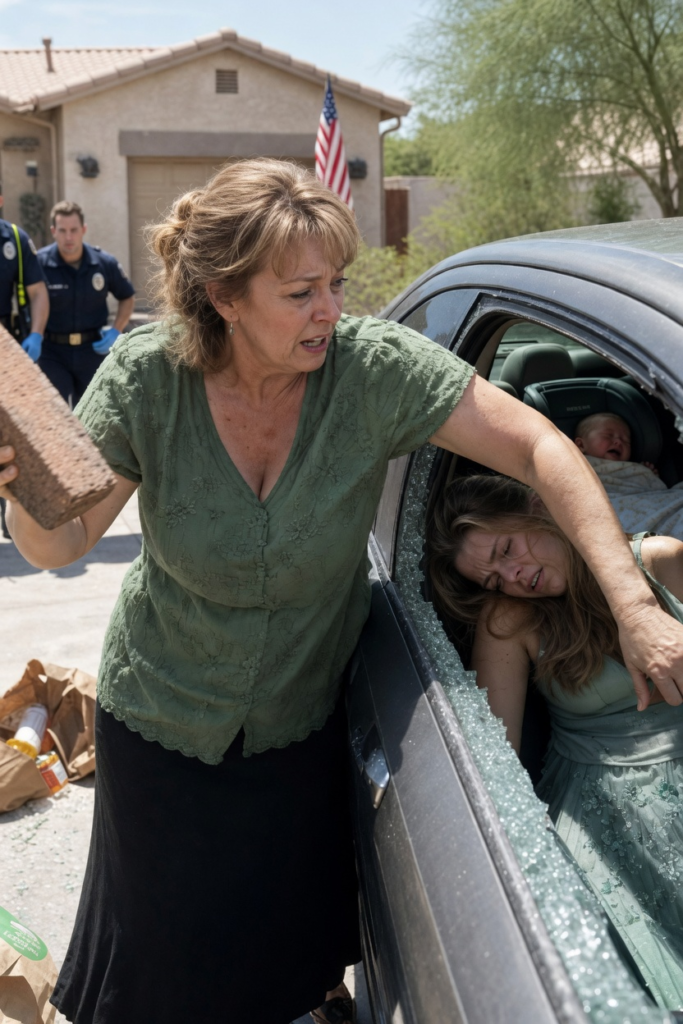
PART 2 — THE HOUSE WITH LOCKED DOORS
For a moment, I thought Detective Ruiz had misspoken.
Your husband’s.
The words did not fit inside the hospital waiting room. They did not belong beside the vending machine coffee, the vinyl chairs, the blinking nurse call lights, the smell of antiseptic and fear. They did not belong anywhere near Frank Bennett, who had driven Emily to swim lessons when she was seven, who had taught her how to check the oil in her first car, who had cried at her wedding even though he said later it was allergies.
“My husband’s what?” I asked.
Ruiz’s eyes held mine.
“His number,” she said. “The contact saved as ‘Mom’ in Denise Harrow’s phone is registered to Frank Bennett.”
“No.”
The word came out automatically. Not because I believed it. Because the body sometimes throws denial in front of truth the way a hand flies up before a blow.
Ruiz did not argue.
That frightened me more.
She only sat beside me, the evidence bag still in her hand, and lowered her voice until it barely rose above the machines beeping down the hallway.
“Mrs. Bennett, I need you to listen carefully. We are still confirming the full timeline. But we believe Denise Harrow was not acting alone.”
My fingers tightened around the arms of the chair.
Down the hall, through two sets of automatic doors, my daughter was unconscious under cooling blankets. My newborn granddaughter had an IV taped to an arm smaller than two of my fingers. And the man who had stood beside me while the paramedics loaded them into the ambulance had been part of the chain that led them there.
Frank.
My Frank.
No.
Not my Frank.
That correction arrived like ice water through the veins.
Not mine. Maybe never mine.
I looked toward the ICU doors. “Where is he?”
Ruiz followed my gaze. “In the lobby, speaking with an officer.”
“He came back?”
“He never left.”
A strange laugh escaped me.
Of course he had not left.
Frank had always understood the importance of staying where people could see him.
At church, he stayed after service to stack chairs. At neighborhood cookouts, he carried coolers. At Thanksgiving, he carved the turkey and let everyone say what a steady man he was. He was the kind of man other women pointed to when complaining about their husbands.
Frank helps Linda with the groceries.
Frank never raises his voice.
Frank is such a good grandfather.
The thought of his hands on Ava that morning made something inside me go sharp and animal.
I stood too fast.
Ruiz stood with me. “Mrs. Bennett.”
“I want to see him.”
“No.”
“I want to ask him what he did.”
“That is exactly why I cannot let you see him right now.”
“I am her mother.”
“And that is why I’m telling you not to give him anything he can use.”
The words stopped me.
Ruiz stepped closer. She was shorter than me, maybe forty, with dark hair pulled tight at the back of her neck and the stillness of someone who had seen too much human ugliness to be surprised by it.
“If Frank is involved,” she said, “he will be watching your face. He will ask what Emily said. He will ask what we found. He will try to measure what we know.”
My mouth went dry.
Because he had already done that.
When the ambulance doors closed, Frank had put his arm around me in the driveway and said, “Did Emily say anything? Linda, did she tell you what happened?”
At the time, I thought he was terrified.
Now I remembered the pressure of his hand on my shoulder.
Too tight.
Not comfort.
Control.
I pressed my palm against my stomach. “He asked me three times.”
Ruiz nodded once, as if another piece had clicked into place.
“What do you need me to do?” I whispered.
“Nothing alone. Nothing emotional in front of him. If he approaches you, you are shocked, confused, focused on Emily and Ava. You do not mention the phone. You do not mention the group text. You do not mention Denise’s note.”
“Can you arrest him?”
“Not yet.”
“Why not?”
“Because I want more than suspicion. I want something that survives court.”
Court.
The word felt obscene. Too clean. Too far away from the sound Ava had made when I lifted her from that car seat.
A thin, broken kitten sound.
I covered my mouth.
Ruiz’s face softened, but only slightly. “The best thing you can do for your daughter right now is stay steady.”
I almost laughed again.
Stay steady.
I had spent thirty-four years staying steady.
Steady while Frank forgot my birthday but remembered the church barbecue schedule. Steady when Emily called at midnight crying because Travis had punched a hole in the pantry door and then blamed her for standing too close. Steady when Denise Harrow told me a wife’s job was to help a man become better by not humiliating him with consequences. Steady when Frank said, “Maybe Emily just needs to stop provoking him.”
I had mistaken steady for strength.
Maybe sometimes it was only silence with good posture.
The ICU doors opened.
A young doctor stepped into the hall, mask hanging loose around his neck. His eyes moved over the waiting room until they found me.
“Mrs. Bennett?”
My knees weakened.
Ruiz touched my elbow.
I walked toward him.
“Emily is alive,” he said first.
That was how I knew the rest would be bad.
Alive, but.
Alive, however.
Alive, for now.
“She suffered severe heatstroke and dehydration,” he continued. “Her body temperature was extremely high when she arrived. We’ve brought it down, but we’re monitoring her kidneys, liver enzymes, and neurological response. She’s unconscious, but she has responded to pain stimulus.”
“Will she wake up?”
“We’re hopeful.”
Hopeful.
A hospital word that meant nothing and everything.
“And Ava?” I asked.
“Your granddaughter is stable. Dehydrated and overheated, but her temperature came down faster. Neonatal is watching her closely. Right now, there are no signs of seizures.”
Right now.
The room tilted.
I gripped the wall.
“Can I see them?”
“One at a time.”
I chose Ava first.
I hated myself for it for half a second, then stopped.
Emily would have chosen Ava too.
The neonatal observation room was dim and humming. Ava lay in a plastic bassinet under soft light, impossibly small, wrapped in a hospital blanket instead of the pink one Denise had used to hide her note. A tiny monitor hugged one foot. An IV was taped to her hand. Her mouth moved in her sleep, searching for milk, comfort, her mother.
I put my hand through the bassinet opening and touched one finger to her cheek.
She was warm.
Not burning.
Warm.
A sob rose from somewhere so deep it felt borrowed from every mother who had ever stood beside a bed unable to trade places.
“Hi, sweetheart,” I whispered. “Grandma’s here.”
Her eyelids fluttered.
That small movement nearly took me down.
A nurse adjusted the monitor and gave me a tired, kind smile. “She’s a fighter.”
“She’s twelve days old.”
“Sometimes they come out knowing.”
I looked at Ava’s tiny face.
No baby should have to be a fighter.
That was the first promise I made her after the car.
Not out loud. Not yet.
You will not have to earn safety.
When I left Ava and went to Emily, Frank was standing outside the ICU doors.
He wore the same blue polo from the morning. The collar had gone limp with sweat. His hair, silver at the temples, was slightly mussed, and he had a paper cup of coffee in one hand like a prop.
He saw me and his face rearranged itself.
Concern first.
Then relief.
Then wounded confusion because I did not immediately go to him.
“Linda,” he said, stepping forward. “How is she?”
I heard Ruiz’s warning.
He will be watching your face.
I made mine collapse the way it wanted to anyway, which was easy, because grief required no acting.
“She’s unconscious,” I said. “They don’t know yet.”
His eyes searched mine. “Did she wake at all?”
“No.”
“Did she say anything else before the ambulance?”
My skin crawled.
There it was.
The same question. Again.
I pressed both hands to my mouth and shook my head.
Frank exhaled through his nose. Too softly. Too carefully.
Then he reached for me.
I stepped back.
It was small. A half step.
His hand froze in the air.
For thirty-four years, I had let that hand rest wherever it wanted. Shoulder. Waist. Back of neck. At parties. In church. In parking lots. The affectionate claim of a husband people liked.
Now his fingers looked unfamiliar.
“Linda?”
“I’m covered in glass,” I said.
I was not, not anymore. A nurse had cleaned the worst of it from my arms. But there was enough dried blood near the bandage on my forearm for the lie to pass.
Frank lowered his hand.
His eyes moved to the bandage.
For one terrifying second, I thought he smiled.
Not with his mouth.
With relief.
As if my injury confirmed the version of events he preferred: frantic grandmother, broken window, tragedy discovered too late but not understood.
“Detective Ruiz said they found Denise’s car on video,” he said.
I kept my breathing slow.
“Did she?”
“They asked me if Denise had ever been to the house.”
“Had she?”
Frank blinked.
I had never answered his question with a question before.
Not like that.
He recovered quickly. “Once or twice. With Travis. Years ago.”
“You remember everything.”
He gave me a wounded look. “What is that supposed to mean?”
I looked through the ICU glass.
Emily lay pale and still beneath a web of tubes, cooling pads, and wires. My daughter, who had once refused to wear socks with seams because she said they made her toes angry. My daughter, who had painted yellow suns on every school art project for two years. My daughter, who had apologized to the nurses while in labor because she was “making too much noise.”
I looked back at Frank.
“It means I’m tired.”
That was true enough to fool him.
He softened. “I know. Come here.”
This time, when he tried to hug me, I let him.
I stood inside the circle of his arms and felt nothing but revulsion. His shirt smelled faintly of coffee and the cedar chips he spread in the side yard that morning. His heartbeat was steady against my cheek.
Mine was not.
Over his shoulder, Detective Ruiz watched from the end of the hall.
I closed my eyes and let my husband hold me, because my daughter needed evidence more than I needed disgust.
That night lasted a year.
Emily did not wake.
Ava cried weakly twice, then took formula from a nurse because Emily was in no condition to feed her. I sat between rooms, moving from daughter to granddaughter, granddaughter to daughter, carrying updates like water in cupped hands.
Frank stayed until midnight.
He performed beautifully.
He brought coffee I did not drink. He called our pastor. He told my sister in Tucson that Emily was “critical but stable,” a phrase he repeated with the solemn pride of someone entrusted with information. When a nurse mentioned police reports, he shook his head and said, “Families can become so broken.”
Families.
He used the word like he had not helped make mine bleed.
At 12:23 a.m., Ruiz returned with another detective, a tall man named Hanley, and asked Frank to come downstairs to answer more questions.
Frank looked at me.
“Will you be okay?”
I nodded.
He kissed my forehead.
I did not flinch.
That was my first victory.
The second was waiting until the elevator doors closed before I ran to the bathroom and vomited into a sink.
When I came out, Ruiz was waiting with a paper towel.
“I’m sorry,” she said.
It was not pity.
It was acknowledgment.
I took the towel. “Tell me.”
“Not here.”
She led me to a small family consultation room with a round table, three chairs, a tissue box, and a framed print of red rocks at sunset. The kind of room where hospitals placed people before changing their lives.
Ruiz closed the door.
“We have the first download from Denise’s phone,” she said. “It is not everything. But enough.”
I sat.
My hands were cold.
“Frank gave her the garage code,” Ruiz said.
I heard the air conditioner click on.
“She did not use it because Emily was already outside when she arrived. But he gave it to her.”
The room did not move, yet I felt myself falling.
“He also texted Denise when you left for Safeway.”
I closed my eyes.
My grocery list had been on the kitchen counter.
Milk. Bananas. Diapers. Rotisserie chicken. The ordinary inventory of a life before.
Ruiz slid a printed page across the table.
I did not want to read it.
I did.
Frank: Linda just pulled out. You have time.
Denise: She’ll listen if Linda isn’t there.
Travis: Don’t let her call cops. She’s been threatening.
Frank: Just scare her straight. No marks.
Denise: She needs to understand no one steals a Harrow baby.
Frank: Don’t be stupid. I said no marks.
I stared at the words until they separated from meaning.
No marks.
That was what Frank considered mercy.
No marks on skin.
No evidence for neighbors.
No bruise for church ladies to whisper over.
A baby in a boiling car apparently did not count as a mark until someone found her.
“There’s more,” Ruiz said.
I looked up.
“Frank had a financial connection to Travis.”
I laughed once. It cracked in the middle.
“No, he didn’t. Frank hated Travis.”
“Not enough to stop lending him money.”
“How much?”
“We have records indicating at least eighty-seven thousand dollars moved from your joint home equity line into accounts connected to Travis Harrow’s contracting business.”
My mind tried to reject the number.
Eighty-seven thousand.
I thought of Frank saying we needed to delay replacing the air conditioner because retirement required discipline. Frank saying we should not help Emily with a divorce attorney because she and Travis needed to “solve their own adult problems.” Frank telling me the bank statements were complicated because he had refinanced some old debt.
“Why?” I whispered.
“Travis’s business was failing. Frank appears to have invested quietly. We believe Emily found something.”
“She did,” I said.
The memory came so fast I almost missed its importance.
Emily at my kitchen table four days earlier, Ava asleep against her chest, her hair greasy from newborn exhaustion.
Mom, did Frank ever say anything about lending Travis money?
I had been folding laundry.
Frank? No. Why?
Nothing. I just saw something weird.
Then Ava cried. Then the conversation disappeared under diapers, bottles, and fatigue.
I gripped the edge of the table.
“She asked me about money.”
Ruiz leaned forward. “When?”
“Four days ago.”
“Did Frank hear?”
I thought back.
The kitchen door to the garage had opened. Frank had come in carrying a socket wrench, asking if anyone wanted iced tea. Emily had gone quiet.
“Yes,” I said. “I think he did.”
Ruiz nodded.
There are moments when grief becomes structure. When scattered horrors line up and point in one direction.
Frank had not only wanted Emily to stay married.
He needed her quiet.
If she divorced Travis, the financial records came out. If she filed for custody, abuse came out. If she talked to an attorney, Frank’s secret money came out. And if Linda Bennett knew her husband had emptied part of their home to prop up the man hurting their daughter, the marriage he had controlled so politely for thirty-four years would split open in daylight.
So he sent Denise when I left for groceries.
Just scare her straight.
No marks.
My daughter had nearly died because men like Frank and Travis believed consequences were something women invented to embarrass them.
“What happens now?” I asked.
“We keep him talking. We get warrants. We secure his phone, computers, financial records. We compare texts with Denise and Travis. And you do not confront him.”
“I want him out of my house.”
“He may not be going home tonight.”
Something in her voice made me look up.
“Are you arresting him?”
“Soon.”
“Soon is not a word I can live inside right now.”
Ruiz studied me.
Then she said, “We are waiting for one more piece.”
“What piece?”
“Emily.”
My throat closed.
“She may have heard something,” Ruiz said gently. “She may have seen more than we know. If she wakes, her statement matters.”
If.
I stood.
“I’m going back to my daughter.”
Ruiz opened the door for me.
Before I stepped into the hall, she said, “Mrs. Bennett.”
I turned.
“Frank did this. Denise did this. Travis did this. Not you.”
I hated that she knew I needed to hear it.
I hated more that I did not believe her yet.
At 4:38 a.m., Emily woke.
I had fallen asleep in the chair beside her bed, my hand around hers, forehead against the rail. A nurse was adjusting an IV when Emily made a sound so small I thought I dreamed it.
“Mom?”
My head snapped up.
Her eyes were half-open, unfocused, glassy with fever and medication.
“I’m here,” I said, standing so quickly the chair hit the wall. “Baby, I’m here.”
Her cracked lips moved.
“Where’s Ava?”
“She’s safe. She’s stable. She’s in neonatal. She’s safe.”
Emily’s face crumpled.
The monitor sped up.
The nurse moved to her other side. “Emily, try to stay calm. You’re in the hospital.”
Emily’s fingers tightened weakly around mine.
“Hot,” she whispered.
“I know.”
“Couldn’t get… door.”
The nurse looked at me.
I leaned closer.
“Don’t try to talk.”
But Emily was a mother now.
Mothers talk through pain when their children are on the other side of a question.
“Denise,” she breathed.
“I know.”
“Phone… she took it. Put it… under seat.”
I closed my eyes.
The nurse stepped toward the door. “I’m calling the doctor.”
Emily’s hand jerked.
“Frank.”
The name stopped my heart.
I bent over her.
“What about Frank?”
Her eyes rolled toward me, fighting sedation.
“Window,” she whispered.
“The car window?”
“No. House.”
For a second, I did not understand.
Then I did.
Our kitchen window faced the driveway.
Emily began to cry without tears. Her body was too dehydrated for them.
“He watched.”
The room changed shape.
The bed.
The machines.
The pale dawn gathering behind the blinds.
Everything became the driveway again: the heat, the glass, the oven breath rolling out of the car.
“He watched?” I asked.
Emily’s mouth trembled.
“Denise yelled. Ava crying. I screamed. I saw him. Kitchen window. He closed the blind.”
I made a sound I had never heard from myself.
Not a sob.
Not a scream.
Something older.
The nurse grabbed my shoulders.
“Mrs. Bennett, sit down.”
I did not sit.
I held my daughter’s hand while the doctor came in, while Emily drifted under again, while Ruiz was called, while a statement was taken in fragments between medical checks.
Frank had not only given the code.
He had not only sent Denise.
He had been home.
He had watched.
He had closed the blind.
By sunrise, they arrested my husband in the hospital parking garage.
I did not see it happen.
Ruiz told me afterward.
Frank had been walking toward the elevator with a Styrofoam cup of coffee and a paper bag containing two blueberry muffins. He seemed annoyed when Detective Hanley asked him to step aside. He asked if this could wait because his stepdaughter was in critical condition.
Stepdaughter.
He had not used that word in years.
Not since Emily was small and cried because someone at school said Frank was not her real dad. He had held her then and said, “Real is who shows up.”
At the arrest, he apparently returned to biology the moment love became evidence.
When Hanley told him he was being arrested for conspiracy, child endangerment, evidence tampering, and attempted second-degree murder pending review, Frank laughed.
That detail stayed with me.
He laughed.
Not because he thought it was funny, Ruiz said.
Because he thought it was impossible.
Men like Frank often mistake reputation for armor.
He asked for me once.
Ruiz said no.
By noon, they arrested Denise Harrow at her sister’s house in Tempe. She had packed two suitcases, a box of jewelry, and Ava’s first hospital photo stolen from Emily’s Facebook page and printed at Walgreens. She had placed it in her wallet behind a picture of Travis as a boy.
When police found her, she said, “I was trying to save my family.”
By evening, Travis was arrested outside a Scottsdale restaurant.
The blonde woman in the green dress was with him.
Her name was Carly Voss.
She was twenty-nine, worked as a real estate coordinator, and yes, she had been sleeping with my daughter’s husband. But when detectives separated them, Carly did something no one expected.
She told the truth fast.
Travis had been receiving texts throughout brunch. He was nervous, checking his phone, laughing too loudly. At one point, Carly heard him say to Denise over the phone, “She won’t leave once she knows how bad it can get.”
Carly thought they were talking about custody.
Then Travis received a text from Frank.
Carly remembered it because Travis smirked and said, “See? Even her own family knows she needs discipline.”
Discipline.
Another clean word people use when they do not want to say cruelty.
Carly gave detectives screenshots Travis had accidentally left visible when she photographed their cocktails for Instagram. She gave them the restaurant receipt, time-stamped. She gave them the name of the valet who saw Travis arguing on speakerphone near the entrance.
She did not become good because she told the truth.
But the truth became useful anyway.
Emily spent six days in the hospital.
The first two were frightening. Her kidneys struggled. Her fever rose again. She woke confused and panicked, asking for Ava, asking if she was still locked in, asking why the air was so hot when the room was cold.
Ava improved faster.
By the third day, I was allowed to hold her for more than a few minutes. She curled against my chest, lighter than a bag of flour, smelling of formula, hospital soap, and the faint sweet scent of newborn skin.
Emily watched from her bed as I carried Ava in.
Her face broke open.
“My baby,” she whispered.
I placed Ava in her arms with two nurses hovering.
Emily kissed Ava’s forehead over and over, murmuring apologies she did not owe.
“I’m sorry,” she cried. “I’m so sorry. I tried. I tried to get you out. I’m so sorry.”
I sat beside them and put my arms around both my girls.
“No,” I said into Emily’s hair. “Listen to me. You kept her alive until I got there. Do you hear me? You stayed awake as long as you could. You screamed. You fought. You kept her alive.”
Emily shook her head.
I held tighter.
It took many months for her to believe me.
Sometimes survival arrives long before forgiveness does.
On the fifth day, Emily told me everything she remembered.
Denise had come to the house at 2:07 p.m.
Emily had been in the driveway because Ava was fussy and sometimes the motion of the car seat calmed her. She had planned to drive to my friend Carol’s house for a half hour, just to sit somewhere Travis and Denise would not think to look.
Denise pulled in behind her, blocking the driveway.
She got out already crying.
That was the first trap.
Women like Denise knew tears could be weapons if they arrived before accusations.
She begged Emily to talk. Said Travis was falling apart. Said Ava needed her father. Said divorce would ruin everyone. Emily told her to leave.
Then Denise saw the diaper bag in the front seat.
She lunged for it.
Emily moved to stop her.
Denise shoved her.
Not hard enough to leave much of a bruise. Just enough. Emily was twelve days postpartum, sleep-deprived, still sore from labor, weak from blood loss she had not admitted was worse than the doctors expected.
She stumbled against the passenger door.
Denise grabbed Emily’s phone from her hand, hit airplane mode, and threw it under the seat.
Then she took Emily’s keys.
Emily managed to get Ava’s door open halfway, but Denise slammed it shut.
“Just sit there until you remember what family means,” Denise said.
Then she locked the car.
Emily screamed.
Ava screamed.
Denise stood outside crying and yelling through the glass. She said Emily had stolen her son’s child. She said a mother had rights. She said wives who broke homes deserved to feel what abandonment felt like.
Then Denise looked toward the kitchen window and shouted, “Frank, tell her!”
Emily turned.
Frank was standing inside the house.
At the window.
Watching.
Emily screamed his name.
He lifted one hand—not a wave, not help.
A command to calm down.
Then he closed the blind.
Denise stayed in the driveway for several more minutes, pacing and talking on the phone. Then she placed the note in Ava’s blanket through the cracked back window, as if leaving a curse, got in her car, and backed out.
Emily did not know how long she screamed after that.
At some point, her voice stopped working.
At some point, Ava’s cries became weaker.
At some point, Emily understood that the people outside the car did not intend to return in time.
So she used the last of her strength to loosen Ava’s straps as much as she could from the front seat, reaching backward until her shoulder felt like it tore. She managed to pull the shade down over Ava’s side window. She kicked at the door. She hit the glass with the heel of her hand until her skin split.
Then the world became white.
Then my voice.
Then the brick.
Then air.
When Emily finished telling it, she was shaking so hard the nurse came in.
I held her hand and looked at the floor.
There are kinds of anger that burn hot.
This was not one of them.
This was desert anger.
Dry. Vast. Patient enough to turn bones to dust.
Frank called me from jail on the seventh day.
I did not answer.
He called again.
And again.
Finally, Ruiz suggested I let the call go through with her and my attorney present, because Frank might say something useful.
My attorney.
I had one now.
Her name was Sonia Patel, a family lawyer recommended by Ruiz and hired by my sister before I even knew I needed hiring. Sonia was small, brisk, and allergic to nonsense. She arrived at the hospital carrying a tablet, two legal pads, and a cardigan despite the Arizona heat.
When I told her I was not ready to think about divorce, she said, “You do not have to be emotionally ready to become legally protected.”
I liked her immediately.
We took Frank’s call in the same consultation room where Ruiz had first told me about the texts.
The recording notification played.
Then Frank’s voice filled the little room.
“Linda?”
I looked at Ruiz.
She nodded.
“Yes.”
Frank exhaled. “Thank God. Honey, this is out of control.”
Honey.
The word disgusted me.
I said nothing.
“You know me,” he continued. “You know I would never hurt Emily or the baby.”
Ava.
He did not say Ava.
“Then why were you texting Denise?” I asked.
A pause.
Small.
Fatal.
“Because I was trying to calm things down.”
“By telling her when I left the house?”
“I didn’t know what she planned.”
“You gave her the garage code.”
“She said she wanted to talk.”
“You watched from the kitchen window.”
Silence.
Ruiz’s pen stopped moving.
Sonia lifted her eyes from the legal pad.
Frank’s voice changed when he spoke again.
Lower.
Harder.
“Emily was hysterical.”
There he was.
Not the man who stacked chairs at church.
The man beneath.
“She was locked in a hot car with her newborn.”
“She could have unlocked it.”
“She tried.”
“She always panics. You know that. She makes everything bigger.”
Something in me went calm.
“She almost died.”
“I didn’t know Denise took the keys.”
“You closed the blind.”
Another pause.
This time longer.
When he spoke, the softness was gone.
“I made one mistake.”
I laughed then.
I could not help it.
“One?”
“I was trying to keep this family from blowing apart.”
“No. You were trying to keep your money from showing.”
His silence told me Ruiz had been right.
I pressed the phone closer.
“How much did you give Travis?”
“Linda—”
“How much of our house did you hand to the man who hurt my daughter?”
“He had a business opportunity.”
“He had a pregnant wife at home and a girlfriend in Scottsdale.”
“You think I don’t know that?” Frank snapped. “You think I liked him? Travis is an idiot. But Emily was going to take him to court, and once lawyers started digging, everything would come out. Our finances. The loans. The fact that you signed papers you never read because you trusted me.”
Sonia’s face sharpened.
Frank realized too late what he had said.
The air in the room changed.
“Papers?” I asked.
He went quiet.
“What papers, Frank?”
“You’re twisting this.”
“No. I’m finally listening.”
His breath came rough through the line.
“You always picked Emily over our marriage.”
I stared at the phone.
“Our marriage?”
“Every time she cried, every time she ran home, every time she needed money, needed a room, needed someone to tell her she wasn’t the problem—you picked her.”
“She was my child.”
“She was grown.”
“She was being abused.”
“She chose him!”
The words cracked through the speaker.
Ruiz looked at me, steady.
Sonia wrote something down.
Frank lowered his voice, but the mask was gone now, lying in pieces around his feet.
“She chose him,” he repeated. “Just like you chose her. And I was supposed to keep paying for everyone’s choices.”
I thought of Emily at six years old, sitting on Frank’s shoulders at the Fourth of July parade.
I thought of him tying her shoelaces.
I thought of the day she called him Dad for the first time.
Real is who shows up.
What a cruel thing memory can be when it brings receipts.
“You should have let her come home,” I said.
“I did.”
“No. You let her come near the house. You never let her be safe in it.”
He made a sound of disgust. “You’re emotional.”
“Yes,” I said. “My daughter and granddaughter were nearly murdered. I have decided to be emotional.”
“Linda, listen to me. Do not let some detective turn you against me. We can handle this privately. I can explain. I can fix the money. I can talk to the prosecutor. Denise is the one who went crazy. Travis is the one who—”
“You watched.”
Silence.
“That is the part I will carry,” I said. “Not the money. Not the lies. Not even the texts. You stood inside my house, behind my window, and watched my daughter scream for help.”
Frank’s breathing filled the room.
Then he said, very softly, “She was never really mine.”
The sentence entered me like a blade.
For one second, I could not speak.
Then I understood something so clearly it felt like mercy.
There was no husband left to grieve.
Only evidence of one who had never existed the way I loved him.
I leaned toward the phone.
“And now neither am I.”
I ended the call.
Sonia reached over and squeezed my hand once.
Ruiz looked almost satisfied.
“He gave us the papers,” she said.
Frank had been right about one thing.
I had signed documents I did not read.
Not because I was stupid. Not because I was careless. Because marriage, at least the kind I thought I had, was built on small acts of trust repeated until they became invisible.
He had brought me forms over breakfast.
Refinancing.
Insurance adjustment.
Retirement planning.
Just sign here, Lin. I already talked to the bank.
I signed because I was making Emily toast after a bad night. I signed because Ava’s baby shower needed planning. I signed because thirty-four years of sleeping beside someone makes suspicion feel rude.
Within a week, Sonia and a forensic accountant found the full damage.
Frank had taken out a home equity line.
He had moved money through a consulting LLC tied to Travis.
Travis had used some of it to cover business debt, some to lease a truck, some on hotels, jewelry, and restaurants with Carly.
Denise knew enough to fear discovery.
Frank knew enough to fear divorce court.
Travis knew enough to keep smiling until someone else did the dirty work.
They had not planned, perhaps, for Emily and Ava to die.
That was what Frank’s attorney later argued.
They planned intimidation, not murder.
They planned fear, not death.
They planned a lesson.
But Arizona heat does not care about intentions.
Cars become ovens.
Babies cannot regulate temperature.
Postpartum women faint.
And evil does not become less evil because it hoped to stop short of a funeral.
The preliminary hearing happened in September.
By then, Emily could walk without dizziness most days. Ava had gained weight and developed a furious cry that made nurses smile and strangers wince. The neurologist said her scans looked good. There would be follow-ups, always, because medicine does not hand out miracles without footnotes. But she was alive, alert, hungry, and personally offended by every bath.
Emily filed for divorce from Travis.
Emergency custody was granted immediately.
Travis’s attorney tried to request supervised visitation.
The judge read the police report, removed his glasses, and said, “Counsel, your client is accused of conspiring in the heat-related near-death of this infant. Choose your next sentence carefully.”
There was no visitation.
At the preliminary hearing, I sat between Emily and Sonia. Ava was with my sister in the hallway, far from cameras, far from the people who treated her life like a legal argument.
Denise looked smaller in jail clothes.
That surprised me.
In my memory, she was enormous. A storm of perfume, opinions, and ownership. The kind of woman who called Ava “my baby” before Emily had even left the hospital after giving birth.
But at the defense table, she was only a woman with gray roots and trembling hands, searching the courtroom for sympathy she had spent years denying others.
Travis would not look at Emily.
Frank looked only at me.
He had aged badly in two months. Or maybe I was finally seeing his face without the soft lighting of habit. His mouth had a mean set. His eyes were restless, not with guilt but calculation.
When prosecutors played the neighbor’s security footage, the courtroom went silent.
There was Denise’s silver SUV pulling in.
There was Emily standing beside her car, one hand on the roof, Ava’s carrier visible through the back window.
There was Denise advancing.
No audio, but body language can scream.
Emily stepping back.
Denise grabbing.
The passenger door opening.
A struggle.
Then Denise standing outside the locked car, pointing, yelling.
Emily pounding the glass.
Then the kitchen window.
Our kitchen window.
The blind moved.
For three seconds, Frank’s face appeared between the slats.
Then the blind closed.
Emily made a sound beside me.
I put my arm around her.
The prosecutor froze the image.
Frank’s face behind glass.
Not confused.
Not frightened.
Watching.
That photograph became the center of the case.
The newspapers used it. Television used it. People at church stopped saying there must be another side.
Some images are so plain they leave cowardice nowhere to stand.
Then came the call recording.
Frank’s voice filled the courtroom.
She was never really mine.
Emily went rigid.
I whispered, “Don’t take that in.”
But of course she did.
Children collect rejection even when it is thrown at their mothers.
Emily stood suddenly.
The judge looked over.
“Mrs. Harrow?”
Her new name was still legally Harrow then, though not for long.
Emily’s voice shook. “May I step out?”
The judge allowed it.
I followed her into the hall.
She made it three steps before folding against the wall.
I caught her.
“I called him Dad,” she said.
“I know.”
“I called him Dad for twenty-eight years.”
“I know.”
“He hated me.”
“No.”
She looked at me, furious. “Mom.”
“No,” I said again, stronger. “Listen to me. He used you. He resented you. He failed you so badly there may not be language big enough for it. But do not call that hate and make it bigger than you. Hate requires seeing someone clearly. Frank never saw you. He saw cost. He saw inconvenience. He saw a woman who would not stay where he put her. That is not your identity. That is his sickness.”
Emily sobbed into my shoulder.
“I should have left Travis sooner.”
“No.”
“I should have told you everything.”
“No.”
“I should have protected Ava.”
I held her face in both hands.
“You did. You are still doing it.”
Her eyes were red, exhausted, alive.
“Ava will know the truth,” I said. “Not the cruel version. Not the shame version. The real one. That her mother fought to get her out. That her grandmother came home in time. That terrible people tried to make fear look like family, and they failed.”
Emily closed her eyes.
From down the hall, Ava began to cry.
A furious, healthy wail.
Emily laughed through tears.
“That child has opinions.”
“She comes by it honestly.”
For the first time since the driveway, my daughter smiled.
Not fully.
Not healed.
But real.
The trial did not happen the way television teaches you trials happen.
There was no single confession shouted from the stand. No dramatic collapse. No one leapt up and admitted everything while the gallery gasped.
Real justice was slower.
It was motions, delays, lab reports, phone extractions, financial subpoenas, witness statements, plea negotiations, victim impact drafts written and rewritten at kitchen tables after midnight.
Denise pleaded first.
Her attorney tried to argue she had suffered a “grandmaternal emotional break.” The prosecutor responded by reading aloud the note she had tucked into Ava’s blanket.
If you won’t let my son have his family, then none of you deserve peace.
Denise accepted a plea to kidnapping, aggravated assault, and child abuse, with a sentencing range that meant she would likely die old and watched.
Travis held out longer.
He seemed to believe charm was a legal strategy.
Then Carly testified before the grand jury, and his business records opened like a sewer.
Fraud.
Coercive control.
Threatening texts.
Photos Emily had hidden in a cloud folder under the name “recipes.”
There were no recipes.
There were bruises.
A broken pantry door.
A video of Travis blocking Emily from leaving a bedroom while she was pregnant, saying, “You don’t get to take my kid and make me look bad.”
He pleaded after that.
Frank went to trial.
Of course he did.
Frank Bennett believed until the end that twelve people could be made to see him the way church committees had seen him: steady, reasonable, unfortunate.
His attorney painted him as a loving grandfather who made a terrible judgment call. A man trying to mediate between two distressed families. A man who did not understand how quickly heat could become fatal.
The prosecutor stood before the jury and said, “This case is not about one bad decision. It is about a locked car, a closed blind, and a man who believed his reputation mattered more than two lives.”
They played the footage again.
They played the call.
They showed the texts.
They showed the financial transfers.
They showed a screenshot from Frank to Denise sent at 2:16 p.m., after Emily had already been locked in the car.
Frank: Don’t stay too long. Linda gets back around 4.
Not call 911.
Not let them out.
Not stop.
Don’t stay too long.
Linda gets back around 4.
The jury deliberated for less than five hours.
Guilty.
Conspiracy.
Aggravated child abuse.
Vulnerable adult abuse.
Reckless endangerment.
Financial fraud.
Evidence tampering.
The attempted murder charge did not stick the way I wanted. The prosecutor warned us it might not. Intent is a narrow door, and the law sometimes refuses to walk through with grief.
But guilty was still guilty.
When sentencing came, Emily read her statement first.
She stood at the podium in a navy dress, Ava’s tiny gold bracelet around her wrist because Ava had outgrown it. Her voice shook only once.
“You all called it family,” she said, looking at Travis, Denise, and Frank one at a time. “Every time I tried to leave, someone told me to think of family. Family reputation. Family unity. Family forgiveness. But family is not a cage. Family is not a man’s comfort. Family is not a grandmother’s ownership. Family is not a locked door in July.”
Denise cried.
Emily did not look away.
“My daughter will grow up knowing that love opens doors. If someone uses love to close one, she will know to run.”
Then I spoke.
I had written six versions.
The one I read was short.
“My name is Linda Bennett. For thirty-four years, I believed I was married to a good man because he was calm in public. I know now calm is not character. Helpfulness is not goodness. Reputation is not innocence.”
Frank stared at the table.
I continued.
“I broke a car window with a landscaping brick and pulled my daughter and granddaughter out of heat that could have killed them. But the truth is, that car was not the first locked place my daughter escaped. It was only the one everyone could see.”
The courtroom was silent.
I looked at Frank.
“You told me Emily was never really yours. You were wrong. Children belong to the people who protect them. By that measure, you were never really hers.”
His jaw tightened.
Good.
I turned to the judge.
“I am not asking for revenge. Revenge would still make them the center of our lives. I am asking for time. Time long enough for my granddaughter to grow up without seeing these people at school plays. Time long enough for my daughter to sleep without wondering who has keys. Time long enough for the rest of us to learn what safety feels like.”
The judge sentenced Denise to twenty-six years.
Travis to nineteen.
Frank to twenty-two, plus restitution.
Not forever.
But long enough.
Long enough for Ava to become a young woman before any of them could stand near her without permission.
Long enough for Emily to rebuild.
Long enough for me to stop listening for Frank’s truck in the driveway.
After sentencing, Frank asked to speak to me.
Sonia said I did not have to.
Ruiz, who had come to the hearing even though the case no longer required her presence, said nothing.
Emily looked at me. “Mom?”
“I’ll be all right.”
They brought Frank into a small side room in handcuffs.
No glass between us.
Just a table.
A guard stood by the door.
Frank looked smaller in jail orange, but not humbled. That was something I had learned: consequences and remorse are not twins. Sometimes consequences arrive alone.
“Linda,” he said.
I sat across from him.
He tried the old voice first. The one he used when explaining a repair bill or apologizing for being short with a waiter.
“I don’t want this to be the last conversation we have.”
“It might be.”
Pain flickered across his face, but I no longer trusted pain as proof of goodness.
“I made mistakes,” he said.
“Yes.”
“I never wanted the baby hurt.”
“You never wanted to be caught.”
His mouth tightened.
There.
The real Frank, peeking through.
“You’re going to let Emily poison you forever?”
I almost smiled.
Even now.
Even here.
Still trying to put the lock back on the door.
“No,” I said. “Emily did not poison me. She woke me up.”
He leaned forward as far as the cuffs allowed. “You think you can start over at your age?”
There it was.
The question beneath all his control.
Who are you without the life I let you have?
I looked at his hands.
Those hands had held mine at an altar. Signed secret papers. Texted Denise. Closed a blind.
Then I looked at my own.
Scar across the forearm from the broken window.
Still healing.
Still mine.
“Yes,” I said.
Frank laughed bitterly. “With what money?”
“The house is being sold. The court froze what you stole. Sonia is very good.”
His eyes darkened.
“You always did need someone to handle things.”
“No,” I said, standing. “I needed to stop letting the wrong person handle them.”
The guard opened the door.
Frank’s voice followed me.
“Linda.”
I turned once.
For a moment, I saw the man I had loved, or the man I had built from gestures, habit, and hope. The version of him who danced with me in the kitchen during a thunderstorm. The version who bought Emily a bike. The version who rocked Ava that morning with murder already moving through his phone.
Memory is cruel because it does not erase the good when the truth arrives.
It makes you carry both.
“I did love you,” he said.
Maybe he meant it.
Maybe he loved me the way some men love houses: for shelter, service, and resale value.
I answered honestly.
“I loved who I thought you were.”
Then I left him there.
The divorce was finalized in May.
I kept my name for exactly three weeks afterward, mostly because paperwork exhausted me.
Then one morning, I woke before sunrise, made coffee, and filled out the forms to return to my maiden name.
Linda Reyes.
I said it aloud in the kitchen of my new rental house.
Small kitchen. Yellow curtains. No garage code. No husband’s boots by the door. No hidden financial files in locked drawers.
Linda Reyes.
It sounded like someone opening a window.
Emily and Ava moved in with me after the hospital and stayed through the trial. At first, Emily apologized for every sound Ava made. Every bottle in the sink. Every night she cried. Abuse had trained my daughter to treat existence as an inconvenience.
So I made rules.
Not many.
Just important ones.
No apologizing for babies.
No explaining tears.
No asking permission to eat the last piece of toast.
No saying “I’m fine” when the truth is “I’m scared.”
We broke all those rules constantly.
Then we started again.
Healing was not graceful.
Emily had nightmares about car doors. I had nightmares about blinds closing. Ava cried whenever the car stopped moving, and for months Emily could not sit in a parked vehicle without shaking.
So we practiced.
At first, the car stayed in the driveway with all four doors open and the engine running. Emily sat in the driver’s seat while I stood outside holding Ava.
One minute.
Then two.
Then five.
Then we drove around the block.
Then to the pediatrician.
Then to the park.
Each time, Emily checked the locks, the windows, the temperature, the keys, Ava’s straps. Each time, she breathed through panic. Each time, she came back.
People talk about bravery as if it is one dramatic act.
Sometimes bravery is sitting in a parked Honda with your mother counting backward from fifty while your baby chews on a giraffe toy.
By Ava’s first birthday, Emily could drive herself to work.
She had a job at a domestic violence resource center in Mesa. Part-time at first. Then full-time. She helped women build safety plans, collect documents, open bank accounts, photograph injuries, believe themselves.
Some nights she came home furious.
Some nights quiet.
Once, she sat at the kitchen table after Ava went to bed and said, “I understand now why I stayed.”
I dried a plate and waited.
“Not because I was weak,” she said.
“No.”
“Because leaving is not a door. It’s a hallway full of people trying to push you back.”
I sat across from her.
“Yes.”
She looked at me.
“I’m glad you were at the end of it.”
I reached for her hand.
“I wish I had been closer sooner.”
Emily squeezed my fingers.
“You came home.”
Those three words became our family scripture.
Not because they erased what happened.
Because they told the part that saved us.
I came home.
I found them.
I broke the glass.
On Ava’s first birthday, we held the party in my backyard.
Not Frank’s backyard.
Mine.
The house was small and stucco, with a desert willow out front and a back patio shaded by a canvas sail. The summer heat had returned, fierce and white, but we had misters along the fence, tubs of ice, lemonade, and a strict rule that no child, adult, balloon, or cupcake stayed outside longer than comfort allowed.
Safety became celebration.
Carol from church came. So did my sister from Tucson. Detective Ruiz came too, out of uniform, carrying a stuffed rabbit and looking uncomfortable with affection. Sonia came with a cake shaped like a sun, which made Emily and me stare at her until she said, “Too soon?”
Then Emily laughed.
Really laughed.
And just like that, the sun became ours again.
Ava wore a yellow dress and smashed cake into her hair with the solemn focus of a scientist. She had three teeth, strong lungs, and a habit of pointing imperiously at whatever she wanted. When she grew tired, Emily lifted her from the high chair and held her close.
For a moment, I saw them as they had been in the car.
Heat.
Glass.
Stillness.
Then Ava grabbed Emily’s necklace and shrieked with joy.
The memory loosened.
Not gone.
But forced to share space with now.
After cake, Emily stood near the patio door and tapped a spoon against her glass.
“Mom,” she said.
“Oh no.”
“Oh yes.”
Everyone turned toward me.
I hated speeches.
Apparently, the people I loved had decided this was a character flaw worth challenging.
Emily held Ava on her hip. My granddaughter had frosting in one eyebrow.
“I just want to say something,” Emily said.
Her voice was steady.
“A year ago, I thought my life was over. Not just because of what happened in the car. Before that. I thought I had ruined everything by marrying the wrong person, staying too long, hiding too much, needing too much.”
She looked at me.
“My mom never once asked why I didn’t leave sooner. She never once made me earn my way home. She just opened the door. And when the door wasn’t enough, she broke a window.”
People laughed softly.
I cried immediately, which felt unfair.
Emily smiled through her own tears.
“So today is Ava’s birthday, but it is also the birthday of the life we got after. The life where no one owns us. The life where love does not lock doors. The life where we come home to people who believe us.”
She raised her lemonade.
“To coming home.”
Everyone lifted a glass.
“To coming home.”
Ava slapped both hands into the remains of her cake and yelled, “Ma!”
It was not clear whether she meant Emily, me, more cake, or the universe in general.
We accepted it as a blessing.
That evening, after everyone left, I sat alone on the patio.
The heat had softened. The sky over Mesa was streaked pink and gold, the mountains darkening at the edges. Inside, Emily was giving Ava a bath, and I could hear splashing, laughter, the ordinary music of safe rooms.
My forearm scar had faded to a pale line.
I ran one finger over it.
For months, I thought of that scar as the mark the day left on me.
Now I understood it differently.
It was the place I opened.
The place where glass gave way.
The place where my old life ended loudly enough that I could not pretend I had not heard it.
My phone buzzed.
A notification from the prison system.
Frank had sent a message.
I looked at the screen for a long moment.
Then I deleted it unread.
Not because I was afraid.
Because peace, I had learned, is sometimes a locked door too.
The difference is who holds the key.
Inside the house, Emily called, “Mom? Ava wants you.”
I stood.
Through the patio glass, I saw my daughter kneeling beside the tub, hair falling loose, sleeves wet, smiling at her child. Ava saw me and reached both dripping arms in my direction.
There were still court dates ahead for restitution.
Still therapy appointments.
Still nights when Emily woke gasping.
Still days when I found myself reaching for a wedding ring no longer there.
But the ending was clear.
Denise could not reach us.
Travis could not claim them.
Frank could not close another blind in my house.
Emily was free.
Ava was safe.
And I was no longer living inside a life built by someone else’s lies.
I opened the patio door and stepped into the warm, bright noise of my family.
This time, every door stayed open.