Your father does not drive like a man going to retrieve clothes.
He drives like a man going back to a crime scene.
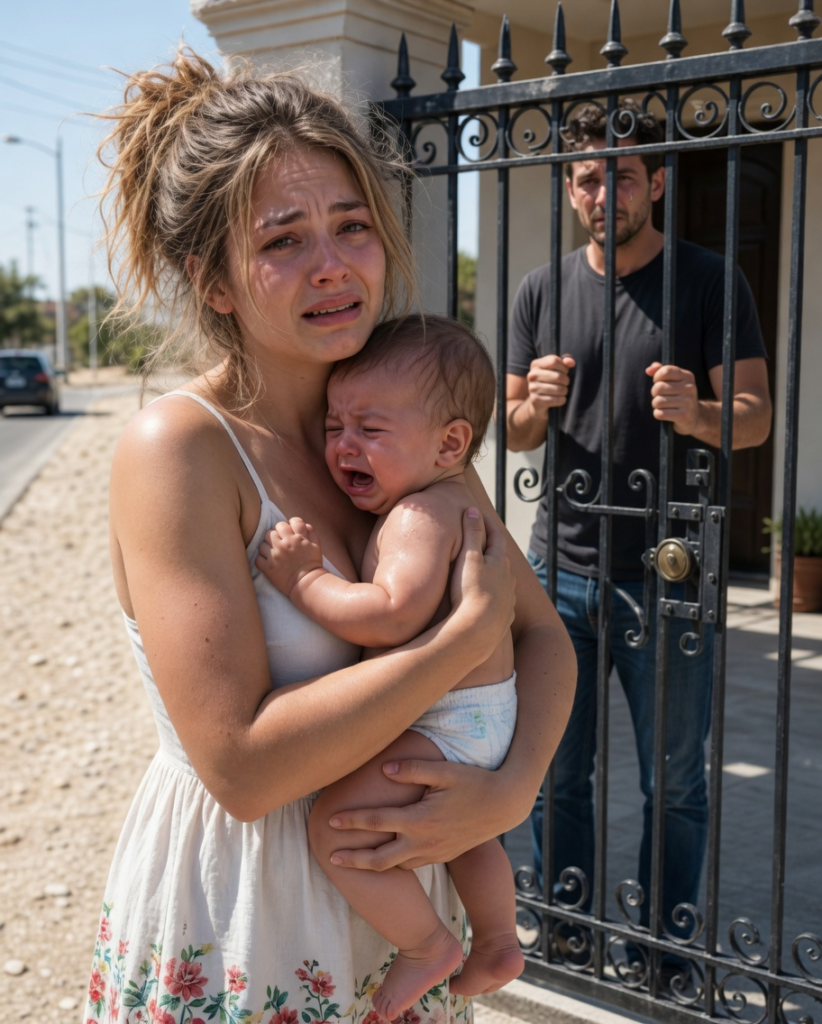
You sit in the passenger seat with Mateo strapped safely behind you, his little cheeks still flushed from the heat. The air conditioner blows cold against your face, but your hands keep shaking in your lap. You keep seeing Alejandro’s face behind the electric gate, calm and certain, as if locking you outside with your baby was just another household decision.
Your father’s jaw is clenched so tightly you can see the muscle moving.
“Dad,” you whisper, “what if he doesn’t let us in?”
Roberto Hernández glances at you once. His eyes are dark, steady, and terrifyingly calm.
“Then he explains that to the police.”
“But he’ll say I’m unstable.”
“He can say the Virgin Mary signed the deed to the moon,” your father says. “Words are cheap. Evidence is not.”
You swallow.
Evidence.
For six months, Alejandro and Carmen had turned your life into something you could not explain without sounding dramatic. They did not hit you. They did not scream every day. They smiled when neighbors visited. Carmen brought soup. Alejandro paid bills. From the outside, it looked like care.
Inside, it felt like slowly disappearing.
You reach back and touch Mateo’s foot. He has finally stopped crying. His tiny sock is damp with sweat.
Your father notices.
His voice softens, but only for you.
“He will never do that to you again.”
You want to believe him.
But fear has lived in your body too long to leave just because someone opens a truck door.
When you arrive, the electric gate is closed.
The house sits behind it in the late afternoon light, beautiful and cruel. White walls, bougainvillea over the side fence, the nursery window half-open upstairs. You remember choosing that crib. Folding tiny clothes. Imagining a home where your son would learn to walk safely.
Now the place looks like a mouth that swallowed you and kept your name.
Your father parks directly in front of the gate and gets out.
You stay inside with Mateo.
A camera above the entrance shifts toward him.
Your father looks straight at it.
“Open the gate, Alejandro.”
No answer.
He presses the intercom.
A crackle.
Then Carmen’s voice, sweet as poisoned honey.
“Roberto, what a surprise. Valeria is very upset right now. It’s better if everyone calms down.”
Your father does not blink.
“Open the gate.”
“Please don’t make a scene. The child needs stability.”
“The child needed water and shade twenty minutes ago when your son locked him on the road.”
A pause.
Then Alejandro’s voice cuts in.
“Don Roberto, with respect, this is a marital issue.”
Your father leans closer to the intercom.
“With respect, I found my daughter walking on gravel beside the freeway with no keys, no money, no phone access, and your son in her arms crying from heat. That stopped being marital the second it became criminal.”
Silence.
You close your eyes.
Criminal.
The word makes your stomach twist. Not because it is wrong. Because part of you still wants to protect Alejandro from it.
That part embarrasses you.
Your father presses again.
“You have ten seconds to open this gate before I call patrol units here and request entry based on domestic confinement, financial control, child endangerment, and unlawful retention of personal property.”
The gate buzzes.
It slides open.
Your father returns to the truck. “Stay behind me. If I tell you to get in the truck, you get in. No arguing.”
You nod.
He looks at you more gently.
“You are not going in there to negotiate your life. You are going in to collect your things.”
That sentence becomes an anchor.
You are not negotiating your life.
You carry Mateo because you cannot bear letting him out of your arms. Your father walks beside you, one hand near his belt out of habit, though he has been retired for years. He no longer wears a badge, but somehow the air remembers he once did.
Alejandro opens the front door before you reach it.
He looks polished. Too polished. White shirt, sleeves rolled, face arranged into concern. Carmen stands behind him with folded hands and soft eyes, the way she looks at church when pretending to pray for people she gossips about.
“Valeria,” Alejandro says, “you scared us.”
You almost laugh.
Your father answers before you can.
“She was outside your gate.”
Alejandro looks pained. “She walked out in one of her episodes.”
There it is.
One of her episodes.
The phrase is so smooth, so practiced, that for a second you feel dizzy. You wonder if maybe you did walk out. Maybe you misunderstood. Maybe you are tired, emotional, confused.
Then Mateo whimpers and buries his sweaty face against your neck.
No.
You remember the gate closing.
You remember Alejandro saying, my son doesn’t move from this house.
You remember Carmen’s coffee cup.
“I didn’t have an episode,” you say.
Your voice shakes, but it exists.
Alejandro’s eyes sharpen.
Carmen steps forward. “Mija, you’re overwhelmed. Nobody is blaming you.”
Your father turns to her. “Stop.”
Carmen freezes.
That is the first time you have ever seen someone cut off her sweetness before it wraps around the room.
Roberto continues, “My daughter is here to get documents, clothes, the baby’s things, her keys, her phone, and anything else that belongs to her. You will not interrupt. You will not follow her alone. You will not touch her.”
Alejandro’s mouth tightens.
“This is my house too.”
Your father looks at him.
“Then behave like a man who knows witnesses are present.”
Something flickers in Alejandro’s eyes.
Fear.
Small, fast, but real.
You step inside.
The house smells like Carmen’s cinnamon candles. That smell makes your skin crawl now. It used to mean she had cleaned while you napped. Later you learned it meant she had been in every room, opening drawers, moving bottles, deciding what a mother should be allowed to keep.
Your father follows you upstairs.
Alejandro and Carmen stay downstairs at first, whispering.
You go to the bedroom and open the closet.
Half your clothes are gone.
Not all. Not enough to be obvious to a visitor. But your jeans, your comfortable bras, your work blouses, your old sneakers—the clothes you actually used—are missing. In their place are dresses Carmen liked, stiff and modest, things she said made you look “more settled.”
You stare at the empty hangers.
Your father sees them.
“Take photos,” he says.
Your hands fumble with your phone.
Then you remember Alejandro has it.
Your father silently hands you his.
You photograph everything.
Drawer. Closet. Missing wallet. Empty space where your laptop used to be. Jewelry box with your mother’s earrings gone. The safe where you kept Mateo’s birth certificate—locked, code changed.
Your breath starts to speed up.
Your father notices immediately.
“Valeria.”
You look at him.
“In through the nose. Out slowly. You are safe.”
You nod, but tears burn your eyes.
“I didn’t know it was this bad.”
He looks around the room.
“I think you did,” he says quietly. “You just weren’t ready to call it by its name.”
You pack what remains into a suitcase your father finds under the bed. Baby clothes. Diapers. Blankets. Your medical records from pregnancy. A few photographs. Your grandmother’s rosary from the bedside drawer.
Then you go to Mateo’s nursery.
Carmen has rearranged it.
Of course she has.
The crib faces the wrong wall. The rocking chair is gone. Your breastfeeding pillow is missing. On the dresser is a framed photo of Alejandro holding Mateo, Carmen beside him, you cropped out so neatly that only the edge of your sleeve remains.
Your throat closes.
Your father picks up the frame.
Looks at it.
Sets it face down.
“Pack his things.”
You do.
You pack with one hand while holding Mateo with the other, because every time you try to place him in the crib, panic rises in your throat. Your father does not tell you to calm down. He simply holds the diaper bag open.
Then you hear voices downstairs.
Alejandro, angry now.
“She can’t just leave with him.”
Carmen replies in a whisper you can still hear.
“Let her take some things. We’ll get the boy legally. She looks unstable enough.”
Your father stops moving.
Slowly, he turns his head toward the hallway.
You feel cold.
“What did she say?” you whisper.
Your father does not answer.
He steps out of the nursery and looks down the stairs.
“Carmen,” he calls, “repeat that.”
Silence.
Then Carmen’s voice, higher now. “I didn’t say anything.”
Your father looks back at you.
“Keep packing.”
You do, but your hands are clumsy now.
Legal.
Get the boy legally.
Unstable enough.
The words move through you like insects.
You open the bottom drawer of Mateo’s dresser, looking for his vaccination booklet. Instead, you find the drawer oddly shallow. You frown, push the clothes aside, and press the bottom.
It shifts.
A false bottom.
Your heart stops.
You lift it.
Underneath is a blue folder.
Not yours.
Not something you have ever seen before.
On the tab, in Carmen’s neat handwriting, are the words:
VALERIA – CASE FILE
For a second, you cannot breathe.
Your father appears in the doorway, as if your silence called him.
“What is it?”
You lift the folder.
His face changes.
He closes the nursery door and locks it.
“Sit down,” he says.
You sit in the rocking chair that is no longer there, so instead you sink onto the floor with Mateo in your lap. Your father opens the folder.
The first page is a printed document from a private psychiatric clinic.
Your name is at the top.
Diagnosis: postpartum psychosis with paranoid episodes.
You have never been to that clinic.
Your father flips to the next page.
A letter, supposedly from a doctor, recommending temporary removal of the child from your care due to risk of harm.
Another page.
A draft custody petition.
Another.
Screenshots of your messages to Alejandro, but cropped. Only the desperate parts remain.
Please give me my keys.
I feel trapped.
Why did you change my password?
Without context, they make you look frantic.
There are handwritten notes in Carmen’s writing:
Emphasize crying.
Mention she talks about being watched.
Get neighbor to say she screams at night.
Ask Dr. Molina to backdate.
Your father goes very still.
Then he finds a printed email.
From Fernanda Méndez, Alejandro’s cousin, who works in family court administration.
If you can get a psychiatric note and two witnesses, we can push emergency custody. The judge on duty next month is favorable if the mother appears unstable. Make sure she has no direct access to bank accounts. Financial dependence helps prove incapacity.
Your mouth opens.
No sound comes out.
Your father reads it twice.
Then he says a word you have only heard from him once before, when a drunk driver killed a child on his watch.
“Bastards.”
Mateo stirs in your arms.
You clutch him closer.
“They were planning this,” you whisper.
Your father looks at you, and his face is no longer only angry.
It is broken.
“Yes.”
“They wanted me to look crazy.”
“Yes.”
“They took my keys, my phone, my money…”
“To create the evidence they needed.”
The room tilts.
You feel suddenly outside your own body, watching a version of yourself sitting on the nursery floor with a baby in her arms while the people downstairs discuss stealing him.
Your father places the folder inside his jacket.
“We’re leaving now.”
“My things—”
“Now, Valeria.”
He opens the nursery door.
Alejandro is standing outside.
Too close.
His face is pale.
“What are you doing in there?”
Your father steps between you and him.
“Moving.”
Alejandro’s eyes flick to your father’s jacket.
“What did you take?”
Your father smiles.
It is a terrible smile.
“The wrong thing to hide.”
Alejandro lunges.
Not at you.
At the jacket.
Your father catches his wrist so fast Alejandro gasps. For one second, you see Roberto Hernández, former commander, not your father. He twists Alejandro’s arm behind his back and pins him against the hallway wall with controlled, humiliating ease.
Carmen screams from downstairs.
“Don’t hurt my son!”
Your father leans close to Alejandro’s ear.
“You locked my daughter outside with a baby in this heat. You planned to frame her as insane. You were about to take my grandson. If I wanted to hurt your son, Carmen, he would already be on the floor.”
Alejandro breathes hard, face pressed to the wall.
Your father releases him with a shove.
“Valeria. Go.”
You move.
Downstairs, Carmen blocks the front door.
Her sweetness is gone now. Her eyes are wild.
“You are not taking Mateo.”
Your father’s voice is quiet.
“Move.”
“He is my grandson.”
“He is her son.”
“She’s sick!”
You clutch Mateo tighter.
Carmen points at you. “Look at her! She can’t even speak. She cries all day. She forgets things. She thinks we’re against her.”
“You are against her,” your father says.
Carmen turns red. “I have protected that child since he was born.”
“No,” you say.
Everyone looks at you.
Your voice comes out thin at first, then stronger.
“You protected your control.”
Carmen’s mouth opens.
You step forward.
For six months, she has told you when to feed your son, when to sleep, when to shower, when you were too emotional, too sensitive, too tired to think. For six months, she has wrapped your cage in soup and called it help.
Now you look her in the eyes.
“You will never use my baby to make me disappear.”
Carmen raises her hand.
Your father moves.
So does Alejandro.
For one stupid second, Alejandro actually tries to catch his mother’s wrist before she can slap you.
Too late for redemption.
But not too late to reveal that even he knows what she is.
The slap never lands.
Your father’s phone is already in his hand.
“This is Roberto Hernández,” he says into the call. “Former commander, badge number 4187. I need units at my daughter’s residence in Coyoacán. Domestic coercion, unlawful retention, child endangerment, suspected falsified medical documents, and attempted custody fraud. Yes. I am on scene.”
Carmen lowers her hand.
Alejandro whispers, “Don Roberto, please.”
Your father looks at him.
“That word should have been used when my daughter asked for her keys.”
The police arrive in twelve minutes.
They do not storm in dramatically. Real law rarely looks like television. They enter, assess, separate everyone, ask questions, take names. One officer speaks gently to you in the kitchen while another photographs the changed locks, the empty purse, the phone Alejandro produces only after being ordered.
Your phone has been wiped.
Not fully.
Enough.
Your father’s face hardens when he hears.
The blue folder becomes evidence.
Carmen tries to claim she created it because she was “worried.”
Alejandro claims he knew nothing.
Then the officers find the safe code written in Carmen’s notebook beside Mateo’s birth certificate, your passport, your bank token, and your car keys.
All hidden in the guest room closet.
The room Carmen had moved into “for a few days.”
You sit at the kitchen table holding Mateo while the house is searched around you.
For the first time, you understand that abuse is not always an explosion.
Sometimes it is a filing system.
At midnight, you leave with your father.
You leave with Mateo’s documents, your recovered keys, your phone, the suitcase, the diaper bag, and a certified copy of the police report. Alejandro is not arrested that night, but he is ordered to stay away pending investigation. Carmen is warned not to contact you.
She cries in the doorway as you leave.
“Mija,” she says, “you’re confused. One day you’ll thank me.”
You turn back.
The porch light falls across her face, making her look older, smaller, but not softer.
“No,” you say. “One day Mateo will thank me for leaving.”
Then you get into your father’s truck.
This time, you do not look back.
Your father takes you to his house in San Juan del Río.
It is the house where you grew up, with terracotta floors, a lemon tree in the courtyard, and old photos of you in school uniforms still hanging crookedly in the hallway. Your mother’s room has been turned into a guest room, but her presence remains in the embroidered pillows, the rosary by the lamp, the smell of lavender sachets in the drawers.
You lay Mateo in the travel crib your father somehow still had from when your cousins visited years ago.
Then you sit on the bed and stare at your hands.
Your father stands at the door.
“You should sleep.”
“I can’t.”
“I know.”
“Dad?”
“Yes.”
“Am I crazy?”
His face changes.
He crosses the room and kneels in front of you with more difficulty than he would admit.
“No, hija.”
“They made everything sound so reasonable.”
“That’s what predators do.”
“I believed some of it.”
“Of course you did. You were tired, isolated, recovering, and they controlled the mirror they held in front of you.”
You start crying.
Not loudly.
Just shaking.
“I let them take my keys.”
Your father takes your hands.
“They took advantage of trust. That is not the same as permission.”
“I should have told you.”
“Yes,” he says gently. “But shame is part of the trap. We break it now.”
The next morning, your father calls a lawyer named Laura Medina.
She arrives before noon with sharp eyes, a leather briefcase, and the energy of a woman who has seen too many mothers called unstable by men who hid the car keys.
She reviews the folder in silence.
The longer she reads, the colder her face becomes.
When she finishes, she looks at you.
“Valeria, I need you to understand something. This is not just marital conflict. This is coercive control, financial abuse, document manipulation, possible medical fraud, and an attempt to manufacture a custody case.”
You hold Mateo against your shoulder.
“So they can take him?”
“So they can try,” she says. “We stop them first.”
Laura moves quickly.
Emergency custody filing.
Protective order.
Asset access restoration.
Bank notices.
Medical records request from the clinic you supposedly visited.
Complaint against Dr. Molina.
Preservation letter to Fernanda Méndez in family court administration.
Demand for all surveillance footage from the house.
A forensic recovery request for your wiped phone.
By evening, she has turned your fear into documents.
You never thought paperwork could feel like a weapon.
Now it feels like oxygen.
Three days later, Alejandro calls from an unknown number.
You answer with Laura beside you, recording.
His voice is soft.
The dangerous soft.
“Valeria, please don’t let your father destroy our family.”
You say nothing.
He continues, “My mom got carried away. She worries too much. You know how she is.”
You close your eyes.
You know exactly how she is.
“I want you home,” he says. “Mateo needs both parents.”
You look at your baby sleeping in the bassinet near Laura’s desk.
“Then why did you lock one parent outside?”
A pause.
“I was scared.”
“Of me?”
“Of what you might do.”
“With no keys, no money, and a baby in my arms?”
He sighs, like you are being difficult.
That sigh used to make you apologize.
Now it makes you tired.
“Valeria, you have been unstable.”
“Who told you that?”
“You know you have been.”
“No, Alejandro. Who told you to use that word?”
Silence.
Then his tone hardens.
“You took documents that don’t belong to you.”
“There it is.”
“What?”
“The real reason you called.”
He inhales. “That folder was private family information.”
“It had my name on it.”
“It was for your own good.”
You almost laugh.
For your own good.
The password to every cage.
“You forged medical records for my own good?”
“I didn’t forge anything.”
“Then you won’t mind explaining it in court.”
He says your name again, but now it is a warning.
“Valeria.”
“No,” you say. “You don’t get to use my name like a leash anymore.”
You hang up.
Laura stops the recording.
“Good,” she says.
You breathe out.
“I was shaking.”
“You can shake and still win.”
The first hearing is ugly.
Alejandro arrives in a navy suit with Carmen beside him dressed like a grieving saint. She carries tissues. She kisses a rosary. She cries before the judge enters.
You arrive with your father and Laura.
Mateo stays home with your aunt.
Alejandro’s lawyer argues that you are emotionally unstable after childbirth, that you left voluntarily, that Alejandro was only protecting the child, that Carmen’s involvement was maternal support, that the folder was “preparatory documentation” in case your mental health worsened.
Then Laura presents the folder.
Not dramatically.
Precisely.
She shows the fake psychiatric diagnosis from a clinic with no record of treating you. She shows the draft custody petition dated before the day you were locked out. She shows Carmen’s notes about isolating you financially. She shows the email from Fernanda about using a favorable judge.
Finally, she plays part of your recorded call with Alejandro.
You took documents that don’t belong to you.
The judge looks over his glasses.
“Mr. Alejandro Cruz, why would documents concerning your wife’s alleged mental health not belong to her?”
Alejandro opens his mouth.
Nothing good comes out.
Carmen tries to whisper to the lawyer.
The judge sees.
“Señora Carmen, if you speak again, you will wait outside.”
For the first time since you met her, Carmen closes her mouth because someone with authority told her to.
You almost cry from relief.
The judge grants temporary full physical custody to you, supervised visitation for Alejandro, no unsupervised contact with Carmen, immediate return of all personal property, and a formal investigation into the medical documents and court administration email.
Then he says something you carry for years.
“Concern for a mother’s mental health does not authorize captivity, financial deprivation, or evidence manufacturing. If the mother needed care, the proper response was medical support, not removal of keys.”
You cry outside the courtroom.
Your father stands beside you, one hand on your shoulder.
This time, the tears do not feel like defeat.
They feel like poison leaving.
The investigation expands.
Dr. Molina denies involvement at first, then claims Carmen pressured him to “draft a preliminary note” without examination. Fernanda Méndez is suspended pending inquiry. Bank records show Alejandro moved money from your joint account into an account controlled by Carmen. Surveillance footage shows Carmen entering your room repeatedly while you slept, taking your phone, your wallet, and eventually your car keys.
The footage hurts more than you expect.
Not because it surprises you.
Because you see yourself in the background, exhausted, breastfeeding Mateo in bed, unaware that the woman bringing you atole has just stolen your bank card from the drawer.
Abuse becomes clearer from a distance.
That clarity is devastating.
Alejandro’s visits with Mateo begin at a supervised center.
At first, he performs fatherhood like an interview. New toys. Soft voice. Tears at the right time. He tries to speak to you in the hallway, but Laura has warned you not to engage.
One afternoon, the visitation supervisor writes in her report that Alejandro repeatedly refers to Mateo as “my son” and corrects staff when they say “your parents.”
Your lawyer highlights that.
Ownership language matters.
You learn that in court.
You begin therapy.
Not because you are unstable.
Because what they did was.
Your therapist, a woman named Dr. Araceli Rojas, teaches you words you wish you never needed.
Coercive control.
Gaslighting.
Postpartum vulnerability.
Financial abuse.
Legal abuse.
Maternal gatekeeping by extended family.
The words are heavy, but they help you separate yourself from the fog.
One day, you tell her, “I feel stupid.”
She shakes her head.
“You were not stupid. You were sleep-deprived, recovering from childbirth, dependent by design, and surrounded by people coordinating a false reality.”
You stare at the floor.
“It still feels like I should have known.”
“You did know,” she says. “That is why you walked out.”
You think of yourself on the gravel, Mateo hot against your chest, your legs trembling.
Yes.
Some part of you knew.
Some part of you chose the road over the cage.
Months pass.
You do not return to the Coyoacán house.
Not to live.
You sell it after the court allows you to remove your things and after investigators finish collecting evidence. Alejandro fights the sale, claiming sentimental attachment. The judge reminds him the property was purchased by you before marriage and that he is currently under restrictions.
You use part of the money to rent a small house near your father.
It has a shaded patio, thick walls, and a gate you can open from the inside.
The first night there, you place Mateo’s crib beside your bed and sit on the floor watching him sleep.
Your father knocks softly.
“Everything okay?”
You nod.
Then you say, “The door has three locks.”
“I know. I installed them.”
“I have all the keys.”
“Yes.”
You start crying again.
Your father sits beside you on the floor with old-man knees and commander silence.
Neither of you says anything for a long time.
Eventually, he says, “Do you know what the difference is between safety and prison?”
You wipe your face. “What?”
“Who holds the key.”
You keep that sentence forever.
The criminal case takes nearly two years.
Carmen is charged with document falsification conspiracy, unlawful retention of personal documents, and coercive conduct tied to custody manipulation. Alejandro faces charges related to financial abuse, child endangerment, unlawful restraint, and conspiracy to manufacture evidence. Fernanda Méndez loses her court position and is charged administratively and criminally for improper influence.
No one gets punished as much as you wish.
That is another hard truth.
Justice is not the same as repair.
But the legal record becomes clear.
You were not unstable.
You were targeted.
Alejandro eventually accepts a plea involving mandatory treatment, probationary restrictions, financial restitution, and a custody order that keeps his visits supervised until he completes extensive requirements. Carmen receives a harsher restriction: no contact with you or Mateo for five years, and afterward only by court review.
When the judge reads the order, Carmen sobs.
“My grandson will forget me.”
You look at her.
You do not say it aloud, but you think:
That is the point.
Mateo deserves to forget the smell of her cinnamon candles.
He deserves to grow up without hearing his mother called crazy by a woman hiding forged papers under baby clothes.
Alejandro looks at you after court.
For once, he does not look angry.
He looks emptied.
“Valeria,” he says.
You stop, but your father steps closer.
Alejandro notices.
He keeps his distance.
“I’m sorry,” he says.
You wait.
He adds, “For everything.”
It is too small.
Everything is a tiny basket for such large cruelty.
But at least he does not say you made him do it.
At least he does not mention his mother.
At least he does not ask for Mateo.
So you nod once.
Then you leave.
Years begin to soften the sharpest edges.
Not erase.
Soften.
Mateo grows into a bright, serious little boy who loves toy trucks, mango popsicles, and sleeping with one hand under your chin. He hates closed doors for a while. Then, slowly, with therapy and patience, he learns that doors can mean privacy, not danger.
You return to work part-time.
Then full-time.
Then better than before.
You become a consultant for women rebuilding finances after domestic control. At first, it happens informally. A friend of a friend calls because her husband took her bank card. A cousin needs help separating accounts. A neighbor’s daughter needs a safety plan.
You understand the language of slow cages now.
You help them find keys.
Your father turns his old garage into a small office for you.
He paints the door blue.
Above it, he hangs a sign:
Casa Llave — Financial Safety for Women and Mothers
Key House.
It starts with folding chairs and borrowed laptops.
Within three years, it becomes a foundation.
Lawyers volunteer. Psychologists visit twice a week. Retired officers teach women how to document safely. Accountants help them recover access to money. Mothers sit in a bright room drinking coffee while children play with blocks in the corner.
Every time you see a woman arrive whispering, “It’s not really abuse,” you remember yourself.
And you say gently, “Tell me what happened.”
Not “Why did you stay?”
Never that.
One afternoon, a young mother named Paola comes in with a baby on her hip and says her husband took her phone “because he worries about her anxiety.”
You feel the old coldness rise.
You sit with her for two hours.
By the time she leaves, she has a new email, copies of her documents, a safety contact, and the beginning of a plan.
That night, you stand outside Casa Llave while the sun sets over San Juan del Río.
Your father joins you.
“You built something good,” he says.
“We built it.”
He chuckles. “I mostly make coffee and scare men in the parking lot.”
“That’s community outreach.”
He laughs, then grows quiet.
“You know,” he says, “when I saw you on that road, I thought I had failed you.”
You turn to him.
“No.”
“I was a policeman for thirty years. I saw this in other houses. I should have seen it in yours.”
You take his hand.
“You came when I needed you.”
His eyes shine.
“I almost didn’t. I was on my way to Querétaro. Something made me take the old road.”
“Mom,” you say softly.
He looks toward the sky.
“Maybe.”
Your mother died before Mateo was born, but sometimes you feel her in small rescues. A neighbor hearing screams. A father taking the old road. A hidden folder found before it reached court.
Maybe love has ways of continuing surveillance from heaven.
When Mateo turns seven, he asks about Alejandro.
Not the simple questions anymore.
Real ones.
“Why don’t I see Dad alone?”
You sit with him under the lemon tree.
“Because when you were a baby, Dad made unsafe choices.”
“Did he hurt me?”
“He put you in danger.”
Mateo thinks about that.
“Did he hurt you?”
You breathe slowly.
“Yes.”
“With hitting?”
“No. There are other ways to hurt people.”
He looks confused.
You choose your words carefully.
“Sometimes people take away choices. Keys. Money. Phones. They tell you that you can’t trust yourself. They try to make everyone believe you are wrong so they can control what happens.”
Mateo frowns.
“That’s mean.”
“Yes.”
“Did Grandma Carmen do it too?”
Your throat tightens.
“Yes.”
He picks at a leaf.
“Do I have to love them?”
You pull him into your lap, even though he is getting too big for it.
“No. You get to feel whatever is true. And feelings can change. You don’t have to decide forever today.”
He leans against you.
“I love Abuelo.”
You smile.
“Me too.”
Later that year, Alejandro petitions for expanded visitation.
He has completed court-mandated therapy. Parenting classes. Psychological evaluations. He has maintained employment and paid restitution. Carmen remains barred from contact.
You are terrified.
Not because you think Alejandro is the same man.
Because you remember how good he was at seeming normal.
The court appoints experts. Mateo’s therapist weighs in. Visits expand slowly. One hour becomes two. Supervised outings become monitored exchanges. Eventually, Alejandro is allowed one afternoon every other week without you present, but only in public places and with strict rules.
The first day, you vomit before dropping Mateo off.
Your father drives.
Mateo returns with a toy dinosaur and a drawing he made with Alejandro at a café.
“He said sorry,” Mateo tells you.
Your body goes still.
“For what?”
“For scaring you. For listening to Grandma Carmen too much. For taking your keys.”
You do not speak for a moment.
“What did you say?”
Mateo shrugs. “I said don’t do it again.”
You laugh.
Then cry.
Then laugh again.
Children can be mercilessly clear.
Alejandro never regains the marriage.
He does not ask after a while.
Maybe because he knows the answer. Maybe because therapy teaches him that remorse is not a claim. Maybe because Mateo’s simple sentence becomes enough:
Don’t do it again.
Carmen tries to return after five years.
She files a petition, claiming rehabilitation, age, loneliness, grandmother’s rights. She arrives in court smaller, hair grayer, still carrying tissues like props. This time you do not tremble when she looks at you.
Mateo is twelve now. Old enough to speak privately with the court psychologist.
He says, “I don’t want to see her.”
That is enough.
Carmen’s petition is denied.
Outside court, she collapses into tears.
“Valeria,” she says, “please. He is my blood.”
You look at her.
For years, you imagined this moment. You imagined shouting, humiliating her, telling her every wound she left. But when it arrives, you feel only tired clarity.
“He is not a bloodline,” you say. “He is a child. And he said no.”
She sobs harder.
You walk away.
The old Valeria would have felt guilty.
This Valeria feels the weight of the key in her pocket.
Many years later, Mateo graduates high school.
He is tall, gentle, stubborn, with your eyes and Alejandro’s smile. Your father is older now, walking with a cane, but he stands when Mateo crosses the stage. Alejandro comes too, sitting several rows back, respectful of boundaries that no longer need to be shouted.
Carmen is not there.
After the ceremony, Mateo takes photos with everyone.
With you.
With your father.
With Alejandro.
The photo with Alejandro is careful but real. A father and son who have built something limited from ruins.
Then Mateo calls you over.
“One more,” he says.
He places you on one side and Roberto on the other. Then he holds up a small blue keychain shaped like a house.
“I made this in workshop,” he says. “For Casa Llave.”
You take it.
On the back, engraved crookedly, are the words:
You held the key.
Your tears come instantly.
“Mateo…”
He hugs you.
“I remember the road,” he says quietly.
Your breath catches.
“You were a baby.”
“I remember heat,” he says. “Or maybe I remember you telling me. But I know we left.”
You hold him tighter.
“Yes. We left.”
“Thank you.”
There are moments in life when every court paper, every therapy session, every sleepless night, every moment of fear collapses into one sentence.
Thank you.
You close your eyes and let the words enter the places still healing.
Years after that, Casa Llave grows beyond anything you imagined.
There are offices in Querétaro, Mexico City, Puebla, and Guadalajara. The foundation trains lawyers, bankers, nurses, and police officers to recognize coercive control before a woman is left on a road or erased in court. You speak at conferences, though you still hate microphones.
When asked how it started, you do not begin with legal terms.
You begin with heat.
The gravel beside the freeway.
Mateo crying against your chest.
Your father’s black truck braking in front of you.
And the hidden folder under the false bottom of a nursery drawer.
You tell women that betrayal often wears familiar faces.
A husband saying you are too fragile.
A mother-in-law saying it is for your own good.
A relative in an office turning your pain into paperwork.
But you also tell them rescue can wear familiar faces too.
A father taking the old road.
A lawyer who believes you.
A neighbor who signs a statement.
A child who keeps breathing against your heart.
On the tenth anniversary of Casa Llave, your father gives the opening speech.
He is very old now, but his voice still carries.
“I spent thirty years chasing criminals,” he says. “But the hardest predator to identify is the one who sits at your table, uses polite words, and calls control love.”
The room goes silent.
He looks at you.
“My daughter taught me that rescue should not arrive only after a woman is on the road. Rescue should begin the first time someone takes her keys.”
People stand to applaud.
You cry like a child.
After the event, you and your father sit alone outside under the evening sky.
He takes your hand.
“You okay?” he asks.
You smile.
“Yes.”
This time, you mean it.
Not because everything was erased.
Not because the betrayal stopped hurting.
Not because Alejandro became harmless, or Carmen disappeared, or the folder never existed.
You are okay because your life belongs to you again.
Your money.
Your doors.
Your story.
Your son.
Your keys.
That night, when you return home, Mateo—now visiting from university—finds you standing at the front door, looking at the lock.
“What are you doing?” he asks.
You hold up your keyring.
There are many keys now.
House. Office. Foundation. Storage. Car. Your father’s place. The small blue keychain Mateo made.
“Just checking,” you say.
He smiles gently.
“Still got them?”
You close your fingers around the metal.
“Yes,” you say. “I still got them.”
And that is how the story ends.
Not with Alejandro.
Not with Carmen.
Not with the blue folder or the courtroom or the accusations that tried to make a mother look insane for wanting freedom.
It ends with you standing at your own door, your son safe inside, your father’s old truck parked outside, and every lock opening from your side.
Because once, they kicked you out and told the world you were unstable.
But when you came back for your belongings, you found the truth hidden under your baby’s clothes.
And from that day forward, no one ever held your keys again.