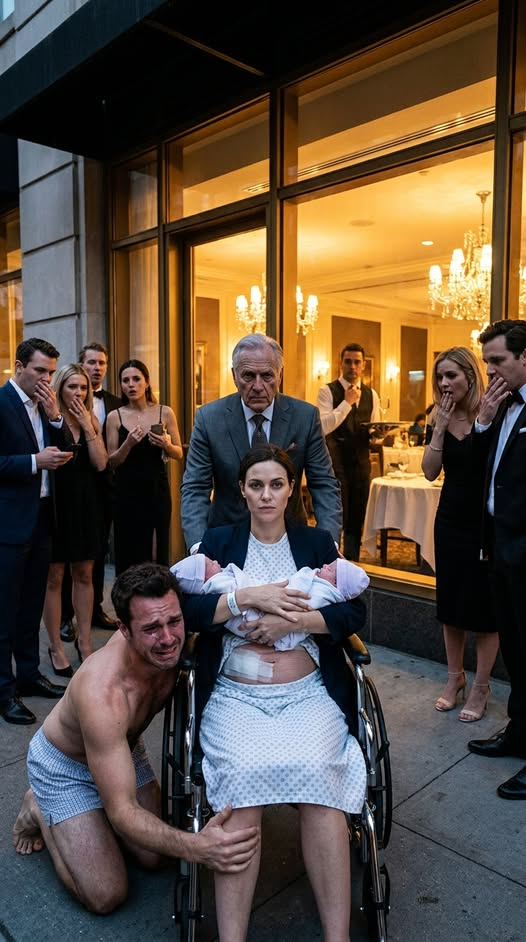
The Architecture of Presence: A Chronicle of My Own Coup d’État
Chapter 1: The Midnight Wool Blazer
The hospital bracelet was still cinched tight around my wrist—a jagged, plastic reminder of the last thirty-one hours—when my husband informed me that he wouldn’t be accompanying us home.
I was ossified with exhaustion. My body felt as though it had been dismantled and reassembled by an amateur, every joint humming with a dull, rhythmic ache. My daughter, Sophie, was exactly four days old. She weighed seven pounds and two ounces, a tiny, warm weight anchored against my sternum in a lemon-yellow blanket my mother had sent from Phoenix.
I was attempting to navigate the impossible geometry of holding a newborn while signing discharge papers on a rolling tray table. I kept glancing at the door, expecting to see him burst through with the frantic energy of a new father. Instead, he drifted in forty minutes late. He wasn’t rushing. He was wearing a midnight wool blazer—the one I had bought him for his last birthday—and his hair was meticulously styled.
Even through the medicinal fog of the maternity ward, I noticed he smelled of expensive cologne. Not the scent of a man who had been pacing a waiting room, but the scent of a man who had just stepped out of a high-end barbershop.
“Hey,” he said, pressing a cool, perfunctory kiss to my forehead. He looked at our daughter the way a casual tourist might glance at a minor artifact in a Museum of Antiquities—with a mild, academic interest, but entirely untouched.
“The car is downstairs?” I asked, my voice sounding like gravel.
He didn’t take the baby from me. He didn’t offer his arm. Instead, he sank into the vinyl chair by the window, crossing one polished loafer over his knee. He checked his phone, a brief flick of his thumb, before looking up with a rehearsed smile.
“So, here’s the thing, Rachel,” he began. “My parents are in the city. They touched down this morning. I know the timing is less than ideal, but they haven’t seen me in months. My mother managed to snag a reservation at Marcello’s. You know how impossible it is to get a table there on a Friday.”
I stared at him, the Chicago skyline behind him looking gray and predatory. “They want to celebrate the baby,” I said slowly, “by excluding the baby?”
“You need to recuperate anyway,” he countered, his smile widening into that charming mask I had once mistaken for kindness. “You’re drained. I figured you could take a car service back to the apartment, get settled in, and I’ll be back by ten. Eleven at the absolute latest.”
I looked down at Sophie. She was a miracle of soft skin and quiet breaths, completely unaware that she was currently being traded for a plate of overpriced pasta.
“Our car,” I whispered. “The Range Rover I bought with my own savings. You’re taking that to dinner, while I take a taxi home with a four-day-old infant.”
“It’s just forty minutes, Rachel. Don’t be dramatic.”
In that moment, the tether snapped. It wasn’t a violent break; it was a cold, silent realization that the man sitting in that chair was not a partner, but a predator who had finished his meal.
“Go to your dinner, Marcus,” I said. My voice was a flatline. “Go. Just… get out.”
He blinked, surprised by the lack of a fight. He muttered something about me being “hormonal” and “difficult,” and then the door swung shut behind his midnight wool blazer. I sat there in the silence of the hospital room, the half-signed papers mocking me. I didn’t cry. I was far too tired for tears. Instead, I felt a visceral sense of relief. The mask was finally off.
Chapter 2: The Sixteen-Minute Father
I reached for my phone and dialed a number I had known by heart since I was five. He answered on the second ring. My father is sixty-one years old, the CEO of a Global Logistics Empire worth two hundred and forty million dollars, and he has never once let a call from me go to voicemail.
“Hey, sweetheart,” he said, his voice a warm anchor in the storm. “How are my girls doing?”
I kept my voice clinical. I told him about the blazer. I told him about the cologne and the reservation at Marcello’s. I told him about the car service and the look in Marcus’s eyes—the look of a man who had already moved on to the next acquisition.
My father was silent for a count of three. When he spoke, his voice was the low, dangerous hum of a man who had spent forty years winning wars.
“I’ll be there in twenty minutes.”
He arrived in sixteen.
He burst through the door in his work suit, tie loosened at the collar, smelling of cedar and stability. He didn’t look at the monitors or the paperwork. He walked straight to me, took my face in his large, calloused hands, and looked at me with a terrifyingly clear-eyed intensity.
“Are you okay?” he asked.
“No,” I said. “But I will be.”
He looked at Sophie for a long, quiet moment, touching her cheek with the tip of his finger as if he were memorizing her. “Yeah,” he whispered. “You will.”
He didn’t mention Marcus. He didn’t waste a single breath on the man who had abandoned us. He carried the car seat himself, shielding Sophie from the biting Chicago wind. In the car, he talked about a bird’s nest on his back porch and the specific way the light hit the lake that morning. It was the most normal conversation I had experienced in four days, a bridge back to the land of the living.
But as I watched the city lights blur past the window, I realized that Marcus’s departure wasn’t an isolated incident. It was the culmination of a three-year campaign of calculated indifference.
Marcus was a master of the “courtship phase.” When we met at a branding conference in San Francisco, he was a virtuoso of charm. He was funny, attentive, and seemingly devoted. He flew across the country just to take me to coffee. What I didn’t understand then was that Marcus was extraordinary at the beginning of things, but he lacked the internal architecture to handle the middle or the end.
The red flags had been there, waving in the wind. The birthdays he “forgot” because of work. The way he referred to my father’s life’s work as “your family’s little operation.” And the most jagged memory of all: the miscarriage I suffered eighteen months ago in Miami. Marcus had stayed for his conference, telling me I was “strong” and that my mother was nearby.
He didn’t come home then. And he wasn’t coming home now.
Chapter 3: The Leather Folder
My father stayed until we were settled, ordering my favorite Thai food and ensuring the bassinet was perfectly positioned. But before he left, he paused at the door.
“Rachel,” he said softly. “I want you to call David tomorrow.”
David was my father’s lead counsel. He was a man who handled corporate mergers and ironclad trusts with the precision of a diamond cutter.
“Dad, I just got home,” I protested.
“Just a conversation,” he insisted. “To understand the ground you’re standing on.”
I called David the next morning. While Sophie slept against my chest, I sat by the window and recounted the last three years. David listened with the silence of a shark. When I finished, he asked for forty-eight hours.
Marcus returned that night after midnight, smelling of red wine and ego. He checked on Sophie for thirty seconds—a performance for an empty house—before falling into a deep, untroubled sleep. I lay in the dark, watching the shadows on the ceiling, and realized I was done explaining him to myself. I was done pretending that a lack of tenderness was just a personality quirk. It was a choice.
David called back in thirty-six hours. He asked to come to the house, and he asked if my father could be present.
When they arrived at 9:00 AM, David was carrying a black leather folder. He had the look of a man who had found a leak in a dam and was deciding whether to repair it or let it burst.
We sat at the dining room table. Marcus was still upstairs, presumably sleeping off the remnants of his “celebration.” David opened the folder and began to speak. It took twenty minutes for my world to shift.
“Marcus has been busy,” David said, laying out a spreadsheet. “Over the course of your three-year marriage, he has been using your personal credit card—the one linked to your premarital trust—for expenses that have nothing to do with this family.”
There were sixty thousand dollars in charges. Hotels in cities he supposedly never visited. A four-day retreat at a resort in Scottsdale while I was working.
But that wasn’t the headline.
“Two months before your wedding,” David continued, “Marcus signed a consulting contract with one of your father’s subsidiaries. He obtained it by representing a client list that didn’t exist. He’s been invoicing for work that was never performed. Small amounts, designed to slide under the radar of a routine audit.”
I looked at my father. He was staring at his coffee cup, his jaw set in a hard line.
“How long have you known?” I whispered.
“I found the invoices forty-eight hours ago,” my father said. “Rachel, I need you to know… I had no idea he was bleeding us from the inside.”
“What are my options?” I asked.
David leaned forward. “The Prenuptial Agreement is ironclad. Your father saw to that. The house, the accounts, the shares—they’re all yours. But the invoicing and the credit card fraud? Those aren’t civil matters. Those are criminal.”
Chapter 4: The Math Problem
At 10:15 AM, Marcus drifted downstairs in sweatpants, looking for coffee. He stopped on the bottom step when he saw the three of us sitting like a tribunal at the table. For the first time, I saw the charm falter. I watched the blood leave his face as he took in the leather folder and David’s clinical expression.
“What’s going on?” he asked, trying for a jovial tone that died in the air.
“Sit down, Marcus,” my father said. It wasn’t a suggestion.
The next hour was a masterpiece of dismantling. I watched Marcus try three different versions of a lie before he realized that David was a man who only dealt in verified data. David laid out the documents one by one—the Scottsdale receipts, the forged invoices, the bank transfers.
It was like watching a teacher explain a math problem to a student caught cheating.
“Rachel, come on,” Marcus said, looking at me with a desperate, predatory hope. He expected me to be the “strong one” again. He expected me to be the buffer between him and the consequences of his own choices.
I didn’t say a word. I just looked at him and felt… nothing. No rage, no heartbreak. Just the cold, sterile clarity of a finished project.
The coup was swift. David served the papers within twenty-four hours. Marcus was given seven days to vacate the property. His access to the accounts was severed. The American Express card he used for his second life was canceled.
He didn’t go quietly. He called me eleven times the first day. He left voicemails that morphed from “apologetic” to “threatening” to “pathetic.” He stood on the front steps on day six, delivering a rehearsed speech about how our daughter “needed her father.”
He delivered that speech to a locked door. My father’s security team stood on the perimeter, silent and unyielding.
Marcus left on day seven. He carried his midnight wool blazer in a garment bag, stepping off my property and into a future of his own making.
Chapter 5: The Indictment
The criminal complaint was filed the following week.
David was meticulous. He didn’t just want a divorce; he wanted a record. He wanted a public acknowledgement that Marcus’s “courtship” had been a long-con. The credit card fraud was straightforward, but the false invoicing—that was the nail in the coffin.
Marcus had assumed that because I was rich and “strong,” I would never look at the receipts. He believed he was the smartest person in the room, a common delusion among men who rely on charm instead of character.
Sophie was three weeks old when the formal indictment was handed down. I was in the kitchen, listening to the soft, rhythmic sounds of her feeding, when my phone buzzed. A text from David.
Guilty on all counts. Sentencing set for next month.
I set the phone face down on the granite counter. I looked at my daughter’s face. She has my eyes. Everyone says so. She has my eyes and my mother’s forehead, and she makes a tiny, contented hum when she sleeps that is the most peaceful sound I have ever heard.
I thought about the woman I was in San Francisco, taking notes on brand development, believing that a man who flew across the country was a man who would stay. I don’t think she was a fool. She was just young, and she hadn’t yet learned that some people come to find you not because they love you, but because they have decided you are something worth taking.
My father came over that evening, as he had every Tuesday and Friday since the hospital. He brought groceries and a new book on National Parks. He sat with Sophie while I ate a real meal, and then he fell asleep on the couch during a documentary, just like he always does.
I watched him sleeping in my living room—this man who drove sixteen minutes through a Chicago storm, who sat across from a predator and didn’t raise his voice, who showed up without being asked.
And I realized: This is what love looks like.
It isn’t a midnight wool blazer or a reservation at Marcello’s. It isn’t cologne and San Francisco coffee. It’s the sixteen minutes. It’s the groceries. It’s the staying.
Chapter 6: The Recognition
The trial took place eight months later. Marcus sat across the courtroom, his charm replaced by a desperate, sallow exhaustion. His attorney tried to paint him as a “man who made mistakes under the pressure of a high-society marriage.”
David dismantled that narrative with the surgical precision of thirty years of experience. He showed the jury that the fraud didn’t start under pressure; it started before the first “I do.” It was a foundational choice.
The jury was out for less than six hours.
I was standing in the hallway when the verdict came back. I had my father on my right and my best friend, Claire, on my left. When David walked out and nodded to me, the weight I hadn’t known I was carrying finally dissipated.
I didn’t stay for the sentencing. I didn’t need to hear the number of years. I drove home, picked up Sophie, and stood at the window of my apartment, looking out at the gold-and-gray Chicago skyline.
The apartment was quiet. But it wasn’t the silence of abandonment; it was the silence of a house built on a solid foundation.
Sophie is ten months old now. She has learned to pull herself up on the coffee table, and she finds this achievement absolutely hilarious. Every time she does it, she looks for me. She scans the room until she finds my eyes, and her whole expression resolves into a look of pure, uncomplicated recognition.
You. I know you. I’m safe.
Someone told me once, with misguided kindness, that I should have been more careful. That a woman with my family’s money should have “known better.”
I disagree. The lesson isn’t to trust less. The lesson is to pay attention to what people do when it costs them something. Anyone can be charming in a San Francisco ballroom. The real test is who picks up on the second ring at 2:00 AM.
I know the answer to that question now. I have stopped pretending otherwise.
My father is coming over tonight. He’ll bring coffee and he’ll fall asleep on the couch, and I will sit in the quiet with my daughter and feel like the luckiest person in the world. Not because of the two hundred and forty million dollars. Not because of the court verdict.
But because I have built a life where the people who show up, stay.
And that is the only coup that matters.