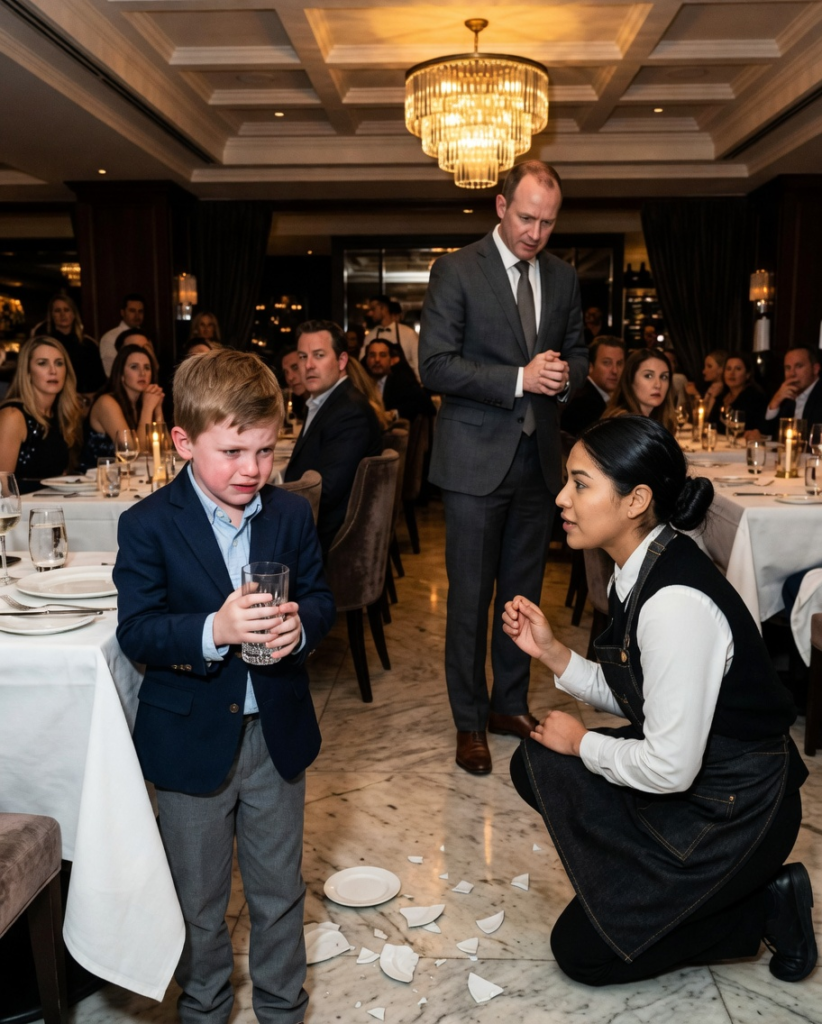
He was smashing plates in a luxury restaurant, and not even his millionaire father could stop him.
Until a waitress stepped forward and taught him a lesson money could not buy.
The plate hit the marble floor with a sound so sharp it seemed to slice through the music.
A dozen heads turned at once.
Conversations died in the middle of sentences.
A violinist in the corner missed a note, recovered, then stopped playing altogether when the second plate went up in a small pale hand.
Leonard Bronski stood beside a table set for two near the tall windows of Maison Verre, the restaurant where politicians smiled for cameras, actresses hid behind sunglasses, and financiers pretended not to notice one another.
He was seven years old, dressed in a navy blazer with gold buttons, his hair combed too neatly, his face too pale beneath the chandelier light.
He looked like a child who had been dressed for a photograph.
But his eyes did not belong in a photograph.
They were blazing.
Across from him stood his father, Adam Bronski, a man known in three countries for never raising his voice because he rarely needed to.
He owned hotels, glass towers, shipping contracts, and more influence than most elected men.
His name opened private entrances.
His phone calls ended arguments.
His silence made lawyers sweat.
And yet, in front of one furious child holding a porcelain plate, Adam Bronski looked powerless.
“Leonard,” he said, low at first.
“Put it down.”
Leonard did not move.
The guests at the nearest tables went stiff.
A woman in emerald earrings pressed her napkin to her mouth.
A man with silver hair leaned toward his wife and whispered, not softly enough, “That’s Bronski’s boy.”
The child heard him.
His fingers tightened.
The second plate flew.
It struck the floor near Adam’s polished shoes and shattered into bright pieces that skittered across the marble like scattered teeth.
Someone gasped.
A waiter stepped forward, then stopped when the manager lifted a trembling hand.
Nobody wanted to be the person who handled the richest customer in the room.
Adam’s face darkened.
He glanced around, seeing everything at once: the broken china, the frozen guests, the raised phones that disappeared quickly when his eyes found them, the restaurant manager turning red behind the reservation stand.
But more than any of that, he saw humiliation.
Not fear.
Not pain.
Humiliation.
“That is enough,” he said, his voice turning harder.
Leonard reached for a crystal glass.
“Do not,” Adam snapped.
The boy lifted it anyway.
His hand shook so badly the light trembled inside the glass.
Laura Martinez saw that tremble from the service station.
She had been carrying a tray of espresso cups when the first plate broke.
Her first instinct had been the same as every other employee’s: stay out of it.
Maison Verre was not the kind of place where waitresses inserted themselves into the lives of millionaires.
They poured water before anyone asked, memorized allergies, laughed quietly at jokes that were not funny, and vanished when the powerful became inconvenient.
Laura had been working there for twenty-nine days.
She still kept a folded copy of her first paycheck in the pocket of her winter coat because it meant rent, groceries, and part of her younger brother’s school fees.
She could not afford a dramatic gesture.
She could not afford to be fired.
But then she saw Leonard’s face.
Not the expensive jacket.
Not the destruction.
Not the tantrum every guest believed they understood.
His face.
The way his lower lip trembled before he clenched his jaw.
The way he kept looking at his father, not as if he wanted to win, but as if he wanted to be seen.
The way anger came out of him like smoke from a locked room.
Laura had seen that look before.
Her brother Mateo had worn it the night their mother did not come home.
He had been eight, standing in their tiny kitchen, throwing mugs at the wall one by one while Laura, barely eighteen, begged him to stop.
The neighbors had banged on the floor.
The landlord had threatened eviction.
Mateo had only screamed harder because grief had no manners, and children did not always know how to say, I am terrified that everyone leaves.
So Laura set down the tray.
Her manager hissed her name under his breath.
“Laura.
Don’t.”
She heard him.
She walked anyway.
The room seemed to stretch as she crossed it.
The chandelier light made the broken porcelain glitter beneath her shoes.
Adam turned when he sensed her approach, and the look he gave her was enough to stop most people where they stood.
It did not stop her.
“Miss,” he said, clipped and cold, “this is not your concern.”
Laura did not answer him.
She lowered herself slowly until she was eye level with Leonard, keeping her hands where he could see them.
She did not grab the glass.
She did not scold him.
She did not smile that fake adult smile children learn to distrust.
She simply said, “That glass is very tired of being held so tightly.”
The room blinked.
Leonard’s eyebrows pulled together.
“What?” he whispered.
His voice was small.
Everyone had expected a scream.
The smallness of it made something shift in the air.
Laura nodded toward the glass.
“It didn’t do anything wrong.
But it’s in danger because someone bigger is hurting too much to know what to do with their hands.”
Adam stiffened.
“Are you implying—”
Laura lifted one finger, not at him, but gently, as if asking the room itself for quiet.
The gesture was so unexpected that Adam stopped.
Leonard stared at her.
The glass still trembled.
“My brother used to break cups,” Laura said.
“Not fancy ones like these.
Ours came from a discount store and none of them matched.
But he broke them when he missed our mother.
He broke them when grown-ups kept saying he was fine because they didn’t want to hear that he wasn’t.”
Leonard’s throat moved.
“I’m not missing anybody,” he muttered.
“Okay,” Laura said.
No argument.
No trap.
The boy looked confused by the lack of resistance.
Adam exhaled sharply.
“Leonard, give her the glass.
Now.”
The boy flinched.
Laura saw it.
Adam did not.
“Mr.
Bronski,” she said quietly, still looking at Leonard, “please don’t make your voice the loudest thing right now.”
A few guests inhaled at once.
No one spoke to Adam Bronski that way in public.
His eyes narrowed.
“Do you know who I am?”
Laura finally looked at him.
“Yes.
You’re his father.”
The words landed harder than an insult.
For a second, Adam said nothing.
Leonard’s grip loosened by the smallest amount.
Laura turned back to him.
“Can I tell you a secret about expensive restaurants?”
Leonard did not answer.
She leaned a little closer.
“Everyone here is pretending the broken plates are the most important thing in the room.
They’re not.
Plates can be replaced.
But when someone breaks inside and nobody listens, that can last a lot longer.”
The boy’s eyes filled.
He blinked furiously, angry at his own tears.
“I hate this place,” he said.
A woman nearby murmured, “Oh, for heaven’s sake.”
Laura ignored her.
“What do you hate about it?” she asked.
Leonard’s face twisted.
He looked past her at his father, and all the fury came back for a moment, hot and desperate.
“He said we were coming for dinner,” Leonard said.
“Just us.”
Adam closed his eyes briefly.
Laura heard the room lean in.
“It is dinner,” Adam said, defensive now.
“We are at dinner.”
Leonard let out a bitter little laugh that did not sound like a child’s.
“You brought Mr.
Cale.
You brought the woman with the folder.
You kept talking about hotels.
You said five minutes, and then you forgot I was here.”
Adam’s mouth tightened.
“This was an important negotiation.
You don’t understand.”
“No,” Leonard said, louder.
“You don’t understand.”
His hand jerked.
The glass almost slipped.
Laura placed her palm on the table, close but not touching him.
“Leonard.
Look at me.”
He did.
“When my brother wanted to break something,” she said, “I used to ask him one question.
Not because it fixed everything.
Because it gave him a door out of the fire.”
Leonard swallowed.
“What question?”
“What do you wish the broken thing could say for you?”
The silence changed.
At first, it had been scandalized.
Then curious.
Now it was almost unbearable.
Leonard looked down at the glass in his hand.
His eyelashes were wet.
His shoulders rose and fell with small, uneven breaths.
Adam stared at his son as though he had never really seen the size of him before.
“I don’t know,” Leonard whispered.
Laura waited.
Waiting was something the rich people in the room seemed unused to.
They filled silence with orders, complaints, money, jokes.
Laura did none of that.
She gave the child room to find words.
At last Leonard said, “It would say stop lying.”
Adam’s face changed.
The color drained from it slowly, as if someone had opened a valve.
Laura felt the shift and understood there was more here than an interrupted dinner.
“Who lied?” she asked.
Leonard looked at his father.
Adam shook his head once, warning, pleading, both.
But Leonard had already been quiet too long.
“He said she was traveling,” the boy said.
A tiny sound escaped Adam’s throat.
Laura’s hands went still.
“Who was traveling?” she asked softly.
Leonard wiped his face with the sleeve of his blazer.
“My mom.”
The room disappeared for Laura in that moment.
The chandeliers, the marble, the expensive perfume, the whispering guests—everything blurred around the child and the father who suddenly looked less like a king and more like a man standing in front of the one locked door he had spent a year refusing to open.
Adam said, “Leonard.
Not here.”
Those three words did what the threats had not.
They broke the boy.
He lowered the glass just enough for Laura to reach out, not to take it, but to wrap her fingers gently around the base.
She did not pull.
She let him decide.
His grip gave way.
The glass settled on the table with a soft click.
No applause came.
No one dared.
Leonard’s hands hung empty at his sides, and somehow that looked worse than when they had been full of things to throw.
“She’s not traveling,” he said.
“She’s dead.”
The word moved through the restaurant like cold air.
Adam turned his head away, but not before Laura saw the raw grief flash across his face.
Leonard kept going, each sentence ragged and sharp.
“She died eleven months ago, and he told everyone I was too little to understand.
He told people not to talk about it around me.
He canceled her birthday dinner.
Then tonight he brought me here because she used to bring me here for cake, but he didn’t even remember.
He just talked and talked and talked.”
Adam whispered, “I remembered.”
Leonard stared at him.
“Then why didn’t you say her name?”
That was the question that ruined Adam Bronski.
Not the broken china.
Not the public shame.
Not the whispers of the people he had spent a lifetime impressing.
His son’s question.
Why didn’t you say her name?
Adam’s shoulders sagged.
He reached for the back of a chair as if the floor had shifted beneath him.
For the first time that evening, the famous millionaire did not look angry.
He looked afraid.
“Because I thought if I said it,” Adam said, his voice hoarse, “you would fall apart.”
Leonard’s answer was immediate.
“I already did.”
Laura felt those words in her chest.
She remembered Mateo sitting on the kitchen floor among broken mugs, screaming until he had no voice.
She remembered adults telling her to be strong, as if strength meant never naming what hurt.
She had been a girl then, forced to become a wall.
She knew exactly what happened when children were asked to grieve politely.
They broke the nearest thing they were allowed to break.
Adam looked at the porcelain scattered around his shoes.
Then he looked at Leonard.
Really looked.
Not as a problem.
Not as an embarrassment.
Not as the heir to a name or a headline waiting to happen.
As a little boy who had lost his mother and then lost permission to miss her.
“Evelyn,” Adam said.
Leonard froze.
Adam’s eyes shone.
“Your mother’s name was Evelyn.
And she loved this restaurant because she said the ceiling looked like a box of stars.”
Leonard’s mouth parted.
Laura slowly stood but did not step away.
Something fragile was happening, and everyone in the room seemed to understand that movement might shatter it.
Adam came around the table, not with the sharp stride of a man reclaiming control, but slowly, carefully, as if approaching an injured animal.
“She always ordered lemon cake,” he said.
“Even when she said she was too full.
She would ask for two forks and then eat most of it herself.”
A tear slipped down Leonard’s cheek.
“She gave me the yellow flower,” he whispered.
Adam nodded, and now his own tears came.
He did not wipe them quickly enough to hide them.
“From the top.
She said you deserved the brightest part.”
The child made a sound that was almost a sob and almost a breath.
Adam opened his arms.
Leonard did not run to him at first.
He stood there, trembling with the stubbornness of a child who had waited too long.
Then his face crumpled, and he stepped forward.
Adam dropped to his knees on the marble, heedless of his suit, the broken porcelain, the staring room.
His son collided with him and buried his face against his chest.
“I thought you forgot her,” Leonard cried.
Adam held him so tightly his knuckles whitened against the boy’s jacket.
“No.
I was afraid to remember her with you.
That was wrong.
I am so sorry.”
The restaurant remained silent.
Not the awkward silence of gossip anymore.
A human silence.
Laura bent down and began gathering the larger pieces of porcelain with a linen napkin.
It gave the room something gentle to do besides stare.
A waiter joined her.
Then another.
The manager, still pale, crouched stiffly and helped too.
Adam saw them and tried to rise, but Leonard clung to him.
“Leave it,” Laura said quietly.
“Hold him.”
This time Adam obeyed.
Several minutes passed before Leonard’s sobs softened.
When he finally pulled back, his eyes were swollen and his cheeks were damp.
He looked embarrassed, as children often do after revealing the truth adults forced them to carry.
Adam brushed the hair from his forehead.
“I’m going to make calls tomorrow,” he said.
“No more pretending she’s away.
No more changing the subject.
We’ll talk about her whenever you need to.”
Leonard’s voice was thin.
“Even if you cry?”
Adam gave a broken laugh.
“Especially then.”
The manager cleared his throat nearby, still holding a napkin full of porcelain shards.
“Mr.
Bronski, about the damages—”
Adam looked up.
For a moment, the old Adam almost returned.
The automatic command, the cold solution, the check that would erase inconvenience.
Then he stopped.
He looked at Laura.
She had not scolded him in front of everyone.
She had done something worse and better.
She had shown him exactly where money ended.
“Send me the bill,” Adam said.
“All of it.
And add the wages of every employee who had to deal with this tonight.
Double them.”
The manager blinked.
“Of course, sir.”
Adam turned back to Laura.
“And you.
What is your name?”
“Laura.”
“Laura,” he repeated, as if committing it properly.
“Thank you.”
She nodded.
“Thank your son.
He finally said what everyone was afraid to hear.”
Leonard peered at her from under his damp lashes.
“Am I in trouble?” he asked.
Laura crouched again, careful to keep her voice from becoming too soft or too harsh.
“There should be consequences for breaking things,” she said.
“But consequences are not the same as being unloved.
You can help clean what is safe to clean.
You can apologize to the people who were scared.
Your father can pay for what was damaged.
And both of you can stop pretending plates were the real problem.”
Leonard absorbed that with grave seriousness.
Then he turned toward a young waiter nearby.
“I’m sorry,” he said.
The waiter, who could not have been more than twenty, looked startled.
“It’s okay.”
Laura gently corrected him.
“You can say thank you for apologizing.
You don’t have to say it’s okay if it wasn’t.”
The waiter swallowed.
“Thank you for apologizing.”
Leonard nodded.
It was a small lesson, but Adam watched it as if he were witnessing a language he had never learned.
The restaurant slowly began breathing again.
Chairs shifted.
Someone cleared their throat.
The violinist, after a long hesitation, began playing something quieter than before.
Adam asked for the lemon cake.
The kitchen sent it out on a plain white plate, perhaps wisely choosing the least expensive one available.
On top rested a small candied yellow flower.
Laura had not asked for that detail, but when she saw it, she understood the pastry chef had been listening too.
Leonard stared at it.
Adam picked up one fork, then paused and asked for a second.
The boy’s lips trembled.
They ate slowly.
Not much.
Mostly they sat close together while Adam told stories about Evelyn Bronski in a voice that broke often and did not apologize for breaking.
He told Leonard how she sang badly in the car, how she always forgot where she put her reading glasses, how she once made Adam leave an investors’ dinner early because Leonard had a fever and she said no deal in the world was worth missing a child who needed you.
At that, Adam stopped.
The lesson found him again.
He looked at his son and placed his phone face down on the table.
Then he turned it off.
Leonard noticed.
The smallest smile appeared through the wreckage of his tears.
Later, when the dining room had thinned and the last of the broken porcelain had been swept away, Adam found Laura near the service corridor.
She braced herself, half expecting a delayed complaint.
Powerful men often thanked people in public and punished them in private.
Instead, Adam stood with his hands in his coat pockets, looking older than he had an hour before.
“You could have embarrassed me,” he said.
Laura did not lower her eyes.
“You were already embarrassed.
I was trying to keep your son from being alone in it.”
He took that without flinching.
“My wife used to say I treated emotion like a problem to solve,” he said.
“After she died, I solved it by removing every reminder from the house.
Her photographs.
Her perfume.
Her piano.
I told myself I was protecting Leonard.”
Laura’s expression softened, but she did not rescue him from the truth.
“You were protecting yourself.”
Adam nodded once.
“Yes.”
A long silence passed between them, filled with the muffled sounds of plates being stacked and water running in the kitchen.
“My son needs help,” Adam said.
“So do I.”
“Then get it,” Laura said.
No flattery.
No awe.
No fear.
Just the answer.
The next morning, Maison Verre employees found envelopes waiting for them, each with a handwritten apology and a bonus large enough to make several of them cry in the coatroom.
The restaurant received payment for the damages without negotiation.
But the story did not end with money, because money had never been the part that mattered.
Adam canceled a trip to Zurich.
He called Leonard’s school and asked for grief counseling referrals.
He had Evelyn’s photographs brought back from storage, not all at once like a museum exhibit, but carefully, room by room, memory by memory.
The first one went on Leonard’s nightstand: Evelyn laughing in the same restaurant, a yellow flower balanced on the end of her fork.
That weekend, father and son returned to Maison Verre before opening hours.
Leonard carried a small envelope in both hands.
Inside was a letter written in careful blocky handwriting, apologizing to the staff for scaring them and for breaking things they had worked hard to care for.
Laura was polishing glasses when he gave it to her.
“I didn’t throw anything today,” Leonard said.
She smiled.
“I noticed.”
He looked down at his shoes.
“I wanted to.
In the car.
When Dad said we were going to talk about Mom.”
Adam, standing behind him, looked pained but stayed quiet.
“What did you do instead?” Laura asked.
Leonard pulled a folded paper from his pocket.
It was wrinkled from being opened and closed too many times.
On it, in uneven handwriting, was one sentence.
I wish the broken thing could say I miss her.
Laura read it and pressed her lips together.
“That’s a very brave sentence,” she said.
Leonard nodded solemnly, as if bravery felt heavy.
“Dad wrote one too.”
Adam looked caught.
Laura raised an eyebrow.
The millionaire reached into his coat and pulled out his own folded paper.
For once, he seemed almost embarrassed to be seen.
Laura did not ask to read it.
Adam offered it anyway.
His sentence was shorter.
I didn’t know how to be his father without her.
Laura handed it back with care.
“Now you know where to begin,” she said.
Adam looked at Leonard, who was watching him with cautious hope, the kind children extend even after adults have mishandled it.
“Yes,” Adam said.
“I think I do.”
Months later, people still told the story of the Bronski boy who shattered plates in the city’s finest restaurant.
Some told it cruelly, because cruel versions travel fast.
Some said he was spoiled.
Some said Adam Bronski had lost control of his own house.
Some remembered only the noise.
But the people who had been close enough to see Leonard’s face remembered something else.
They remembered the waitress who walked into the storm when everyone richer and more powerful stood still.
They remembered a father kneeling on broken porcelain because pride finally became less important than his child.
They remembered that the most expensive thing broken that night was not the china.
It was the silence.
And once it broke, a little boy could finally grieve out loud.
Whether Adam deserved forgiveness so quickly was something people disagreed about afterward.
Some believed grief explained his distance but did not excuse it.
Others believed the moment he listened, truly listened, he became the father Leonard had been begging for all along.