The Cost of a Toast: A Reckoning at Harbor & Hearth
The most expensive lesson I ever learned didn’t come from business school, nor did it come from the grueling sixteen-hour shifts I spent building my reputation in the culinary world of Boston. It came from the woman who sat across from me every Mother’s day—the woman who believed that my marriage to her son was less of a union and more of an acquisition.
Evelyn Whitmore never entered a room like an ordinary citizen. She moved with a predatory grace, a woman who expected the world to rearrange its molecular structure to accommodate her arrival. When she stepped into Harbor & Hearth, my flagship restaurant overlooking the dark, churning waters of the Atlantic, she didn’t look for a host. She didn’t wait for a table. She simply colonised the space, her heels clicking against the hand-polished Italian marble like a rhythmic countdown to a disaster I hadn’t yet seen coming.
Three nights ago, that rhythmic clicking had cost me twelve thousand dollars.
It had been a “small family gathering,” she’d claimed. Thirty-two guests had arrived in black cars, consuming vintage Bordeaux and three-tiered seafood towers like they were at a state funeral. When the night ended, Evelyn had kissed my cheek, smelling of expensive lilies and betrayal, and whispered, “I’ll have my assistant wire the funds in the morning, darling. Family discount, of course?”
The wire never came. My husband, Ethan, had begged me to let it go. “She’s just being Evelyn,” he’d said, staring at his shoes. “If you push her, she’ll make the next five years of our lives a living hell. Is twelve grand really worth the war?”
I had looked at my husband—the man I loved, the man who had helped me pick out the very granite for these counters—and realized he was still a boy hiding under his mother’s silk skirts. I let the debt slide. I thought I was buying peace.
But as I stood in the foyer of my own restaurant tonight, smelling the salt air and the faint, earthy scent of truffle oil, I realized that silence isn’t a peace treaty. It’s an invitation for a second invasion.
And tonight, the invasion was in full swing.
Maya Patel, my general manager and the only person who kept my sanity tethered to this earth, intercepted me near the host stand. Her face was a mask of professional neutrality, but her knuckles were white as she clutched a leather-bound tablet.
“Claire,” she said, her voice a low vibration beneath the hum of the dining room. “She’s back. And she’s brought half of the Beacon Hill social register with her.”
My chest tightened, a familiar cold dread coiling in my gut. “Did she book? Did she sign a contract?”
Maya shook her head, a stray lock of dark hair falling over her eyes. “She called from a blocked number two days ago. She told the junior host that you had personally authorized a full buyout of the Seafarer Suite. No deposit. No credit card on file. When I tried to intervene, she laughed. She actually laughed, Claire. She said she didn’t need a contract to visit her own property.”
“Her own property?” I whispered, the words tasting like ash. “I spent ten years in grease-stained kitchens to build this. I took out the loans. I signed the deed.”
“She’s telling the guests a different story,” Maya said, her eyes drifting toward the heavy oak doors of the private dining room. “The champagne wall is up. The imported peonies from Holland arrived an hour ago—billable to us, of course. She’s already gone through six bottles of the ’96 Krug.”
I looked toward the Seafarer Suite. Through the glass partitions, I could see the balloon arch—cream and gold, looking like a gilded cage. I could see the elite of Boston laughing, their diamonds glinting under my carefully curated lighting. And at the center of the orbit was Evelyn.
“Where is Ethan?” I asked.
“He hasn’t answered my calls,” Maya replied. “I think… I think he knew she was doing this. I think he’s hiding.”
The betrayal hit harder than the financial loss. I walked toward the private room, my breath shallow. I wasn’t just a business owner anymore; I was a ghost in my own house. As I approached the doors, the sound of a silver spoon tapping against a crystal glass rang out, silencing the room.
I stood in the shadows of the hallway, watching through the crack in the door. Evelyn stood at the head of the long, mahogany table, her glass raised high.
“A toast!” she cried, her voice ringing with a terrifying, effortless authority. “To the success of Harbor & Hearth. Many of you have asked how I manage to keep this place so pristine while juggling my charities.”
A ripple of polite laughter moved through the crowd. My heart hammered against my ribs like a trapped bird.
“I simply adore this little project,” Evelyn continued, a smug, cat-like grin spreading across her face. “It’s wonderful to have a place where I practically own the air everyone breathes. And as for my daughter-in-law, Claire…”
She paused, making eye contact with a prominent food critic sitting to her left.
“She’s such a dear. A hard worker. Truly. Every queen needs a little servant to keep the silver polished, doesn’t she?”
The room erupted into laughter. It wasn’t mean-spirited from the guests—they didn’t know the truth. They thought it was a playful jest between a powerful matriarch and her subordinate. But from Evelyn, it was a declaration of war. It was the moment she stripped me of my name, my effort, and my dignity in front of the very people who kept my business alive.
I stood there, my palms slick with sweat, a cold clarity finally washing over me. I wasn’t angry anymore. I was finished.
I turned to Maya, who was standing behind me, her face twisted in shock.
“Maya,” I said, my voice as cold as the Atlantic. “I want the total. Everything. The twelve thousand from three nights ago. Every bottle of Krug opened tonight. The floral arrangements. The labor. The loss of revenue for closing the suite without a buyout fee. I want the ‘Evelyn Tax’ applied to every single item.”
Maya’s eyes sharpened. She understood. “It’s going to be a massive number, Claire.”
“Good,” I replied, looking back at the woman in the cream silk dress. “Because tonight, the ‘servant’ is presenting the bill.”
The next hour was a symphony of calculation. While Evelyn regaled her guests with stories of her ‘vision’ for the restaurant’s new spring menu—a menu she hadn’t even seen—Maya and I were in the office, pulling records.
TheBeluga caviar: $4,000.
The vintage champagne: $18,000.
The floral installation: $6,500.
The private room buyout fee: $10,000.
The previous unpaid balance: $12,000.
By the time we were done, the number at the bottom of the page was staggering. Forty-eight thousand dollars for the evening. Sixty thousand in total.
“She’ll never pay it,” Maya whispered as the printer began to hum, spitting out the formal, high-gloss invoice.
“Oh, she’ll pay,” I said, sliding the paper into a silver tip tray. “Because Evelyn Whitmore cares about one thing more than money. She cares about the image of having it.”
I walked back into the Seafarer Suite. The party was at its zenith. The air was thick with the scent of expensive perfume and the lingering smoke of seared scallops. I didn’t wait for a lull in the conversation. I walked straight to the head of the table, the silver tray balanced on my fingertips.
The laughter died down as I approached. Evelyn looked up, her eyes narrowing as she saw the expression on my face.
“Claire, darling! Are you finally joining us? I was just telling the Wellington-Smythes about your… charming little background in the suburbs.”
I didn’t smile. I didn’t acknowledge the jab. I simply placed the tray on the table, right next to her half-empty glass of champagne.
“The evening is winding down, Evelyn,” I said, my voice projecting to every corner of the room. “And since you were just telling everyone how much you ‘own’ this establishment, I thought you’d like to settle the accounts before the guests depart.”
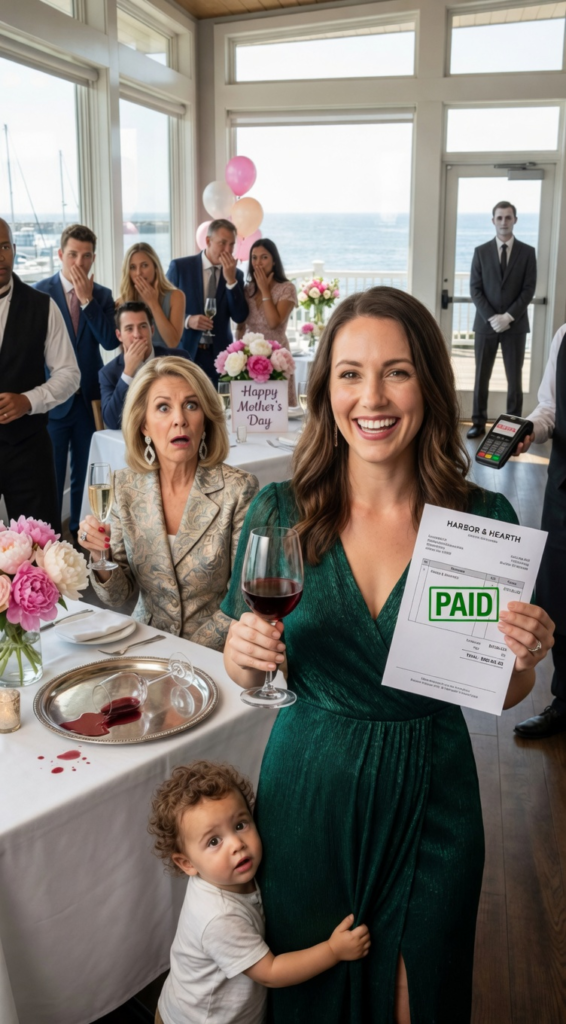
The silence that followed was absolute. You could hear the faint hiss of the waves hitting the pier outside. Evelyn’s hand trembled slightly as she reached for the paper. She glanced at the total, and for the first time in the ten years I had known her, I saw the mask slip. Her face went from pale to a mottled, angry red.
“This is an absurdity,” she hissed, her voice dropping to a jagged whisper. “We’ll discuss this privately, Claire. Take this away at once.”
“There’s nothing to discuss privately,” I said, leaning in just enough so that the food critic and the socialites nearby could hear. “You’ve hosted two major events this week without a contract or a deposit. My vendors need to be paid. My staff needs their gratuity. Since you’ve been telling everyone tonight that you’re the power behind this throne, surely sixty thousand dollars is a small price to pay for the ‘visibility’ you’ve provided me.”
“Sixty thousand?” someone at the table gasped.
Evelyn looked around the room. She saw the curiosity in the eyes of her peers. She saw the food critic’s eyebrow arch in silent judgment. She was trapped in the very theater she had built.
“You’re embarrassing yourself, child,” Evelyn spat, her eyes burning with a predatory fire. “Do you have any idea who I am? Do you know what I can do to this place?”
“I know exactly who you are,” I replied. “You’re a guest who hasn’t paid her bill. And in this restaurant, that makes you a liability.”
At that exact moment, the heavy oak doors swung open. Ethan walked in.
He looked disheveled, his tie loosened, his eyes darting between his mother and me. He had finally emerged from his hiding spot, lured out by the scent of a brewing storm.
“Claire? Mother? What’s going on?”
Evelyn turned to him like a drowning woman reaching for a life raft. “Ethan! Tell your wife to stop this madness! She’s trying to extort me in front of my friends! Over a… a simple family dinner!”
Ethan looked at the tray. He looked at the invoice. Then he looked at me. For a long, agonizing second, I thought he was going to break. I thought he was going to tell me to apologize, to take the bill back to the office, to let the Whitmore name win again.
But then, he looked at Maya, who was standing at the edge of the room with a look of profound disappointment. And finally, he looked at his mother—really looked at her—and saw the cruelty beneath the silk.
“Is the bill accurate, Claire?” Ethan asked, his voice surprisingly steady.
“To the penny,” I replied. “Including the twelve thousand she walked out on last Tuesday.”
Ethan turned back to his mother. The room held its breath.
“Pay it, Mother,” he said.
Evelyn gasped, a hand fluttering to her throat. “Ethan! How dare you? I am your mother!”
“And she is my wife,” Ethan said, stepping toward the table. “And this is her life’s work. You don’t get to treat her like a ‘servant’ in her own house. You don’t get to use our name to steal from her. Pay the bill, or I’ll be the one to escort you and your guests to the door.”
The humiliation was a slow, agonizing burn. Evelyn’s hands were shaking so violently she could barely dig her black American Express card out of her designer clutch. She didn’t look at me as she handed it over. She didn’t look at Ethan. She stared straight ahead, her reputation crumbling like dry parchment in the wind.
Maya took the card and processed the transaction right there at the table. The beep of the machine was the most beautiful sound I had ever heard.
“Thank you, Evelyn,” I said, taking the card back and handing it to her with a polite, professional nod. “We hope you enjoyed your evening. Maya will see your guests out. Oh, and one more thing.”
I leaned down, my voice a whisper intended only for her ears.
“Don’t bother calling the ‘blocked number’ for a reservation again. You’re no longer on the list. Not as an owner. Not as a guest. Not as family.”
The room cleared out with a staggering speed. The guests, sensing the shift in the atmosphere, scurried away like mice from a sinking ship. The laughter was gone, replaced by the awkward silence of people who had witnessed a queen being dethroned.
When the last guest had departed, and the heavy doors had clicked shut, the Seafarer Suite felt hollow. The flowers were still beautiful, the champagne glasses still gleamed under the gold lights, but the magic was gone. It was just a room again.
Ethan stood by the window, watching the lights of the harbor. “I should have done that years ago,” he said softly.
“Yes,” I replied, joining him. “But you did it tonight. That’s what matters.”
“She’s going to try to ruin us, you know,” he said, turning to look at me. “She’ll tell everyone you’re crazy. She’ll try to pull my inheritance.”
I looked around my restaurant. I looked at the staff who were already moving in to clear the tables, their movements efficient and proud. I looked at the “Paid in Full” receipt sitting on the mahogany table.
“Let her try,” I said. “She doesn’t realize that I didn’t build this place with her money or her name. I built it with my own hands. And those hands are still here.”
The aftermath was exactly as predicted, and yet, entirely different. Evelyn launched a scorched-earth campaign in the social circles of Boston. She told stories of my ‘greed’ and ‘instability.’ She claimed I had lured her into a trap.
But something strange happened.
The food critic who had sat at her left that night? He wrote a piece. Not about the food—though he praised the sea bass—but about the ‘Authenticity of Harbor & Hearth.’ He wrote about a young woman who refused to let a legacy name steamroll her integrity. He wrote about the moment the ‘servant’ proved she was actually the master.
Suddenly, the phone started ringing. Not with calls from the Whitmores, but from new clients. People who wanted to host events at the restaurant that ‘stood up to Evelyn Whitmore.’
Two days later, a message came into my personal inbox. It was from a prominent law firm in the city, representing a high-end tech conglomerate.
“We saw what happened the other night. We respect your boundaries and your business sense. We’d like to discuss hosting our annual gala at your venue—provided we can sign a contract and pay a deposit immediately.”
I sat at my desk, looking out at the water. The sun was setting, painting the waves in shades of bruised orange and deep violet. I realized then that this hadn’t been about the sixty thousand dollars. It hadn’t even been about the insult.
It was about ownership.
Not just the ownership of a building or a brand, but the ownership of my own soul. I had spent years trying to fit into a mold that was designed to break me. I had let Evelyn define the terms of my life because I was afraid of the noise she could make.
But as the restaurant began to fill for the evening service, and the familiar, comforting sounds of the kitchen began to rise through the floorboards, I knew I was finally free.
The Whitmores were a dynasty built on shadows and silence. But Harbor & Hearth was built on fire and salt. And as any chef will tell you, fire and salt are the only things that truly last.
The storm had come, just as the meteorologists had promised. But as I walked out into the dining room to greet my guests, I didn’t feel the cold. I felt the heat of a new beginning.
Like and share this post if you find it interesting and believe in the power of setting boundaries and standing your ground.