PART 1
THE TWINS IN GATE 17
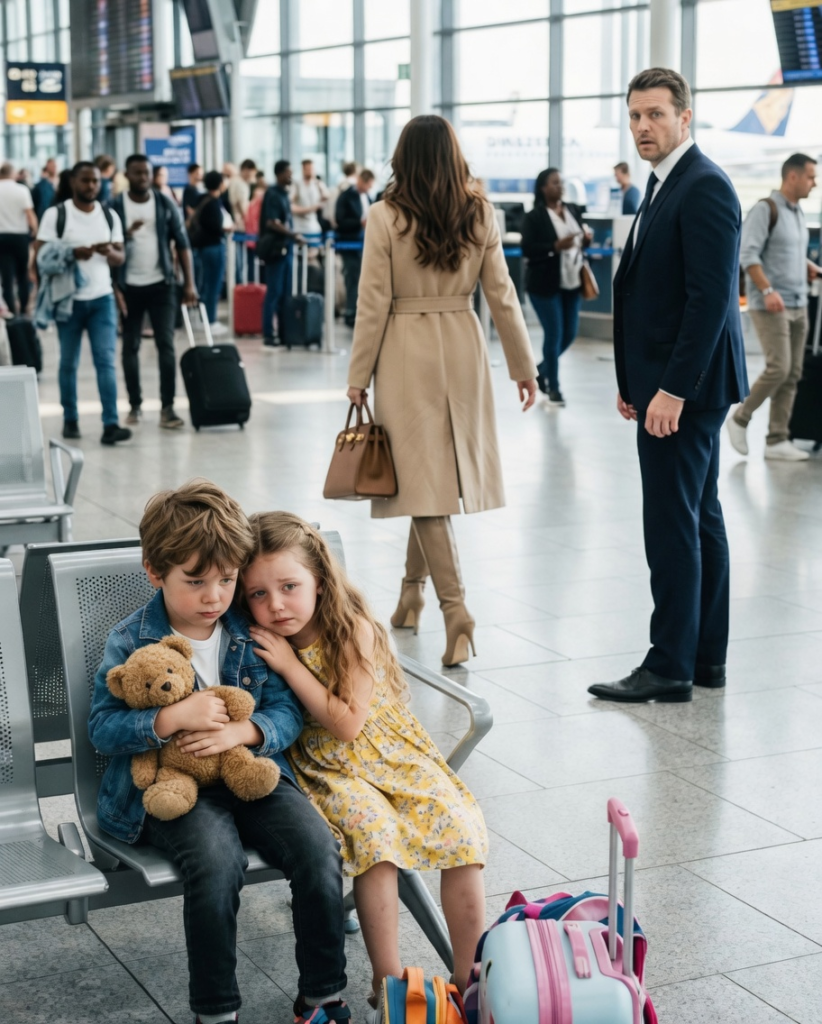
Terminal 2 of Mexico City International Airport was a steel-and-glass monster that swallowed thousands of people every hour. Amid the smell of burnt coffee, the echo of announcements, and the hurried footsteps of travelers, it was the perfect setting for human indifference to operate at its fullest. It was a place where anyone could become invisible if they wanted to.
And that’s exactly what Valeria did with two five-year-old children.
The woman walked with quick strides, her heels clicking sharply on the polished floor. She wore a designer coat that clashed violently with the worn-out clothes of the two little ones running behind her. They were twins—a boy and a girl—with messy hair, big dark eyes, and that perpetual alert expression developed by children who have stopped expecting adults to treat them with tenderness. The boy clutched a one-eyed stuffed dog to his chest. The girl never let go of her brother’s hand, squeezing it until her knuckles turned white.
Valeria stopped abruptly in front of the row of metal seats at gate 17. She turned to them with an annoyed look, pointed to an empty bench, and spoke three words that were drowned out by the roar of the engines. The two children, conditioned by fear, obeyed instantly and sat down with their legs dangling.
Valeria observed them for a brief second.
There was no goodbye hug.
There was no caress on the forehead.
There was not a single tear of regret.
She simply turned on her heel, handed her boarding pass to the flight attendant, and disappeared down the jetway leading to flight 402 bound for Cancún.
The crowd kept flowing. No one stopped to look at the two small children abandoned like forgotten luggage. No one, except Alejandro Villalobos.
In the northern states of Mexico, saying the name Alejandro changed the temperature in any room. At forty-five years old, he was an untouchable businessman, a silent benefactor for his community in Sinaloa, and the most feared man by the cartels and corrupt politicians. He had a reputation forged in blood, ice-cold decisions, and a gaze that made the toughest men lower their heads. His four bodyguards stayed three meters away, forming an invisible barrier around him.

“Boss, the private flight to Monterrey is ready for takeoff,” his head of security reported quietly.
Alejandro didn’t blink. He wasn’t looking at his solid gold watch or the departure screens. His dark eyes were fixed on the boy with the stuffed animal.
The five-year-old kept staring blankly at the empty jetway where Valeria had vanished. He wasn’t crying. He wasn’t throwing a tantrum. He only clenched his jaw with the mute desperation of someone who had learned through beatings that crying was useless.
Alejandro felt a strange pressure in the pit of his stomach. He made a hand gesture to stop his men and walked straight toward the bench.
The giant in the tailored suit crouched down to the level of the two children. The boy looked at him with distrust, but the girl held the capo’s gaze with a fierce courage that left him disarmed.
“Where’s your mom, kids?” Alejandro asked, using a deep but strangely gentle tone.
The boy hugged his stuffed dog tighter.
“She’s not our mom,” he answered. His voice lacked emotion; it sounded like a painful truth repeated a hundred times in the dark.
Alejandro frowned. “What are your names?”
“I’m Sofía,” the girl said, straightening her back. “And he’s my brother Diego. We’re five years old.”
Alejandro sat on the cold metal bench, ignoring the nervous glances from his escorts.
“Are you waiting for someone else? Your dad?”
Sofía slowly shook her head. Diego looked down and, with trembling hands, pulled a small, wrinkled photograph protected in plastic from his pocket. It was a picture of a smiling man covered in motor grease, hugging the two children when they were babies.
“Our dad went to heaven two months ago,” Diego murmured. “He fell at the construction site where he worked. Valeria told us she was taking us to the beach, but she said to wait here and never came back.”
Alejandro took the photograph with two enormous fingers. As he focused on the smiling face, the world around him seemed to stop dead. The air left his lungs.
He knew that face.
He knew it because eight years earlier, on a desolate highway near the border, his armored SUV had been ambushed. With the vehicle overturned and engulfed in flames, three bullets in his body and the doors jammed, Alejandro had accepted his death. But a young mechanic passing through the area ignored the gunfire, smashed the window with a steel pipe, and dragged him out of the flames seconds before the explosion.
That young man had refused the million pesos Alejandro offered him days later. He only asked one thing: “If life ever gives you the chance, do something good for someone who can’t defend themselves.”
The man in the photograph was Héctor, his savior. And these two children in worn clothes with empty eyes were his blood.
Alejandro clenched his teeth so hard his jaw ached. He stood up slowly, and a shadow of absolute fury covered his face. The debt had just come back to collect its interest, and it had the eyes of two broken angels. He pulled out his satellite phone and dialed an exclusive number.
No one in that terminal could imagine the absolute hell that was about to be unleashed…

PART 2: THE DEBT OF BLOOD AND FIRE
“Cancel the flight to Monterrey,” Alejandro ordered, his voice freezing the blood of the nearest bodyguard. “Get me the passenger manifest for flight 402 to Cancún. Now.”
While his men activated a network of contacts that reached the highest offices of the federal government, Alejandro turned his attention back to the two children. He took them by the hand to a VIP lounge in the airport. There he ordered an improvised feast for them: molletes, hot chocolate, vanilla conchas, and strawberries. Diego ate with the desperation of a hungry little animal, while Sofía saved half her bread in a napkin—a survival habit that shattered what little patience Alejandro had left.
In less than ten minutes, his lead lawyer was on the line.
“Boss, the woman’s name is Valeria Montes. She married Héctor a year and a half ago. After his death on the construction site, she collected two massive life-insurance payouts for workplace negligence. We also uncovered something dirty: she sold the family house in Guadalajara that belonged to the children’s paternal grandmother, Doña Esperanza, by forging her signature. The grandmother is about to be evicted. Valeria is on her way to Cancún to meet an engineer.”
“What engineer?” Alejandro growled.
“The site supervisor who approved the defective scaffolding where Héctor fell. They’ve been lovers for three years.”
The room fell into a deathly silence. It had not been an accident. It had been a calculated murder to take the money and get rid of the two bothersome children.
Alejandro ended the call. His gaze turned black, empty of any trace of mercy. He walked to the window overlooking the runways. In the distance, the airline plane was beginning to taxi toward the takeoff runway.
He dialed a second number, this time to the director of the Federal Police at the airport—a man who owed him both his position and his life.
“Flight 402 does not take off. Return it to the gate. If a single wheel leaves the ground, I swear you will be the next one to disappear.”
On the runway, the pilots received an emergency order from the control tower. The engines powered down and the giant aircraft slowly turned, returning to the terminal.
Aboard, in first class, Valeria Montes was drinking her second glass of champagne. She was already savoring the millions in her bank account and the life of luxury waiting for her on the Riviera Maya. She had freed herself of the two useless brats. Everything was perfect.
Suddenly the plane door burst open. Four armed agents, dressed in civilian clothes but with federal badges hanging from their necks, stormed the cabin. They ignored the flight attendants and walked straight to seat 3A.
“Valeria Montes, stand up slowly and put your hands where we can see them,” ordered the lead agent.
“What is this about?” Valeria shrieked, indignant, trying to maintain her high-society posture. “You don’t know who you’re messing with! I demand to speak to a lawyer!”
The agents did not argue. They grabbed her arms firmly, lifted her, and dragged her down the aisle in front of the 150 passengers who were filming in shock with their phones. Valeria kicked and screamed classist insults, pretending to be the victim of a kidnapping, but the act collapsed when she was pushed into a windowless interrogation room in the bowels of the airport.
There, it was not the police waiting for her. It was Alejandro Villalobos.
When Valeria looked up and saw that enormous man with scarred knuckles and an aura of contained violence, her arrogance evaporated. Her basic survival instinct screamed that she was standing before the apex predator of the food chain.
Alejandro threw a leather folder onto the aluminum table. Photographs of the sabotaged scaffolding, bank transfers in the engineer’s name, and security-camera footage from gate 17 spilled across the surface.
“You think you’re smart, Valeria?” Alejandro’s voice was not a shout; it was a threatening whisper that cut to the bone. “You left two five-year-old children lying there like trash so you could run off with their father’s killer.”
Valeria went pale. Her lips trembled.
“They were a burden! They were unbearable little demons!” she tried to justify herself, crying dry tears. “You don’t understand! I deserved that life, I deserved that money! Their father was nobody!”
Alejandro leaned across the table, invading her space.
“That man you call ‘nobody’ pulled me out of a hell of fire eight years ago. He gave me a second chance at life. And you, you piece of scum, repaid him by killing him and throwing away his blood.”
Valeria tried to back away, but the chair hit the wall.
“What are you going to do to me?” she sobbed, now truly terrified.
“I’m not going to do anything to you,” Alejandro replied, adjusting the cuffs of his shirt with millimeter precision. “Justice in this country is sometimes blind, but today I’m lending it my eyes. You’re going to Santa Martha Acatitla. You face three federal charges: fraud, aggravated abandonment of minors, and conspiracy to commit murder. Your lover was already intercepted by my boys in Cancún. He’s singing everything right now. Your luck is over.”

Valeria collapsed to the floor, screaming and begging for mercy, but Alejandro had already turned his back. He left the room and let the federal agents finish the job. The sound of handcuffs snapping shut around Valeria’s wrists was the closing of a dark chapter.
Meanwhile, in the VIP lounge, a DIF social worker named Licenciada Susana had arrived to evaluate the minors. She was a woman hardened by the Mexican system, accustomed to seeing child misery. Yet when she saw Alejandro—the untouchable boss—sitting on the carpeted floor helping Diego build a tower of plastic blocks, she had to rub her eyes.
At seven o’clock that evening, the lounge doors burst open. Doña Esperanza, a sixty-eight-year-old woman with a face lined by wrinkles and completely white hair, entered with difficulty, leaning on a wooden cane. Alejandro had sent his private jet to Guadalajara to bring her in a matter of hours.
“Grandma!” the two twins shouted in unison.
Sofía and Diego ran to her. The old woman fell to her knees, dropping the cane, and wrapped them in a desperate embrace. The three of them cried with a pain so deep and ancient that even Alejandro’s hardened bodyguards had to look at the ceiling and swallow hard.
Alejandro remained in the corner, respecting the sanctuary of that family reunion.
After a few minutes, Doña Esperanza stood up with Sofía’s help. She walked slowly toward Alejandro. She knew exactly who the man in front of her was; in Mexico, legends of power cannot be hidden.
“My son Héctor always said that the man from the accident had fire in his eyes but honor in his soul,” the old woman said, her voice broken but firm. “I have nothing with which to repay you for this, sir. You have given me back my entire life.”
Alejandro removed his hat—a gesture of absolute respect that no one had seen him make in twenty years.
“You owe me nothing, señora. I only came to settle an outstanding debt.”
Before midnight, Alejandro’s lawyers had already pulled the necessary strings. The forged signature on the Guadalajara house was annulled and the property returned to Doña Esperanza’s name. In addition, Alejandro established an ironclad trust with sufficient funds to guarantee the two children the best education, medical care, clothing, and toys until they turned twenty-five. The grandmother would receive a lifetime pension. They would never go hungry again. They would never be the last to eat.
The next morning, Alejandro accompanied the family to the steps of his private jet that would take them back to their home in Jalisco.
Diego stopped at the foot of the stairs. He looked at Alejandro, then at his stuffed dog, and finally hugged the giant’s leg with all his strength. Alejandro, stiff and awkward with affection, lowered his huge hand and stroked the boy’s messy hair.
Sofía, always more analytical, stood in front of him and held out a sheet of paper torn from a notebook.
Alejandro took it carefully. It was a crayon drawing. It showed a house, a grandmother, two children, and behind them, protecting them like an enormous shadow, the figure of a giant wolf with a shield.
“Valeria used to tell us the world was full of monsters that were going to eat us,” Sofía said, looking straight into his dark eyes. “But she was wrong. Sometimes the monsters are the only ones who protect you.”
Alejandro felt a single tear—the first in fifteen years—burn his cheek. He folded the paper with reverence and placed it in the pocket of his jacket, right over his heart.
The jet took off toward the sunlit horizon. Alejandro stood on the tarmac watching the plane disappear into the clouds. He had built an empire based on fear, violence, and ruthless power. But that sheet of paper reminded him that, at the end of the day, true power does not lie in how many lives you can destroy, but in how many souls you can save when the whole world has decided to look the other way.