PART 2
Lena had said yes because yes was easier than telling the truth.
Yes, they were going to the market bins.
Yes, maybe someone had thrown away fruit that could still be washed.
Yes, maybe there would be bread with only one corner molded.
Yes, maybe today would not be as cruel as yesterday.
She had tied Lily’s shoelace twice because the knot kept slipping. She had buttoned June’s coat all the way to her throat, even though one button was missing and another was cracked. Then she had cupped both girls’ faces in her cold hands and said the same thing she said every time they went out.
“Stay together. Look before you touch. Don’t talk to strangers. And if anything scares you, you run home.”
Lily had nodded solemnly.
June had asked, “Can we bring you something sweet if we find it?”
Lena’s heart had broken quietly, the way poor mothers’ hearts broke all the time—without sound, without permission, without anyone noticing.
“If you find something sweet,” Lena had said, “you two eat it first.”
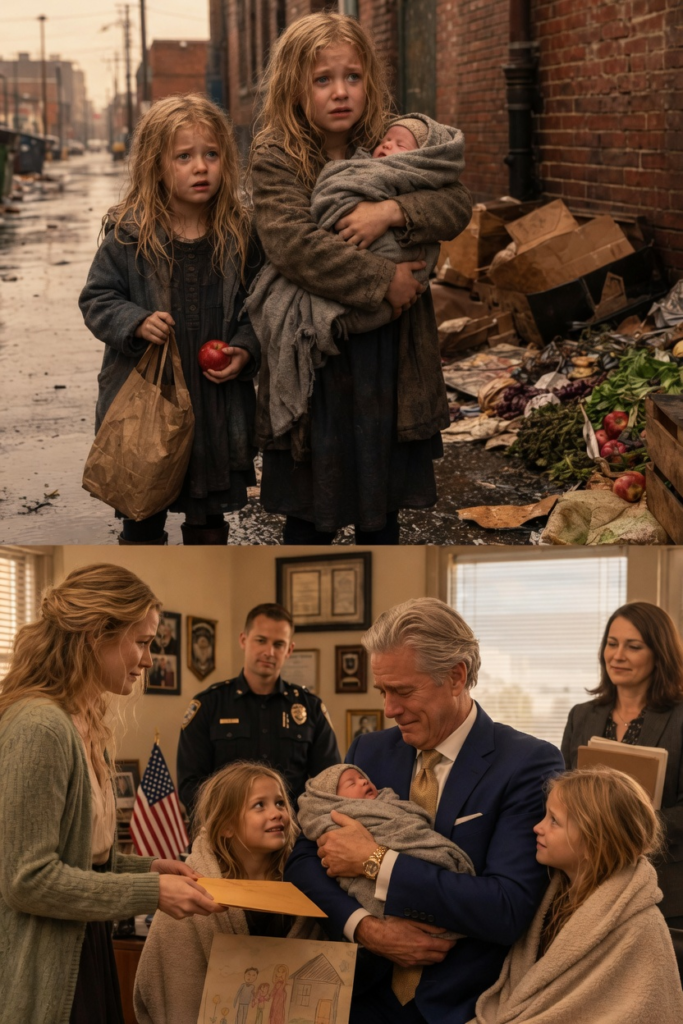
Now, standing in the doorway of the shack less than an hour later, Lena Walker saw her daughters coming across the muddy lot with Lily’s sweater bundled in her arms.
At first, Lena thought one of them had gotten hurt.
Then she heard the cry.
Her whole body went still.
Lily was pale from the cold. June’s face was streaked with tears. Between them, wrapped in damp cloth and Lily’s thin sweater, was a newborn baby boy.
For one terrible second, Lena could not move.
The world narrowed to the baby’s trembling mouth, his bluish lips, his tiny hand clenched against Lily’s chest.
“Mom,” Lily said, her voice shaking. “We found him.”
June burst into sobs. “Somebody put him in the trash.”
Lena crossed the room so fast she nearly slipped on the old rug. She took the baby from Lily with hands that knew hunger, fear, and tiredness—but also knew how to hold something fragile.
“Oh, Lord,” she whispered. “Oh, sweet baby.”
The child was freezing.
His blanket was wet. His little cheeks were raw from the cold. His cries were weak, like a match flame trying not to go out in the wind.
Lena tucked him against her chest and turned sharply.
“June, get the towel by the stove. Lily, bring me the blanket from the bed. Hurry.”
The twins moved at once. They were frightened, but they obeyed. That was something poverty taught children early: when fear came, you did not fall apart until the emergency was over.
Lena sat on the edge of the bed and stripped away the damp gray blanket. The baby’s body was so small it seemed impossible that anyone could have looked at him and chosen abandonment. Around one ankle was a hospital band, but the ink had smeared from rain and grime. On his wrist was a soft white bracelet, the kind newborns wore in nurseries, only this one had been cut and tied back together with thread.
Lena leaned close.
There were letters.
N.W.
A number.
And one word she could barely read.
Whitmore.
She did not know the name. Not then. Not in any way that mattered.
To Lena Walker, he was not a name. He was not money. He was not a headline waiting to happen.
He was a baby turning cold in her hands.
“Mom?” Lily whispered. “Is he going to die?”
Lena pressed the child against the warmest part of her body and rubbed his back with slow, careful circles.
“Not if I can help it.”
“We don’t have a phone,” June said.
Lena looked toward the broken window, where morning light leaked through a plastic sheet. Across the lot, old Mr. Bell lived in a trailer with a working landline and a bad heart. He did not always answer his door. He did not always hear knocks. But he had once told Lena that if the girls were ever in danger, they could come.
“Lily,” Lena said. “Run to Mr. Bell. Tell him we need an ambulance. Say it exactly. A newborn baby is freezing. Tell him to call 911.”
Lily’s eyes widened.
“Can I go with June?”
“No. June stays with me.”
“But you said stay together.”
Lena swallowed hard. “I know what I said. But right now I need you to be brave in a different way.”
Lily looked at the baby.
Then she ran.
The door slapped shut behind her. The shack felt colder without her, as if courage had left the room.
June climbed onto the bed beside Lena, tears still shining on her face. She touched the baby’s foot with one finger.
“He held Lily’s hand,” June whispered. “In the alley. He knew we were there.”
Lena closed her eyes for one second.
She could picture it too clearly: her daughters in the back alley behind McKinley’s, digging through what the city had discarded, finding something more helpless than themselves.
There were moments that divided a life in two. Before and after. This was one of them.
Outside, Lily’s small feet pounded across the lot.
Inside, the baby made a faint whimper.
Lena bent her head and whispered against his damp hair.
“You hang on, little man. You hear me? You hang on.”
By the time the ambulance arrived, the whole block had begun to gather.
Neighbors stood in coats and slippers. Someone brought a dry towel. Someone else brought an old knit cap that had once belonged to a grandchild. Mr. Bell, wheezing from the effort of calling 911 and walking over, stood in Lena’s doorway with one hand pressed against his chest.
“Baby?” he kept saying. “A baby, Lena?”
Lena did not answer because she was listening to his breathing, counting every shallow rise and fall.
The paramedics came in carrying bags and equipment that looked too clean for that room. One of them was a woman with tired eyes and a soft voice.
“I’m Erin. Can I take him?”
Lena hesitated.
It was absurd. He was not hers. She had held him for less than twenty minutes. But fear rose in her anyway—the fear that if she let go, he would disappear into a system that swallowed poor people whole.
Then the baby’s breath hitched.
Lena handed him over.
“Please,” she said. “Please be careful.”
Erin’s expression changed when she saw his color.
“Newborn male, hypothermic, possible exposure,” she said to her partner. “Get the thermal blanket.”
Lily stood in the doorway, shivering in her T-shirt. June clung to her arm.
Erin looked at Lily. “Is that your sweater?”
Lily nodded.
“You may have saved his life.”
Lily did not look proud. She looked terrified.
The police arrived after the ambulance.
Two officers. One young, one older. The younger one looked around the shack, at the dirt floor, the patched roof, the empty shelves, and his face hardened in a way Lena knew too well.
The older officer asked, “Who found the child?”
“My daughters,” Lena said.
“Where?”
“Behind McKinley’s Market. In the alley.”
The younger officer glanced at the twins.
“They were digging in trash?”
Lena’s back straightened.
“They were looking for food.”
The words landed in the room like a thrown stone.
The young officer looked away first.
The older one took out a notebook. “Did you see anyone? Any vehicle? Anything unusual?”
Lily spoke before Lena could answer.
“There was a black car.”
Everyone turned toward her.
Lena’s heart kicked.
“What car, baby?”
Lily swallowed. “Before we went into the alley. It was parked by the back fence. The windows were dark. A man was sitting in it.”
June nodded quickly. “I saw it too. It had shiny wheels.”
The older officer crouched down, careful not to crowd them. “Did the man talk to you?”
“No,” Lily said. “But when the baby cried, the car drove away fast.”
“What kind of car?”
Lily shook her head helplessly.
“It was long,” June whispered. “Like the cars outside hotels.”
“A limo?” the younger officer asked.
June shrugged. “Maybe.”
The older officer wrote it down.
Then his eyes fell on the damp gray blanket lying on the bed.
“Is that what he was wrapped in?”
“Yes.”
He picked it up carefully with gloved hands. Something fell from the fold and landed on the floor with a tiny metal sound.
Everyone stared.
It was a silver baby rattle.
Not plastic. Not cheap. Silver.
Dented at one end. Engraved on the handle.
To Noah, with all my love. —Daddy
For a moment, no one spoke.
The young officer picked it up and read the engraving. His face changed.
The older officer’s voice dropped.
“We need to get this to the hospital.”
Lena hugged June against her side.
“Who is Noah?” Lily asked.
Nobody answered.
At Cleveland Metro Medical Center, the baby was rushed through doors Lena was not allowed to enter.
She stood in the hallway with her daughters wrapped in donated blankets, feeling smaller than she had ever felt in her life.
Hospitals made Lena nervous. Not because she feared doctors, but because hospitals had rules. Forms. Questions. Authority. People who looked at your clothes, your address, your children’s hair, and decided what kind of mother you were before you opened your mouth.
A social worker came. A detective came. Another officer came. Nurses passed in soft shoes. Doors opened and closed.
The twins were given orange juice and crackers. June ate hers slowly. Lily did not touch hers.
“Eat,” Lena whispered.
“I’m not hungry.”
“You are.”
“I want to know if he’s okay.”
Lena pulled her close.
“So do I.”
The detective introduced herself as Marisol Reyes. She wore a navy coat and carried herself like someone who had learned long ago not to waste words.
“I know you’ve answered questions already,” she said gently. “I need to ask a few more.”
Lena nodded.
Detective Reyes looked at the twins. “Can they tell me what happened in their own words?”
Lena’s first instinct was to say no. They were five. They had seen enough. But Lily sat up straighter and said, “We found him.”
Reyes pulled a chair close.
“I’m listening.”
Lily told the story. The cardboard. The tiny hand. The cry. The dark car. The sweater. June added details when Lily forgot. The alley smelled bad. The baby’s blanket was wet. He stopped crying when Lily held him. There were no grown-ups nearby.
Detective Reyes wrote everything down.
When the girls finished, she closed her notebook.
“You both did a very brave thing.”
June asked, “Are we in trouble for taking him?”
Reyes blinked. Then her face softened.
“No, sweetheart. You are not in trouble.”
Lena looked at her. “What happens to him now?”
“The doctors are treating him. We’re trying to identify him.”
Lena’s eyes flicked toward the hall. “His bracelet had a name.”
Reyes studied her.
“You saw it?”
“Just letters. Whitmore. Maybe. I don’t know.”
Reyes’s expression did not change, but something behind her eyes sharpened.
“Mrs. Walker—”
“Miss.”
“Miss Walker. Have you heard that name before?”
“No.”
“Are you sure?”
Lena felt heat rise in her face. “I know what you’re asking. I didn’t take somebody’s baby.”
“I’m not accusing you.”
“Maybe not with your words.”
The detective was quiet.
Then she said, “A newborn disappeared from a private medical facility yesterday evening.”
Lena’s arms tightened around her daughters.
“Disappeared?”
“Yes.”
“Someone stole him?”
“That is what we are trying to determine.”
June whispered, “From his mommy?”
Detective Reyes did not answer right away.
“His mother passed away shortly after delivery.”
The hallway seemed to go colder.
Lily lowered her eyes.
“So he lost his mommy,” she said. “And then someone put him in the trash?”
Reyes’s mouth tightened.
“Yes.”
June began to cry again, not loudly, just a silent spill of tears that made Lena ache.
Lena rubbed her back.
“Who’s his daddy?” Lily asked.
Detective Reyes looked down at her notebook.
“His father is a man named Gabriel Whitmore.”
The name meant nothing to the girls.
But one of the nurses standing nearby turned sharply.
“Gabriel Whitmore?” she said. “As in Whitmore Global?”
Reyes glanced at her.
The nurse covered her mouth.
Lena looked from one face to another. “Who is that?”
The nurse answered quietly, almost unwillingly.
“He’s one of the richest men in Ohio.”
Lena looked toward the doors where the baby had disappeared.
The baby she had held in her cold shack. The baby wrapped in Lily’s sweater. The baby found behind wet cardboard like something the world had no use for.
Richest men in Ohio.
It made no sense.
Babies with billionaire fathers were born under chandeliers, surrounded by flowers and cameras and people paid to protect them. They did not end up behind grocery stores in the cold.
But Lena had lived long enough to know that money did not make people good.
Sometimes it only gave them cleaner places to hide their sins.
Across the city, in the top-floor suite of the Whitmore Tower, Gabriel Whitmore had not slept for thirty-six hours.
He stood before a wall of glass overlooking downtown Cleveland, but he saw none of it. Not the river. Not the bridges. Not the morning traffic. Not the city that had made his family name powerful.
In his hand, he held a newborn hospital cap.
It was pale blue.
It had never touched his son’s head.
Behind him, his mother sat on a white sofa, wrapped in black cashmere, one hand pressed to her temple. Vivian Whitmore had the posture of royalty and the expression of someone being forced to endure an inconvenience in public.
His younger brother, Conrad, stood near the bar pouring himself coffee with the steady hand of a man who had not spent the night imagining his child freezing somewhere alone.
“We need to issue a statement,” Conrad said.
Gabriel did not turn around.
“My son is missing.”
“I know that.”
“My wife is dead.”
“I know that too.”
Gabriel turned then.
Conrad looked away.
Vivian spoke softly. “Gabriel, darling, no one is minimizing your grief.”
Gabriel laughed once, without humor.
“My wife died begging to see him. Do you understand that? Celia asked me if he was beautiful. Those were almost her last words. I told her yes because I had seen him for five seconds through glass before they rushed me out.”
Vivian closed her eyes. “You are torturing yourself.”
“No. Someone took my son. That is torture.”
Conrad set down his cup.
“The police are doing what they can. But if this becomes public before we control the narrative, the company stock will drop. The board is already nervous.”
Gabriel stared at him.
“The board?”
Conrad’s jaw tightened. “You are not thinking clearly.”
“No,” Gabriel said. “For the first time in my life, I am thinking clearly. My son is missing and you are talking about stock.”
Vivian rose.
“Enough. Your brother is trying to protect what you built.”
“What I built?” Gabriel said. “Celia built it with me. She sat at our kitchen table when Whitmore Global was four trucks and unpaid invoices. She answered customer calls while eight months pregnant. She believed in me when this family called me reckless.”
His mother flinched at that.
The phone rang.
All three turned.
Gabriel grabbed it.
“Yes?”
He listened.
The hand holding the phone began to tremble.
“Where?”
His knees weakened.
“Is he alive?”
Vivian stood very still.
Conrad stopped breathing.
Gabriel closed his eyes as tears broke loose for the first time since Celia died.
“I’m coming.”
He dropped the phone and ran.
At the hospital, Lena saw the billionaire before anyone introduced him.
Some people entered a room like they owned it. Gabriel Whitmore entered like a man who would trade everything he owned to change the last twenty-four hours.
He was tall, unshaven, still wearing the wrinkled suit he had likely put on the day before. His eyes were red. His face looked carved out by grief.
Behind him came security, police, a woman in black pearls, a man in a tailored coat, and a storm of whispered names.
But Gabriel saw none of them.
He saw the nursery window.
He walked to it like a sleepwalker.
Inside, under warming lights, the baby lay wrapped in clean blankets with tubes and monitors around him. A nurse adjusted something near his tiny foot.
Gabriel put one hand flat against the glass.
“Noah,” he whispered.
Lily heard him.
The word moved through her with a strange ache. Noah. The baby had a name.
Not “the baby.”
Not “found infant.”
Noah.
Gabriel turned to Detective Reyes.
“Can I see him?”
“The doctors need another few minutes.”
“He’s my son.”
“I know.”
“Then let me see him.”
The doctor came out before Reyes could answer. He was a gray-haired man with kind eyes and the exhausted dignity of someone who had given bad news too many times and good news not often enough.
“Mr. Whitmore?”
Gabriel stepped forward.
“Is he going to live?”
The doctor nodded.
Gabriel’s face crumpled.
“He was severely cold when he arrived,” the doctor said. “But whoever wrapped him before transport likely prevented the worst. His vitals are stabilizing. We’ll monitor him closely, but I believe he has an excellent chance.”
Gabriel covered his mouth with his hand.
Behind him, Vivian whispered, “Thank God.”
But there was something wrong with the way she said it.
Lena did not know why she noticed. Maybe it was because she had spent years cleaning houses for women who smiled while insulting her. Maybe poverty trained the eye to read what people hoped to hide.
Vivian Whitmore looked relieved.
But not like a grandmother whose grandson had been found alive.
More like someone who had nearly been caught and had just been given a little more time.
Gabriel turned.
“Who found him?”
The hallway grew quiet.
Detective Reyes nodded toward Lena and the twins.
“These are the Walkers. Lily and June found Noah behind McKinley’s Market. Their mother got him warm and called for help.”
Gabriel looked at them.
For a few seconds, he seemed unable to understand what he was seeing: two tiny girls in donated hospital blankets, one without a sweater, and a mother whose shoes were split at the seams.
Then he walked over and knelt in front of Lily.
“You found my son?”
Lily nodded.
Gabriel’s voice broke.
“Thank you.”
Lily looked at his expensive coat, his shaking hands, his haunted face.
“He was scared,” she said. “I didn’t want him to be scared by himself.”
Gabriel bowed his head.
A sound came from him then—half sob, half breath—that made even the nurses look away.
June stepped closer to Lena.
Lena put a hand on her shoulder.
Gabriel looked up at both girls.
“You saved his life.”
June whispered, “Lily gave him her sweater.”
Lily said, “June helped carry the bag.”
Gabriel gave a trembling laugh through tears.
“Then both of you saved him.”
Vivian came forward.
Her smile was polished, but her eyes swept over Lena’s clothes, the twins’ tangled hair, the worn soles of their shoes.
“How… fortunate,” she said.
Lena did not reply.
Conrad looked at Detective Reyes.
“Have they been questioned thoroughly?”
Gabriel turned slowly toward his brother.
Conrad lifted his hands. “I’m only asking what everyone is thinking. The child disappears from a secure facility and turns up with—”
“With children who were looking for breakfast in garbage cans,” Lena said.
The hallway went silent.
Conrad’s face tightened.
Lena’s voice did not rise. It did not need to.
“My daughters found your nephew freezing behind cardboard. They carried him home. They gave up the only warm sweater they had. So before you finish whatever sentence your money taught you to start, you better choose the rest of it carefully.”
Gabriel stood.
For the first time since arriving, something like steel returned to his eyes.
“My brother will not question them again.”
Conrad’s mouth opened.
Gabriel stepped closer.
“Not one word.”
Vivian touched Gabriel’s arm.
“Darling, Conrad is only concerned. We all are.”
Gabriel pulled away.
“You should be with Noah,” she said softly.
He looked at her.
“Yes,” he said. “I should.”
The doctors let him in minutes later.
Through the glass, Lily watched Gabriel put on a gown and wash his hands. He moved slowly, as if afraid the world would punish him for touching his own child. When the nurse finally placed Noah in his arms, Gabriel froze.
The baby made one small sound.
Gabriel bent over him.
His shoulders shook.
Lily pressed her palm to the glass.
June whispered, “He knows his daddy.”
Lena looked at the father and child, then at Vivian Whitmore standing behind them with dry eyes.
“I hope so,” Lena said.
By noon, the story had begun to spread.
A missing billionaire’s newborn son found alive.
Two homeless twin girls discovered him in an alley.
Their mother warmed him in a shack.
By three, news vans lined the street outside the hospital. By evening, the twins’ faces were on television, blurred at first and then not, because someone always found a way to turn poor children into public property.
Lena refused interviews.
That did not stop reporters from shouting questions when she stepped outside.
“Miss Walker, did you know who the baby was?”
“Are you expecting a reward?”
“Where exactly do you live?”
“Is it true your daughters were digging through trash?”
“Miss Walker, how much money do you think Mr. Whitmore owes you?”
Lena kept the girls under her arms and walked forward.
Inside, Detective Reyes intercepted them near the elevators.
“I’m sorry,” she said. “We’re trying to keep them back.”
“They know where we live yet?”
Reyes hesitated.
“That means they will soon.”
The detective’s silence was answer enough.
Lena looked at her daughters. Lily was exhausted. June was nearly asleep on her feet.
“We can’t go back there tonight,” Lena said.
Reyes nodded. “I can arrange emergency placement.”
Lena’s spine went stiff. “Placement?”
“A shelter room. For all three of you. Not foster care.”
Lena hated that the distinction had to be made. She hated even more that she was grateful.
Before she could answer, Gabriel came down the hallway.
He had washed his face, but grief still clung to him. In his hands was Lily’s sweater, folded carefully.
“I asked the nurse whose this was,” he said.
Lily reached for it.
It had been cleaned and dried.
“Thank you,” she whispered.
Gabriel looked at Lena.
“I heard you can’t go home tonight.”
Lena’s face closed.
“We’ll manage.”
“No one should have to manage after saving my son’s life.”
“We didn’t do it for you.”
“I know.”
Something in the way he said it stopped her.
He reached into his coat and removed a check.
Lena already knew what it was before she saw the amount.
“There was a reward,” Gabriel said quietly. “Five million dollars for information leading to Noah’s return. You found him. It belongs to you.”
Lena stared.
Five million dollars.
The number did not fit inside her life.
Five million dollars meant food forever. Medicine. A house with heat. School clothes. Dental visits. Beds that did not sag. A door that locked. A refrigerator that hummed in the dark with milk and eggs and fruit that no one had thrown away.
Lily and June looked at her, too young to understand the number but old enough to understand everyone’s faces.
Conrad appeared behind Gabriel.
“Frankly, it’s more than generous,” he said. “Most people would be grateful for far less.”
Lena looked at him.
Then she looked at the check.
Then at her daughters.
There are decisions that seem impossible until you understand what they are really asking you to sell.
Lena could feel the weight of poverty pressing against her back. She could hear every empty morning. Every unpaid bill. Every time she had told her girls she was not hungry so they would eat. She could see the shack, the rotten boards, the cupboard with nothing inside.
And still, she knew.
If she took that check in that hallway, from those hands, under those cameras, the story would become simple.
Poor woman finds rich man’s baby.
Rich man pays poor woman.
Debt settled.
Truth buried.
No.
Lena folded Gabriel’s fingers back over the check.
“My daughters did not save your baby for money.”
Gabriel stared at her.
Lena’s voice remained steady.
“They saved him because he was cold and alone. You don’t owe us five million dollars for being human.”
Conrad gave a short laugh.
“You cannot be serious.”
Lena did not look at him.
Gabriel said, “Miss Walker, please. This could change your life.”
“It would,” Lena said. “But not all change is clean.”
His brow furrowed.
She leaned closer, lowering her voice so only he could hear.
“You want to do something for my girls? Find out who left your son in that alley. Find out who thought his life was worth less than their secret. That’s what you owe.”
Gabriel looked at her for a long moment.
Then slowly, he put the check away.
Behind him, Vivian had arrived silently.
Her eyes were fixed on Lena.
And for the first time, Lena saw fear.
Not grief.
Not shock.
Fear.
That night, the Walkers slept in a family room at the hospital because Gabriel insisted and Detective Reyes quietly allowed it.
Lena slept badly. She woke at every sound. The twins slept curled together on a narrow couch, Lily’s hand tucked under June’s cheek.
At 2:13 in the morning, Lena opened her eyes and saw a man standing in the doorway.
He was not police.
He wore a dark overcoat, leather gloves, and the kind of shoes no one bought unless they expected floors to be clean wherever they went. His hair was silver at the temples. His face was calm.
Too calm.
Lena sat up.
“Wrong room.”
The man raised both hands slightly.
“Miss Walker. I don’t mean to alarm you.”
“You failed.”
He stepped in just enough for the door to begin closing behind him.
Lena stood.
“Leave it open.”
He paused.
Then pushed the door open again.
“My name is Arthur Vale. I represent the Whitmore family.”
“Mr. Whitmore has my number? No, wait. I don’t have a phone.”
Arthur smiled politely.
“I represent Mrs. Vivian Whitmore.”
Lena’s stomach tightened.
“What do you want?”
“A conversation.”
“At two in the morning?”
“A private one.”
Lena glanced at her daughters. Still sleeping.
“Talk.”
Arthur reached into his coat and removed an envelope.
Lena did not take it.
“What’s that?”
“Ten thousand dollars in cash.”
She almost laughed.
After five million, ten thousand should have looked small. It did not. Ten thousand dollars could still change a month, maybe a year. It could buy warmth by morning.
Arthur set the envelope on the chair.
“Mrs. Whitmore understands that today has been overwhelming. She admires your daughters’ actions. But she is concerned about media attention. Children can become confused. Memories can shift under pressure.”
Lena’s face went still.
Arthur continued.
“It would be best if your statement remained simple. Your daughters found the infant. They saw no vehicle. No person. No suspicious circumstances beyond the abandonment itself.”
Lena stared at him.
“There was a black car.”
“Children see many things.”
“They saw a black car.”
“And perhaps it had nothing to do with the child.”
“Then why are you here?”
For the first time, Arthur’s polite expression flickered.
Lena stepped closer.
“You came to pay me to erase what my little girls saw.”
“I came to prevent unnecessary speculation.”
“No. You came because somebody is scared.”
Arthur’s voice cooled.
“Miss Walker, you are in a vulnerable position. No permanent address. No steady employment. Two young children exposed to unsafe conditions. It would be unfortunate if authorities began asking whether you can properly care for them.”
The words struck exactly where he intended.
Lena felt them in her bones.
June murmured in her sleep.
Lena looked at her daughters. Her fear rose like floodwater, but behind it came something older than fear.
Rage.
Quiet, disciplined rage.
She picked up the envelope.
Arthur relaxed.
Then Lena walked to the sink, tore it open, and dumped the money into the basin. Bills spilled like dirty leaves.
Arthur’s mouth tightened.
“Pick it up,” Lena said.
“Excuse me?”
“Pick up Mrs. Whitmore’s trash and get out.”
“You are making a mistake.”
“No. Your mistake was thinking poor means for sale.”
Arthur moved toward the sink.
Lena raised her voice.
“Detective Reyes!”
Arthur froze.
The detective appeared almost immediately from the hall.
She had not been far.
Her eyes moved from Lena to Arthur to the cash in the sink.
“Well,” Reyes said. “This is interesting.”
Arthur straightened.
“I was only—”
“Leaving,” Reyes said.
Lena pointed at him.
“He said Vivian Whitmore sent him. He tried to pay me to change my daughters’ statement.”
Arthur’s face closed.
“That is a serious accusation.”
Reyes smiled without warmth.
“Yes. It is.”
Two officers escorted him out.
Before he disappeared into the hall, Arthur looked back at Lena.
For the first time that night, he looked less like a lawyer and more like a messenger who had failed someone dangerous.
Lena sat down because her knees were shaking.
Detective Reyes stepped inside.
“You handled that well.”
Lena gave a bitter laugh.
“I almost threw up.”
“That’s also allowed.”
Lena looked toward the sleeping twins.
“He threatened to take them.”
“I heard.”
“You heard?”
Reyes hesitated.
“After what you said about Vivian earlier, I thought it might be wise to keep an officer nearby.”
Lena stared at her.
“Why didn’t you warn me?”
“Because if I warned you, he might not come.”
Lena should have been angry. Maybe she was. But she was too tired for the full shape of it.
Reyes looked at the money in the sink.
“Do you understand what this means?”
“It means rich people are worse at crime than they think.”
This time, Reyes almost smiled.
“It means we may have a path to whoever took Noah.”
Lena looked down at her hands.
“Then take it.”
By sunrise, Gabriel Whitmore had learned two things.
First, his mother had sent Arthur Vale to Lena Walker with cash.
Second, Noah’s security footage from the private birthing wing had been erased for a forty-seven-minute window the previous evening.
He received both pieces of information while standing beside his son’s hospital crib.
Noah slept with one fist near his face. He looked impossibly peaceful for someone who had already survived betrayal.
Gabriel listened as Detective Reyes spoke.
His mother stood behind him.
Conrad stood beside her.
Arthur Vale was not present.
When Reyes finished, Gabriel did not move.
Vivian spoke first.
“This is absurd.”
Reyes turned. “Mrs. Whitmore, did you send Mr. Vale to speak with Miss Walker?”
“I sent Arthur to offer assistance. If he acted inappropriately, that is his responsibility.”
“He brought cash.”
“I don’t dictate how my attorneys handle delicate situations.”
Gabriel finally turned.
“Why?”
Vivian blinked. “Gabriel—”
“Why send anyone to her?”
“To protect this family.”
“My son is this family.”
Her face tightened.
“You are grieving. You are not seeing the larger picture.”
“The larger picture?” Gabriel’s voice lowered. “My newborn son was stolen after my wife died. He was dumped in an alley. A woman who has nothing saved him. And you sent a lawyer to threaten her children.”
“I did not instruct him to threaten anyone.”
“But you instructed him to make them quiet.”
Vivian looked at Reyes. “Is this an interrogation?”
Reyes said, “It can be.”
Conrad stepped forward.
“We’re done here. Mother shouldn’t say another word without counsel.”
Gabriel looked at him.
“How did you know?”
Conrad paused.
“Know what?”
“That she needed counsel.”
The room shifted.
Conrad gave a thin smile.
“Because a detective is accusing her of something.”
“No,” Gabriel said slowly. “Detective Reyes said Arthur behaved inappropriately. You jumped to counsel.”
Vivian snapped, “Gabriel, stop.”
He looked between them.
All his life, he had mistaken their coldness for strength. Their calculation for wisdom. Their contempt for ordinary people as a harmless symptom of old money.
But Noah had been found in the arms of people his family would not have allowed through their front gate.
And his family was standing here worried about exposure.
Not Noah.
Exposure.
Gabriel stepped toward his brother.
“Where were you last night between six and seven?”
Conrad’s face hardened.
“With Mother.”
Vivian said, too quickly, “Yes.”
Reyes wrote that down.
Gabriel noticed.
So did Conrad.
The investigation moved quickly after that, because rich people leave expensive traces.
The black car Lily and June had seen was found on a traffic camera three blocks from McKinley’s Market. It was a black Bentley registered to a shell company tied to Conrad Whitmore. The driver, a former private security contractor named Miles Danner, was arrested at a private airport trying to board a flight to Toronto.
At first, he said nothing.
Then police found baby formula, a stained gray blanket, and a hospital access badge in the trunk of the car.
Then Miles Danner began to talk.
He said he had been hired for a simple job: remove the infant from the private birthing suite, drive him to a safe drop location, and hand him to a woman who would take him out of state. He claimed he had not been told the baby would die. He claimed the woman never arrived. He claimed the baby started crying and he panicked. He left him behind the market because he saw people nearby and thought someone would find him.
Detective Reyes did not believe all of it.
But she believed enough.
The nurse who had given Danner access confessed next. Her debts were enormous. Conrad had paid them. Vivian had promised protection. The plan, she said, had been to make Gabriel believe his son had died shortly after Celia. No body, only paperwork. A private cremation. A grieving father too shattered to ask questions until it was too late.
Why?
The answer was both complicated and simple.
Celia had changed Gabriel’s will.
Three weeks before giving birth, Gabriel and Celia had signed new estate documents. If Gabriel died or became incapacitated, control of his voting shares in Whitmore Global would pass not to Vivian or Conrad, but into a trust for his child, overseen by independent trustees until Noah turned twenty-five.
Celia had insisted.
“She never trusted them,” Gabriel whispered when Reyes told him.
He was sitting in a hospital chapel, elbows on his knees, hands clasped so tightly his knuckles had gone white.
Detective Reyes sat two rows behind him, giving him distance without leaving him alone.
“She told me my mother looked at Noah like a rival before he was even born,” Gabriel said. “I laughed. I told her Vivian was just old-fashioned. I told her Conrad was ambitious but loyal.”
His voice broke.
“She knew.”
Reyes said nothing.
Gabriel pressed his hands against his eyes.
“My wife died, and while I was holding her hand, they were stealing our son.”
In the doorway, Lena stood with two cups of bad hospital coffee.
She had not meant to overhear.
She should have left.
Instead, she walked in and set one cup on the pew beside him.
Gabriel looked up.
“I’m sorry,” she said. “Detective said you might need coffee.”
He laughed once, raggedly.
“Coffee won’t fix this.”
“No,” Lena said. “But it gives your hands something to do while the world burns.”
He looked at her.
Then he picked up the cup.
For a long moment, they sat in silence.
Finally Gabriel said, “You were right.”
“I’m not happy about that.”
“You said I owed Noah the truth.”
“Yes.”
“I don’t know what to do with it now that I have it.”
Lena watched the small flame of a candle flicker near the front of the chapel.
“You protect him with it.”
“My mother tried to erase him. My brother paid people to take him. I brought them into every part of my life. They sat beside Celia at dinner. They touched her stomach. My mother bought him a crib.”
Lena’s face softened.
“Evil people can buy cribs.”
Gabriel closed his eyes.
Lena took a breath.
“I don’t know your world, Mr. Whitmore. I don’t know trusts or shares or private hospitals. But I know this. When somebody shows you what they are, you don’t owe them another chance to hurt your child.”
Gabriel looked down at the coffee.
“What about your children?”
She frowned.
“What about them?”
“You refused money that could have saved you from that shack.”
Lena’s jaw tightened.
“I refused payment for saving a baby. That’s different.”
“Is it?”
“Yes.”
He studied her, not with pity now, but with something like respect.
“What would you accept?”
“Nothing.”
“That’s pride.”
“That’s survival.”
“No,” he said gently. “Survival is accepting help before the cold wins.”
The words angered her because they were true.
She stood too quickly.
“My girls are not a charity project.”
“I know.”
“They’re not something you fix so you can feel better.”
“I know that too.”
“Then stop looking at me like you’re about to write another check.”
Gabriel stood.
“I don’t want to buy what they did. I want to honor it.”
Lena’s eyes stung. She hated that. She hated crying in front of rich men, even broken ones.
“You can honor it by raising Noah right.”
“I will.”
“Then we’re done.”
But Gabriel shook his head.
“No. We are not.”
Outside the chapel, Lily and June were sitting with a nurse, coloring on printer paper. Someone had given them crayons. Lily was drawing Noah wrapped in yellow light. June was drawing a house with three windows and smoke from a chimney.
Gabriel looked at the drawings, then back at Lena.
“Do you know what Celia wanted to do before she got sick?” he asked.
Lena said nothing.
“She wanted to open a family center near the east side industrial lots. Food, showers, legal aid, job placement, childcare. Not a shelter that treats people like problems. A place that assumes people are worth investing in.”
Lena’s expression shifted.
“She had plans,” Gabriel said. “A building picked out. I kept telling her we’d start after Noah was born.”
He swallowed.
“She didn’t get after.”
Lena looked through the chapel doors at her daughters.
Gabriel said, “Help me build it.”
She turned back sharply.
“What?”
“I don’t need a spokesperson. I don’t need a photo. I need someone who knows what families actually need. Someone no one like me has ever listened to enough.”
“I clean offices.”
“You raised two daughters in conditions that would have broken people with more resources and fewer burdens. You kept them kind. You kept them brave. That qualifies you more than half the consultants in my building.”
Lena looked away.
“That sounds pretty. Pretty words are cheap.”
“Then make them expensive,” Gabriel said. “Salary. Benefits. Housing while the center is built. Not as reward. As employment. As partnership. You can say no. But don’t say no because someone taught you that accepting a door means you didn’t deserve one.”
Lena had no answer.
Because beneath all her fear, pride, suspicion, and exhaustion, something dangerous had opened.
Hope.
She did not trust it.
Hope had hurt her before.
But Lily was drawing a baby in light.
June was drawing a house.
And Lena was tired of teaching her children to survive when they deserved to live.
“I’ll think about it,” she said.
Gabriel nodded.
“That’s all I ask.”
The arrests happened before Noah left the hospital.
Vivian Whitmore was taken from her home at 7:42 in the morning. Cameras caught only the back of her silver head as detectives guided her into a waiting car. Conrad was arrested at the Whitmore Tower in front of twelve board members and one terrified assistant holding a tray of untouched coffee.
Arthur Vale surrendered through his attorney.
Miles Danner pleaded for a deal.
The nurse cried through her arraignment.
The news called it the Whitmore Heir Conspiracy.
Lena hated that phrase.
Noah was not an heir when Lily found him.
He was a cold baby.
But the world preferred stories with money in the title.
Reporters camped outside the hospital. They found old photos of Lena from a church pantry volunteer list. They found the shack. They filmed the alley. They called Lily and June “the garbage-picking twins,” until Gabriel’s legal team threatened every network that used the phrase again.
The public loved the story for the wrong reasons.
They loved that poor children had saved a rich baby.
They loved the image of innocence touching wealth.
They loved asking whether Lena should have taken the money.
Some called her noble.
Some called her stupid.
Some said she refused because she was hiding something.
Some said Gabriel should adopt the twins.
Some said Lena did not deserve them because they were hungry.
The cruelty of strangers, Lena learned, had no income bracket.
One afternoon, while Noah was still in the neonatal unit, Lily found Lena crying in a restroom.
Lena quickly wiped her face.
“Mom?”
“I’m okay.”
Lily did not believe her. Children of tired mothers become experts in lies spoken gently.
“Are they going to take us away because we looked in the trash?”
Lena knelt.
“No.”
“But people keep saying—”
“People say many things when they don’t have to live the life they’re talking about.”
Lily’s lip trembled.
“I didn’t know everyone would be mad.”
“Oh, baby.” Lena pulled her close. “They’re not mad because you did wrong. They’re loud because you did right and it made them uncomfortable.”
June came in behind them.
“Can we stop being on TV?”
Lena held out her other arm.
“Yes,” she said fiercely. “Yes, we can.”
That evening, Gabriel held a press conference.
Not in front of the hospital. Not with Noah displayed like proof. He stood alone behind a podium at Whitmore Global, pale and exhausted, and looked directly into the cameras.
“My son, Noah Gabriel Whitmore, is alive because two children acted with more courage than the adults who failed him. Their mother acted with more integrity than people who had every advantage and chose greed.”
Flashbulbs went off.
He continued.
“The Walker family owes the public nothing. They are not symbols. They are not entertainment. They are a mother and two little girls who did the right thing. I ask, with all the force and resources available to me, that you leave them in peace.”
A reporter shouted, “Mr. Whitmore, is it true Lena Walker refused the five-million-dollar reward?”
Gabriel paused.
“Yes.”
“Why?”
Gabriel looked down for a moment.
Then he said, “Because she understood something my own family forgot. A child’s life is not a transaction.”
The clip played everywhere.
For the first time, the world fell quiet around Lena.
Not completely. The world never gave up that easily. But enough.
Noah came home from the hospital eight days after Lily and June found him.
Gabriel did not take him to the Whitmore estate.
He took him to the smaller house he and Celia had bought before the money became enormous—a brick home with a yellow kitchen, creaky stairs, and a nursery Celia had painted with clouds.
Before leaving the hospital, Gabriel asked Lena and the girls to visit.
Lena almost said no.
June said yes for all of them.
“We have to say goodbye,” she insisted.
So they went.
Noah looked healthier now. His cheeks had filled out. His fists had gained strength. He wore a soft blue outfit with tiny white socks. When Gabriel lowered him carefully, Lily touched his hand.
Noah’s fingers curled around hers.
Again.
Lily’s eyes widened.
“He remembers me.”
Gabriel smiled.
“I think he does.”
June leaned close.
“Hi, Noah. Don’t go in any more trash, okay?”
Lena closed her eyes.
Gabriel laughed, but it hurt.
“I’ll do my best to make sure he doesn’t.”
Lily looked up at him.
“Are you still sad?”
The room quieted.
Gabriel sat beside her.
“Yes.”
“Because his mommy died?”
“Yes.”
“And because your mommy was bad?”
Lena whispered, “Lily.”
Gabriel raised a hand.
“It’s okay.”
Lily’s face was serious.
“Sometimes when people are bad, you still love them and it makes your stomach hurt.”
Gabriel stared at her.
“How do you know that?”
She shrugged.
“Our dad was bad sometimes.”
Lena’s face changed, but she said nothing.
Gabriel’s voice softened.
“I’m sorry.”
“He left,” June said. “Mom says leaving is sometimes the only good thing a bad person does.”
Lena rubbed her forehead.
“I said that once.”
“It was true,” June said.
Gabriel looked at Lena, and something unspoken passed between them—two parents standing in the wreckage other people left behind, both trying to build something their children could trust.
Lily gently freed her finger from Noah’s grip.
“Bye, baby,” she whispered. “Be safe.”
Gabriel’s eyes filled.
“He will know who saved him.”
Lena said, “He doesn’t need to owe them.”
“No,” Gabriel said. “But he does need to know goodness when he hears about it.”
Three weeks later, Lena visited the building Celia had chosen.
It was an old community clinic on Buckeye Road, empty for six years, its windows boarded, its walls tagged with graffiti, its waiting room full of dust and broken ceiling tiles.
Gabriel met her there wearing jeans, work boots, and a baby carrier strapped to his chest. Noah slept against him, one cheek pressed to his shirt.
Lena tried not to smile.
“You bring him to business meetings?”
“I don’t let him out of my sight.”
“That’s not healthy forever.”
“No,” he said. “But it’s necessary for now.”
She accepted that.
They walked through the building with contractors, architects, and a woman named Priya Shah, who had run nonprofit housing programs for twenty years and had no patience for rich guilt.
“This can be the kitchen,” Priya said, pointing through a doorway.
Lena stepped into the room.
She imagined big pots. Coffee. Bread. Soup. A refrigerator with labeled shelves. A pantry where no mother had to pretend not to be hungry.
Her throat tightened.
“This should be open early,” Lena said.
Priya looked at her.
“How early?”
“Before school. Before day labor pickup. Hunger starts before offices open.”
Priya nodded and wrote it down.
“And showers,” Lena said. “Not just two. People line up for showers like dignity has business hours.”
Gabriel listened.
Lena kept walking.
“Laundry. A room for kids to sleep while parents fill out forms. Lockers that actually lock. Mailboxes. You can’t get a job without an address. You can’t get papers mailed to a tent.”
Priya kept writing.
“Phones,” Lena said. “Not one phone at a desk where everyone hears your business. Private ones. People need to call landlords, doctors, case workers, maybe someone they’re scared of.”
Gabriel said quietly, “What else?”
Lena looked around the ruined room.
“Don’t make it pretty in a way that tells people they don’t belong. Make it clean. Warm. Strong. Make the chairs comfortable but not fancy. And don’t put the security guard at the front like everyone walking in is already guilty.”
Priya smiled.
Gabriel looked at Lena.
“You’ll take the job?”
Lena looked down at Noah.
The baby yawned in his sleep.
“I’ll take the job,” she said. “But I won’t be your charity story.”
“No.”
“And my girls are not props.”
“Never.”
“And if you start making decisions that look good in speeches and bad in real life, I’ll tell you.”
Gabriel smiled for the first time in days like he meant it.
“That’s why I want you there.”
The Celia Whitmore Family Center opened six months later.
By then, Vivian and Conrad had been indicted on charges that filled columns: conspiracy, kidnapping, fraud, attempted custodial interference, obstruction, bribery. The trials would take time. Rich people’s consequences often moved through the world in expensive slow motion. But they moved.
Gabriel cut off every financial channel he could. He removed Conrad from the company. He stepped down from daily leadership for three months and installed an interim CEO who had once made the mistake of asking if “the baby situation” would affect quarterly projections.
It did not go well for that CEO.
Gabriel spent mornings with Noah and afternoons helping build the center.
Lena moved with Lily and June into a small rental house owned by the foundation—not free, not a gift, but tied to her salary at a rent she could actually pay. The first night, June ran from room to room counting light switches.
“Mom! This bathroom has a lock!”
Lily opened the refrigerator and stared.
There was milk. Eggs. Apples. Chicken. Yogurt. Carrots. A whole loaf of bread.
She touched the loaf with two fingers.
“Can we eat it whenever?”
Lena leaned against the counter.
“Yes.”
Lily frowned.
“Even if it’s not almost bad?”
Lena covered her mouth.
June opened a cabinet.
“There are plates that match!”
That night, the twins slept in separate beds for the first time.
At midnight, Lily carried her blanket into June’s room.
At 12:07, June carried her pillow into Lily’s.
Lena found them asleep together on the floor between the beds.
She left them there and covered them with both blankets.
Some kinds of safety take time to believe.
At the family center, Lena became known for three things.
First, she remembered names.
Second, she could detect foolish policy from fifty feet away.
Third, she never let donors tour during breakfast.
“If you want to help, help,” she told a banker who arrived with a photographer. “If you want pictures of hungry children, go home and ask yourself why.”
The banker donated anyway.
People often did, after Lena embarrassed them.
The kitchen opened at 5:30 every morning. By winter, it served two hundred breakfasts a day. There were showers, laundry machines, legal clinics, addiction counselors, job placement, mailboxes, childcare, and a small room called June’s Corner because June insisted every place needed books and crayons.
Lily asked for a first-aid cabinet.
Then a bigger one.
Then weekly nurse visits.
“You can’t help people if their feet hurt too much to walk to the help,” she explained.
Gabriel funded both.
Noah grew.
He became round-cheeked and solemn, with Celia’s dark curls and Gabriel’s serious eyes. He liked being held by Lena because she bounced him exactly twice before settling him against her shoulder. He liked June because she made ridiculous faces. He liked Lily because whenever she entered the room, he reached for her finger.
On Noah’s first birthday, Gabriel held a small gathering in the center’s courtyard. Not a gala. Celia would have hated a gala for a baby. There were cupcakes, paper lanterns, children running between folding chairs, and a banner June painted herself:
HAPPY BIRTHDAY NOAH. NO TRASH EVER AGAIN.
Lena tried to take it down.
Gabriel laughed so hard he nearly dropped the cake.
“Leave it,” he said. “It’s honest.”
During the party, Gabriel stood beside Lena near the kitchen door.
Noah sat on a blanket with Lily and June, smashing frosting into his own hair.
“He looks happy,” Lena said.
“He is.”
“Are you?”
Gabriel did not answer quickly.
“I am becoming something like happy again.”
“That counts.”
He glanced at her.
“Are you?”
Lena watched her daughters laugh.
“I’m learning not to be afraid every time something good happens.”
“That counts too.”
Across the courtyard, Noah crawled toward Lily and grabbed her shoelace.
Lily bent down.
“No, sir. We don’t eat shoes.”
June said, “He’s rich. Maybe rich babies eat shoes.”
“They do not.”
“You don’t know.”
Gabriel smiled.
For a moment, the sunlight touched everything gently—the chipped brick, the folding tables, the children, the woman who had lost so much, the man who had nearly lost everything, the baby who had been thrown away and found.
Then his phone rang.
His smile faded when he saw the number.
Lena noticed.
“What?”
Gabriel answered.
He listened.
His face changed.
After a moment, he said, “Thank you for telling me.”
He hung up.
“Vivian wants to see me,” he said.
Lena looked toward Noah.
“Why?”
“She’s offering a full confession in exchange for a reduced sentence. But she asked to speak to me first.”
“Are you going?”
“I don’t know.”
Lena crossed her arms.
“What do you want from that room?”
He looked at her.
“The truth.”
“You have the truth.”
“Maybe an apology.”
Lena’s face softened.
“Gabriel.”
He looked away.
“She’s my mother.”
“I know.”
“What if I need to hear her say she’s sorry?”
“Then go. But don’t confuse needing it with getting it.”
He stood silent for a long time.
The next morning, Gabriel went to the county detention center.
Vivian Whitmore entered the visitation room wearing beige jail clothing as if it were a personal insult. Her hair was still immaculate. Her posture remained perfect. Only her hands betrayed her; they trembled when she sat.
Gabriel sat across from her.
For the first time in his life, there was glass between them.
Vivian lifted the phone.
Gabriel lifted his.
“Darling,” she said.
The word nearly broke him. Not because it was warm, but because once he had believed it was.
“Don’t call me that.”
Pain flashed across her face, or something rehearsed to look like pain.
“Gabriel, I have made terrible mistakes.”
He said nothing.
“I was afraid.”
“Of a newborn?”
“Of losing everything your father built.”
“I built Whitmore Global.”
“With this family’s name.”
“With Celia.”
Vivian’s mouth tightened.
“Celia turned you against us.”
“Celia tried to protect our son from you. She was right.”
His mother’s eyes hardened, and suddenly Gabriel saw the truth beneath all the silk.
Vivian was not sorry Noah had been taken.
She was sorry he had survived.
“She wanted to replace us,” Vivian said.
“He was a baby.”
“He was an instrument. You were too blinded by grief and sentiment to see what she was doing.”
Gabriel stared at her.
There it was.
No apology.
No love large enough to recognize a child.
Only power, threatened by a crib.
Vivian leaned closer to the glass.
“Listen to me. Conrad was foolish. He hired unstable people. I never wanted the child harmed.”
“His name is Noah.”
She flinched.
“I never wanted Noah harmed. I only wanted time. Time to challenge the trust. Time to keep the company safe.”
“You left him to die.”
“No. Danner panicked. That was never the plan.”
Gabriel’s voice was quiet.
“What was the plan?”
Vivian looked at him.
“To place him with a family far enough away that he would never return.”
The words emptied him.
Somewhere, in another version of life, Noah would have grown up nameless in someone else’s arms while Gabriel mourned a false death. Lily and June would have passed that alley and found nothing. Lena would still be hungry. Celia’s nursery would remain empty.
Gabriel put the phone down.
Vivian’s eyes widened.
He stood.
She struck the glass with her palm.
Gabriel did not look back.
At the trial, Vivian’s confession sealed the case.
She tried to shape it, of course. Tried to make herself a protector of legacy. Tried to paint Celia as manipulative, Gabriel as unstable, Conrad as devoted but misguided.
Then the prosecution played the hospital audio.
Celia had recorded a message for Noah the night before delivery.
No one knew until her phone was recovered from a bag Vivian had ordered removed from the birthing suite.
In the courtroom, Celia’s voice filled the air.
“Hi, little one. It’s your mom. You’re not here yet, but you are already loved more than you can imagine. Your dad is pretending he isn’t nervous, but he’s rearranged your books three times. I want you to know something. You are not a company. You are not a name. You are not anyone’s second chance. You are our son. That is enough. That will always be enough.”
Gabriel lowered his head.
Lena, sitting behind him with the twins, wiped her eyes.
Even the judge looked down.
Vivian did not cry.
The jury noticed.
Conrad took a plea before closing arguments.
Vivian did not. Pride carried her all the way to conviction.
She was sentenced to prison.
So was Conrad.
Not forever. Not long enough, some said. Too long, others argued. But long enough that Noah would grow up knowing locked doors could protect as well as imprison.
Outside the courthouse, reporters shouted again.
Gabriel did not answer.
Lena did not answer.
Lily, now six, held June’s hand and looked straight ahead.
But when one reporter yelled, “Lily, do you forgive the people who hurt Noah?” she stopped.
Lena whispered, “Keep walking.”
Lily turned anyway.
“I’m a kid,” she said. “Ask God.”
Then she walked on.
The clip went viral by dinner.
June was furious.
“I wanted to say something too.”
“What would you have said?” Lena asked.
June thought about it.
“I would have said, ‘Also ask God.’”
Lena laughed until she cried.
Years passed, not smoothly, but steadily.
The Celia Whitmore Family Center became three centers, then five. Lena became director of community operations, a title she initially hated because it sounded like something printed on glass doors. She kept it when she learned it came with the authority to fire people who treated families like case numbers.
She bought her own house after four years.
Not rented.
Bought.
It was small and white with blue shutters and a maple tree in the front yard. On the day she received the keys, Lily and June ran through the rooms screaming. Lena stood in the kitchen alone and pressed her hand to the wall.
No landlord could remove them.
No storm came through the roof.
No extension cord powered the lights.
She sank to the floor and sobbed with relief so deep it frightened her.
Gabriel arrived an hour later with Noah, now four, carrying a houseplant bigger than his torso.
Noah marched in proudly.
“Auntie Lena, Daddy says plants mean roots.”
Lena looked at Gabriel over Noah’s curls.
“Auntie Lena?”
Gabriel winced.
“He started that himself.”
Noah hugged her knees.
“You are Auntie Lena.”
Lena bent and kissed the top of his head.
“Then I guess I am.”
Lily and June came running.
Noah shouted, “My sisters!”
Gabriel opened his mouth to correct him, then closed it.
The girls did not correct him either.
Family, they had all learned, was not always a straight line. Sometimes it was a baby’s hand in a cold alley. Sometimes it was bad coffee in a hospital chapel. Sometimes it was someone refusing money because truth mattered more. Sometimes it was showing up again and again until love stopped needing an explanation.
Noah grew up knowing the story.
Not all at once.
Gabriel told it in pieces, as children can bear them.
When Noah was five, he learned Lily and June found him when he was very cold.
When he was seven, he learned someone had made a terrible choice and left him where he should not have been.
When he was ten, he learned his grandmother and uncle had gone to prison because they cared more about power than his life.
When he was twelve, he asked the question everyone had feared.
“Did my mom know?”
Gabriel sat with him on the porch of Lena’s house while Lily and June, now teenagers, argued inside over who had eaten the last piece of cornbread.
“Know what?” Gabriel asked, though he understood.
“Did she know they were bad?”
Gabriel looked across the yard.
“Yes,” he said. “I think she did.”
“Did you?”
Gabriel took a long breath.
“I should have.”
Noah was quiet.
The old guilt rose, familiar as weather.
Then Noah said, “But you found me.”
Gabriel looked at him.
“No,” he said. “Lily and June found you.”
“And you kept me.”
Gabriel’s throat tightened.
“Yes.”
Noah leaned against him.
“Then you’re not bad at knowing. You just learned late.”
Inside, Lily shouted, “June Walker, I know you took it!”
June shouted back, “Prove it in court!”
Noah smiled.
Gabriel put an arm around his son.
“I did learn,” he said.
When Lily and June graduated high school, the ceremony was held on a hot June afternoon in the football stadium.
Lena arrived two hours early.
She saved seats for Gabriel and Noah in the front row, though Gabriel insisted he did not need special treatment. Lena told him not to be annoying.
The twins walked one after the other.
Lily Walker, honors, scholarship to study nursing.
June Walker, honors, scholarship to study social work and public policy.
Lena cried before either name was called.
Gabriel handed her tissues.
Noah, now thirteen, cheered so loudly that June bowed dramatically onstage.
After the ceremony, they took photos under a tree. Caps tilted. Gowns flapped in the warm wind. Lena kept touching the girls’ faces as if checking they were real.
“You did it,” she kept saying.
Lily hugged her.
“We did it.”
June pulled Gabriel into the photo.
“Come on. You’re part of the weird family.”
Noah said, “We need a name.”
Lena said, “Absolutely not.”
June gasped. “The Alley Avengers.”
“No,” said everyone at once.
Lily laughed.
Later, after cake at Lena’s house, Gabriel found Lily sitting alone on the porch steps.
She held something in her hand.
“What’s that?” he asked.
She opened her palm.
It was the silver rattle.
Gabriel froze.
“I thought that was in evidence.”
“It was. Detective Reyes gave it back to you, remember? You gave it to Noah. Noah gave it to me when he was seven because he said I found it first.”
Gabriel smiled faintly.
“That sounds like him.”
Lily ran her thumb over the engraving.
“Do you ever think about how small things change everything?”
“All the time.”
“If I hadn’t reached behind that cardboard…”
Gabriel sat beside her.
“But you did.”
“What if I had been scared?”
“You were scared.”
“What if I had run?”
“You didn’t.”
She looked at him.
“I didn’t know he was yours.”
“That’s why it mattered.”
Lily frowned.
“Would it have mattered less if he wasn’t?”
“No,” Gabriel said. “But it mattered that you didn’t need to know who he belonged to before deciding he deserved to live.”
Lily looked down.
“I want to work in emergency medicine.”
Gabriel smiled.
“I know.”
“I want to be the person who doesn’t look away.”
“You already are.”
Her eyes filled, but she blinked the tears back.
Inside, June shouted for them to come before Noah ate all the cake.
Lily stood.
Gabriel touched the rattle once before she slipped it into her pocket.
“Thank you,” he said.
She gave him the same serious look she had given him in the hospital years earlier.
“You already said that.”
“I’ll never be done saying it.”
At twenty-three, Lily Walker became a neonatal emergency nurse.
At twenty-three, June Walker became the youngest program director in the history of the Celia Whitmore Family Network.
At eighteen, Noah Whitmore stood in the courtyard of the original center on Buckeye Road, wearing a suit he hated, preparing to give a speech he had rewritten fourteen times.
The center had been renovated twice since opening, but Lena had insisted the first kitchen table remain. It sat near the entrance, scarred and sturdy, with a small plaque:
At this table, no one earns dignity. They arrive with it.
Noah stood beside it, folding and unfolding his notes.
Gabriel watched from across the room. Silver had entered his hair. Grief had not vanished from his face, but it had softened into something livable.
Lena came up beside Noah.
“Nervous?”
“Yes.”
“Good.”
“How is that good?”
“Means you care.”
He looked toward the crowd. Donors, families, staff, reporters, former clients, city officials, children eating cookies before dinner because June had stopped trying to control that battle.
Lily stood near the medical station in scrubs, having come straight from a shift. June moved through the crowd with a clipboard, commanding chaos like a general in earrings.
Noah looked at them.
“I don’t know how to say it right.”
Lena touched his cheek.
“Say it true.”
He stepped onto the small platform.
The room quieted.
Noah looked at his father first.
Then at Lena.
Then at Lily and June.
“My name is Noah Gabriel Whitmore,” he began. “Most people who know my story know the worst part first. They know I was taken from a hospital. They know I was left in an alley. They know my father was rich and my rescuers were poor, because people like stories that sound impossible.”
He paused.
“But the truth is simpler than that. I was a baby. I was cold. I cried. And two little girls heard me.”
Lily wiped her eyes.
June pretended not to.
Noah continued.
“They didn’t ask my last name. They didn’t ask what I was worth. They didn’t wonder whether helping me would help them. They saw someone smaller than they were, and they did what their mother taught them to do.”
He looked at Lena.
“If somebody is smaller than you and hurting, you help.”
Lena pressed a hand to her mouth.
“My father once offered Lena Walker a reward,” Noah said. “She refused it. For years, people have argued about that. Some called it noble. Some called it foolish. But I think they missed the point. She refused to let the world turn kindness into a receipt.”
The room was silent.
“That refusal exposed the people who hurt me. Not because money is evil. Money can build kitchens, clinics, classrooms, homes. Money can do good when it remembers it is a tool, not a god. But the people who took me believed everyone had a price. Lena Walker proved they were wrong.”
Gabriel lowered his head.
Noah’s voice strengthened.
“This center exists because of Celia Whitmore, my mother, who believed people are not companies or names or second chances. It exists because of my father, who chose truth over blood. It exists because of Lena, Lily, and June Walker, who taught me that family is not only who holds you first, but who refuses to let go when the world gets cold.”
He unfolded the last page.
“Today, on my eighteenth birthday, the trust my mother created begins transferring into my legal control. I have decided that the first act of that trust will be to permanently endow the Walker Fund, supporting emergency housing, child nutrition, and medical care at every Celia Whitmore Family Center in Ohio.”
Applause broke out, but Noah raised a hand.
He turned toward Lily and June.
“And I have one more thing.”
June narrowed her eyes suspiciously.
Noah smiled.
“This is not a reward.”
Laughter moved through the crowd.
“It is not payment. It is not charity. It is a promise. The Walker Fund will be governed by people who have lived the problems it exists to solve. Lena will chair the board. June will direct statewide programs. Lily will lead the neonatal outreach initiative we are launching with Metro Medical Center.”
Lily stared at him.
“What?” she mouthed.
June whispered, “He got us.”
Noah looked back at the crowd.
“When I was five days old, I was left behind a market in a gray blanket. Today, families walk into this building before sunrise and find breakfast, showers, medicine, mail, legal help, and someone who knows their name. That is not a happy ending because bad things stopped happening. Bad things still happen.”
His voice softened.
“It is a happy ending because good people did not stop either.”
The room rose to its feet.
Gabriel clapped with tears on his face.
Lena did not clap at first. She just looked at Noah—the baby who had once fit inside Lily’s sweater, now standing tall beneath lights, using his inheritance not as armor but as a bridge.
Then she stood too.
After the speeches, after the photographs, after June scolded Noah for surprising her in public and Lily hugged him so tightly he complained about his ribs, the five of them slipped away to the old alley behind McKinley’s Market.
The store had changed owners. The brick wall had been repainted. The dumpsters were newer. A security light buzzed overhead. Someone had planted flowers in barrels near the back door.
But Lena knew the place.
Lily stood where the cardboard boxes had been.
June slipped her hand into her sister’s.
Noah looked around quietly.
“This is smaller than I imagined,” he said.
“Most monsters are,” Lena replied.
Gabriel held a small box.
Inside was the silver rattle.
He had asked Lily’s permission before bringing it.
Noah took it out and read the engraving, though he knew it by heart.
To Noah, with all my love. —Daddy
He looked at Gabriel.
“You bought this before I was born?”
Gabriel nodded.
“Your mom said it was too fancy for a baby. She was right.”
Noah smiled.
“She usually was?”
“Almost always.”
Lily looked behind the stack of new crates near the wall.
“I reached there,” she said softly.
June leaned against her.
“I dropped an apple.”
“I remember.”
“It was bruised anyway.”
Lena laughed quietly.
Noah stepped toward them.
“I used to hate this place,” he said. “Even before I saw it. I hated that my life almost ended here.”
No one interrupted.
“But now I think maybe my life began here too. Not my breathing life. My real one. The one where I belonged to more people than blood.”
Gabriel’s eyes shone.
Noah crouched and placed the silver rattle on the ground for a moment, exactly where Lily had found him.
Then he picked it back up.
“I’m not leaving anything here,” he said.
Lena smiled.
“Good.”
June wiped her face.
“Can we go? This alley is making me emotional and it still smells weird.”
They laughed.
As they turned to leave, Noah caught Lily’s hand.
Not because he was cold.
Not because he was afraid.
Because some gestures become history, and some history becomes home.
Lily squeezed his fingers.
June took his other hand.
Lena walked beside Gabriel.
For a moment, the old image returned to her: two little girls crossing a muddy lot with a baby wrapped in a sweater, carrying him toward a shack that could barely keep out the wind.
Then it faded.
In its place was this.
A family walking out of an alley together.
No reward between them.
No debt unpaid.
No secret left buried.
And above Cleveland, morning light broke over the rooftops, clean and gold, touching the city as if every lost thing might still be found.