After I Changed My Bank Account, My Daughter and Son-in-Law Came Screaming for the Secret I’d Finally Found
My name is Margaret Whitaker, though everyone in Willow Creek, Ohio, calls me Maggie. At sixty-three, I had learned to measure life in small, dependable things: the whistle of the kettle at 6:30 each morning, the soft creak of the porch swing, the smell of dryer sheets when I folded towels in the laundry room my late husband built with his own hands.
I had been a widow for almost four years when the trouble started, though if I am honest, it had probably started long before I was brave enough to see it.
My husband, Robert, had always handled the bills. He was not controlling about it; he was simply good at it. He kept folders labeled by year, receipts clipped neatly, insurance papers in a fireproof box, passwords written in a little black notebook he hid inside a cookbook because, as he said, “No thief is going to look inside Betty Crocker’s New Picture Cook Book.”
After Robert died from a sudden heart attack in our kitchen, I felt like the house had lost its foundation. For months, I wandered from room to room as if I had misplaced something. My daughter, Emily, came over often during that time. She was thirty-five, pretty in the polished way women get when they spend half their lives trying to look more successful than they feel. Her husband, Brandon, was the kind of man who shook your hand too hard and spoke too loudly about business.
At first, I was grateful for them.
“Mom, you don’t need to worry about this stuff,” Emily told me one evening, sitting at my dining room table with Robert’s files spread around her. “Dad always took care of it. Let me help.”
I handed her the little black notebook.
That was my first mistake.
Emily set up online banking for me, downloaded the bank app on my phone, ordered me a debit card, and showed me how to use automatic payments. She said it would make life easier. And for a while, it did.
Every month my pension came in. Robert’s life insurance had long since been deposited. I also had Social Security and a modest investment account he had built slowly, carefully, without ever bragging about it. We were not rich, but we had been comfortable. Comfortable enough that I could pay the property taxes on the house, buy groceries, keep the lights on, and send birthday checks to my grandchildren.
Emily and Brandon had two kids, Ava and Mason. I loved those children with the helpless kind of love that makes you buy cookies you should not buy and sit through school plays where nobody knows their lines.
Brandon called me “Mom” within a year of marrying Emily. Back then, I thought it was sweet. Later, I understood that some people use family words like keys.
The first strange thing happened on a Tuesday in March.
I was at Miller’s Market buying chicken breasts, coffee, and a small bouquet of yellow tulips because I missed Robert more in spring. When the cashier rang me up, my card declined.
“Oh, honey, try it again,” said Linda, the cashier. We had known each other since our kids were in kindergarten.
I tried again.
Declined.
My cheeks burned. There is a particular humiliation that comes from standing under fluorescent lights with groceries bagged in front of you while people behind you pretend not to notice.
“I’ll use another card,” I murmured, though I only had one.
Linda lowered her voice. “Don’t worry about it. Bring me cash tomorrow.”
I carried my groceries to the car with shaking hands. At home, I called Emily.
“Mom, it’s probably a bank glitch,” she said quickly. “Don’t panic.”
“I’m not panicking. I just don’t understand. My pension came in last week.”
“Banks do this sometimes. Brandon says digital systems are unreliable.”
I heard Brandon in the background say, “Tell her not to go to the branch. They’ll just confuse her.”
That sentence stayed with me.
They’ll just confuse her.
It sounded helpful, but it landed like a hand on the back of my neck.
“I think I’ll call the bank anyway,” I said.
“Mom,” Emily sighed, using the same tone she had used when she was sixteen and I asked where she was going. “You know how you get with paperwork. Let me handle it.”
A good mother wants to believe her child. A lonely widow wants to believe even more.
So I let her handle it.
Two days later, Emily said everything was fixed. She said some “pending transactions” had caused a temporary hold. I did not know enough to argue.
But then it happened again.
This time at the pharmacy.
Then again at the gas station.
The third time, I sat in my car outside the pump and cried with the engine off.
I was not poor. At least, I did not think I was. Yet every few weeks, my card seemed to stop working, and Emily always had an explanation. A subscription renewal. A bank security flag. A transfer delay. A new app update.
Finally, in late April, I received a letter from my bank. Not an email. A real letter, folded in an envelope, addressed to me.
It said my account had been overdrawn three times in the last sixty days.
Overdrawn.
I read the word again and again at the kitchen table where Robert had died, and something cold moved through me.
The next morning, I drove to First County Bank.
It was raining, the kind of steady gray rain that makes Ohio look tired. I wore my navy coat and Robert’s old watch, which was too big for my wrist but made me feel less alone.
The young teller smiled when I stepped inside.
“Good morning. How can we help you?”
“I need to speak with someone about my account,” I said.
“Of course. Do you have an appointment?”
“No.”
She glanced at my face and must have seen something there, because she softened. “Let me see who’s available.”
Ten minutes later, a woman named Denise Carter led me into a small glass-walled office. She was in her fifties, with silver-streaked hair pulled into a bun and eyes that missed nothing.
“What seems to be going on, Mrs. Whitaker?”
I placed the letter on her desk. “I don’t understand this.”
She read it. Then she pulled up my account on her computer. Her expression changed, but only slightly. Bank people are trained not to look shocked.
“Mrs. Whitaker,” she said carefully, “are you aware of the recurring transfers from your checking account?”
“What transfers?”
She turned the monitor a little, not enough for me to read everything, but enough that I saw rows and rows of numbers.
“There are monthly withdrawals to a company called B&H Residential Holdings,” she said. “Also payments to Crestline Auto Finance, NorthStar Credit, and several online retail accounts.”
I stared at her.
“I don’t know those names.”
“Do you know someone named Brandon Hayes?”
My son-in-law’s full name was Brandon Hayes.
For a moment, the rain against the window sounded very far away.
“That’s my daughter’s husband.”
Denise folded her hands. “There are payments connected to accounts under his name.”
“No,” I whispered.
“I need to ask you directly. Did you authorize Mr. Hayes or your daughter to use your debit card, bank login, or checking account for their personal expenses?”
I opened my mouth.
What came out was not an answer. It was a memory.
Emily sitting at my dining table after Robert’s funeral. Her hand on mine. “Mom, you don’t need to worry about this stuff.”
Another memory followed.
Brandon taking a photo of my debit card “just in case I lost it.”
Emily asking for my phone to “fix the banking app.”
Brandon laughing at Thanksgiving, saying, “Maggie’s lucky she has us. Half the people her age get scammed.”
Denise waited.
“No,” I said finally. “I did not authorize this.”
She nodded once, slowly, as if she had expected the answer but hated hearing it. “Then we need to protect you immediately.”
Within an hour, she had frozen my old card, opened a new checking account, issued a new debit card, changed my online banking credentials, removed all external transfer permissions, and placed fraud alerts on my profile. She also printed six months of statements for me and gave me the name of a local attorney who handled elder financial abuse cases.
“Mrs. Whitaker,” she said before I left, “I know this is painful. But you did the right thing by coming in.”
I sat in my car with the statements in my lap.
The windshield wipers moved back and forth like a metronome.
I looked at the pages.
B&H Residential Holdings: $1,850 monthly.
Crestline Auto Finance: $642 monthly.
BrightCart Online: $317.24.
LuxuryPetals Boutique: $486.90.
Sunset Resort Deposit: $1,200.
NorthStar Credit: $900.
There were restaurant charges, clothing charges, gas charges, even a payment to a private preschool I did not recognize. Not my grandchildren’s school. Someone else’s bill, or maybe some hidden account tied to Brandon’s family.
The total, over six months, was more than $28,000.
My hands went numb.
I had worried about buying tulips.
My daughter and son-in-law had been using my life like an open wallet.
I did not call Emily.
That was the second thing I did right.
I drove home, put the statements in Robert’s fireproof box, then sat quietly in the living room until the rain stopped. Around four o’clock, my phone rang.
Emily.
I let it go to voicemail.
She called again.
Then Brandon called.
Then Emily texted.
Mom, call me. Something is wrong with your bank.
Then:
Did you change something?
Then Brandon:
Maggie, we need to talk. Now.
I turned my phone face down.
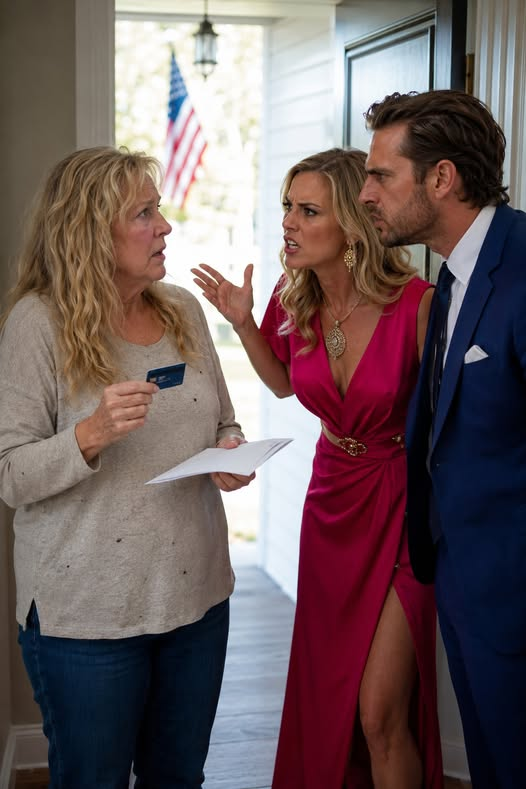
At 6:17 p.m., their SUV pulled into my driveway so fast the tires spat gravel.
I watched from the front window as Emily jumped out before Brandon had even turned off the engine. She wore a beige trench coat and white sneakers that looked too clean for the rain. Brandon came around the car with his jaw tight and his phone in his hand.
They did not knock politely.
Emily pounded on my door.
“Mom!”
I opened it with the chain still on.
Her face was flushed. Brandon stood behind her, breathing hard.
“Why is your card not working?” Emily demanded.
Not “Are you okay?”
Not “Mom, what happened?”
Why is your card not working?
I looked at my daughter through the narrow gap in the door, and the last little piece of denial inside me broke.
“Good evening, Emily.”
“Don’t do that,” she snapped. “Don’t use that calm voice. Did you go to the bank?”
“Yes.”
Brandon stepped closer. “Open the door, Maggie.”
“No.”
His eyebrows jumped. “Excuse me?”
“I said no.”
Emily looked stunned. “Mom, you’re being ridiculous.”
“Am I?”
Brandon held up his phone. “Our mortgage payment bounced.”
My stomach tightened.
So B&H Residential Holdings was their mortgage.
“Our car payment got rejected too,” Emily said. “Brandon’s business card is frozen because it was tied to your account as backup. Do you understand what you’ve done?”
I stared at her.
“What I’ve done?”
“Mom, we had an arrangement.”
“No, Emily. You had access.”
Her mouth opened, then closed.
Brandon’s voice turned sharp. “You gave us permission.”
“I gave Emily permission to help me pay my bills after her father died. I did not give either of you permission to pay your mortgage, your car loan, your credit cards, your vacations, and God knows what else.”
Emily’s eyes flickered.
There it was. Not confusion. Not shock.
Fear.
Brandon noticed it too and moved in quickly.
“Maggie, you’re getting worked up over numbers you don’t understand. We’ve been managing everything. You’re not seeing the full picture.”
“I saw enough.”
“Open the door,” he said again.
“No.”
He laughed once, an ugly sound. “You’re going to stand there behind a chain like we’re criminals?”
I did not answer.
Emily’s voice changed. “Mom, please. We can explain.”
“You had six months to explain.”
“It wasn’t like that.”
“Then what was it like?”
She looked at Brandon.
He answered for her. “Family helps family.”
“Family asks.”
“Family doesn’t keep score.”
“Thieves say that too.”
Emily flinched as if I had slapped her.
Brandon’s face hardened. “Be careful.”
For the first time in years, I was not afraid of making my daughter angry. I was afraid of how long I had trained myself to avoid it.
“I want you both to leave,” I said.
Emily leaned toward the gap. “Mom, if that mortgage payment doesn’t go through by tomorrow, we’re in serious trouble.”
“Then you should call your bank.”
“You don’t understand. We used your account because Brandon’s business—”
“Emily,” Brandon warned.
She stopped.
I looked between them. “Because Brandon’s business what?”
Nobody spoke.
Then my landline rang behind me.
The old phone on the side table, the one Robert refused to disconnect because he liked “a phone that stayed where it belonged.”
I let it ring.
Brandon glanced past me. “Who’s calling you?”
“That is none of your business.”
The answering machine clicked on.
Denise Carter’s voice filled the hallway.
“Mrs. Whitaker, this is Denise from First County Bank. I wanted to confirm that your account protections are active and that no one besides you has access. Please call me in the morning about the additional documents we discussed.”
Emily’s face went pale.
Brandon’s went red.
“You talked to a bank manager?” he said.
“Yes.”
“What documents?”
“Good night.”
I shut the door.
Emily began crying on the porch.
“Mom! Please! You’re destroying us!”
I stood with my back against the door, one hand over my mouth.
My child was sobbing outside my house, and every instinct in me screamed to open the door, to comfort her, to say we would figure it out.
But then Brandon shouted, “This is your fault, Maggie! You spoiled her your whole life and now you’re acting like a victim!”
The sobbing stopped.
Something inside me became very still.
I picked up the phone and called the police.
When the cruiser arrived, Emily and Brandon were still in the driveway. Emily sat in the SUV, crying into her hands. Brandon was pacing near the porch.
Officer Carla Mendoza came to the door. I had known her since she was a teenager working summers at the pool snack bar.
“Mrs. Whitaker?” she asked gently. “You called about a disturbance?”
“Yes. My daughter and son-in-law are refusing to leave.”
Brandon rushed over. “Officer, this is a family matter. She’s confused. We’re worried about her.”
Carla looked at me. “Are you confused, Mrs. Whitaker?”
“No.”
“Do you want them on your property?”
“No.”
Carla turned to Brandon. “Then you need to leave.”
He gave her the same business smile I had seen him use at church fundraisers. “You don’t understand. She’s elderly and making financial decisions that affect our family.”
Carla’s face cooled. “Sir, that is not helping you.”
Emily got out of the SUV, mascara streaked beneath her eyes. “Officer, she’s my mother.”
“And she asked you to leave,” Carla said.
Brandon’s mouth tightened. “Fine. But this isn’t over.”
“No,” I said from the doorway. “It isn’t.”
For one second, his confidence slipped.
Then he got in the SUV and slammed the door hard enough to rattle my windows.
They left.
That night, I slept in Robert’s recliner with the hall light on.
The next morning, I called the attorney Denise had recommended. His name was Samuel Price, though he told me to call him Sam. His office was above a bakery downtown, and everything smelled faintly of cinnamon.
I brought the statements, the letter, and Robert’s file box.
Sam was a careful listener. He did not interrupt. He took notes with a fountain pen and frowned only once, when I told him Emily had the little black notebook.
“Do you have a power of attorney document naming your daughter?” he asked.
“I don’t think so. Robert and I had wills, but I never signed anything giving Emily control.”
“Let’s verify.”
We went through the file box together. Robert’s will. My will. The deed to the house. Insurance papers. Tax returns. Medical directives.
Then Sam pulled out a folded document I had never seen.
“Mrs. Whitaker,” he said slowly, “is this your signature?”
I leaned closer.
It was a power of attorney document naming Emily Hayes as my financial agent.
The signature looked like mine.
Almost.
My M had a loop at the beginning. This one did not. My t’s were crossed sharply. These were soft and low.
“No,” I whispered.
“You didn’t sign this?”
“No.”
“Do you recognize the notary?”
The notary stamp read: Diane L. Mercer, Notary Public, State of Ohio.
I did recognize the name.
Diane Mercer was Brandon’s aunt.
Sam sat back.
“Then we have a bigger problem.”
Over the next week, my life became a stack of documents.
Sam helped me revoke the fraudulent power of attorney formally, notify the bank, file a police report, and request records from companies that had taken payments from my account. Denise at the bank gave us everything she legally could. Officer Mendoza connected me with a detective who specialized in financial crimes against older adults.
Older adults.
The phrase embarrassed me at first.
I still drove. I still cooked. I still remembered everyone’s birthdays. I did not feel like an “older adult” in need of protection.
Then I looked at the forged document again and realized predators do not always attack weakness. Sometimes they attack trust.
Emily did not call for five days.
On the sixth day, she left a voicemail.
Her voice was small.
“Mom, I know you’re angry. But you have to understand, Brandon said we would pay it back. He said it was temporary. I didn’t know it had gotten that bad. Please don’t talk to lawyers. Please don’t ruin my children’s lives because of money.”
Because of money.
I listened to the message three times.
Then I saved it.
Sam said, “That voicemail matters.”
I hated that it mattered.
I hated that my daughter had given me evidence when all I wanted was a real apology.
The following Sunday, I went to church for the first time in months. Willow Creek Community Church was the kind of place where everyone knew who brought deviled eggs to potluck and whose knee replacement had gone poorly.
I arrived late and sat in the back.
Pastor Greg preached about forgiveness. Of course he did. Life has a cruel sense of timing.
“Forgiveness,” he said, “does not mean pretending harm did not happen. It means refusing to let harm become your home.”
I stared at the wooden cross behind him and thought of Emily as a child, running through the sprinkler in our backyard with missing front teeth.
After service, people hugged me. Asked how I was doing. Said I looked tired.
I gave the standard Midwestern answer.
“Oh, I’m hanging in there.”
Then I saw Emily standing near the fellowship hall.
She looked thinner. Her hair was pulled back messily. Ava and Mason were not with her.
“Mom,” she said.
Several heads turned.
I did not want an audience, so I stepped outside. The air smelled like wet grass and coffee.
Emily followed me to the side walkway.
“I came alone,” she said.
“Where is Brandon?”
“At home.”
“Is that true?”
She looked down. “Yes.”
For a moment, neither of us spoke.
Then she began to cry.
“I messed up.”
The words should have softened me. Instead, they made me tired.
“Yes,” I said. “You did.”
She wiped her cheeks. “It started after Brandon’s contracting business lost that big job in Cincinnati. He was behind on everything. He said if we missed one mortgage payment, we’d lose the house. I told him no at first.”
“At first.”
Her face twisted. “Mom, I was scared.”
“So you stole from me?”
“I didn’t think of it like stealing.”
“What did you think it was?”
“Borrowing.”
“Borrowing requires permission.”
She looked at me then, and I saw shame. Real shame. It did not fix anything, but it was there.
“Brandon said you had plenty. He said Dad left you comfortable and you didn’t even use most of it. He said we were struggling and you were just sitting on money.”
“Did you believe him?”
“I wanted to.”
That answer hurt more than yes.
I looked past her at the parking lot, where families were loading children into minivans, where life looked normal if you stood far enough away.
“Did you forge my signature?”
She covered her mouth.
I closed my eyes.
“Emily.”
“Aunt Diane notarized it,” she whispered. “Brandon said it was just paperwork so we could help you if something happened. He said you would have signed it anyway.”
“But I didn’t.”
“No.”
“Did you sign my name?”
Her silence answered.
The world did not tilt or explode. Birds still moved in the maple trees. A truck passed on the street. Somewhere inside the church, someone laughed.
“How could you?” I asked.
Emily stepped toward me. “Mom, I am so sorry.”
I stepped back.
“Do not come to my house without calling. Do not use my accounts. Do not ask me to stop the investigation.”
Her eyes widened. “Investigation?”
“Yes.”
“Mom, please. If Brandon gets charged, he’ll lose everything.”
“And if you get charged?”
She went white.
I did not say it cruelly. I said it because the truth had finally entered the room and I refused to escort it back out.
“I don’t want you in prison, Emily. But I will not lie for you.”
Her lips trembled. “What about Ava and Mason?”
“I love them. I will always love them. But you do not get to hide behind your children after using me.”
She sobbed again, but this time I did not move to hold her.
That was the hardest thing I had ever done.
Two weeks later, Brandon came back.
He waited until dusk, when the streetlights flickered on and my neighbors were inside eating dinner. I was in the kitchen making tomato soup when I heard knocking.
Not pounding this time.
Three slow knocks.
I looked through the peephole and saw him standing under the porch light.
I called Officer Mendoza before opening the door.
Then, with the chain on, I said, “What do you want?”
Brandon smiled.
It was not his church smile. It was smaller, meaner.
“Just wanted to talk.”
“I have nothing to say to you.”
“Sure you do.”
He held up an envelope.
“What is that?”
“Copies.”
“Of what?”
“Things Robert wouldn’t want people seeing.”
For a second, my heart stopped.
Brandon saw it and smiled wider.
“There it is.”
I hated myself for reacting.
“My husband has nothing to do with this.”
“Doesn’t he?” Brandon leaned close enough that I could smell mint gum. “You think Robert was some saint? He had accounts you didn’t know about. Documents. Payments. You open this investigation, and all of it comes out.”
I did not understand. That was his advantage.
“What are you talking about?”
He tapped the envelope against the door.
“Drop the complaint. Tell the bank it was a misunderstanding. Tell your lawyer to back off. Then nobody has to know.”
“Know what?”
He slid the envelope through the gap before I could stop him. It landed on the floor.
“Ask your perfect husband.”
Then he walked away.
I waited until his SUV disappeared before picking up the envelope.
Inside were photocopies of old bank transfers from an account I did not recognize. Several payments had gone to a woman named Laura Bennett. Another to a medical clinic in Columbus. One memo line read: For Daniel.
My husband’s name was on the account.
Robert Whitaker.
I sat down on the stairs.
For Daniel.
I did not know a Daniel.
By the time Officer Mendoza arrived, I had read the papers so many times the edges had curled in my hands.
“Mrs. Whitaker,” she said, “are you okay?”
“No.”
I handed her the envelope.
She read quietly.
“Did he threaten you with this?”
“Yes.”
“We’ll document it.”
“Carla,” I said, forgetting to call her Officer, “was my husband hiding something?”
Her expression softened. “I don’t know. But Brandon wanted you scared. That doesn’t mean he wanted you informed.”
That sentence kept me breathing.
The next morning, I took the envelope to Sam.
He examined the copies, then asked if Robert had ever mentioned a Laura Bennett.
“No.”
“Daniel?”
“No.”
“Do you want me to look into it?”
My first instinct was no.
The dead have so little privacy left. Marriage has so few mysteries we can bear to reopen. Part of me wanted to burn the papers and keep Robert exactly as I remembered him.
But Brandon had used the envelope like a weapon. If I stayed ignorant, the weapon remained loaded.
“Yes,” I said. “Find out.”
It took Sam nine days.
During those nine days, I barely slept. I wandered around the house looking at photos of Robert, searching his face for secrets. Robert at our wedding, young and nervous in a brown suit. Robert holding newborn Emily. Robert at Lake Erie, laughing with his fishing pole bent. Robert in hospice volunteering photos, his arm around cancer patients whose names I had forgotten.
Had he loved someone else?
Had he had another child?
Had my whole marriage contained a locked room I never noticed?
On the tenth day, Sam called.
“I found Laura Bennett,” he said. “She lives in Columbus. She was a nurse at St. Mark’s Hospital twenty-seven years ago.”
My hand tightened around the phone.
“And Daniel?”
“Daniel Bennett is her son. He’s thirty-two.”
The kitchen wall seemed to move away from me.
“Oh.”
“Maggie,” Sam said gently, “there is more.”
I closed my eyes. “Tell me.”
“Daniel Bennett was born with a congenital heart condition. Robert made payments to help cover medical expenses. But I found no evidence that Daniel was Robert’s biological child.”
I opened my eyes.
“What?”
“Laura Bennett’s husband died in a workplace accident before Daniel was born. Robert’s company was involved in a charity fund connected to the hospital. From what I can tell, Robert quietly helped several families over the years. Laura and Daniel were one of them.”
I gripped the counter.
“So Brandon lied.”
“Brandon showed you real documents and let you assume the worst.”
That sounded exactly like Brandon.
Sam continued. “There’s something else. Daniel Bennett is now an attorney.”
I laughed once, not because it was funny, but because the world had become absurd.
“Of course he is.”
“He works in Columbus. Disability rights and elder advocacy.”
“Elder advocacy,” I repeated.
“Yes. And he remembers Robert.”
Two days later, Daniel Bennett came to my house.
He was tall, with sandy hair and a slight limp. He brought a folder and a bouquet of yellow tulips.
“I wasn’t sure if this was appropriate,” he said, holding them out awkwardly. “My mom said Mrs. Whitaker liked tulips. She remembered from a thank-you note your husband wrote years ago.”
I took the flowers and nearly cried.
Daniel sat at my dining room table, in the same chair where Emily had once spread out my bills.
“Your husband helped save my life,” he said.
I did not know what to do with that sentence.
Daniel explained that his father had died before he was born, leaving Laura with medical debt and a sick baby. Robert had learned about them through a workplace charity. When the official funds ran out, he continued helping privately.
“My mom tried to refuse,” Daniel said. “Mr. Whitaker told her, ‘Then pay it forward when you can.’ She became a nurse practitioner because of him.”
I pressed my fingers to my lips.
“He never told me,” I said.
Daniel smiled gently. “Mom said he didn’t like being thanked.”
That was Robert.
He once repaired our neighbor’s furnace at midnight and let everyone believe the HVAC company had come early.
Daniel opened his folder.
“Mr. Price told me what’s happening. I can’t represent you because I’m not local counsel on this, but I can help connect you with resources. And I can write a statement about those documents Brandon Hayes used to intimidate you.”
“Why would you do that for me?”
His eyes softened.
“Because your husband helped my family when nobody was watching. Let me pay it forward.”
For the first time since Denise showed me the bank records, I felt Robert in the room.
Not as a ghost. As a truth.
Brandon had tried to turn my husband’s kindness into shame.
Instead, he had handed me another witness.
The investigation moved faster after that.
Diane Mercer, Brandon’s aunt, admitted she notarized the power of attorney without me present. At first, she claimed it was a clerical mistake. Then Detective Harris showed her the date: I had been at a dental appointment in another county when the document was supposedly signed.
Emily eventually gave a statement.
She admitted she forged my signature, but said Brandon pressured her. She said he told her they would lose the house, the children, their marriage. She said he had taken out loans she did not know about and used my account to keep creditors quiet.
I wanted to believe she was only a victim.
Sam warned me gently not to simplify it.
“People can be pressured and still responsible,” he said.
That became a sentence I repeated to myself often.
Brandon did not confess. Men like Brandon rarely do. He blamed Emily. He blamed the economy. He blamed my “mental decline,” which backfired spectacularly when Denise, Officer Mendoza, Sam, Daniel, and my doctor all documented that I was fully competent.
Then he blamed Robert.
That backfired too.
By June, charges were filed: forgery, theft, misuse of a power of attorney, intimidation, and financial exploitation of an older adult.
Emily was charged as well.
The day I received that call, I sat on the back porch until sunset. Fireflies blinked over the lawn. Robert’s rose bushes were blooming, wild and stubborn.
I thought I would feel victorious.
I did not.
I felt like a mother standing in the wreckage of a house her own child had helped burn down.
A week later, Ava called me.
She was twelve, old enough to know something was wrong and young enough to hope adults could still fix it.
“Grandma?” she said.
“Hi, sweetheart.”
“Mom says you’re mad at us.”
My heart cracked.
“No, baby. I am not mad at you or Mason.”
“Dad says you’re trying to send him away.”
I closed my eyes.
“I’m trying to tell the truth.”
There was silence.
Then she whispered, “Is telling the truth bad?”
“No,” I said, though my voice shook. “But sometimes people who are scared act like it is.”
“Can I still come over?”
“Always.”
“Even if Mom and Dad are fighting?”
“Especially then.”
The following Saturday, Emily dropped Ava and Mason off at my house. She did not come inside. She looked hollow, like someone who had been crying for weeks.
Mason ran straight into my arms. He was eight and smelled like bubble gum.
“Grandma! Do you still have the puzzle with the wolves?”
“I do.”
Ava hugged me longer than usual.
Over grilled cheese sandwiches, they told me little things: Mason’s baseball team lost twice, Ava got a B+ in math, their dog Pepper had chewed Brandon’s expensive shoes.
I laughed at that harder than I should have.
For four hours, my house felt alive again.
When Emily came to pick them up, she stood on the porch while they gathered their backpacks.
“Thank you,” she said quietly.
I nodded.
She looked at me as if waiting for something more.
I did not give it.
Not because I hated her. Because forgiveness offered too quickly can become permission.
In July, Brandon’s business collapsed.
It turned out there had never been one big lost contract. There had been several bad deals, unpaid suppliers, a lawsuit from a homeowner, and gambling debts disguised as “investment losses.” He had used Emily’s credit, then their joint accounts, then my money.
Emily filed for separation after finding out he had also opened a credit card in her name.
She called me the night she left him.
“I’m at a hotel with the kids,” she said. “I didn’t know who else to call.”
I stood in my kitchen, looking at the rain streaking the window.
The old Maggie would have said, “Come home.”
The new Maggie said, “Are you safe?”
“Yes.”
“Do you have money for the room?”
“Yes.”
“Do the kids have food?”
“Yes.”
“Then tomorrow, call your attorney.”
She was quiet.
“You won’t let us stay with you?”
I gripped the counter.
“I love you. I love the kids. But you cannot move back into my house while there is an active case involving money you stole from me.”
“I said I was sorry.”
“I know.”
“What else do you want?”
“Accountability.”
She made a small, wounded sound. “You sound like your lawyer.”
“No. I sound like myself.”
That was the first time in years I recognized my own voice.
Emily did not speak to me for three weeks after that.
Then came the preliminary hearing.
The courthouse in Willow Creek was a brick building with white columns and a flag that snapped loudly in the wind. I wore a gray dress Robert had liked and low black shoes because my knees were not what they used to be.
Sam met me on the steps.
“You don’t have to say much today,” he reminded me.
“I know.”
“You okay?”
“No.”
He smiled sadly. “Fair answer.”
Inside, Brandon sat with his attorney. He wore a navy suit and looked almost handsome if you did not know him. Emily sat separately with a public defender, her hair pinned back, eyes red.
When she saw me, she started to rise.
Her attorney touched her arm, and she sat back down.
The hearing itself was mostly procedural. Dates. Charges. Conditions. Words that sounded too small for what they contained.
Then Brandon’s attorney suggested the matter was a “family misunderstanding” and that I might have been influenced by outsiders.
Sam stood.
“Your Honor,” he said, “Mrs. Whitaker’s bank account was used repeatedly without authorization for the defendants’ mortgage, vehicle payments, debts, and personal expenses. A power of attorney bearing a forged signature was notarized without her presence. When Mrs. Whitaker secured her accounts, Mr. Hayes appeared at her home and attempted to intimidate her with documents related to her deceased husband’s private charitable payments.”
The judge looked over her glasses at Brandon.
Brandon looked at the table.
It was the first time I had seen him unable to perform confidence.
Afterward, in the hallway, Emily approached me.
“Mom.”
Sam stayed nearby but gave us space.
Emily’s hands trembled. “I’m pleading guilty.”
I had expected many things.
Not that.
She swallowed. “My attorney says if I cooperate and pay restitution, I might avoid jail. Maybe probation. Community service. Financial counseling.”
“What about Brandon?”
“He won’t plead. He says it’s all me.”
I said nothing.
“I know I don’t deserve your sympathy,” she whispered.
“No,” I said. “You deserve the truth.”
Tears filled her eyes.
“I did sign your name. I did let him use your account. I told myself it was temporary because I couldn’t face what I was doing. But I knew it was wrong.”
The hallway around us blurred.
That was the apology I had been waiting for. Not the polished kind. Not the kind with excuses dressed as explanations.
A real one.
“I can’t fix it,” she said. “But I’m going to stop lying.”
I nodded once.
It was all I could manage.
That night, I took out Robert’s photo album.
I looked at pictures of Emily as a baby, as a child, as a teenager holding a softball trophy. I let myself grieve not only what she had done, but who I thought she was.
Then I wrote her a letter.
Not to send. Not yet.
I wrote:
I love you. I am furious with you. I miss you. I do not trust you. I hope someday those truths can sit in the same room without destroying us.
I folded the letter and put it in Robert’s cookbook.
By August, my life had become both smaller and stronger.
I changed the locks. I installed a doorbell camera. I met every other Thursday with a counselor named Janine, who specialized in family trauma and betrayal. At first, I told her I did not need therapy.
She said, “Then think of this as a place where you don’t have to protect anyone’s feelings.”
I went back the next week.
I also joined a senior financial safety workshop at the library. I hated the word senior slightly less by then. Denise Carter gave one of the talks. She explained how trusted relatives often commit financial exploitation, how shame keeps victims silent, and how asking questions at the bank is not foolish but protective.
At the end, she asked if anyone wanted to share.
To my own surprise, I stood.
“My daughter and son-in-law used my accounts,” I said.
The room went silent.
I nearly sat down.
Then a woman in a purple cardigan raised her hand to her mouth and began crying.
Afterward, she approached me near the coffee table.
“My nephew has my checkbook,” she whispered. “He says he’s helping.”
I gave her Denise’s card.
That day, I understood something: shame grows in darkness, but so does abuse. Speaking did not make the pain disappear. It made the room safer for someone else.
In September, Brandon came to trial.
Emily testified.
I will never forget watching my daughter take the stand against her husband.
She looked young up there. Younger than thirty-five. Her voice shook at first, but then steadied.
She described how Brandon had convinced her to access my accounts. How he coached her through forging my signature. How Diane notarized the document. How they used my money to cover their mortgage and debts. How Brandon told her I was “too comfortable to notice.”
That phrase made the jury look at him.
Too comfortable to notice.
As if comfort were an invitation.
Brandon’s attorney tried to paint Emily as the mastermind.
“Mrs. Hayes, isn’t it true you had access to your mother’s passwords?”
“Yes.”
“Isn’t it true you signed the document?”
“Yes.”
“Isn’t it true many transactions were made from your phone?”
“Yes.”
“So why should this jury believe Mr. Hayes controlled anything?”
Emily looked at Brandon. For a second, I thought she might collapse.
Then she said, “Because I was afraid of losing my marriage, and he knew it. But being afraid doesn’t make me innocent. It makes me responsible for telling the truth now.”
The courtroom was silent.
Later, Denise testified. Sam testified about the documents. Daniel testified about Robert’s payments to his family and how Brandon had twisted them into a threat.
When Daniel described Robert’s kindness, I cried openly.
Brandon stared straight ahead.
The jury deliberated for five hours.
Guilty on all major counts.
Brandon was sentenced to prison time, restitution, and probation after release. Diane Mercer lost her notary commission and faced charges of her own. Emily received probation, mandatory restitution, financial ethics counseling, and community service, partly because she cooperated and partly because I gave a victim statement that asked the court not to separate her from the children if there was a lawful alternative.
Writing that statement nearly broke me.
I did not excuse her. I did not minimize the harm. I said exactly what she had done.
Then I said Ava and Mason needed one stable parent, and Emily had taken the first real step toward becoming that.
The judge listened.
Emily wept when she heard the sentence.
Brandon did not look at anyone.
After court, reporters from the local paper waited outside because small towns love scandals, especially the kind involving money and family. Sam guided me past them.
One woman called, “Mrs. Whitaker, do you forgive your daughter?”
I stopped.
Sam murmured, “You don’t have to answer.”
But I turned.
“Forgiveness,” I said, “is not a headline.”
Then I walked away.
By Thanksgiving, Emily was living in a small rental house on Maple Street with Ava and Mason. She worked at a dentist’s office and delivered groceries on weekends. Restitution payments came to me every month, small but consistent.
The first one was $150.
I stared at the check for a long time.
There had been a season when that amount would have insulted me.
Now, I saw something else.
Not repayment. Not yet.
Proof of direction.
Thanksgiving had always been at my house. That year, I planned to spend it alone with a turkey breast and a store-bought pumpkin pie.
Two days before the holiday, Emily called.
“Mom, I know I have no right to ask,” she said, “but Ava and Mason keep asking about Thanksgiving at Grandma’s.”
I looked around my kitchen.
The copper molds on the wall. Robert’s recipe cards. The long table with scratches from decades of family dinners.
“I’m not ready for a big family Thanksgiving,” I said.
“I understand.”
“But you and the kids can come for dessert.”
She inhaled sharply.
“Just dessert?”
“Pie and coffee. Two hours.”
“We’ll be there.”
They arrived at four.
Emily brought flowers and a nervous smile. Ava brought a handmade card. Mason brought a plastic container of cookies he had decorated himself, mostly with blue frosting.
We sat at the table.
At first, conversation moved carefully, like people walking across ice.
Then Mason told a story about his teacher accidentally calling him by the dog’s name because she had been looking at photos of her golden retriever. Ava rolled her eyes and corrected three details. Emily laughed, and for one brief second, I saw the girl she used to be.
After pie, Emily helped me wash dishes.
The kids watched a movie in the living room.
She dried a plate slowly.
“Mom?”
“Yes.”
“I know sorry isn’t enough.”
“No, it isn’t.”
“I’m going to keep saying it anyway.”
I placed a cup in the cabinet.
“Good.”
She looked at me with wet eyes. “Do you think you’ll ever trust me again?”
I leaned against the counter.
“I don’t know.”
She nodded, accepting the answer though it hurt.
“But I would like to try knowing you honestly,” I said. “Not as the daughter I imagined. As the woman standing here.”
Her face crumpled.
That time, when she cried, I put my arms around her.
Not because everything was fixed.
Because truth had finally made room for grief.
Winter came early that year.
Snow fell before Christmas, covering the brown lawns and making Willow Creek look like a town inside a glass ornament. I decorated less than usual. No ladder, no roof lights, no giant wreath on the garage. Just a small tree, stockings for the grandchildren, and Robert’s ceramic nativity on the mantel.
On Christmas Eve, Daniel Bennett and his mother Laura stopped by with homemade bread.
Laura was in her sixties, with kind eyes and hands that looked like they had worked hard. She hugged me as if we had known each other for years.
“I have wanted to thank you for a long time,” she said.
“It was Robert,” I replied.
“You were his family. His goodness belonged to you too.”
I did not know how to answer.
We drank coffee in the living room while snow tapped against the windows. Laura told me stories Robert had never shared. How he dressed as Santa at the children’s ward one year. How he fixed her broken porch railing when Daniel was recovering from surgery. How he sent grocery cards anonymously until she caught him by recognizing his handwriting.
“He made me promise not to tell you,” she said.
“That sounds like him.”
“I think he was afraid you’d make him let you help.”
I laughed through tears. “He was right.”
After they left, I sat beside the tree and thought about secrets.
Some secrets rot a family from the inside.
Some secrets are hidden kindness waiting for the right season to bloom.
Robert had left me more than money. He had left me evidence that goodness done quietly still matters loudly.
In January, Emily began community service at the same library where Denise had given the financial safety talk. She helped set up chairs, made coffee, and handed out pamphlets about fraud prevention.
The first time I saw her there, she looked embarrassed.
I was attending as a volunteer speaker by then.
Yes, me.
Maggie Whitaker, who once cried in a parking lot because her card declined, now stood in front of strangers and said, “Check your accounts. Ask questions. Do not let anyone make you feel foolish for protecting yourself.”
After the session, an elderly man approached Emily.
“My grandson keeps asking to borrow my debit card,” he said. “You think that’s bad?”
Emily looked at me.
I said nothing.
She turned back to him. “I think you should talk to your bank before you give anyone access. Even family.”
Her voice trembled on the word family.
But she said it.
That spring, I planted tulips along the walkway.
Yellow ones.
Mason helped, though he mostly dug holes in the wrong places. Ava made little markers with popsicle sticks.
Emily came by after work, still in scrubs from the dentist’s office. She knelt in the dirt beside me.
“I got a second job offer,” she said.
“Doing what?”
“Office manager for a pediatric clinic. Better hours. Benefits.”
“That’s wonderful.”
“I’m scared I’ll mess it up.”
“You might.”
She looked startled.
I smiled a little. “People mess things up. Then they tell the truth, fix what they can, and keep going.”
She pushed soil around a bulb.
“I’m learning that.”
I watched her hands, the same hands that had forged my name, now planting flowers outside my house.
Life is strange that way. It rarely gives you clean symbols. It gives you complicated ones and asks what you will do with them.
In April, one year after the card declined at Miller’s Market, I went back for chicken, coffee, and tulips.
Linda was at the register.
When I inserted my new card, she gave me a little wink.
“Moment of truth.”
The machine beeped.
Approved.
I laughed.
Not loudly. Not dramatically.
Just enough.
Linda bagged the tulips carefully.
“Glad to see you smiling, Maggie.”
“Me too.”
Outside, the sky was bright and blue. My car was old but paid for. My bank account was mine. My house was quiet but safe.
My phone buzzed as I loaded groceries.
A text from Emily.
Restitution payment sent today. Also, Ava got an A on her math test. She wants you to know because you helped her study.
A second text followed.
I love you, Mom. I’m still sorry.
I stood in the parking lot for a long moment.
Then I typed:
I love you too. Keep going.
I did not add, I forgive you.
Not yet.
Maybe someday.
Maybe forgiveness would arrive slowly, like tulips pushing through thawed ground. Maybe it would not look like forgetting. Maybe it would look like boundaries, bank alerts, honest conversations, and dessert on holidays.
Maybe that was enough.
That evening, I placed the yellow tulips on the kitchen table beneath Robert’s photograph.
“You were right,” I told him.
About what, I could not say exactly.
About saving receipts. About hiding passwords in cookbooks. About helping people quietly. About the fact that love means nothing without truth standing beside it.
The house creaked around me, familiar and steady.
For the first time in a long time, I did not feel like a widow waiting for someone to rescue her from the paperwork of life.
I felt like the owner of my own name.
My own door.
My own account.
My own future.
And when the phone rang later that night, I checked the caller ID before answering.
Because trust is a beautiful thing.
But wisdom is what keeps the lights on.
THE END