ACT 1 — The House Everyone Admired
Everyone in Lomas de Chapultepec knew the Mondragón mansion because it looked less like a home than a promise. Behind the tall gates were trimmed hedges, pale stone balconies, and windows that glowed at night like jewelry.
Alejandro Mondragón had built that life from hotels, risk, and a schedule so crowded it left little space for ordinary tenderness. He loved his daughter Valentina, but love sent from airports can start to feel like a receipt.

Renata understood appearances better than anyone in their circle. She knew which flowers belonged on which table, which guest should sit beside which investor, and how to make a family photograph look peaceful even when no one in it was breathing easily.
Valentina was sixteen, old enough to recognize silence and young enough to still hope her father might hear what she could not say. In the photos Renata sent him, she smiled because not smiling had consequences.
Maricela, the maid, noticed the changes first. Valentina stopped eating breakfast downstairs. She wore long sleeves in warm weather. She startled when Renata entered a room, then pretended she had only been thinking about school.
Alejandro did not see those details because he was away in Madrid, chasing the biggest hotel deal of his life. Renata sent him messages covered in sweetness: dinners, crystal glasses, guests, and one photo of Valentina near a silver centerpiece.
That picture unsettled him. His daughter’s mouth curved, but her eyes looked past the camera, as if she were searching for an exit. For the first time in months, Alejandro stared at his phone and felt ashamed.
ACT 2 — The Return No One Expected
He changed his flight without telling Renata. The decision felt impulsive, but underneath it was something older: a father’s fear arriving late, pushing through pride, schedules, and all the excuses money had made convenient.
In Mexico City, he did not call his driver. He took an ordinary taxi from the airport and watched the city slide past the window in yellow and red streaks, every traffic light making him more anxious.
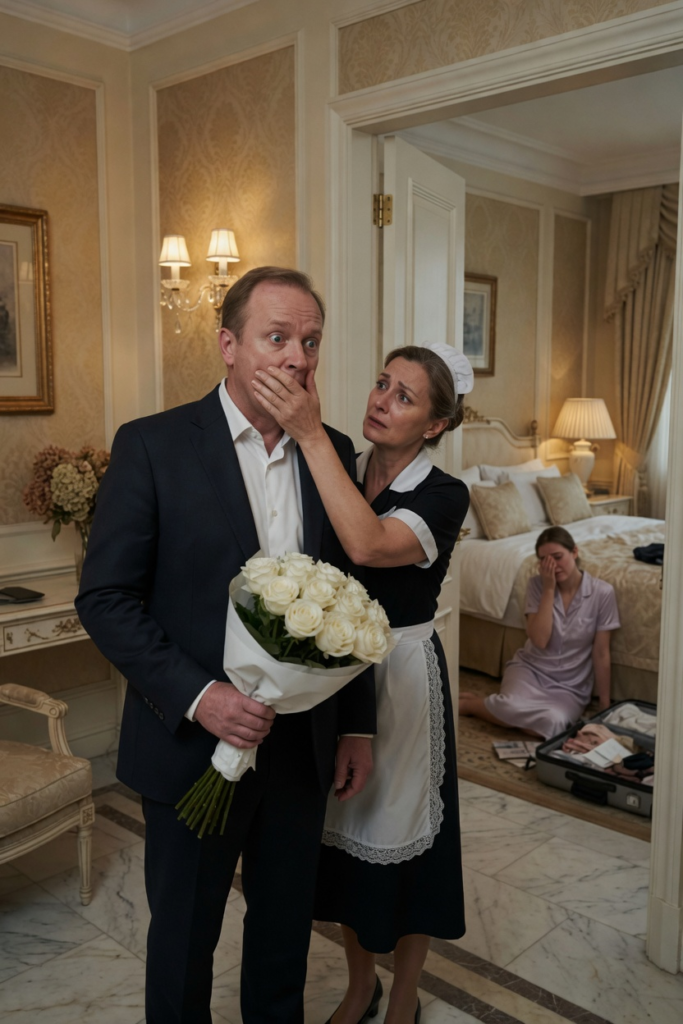
Before reaching Lomas de Chapultepec, he stopped in Polanco and bought white roses. They were the same flowers he had given Renata when he proposed, back when he believed elegance and devotion were the same language.
He imagined arriving quietly, apologizing to his wife, and then sitting with Valentina without phones between them. He wanted to tell her he had been absent, not indifferent. He wanted the sentence to matter.
Instead, he saw luxury cars at the gate. A party filled his house, though no one had mentioned a party because everyone believed he was still across the ocean. Music floated above the hedges, polished and careless.
He asked the taxi to stop one block away. The roses were cold in his hand. By the time he reached the service entrance, the first crack in the perfect evening had already formed inside him.
The kitchen was crowded with staff carrying trays of champagne. Lemon polish and warm pastry filled the air. Then Maricela saw him, dropped a tray, and sent glass exploding across the marble like a warning.
That was when she covered his mouth and whispered that he needed to be quiet. If Renata heard him, she said, Valentina might not leave that house alive. Alejandro stopped thinking like a businessman.
ACT 3 — The Room Upstairs
Maricela led him up the service stairs, away from the party’s perfume and laughter. The second floor felt abandoned, though the house was full. Even the air seemed to know it was carrying a secret.
Outside Valentina’s room, Maricela told him not to go in yet. Look first, she said. Alejandro pushed the door just wide enough, and the sight on the other side broke something permanent in him.
Valentina sat on the carpet beside two open suitcases. Her clothes were folded in rushed, uneven piles. Her passport lay near her school backpack. Beside it sat an envelope with money, too deliberate to be teenage panic.
On the bed was a letter with Alejandro’s name written across the front. Valentina held an old photo of him carrying her as a little girl, when she still believed his arms were the safest place in the world.
Not a memory. A goodbye.
Alejandro’s roses slipped from his hand. He asked why his daughter was packing, and Maricela answered the question no father wants to hear. Tonight, she said, they were going to take Valentina away.
When Alejandro asked who, Renata’s laughter rose from downstairs, bright enough to make the answer cruel before Maricela spoke it. Your wife, she whispered, and the words seemed to change the temperature of the room.
Alejandro stepped inside. Valentina looked up and said, “Dad?” like the word hurt. Then she apologized for not waiting longer, though she was the one surrounded by suitcases and fear.
Downstairs, Renata called, “Is she ready?” Her voice carried the same sweetness guests admired, but upstairs it sounded like a key turning in a lock. Valentina’s hands trembled around the envelope.
Alejandro told her to open it. Before she could, her phone lit up on the carpet. Unknown Driver: Five minutes. Service gate. The message made Maricela press both hands to her mouth.
The letter was worse because it used Valentina’s voice against her. Renata had forced her to write that she was leaving by choice, that she was unstable, that Alejandro should not look for her.
Valentina began to shake. She confessed that Renata had spent weeks telling her she had embarrassed the family, that Alejandro was tired of rescuing her moods, and that a private facility would make her easier to manage.
The envelope of money was not kindness. It was theater. The passport was not preparation. It was evidence. The party downstairs was a curtain, loud enough to hide one frightened girl leaving through a service gate.
ACT 4 — What Alejandro Did Next
Alejandro wanted to run downstairs and tear Renata’s mask from her face in front of every guest. He wanted the chandeliers, the champagne, and the polished voices to witness exactly what their hostess had arranged.
Instead, he knelt in front of Valentina and asked one question. “Did you write this because you wanted to leave?” She shook her head before he finished, tears slipping silently down her swollen face.
That answer steadied him. Rage became cold, precise, and useful. He gave Valentina his jacket, told Maricela to lock the bedroom door behind them, and took the letter, the phone, and the passport.
At the service gate, the driver was already waiting. He did not know Alejandro by sight. He only knew Renata’s instructions: collect the girl quietly, no front entrance, no conversation with guests.
Alejandro photographed the license plate, took the driver’s phone long enough to see Renata’s messages, then ordered security to keep the man there. The driver began apologizing immediately, insisting he had been told this was family business.
Alejandro walked into the main hall with the letter in his hand. The music softened as guests noticed him. Renata turned at the center of the room, a champagne flute paused halfway to her mouth.
For one second, her smile held. Then she saw the paper. She saw Maricela behind him. She saw Valentina at the top of the stairs wearing her father’s jacket, and the color left her face.
No one spoke. Forks hovered near plates. Glasses remained suspended. A woman near the piano looked down at her napkin as if linen could excuse her from witnessing what came next. The candles kept trembling.
Alejandro did not shout. That frightened Renata more than shouting would have. He asked her, in front of everyone, why his daughter’s passport was packed beside money and a forced goodbye letter.
Renata tried to laugh. She said Valentina was dramatic, sensitive, impossible lately. She said Alejandro had no idea what it was like to manage a teenage girl while he built hotels in other countries.
Then Valentina spoke from the stairs. Her voice was small, but it traveled through the silent hall. “You told me Dad would be relieved when I was gone.” That sentence ended the party.
ACT 5 — The Full Ending
Renata denied it until Alejandro held up the phone with the driver’s message. Then she denied the meaning. When that failed, she blamed pressure, reputation, and Valentina’s attitude, as if reputation were a wound deeper than a daughter’s terror.
The family attorney arrived before midnight. By morning, Alejandro had removed Renata’s access to Valentina’s school records, passport documents, and household staff instructions. The driver’s messages were preserved. So was the letter.
Alejandro did not pretend innocence. He sat with Valentina in the kitchen after the guests left, among the smell of coffee and lemon polish, and admitted the thing she deserved to hear first.
“I paid for everything,” he told her, “and still failed to notice what you needed.” Valentina cried then, not silently, but openly, because the danger had finally moved outside the locked room.
Maricela stayed. She had been frightened, but she had acted when it mattered. Alejandro thanked her in front of Valentina, not as a servant, but as the person who had saved his daughter from vanishing quietly.
Renata left the mansion days later under legal restrictions and social silence sharper than any scandal column. The marriage did not survive, because Alejandro could forgive many things, but not the planned disappearance of his child.
Healing was not instant. Valentina still flinched at loud heels in hallways. Alejandro still woke before dawn, remembering the suitcases, the passport, and the way a goodbye had almost been staged as consent.
But he changed. He moved meetings. He learned her school schedule. He attended ordinary breakfasts. He stopped treating presence as something that could be replaced by drivers, vacations, and well-funded apologies.
Months later, Valentina placed the old photo in a frame on Alejandro’s desk. The white roses from that night were gone, but he kept one dried petal inside the letter he never let her read alone again.
The house in Lomas de Chapultepec became quieter after Renata left, but it finally became a home. Not perfect. Not unscarred. But honest enough for a daughter to breathe inside it.
Alejandro had come home early with flowers, believing he was there to apologize for absence. In truth, he arrived just in time to learn that love is not what you pay for.
It is what you notice before someone disappears.