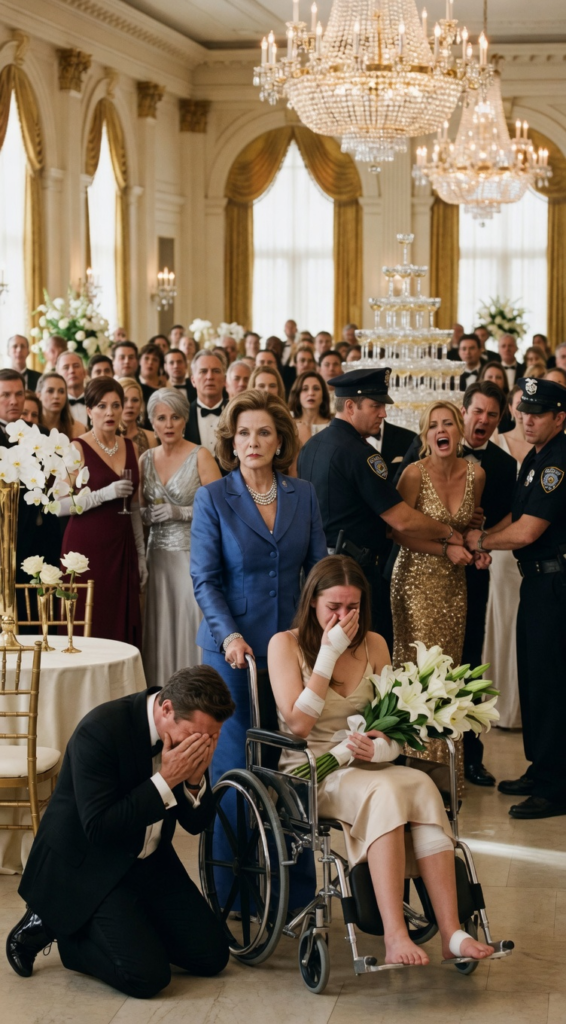
They thought they had successfully erased her from their world; they didn’t realize that by midnight, I would ensure both their social standing and their bank accounts were burning to the ground. This is the chronicle of my own coup d’état.
I had spent my entire life building fortresses. As a forensic accountant, my days were defined by tracing the invisible lines of deceit that wealthy men drew to hide their sins. I dealt in hard numbers, immutable truths, and the cold reality of hidden ledgers. But the only treasure I ever truly guarded was my daughter, Clara. When she married into the Van der Holts—a Manhattan real estate dynasty whose arrogance was outpaced only by their inherited wealth—I felt a phantom chill. They were a family of polished marble: beautiful to look at, but impossibly cold to the touch. They viewed my Clara not as a daughter-in-law, but as a quaint, middle-class accessory to be worn and discarded when the season changed.
I had been flying for four hours, clutching a bouquet of stargazing lilies—her favorite—anticipating the joyous surprise on her face for her twenty-fifth birthday. She had been distant lately, her calls brief and shadowed by a forced cheerfulness. She told me they had relocated to a luxurious penthouse in Chicago while her husband, Julian, managed a midwestern acquisition.
The cab dropped me off not at the glittering glass high-rise she had described, but in front of a crumbling, brick tenement on the city’s industrial edge. The wind howling off Lake Michigan cut right through my wool coat. I double-checked the address she had given me months ago. It matched. A heavy dread, thick and suffocating, settled in the base of my throat.
I pushed through the unlocked front door, the hallway reeking of damp rot and boiled cabbage. I found unit 4B. The door was slightly ajar.
I stepped inside, the lilies trembling in my grip. The room was dim, illuminated only by the sickly amber glow of a streetlamp filtering through a grimy window. The heating was completely broken; my breath bloomed in white clouds in the frigid air. And there, curled defensively on a bare, stained mattress on the floor, was my vibrant, brilliant daughter.
She looked skeletal. But it was the deep, purple-black contusion wrapping around her left forearm, extending toward her shoulder—an untreated, brutal injury—that made my vision narrow.
The lilies slipped from my fingers, scattering across the cracked linoleum. “Clara?” I choked out.
She flinched violently, pulling her knees to her chest. Her eyes, wide and hollowed out by terror, met mine. She didn’t rush to me. She shrank away. “Mom, you weren’t supposed to see this,” she whispered, her voice a fragile, broken rasp. “They told me if I stayed quiet, they’d help pay my bills.”
The implication hit me like a physical blow. Help pay her bills. They hadn’t just discarded her; they had exiled her, starved her out, and battered her into submission. As I knelt on the freezing floor, my hands shaking as I gently reached to inspect the horrific wound on her arm, the silence of the room was shattered by a sharp, synthetic chime.
Clara’s cracked phone lit up on the floorboards. It was a text from Julian.
Hope you’re enjoying your birthday alone. We’re at the gala tonight, and it’s better for everyone if you stay invisible.
The grief that had momentarily paralyzed me evaporated, instantly incinerated by a sudden, absolute, and terrifying rage. It wasn’t a hot, screaming anger. It was a glacial, tactical fury.
I pulled my coat off, wrapping it around Clara’s shivering shoulders, murmuring soft, meaningless assurances. I’ve got you. You’re safe. I’m here. But my mind was already a thousand miles away, racing through server nodes, offshore routing numbers, and corporate structures.
I opened my laptop, the screen casting a harsh, blue light across the squalid room. I didn’t need to search hard to find them. The Van der Holts lived for the camera. I pulled up a live stream of the annual St. Jude’s charity gala in Manhattan. The screen filled with the nauseating opulence of crystal chandeliers, flowing champagne, and bespoke tuxedos.
There he was. Julian. He looked entirely unbothered, his hair perfectly coiffed, a charming, easy smile plastered across his face. Beside him stood his mother, Eleanor Van der Holt, a woman whose soul was as tightly pulled as her face.
A society reporter thrust a microphone toward them. “Eleanor! Julian! Such a spectacular evening. And Julian, we hear you’re walking the red carpet solo tonight?”
Eleanor let out a sharp, aristocratic laugh, placing a manicured hand on her son’s arm. “Our son is finally free of that unfortunate entanglement,” she purred into the microphone, her eyes glittering with malice. “We are focusing on the future, and Julian is very much… available.”
Julian raised his glass of champagne, winking at the camera.
I felt the blood go cold in my veins. My jaw locked so tightly my teeth ached. They had broken my child’s body, stripped her of her dignity, and now they were publicly erasing her existence over vintage champagne.
My fingers hovered over the keyboard. For the past three years, out of an instinct I could never quite name, I had quietly monitored the Van der Holts’ public financial filings. I had kept digital safety nets—encrypted backups of Clara’s devices, records of Julian’s erratic transfers, quiet little anomalies I had brushed off as tax loopholes. Now, I saw them for what they were: a roadmap to their destruction.
I didn’t scream. I didn’t cry. My hands moved with a surgical, practiced precision.
Clara peeked out from beneath my wool coat, tears tracking through the grime on her cheeks. “Mom, please,” she whimpered. “They have lawyers. They have judges. They’ll ruin you too.”
I turned to my daughter, the only soft thing left in my world, and smoothed the matted hair from her forehead. “They wanted you to disappear?” I said, my voice eerily calm. “I am going to make sure they are the ones who cease to exist—at least in the world that matters.”
I pulled up a secure, encrypted terminal. I bypassed the first layer of the proxy servers I had mapped months ago. With a final, decisive keystroke, I sent a heavily encrypted, blind email to the SEC, attaching a dozen meticulously compiled dossiers on their Cayman Island shell companies, and CC’d three of the most aggressive investigative journalists at the Wall Street Journal.
I turned back to Clara, the blue light reflecting in my eyes. “Do you have the passwords to their joint offshore accounts?”
She did. Clara, in her desperate attempts to manage the household finances before Julian cut her off, had memorized the master key to the Kensington Trust portal. She whispered the alphanumeric string, a ghost sharing a deadly secret.
The next three hours were a symphony of calculated demolition. I utilized every ounce of my background in forensic accounting, descending into the Van der Holts’ digital vault like a wraith. I didn’t just expose their illegal tax shelters; I dismantled the scaffolding holding up their entire empire.
I found the Lazarus accounts—dummy corporations set up in Delaware used to funnel liquid cash away from the Van der Holt real estate holdings to avoid capital gains. I initiated irreversible, cascading wire transfers, dumping the funds into locked escrow accounts flagged for federal audit. I found the inflated appraisals for their commercial properties and forwarded the original, un-doctored assessments directly to the board of directors of their primary lenders.
I wanted them to feel the air leaving the room before they realized they were suffocating. I started leaving subtle, terrifying breadcrumbs.
On the livestream, the gala was reaching its peak. The orchestra was playing a sweeping waltz. Julian, flushed with alcohol and arrogance, led a group of sycophants to the main bar. “Next round is on me, gentlemen! Top shelf only,” he boasted, slapping his exclusive, titanium black card onto the polished mahogany counter.
The bartender swiped it. A discreet beep. He frowned and swiped it again.
“I’m sorry, Mr. Van der Holt. It seems to be declining.”
Julian laughed, a harsh, grating sound. “Bank error. Try it again. Run it manually.”
He was sweating now. I watched his reflection in the mirrored bar backing on the livestream. Twice more, the machine blinked red. The sycophants exchanged uncomfortable glances. Julian pulled out a secondary platinum card. Declined.
Across the ballroom, Eleanor was holding court with a state senator. Suddenly, her diamond-encrusted phone lit up. And then it buzzed again. And again. A rapid, frantic vibration. She excused herself, her perfectly painted smile faltering as she stared at the screen.
Through the tracking software I had installed on Clara’s old synced devices, I could see exactly what Eleanor was seeing: frantic, automated texts from her private wealth manager. Margin calls. Accounts frozen. Liquidity crisis. Please contact the office immediately.
“Mother,” Julian hissed, marching over to her, his voice entirely stripped of its former arrogance. He grabbed her arm—the exact way he had grabbed Clara’s. “Why are our accounts showing a zero balance? What is this?”
I sat in the dark of the Chicago studio, thousands of miles away, the glow of the monitors painting my face in stark shadows. I watched their panic unfold, a god of their own making handing down a digital plague. They were drowning in the middle of a ballroom, and nobody around them knew it yet.
I picked up Clara’s phone. I attached a video file I had taken just twenty minutes ago—a slow, unforgiving pan of Clara’s bruised, battered arm, the squalor of the apartment, the broken heating vent.
I pressed record on the voice note. “You forgot to account for a mother’s love in your budget.”
I hit send. Through the livestream, I watched Julian’s phone light up in his hand.
The psychological torture was only the appetizer.
I didn’t stay in Chicago. While my automated scripts continued to bleed their accounts dry and leak the darkest corners of their financial history to the press, I chartered a private red-eye flight to Teterboro. Clara was safe, sleeping under the watchful eye of a private security firm I had hired with my own untraceable funds. I needed to see the collapse in person.
By the time my town car pulled up to the glittering facade of the Manhattan venue the next morning—where the Van der Holts were hosting a mandatory, damage-control brunch for their investors—the world had already caught fire.
The documents I had leaked the night before had gone viral by sunrise. Van der Holt Empire Built on Fraud, read the Forbes digital headline. Domestic Abuse and Tax Evasion: The Fall of Manhattan’s Royalty.
The ballroom, intended for mimosas and hushed reassurances, was instead a scene of absolute, apocalyptic chaos. Investors were screaming at the podium. Security guards were forming a barricade around the Van der Holt family. Outside the floor-to-ceiling windows, a swarm of journalists pressed against the glass like hungry wolves, their camera flashes creating a stroboscopic nightmare.
I walked into the venue, bypassing the frantic reception desk. I wasn’t in disguise. I wasn’t hiding. I wore a tailored, slate-gray suit, my hair pulled back sharply. I was the architect of their ruin, stepping out of the shadows to admire the ashes.
I waited by the gilded exit doors, holding a single, heavy cream envelope.
Eleanor saw me first. She was being escorted out by a panicked bodyguard, her hair disheveled, the aristocratic mask entirely shattered. She looked small, frail, and terrified. As she tried to push past the exit, I stepped directly into her path.
I smiled. It was a smile of genuine, terrifying warmth that entirely masked my razor-sharp intent.
“Excuse me,” Eleanor snapped, trying to shove past me, not recognizing the mother of the girl she had thrown away.
“You didn’t think I would let you hurt her for a tax break, did you?” I whispered, my voice carrying only to her ears over the din of the shouting crowd.
Eleanor froze. The realization hit her eyes like a physical strike. She looked at my face, tracing the resemblance to the girl she had tortured. Her mouth opened, but only a dry, rattling gasp came out. She realized in that exact second that this “nobody” from Chicago, this middle-class accountant she had dismissed as irrelevant, had just systematically erased her family’s name from the history books.
Behind her, the heavy glass doors burst open. Not journalists. Federal agents. The SEC had moved faster than even I anticipated, spurred on by the overwhelming, undeniable evidence I had gift-wrapped for them.
“Julian Van der Holt,” a stern man in a windbreaker barked, flashing a badge. “You’re under arrest for securities fraud, wire fraud, and grand larceny. Put your hands behind your back.”
As the cuffs clicked around Julian’s wrists, the reality of his total annihilation finally pierced his arrogance. He saw me standing there, Eleanor trembling beside me. His face twisted into a mask of pure, unadulterated venom.
He lunged toward me, restrained violently by two federal agents, his voice cracking as he screamed, “You’ve ruined us! Do you have any idea who we are?”
“I know exactly who you were,” I replied softly, though he couldn’t hear me over the reading of his Miranda rights.
The fallout was biblical.
Two months later, the Van der Holts were no longer a dynasty; they were a cautionary tale. The news cycles were endlessly saturated with the trial of the decade. The Van der Holts sat in the federal courthouse day after day, haggard, graying, and utterly unrecognizable. Stripped of their designer suits, their private jets, and their bought-and-paid-for influence, they were nothing but common criminals facing decades behind bars. Their “friends”—the senators, the board members, the sycophants—vanished into the ether overnight. It proved what I had always known: their social status was a parasite entirely dependent on the host of their wealth. Once the money died, the loyalty rotted with it.
I didn’t watch the trial coverage. My focus had shifted back to where it belonged: building.
We were in Charleston now, in a sun-drenched cafe with wide, open windows that let in the salty breeze from the harbor. Across the small, wrought-iron table sat Clara.
The transformation was miraculous. The bruising on her arm had faded into a pale, almost invisible memory. The hollow terror in her eyes had been replaced by a bright, returning spark. She was undergoing intensive psychological therapy, unpacking the trauma Julian had inflicted upon her, but she was no longer a victim hiding in a freezing room. She was a survivor.
She took a sip of her iced tea, a genuine, light laugh escaping her lips as a seagull aggressively stole a pastry from a nearby table. I watched the movement of her throat, the relaxed posture of her shoulders. It was the most beautiful thing I had ever seen.
“It’s strange,” Clara said, her smile lingering as she looked at me. “I wake up now, and my chest doesn’t hurt. I don’t feel like I’m bracing for a hit.” She paused, tracing the condensation on her glass. “I never knew what it was like to be safe.”
The words lodged in my heart. I reached across the small table, my hand covering hers. The skin was warm, vibrant. In that moment, the heavy, suffocating weight of the revenge I had exacted finally dissolved. The coldness I had carried in my veins since that night in Chicago melted away into the profound, overwhelming relief of my daughter’s survival. The devastation of the Van der Holts wasn’t just punishment; it was the necessary surgical removal of a cancer so my child could live.
As we stood up to leave the cafe, the warmth of the southern sun wrapping around us, Clara paused by a newsstand near the door. The front page of a national paper blared a bold headline: JULIAN VAN DER HOLT TO BE SENTENCED TUESDAY.
Clara stared at the photo of her soon-to-be ex-husband, looking small and defeated in his prison jumpsuit. She leaned in close to me, her voice barely a whisper.
“Do you think he finally understands why you did it?”
A year passed, smoothing the jagged edges of our history into something manageable.
We had bought a house on the coast, a beautiful property surrounded by ancient oaks draped in Spanish moss. Clara had flourished. She took her degree in botany, previously mocked by Eleanor as a “peasant’s hobby,” and turned it into a thriving landscape design firm. She was independent, confident, and fiercely protective of her own peace. She had learned the hard way that her worth was never, and would never be, defined by a Van der Holt bank account.
I stood on the second-story balcony of our home, a mug of black coffee in my hands. The horizon stretched out over the Atlantic, infinite and deeply calming. The air smelled of salt and blooming jasmine.
Earlier that morning, I had received a final, encrypted message from the quiet legal team I retained to monitor the fallout. The Van der Holt estate was officially liquidated. Between the SEC fines, the civil lawsuits from defrauded investors, and Clara’s monumental divorce settlement, there was nothing left. They would be mired in litigation and debt for the rest of their natural lives.
Looking out at the water, I realized something profound. When I opened my laptop in that freezing Chicago apartment, I was fully prepared to burn the world down to save my daughter. But in the ashes of that fire, I didn’t just save Clara. I had saved myself. I had spent my life quietly managing other people’s ledgers, a passive observer to power. I had stepped out of the shadows and proved that the most terrifying force on earth wasn’t a billionaire’s influence, but a mother’s wrath.
I watched Clara walking in the garden below, laughing as she directed a team planting a row of hydrangeas.
Money is a tool, I reflected to myself, taking a slow sip of my coffee. But a mother’s love is a weapon. I smiled, a genuine, peaceful expression, and turned away from the wooden railing. I was ready to walk inside, join my daughter for dinner, and leave the ghosts of Manhattan entirely behind us.
But as I reached for the handle of the sliding glass door, a flicker of movement down the street caught my eye. I paused, squinting through the twilight shadows.
Parked a block away, partially obscured by a massive oak tree, sat an old, nondescript black sedan. Its engine was off, but I could faintly see the silhouette of a driver behind the tinted glass, the red cherry of a cigarette glowing in the dim cabin. The car was angled perfectly, its unseen occupant watching our house with quiet, unblinking intent. I felt a familiar, icy prickle at the base of my neck, suggesting that while the Van der Holts were gone, perhaps the world of secrets I had stepped into wasn’t finished with me yet.
If you want more stories like this, or if you’d like to share your thoughts about what you would have done in my situation, I’d love to hear from you. Your perspective helps these stories reach more people, so don’t be shy about commenting or sharing.