The heavy, soundproofed doors of the London media summit were a marvel of modern architecture, specifically designed to block out the chaotic, relentless noise of the sprawling city below. Inside the conference room, the atmosphere was one of refined intellectual intensity. But no amount of acoustic paneling, no thickness of reinforced glass, could block out the sudden, violent vibration of my cell phone against the polished mahogany table.
It was exactly 8:00 AM in the UK. I was an investigative journalist, a veteran of exposing corporate malfeasance and political rot, and I was right in the middle of moderating a high-stakes keynote panel regarding global corruption and digital privacy. I was sitting under the bright stage lights, listening to a whistleblower from Geneva, a notebook open in front of me. I usually ignored my phone during these panels. In my line of work, focus is everything. But out of the corner of my eye, the screen illuminated, and I saw the caller ID flash across the cracked glass.
Principal Higgins – Crestview Elementary.
My heart performed a sharp, erratic flutter against my ribs. A cold prickle of unease washed over my skin. A school principal does not call a parent who is overseas on assignment unless every other local emergency contact has failed.
I stood up so quickly my chair scraped loudly against the floorboards. I excused myself abruptly, offering a hurried, unconvincing apology to the microphone, leaving my esteemed colleagues and a room full of international journalists staring in confusion. I pushed through the heavy doors and stepped out into the quiet, heavily carpeted hallway. The silence out here was oppressive.
“Hello, Mrs. Higgins?” I answered, my voice tight, my mind already racing through a dozen mundane possibilities to stave off panic. “Is everything alright? What time is it in Boston?”
“Mr. Davis,” the principal’s voice came through the earpiece. It was remarkably controlled, attempting a professional veneer, but beneath that thin layer of composure, I could hear a distinct, vibrating thread of absolute, unadulterated panic. “It is two o’clock in the morning here, Marcus. I am calling you from my office.”
I stopped walking. My shoes felt glued to the patterned carpet. The ambient, distant noise of the hotel hallway faded into a dull, rushing roar in my ears.
“Two in the morning?” I echoed, the words feeling foreign and wrong in my mouth. “Why are you at the school, Mrs. Higgins? Where is Lily? She’s supposed to be with my wife at her grandfather’s estate.”
“Lily is here with me, Marcus,” Mrs. Higgins said softly, her voice cracking on the final syllable.
The air vanished from my lungs in a single, violent rush. A jagged, freezing shard of ice slid down my throat, lodging securely and painfully in the center of my chest. The world began to tilt on its axis.
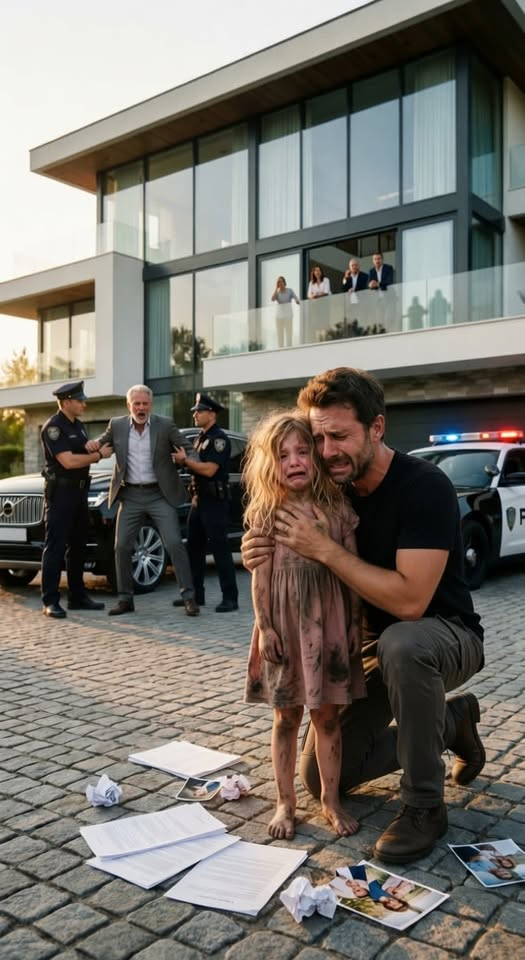
“She just showed up at the school’s front entrance,” Mrs. Higgins continued, her breath shuddering over the international connection. “The night watchman found her banging her fists against the reinforced glass doors. Marcus… she is barefoot. She is bleeding heavily from the soles of both feet. She is freezing cold, shivering so hard we can barely keep a blanket on her, and she is in a severe state of clinical shock. She refuses to speak. Her vocal cords seem completely locked.”
“Is she safe?!” I shouted into the phone. The seasoned, objective investigative journalist evaporated into the ether, replaced instantly by a terrified, desperate father. “Where is she right now? Did you call the police?!”
“The police are with her now in the nurse’s office, and paramedics are actively wrapping her in heated blankets,” Mrs. Higgins reassured me quickly, trying to de-escalate my rising hysteria. “Physically, she is secure. But Marcus, she won’t talk. The officers tried to ask her what happened, who she was running from. We gave her a notepad and a pen to see if she could at least write it down.”
“What did she write?” I demanded, my hands shaking so violently I almost dropped the sleek metal device. I pressed it harder against my ear, desperate for the answer and terrified to hear it.
Mrs. Higgins took a shaky, profound breath. I could hear the rustle of paper over the line. “She just keeps writing the exact same sentence over and over again, filling the whole page.”
“What did she write, Diane?”
“Grandpa hurt me.”
The hotel hallway spun into a blur of beige and gold. My knees weakened.
My seven-year-old daughter. My quiet, sweet, incredibly smart little girl, who loved collecting smooth stones and reading books about space, had somehow fled her grandfather’s massive, highly secured, gated suburban estate in the middle of the freezing Massachusetts night. She had navigated the heavy security. She had run three miles barefoot over unforgiving asphalt, broken glass, and sharp gravel, bypassing dozens of warmly lit houses just to seek refuge at the only place outside her home she felt safe—her elementary school.
“I am on my way,” I choked out. “Do not let her out of your sight.”
I hung up the phone. I bolted back into the conference room, ignoring the shocked faces of the panelists. I grabbed my leather laptop bag from the table, my lifeline to the world, and sprinted for the elevators without offering a single word of explanation to my team.
As the glass elevator descended rapidly toward the lobby of the London hotel, my fingers fumbled frantically over the screen of my phone to dial my wife, Claire. She was supposed to be staying at her father’s sprawling estate in the affluent suburbs for the weekend with Lily while I was overseas. It was supposed to be a quiet weekend of bonding.
Ring. Ring. Ring. “Hi, you’ve reached Claire. I can’t come to the phone right now. Leave a message.”
I cursed loudly, the sound echoing in the empty elevator car. I dialed her number again, my thumb pressing the screen so hard it almost cracked. Voicemail again. Where the hell was she? How could a mother sleep through her child fleeing the house into the freezing night?
My mind spinning with dark possibilities, I pulled up the contact for my father-in-law, Senator Robert Sterling.
Robert was a prominent, incredibly powerful, and deeply entrenched politician in Massachusetts. He was currently gearing up for a ruthless, highly publicized gubernatorial run. He was a man obsessed with optics, control, and the immaculate preservation of his own formidable legacy. He tolerated my presence in the family primarily because my journalism awards looked good in his campaign brochures—a progressive badge of honor he could flaunt. But behind closed doors, he clearly viewed my analytical, probing nature as a liability. I was a man who dug up secrets; he was a man who buried them.
The line connected. He answered on the second ring.
His voice was smooth, deep, and entirely untroubled. The rich baritone echoed with the unearned confidence of a man who owned the world. He sounded like a man who had just woken from a very peaceful, uninterrupted sleep.
“Marcus,” Robert rumbled, a hint of patronizing amusement in his tone. “It’s a bit early for international calls, isn’t it? I thought you were saving the world in London. Is everything alright?”
“Robert! Where is Lily?!” I yelled, completely abandoning the polite, tense political theater we usually engaged in. “She walked to her school! She’s bleeding from her feet! The principal called me—she wrote—”
“Marcus, stop,” Robert interrupted.
His tone didn’t shift into the frantic panic of a grandfather learning his granddaughter was hospitalized. It didn’t elevate with a protector’s concern. It dropped. It plummeted into a chilling, dismissive, and incredibly cold register. It was the exact voice of a seasoned, untouchable politician shutting down a hostile reporter at a press conference. It was a voice devoid of humanity.
“I do not interfere in your parenting choices, Marcus,” Robert stated flatly, his words clipped and measured. “And I certainly do not interfere with the dramatics of your child. If the girl decided to wander off in the middle of the night to throw a tantrum because her mother told her to go to bed, that is a reflection on your lack of discipline, not me.”
“She ran three miles barefoot, Robert! She wrote that you hurt her!”
“I am in the middle of a highly sensitive, critical campaign cycle,” Robert continued, his voice rising just enough to drown me out, entirely unbetted by the accusation. “I will not have police cars with flashing lights showing up at my front gates over a spoiled child’s bad behavior. It is terrible for optics. Handle it yourself, Marcus. And control your daughter before she creates a scandal.”
Click.
He hung up on me.
I stared at the phone screen as the elevator doors pinged open into the lavish, marble-floored lobby. The sound of the busy hotel rushed in, but I was frozen.
A seven-year-old child had fled his house, bleeding into the freezing night, and the man who was supposed to protect her called it “dramatics.” He hadn’t asked if she was hurt. He hadn’t asked what hospital she was at. He was entirely, sociopathically unbothered by her absence.
I realized then, with a horrifying, absolute certainty that turned my blood to ice, that my daughter hadn’t run away from a bad dream. She hadn’t sleepwalked. She had run away from a monster.
I immediately dialed my older sister, Chloe. She lived in a quiet neighborhood twenty minutes outside of Boston. She was a tough, no-nonsense pediatric nurse, and the only person I trusted absolutely.
“Chloe, wake up,” I commanded the second the line connected, not giving her time to utter a sleepy greeting.
“Marcus? What time is it—”
“Get your keys and get to Crestview Elementary right now,” I ordered, my voice shaking with a terrifying intensity. “Lily is there. She’s hurt. They are transferring her to Boston Memorial Hospital. Do not, under any circumstances, let Claire or Robert near her until I get there. Do you understand me? If they show up, you tell the police they are the primary suspects in an assault. You stand between them and that door.”
“I’m in my car,” Chloe said. The sleep instantly vanished from her voice, replaced by a fierce, primal, protective instinct. “I won’t let them touch her, Marc. I swear it. Get on a plane.”
I ran out of the hotel, hailed a black cab, and offered the driver double his fare to break every speed limit to Heathrow.
Seven hours.
Seven agonizing, claustrophobic, torturous hours trapped in a pressurized metal tube flying thirty thousand feet over the dark expanse of the Atlantic Ocean. I had managed to secure a seat on the very first available flight out of London, but boarding the plane felt like stepping into a sensory deprivation chamber.
The plane’s Wi-Fi was spotty at best, cutting out every few minutes. I was entirely cut off from the world, hovering in a terrifying liminal space. My mind was left entirely alone in the dim cabin lighting to construct a thousand horrific, vivid scenarios of exactly what Senator Robert Sterling had done to my little girl.
I sat by the window, staring out at the impenetrable blackness, gripping the armrests until my knuckles turned stark white. I pictured Lily crying. I pictured the harsh, cold asphalt tearing at her bare soles. I tried to imagine the absolute, suffocating terror she must have felt, a tiny girl in a nightgown, running alone in the dark, looking over her shoulder to see if the monster was following her.
My thoughts drifted to Claire. We had been married for ten years. When we met, she was a passionate, idealistic political science major who claimed she wanted to use her family’s influence to dismantle corrupt systems. But over the last few years, as her father’s political ambitions grew from state Senate to the Governor’s mansion, I watched a slow, insidious change creep over her. She became obsessed with the campaign. The optics. The legacy. She started defending her father’s more ruthless tactics, claiming the ends justified the means.
Had she changed so much that she would ignore a crisis? Why hadn’t she answered her phone? Was she asleep, blissfully unaware of the horror that had unfolded under her own roof?
I squeezed my eyes shut, a headache pounding behind my temples. I couldn’t afford to fall apart. I needed to be sharp. I needed to be the investigative journalist who dismantled empires. If Robert had hurt my daughter, I was going to burn his political kingdom to the absolute ground, brick by brick.
When the plane finally touched down on the tarmac at Logan International Airport, I didn’t wait for the seatbelt sign to ding. I was out of my seat, grabbing my laptop bag. I sprinted through customs, utilizing my expedited press pass, entirely abandoned my checked luggage on the carousel, and threw myself into the back of a yellow cab.
“Boston Memorial,” I told the driver, tossing a hundred-dollar bill into the front seat. “Drive like your life depends on it.”
I burst through the heavy sliding glass doors of the Boston Memorial pediatric ward like a man possessed by a demon. The familiar, sterile smell of bleach and sharp antiseptic hit me like a physical blow to the face, a sensory reminder of vulnerability and pain.
“Lily Davis!” I yelled at the nurses’ station, my voice echoing down the quiet, pastel-colored corridors. I dropped my laptop bag onto the counter, my chest heaving. “I am her father. Where is she?”
Before the startled nurse could answer, Chloe stepped out of a private room down the hall.
I ran to her. Chloe looked terribly pale, her face carved from stone. She was wearing her casual clothes, thrown on in a rush. She didn’t smile when she saw me. She looked profoundly, deeply shaken, carrying a weight I had never seen her bear.
“She’s sleeping, Marcus,” Chloe whispered as I rushed up, gently placing a hand on my chest to slow my momentum. She pointed through the reinforced glass window of the hospital room door.
I walked slowly to the glass, pressing my palm against it. Inside the sterile hospital room, lit only by the soft glow of a monitoring machine, lay my entire world. On the bed, wrapped tightly in two heavy, heated hospital blankets, Lily was curled into a tight, defensive knot. She was fast asleep, but even in her unconscious state, her small body was still trembling slightly, twitching with residual adrenaline and trauma.
At the end of the bed, resting atop a pillow, were both of her small feet. They were heavily wrapped in thick, white medical gauze, secured with surgical tape.
I pushed the door open, the hinges entirely silent, and walked to her bedside. I dropped to my knees on the cold linoleum floor, burying my face in the mattress near her small shoulder. I breathed in the scent of her strawberry shampoo, mixed with the harsh hospital soap.
Tears of profound, overwhelming relief finally spilled over my cheeks, soaking the white sheets. She was alive. She was safe. She was breathing.
After a few minutes of simply listening to her steady heartbeat, I stood up, kissed her forehead softly so as not to wake her, and walked back out to the hallway where Chloe was waiting like a sentinel.
“The doctors cleaned her feet,” Chloe said softly, crossing her arms defensively over her chest. “The glass and gravel cuts were incredibly deep, Marcus. She required dozens of stitches. They’ve given her a mild sedative and painkillers. But…”
Chloe hesitated, her voice catching. She reached into her pocket and slid her smartphone toward me. “Look.”
I took the phone, my hands steadying with a grim, terrible resolve. Chloe had taken photos of Lily’s injuries before the nurses wrapped her feet in gauze. The lacerations on her soles were indeed horrific, angry red lines crossing the tender skin.
But that wasn’t what made the blood freeze in my veins.
Above the cuts, ringing both of Lily’s delicate, pale ankles, were deep, dark, jagged purple bruises. They were clearly defined against her skin. They were the unmistakable, violent, overlapping shapes of large adult fingers. Someone had grabbed her by the ankles with immense, terrifying, brutal force. The bruising pattern indicated they were trying to drag her backward across a floor.
“Has she said anything to the doctors?” I choked out, my chest heaving as the absolute reality of the physical violence hit me. This wasn’t a slap. This was a sustained assault.
“Her vocal cords are completely locked. The pediatric psychiatric team was here an hour ago. They say it’s a severe, acute trauma response,” Chloe whispered harshly, tears welling in her eyes. “She hasn’t spoken a single, solitary word since she arrived at the school. She just stares blankly at the wall. But…”
Chloe reached into her purse. Her hand was trembling.
“She wrote something else when she woke up an hour ago, Marcus,” Chloe said, her voice dropping to a terrified, devastated whisper. “And this time, it’s not just about Robert.”
She handed me a crumpled, tear-stained piece of hospital stationery.
I stared at the paper. Lily’s shaky, uneven, child-like handwriting stared back at me in blue ink. The letters were pressed so hard into the paper they had almost torn through.
Mommy watched. Mommy locked the door.
The hospital hallway tilted violently on its axis. The fluorescent lights overhead seemed to strobe. I gripped the cold, stainless-steel edge of a passing medical cart so tightly my knuckles popped, desperate to keep from collapsing to my knees.
Claire. My wife. The woman I had loved for ten years. The woman who had carried Lily in her womb.
She hadn’t been asleep. Her phone hadn’t just been off because it was charging. She had been awake. She had been in the room. She had stood there and watched her father violently assault our seven-year-old daughter, and instead of protecting her child, instead of throwing herself between Lily and Robert, she had locked the door. She had actively trapped Lily inside a room with a monster.
The betrayal was so absolute, so fundamentally unnatural and grotesque, that it bypassed the grieving process entirely. It bypassed sorrow and immediately crystallized into an icy, impenetrable, towering wall of pure, unadulterated rage.
“Where is Claire now?” I asked. My voice didn’t shake. It dropped into a dead, terrifying calm that made Chloe physically take a step back.
“She called my phone twenty minutes ago,” Chloe said, her eyes dark with profound disgust. “She said she was on her way to the hospital. She claimed Lily had a ‘severe night terror’ and got confused in the dark, and that the principal was wildly overreacting to a scraped foot. She thinks she can just walk in here, play the worried, devoted mother, gaslight all of us, and take Lily home to protect the campaign optics.”
I looked down at the crumpled piece of paper. I looked at the digital photos of the violent bruises on my daughter’s ankles.
“Let her come,” I said, turning my back on the room and walking toward the secluded hospital waiting area at the end of the hall. “Because she is walking straight into a trap.”
I didn’t scream in the hallway. I didn’t smash a hole in the pristine drywall. I didn’t break down into a hysterical, sobbing mess.
I was an investigative journalist. I lived my entire professional life in the architecture of hidden truths, buried secrets, and encrypted lies. I understood leverage, digital footprints, and human corruption better than anyone in my wealthy, elite, politically connected in-law family realized. And I knew one absolute, undeniable, universal truth about powerful, paranoid politicians: their obsession with control always, inevitably, leaves a digital trail.
I sat down at a small table in the corner of the waiting room. I opened my leather bag, pulled out my high-powered laptop, connected to my encrypted, secure mobile hotspot, and went to war.
Senator Robert Sterling was obsessed with security. His sprawling estate was wired with a state-of-the-art, military-grade surveillance camera system. What he didn’t know—or had completely forgotten in his arrogance—was that two years ago, when his private security firm updated his servers, I had investigated that exact firm for a massive piece on corporate data vulnerabilities. I knew the backend architecture of their closed-circuit systems better than their own technicians did.
More importantly, a month ago, Claire’s laptop had died, and she had used my machine to log into her father’s estate manager portal to check on a secure package delivery. She didn’t clear the cache. My system had quietly saved the administrative credentials.
My fingers flew across the keyboard, a blur of motion. I bypassed the standard, outward-facing login page, routing my connection through a secure proxy server located in Switzerland to avoid triggering any immediate perimeter alerts on the estate’s network administrators’ end. I accessed the primary cloud backup—the digital vault where the security footage was temporarily cached for 48 hours before permanent deletion.
I didn’t care about the perimeter cameras or the driveway feeds. I ran a highly targeted search query for the interior, motion-activated cameras located inside Robert’s private, soundproofed study, timestamped from 1:00 AM the previous night.
The system showed a gap. A manual deletion.
They had tried to wipe it. But they were politicians, not hackers. I found the deleted file fragment lingering in the temporary, unpurged trash bin on the server. I ran a quick restoration protocol and hit play.
The truth unspooled on my high-definition screen in a horrific, silent, undeniable video.
Senator Robert Sterling wasn’t just staying up late preparing for a gubernatorial debate. The footage showed him standing by his massive mahogany desk, visibly sweating, frantically feeding massive, thick stacks of physical documents, glossy photographs, and thick, bound offshore banking ledgers into a heavy-duty, industrial shredder. These weren’t campaign flyers. I recognized the format of the ledgers from my years on the financial beat. They were the physical proof of massive political corruption, multi-million dollar bribery, and illicit kickbacks he had accepted from Boston construction conglomerates over the last decade.
And Claire.
Claire, who held a master’s degree in political science, wasn’t just acting as a supportive daughter; she was acting as his “cleaner.” She was standing right beside the shredder, rapidly organizing the damning, heavily incriminating files, feeding them into the machine to be destroyed before an upcoming, rumored federal audit.
As I watched the video’s digital timestamp tick to 1:15 AM, the horrifying, heartbreaking narrative of Lily’s assault finally unfolded in brutal clarity.
Lily hadn’t just woken up from a bad dream and wandered aimlessly into the wrong room. She had woken up thirsty. She was carrying a large, heavy glass of water downstairs from the kitchen. The camera caught her pushing open the heavy oak door to the study, her small face sleepy and confused, startling her grandfather and mother.
As she stumbled backward in surprise at their frantic, guilty movements, the heavy glass slipped from her small hands. It shattered on the floor, but the water splashed in a wide arc, spraying directly across the mahogany desk, soaking a crucial, massive stack of original, handwritten bribery ledgers that Robert hadn’t yet managed to shred. The ink immediately began to run.
The video showed Robert exploding in a violent, completely uncontrollable, animalistic rage. His entire political survival, his freedom, and his legacy were suddenly threatened by a spilled glass of water from a seven-year-old child.
He lunged across the room, his face contorted in a terrifying mask of fury. Lily dropped the remnants of the glass and tried to sprint away in absolute terror toward the hallway. But Robert was too fast. He tackled her legs, his massive hands grabbing her violently by the ankles. She hit the floor hard. He began dragging her backward, across the expensive Persian rug, pulling her back into the center of the study. Lily was thrashing, kicking, trying desperately to break free.
And Claire?
I watched the screen, my heart turning to ash. Claire didn’t rush to her daughter’s defense. She didn’t scream at her father to stop. She looked at the ruined, soaked ledgers, then looked out into the hallway.
She rushed past her struggling daughter, grabbed the heavy oak door, and slammed it shut, turning the heavy brass deadbolt to ensure the household staff wouldn’t hear the commotion. She trapped her child in a soundproof room with a violent man. She prioritized her father’s political campaign, her massive future inheritance, and her elite social status over the physical safety and life of her own flesh and blood.
The footage continued. Driven by pure, primal survival instinct, Lily kicked wildly, her small heel connecting with Robert’s knee. He stumbled. Lily scrambled up, climbed onto the heavy, built-in bookshelves beneath the large ground-floor window, and violently threw her small body against the glass pane. It shattered, raining glass down on her bare feet as she escaped into the freezing, unforgiving night.
Robert and Claire didn’t pursue her. The video showed them turning back to the desk, frantically trying to salvage the wet documents, more concerned with the paper than the bleeding child running into the snow.
I sat back in the hard plastic hospital chair, staring blankly at the glowing screen. The evidence was irrefutable, undeniable, and utterly damning. It wasn’t a domestic dispute. It wasn’t a misunderstanding. It was documented, timestamped, high-definition proof of felony child abuse, child endangerment, and massive, systemic political corruption.
“I have the video,” I said to Chloe, who had walked up behind me, watching the screen in horrified silence. My voice was a hollow, robotic, terrifyingly calm monotone.
I took a highly encrypted, portable flash drive from my bag and downloaded the raw MP4 file directly from the server. Then, I quickly sent a print command to the nurses’ station printer down the hall. I printed out high-resolution, full-color screenshots of the assault—Robert’s hands wrapped like vices around Lily’s ankles, Claire turning the deadbolt, and the clearly visible bribery ledgers stacked on the desk.
I gathered the warm papers and turned to my sister.
“Call Detective Reynolds,” I instructed, my eyes devoid of any remaining mercy. Reynolds was a seasoned, cynical, and highly decorated investigator with the Boston PD who had consulted on several of my previous corruption articles. He owed me a favor, and he hated dirty politicians. “Tell him to bypass the front desk and meet us in Lily’s hospital room immediately. Tell him to wear plain clothes, no badge showing, and to stand completely silent behind the privacy curtain.”
At exactly 10:30 AM, the heavy, double doors of the pediatric ward swung open with a loud thud.
I stood in the doorway of Lily’s hospital room, my arms crossed, the printed photos folded in the inside pocket of my jacket.
Claire was rushing down the long, brightly lit hallway. She was dressed meticulously for the role she was about to play. She wore a comfortable, soft, maternal-looking cashmere sweater, her hair pulled back into a messy, relatable bun. She was holding a plush, brand-new teddy bear she had clearly purchased at the hospital gift shop. She was wearing a frantic, perfectly executed, incredibly performative mask of exhausted, desperate motherly concern.
She was entirely ready to play the victim of a stressful, chaotic night. She was ready to gaslight me, ready to smooth over the “misunderstanding” with her characteristic political charm, and take her daughter back to the house of horrors before the press caught a single whiff of a scandal.
She thought she was walking into an argument with her stressed husband about her father’s notorious temper.
She didn’t know she was walking into a federal indictment.
“Marcus! Oh, thank God you’re here,” Claire gasped, her voice trembling with manufactured, fake emotion as she reached me. She reached out to hug me, but I didn’t move an inch. She dropped her arms, pivoting seamlessly. “I was so incredibly worried! My flight back from the cape got delayed. Lily has been having these terrible, terrifying night terrors lately, did the doctors tell you? My dad tried to stop her from leaving the house so she wouldn’t hurt herself, but she just panicked, got confused in the dark, and ran out the window! Is she okay? Is my baby okay?”
“Is that what happened, Claire?” I asked, my voice dangerously even, devoid of any inflection. I stepped smoothly out into the hallway and pulled the hospital room door mostly shut behind me, creating a barrier.
“Yes! It was a nightmare, we were absolutely terrified!” Claire insisted, her eyes wide, playing the role to absolute perfection. She tried to physically look past my shoulder into the room. “Let me see her, Marcus. I need to take her home to her own bed so she feels safe. The campaign trail has been so incredibly stressful for Dad lately, we just need to keep this quiet and handle it as a family—”
I stepped smoothly and aggressively into her path, my large frame completely, undeniably blocking the door.
“She’s not going anywhere with you, Claire,” I said flatly, the words dropping like lead weights. “Not today. Not ever.”
Claire sighed, a harsh, irritated, deeply patronizing sound. The concerned, weeping mother facade slipped for a fraction of a second, revealing the manipulative, cold, calculating political operative beneath the cashmere. She crossed her arms over her chest, tapping her foot.
“Marcus, please don’t be dramatic,” Claire scolded, using the exact, precise word her father had used on the phone hours earlier. “I know you flew all night, and you’re exhausted, but she’s fine. It’s just a few minor scrapes on her feet from the gravel. You are wildly overreacting and risking my father’s entire political future with this hospital spectacle.”
I reached slowly into the inside pocket of my jacket. I pulled out the two pieces of crinkled, tear-stained hospital stationery.
“She isn’t fine, Claire,” I stated, holding the papers up at eye level so she was forced to look at them. “She is in a severe state of clinical shock. Her vocal cords are entirely locked from trauma. She can’t speak. But she did manage to write this.”
Claire’s eyes darted to the first note, written in blue ink.
Grandpa hurt me.
She swallowed hard, her throat bobbing visibly. A genuine, unscripted flicker of panic broke through her carefully constructed, polished facade.
“She… she’s confused, Marcus, she’s just a child,” Claire stammered, taking a small, involuntary step backward. “She was having a night terror. She tripped on the rug and Dad tried to catch her ankles so she wouldn’t hit her head.”
I didn’t blink. I slowly lowered the first note and held up the second crumpled piece of paper.
Mommy watched. Mommy locked the door.
The blood drained completely, violently, and absolutely from Claire’s face. She looked exactly like a ghost. Her mouth opened, but no sound came out. The air in the hospital corridor became thick, heavy, and suffocating.
“And before you try to look me in the eye and tell me that a traumatized seven-year-old girl is lying to manipulate me,” I added, my voice turning to ice. I reached behind me, grabbed the thick stack of printed, high-resolution screenshots from a small tray near the door, and slammed the photos directly against her chest, forcing her to grab them or let them fall.
“I pulled the deleted security footage from the study, Claire,” I said, my voice dropping to a lethal, freezing whisper that cut deeper than a shout. “I bypassed the server. I watched Robert burning the bribery ledgers. I watched the water spill. I watched him tackle my daughter and drag her across the floor by her ankles.”
Claire stared down at the printed photos in her hands. The image of her father grabbing Lily. The image of the illegal ledgers. Her eyes widened with absolute, unadulterated, world-shattering terror.
“I know,” I continued relentlessly, stepping closer, forcing her to look at me, “that you stood there and locked that door to trap her inside with a violent man, because you were afraid of losing a Senate seat and going to federal prison.”
Claire stumbled backward, her designer heels slipping on the linoleum, her back hitting the cold hospital wall. The photos slipped from her trembling hands, scattering like fallen leaves across the floor.
“Marcus… Marcus, you don’t understand!” Claire shrieked, the panic finally, totally, and completely consuming her. The poised facade was entirely obliterated. “He was going to be Governor! If those documents weren’t destroyed tonight, the auditors would have found them! We would have lost everything! The legacy, the estate, the trusts, everything! It was just a bruise, Marcus! She’s fine! You can’t ruin our entire lives over a spilled glass of water!”
“She’s not fine,” a deep, gravelly, authoritative voice echoed from inside the hospital room behind me.
The door swung fully open. Detective Reynolds stepped out into the hallway, his gold badge prominently displayed on his belt, his hand resting near his service weapon. He had been standing silently behind the privacy curtain the entire time, his digital recorder running, listening to her desperate, damning, incredibly detailed attempts to justify the abuse and confess to the destruction of evidence.
“And neither are you, Mrs. Davis,” Detective Reynolds stated coldly, looking at her with undisguised contempt.
Claire shrieked, a high-pitched sound of pure terror, pressing herself flat against the wall as two uniformed police officers rounded the corner of the hallway and advanced on her with terrifying speed.
“Claire Davis,” Detective Reynolds said, stepping forward and pulling a pair of heavy, cold steel handcuffs from his belt. “You are under arrest for felony child endangerment, conspiracy to commit fraud, destruction of federal evidence, and accessory to aggravated assault.”
“No! Marcus, please! Stop them!” Claire wailed, struggling wildly, kicking out as the officers grabbed her arms and forced them roughly, unceremoniously behind her back. The steel cuffs clicked loudly into place. “I’m her mother! You can’t do this to me! Think of the press! Think of Lily! Tell them to stop!”
I didn’t flinch. I didn’t step forward. I didn’t feel a single, solitary shred of pity for the woman writhing in front of me. I looked at the woman who had prioritized a corrupt political campaign over the life and safety of our innocent child.
“You stopped being her mother the exact second you turned that deadbolt,” I said, staring at her with profound, unyielding disgust. “Enjoy federal prison, Claire. I hear the press access is terrible.”
The officers marched her down the long hallway, her hysterical, begging sobs echoing off the sterile walls until the elevator doors swallowed her whole.
As the silence returned to the ward, Detective Reynolds turned to me, his expression grim but deeply respectful.
“We have a heavily armed tactical unit currently executing a no-knock raid at Senator Sterling’s estate as we speak,” Reynolds informed me, checking his phone. “Between your video recovery, the partially destroyed bribery documents we are seizing, and the child’s written statement, the Attorney General is having an absolute field day. Robert is looking at thirty years in a federal penitentiary for the corruption charges alone, and that’s before we even add the felony assault charges on a minor.”
“Make sure he never sees the sky as a free man again,” I said quietly, the adrenaline finally beginning to fade, leaving behind a bone-deep exhaustion.
“We will,” Reynolds promised, patting my shoulder. “Go be with your daughter.”
I turned my back on the wreckage of my marriage, the ashes of a decade-long lie, and walked straight back into the hospital room.
Lily was awake.
She was sitting up in the center of the bed, the heavy white blankets pooling around her waist. She had heard the shouting in the hallway. She had heard the police. She was watching me with wide, terrified, incredibly vulnerable eyes, her small hands gripping the sheets.
I walked slowly over to the bed. I didn’t say a word. I didn’t ask her to be brave. I didn’t ask her to speak. I simply dropped to my knees on the floor in front of her, making myself as small and non-threatening as possible, and opened my arms wide.
Lily hesitated for a fraction of a second, her gray eyes searching my face for the truth.
Then, she lunged forward.
She threw her small body completely off the mattress, burying her tear-streaked face deep into the crook of my shoulder. Her small, bruised hands gripped the fabric of my shirt with the desperate, crushing, frantic strength of a drowning victim holding onto the only lifeline in a stormy sea.
She began to cry.
It wasn’t a loud, theatrical wail. It was a silent, violent, full-body shaking sob that vibrated through her entire frame—a massive, overwhelming release of pure, unadulterated terror, grief, and ultimate relief that broke my heart into a million pieces all over again.
“I’ve got you, baby,” I whispered fiercely into her hair, wrapping my arms tightly around her, creating a human shield against the world. “I’ve got you. I’m right here. The monsters are gone. They are locked away in a cage. And I swear to you on my life, they are never, ever coming back.”
The next few months were a grueling, exhausting, relentless marathon of grand juries, endless legal depositions, federal investigations, and intense, specialized pediatric trauma therapy.
The criminal trials were shockingly swift and brutal. Faced with the overwhelming, irrefutable video evidence I had recovered from the cloud, the unredacted bribery ledgers seized by the FBI, the audio of Claire’s confession in the hospital hallway, and the horrific medical photos of Lily’s injuries, both Claire and Robert’s high-priced, elite defense attorneys advised them to immediately take plea deals. It was the only way to avoid the maximum, life-ending sentences a furious, disgusted jury would undoubtedly hand down.
Senator Robert Sterling’s massive, generations-old political empire collapsed overnight in one of the most historic, scandalous implosions in Massachusetts history. He was sentenced to twenty-eight years in a maximum-security federal penitentiary, his legacy reduced to a cautionary tale of greed and violence.
Claire, for her role as the “cleaner” in the corruption cover-up, the destruction of federal evidence, and her active, horrific complicity in the assault of her own child, received fourteen years without the possibility of early parole. Her immense wealth, her soaring political aspirations, and her freedom were utterly, completely annihilated by the very truth she had tried to lock behind a heavy oak door.
I filed for divorce the very day after her arrest. Given her violent felony conviction and the overwhelming evidence of child endangerment, the family court judge bypassed standard procedures and granted me sole, irrevocable, and permanent physical and legal custody of Lily. Claire was legally stripped of all parental rights. She was a stranger to us now.
We didn’t stay in Boston. The city held far too many ghosts, too many aggressive reporters staking out our apartment, and too many dark, lingering memories of a family that had proven to be nothing more than a dangerous mirage.
I transitioned my career from active field reporting to freelance investigative writing, allowing me to work remotely. I packed our belongings, sold the house, and moved us across the country to a quiet, beautiful, sunlit, A-frame cabin deep in the Colorado Rockies.
It was perfect. It had a massive, sprawling backyard that backed up to thousands of acres of protected national forest, large, floor-to-ceiling windows that let in the crisp, pure mountain air, and absolutely no heavy oak doors with locks on the outside.
It was our sanctuary.
A full year later, the harsh, bitter, freezing winter of our collective trauma had finally, slowly thawed into a warm, bright, promising summer.
The intense therapy, the change of scenery, and the absolute guarantee of safety had worked wonders. The profound, psychological silence that had gripped Lily’s vocal cords for weeks after the assault had slowly, steadily begun to crack. It started with soft, hesitant whispers in the dark before bedtime, then quiet, careful sentences during our morning hikes, and eventually, the beautiful, loud, completely unobstructed, joyful sound of her real voice fully returned to the world.
I was sitting on the expansive wooden deck of our new cabin, a steaming cup of dark roast coffee in my hand, the crisp, pine-scented mountain breeze ruffling my hair.
I watched Lily running wildly across the bright green grass of the sprawling backyard. She was chasing our newly adopted golden retriever puppy, laughing hysterically, a bright, musical sound that filled the valley, as the clumsy dog playfully nipped at her heels.
Her feet were fully, perfectly healed, leaving only the faintest silver scars that would fade with time. She was running barefoot against the warm, soft earth, moving fast, entirely free of pain, and entirely free of fear.
She stopped near the edge of the dark green tree line, bending down to pick up a brightly colored, neon-yellow frisbee. She turned around and looked back at me sitting on the porch. A bright, brilliant, completely unburdened smile illuminated her young face, shining brighter than the Colorado sun.
“Daddy! Look at him go! He’s so fast!” Lily shouted, her voice ringing clear, incredibly strong, and beautifully loud across the open valley as she threw the plastic toy high into the air for the dog to catch.
I smiled, a deep, profound, anchoring sense of peace settling permanently into my chest, replacing the icy shard of terror that had lived there for a year. I raised my hand and waved back at her.
As an investigative journalist, I had spent my entire adult life looking for hidden corruption, analyzing complex data sets, deciphering encrypted files, and believing that uncovering massive political scandals was the ultimate, objective truth of the world. I thought truth was found in ledgers and hard drives.
But as I watched my daughter play happily in the sun, I realized how entirely wrong I had been.
The most powerful, important, and devastating piece of truth I had ever uncovered in my entire life wasn’t sitting on a secure, encrypted server. It wasn’t hidden in a corrupt politician’s shredded ledger.
It was two shaky, terrified, incredibly brave sentences, written in blue ink on a piece of crumpled hospital paper by a seven-year-old girl in the middle of the darkest night of her life.
She had possessed the immense, unbelievable, world-altering courage to write the truth down when the very adults who were supposed to protect her had tried to violently, permanently bury it.
I took a slow sip of my coffee, feeling the warm, healing Colorado sun on my face. I watched her laugh, knowing with absolute, unshakeable, eternal certainty that I would spend every single day of the rest of my life ensuring she never, ever had to be silent again.
If you want more stories like this, or if you’d like to share your thoughts about what you would have done in my situation, I’d love to hear from you. Your perspective helps these stories reach more people, so don’t be shy about commenting or sharing.