Hope Mendoza had lived in the same brick house in Chicago long enough to know every sound it made. The pipes clicked before the heat rose. The refrigerator hummed in uneven bursts. The old hardwood whispered under slippers.
She was sixty-eight years old, and the house had not come easily. Hope and her husband Anthony bought it through teacher salaries, coupon folders, postponed trips, and years of treating every dollar like it had weight.
Anthony used to say the house was not big, but it was honest. The porch steps were worn smooth in the middle. The kitchen cabinets stuck in damp weather. The dining room caught evening light beautifully.

After Anthony died, Hope kept his reading glasses in the top drawer of the end table. His favorite mug stayed at the back of the cabinet, chipped but untouched. Grief had made the house quiet, not empty.
Edward was her only son. When he called one Tuesday morning at 10:42 and said he had lost his job, Hope did what she had always done. She opened the door before he finished asking.
He told her it would only be for a while. He needed time to find work, reset, and give Linda and the children somewhere steady. Hope did not ask for rent. She did not mention deadlines.
Instead, she washed sheets, filled the refrigerator, and bought Dylan’s favorite snacks. She put flowers on the dining table because she wanted their arrival to feel like welcome, not failure.
That was Hope’s way. She believed a mother’s job did not end just because her child grew tall, married, and had children of his own. Love, to her, was practical before it was sentimental.
Still, Anthony had known her softness could be used against her. Five years before his death, he had asked Gabriella Ortiz, a longtime friend and attorney, to prepare certain papers in case Hope ever needed protection.
Hope had not thought about those papers often. They sat in Gabriella’s files, alongside the Cook County property record, the final mortgage payoff letter, and a notarized occupancy agreement Anthony insisted on drafting.
At the time, Hope had laughed. She told Anthony no family of theirs would ever make her need something so formal. Anthony had only touched her hand and said love was not the same thing as blindness.
When Edward arrived, Hope saw the strain immediately. He looked thinner, his shoulders rounded inward. Dylan ran into her arms. Sarah barely looked up from her phone. Linda entered last, polished and assessing.
“Thank you for letting us stay, Hope,” Linda said.
The sentence was correct, but the feeling behind it was not. Hope noticed the way Linda’s eyes moved around the living room, not with gratitude, but with measurement.
Within hours, Linda had complaints. The guest room was too cramped. The upstairs bathroom had poor lighting. The closets were impractical. Hope listened, nodded, and reminded herself that stress made people sharp.
Then Linda said she and Edward should probably take the master bedroom. It made the most sense, she said, as if Hope’s room were a hotel upgrade waiting for the boldest guest.
Hope felt her jaw tighten. For one moment, she imagined taking Anthony’s chipped mug from the cabinet and setting it between them. She wanted Linda to see exactly whose house she was entering.
She did not do it. She folded a dish towel instead and told herself peace still mattered. That had been Hope’s mistake for too many years: believing peace and silence were the same thing.
By late afternoon, she decided to cook Edward’s favorite beef stew. He had loved it as a boy after soccer practice, coming home cold, hungry, and grass-stained. Hope wanted to remind him of home.
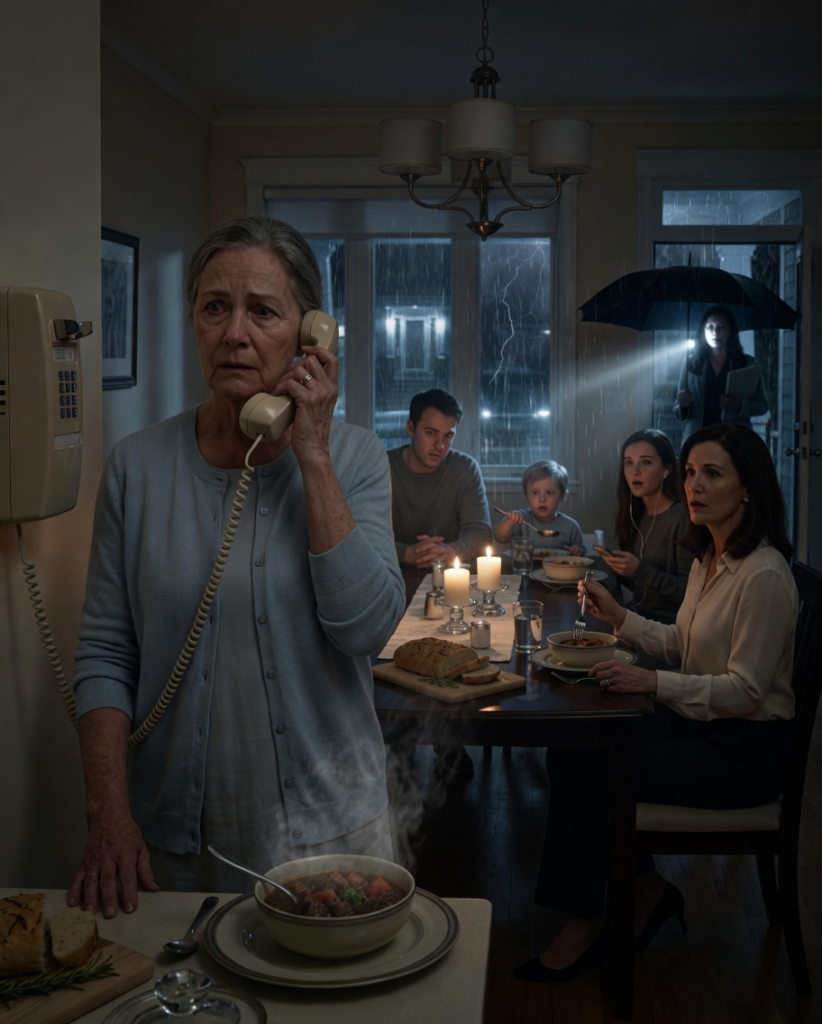
The kitchen filled with rosemary, warm bread, and the soft heat of simmering beef. Hope set the good dishes on the dining table, the ones she used for birthdays and Christmas Eve.
She lit two candles. She opened a bottle she had been saving. She told herself the first dinner could still be a soft landing. Maybe Linda would settle. Maybe Edward would breathe.
For a few minutes, the scene almost looked like what Hope had hoped for. Dylan helped carry bowls. Edward sat down tired but grateful. Sarah slid into her chair with one earbud still in.
Linda came last, perfectly dressed, moving as if she were attending dinner downtown and Hope’s dining room simply happened to be the room assigned to her that evening.
Steam rose from the plates. Silverware touched china. Candlelight flickered on the polished edge of the table. Hope let herself believe she had exaggerated Linda’s sharpness.
Then Linda set down her fork and looked directly at Hope.
“I’m the one in charge of this house now,” she said.
The words seemed to pull all the sound out of the room. Dylan froze with his spoon halfway lifted. Sarah gave a startled laugh that died almost immediately. Edward lowered his eyes.
That was the deepest cut. Not Linda’s arrogance. Not even the cruelty of saying it under Hope’s roof. It was watching Edward choose his plate over his mother’s face.
Linda glanced toward the back door and added, “Take your plate outside and eat with your friend.”
Hope later remembered absurd details from that moment. A drop of stew slipping from the serving spoon. The candle flame leaning sideways. The phone still glowing faintly in Sarah’s lap. Edward’s hands motionless near his bowl.
Nobody moved.
Hope had spent a lifetime staying calm. In classrooms, in parent meetings, in hospital hallways after Anthony’s diagnosis, she had learned to hold herself together until everyone else survived the room.
But this was different. Linda was not simply being rude. She was testing whether Hope could be erased in her own home while her family watched.
Hope did not scream. She did not cry. She did not beg Edward to remember who had loved him first. Rage did not rise in her. It went cold.
She smiled.
Then she stood, walked to the kitchen wall phone, and dialed a number she had kept longer than anyone in that room knew. Linda’s smile widened at first, mistaking calm for defeat.
Gabriella Ortiz answered on the second ring. Hope kept her voice low, but steady.
“Gabriella,” she said, “it’s time.”
Eight minutes later, headlights crossed the dining room window. Linda’s expression shifted. Not fear yet. Just the first crack in the confidence of someone realizing the room has changed without her permission.
The knock came in three calm taps.
Gabriella entered wearing a charcoal coat and carrying a slim leather folder. She greeted Hope first, then looked at the table, the bowls, the candles, and the family frozen around them.
Linda tried to laugh. “Is this necessary?”
Gabriella did not answer her. She asked Hope, “Do you want me to read it here?”
Hope nodded.
The first page Gabriella placed on the dining table was the Cook County property record. It showed Hope Mendoza as the surviving owner. The second was Anthony’s final mortgage payoff letter. The third was the occupancy agreement.
Linda stared at the pages as if paperwork were a language she had never expected Hope to speak. Edward recognized the folder faster. His face lost color before Gabriella reached the final document.
The occupancy agreement had been prepared years earlier. It said any family member staying in Hope’s home did so as a guest, not as an owner, tenant, or decision-maker. It also allowed Hope to revoke permission immediately.
Linda’s mouth tightened. “She invited us.”
“Yes,” Gabriella said. “She invited you to stay. She did not surrender authority over her home.”
Edward whispered, “Mom, I didn’t know Dad did this.”
Hope looked at him then. Not with anger first, though anger was there. She looked at him with the exhaustion of a mother who had waited too long for her son to stand up.
“Your father knew I would forgive people before I protected myself,” she said.
Gabriella removed one final envelope from the folder. Edward’s name was written across it in Anthony’s handwriting. That was the point when Edward finally stood.
Inside was a letter Anthony had written for the possibility he feared most: that Edward, out of weakness or pressure, would allow someone to push Hope aside in the house they had built.
Gabriella read only one line aloud at first. Anthony had written that a man who lets his wife dishonor his mother under her own roof has already lost more than employment.
Edward covered his mouth. Dylan began to cry silently. Sarah lowered her phone completely for the first time that evening. Linda looked at Edward, then at Hope, calculating whether tears or outrage would work better.
Neither worked.
Hope told them the rules. Edward and the children could stay for thirty days while he found work and made arrangements, but only if Linda apologized and respected the house. Linda could not move rooms, change locks, or give orders.
Linda said Hope was being dramatic. Gabriella closed the folder and said quietly that if Linda refused to leave after permission was revoked, the next call would be to the appropriate authorities.
That was when the last of Linda’s confidence drained from her face. She had believed Hope was only an old woman with a soft voice and a spare bedroom. She had not counted on documents.
Edward finally spoke to his wife. “Stop,” he said.
It was not enough to repair the silence he had already given, but it was the first honest word he had said all night. Linda stared at him as if betrayal belonged only to her.
By morning, Linda had packed two suitcases and taken Sarah to her sister’s apartment. Dylan stayed with Edward at Hope’s house for the remainder of the week. Edward slept in the guest room without complaint.
The next day, he apologized to Hope in the kitchen. Not quickly, not neatly. He cried, and Hope let him. Forgiveness, she knew, did not mean pretending the wound had not happened.
“I should have said something,” he told her.
“Yes,” Hope answered. “You should have.”
That was the sentence that changed their relationship more than the fight itself. Hope did not rush to comfort him. She let the truth sit on the table between them, as real as the mortgage letter.
Over the next month, Edward found temporary work. He and Linda began counseling, though Hope did not ask for details. Sarah apologized awkwardly one afternoon, and Dylan kept hugging Hope harder than usual.
Linda never again called the house hers. When she came to pick up the children, she stayed on the porch unless invited in. She learned, slowly and unwillingly, that Hope’s kindness had boundaries.
Hope also changed. She moved Anthony’s mug from the back of the cabinet to the open shelf where morning light could touch it. She updated her papers with Gabriella and made copies for her own files.
The house grew quiet again, but not in the old way. This time the quiet felt chosen. Protected. Hope still cooked beef stew, still lit candles, still loved her family. But love no longer meant surrender.
Years of peacekeeping had taught Hope to stay small. That night taught her something better: a woman can open her door without handing over her dignity.
And whenever she remembered Linda’s words — this is my house now — Hope no longer felt the old sting first. She remembered the headlights, the knock, and the folder on the table.
Most of all, she remembered the moment she smiled, picked up the phone, and made one call that wiped the smile right off Linda’s face.