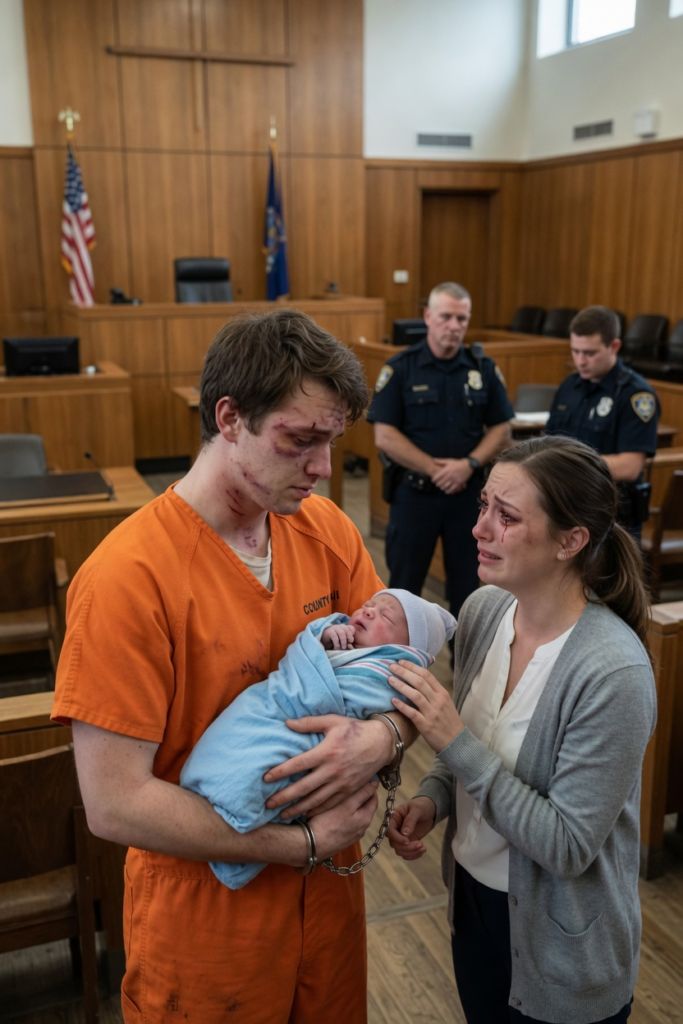
Mateo’s fingers trembled slightly as he held the small object, feeling its cold weight against his palm. Every second stretched unbearably long, as if time itself had slowed inside the courtroom.
He could hear Clara’s uneven breaths, each one sharp and shallow, a mirror of his own internal panic. The guards hesitated, unsure whether to intervene or wait.
Vicente’s usual calm had cracked. His eyes darted from Mateo to the object, and back to the baby, and for a fleeting moment, he looked genuinely afraid. Fear that Mateo had never seen in him before.
The metallic object glinted under the overhead lights, taped and folded in a way that made it both innocuous and threatening at the same time. Mateo’s gut twisted. He knew what this meant.
It was a recording device. Tiny. Hidden. Implanted. Whoever had done this had intended for it to stay secret, but its very presence screamed of betrayal and manipulation.
Clara’s hands clutched at her chest. “Mateo… please… be careful,” she whispered. Her voice broke, almost drowned in the heavy silence that had settled over everyone.
Mateo’s mind raced. Every memory of the past months, every distorted testimony, every unfair ruling, now slotted into place with chilling clarity. This was not just a frame. It was a setup of devastating precision.
He realized that revealing it now would shatter lives. But keeping it hidden might let a monster continue controlling everything. His mind swung between justice and the safety of his son.
The judge leaned forward. “Mr. Santos… what is that you’re holding? Explain yourself,” her tone stern but curious, betraying her own tension. Mateo felt the weight of every eye in the room.
For a moment, he considered speaking. To tell the truth would mean pointing a finger at Vicente, exposing corruption at the highest level. But it could also put Leo in danger if Vicente retaliated later.
The courtroom’s ambient noise—pens scratching, faint breathing, the shuffle of papers—seemed magnified. Mateo focused on the little metallic device, its coldness a reminder that decisions had consequences.
His wrist cuffs bit into his skin as he held it tightly. Every muscle in his body tensed. This was more than a courtroom scene; it was a crucible of morality, trust, and fear.
He remembered Clara’s eyes earlier that morning, bright with hope, even after the verdict. And he thought of Leo, soft and unaware in his tiny blue blanket. Could he risk this innocence for the sake of exposing Vicente now?
Mateo’s fingers grazed the tape covering the device, feeling the ridges and bumps. He recognized the pattern—it was custom, precise. Not a generic recording device; someone had gone to lengths to make this untraceable.
The room seemed to shrink around him. Vicente’s stare was cold, almost predatory, but beneath it flickered panic. Mateo knew he had Vicente in a corner—if he acted wisely.
A memory flashed: a whispered conversation months ago, someone telling him, “Never trust appearances. Everyone has a stake in your fall.” The voice was distant, but the truth echoed through his chest.
He shifted his gaze back to Leo, who now cooed softly, oblivious to the tension thickening the air. Mateo’s chest tightened. Every choice felt weighted with the possibility of harm to the only life that mattered.
The guards inched closer, unsure whether to take the device or wait for instructions. Mateo’s eyes flicked between them and the judge, measuring the silence, calculating what could be said without triggering catastrophe.
He could accuse Vicente openly, reveal the corruption, and risk a violent backlash. Or he could stay silent, take the evidence to plan a safer path, protect Clara and Leo, but let Vicente’s influence linger.
The choice gnawed at him. Every heartbeat felt like a drum of inevitability, counting down to a decision that would leave no room for regret or retreat.
Then he noticed a detail—a tiny scratch on the tape, almost imperceptible. It suggested recent tampering, someone had planted it with precision, perhaps minutes before the trial. Mateo’s stomach dropped.
Vicente shifted, clearly uncomfortable. The half-smile had disappeared. He said nothing, but his posture screamed tension. Mateo felt the quiet power of observation—sometimes silence was louder than accusation.
Clara stepped forward slightly, instinctively. Her eyes pleaded with him, but Mateo could see the question unspoken: “Do what’s right… but don’t hurt us.” The weight of trust pressed on him.
He closed his eyes, feeling the cool air of the courtroom, the soft warmth of Leo in his arms, and the palpable threat radiating from Vicente. Every choice seemed to carry permanent consequences.
Mateo’s breathing slowed, deliberately, each inhale measured, each exhale releasing part of the panic. He had to think clearly. Every second wasted could tip the balance, for better or worse.
The metallic object rested against his palm, silent but potent. It was proof, leverage, and danger all in one. Mateo knew that holding it was the first step toward either salvation or disaster.
He remembered a line from a book he’d once read: “Sometimes the hardest truth is the one you most fear to face, and yet it is the only one that can set you free.”
His gaze settled on Vicente. Mateo’s voice, quiet but firm, broke the tension: “This isn’t just a device. It’s evidence of everything. And you know it. But I have to decide how much of this truth to let out.”
Vicente’s eyes narrowed. For the first time, he seemed vulnerable. Mateo sensed that his next words, even a small gesture, could change the trajectory of all their lives forever.
He felt the subtle tremor in Clara’s hand as she pressed it lightly against his arm. It anchored him, reminded him that the choice wasn’t just about himself. It was about protecting the lives he loved most.
Mateo inhaled sharply. The seconds felt infinite. His mind raced through possibilities, weighing the protection of innocence against the justice that burned inside him, desperate to be unleashed.
Finally, he exhaled and made a deliberate choice. He would not speak yet. Not here. Not with Leo’s life at stake. The device would be his secret weapon, his shield, his quiet revolution.
The courtroom remained suspended, unaware of the internal decision Mateo had made. Vicente still looked uncertain, Clara tense, the judge expectant. Every eye was on him, but none knew the storm quietly forming in his mind.
Mateo lifted Leo slightly, letting him coo against his chest, and whispered softly, “We’ll survive this… I promise.” His voice carried a weight of resolve, quiet but unshakable, a calm amidst imminent chaos.
The guards tightened their formation, sensing a change, but Mateo did nothing overt. He handed Leo back to Clara gently, careful to maintain composure, aware that every movement now carried meaning.
Vicente’s gaze lingered, sharp and calculating, but Mateo no longer flinched. He had discovered leverage, yes, but more importantly, he had regained the part of himself no one could take away—the capacity to choose, even under pressure.
As Clara cradled Leo, she whispered a trembling, “Are you… okay?” Mateo’s eyes met hers. He nodded, faintly, reassuringly, but the nod carried more than comfort—it carried intent, a promise that the fight was far from over.
Mateo took a final glance at Vicente, reading every flicker of hesitation, every attempt to mask fear. And in that moment, he realized the choice he had made would shape not just the next hours, but potentially the course of every life in that room.
The gavel’s impending fall no longer mattered. The court’s judgment had been delivered. But the judgment Mateo would enact in silence, with patience and careful strategy, was just beginning.
He stepped back, hands empty, but the weight of the metallic device still alive in his mind. He had chosen secrecy over confrontation—for now—but the storm it promised would arrive soon, and the moment of truth was drawing nearer.
For the first time in months, Mateo felt a flicker of control. Not complete freedom, but the power to steer the coming chaos. And in that flicker, a plan began to form, as deliberate and precise as the device he now hid from everyone.
The courtroom buzzed again with murmurs, unaware that the tide had shifted quietly, invisibly. Mateo walked toward the exit, handcuffs still biting his wrists, heart steady, mind sharper than ever.
Outside, Clara’s eyes met his once more, and he knew that whatever path lay ahead, the first choice—protecting Leo while keeping the truth hidden—had been made. The storm could wait. The fight would come, but on his terms.
And in that small, fragile moment, Mateo felt the tiniest spark of hope ignite, a quiet defiance in the face of a world determined to crush him. The first act of a long reckoning had begun.

Mateo stepped into the corridor, the hum of the courthouse behind him fading like a distant storm. The metallic device remained hidden beneath his shirt, a quiet secret carrying immense weight.
Clara fell into step beside him, her arms still cradling Leo. Her face was pale, but her eyes shone with a fragile mixture of relief and apprehension, reflecting the delicate balance they now shared.
He could feel the gaze of the guards lingering, measuring, uncertain. Mateo kept his head down, breathing deliberately, letting the ordinary sounds of footsteps and distant chatter ground him.
Outside the courthouse, sunlight struck the pavement in harsh lines. It seemed absurdly ordinary after the suffocating intensity inside, yet every shadow felt loaded with potential threat.
“You were incredible,” Clara whispered softly, her voice trembling. “I don’t know how you—” she stopped, swallowing hard, aware that the words could neither contain nor express the weight of the moment.
Mateo shook his head faintly. “No. We were incredible,” he corrected, glancing down at Leo, who had begun fussing again, tiny fists curling and uncurling in his blanket. “This isn’t over. Not yet.”
For the first time in months, Mateo allowed himself a thought: survival meant patience. Not confrontation. Not revenge. Patience. Every move had to be calculated, measured, small enough not to reveal the truth prematurely.
Back at Clara’s apartment, the three of them settled into a tentative quiet. Mateo placed Leo in his crib, watching the baby’s soft chest rise and fall. Each breath was a reminder of what was at stake.
Clara poured two cups of coffee. The aroma filled the room, oddly grounding. Neither of them spoke for a while. Words felt insufficient, unnecessary, perhaps dangerous, even in this small sanctuary.
Mateo’s hands traced the rim of his cup, thinking. Every glance at Clara reminded him of the choices ahead—the decisions that had to balance justice, safety, and the fragile bonds they still clung to.
He had kept the device hidden. Vicente had no idea it existed. But Mateo knew the consequences of exposure: public scandal, legal battles, potential danger for them all. The device was both weapon and curse.
Days passed. Mateo returned to the routines of prison life, though nothing felt normal. Letters from Clara were measured, careful. Every word weighed with double meaning, protective instructions, silent warnings.
In the evening, Mateo sat on the edge of his bunk, holding a small notebook Clara had sent him. She detailed every ordinary act of life, hoping to anchor him to reality, yet each line was a reminder of the world he had lost outside these walls.
The metallic device stayed in a safe hiding place, unreachable yet present. Every time Mateo thought of Vicente, a quiet storm of strategy formed in his mind. He was not ready to act, yet he could not ignore it.
Clara visited often, their conversations sparse, careful. Sometimes she laughed softly, a fragile sound that seemed to fill the cell with light. Other times, she cried silently, letting Mateo hear without needing words.
Through it all, Leo’s letters and photographs arrived. Tiny, perfect glimpses of life growing, unaware of the danger, unaware of the secrets shaping his parents’ choices. Mateo felt the weight of every smile, every tiny milestone.
One night, Mateo pressed the device to his ear, listening to the faint recordings. Vicente’s voice, the whispered commands, the orchestrated lies—every sound confirmed what Mateo had suspected. The truth, at last, was tangible, undeniable.
The realization brought clarity, but also isolation. He could not act impulsively. The law might still fail him. Exposure could endanger Clara, endanger Leo. Mateo felt the crushing cost of truth weighed against the safety of those he loved.
Weeks turned into months. Vicente remained publicly untouchable, serene in his wealth and influence. But Mateo had patience, calculation, and a secret. The balance of power had shifted subtly, invisibly, like a stone settling beneath the surface of a river.
Mateo realized the cost of the choice he had made. By keeping the device secret, he had preserved Leo’s safety, preserved Clara’s trust, yet sacrificed the immediate satisfaction of justice. Every delayed action came with gnawing anxiety.
Clara confronted him one evening. “Mateo… how long can you hold it in? How long before it consumes you?” Her voice was quiet but edged with fear. Mateo looked at her, seeing both love and desperation mirrored in her eyes.
“I don’t know,” he admitted softly, “but I can’t let them hurt him. Not for anything. We have to survive. That’s the first truth. The rest… we’ll handle carefully.” His words were calm, deliberate, but carried the weight of months of restraint.
Leo’s first birthday arrived. Mateo was allowed to see him for a few hours. The child toddled, giggling, oblivious to the undercurrents of fear and strategy surrounding his life. Mateo held him close, heart swelling, aware of the price of every decision.
Vicente, unaware, continued to walk the world with unshaken confidence. Mateo watched him in the newspapers, in reports, realizing the subtle triumph of patient restraint. Justice was delayed, but the seed of accountability had been planted.
Mateo began documenting everything. Small, meticulous notes, dates, observations, careful strategies. Each entry was a tether to the world beyond the prison walls, a reminder that truth would not be forgotten, even if hidden.
Clara and Mateo developed an unspoken rhythm. Visits, letters, gestures—every interaction weighed with unspoken rules, trust, and the ongoing negotiation of risk versus protection. Life had become an exercise in careful observation.
One evening, Mateo closed his eyes, holding a photograph of Leo in his hands. The child smiled, unaware of the world’s shadows. Mateo understood the cost of his choice: peace now, confrontation later, patience as both shield and burden.
Months later, the court system began murmurs of investigation into Vicente. Small leaks, subtle scrutiny, careful probes. Mateo’s device, safely hidden, had begun its work indirectly, a quiet force shaping reality without open confrontation.
When the truth finally emerged publicly, it was not explosive. It was steady, undeniable, a tide rising with measured persistence. Vicente’s corruption, manipulation, and crimes became undeniable to those who looked closely.
Mateo watched the news reports, sitting in his cell, sipping coffee. Clara called afterward, relief and joy in her voice. Leo was safe. The world outside had begun to align with the reality Mateo had carried silently.
He realized the cost of his choice: months of tension, the gnawing fear of exposure, the small but persistent loss of freedom. Yet the payoff was the slow restoration of justice, and the unbroken lives of Clara and Leo.
Mateo stepped onto the prison yard, sunlight warming his face. For the first time, he allowed himself a quiet smile. He had chosen patience, secrecy, and protection over immediate confrontation. The weight of that choice had been enormous.
Clara visited that evening, holding Leo in her arms. Mateo’s eyes softened. He reached out, brushing the child’s hair gently, feeling the fragile, precious life that had guided every decision he had made.
The storm had not ended, but the worst had passed. Mateo understood that sometimes victory comes not in spectacle, but in careful, deliberate preservation of those you love.
As the sun dipped behind the distant walls, Mateo felt the quiet strength of choices made thoughtfully. He could not undo the past, nor control every outcome, but he had safeguarded the most vital truths.
In that light, Mateo, Clara, and Leo shared a simple moment. Not triumphant, not entirely free, but together. And that, he realized, was enough to sustain them through the long shadows still to come.
The world outside remained complicated, imperfect, and often unfair. Yet within that small circle, Mateo felt a fragile certainty: some truths, when handled carefully, could finally set life on its rightful path.
The weight of patience, the cost of protection, and the quiet triumph of careful truth had reshaped their lives. Mateo looked at Clara, then at Leo, and whispered, “We survived this. That’s enough… for now.”
And with that, the chapter closed—not with fireworks, not with vengeance—but with acceptance, care, and the quiet, enduring hope that the next steps would be taken together, thoughtfully, and with love.