The sun in Lisbon didn’t shine the way it did back in Seattle.
In Seattle, light was something timid, diffused through layers of cloud like a secret no one wanted to tell out loud. It slid down skyscrapers in pale streaks and clung to puddles at the curb, never quite sure if it was welcome. But in Lisbon, the sun was unapologetic. It flung itself across the Praça do Comércio like it owned the place, turning the yellow facades into warm squares of light, glinting off café glasses and the slow, patient river beyond.
I sat at a little iron table in the corner of the plaza, my chair tilted just enough so I could see both the water and the crowd. The stem of my wine glass felt cold against my fingers, condensation sliding lazily down the bowl. Vinho Verde, crisp and faintly effervescent. It tasted like starting over.
My phone vibrated on the table, skittering an inch across the surface.
I glanced down absentmindedly, expecting some innocuous notification: an email from HR, a promotional text, maybe a time zone mix-up from a friend who still forgot I wasn’t in Seattle anymore.
Instead, I saw one word across the screen: Amber.
For a moment, I just stared at her name, my thumb hovering over the answer button. My body knew before my conscious mind caught up—the way my chest tightened, the weird hollow drop in my stomach, that subtle instinctive bracing I had trained myself to do whenever my family called. Dysfunction leaves a muscle memory.
I answered anyway.
The sound that exploded into my ear wasn’t crying. Crying would have been softer, wetter, human. This was a kind of shrieking panic, high and jagged, as if someone had taken a piece of metal and scraped it along the inside of my skull.
“LAUREN!” she screamed. “Lauren, oh my God, they’re calling the police! They’re calling the police!”
My hand froze halfway to my wine glass.
“Amber,” I said slowly, already suspecting the shape of what she’d done, the way you recognize a pattern before you see the full image. “Where are you?”
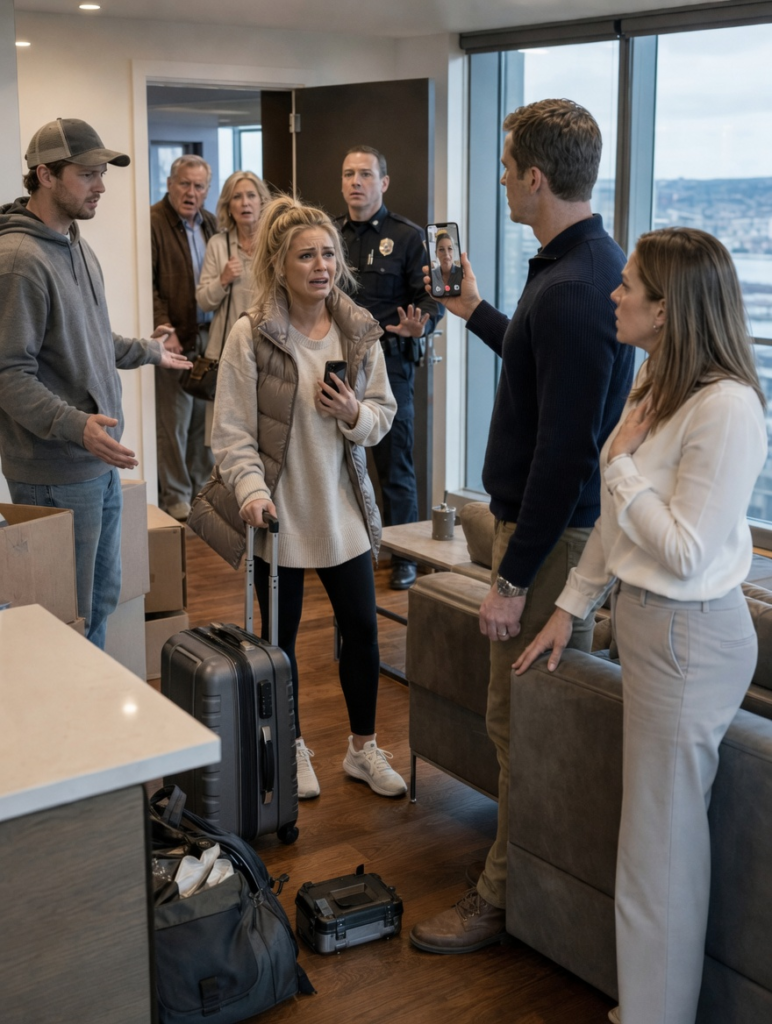
“In your condo!” she sobbed. “In my condo— they’re saying it’s not mine— they’re saying it’s not ours— there are strangers in your living room and they— they— they—”
Her voice broke into static and hiccuping breath.
The words should have been impossible. My condo. My old condo. The one with the floor-to-ceiling windows and the water view and the HOA that charged extra if your guests’ car tires touched the wrong line in the garage.
The condo I had sold two weeks ago.
I didn’t gasp. I didn’t bolt upright in my chair or knock over my glass. I watched a flock of pigeons spiral over the square and felt the faintest tug of something like inevitability.
Of course.
Of course she had.
“Amber,” I said, keeping my voice level, measured, like I was interviewing a particularly difficult user in a research session, “how did you get in?”
“The emergency key!” she said, as if I were stupid. “The one in the lockbox in the garage, the one you said was only in case of a fire or flood or whatever. Mom said it was fine. She said you’d want to help, that you’re just being difficult and— Lauren, they’re threatening to have me arrested.”
In the distance, the bells from a nearby church started chiming the hour. A tram rattled over cobblestones behind me. Tourists laughed, oblivious. The world went on, aggressively normal.
I lifted my glass and took a slow sip of wine.
Of course my parents had driven my sister—boxes and boyfriend and entitlement in tow—to a property I no longer owned, unlocked the door with a key they were never supposed to use, and tried to plop her life down into a space that had cost me a decade of work.
Of course they had.
“Amber,” I said, “listen to me very carefully. I need you to put whoever lives there now on the phone.”
“What?” she yelped. “No! They’re insane, Lauren, they’re yelling at me—”
“Put them on,” I repeated, steel sliding quietly into my tone.
For the first time since she called, she paused. I heard muffled voices: a deeper one, firm and strained, and a lighter one in the background that carried that particular quality of someone trying not to panic in their own home.
An image flickered in my mind unbidden: the Coopers, standing in my—no, their—living room, staring at my sister and her towers of boxes, at the piles of cheap luggage and the boyfriend slouched with his hands in his hoodie pocket, at the familiar layout suddenly colonized by strangers.
Because that was what we were to them: strangers.
The way they had once been to me.
The phone crackled, and a new voice came on. Male, tightly controlled, with the brittle edge of someone whose nerves were scraped raw.
“Hello?”
“Hi,” I said, adjusting my posture. “Is this Ryan Cooper?”
“Yes,” he said shortly.
“This is Lauren Wallace.”
There was a tiny silence, the kind that has weight.
“Ms. Wallace,” he said at last. “I am so incredibly sorry to call you like this, but your sister is in my home claiming it’s hers, and the police are on their way.”
“Thank you for calling me,” I said. “And I’m sorry you’re going through this. To be clear: you bought the condo from me two weeks ago. I no longer own it, and no one in my family has any legal right to be there.”
On the other end of the line, I heard his exhale, sharp and disbelieving, like someone who had been bracing for a fight and wasn’t sure whether he’d just won or walked into a new battle entirely.
“She says you gave her permission,” he said. “She says your parents said—”
“Ryan,” I said, using his first name on purpose, steady as a metronome, “please put me on speaker.”
He didn’t argue. There was a rustle, a faint beep, and then the room opened up in my ear: overlapping voices, the echo of a high ceiling I knew too well, the slight distortion of people talking too loudly in a space that used to be mine.
“Amber,” I said. “Can you hear me?”
Her reply was instant and desperate. “Lauren, finally. Tell them. Tell them this is our place, that you said I could stay while you’re away. They’re kicking me out, they’re calling the police, they—”
“I never said you could stay there,” I said.
Silence.
A hard, shapeless silence that sucked the air out of the room four thousand miles away and somehow out of my corner of Lisbon too. For a second, everything seemed to slow: the waitress sliding a saucer onto a nearby table, the flap of seagull wings overhead, the clink of cutlery from the restaurant behind me.
“What?” Amber’s voice wobbled. It sounded smaller suddenly, like her vocal cords had shrunk. “Lauren, stop messing around. Mom and Dad said—”
“Mom and Dad don’t own that condo,” I said, each word a clean cut. “I did. And I sold it. You are trespassing.”
Somebody gasped. It might have been Amber. It might have been Ryan’s wife. It might have been the ghost of who I used to be.
In the distance, faint through the phone, came the first whisper of sirens.
I took another sip of wine while chaos bloomed on the other end of the line.
To understand why my pulse stayed level, why I sat in that square and watched a dog chase pigeons instead of dissolving into panic, you have to understand where I came from. You have to understand the architecture of guilt my parents built and taught me to live in.
For thirty-two years in Seattle, guilt was the wallpaper of my life.
Seattle was gray more often than it wasn’t. The clouds blanketed the city, thick and low, pressing on the tops of buildings and mountains alike. Tourists called it cozy. Locals called it normal. I called it camouflage. Under that gray, it was easy to pretend imbalances were just shadows.
Our house was one of those boxy craftsman places in a neighborhood that had once been middle-class and was now “up-and-coming,” which meant the coffee got better every year and the rent doubled every five. The paint peeled a little on the eaves. The lawn was trimmed just enough that the HOA wouldn’t send a letter.
Inside, everything was arranged around my sister.
Her name is Amber, which felt annoyingly on-the-nose given how my parents treated her: something precious and warm and constantly polished, held up to the light to admire. I used to wonder if they’d known, somehow, when they named her. If they’d looked at her newborn face and decided on the spot that this one would be special and the first one—me—would be… functional.
My parents, Jeffrey and Holly Wallace, did not build a home on love. They built it on utility.
They would never admit that, of course. They said things like “family first” and “we’re a team” and “we all pitch in for each other.” But blueprints don’t lie, and the blueprint of our family was painfully clear: Amber was the centerpiece, the sun everything revolved around. I was a load-bearing wall, silent and sturdy, meant to keep things upright and out of the rain.
The evidence was everywhere, if you knew where to look.
When I was fifteen, I didn’t know where to look. I just knew that my sneakers were always a little too worn, that my requests always had to be reasonable and moderate and phrased like business proposals. I knew that when Amber floated ideas, they were never called “unrealistic” or “impractical” the way mine were. They were “dreams” and “goals” and things “worth investing in.”
The first time the pattern hard-etched itself into my brain was the year Amber turned sixteen.
I remember the morning vividly because I had an algebra test and had been up late studying in the flickering yellow glow of my desk lamp. Sleep still clung to my eyes as I grabbed a bowl from the cabinet, trying not to trip over the balloon strings scattered across the kitchen floor.
Amber’s sweet sixteen extravaganza had technically been scheduled for that Saturday, but my mother had insisted on decorating the night before “so we can wake up to the magic.” There were pink and gold streamers taped to the archway, a huge glittering sixteen perched on the dining table, and a stack of wrapped gifts in the corner.
On the counter, amid a small forest of champagne flutes waiting for later, sat a thick folder. The flap was open. Papers fanned out inside, one of them pushed just far enough that the bold numbers at the top were impossible to miss.
$36,000.00
My brain, already primed for algebra, snapped to attention.
I recognized the logo in the corner—dealership, something-Honda, something-Motors. Below the number, in smaller type, were words like total amount financed and payment schedule and APR.
I stood there with my hand on the cereal box, watching those numbers burn themselves into my retinas.
Thirty-six thousand dollars.
I didn’t say anything. Saying something would have broken the rule: Don’t be ungrateful. Don’t be jealous. Don’t be that kind of sister. So I poured my cereal and ate it in tight, mechanical bites, the crunch of each spoonful a metronome to the thoughts racing through my mind.
When I turned sixteen, my father had handed me a bus schedule.
Literally. A folded, laminated map of routes in a neat little pocket holder, like a consolation prize from the universe.
He’d sat me down at the kitchen table, slid the schedule across the chipped wood, and launched into a lecture about climate change and “character building.”
“Driving everywhere is a luxury, Lauren,” he’d said. “You need to learn that. Taking the bus will teach you time management, patience, and how to navigate the world. Isn’t that better than another car on the road?”
At the time, I’d nodded. I’d forced a smile. I’d accepted the implication that asking for a car made me lazy and short-sighted and that buses were a moral high ground.
I remembered that conversation perfectly as I stared at the $36,000 price tag for Amber’s “starter vehicle.”
My father walked into the kitchen whistling, stopping short when he saw me.
“Oh,” he said, following my gaze. “Don’t snoop in there, kiddo. That’s a surprise.”
“For Amber?” I asked.
His expression brightened with the pride of someone who’d just pulled off a masterstroke. “Wait until you see her face. Sixteen only comes once, right?”
Once for her, I thought.
Fifteen minutes later, Amber bounced into the kitchen in flannel pajama pants and a tank top, her hair perfect in that effortless way that made people assume she woke up like that. Our parents pulled her outside with exaggerated suspense, hands over her eyes.
I watched from the doorway as Amber squealed, the sound bubbling up from somewhere genuine and delighted, when she saw the shiny new crossover SUV in the driveway, a huge ribbon flopped across the hood.
It wasn’t that she didn’t deserve happiness, I thought. It was just that, apparently, I didn’t.
It didn’t stop at cars.
Amber’s high school years came with tutors and SAT prep courses and campus tours that somehow always started with the expensive private colleges. My mother would sit at the kitchen table with spreadsheets open, clicking her tongue over tuition numbers before saying things like, “Well, we’ll make it work. You only go to college once.”
By then I had already gone to college. Community college, then state university, piecing together enough scholarships and grants and late nights scanning groceries to climb my way out. They’d come to my graduation, sat through the ceremony, and clapped at the right times. Afterward, my father had ruffled my hair and said, “You’re so low-maintenance, Lauren. You barely needed us at all. We’re so proud of you.”
Low-maintenance.
Maybe he meant it as a compliment. It lodged in my brain as a brand.
While Amber’s liberal arts degree racked up two hundred and fifteen thousand dollars’ worth of tuition payments and dorm fees—numbers I overheard once when my parents were on the phone with the bursar—I was paying my own way. I worked at the grocery store, at a campus coffee shop, at a research lab, logging hours until my eyes crossed. I’d stumble home at two in the morning, drop my bag on the floor, and collapse into bed, only to drag myself up again for class at eight.
They saw the dark circles under my eyes, the way my shoulders tightened under the weight of my backpack, and they decided it meant they’d raised a resilient daughter.
Resilience, in my parents’ vocabulary, was code for “you can handle being neglected.”
Still, I did what I always did: adapted. I funneled my frustration into achievement. I graduated with honors, shaking hands with the dean while my parents snapped photos and Amber updated her Instagram Stories about how boring the ceremony was.
When I landed my first real job—a junior UX researcher at a mid-sized tech company—my parents didn’t ask what I did. They asked how much I made.
“Wow,” my father had whistled when I told him. “That’s great, kiddo. With that, you’ll be fine. You were always our independent one. So low-maintenance.”
Sometimes I wondered what would happen if I stopped being low-maintenance. If I broke down, if I admitted I needed help, if I demanded even half of what they gave Amber without a second thought.
But I had been trained for decades to carry the load quietly. It was how the house stayed standing.
As the years passed, my career grew. I learned to read user behavior like a language—the way they hesitated over a button, the parts of an interface that made them frustrated or delighted, the patterns that emerged when you stopped treating people as mysterious and started treating them as data.
Naturally, I turned that lens on my family.
What I saw was brutal.
To my parents, I wasn’t a daughter. I was diversification. Their emotional and practical finances had two accounts: one for Amber, labeled “Dreams,” overflowing with energy and attention and money; and one for me, labeled “Stability,” where they stashed responsibilities and crisis management and spare keys.
I was the safety net they’d stretched under Amber’s tightrope. Every time she slipped—missed rent, maxed credit card, bad boyfriend—they didn’t catch her themselves. They called me.
“It’s just this once,” my mother would say. “You know how hard the job market is for her field.”
“Family helps family,” my father would add. “And you’re doing so well, kiddo. You can spare it.”
At first, “helping” meant lending Amber a few hundred dollars. Then it meant bailing her out of a car lease. Then it meant co-signing an apartment when my parents’ credit was tied up in refinancing their own house.
My savings account grew slower than it should have, each transfer to Amber a tiny, silent hemorrhage I convinced myself was normal.
Then came the condo.
I bought it at thirty. A sleek two-bedroom in a glass-and-steel building downtown, with floor-to-ceiling windows that looked out over the Sound and let in honest sunlight, even on Seattle’s gray days. The kind of place that didn’t smell like anyone else’s cooking or hold imprints of old arguments in its walls.
I called it my sanctuary.
I wasn’t naïve: I knew my parents would have opinions. What I didn’t realize, until they stepped over the threshold for the housewarming, was how quickly they would convert my sanctuary into a line item on the family balance sheet.
Holly moved through the living room like an appraiser, running her fingers along the quartz countertop.
“This is so much space for just one person,” she said, in that tone that sounded casual if you weren’t listening closely. “It’s almost wasteful, isn’t it?”
Jeffrey stepped out onto the balcony, hands on his hips, nodding appreciatively at the view.
“This is a good investment,” he said. “It’s good to know we have this in the family.”
We.
Not you.
In that moment, watching my parents walk through rooms I had paid for with overtime and bonuses and stock options, I felt the ground shift beneath me. They didn’t see my name on the deed as a boundary. They saw it as a technicality, the same way you might view a password you could ask someone to type in for you.
To them, this condo wasn’t mine. It was ours. A spare room for Amber when she got tired of roommates. A place my father could imagine selling “if things ever get tight.” A resource they assumed they could tap, because they had always been allowed to.
That night, after they left, the joy I had felt on move-in day curdled into something else.
I stood in the dark living room, the city lights glittering outside like scattered coins, and tried to picture my future. Myself in Europe, maybe, on some project or adventure, and Amber sprawling on my couch with her shoes on, insisting she was “house-sitting” and treating my painstakingly curated space like an Airbnb paid for with feelings.
The thought made my stomach clench.
I told myself it was hypothetical. I told myself my parents wouldn’t really assume that level of ownership.
Then I got the job offer from Lisbon.
It hit my inbox on a Tuesday, subject line: Opportunity in Lisbon – Senior UX Researcher.
The company was one I knew by reputation—a European startup that had somehow managed to balance purpose and profit without sounding insufferable. They were expanding, they wanted someone to lead research in Europe, and my name had come up through an old colleague.
I clicked the email and scanned through the details. Salary. Relocation package. Visa support. The words blurred for a moment, replaced by images: orange rooftops, narrow streets, trams, sun.
My first reaction should have been pure exhilaration.
Instead, my brain jumped ahead to one question: What about them?
Who would help Amber with rent if I moved an ocean away? Who would talk my mother through software updates and scam calls? Who would be on my father’s emergency contact form, the one he waved at me every tax season, smug in the knowledge that I was always reachable?
Who would be their wall?
The panic that surged through me told me everything I needed to know. It was a wake-up call disguised as anxiety.
In my day job, I built simulations. I ran scenarios. I asked, “If we change this variable, what happens to user behavior?”
Sitting at my desk with the email open, I ran a simulation of my life.
I imagined telling my parents about Lisbon.
My mother, hand to her chest. “Europe? But what about family?” My father, leaning back, calculating. “Well, if you’re going to be gone, what’s the plan for the condo? It’d be crazy to leave it empty.”
I imagined the conversation where I, foolishly, told them I wasn’t sure yet.
Amber would chime in. “Oh my God, I could totally live there while you’re gone. It would be perfect. My lease is up in like three months anyway, and my roommate’s getting so annoying, and—”
My parents’ eyes would light up like someone had found extra frosting in the fridge.
“It’s a win-win,” my father would say. “You keep it in the family, Amber gets on her feet, and we don’t have to worry about strangers in your place.”
I would hesitate. They would notice. My hesitation would become selfishness, and my selfishness would become betrayal.
You know how this goes.
I sat there, staring at the rain-streaked window of my office, and realized my competence—my endless problem-solving and crisis-containing—hadn’t saved my family. It had crippled them. I had made it so easy for them to lean on me that they had forgotten how to stand.
Amber wasn’t just entitled. She was atrophied.
My parents weren’t just loving. They were dependent, in a way that made love impossible to tell from consumption.
If I told them about Lisbon, the guilt trip would be a foregone conclusion. They would beg me to keep the condo “just in case” and I, conditioned by years of duty, would cave. I’d end up paying HOA fees from Portugal while my sister treated my once-sanctuary like a crash pad, sending me photos of her latest party in the living room where my favorite reading chair used to sit.
There was only one way to break a structure that embedded: you don’t ask for the key. You demolish it.
The decision came on slowly and then all at once. I called a real estate agent a friend recommended—someone discreet, someone with experience in off-market listings for people who didn’t want their entire social circle to know their business.
Her name was Marisol. She met me at the condo one Wednesday afternoon, a leather folder under her arm and a sympathetic tilt to her mouth.
“You’re sure you want to do this quietly?” she asked, looking out at the water. “A public listing might get you a bidding war.”
“I’m sure,” I said. “I don’t want my family to know I’m selling until it’s done. The fewer ripples, the better.”
She studied me for a moment, that intuitive realtor look that says she’s reading more than square footage.
“Okay,” she said at last. “We’ll keep it off the major sites, reach out to a few clients we know are looking. I’ll make some calls.”
The process slipped into my life like a secret.
In the evenings, I packed boxes under the guise of “spring cleaning,” stacking them neatly in the second bedroom. I donated clothes I didn’t wear anymore, sorted through old papers, took down art on the walls. To my parents, when they visited, it looked like I was decluttering, maybe experimenting with minimalism like some lifestyle blog had told me to.
Over Sunday dinner, my mother asked the question I’d been bracing for.
“So,” Holly said, spearing a roasted carrot, “what’s your plan for the condo if you go to… where was it?”
“Lisbon,” I said.
“Yes, Lisbon.” She said it like it was a phase, like Lisbon was a short-lived affair I’d eventually grow out of and come home from with a vague fondness for seafood.
I took a sip of water. “I’ve hired a property management company,” I said. “They’ll rent it out to corporate clients. Strict lease. No family allowed.”
Her fork paused mid-air.
“A management company?” she repeated. “That sounds so impersonal. Strangers in your home.”
“It pays the mortgage,” I said, keeping my voice flat. “It’s practical.”
My father nodded slowly, but there was a furrow between his brows I knew well—the one that meant he was already thinking of ways around this, little cracks in the plan where he could wedge a crowbar.
I didn’t give him the chance.
Two weeks before my flight, I met the Coopers.
They were younger than I expected, both with that polished, slightly harried look of people who spent too much time in meetings. Ryan shook my hand firmly, his grip warm and dry, while his wife, Elena, walked around the living room, her gaze bright.
“It’s beautiful,” she said, almost reverent. “And the light— Ryan, look at this light.”
He smiled in that quiet way people do when they can already see their future unfolding in a space.
They were both architects, as it turned out, which felt weirdly appropriate. They spoke about the condo in terms of lines and flow and the way people would move through it. They pointed out where they’d put the crib, where they’d host dinner parties, where they’d set up a little reading nook by the window.
It wasn’t my home they were seeing. It was theirs.
At the closing, I signed my name on a dozen forms, each signature another step away from the life I had built under someone else’s expectations. When Ryan slid a pair of keys across the table to me and said, “We’ll have the locks changed next week, just in case,” I felt a strange lightness in my chest.
“Do it as soon as possible,” I said. “You never know who still thinks they have a claim.”
He gave me a look—a flicker of curiosity, of question—but he was too polite to ask.
I walked out of that office lighter by one condo and heavier by a quiet, stubborn sense of resolve.
I didn’t tell my parents. I didn’t tell Amber. When they asked, I repeated the property management story, layering it with just enough detail to be convincing. I took photos of generic “corporate housing” style apartments from Google and texted them occasionally with captions like “Here’s the kind of renters they’re aiming for.”
It felt strange, lying. I’d always been the honest one, the reliable narrator in a family full of selective memory. But this lie felt less like deceit and more like… privacy. Like closing the curtains instead of leaving every window bare.
The day I left Seattle, it rained.
Of course it did.
At the airport, my mother clung to me like a movie cliché, her perfume sharp and familiar. My father kept his distance, hands shoved deep into his jacket pockets, doling out advice instead of affection.
“Keep your passport in a money belt,” he said, as if I were backpacking through the jungle instead of moving for a corporate job. “Watch your bag in crowds. Don’t drink the water.”
“Lisbon has municipal water, Dad,” I said.
“Don’t argue,” he snapped automatically, then softened. “Just… be careful, okay? And call us. Every Sunday. We need updates.”
Amber was late, of course.
She breezed up to the gate minutes before boarding, cheeks flushed, latte in hand, boyfriend in tow. She hugged me with one arm.
“Don’t stay too long,” she said into my ear. “It’s not the same here without you. I need my big sis.”
My chest twinged, a familiar ache. She said it lovingly, without malice, without any sense of the weight behind those words.
I smiled and hugged her tighter, thinking: That’s exactly the problem.
On the flight to Lisbon, the clouds finally broke.
We punched through layers of gray into bright, clean sunlight, the plane wing slicing through blue. I pressed my forehead to the window and watched the world curve below us, an entire continent about to slip between me and the life I’d always known.
When I landed, Lisbon smelled like salt and citrus and exhaust. The taxi driver sang along softly to a fado song on the radio. The streets narrowed and tilted, cobblestones glittering faintly under the streetlights, the city unfolding in sharp climbs and sudden views of water.
My new apartment was smaller than the condo had been, but it felt enormous to me because every square foot was mine alone, untouched by family expectations. I unpacked slowly, hanging up clothes, stacking books, lining up dishes in the cabinets.
The first night, jet-lagged and disoriented, I lay awake listening to sounds I didn’t recognize: a neighbor’s shoes on the stairs, a burst of laughter from the bar on the corner, a tram’s bell clanging in the distance. My phone buzzed with texts from my parents, my mother asking if I’d arrived, my father sending a link about pickpocketing.
I answered politely. I did not mention the condo.
For two weeks, the silence around that omission held.
Then, sitting in the Lisboa sun with my Vinho Verde, my sister broke into a house that no longer existed as far as my responsibilities were concerned.
“Ms. Wallace?”
Ryan’s voice yanked me back to the present. The sirens were louder now, pressing at the edges of the conversation.
“Yes,” I said.
“The police are almost here,” he said. “Your sister is insisting you told her she could live here while you were abroad.”
“I did not,” I said. “And I have the bill of sale to prove it. When the officers arrive, please let them know I can email documentation confirming the transfer of ownership and that no one in my family has any right to be there.”
“Lauren!” Amber’s voice cut through the background noise, shrill and frantic. “You can’t do this! Mom and Dad said—”
“Careful, Amber,” I said. “You’re confessing to premeditation on a recorded line.”
“Premedi— what? Oh my God, why are you talking like that? Just tell them, okay? Tell them you didn’t sell it, or that it was a mistake, or—”
“I did sell it,” I said. “It’s done. You are in a stranger’s home, without permission, using a key you were never supposed to touch.”
“You’re my sister!” she cried. “You’re supposed to help me!”
The sirens cut off abruptly. A door opened—too far from the phone to hear clearly, but I knew that sound, the way condos swallowed and bounced noise.
“Mr. Cooper?” a new voice called faintly in the distance.
“Officer,” Ryan said away from the phone. “In here.”
“Ryan,” I said. “When the officer gets to you, please put him on the phone. I’ll email you the deed right now.”
I ended the call long enough to open my email app. My heart was racing now, not with fear but with a cold, focused adrenaline. My fingers flew across the screen, pulling up the closing documents and forwarding them to Ryan’s address with a subject line: Proof of Sale – 14B.
I didn’t allow myself to dwell. I dialed again. This time, when he answered, there was another voice in the room: deeper, calmer, with that particular exhausted patience you hear from people who see too much of human nonsense.
“Ms. Wallace?” the officer said when Ryan handed him the phone.
“Yes,” I said. “I’m the former owner of the property. I just emailed proof of sale to Mr. Cooper. No one in my family has permission to be in that unit. If my sister refuses to leave, I fully support whatever legal action the Coopers decide to take.”
There was a pause while he located the email on Ryan’s phone. Papers rustled. I imagined Amber standing there, chest heaving, mascara smudged, cheeks red with fury and humiliation.
“Okay, Ms. Wallace,” the officer said finally, his voice shifting—more formal now. “I see the paperwork. Thank you for clarifying.”
“You’re welcome,” I said. “If you need a written statement from me, I can send that too.”
“We may follow up,” he replied. “For now, we’ll handle it from here.”
I stayed on the line just long enough to hear him turn away from the phone.
“Ma’am,” he said to Amber, his tone firm but not unkind, “you’ve been informed by the previous owner that you do not have permission to be here. The current owners have asked you to leave. At this point, you have two options: you can walk out voluntarily, or I can escort you out and we’ll discuss trespassing charges downtown.”
“You can’t do this!” Amber wailed. “My parents said—”
“Ma’am,” he repeated, “your parents don’t own this condo.”
The call ended on a chaotic blur of sound: Amber’s protests, a door opening, the officer’s low, calm replies, Ryan thanking him, Elena’s trembling voice in the background.
I set my phone down on the table and realized my hand was shaking slightly.
Not with fear.
With something like… release.
The sun had shifted while I was on the phone, sliding lower, softening the light. The plaza was full of people who had no idea that a thirty-two-year-old woman had just evicted her sister from a continent away.
I signaled the waiter.
“Another glass, please,” I said.
He nodded, whisked my empty away, and replaced it with a new one.
I raised it slightly in a private toast—to boundaries, to consequences, to finally saying no.
My phone lit up again before I could drink.
Incoming video call: Dad.
Of course.
I considered letting it go to voicemail. But avoiding conflict, I knew from years of observation, only deferred it, never diffused it.
I slid my fingertip across the screen and lifted the phone.
Jeffrey and Holly filled the frame, perched on their beige sectional like a portrait of outraged domesticity. Amber sat between them, blotchy and furious, clutching a tissue like a prop. It reminded me, absurdly, of a press conference where the disgraced CEO wheels his family out for sympathy.
“Lauren,” my father barked, his face inching too close to the camera. “We demand an explanation right now.”
In the background, I could see the familiar details of their living room: the sagging bookshelf, the framed school photos of Amber in chronological order, the one graduation picture of me wedged at the end like an afterthought. It would have been funny if it hadn’t been so on-the-nose.
“I think you’re confused,” I said calmly. “I’m not the one who broke into a stranger’s house.”
“Don’t play games with us,” my mother snapped, her voice high and brittle. “You set a trap. You lied about that ridiculous management company, and you let us believe the condo was available while you ran off to Europe. You humiliated your sister. Do you know she had to leave in a police cruiser? Do you have any idea how traumatic that was for her?”
“Traumatic,” I repeated, letting the word roll around my mouth. “Traumatic is coming home to find strangers in your living room. Traumatic is getting arrested for trespassing. Amber is lucky the Coopers decided not to press charges. That was my doing, by the way. I talked them down.”
Amber sniffled loudly.
“You should have told us,” she wailed. “You knew I needed a place. You knew my lease was up. You did this on purpose to hurt me.”
“I sold my property because I am moving to another continent,” I said. “It wasn’t about you, Amber. Not everything is about you.”
Jeffrey’s face turned a mottled shade of red.
“We are family,” he shouted. “Family helps family. That condo was a resource, Lauren. You had a duty to share it until you were settled.”
There it was.
Not “home.” Not “your space.” A resource. Like an extra car, or a savings account, or a spare room in a hotel he assumed he could use because his name was on the loyalty card.
“How could you be so cold, so calculating?” he continued. “You blindsided us. You blindsided Amber. She’s devastated.”
I looked at them—all three of them—their anger, their self-pity, their total lack of understanding that what they had done was wrong, not just socially but legally.
Something in me clicked into place.
Maybe it was the distance. Maybe it was the sunlight slanting across the square. Maybe it was the fact that, for once, I was literally and figuratively not under their roof.
“Let me be very clear,” I said, slipping, almost without thinking, into my project manager voice—the one that had gotten stubborn stakeholders to listen in meetings. “I didn’t owe you that condo. I didn’t owe you a warning. And I certainly don’t owe you an apology.”
My mother’s eyes widened, offended less by my words than by my tone. “How dare you talk to us like—”
“What I am going to do,” I continued over her, “is send you an invoice.”
“A what?” Holly’s voice went up an octave. “An invoice?”
“Yes,” I said. “For the emergency locksmith the Coopers had to hire because Amber jammed the lock trying to force her way in. For the professional cleaning crew they needed after you tracked mud through their foyer. And for the three nights at a hotel I just booked for Amber so she’s not homeless while she figures out her next move. That hotel stay is the last financial assistance you will ever receive from me.”
“You wouldn’t dare,” Jeffrey growled.
I smiled, small and humorless.
“Check your email,” I said. “I just hit send. You can pay it, or you can explain to the Coopers why you won’t.”
“Lauren—” my mother started.
“Goodbye,” I said, and ended the call.
My hands were trembling now, for real. Not with fear. With adrenaline. With the disorienting high of doing something you’ve spent your whole life told you’re not allowed to do.
Across the plaza, a street performer started playing a melancholy tune on a guitar. Children chased each other in circles. A couple argued quietly over a map, their frustration wordless but clear.
I took a long drink of wine.
For a moment, I dared to think the worst was behind me.
Then my email pinged.
The sender line made my heart stutter for the first time that day.
Subject: Urgent – Call me
From: Michael Gray
Michael had been my boss back in Seattle. Not my direct manager by the time I left, but an executive two levels up, the kind of person who only emailed you directly when something big was happening.
I opened it.
Lauren,
We need to talk. Please call me as soon as you can.
The new owner of your condo—Ryan Cooper—is the CFO of Pinnacle Group, our biggest client and your father’s biggest client.
My stomach dropped.
I read the sentence again and again, as if repetition would make it change.
Ryan Cooper. CFO. Pinnacle Group.
The Coopers weren’t just any buyers. They were corporate royalty in my father’s world, the keystone client that kept his boutique consulting firm afloat. In my world, they were the kind of client my old company courted carefully, with hand-picked teams and quarterly review meetings and an entire slide deck devoted to “relationship management.”
And my sister had just broken into his house.
I could see the ripple effect in my mind, like a user flow diagram branching into disaster.
Ryan, calling my father, voice frosty. “Jeff, I thought you were someone I could trust. I thought your family had boundaries.”
Ryan, calling my old VP of Product. “Michael, one of your former employees—Lauren Wallace—her family just tried to squat in my condo. How do you vet the people you hire?”
Seattle’s tech scene wasn’t huge. Neither was its executive gossip network. One messy incident could stain you in circles you didn’t even know were intersecting.
My phone started ringing before I could finish exhaling.
Jeffrey.
I stared at the name. The last time he’d called, his voice had been full of righteous fury. Now, I imagined, it would be something else entirely.
I considered ignoring it. But avoidance, again, would only delay the inevitable.
I answered.
“Lauren.” His voice was raw. The bluster, the indignation—they were gone. Panic remained, stripped and naked.
“Yes?” I said.
“You have to help me,” he blurted. “Ryan called. He’s pulling the Pinnacle account. He says he can’t trust a man whose family doesn’t respect boundaries or property law.”
I closed my eyes, pressing my fingertips to my forehead.
“I’m sorry to hear that,” I said, and meant it—just not in the way he wanted.
“If I lose this account, the firm goes under,” he continued. “Do you understand? We lose everything. Your mother and I— the retirement, the house— Lauren, please. You have to fix this. You have to talk to him.”
“And say what?” I asked quietly.
“Tell him it was a miscommunication,” Jeffrey said, words tumbling fast. “Tell him you gave Amber permission and forgot to tell the Coopers. Tell him anything. Just take the blame. He likes you. You’re competent. He’ll believe you.”
There it was again: that reflexive expectation that I would light myself on fire to keep them warm.
He was asking me to sacrifice my professional integrity, to paint myself as irresponsible and forgetful, to feed a story that made me look incompetent—all to save him from consequences of his own boundary failure.
A familiar voice rose inside me. The old one. The one that said, It’s just a letter. Just a phone call. You can handle the hit better than he can. You owe him. He’s your father.
I let it talk. Then I thought about the Lisbon skyline outside my window, the way the buildings stacked over each other like misaligned teeth, bright and stubborn and ancient. I thought about all the simulations I’d run, all the times I’d seen what happened when you kept fixing every problem for your users instead of teaching them how to navigate the system themselves.
“Dad,” I said finally. “Do you remember when I was twelve and I asked you for money to build that project for the science fair?”
He sounded startled. “What does that have to do with anything?”
“You told me failure is the best teacher,” I said. “You said if I really cared about it, I’d find a way. And I did. I babysat the neighbors’ kids and walked their dogs and saved up until I could buy the materials myself.”
“Lauren, this isn’t the time for a trip down memory lane,” he snapped. “This is serious. We’re going to lose the business.”
“It is exactly the time,” I said. “Because what’s happening to you right now is a very expensive science fair project you never thought you’d have to do.”
“You’re being selfish,” he said, the old anger flaring. “After everything we’ve done for you, you can’t write one stupid email? You can’t tell one little lie?”
“Yes,” I said, and to my surprise, a laugh bubbled up, sharp and almost giddy. “I am being selfish. I am preserving myself. I am refusing to torch my reputation for something I had no part in. And I am finally, finally happy with that choice.”
He sputtered, groping for a lever that no longer existed.
“If you walk away from this,” he said, his voice low now, dangerous, “you are dead to us. Do you understand? Don’t come crawling back when you need us.”
The idea of needing him struck me as so absurd I almost choked.
“I understand,” I said. “Goodbye, Dad.”
I hung up.
Then, before my resolve could waver, I blocked his number. I blocked my mother’s. I blocked Amber’s. Then I opened my email and added their addresses to a filter that funneled anything from them into a dark little folder I never looked at.
The sun finally slipped behind the buildings. The square cooled into evening. My wineglass sat empty, a ring of condensation on the table the only evidence it had been full at all.
I stared at my phone, the block confirmations still on the screen, and waited for the crushing guilt to descend.
It didn’t.
What descended instead was a strange, exhilarating quiet.
For the first time in thirty-two years, my life felt like it was mine alone.
Six months later, the quiet remained.
Life in Lisbon settled into a rhythm I hadn’t known I was craving. Mornings started with coffee so strong it felt like a physical force dragging me into the day, and a pastel de nata from the little bakery at the corner—a warm custard tart whose flaky crust left crumbs on my fingers and whose sweetness somehow never got old.
I learned the tram routes, the shortcuts through alleys, the way the city’s hills could ambush you if you didn’t respect them. I stumbled through Portuguese, my accent growing less embarrassing with each trip to the market. I worked. I built a new team. I sat in glass-walled conference rooms with people from half a dozen countries and argued about user onboarding flows and consent patterns.
And in the background, across an ocean, the collapse I had refused to prevent played out exactly the way my simulations said it would.
I didn’t follow my family’s lives directly. I had blocked their numbers, their social media accounts, anything that would bring their drama directly into my home. I didn’t do it to punish them. I did it because every time my phone lit up with their crises, it yanked me back into the role of fixer, and I couldn’t build a new life while tethered to a burning building.
But the world is small, and the internet is smaller.
A former colleague from Seattle sent me a message on LinkedIn one day.
Saw your dad’s firm downsized. You okay?
I blinked at the screen.
I hadn’t asked about my father’s business after that last phone call. It had felt like studying a plane crash in real time. But curiosity and residual concern flared in equal measure.
I wrote back, eventually:
I’m fine. Haven’t talked to them in a while. What happened?
The pieces came in slowly, scattered across casual messages and the occasional article linked without context.
Pinnacle Group pulled their account, just as my father had feared. Ryan Cooper, I learned, didn’t make a quiet exit. He told his network why.
In the kind of business circles my father floated in, reputation was currency. You could weather a couple of bad quarters if people trusted you. You couldn’t survive a story about your daughter trying to squat in a client’s condo while you shrugged it off as a misunderstanding.
Other clients followed Pinnacle’s lead. Some left out of solidarity. Some left because they didn’t want to be associated with chaos. Some probably left because they’d been looking for an excuse.
The firm “restructured,” which was corporate-speak for “laid off half the staff and moved into a smaller office.” My father took a pay cut. My mother, who had long prided herself on not needing to work, picked up a part-time job at a friend’s boutique “just to get out of the house.”
The family war chest dried up.
No more private tutors. No more emergency rent checks. No more parental subsidies for Amber’s “finding herself.”
I didn’t hear this from them, of course. I pieced it together from the margins—someone’s throwaway comment on Facebook that slipped past my filter, a cousin’s Instagram story showing Amber in scrubs behind a reception desk with a caption: Look who joined the workforce!.
I stared at that photo longer than I care to admit.
Amber looked… different. Her hair was pulled back in a ponytail. She wore minimal makeup. The scrubs were a cheerful teal that clashed slightly with the beige reception area behind her. She was smiling—not the practiced, filtered smile I’d seen a hundred times, but something smaller, tired, and real.
The caption said she was working as a receptionist at a dental office in Bellevue.
It wasn’t glamorous. It wasn’t the high-flying influencer or entertainment career she’d once talked about between sips of overpriced cocktails. But it was a job. A real one. With schedules and responsibilities and people who depended on her to show up.
The vacuum of competence had finally forced someone else to step into it.
I set my phone down and stared at the ceiling.
There was a version of this story, I knew, where I swooped in at the last minute. Where I called Ryan and begged him to reconsider, offering myself up as collateral. Where I unblocked my parents, listened to their panicked voices, and opened my banking app to transfer one more chunk of savings into Amber’s account.
In that version, my father’s firm limped on. My parents kept their house. Amber never took the receptionist job because she didn’t have to. She drifted, maybe, into something adjacent to responsibility but never quite landing.
In that version, I stayed the wall.
This version—my version—was messier. It involved bankruptcy and humility and my parents blaming me for their misfortune in late-night rants to anyone who would listen. It involved Amber crying in her tiny bathroom after a long day at work, wondering how it had come to this, and then waking up and doing it again.
But it also involved growth.
Painful, reluctant, stumbling growth.
It’s easy to judge from a distance. To say, “Well, good, they finally had to face reality.” But I don’t feel triumphant about their struggle. I feel… relieved. Relieved that I’m not the one subsidizing their denial. Relieved that, for once, consequences are landing where they should.
One evening, months after the condo incident, I sat at a small table in the Alfama district, the oldest part of Lisbon. The streets here twisted like secrets, narrow and steep, houses leaning in close, tiles gleaming blue and white in the setting sun.
The air smelled like grilled sardines and laundry detergent and the faint tang of the river. A singer in a tiny bar up the hill let out a melancholy run of notes that floated over the rooftops.
The waiter set down my order: a pastel de nata so fresh the custard trembled, and a bica—a short, strong espresso that looked small and tasted like gravity.
I took a bite of the pastry. The custard was warm and sweet, the crust shattering into delicate flakes that stuck to my lips. It was such a small, ordinary pleasure, and yet, sitting there alone, it felt like wealth.
My phone lay face-down on the table.
No emergency contacts. No group chats full of demands. No little red notification dots from a shared family calendar reminding me to send money or call or cover for someone else’s mistake.
For thirty-two years, I’d thought this kind of solitude meant failure. That if you ended up alone, with no one to call on in a crisis, you had done something wrong. That you had failed the family test.
Now, watching a yellow tram clatter past, tourists clinging to its sides with expressions of delighted terror, I realized how wrong that was.
I hadn’t lost my family because I set boundaries.
I’d lost access to a specific role they’d written for me.
The real, messy, unperformed version of family—the one that might someday involve honest conversations, apologies, and trying again—could only exist if the old script burned.
Maybe, I thought, as I sipped my coffee, they would never choose that version. Maybe my parents would hold onto their resentment like a security blanket, telling anyone who would listen that their ungrateful eldest daughter abandoned them. Maybe Amber would always see me as the villain in the story of her life’s sudden crash into adulthood.
I couldn’t control that.
What I could control was who I allowed into my circle. What I tolerated. How much of my finite time and emotional energy I spent on people who saw me as a person versus those who saw me as infrastructure.
Slowly, in Lisbon, I started building something new.
There were friends—real ones, not just colleagues. People who liked me for my sarcasm and my weirdly obsessive love of interface microcopy, not for my credit score. There were coworkers who respected my “no” and never tried to guilt-trip me into a “yes.” There was a neighbor in my building, an older woman named Inês, who brought me soup when I was sick and refused to let me pay her back.
“Next time,” she said, patting my hand. “You make soup for someone else.”
There was a dentist appointment where the receptionist, chatting as she checked me in, mentioned she’d just hired a girl from Seattle—funny coincidence, huh?—and for a full minute, heart hammering, I wondered if Amber had somehow crossed the ocean too.
She hadn’t. Different clinic. Different girl.
Still, the coincidence made me laugh. The world was small. The ripples of my choices would always intersect with the edges of their lives, even if we never spoke again.
Sometimes, late at night, lying in my bed with the window cracked open to let in the city’s hum, guilt would creep in.
It would whisper: You ruined your father’s business.
It would hiss: You left them with nothing.
It would sneer: You’re selfish. You’re alone. You’ll regret this when you’re older and there’s no one to take care of you.
I listened. Then I reminded myself of the truth.
I hadn’t ruined my father’s business. His refusal to respect boundaries, his insistence that his family’s lives and properties were extensions of his own domain—that had ruined his business. I had simply declined to cover the final bill.
I hadn’t left them with nothing. I’d left them with each other, with their own capabilities, with the opportunity to develop muscles they’d let atrophy for decades.
As for being selfish… yes. I was. And after thirty-two years of being the opposite, of self-erasing and self-sacrificing and self-silencing, selfishness felt less like sin and more like oxygen.
One weekend, I took a train down the coast with some friends. We spent the day on a windy beach, our hair full of salt, our feet buried in sand, laughing about nothing. At one point, someone asked about my family.
I told the story, condensed—the golden child sister, the condo, the break-in, the client, the ultimatum. I watched their faces shift from disbelief to horror to a kind of protective anger on my behalf.
“What did you do?” one of them asked when I got to the part about my father begging me to lie.
“I said no,” I replied.
“And then?” another asked.
“And then I blocked them,” I said. “And I moved on.”
They were quiet for a moment. Then one of them reached out and clinked their beer bottle gently against mine.
“To moving on,” he said.
“To boundaries,” another added.
“To not being the family ATM,” a third chimed in.
We laughed, and the sound was light, easy in my chest.
Later, alone on a rock at the edge of the beach, watching waves smash themselves against the shore over and over, I thought about bridges.
People like to say “Don’t burn bridges; you never know when you might need to cross them again.”
It sounds wise. It sounds diplomatic. It keeps relationships politely intact even when they’re rotting underneath.
But here’s what I’ve learned: some bridges lead back to places that will kill you, slowly and quietly. Some bridges exist only to funnel your energy into someone else’s comfort. Some bridges are built from the bones of your own self-respect.
In those cases, burning isn’t cruelty. It’s self-defense.
I didn’t just survive my family.
I outgrew my assigned role in it.
I built a life that fits me—not a storage unit for other people’s expectations, not an emergency exit for their bad decisions.
In Lisbon, at my little table in Alfama, with coffee cooling and pastry crumbs on my plate, the thought no longer filled me with fear.
It felt like victory.
Not the loud, triumphant kind with confetti and applause. The quiet version, like the first breath after surfacing from deep water. Like standing in your own house—one you chose, one you paid for, one no one else has a key to—and realizing that every object, every decision, every minute of your day finally answers to you.
I am selfish. I am solitary. I am free.
THE END.