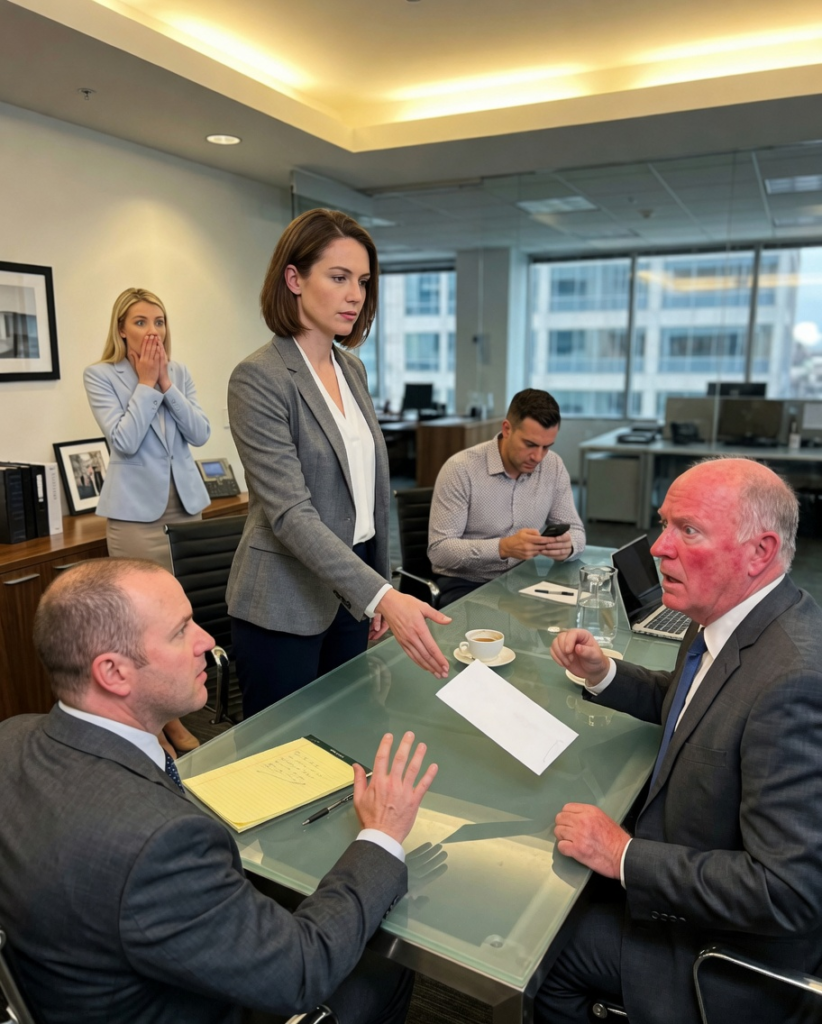
After three years of dedication, my husband’s dad—the boss—gave the promotion to his niece, who had worked there just five weeks. I smiled, handed in my resignation, and said, “Tell Lilly congrats.” His face turned red. “You can’t be serious!” he shouted.
What nobody in that room understood was that I had already had the worst part of the betrayal. The public humiliation was just the part everyone else got to see.
I had spent three years at Evans Holdings making myself indispensable in all the least glamorous ways. I was the person people called when a vendor threatened to walk, when a regional manager missed compliance, when a shipping delay wrecked a quarter-end forecast, when two departments were blaming each other and nobody wanted to read the details closely enough to find the truth. I worked late, worked weekends, answered emails from airport gates, from waiting rooms, from family dinners where Harold liked to tell people how lucky the company was to “have someone so committed.”
Committed. That was the word they always used when they wanted your labor to sound like a gift.
By the time the Senior Vice President of Operations role opened, half the company assumed I would get it. Not because I was family. Because I wasn’t. Because I had earned it in the one way Harold always claimed mattered most: results.
At least, that was what I thought before I learned what actually mattered to him.
The first signs had seemed small. Harold started inviting Lilly Sierra Blake, his sister’s daughter, to executive lunches even though she had only just joined the company. She’d arrived with polished confidence, a famous university on her résumé, and the kind of ease that comes from never doubting a room was built to welcome you. She was not stupid. That would have been simpler. She was inexperienced, overly sure of herself, and utterly unaware of how much other people kept cleaning up after her.
In her first week, she copied the wrong vendor terms into a procurement draft and nearly triggered a price increase. I corrected it before it reached legal. In her second week, she sent a department-wide email asking for metrics that already lived in the dashboard she had never learned to access. In her fourth week, Harold asked me to “bring her up to speed” on strategic operations, which turned into me explaining the basics while she nodded, took credit in meetings for ideas she’d heard from me in private, and casually called me “the one who keeps everything moving.”
I should have seen it then.
But ambition makes people generous with warning signs. You tell yourself there’s a rational explanation because the irrational one is too insulting to accept.
The board meeting made the truth impossible to soften.
The room smelled like lemon polish and burnt coffee. Harold smoothed his paper. Daniel sat two chairs down with his legal pad and his hopeful silence. I remember all of it with painful clarity because some moments brand themselves into you while they happen.
“After careful consideration,” Harold announced, “our new Senior VP of Operations will be Lilly Sierra Blake.”
Nobody moved. Then came the shallow applause.
Lilly rose in that powder-blue blazer with the department-store creases still visible. She smiled. Harold talked about fresh perspective, energy, education, and legacy. Legacy.
I stood, congratulated her, and slid my resignation across the table.
Harold looked personally offended by the existence of the envelope. “What is this?”
“My resignation,” I said. “Effective immediately.”
His face went red almost at once. “You can’t be serious!”
“I’ve never been more serious.”
The argument unfolded exactly the way power always argues when it thinks it still owns the room. He told me not to be emotional. He said the company needed me. He hinted at future compensation, broader authority, a revised title. He acted as though the real problem was my reaction, not his decision.
Daniel’s contribution was worse than silence because it wore the costume of reason.
“Maybe we should all talk privately,” he said.
Private. A family word for burying what would look ugly in daylight.
I told them no. I picked up my bag. Harold warned me not to expect the door to stay open if I walked out. Then I said something I had not planned to say aloud, but once it was in the room, it changed everything.
“I’m not the one throwing something away,” I told him. “I’m the one who knows exactly what breaks the minute I leave.”
That was when Daniel looked at his phone.
I had scheduled an email.
It had gone to the board’s outside counsel, the independent audit chair, the head of HR, and one board member Harold did not control with golf invitations and old favors. Attached were files I had spent six weeks organizing after I realized the promotion was not the only thing being manipulated.
Daniel lifted his eyes slowly. He had gone pale. “What email?”
Harold’s voice sharpened. “Whatever stunt she’s pulling, IT can stop—”
“Already sent,” I said.
The room changed in a way you could almost hear. Chairs shifted. Someone inhaled. One of the department heads reached for his water without taking his eyes off Harold.
I had not gone looking for corruption. I had gone looking for logic.
Months earlier, I noticed odd discrepancies in expense allocations tied to one of our expansion branches. Numbers were being moved in ways that made ordinary operational overruns look smaller than they were. Purchase orders were split below review thresholds. Consulting invoices appeared under temporary cost centers and then vanished into consolidated reporting. On paper, none of it looked dramatic. In practice, it was exactly the sort of pattern you saw when someone thought they were too important to be questioned.
The first time I asked Harold directly, he smiled and said, “You don’t need to worry about executive strategy.”
The second time, he told me some expenses were “politically sensitive” and should remain at the leadership level.
The third time, Daniel asked me not to push. “He’s under pressure,” he said over dinner. “Can you just let the quarter close first?”
That sentence sat with me for days. Not because it convinced me, but because it told me my husband’s instinct was still to protect the shape of peace instead of the substance of truth.
So I stopped asking out loud.
I started saving copies.
Not confidential customer data. Not anything I wasn’t authorized to access in the ordinary scope of my role. I saved approvals, budget revisions, email instructions, version histories, expense reclassifications, and the threads where Harold directed me to alter language in reports before board review. I saved the note where he told finance to “keep Lilly’s branch support out of the ops spotlight for now.” I saved the timestamped approval that attached her initiative code to spending she could not possibly have authorized because she had not even joined the company when it began. That part mattered.
Because whatever else Harold had done, he had made his niece the visible face of spending she likely didn’t understand. Whether he meant to protect himself or simply assumed no one would ever trace it back, he had positioned her as a shield.
When I said as much in the boardroom, Lilly’s expression finally cracked.
“I didn’t do anything wrong,” she said.
“I know,” I told her. “That’s why you should ask why your name is attached to expenses you never approved.”
She turned to Harold so quickly her chair struck the credenza. “What does she mean?”
Harold ignored her and looked at me with a hatred so naked it almost startled me. The warmth, the family language, the speeches about values—all gone. What remained was a man furious that an obedient structure had suddenly developed a spine.
“You are not destroying this company because you’re upset,” he said.
“No,” I replied. “I’m refusing to help you hide what you’ve been doing.”
That was when Marlene from HR, who had been silent the entire meeting, slid a sealed envelope onto the table.
Marlene had worked there seventeen years. She had the patient expression of someone who had watched executives mistake fear for respect so many times it no longer impressed her.
“Actually,” she said, “there’s something everyone needs to review before this meeting continues.”
Harold frowned. “What is that?”
“Complaint documentation,” she said. “And a response timeline.”
I stared at her.
She did not look at me, only at the board members gathering around the far side of the table. “The submission came through our external ethics channel three days ago,” she said. “It references retaliation risk, falsified reporting pressure, and familial conflicts of interest.”
Three days ago.
For one confused second, I thought she meant my material, but I had only sent that morning.
Then I understood.
I wasn’t the only one who had been watching.
The room fractured into overlapping voices. A board member asked for copies. Finance wanted specifics. Lilly kept demanding to know what her name had been used for. Harold tried to reassert control, but the tone had shifted against him. Authority depends on the illusion that everyone is still afraid of the same consequences. Once that illusion breaks, it goes quickly.
Daniel stood. “Dad, tell us the truth.”
Harold laughed—a thin, ugly sound. “The truth? The truth is that none of you understand what it takes to protect a company this size.”
“There it is,” Marlene murmured.
He ignored her. “Sometimes money gets moved. Sometimes optics matter. Sometimes we keep things inside the family because outsiders don’t understand the long game.”
I almost felt the exact instant Daniel’s loyalty split in two.
He had spent most of his life translating his father’s behavior into kinder language. Strong became demanding. Strategic became controlling. Proud became impossible to please. But there are only so many euphemisms available when a man starts defending deception as leadership.
“Did you falsify board reporting?” Daniel asked.
Harold glared at him. “Watch yourself.”
“That’s not an answer.”
Lilly’s voice came out sharp and frightened. “Did you put my name on those expenses?”
Still he tried not to answer directly, which was answer enough.
The independent board member, Thomas Reeve, finally spoke. He had been quiet all meeting, fingertips pressed together, studying everything. “Mr. Evans,” he said, “from this point forward, do not alter records, contact accounting, or instruct anyone regarding document retention. Your access will be temporarily suspended pending an emergency review.”
Harold stared at him as if the English language had betrayed him.
“You can’t suspend me from my own company.”
Thomas held his gaze. “We can, pending cause. And at this moment, we have cause.”
What followed was not cinematic. No one pounded fists. No one confessed in a dramatic monologue. Real collapses are messier. Harold demanded counsel. Lilly cried in furious, humiliated silence. Finance began listing reports that would need to be reissued. Marlene called outside legal. Thomas instructed IT to preserve all executive accounts. Daniel remained standing, looking at his father as if he had just met him and didn’t like what he saw.
I should have felt triumphant.
Instead, I felt tired. Bone-deep, soul-deep tired.
Because vindication does not refund what betrayal costs.
I left the room before anyone could ask me to stay and “help transition through the review.” There are moments when competent women are expected to become both witness and janitor for the mess powerful men make. I had done enough cleaning.
Daniel came after me in the parking garage.
My footsteps echoed between the concrete pillars. I heard his before I turned.
“Wait.”
I stopped beside my car but didn’t unlock it.
He looked wrecked. Not performatively upset. Genuinely split open. “How long did you know?” he asked.
“That he was going to give her the promotion? I suspected for two weeks. About the reporting? Long enough to verify before I said anything.”
His jaw tightened. “Why didn’t you tell me everything?”
I let the question hang between us.
“Daniel,” I said quietly, “I did tell you something was wrong. More than once. You asked me to wait. You asked me not to push. You asked me to make your father’s comfort more important than my instincts.”
He looked down.
“I didn’t think…” he began.
“I know,” I said. “That’s the problem.”
For a moment he said nothing. Then, in a voice so low I almost missed it, he asked, “Are you leaving me too?”
It was the first honest question he had asked all morning.
I leaned against the car door and closed my eyes for a second. I thought about all the dinners I had spent swallowing anger so family holidays would stay pleasant. All the times Harold interrupted me and Daniel changed the subject instead of challenging him. All the moments I had mistaken Daniel’s gentleness for courage when really it was avoidance with better manners.
“I don’t know,” I said.
That hurt him. I could see it. But pain was overdue in that family. It had been rerouted into me for too long.
The following weeks were brutal.
The board opened a formal investigation. Outside counsel interviewed staff. Finance uncovered additional reallocations tied to expansion projects Harold had insisted were personally supervised. Several board packages had been modified before circulation in ways that understated risk. Nothing looked dramatic enough for a headline by itself, but together the pattern was devastating: concealed losses, manipulated classifications, related-party favoritism, retaliation risk, and deliberate efforts to bypass oversight.
Harold was placed on leave, then forced to resign.
The company’s statement used careful language. A leadership transition. Governance concerns. A commitment to transparency. Publicly, it was clean. Internally, everyone knew it was a controlled detonation. Lilly resigned too, though not under accusation. She requested a meeting with me before she left.
We sat in a quiet coffee shop across from the river. She looked different without the polished office confidence. Younger. Ashamed.
“I should have known,” she said, twisting the sleeve of her coat. “Not about the money. But about the promotion. I knew it didn’t make sense. I just wanted to believe I could grow into it.”
“That’s human,” I said.
She laughed bitterly. “You’re being kinder than I deserve.”
“No,” I said. “I’m being accurate. There’s a difference between being flattered into a role and building the system that put you there.”
Her eyes filled. “He said you were valued. He said you didn’t want executive pressure.”
That hurt less than it should have, maybe because by then I had seen the entire architecture of his lies. He told everyone a version that served him.
“Take this as a lesson early,” I told her. “If someone has to diminish another woman’s work to make room for you, the seat isn’t yours. It’s bait.”
She nodded once, hard, as if trying to tattoo the sentence somewhere permanent.
Daniel and I started therapy.
I almost wrote that sentence as if it were a tidy redemption arc, but it wasn’t. Therapy was not candlelight and breakthroughs. It was ugly, repetitive, humbling work. It was me saying, over and over, that neutrality in the face of disrespect is not kindness. It was Daniel having to admit that he had spent his entire life managing his father, never opposing him, and had carried that pattern into our marriage where I was expected to absorb the impact.
For a while, I stayed in the guest room. For a while, we spoke mostly in scheduled sessions and clipped logistics. He cried exactly twice, and both times it scared him more than it did me.
“I thought keeping the peace was love,” he said once.
“No,” I answered. “Sometimes keeping the peace just means choosing the stronger person and asking the other one to survive it quietly.”
That was the sentence our therapist wrote down.
Months later, Evans Holdings offered me a consulting contract during the restructuring. Triple my prior rate. Independent authority. Limited term. Direct board reporting.
I said no the first time.
I said no the second time too.
On the third request, Thomas Reeve asked to meet. We sat in a conference room in a different building, one that did not smell like Harold’s aftershave and old power.
“We’re not asking you to save us,” he said. “We’re asking whether you want the chance to rebuild the part you created without interference.”
That landed differently.
So I accepted, but only on my terms.
No family vetoes. No buried reporting lines. No unofficial requests. Full hiring discretion within operations. And a written governance safeguard that prevented any executive relative from receiving a role without independent review.
I did not accept because they finally appreciated me. That kind of hunger is dangerous. I accepted because I knew exactly what I could build when sabotage was removed from the blueprint.
A year later, the company was smaller, steadier, and less theatrical. We closed two vanity projects Harold had protected for image reasons. We rebuilt vendor confidence. We reissued forecasting protocols. We promoted people who understood the work instead of people whose surnames opened doors. And me?
I finally got the title everyone had once treated like a favor.
Senior Vice President of Operations.
When the board voted, there was no dramatic applause. No patriarchal speech. No family smile stretched over a private insult. Just a formal motion, a second, a vote, and my name entered into the record exactly where it belonged.
Daniel was there that evening at home when I set the letter on the kitchen counter. He read it, looked at me, and for once did not try to soften the moment or redirect it into something easier.
“I’m proud of you,” he said.
I believed him.
That mattered more than I expected.
We stayed married.
Not because what happened wasn’t serious enough to break us, but because he finally understood that love without backbone becomes permission. He changed slowly, and because I watched the change under pressure, I trusted it. He set boundaries with Harold after the resignation. He stopped translating manipulation into politeness. He let his father be angry without treating that anger like a weather system everyone else had to reorganize around.
Harold called exactly twice after he was removed.
The first time, I didn’t answer.
The second time, Daniel did. He listened, said, “No,” and hung up.
It was one word, but I knew how many years it had taken him to find it.
Sometimes people ask what hurt most—the promotion, the public humiliation, the financial misconduct, or my husband’s silence.
It was the silence.
Ambition can survive disappointment. Self-respect can survive insult. Even careers can survive sabotage if the truth comes out in time.
But silence from the person standing closest to you has a way of making every other betrayal feel earned.
That was the lie I had to unlearn.
The truth was simpler and much harder: I was never asking for special treatment. I was asking not to be erased in favor of someone easier to control.
Harold lost his position because he believed family loyalty meant immunity. Lilly lost her illusion that being chosen is the same as being capable. Daniel nearly lost his marriage because he confused peace with goodness.
And I learned something I wish I had understood earlier.
The biggest red flag is not always the loud bully at the head of the table. Sometimes it is the person beside you who sees the cruelty clearly and still asks you to endure it quietly for one more quarter, one more dinner, one more meeting, one more chance.
That kind of patience can look loving from a distance.
Up close, it feels a lot like abandonment.