The Woman Everyone Forgot
The courthouse in Millbrook, Ohio, had never been that quiet before.
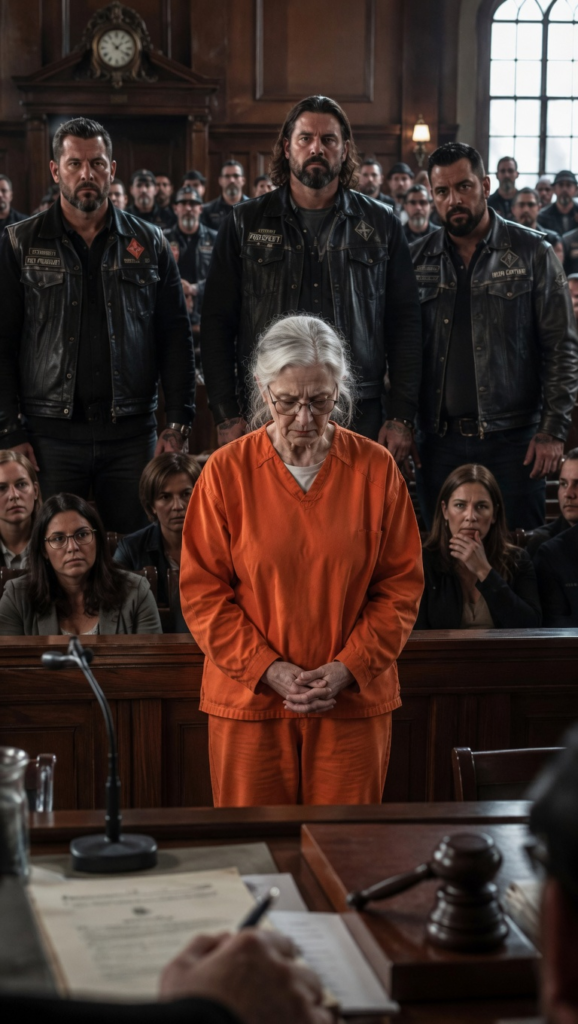
At the front of the room sat a seventy-two-year-old woman named Maribel Keane. Her gray hair was pinned back neatly. Her hands rested in her lap. She wore her old brown work jacket over a simple navy dress because it was the only outfit that made her feel brave.
For thirty-five years, Maribel had cleaned the halls of Westbridge Elementary. She had fixed broken sinks, replaced flickering lights, patched classroom doors, and stayed late whenever the children needed a safe place to wait.
Now the school district was accusing her of taking money that was never hers.
Across the aisle, the new superintendent, Victor Langford, sat in an expensive suit, looking calm.
Then the courtroom doors opened.
Three grown men stepped inside, followed by two dozen bikers in black leather vests.
The room turned.
The oldest man, a tall biker named Nolan Keane, walked straight toward Maribel. His voice was low, but everyone heard it.
“Mom, you are not standing here alone.”
Maribel looked up, and for the first time that morning, her eyes filled with hope.
The Letter on the Kitchen Table
It had started with a letter.
Maribel had been sitting at her small kitchen table on Maple Street, drinking weak coffee from a chipped mug, when she read the words again and again.
Misuse of school funds.
Missing supplies.
Forty-eight thousand dollars.
Her name was printed on every page.
She stared at her hands. Those hands had spent decades making sure children had clean classrooms, warm hallways, and working bathrooms. Those hands had carried lunches, repaired lockers, and wiped tears from little faces when teachers were too busy to notice.
She had never taken anything from that school.
Not one dollar.
Not one box of pencils.
Not one can of paint.
Maribel picked up the phone and called Nolan, the first boy she had ever brought home.
“Nolan,” she said softly, “the school says I did something wrong.”
His voice changed immediately.
“What kind of wrong?”
“They say I took money.”
Silence.
Then Nolan said, “Don’t talk to anyone. Don’t sign anything. I’m coming.”
“Honey, you don’t have to make a big thing out of this.”
“You made us your whole life, Mom. This is already big.”
Three Boys and One Empty House
Maribel had never planned to raise three boys.
Years earlier, she had been a lonely widow working the morning shift at Westbridge Elementary. Her own little son had passed away from an illness when he was very young, and after that, her house became too quiet.
Then, one cold Monday morning, she found a baby wrapped in a blanket near the school gym.
There was a note tucked beside him.
Please keep him safe.
That baby became Nolan.
Maribel took him home for “just a few nights.” A few nights became forever.
Years later, a quiet six-year-old boy named Caleb started waiting near her supply closet after school. His mother worked long shifts at a diner and could not afford after-school care. Maribel gave him crackers, helped with homework, and let him sit beside her while she sorted cleaning supplies.
When Caleb’s mother passed unexpectedly in a road accident, no relative came for him.
Maribel did.
Then came Mason.
He was eight when she found him hiding in the school basement, hungry, silent, and too afraid to trust anyone. Maribel brought him soup, a blanket, and the first calm voice he had heard in a long time.
Months later, Mason asked her one question.
“Can I stay with you for good?”
Maribel answered without hesitation.
“Yes, sweetheart. You can stay for good.”
A Biker Family Built from Love
The boys grew up poor, but never unloved.
Maribel worked double shifts. She ate after they ate. She patched their jackets instead of buying new ones for herself. She missed sleep, but never missed a school meeting. She rode the bus before sunrise because she had sold her old truck to pay for Caleb’s emergency room bill.
Nolan became strong and protective.
Caleb became calm and careful.
Mason became quiet, loyal, and sharp-eyed.
As adults, they all joined the same motorcycle club, the Iron Haven Riders. To the town, they looked rough. To Maribel, they were still her boys.
When Nolan arrived at her house that evening, he did not come alone.
Caleb and Mason came with him.
Behind them came twenty-four bikers.
They filled her front yard with folding tables, laptops, notebooks, and phone chargers. It looked like a command center made of leather jackets and loyalty.
Nolan held up the school district’s papers.
“They say she stole from the school,” he told the bikers. “We know better. We are going to prove better.”
One biker raised his hand.
“Maribel fixed my mother’s porch for free.”
Another said, “She helped me read when I was in fourth grade.”
Another nodded.
“She stayed late with my little sister every day until my dad got off work.”
By midnight, no one had left.
The Notebooks
The truth was waiting in Maribel’s hallway closet.
For thirty-five years, she had kept notebooks. Every repair. Every order. Every lightbulb. Every gallon of floor wax. Every broken pipe. Every hour she worked.
Caleb opened the first notebook and froze.
“Mom,” he said, “do you know what this is?”
Maribel shrugged.
“Just records.”
“No,” Caleb said. “This is evidence.”
They compared her notebooks to the district paperwork.
The early records matched.
Then, after Victor Langford became superintendent, the numbers changed.
Maribel’s notebook said twelve gallons of floor wax.
The district record said thirty.
Maribel’s notebook said four light fixtures.
The district record said eighteen.
Maribel’s notebook said the boiler had not been replaced.
The district record said the school had paid thousands for a new one.
Mason returned from the school the next night with photographs. Peeling paint. Cracked sinks. Old heating units. Unfinished repairs that had supposedly cost the district a fortune.
Then Nolan found the company name on the inflated orders.
Langford Supply Solutions.
It had been created eighteen months earlier.
The owner was Victor Langford’s brother-in-law.
Caleb looked at the papers and whispered, “He blamed Mom for what he was doing.”
Nolan’s jaw tightened.
“Then we show the judge everything.”
The Ride to Court
On Monday morning, twenty-seven motorcycles lined Maple Street.
Maribel stepped onto her porch wearing her navy dress, polished work boots, and brown jacket.
Nolan handed her a helmet.
“When was the last time you rode?”
Maribel looked at the bikes and smiled faintly.
“Before you boys got too expensive.”
For the first time in days, Nolan laughed.
“Then today is a good day to remember.”
She climbed onto the back of his motorcycle.
The engines started one by one, deep and steady, like thunder rolling through the quiet neighborhood.
People came out of their houses to watch.
By the time they reached the courthouse, the sidewalk was full. Teachers, parents, former students, neighbors, diner workers, and old friends stood shoulder to shoulder.
Nobody shouted.
Nobody pushed.
They simply stood for the woman who had stood for them.
Maribel looked at the crowd and whispered, “I didn’t know they remembered.”
Caleb touched her shoulder.
“They remembered everything, Mom.”
The Truth in the Courtroom
Victor Langford’s attorney spoke first.
He made Maribel sound careless, dishonest, and small.
Then Maribel stood.
Her hands trembled, but her voice did not.
“Your Honor, I worked at that school for thirty-five years. I cleaned it, repaired it, and cared for it because children spent their days there. I did not take anything from that building. I gave that building everything I had.”
Then Nolan testified.
He showed the judge the notebooks.
He showed the changed numbers.
He showed orders signed under Maribel’s name after she had already retired.
The judge leaned forward.
“Mr. Keane, are you saying someone continued using your mother’s name?”
Nolan answered clearly.
“Yes, Your Honor. And we believe it was done to hide where the money really went.”
Caleb showed the signature differences.
Mason showed the photographs of the school.
Then they showed the company records connecting Victor Langford to the vendor receiving the payments.
The courtroom went still.
Victor’s face turned pale.
The judge looked at his attorney.
“Counsel, I suggest you choose your next words carefully.”
The Woman Who Showed Up
Before the judge made her decision, Maribel asked to speak one last time.
She stood slowly.
“I am not an important woman,” she said. “I cleaned floors. I fixed things. I raised three boys who needed a home. I did not have much money, but I had a door that opened, food to share, and enough love to keep trying.”
She looked at Nolan, Caleb, and Mason.
“People keep saying I saved them. But the truth is, they saved me too.”
The room was silent.
Maribel continued.
“I never wanted a reward. I only wanted to do right by the children, by that school, and by the boys who became my family.”
The judge removed her glasses.
Her voice softened.
“Mrs. Keane, this court finds the claim against you unsupported and deeply troubling. The complaint is dismissed. I am also ordering a full independent audit of the district’s maintenance accounts.”
A quiet sound moved through the room.
Not cheering.
Relief.
Nolan closed his eyes.
Caleb covered his face.
Mason walked to Maribel and wrapped his arms around her.
For once, the quietest son spoke the clearest words.
“You’re coming home, Mom.”
The Hallway After the Verdict
Outside the courtroom, people lined the hallway.
One by one, they came to Maribel.
A retired teacher hugged her.
A former student thanked her.
A diner cook pressed a tissue into her hand.
An old neighbor said, “You were never invisible to us.”
Maribel could barely answer.
Nolan stood beside her, his leather vest creased, his eyes bright.
“You okay?”
Maribel nodded.
“I think I am.”
Caleb smiled.
“Good. Because we’re taking you to breakfast.”
Maribel looked at all three men.
For years, she had worried about them. Fed them. Protected them. Prayed over them.
Now they stood around her like a wall.
Not because she was weak.
Because she was loved.
The School with Her Name
Months later, Westbridge Elementary reopened after a full renovation.
The broken boiler was replaced. The cracked floors were repaired. The bathrooms worked. The classrooms were freshly painted.
Victor Langford was gone, facing the consequences of his choices.
At the entrance of the school, a bronze plaque was placed on the wall.
The Maribel Keane Community Hall
Dedicated to the woman who showed up when no one else did.
Maribel touched the plaque with trembling fingers.
Nolan, Caleb, and Mason stood behind her.
“You boys did this?” she asked.
Nolan smiled.
“No, Mom. You did. We just made sure people finally saw it.”
That evening, they returned to her little house on Maple Street.
Four people sat around a table that had only three matching chairs.
Mason pulled in a stool from the garage, just like he had when he was a boy.
Maribel looked at them and smiled.
“We turned out all right, didn’t we?”
Caleb reached across the table and took her hand.
“No, Mom. We turned out loved.”
Sometimes the people who seem ordinary are the ones quietly holding entire lives together, and their kindness may not be noticed every day, but it is never truly wasted.
A family is not only created by blood, last names, or perfect beginnings; sometimes it is built by one person opening a door when a child has nowhere else to go.
The world may overlook a humble worker, a quiet mother, or someone who never asks for praise, but time has a way of revealing the value of those who keep showing up.
When someone gives you safety, patience, and love during the hardest season of your life, the greatest honor is to stand beside them when their own strength begins to shake.
True loyalty is not loud for attention; it is steady, present, and willing to enter the hardest rooms with the people who once carried you through your own dark days.
A good heart does not always receive thanks immediately, but every act of kindness leaves a mark somewhere, often in people who will remember it when it matters most.
No one should underestimate a person who has spent a lifetime doing honest work, because quiet integrity can become stronger evidence than any polished lie.
The most powerful legacy is not money, status, or recognition, but the lives that are changed because someone cared enough to stay.
Sometimes the person who saves others is also being saved by them, because love has a way of healing both the giver and the one who receives it.
In the end, Maribel’s story reminds us that showing up every day with kindness, courage, and honesty may seem small in the moment, but it can become the kind of love that returns when you need it most.