Olivia Parker had pictured the birth a hundred ordinary ways. Michael would park too crooked near the hospital entrance. Ethan would ask too many questions. Someone would forget the overnight bag, and they would laugh about it later.
That was the kind of family they were. Not perfect, not polished, just steady. A small house, a crowded refrigerator door, shoes by the back entrance, and a seven-year-old boy who already loved a brother he had not met.
Ethan called the baby “my teammate.” He practiced being careful with a stuffed bear, carrying it from the couch to the kitchen with both arms stiff and serious. Olivia never teased him for it. She knew children prepare for love through rituals adults barely notice.

Michael worked long hours as a financial advisor, but he came home every night and stood in the nursery doorway. The crib was secondhand, the dresser scratched, and the tiny clothes were stacked in neat piles Olivia kept rearranging.
On the Tuesday everything changed, rain had turned the driveway dark. The house smelled like toast and coffee. Ethan was at the back door pointing toward the yard, explaining where he would show the baby the secret fort behind the hedge.
Olivia laughed, then stopped. One hand pressed low against her belly. The color drained from her face so quickly that Ethan’s smile disappeared before he understood why.
She took one step toward the counter, missed it, and dropped hard onto the kitchen tile. The sound was dull and wrong. Ethan froze, then ran to her, calling “Mom” in a voice that kept getting smaller.
Olivia could not answer clearly. Her breathing had changed. Ethan remembered what Michael had taught him in a calmer season: call 911, say the address, stay on the line.
The dispatch log later showed 4:18 p.m. Ethan gave his street number through sobs. He kept saying his mom was pregnant and could not breathe right. The operator kept him talking until sirens came close enough to rattle the window glass.
At the county hospital, the intake desk printed Olivia’s wristband at 4:44 p.m. Her wedding ring went into a clear plastic belongings bag. A nurse clipped it shut and placed it beside the hospital intake form.
Dr. Caroline Miller met Michael near the emergency department doors. She did not soften the truth, because soft words could not slow what was happening inside Olivia’s body.
“She has a placental abruption,” the doctor said. “We have to deliver now. Your wife’s life is in danger, and so is the baby’s.”
Michael looked through the glass and saw Olivia under harsh light, her face pale, her hand still curved around the child they had been waiting for. Ethan stood beside him in a damp hoodie, sleeves pulled over his hands.
The surgical consent form shook when Michael signed it. His signature looked nothing like his own. He asked if he could go in. The nurse said not yet, then guided Ethan to a chair by the wall.
For Ethan, the next hour became a row of sounds. Wheels rolling. Shoes squeaking. A phone ringing and stopping. His father whispering, “Please,” with no one in particular to answer him.
Inside the operating room, Olivia’s pressure dropped. The baby’s position made the delivery more difficult. Nurses called numbers. Dr. Miller moved with practiced focus, every instruction clipped and clear.
Michael was told there might be a choice. There are sentences hospitals try to say gently, but no gentleness can make them less cruel. He heard that Olivia was slipping, and that the baby was not tolerating the emergency.
“Save my wife,” he said finally. The words tore out of him. He loved both of them, and the impossibility of that moment would remain with him long after people stopped asking about it.
Olivia survived the surgery. That was the first miracle, though nobody in the room was ready to call it one. She was stabilized, pale and unconscious, with tubes and monitors surrounding her.
Then the baby came.
No cry followed.
The quiet was not peaceful. It was thick, stunned, and clinical. A warmer light glowed over the tiny body. A nurse held a blanket. Someone opened the delivery record but did not immediately complete the final notation.
Dr. Miller checked for signs of life. Then she checked again. The room waited for a sound that did not come. A resident lowered his eyes. One nurse blinked fast and turned toward the supply cart.
When Michael saw the doctor’s face, he understood before she spoke. He sat beside Olivia’s bed and pressed both hands against his mouth, trying to hold himself together because Ethan was watching.
The nurses asked whether they wanted to hold the baby. It was not a question anyone should ever have to answer, but it mattered. It gave parents one last piece of tenderness in a room that had taken everything else.
Olivia was awake enough by then to hear. Her lips trembled. Michael bent close, and she whispered that she wanted to see him. Then Ethan stepped forward from the doorway.
“I want to hold him,” he said.
Michael turned, shaken. He wanted to protect Ethan from the sight, from the weight, from the kind of memory a child should not have to carry. But Ethan’s face had changed. He was frightened, yet certain.
“He’s my brother,” Ethan said. “I promised I’d protect him.”
Olivia opened her hand toward Michael. She could barely lift it, but the meaning was clear. Let him. Let love have this one small thing.
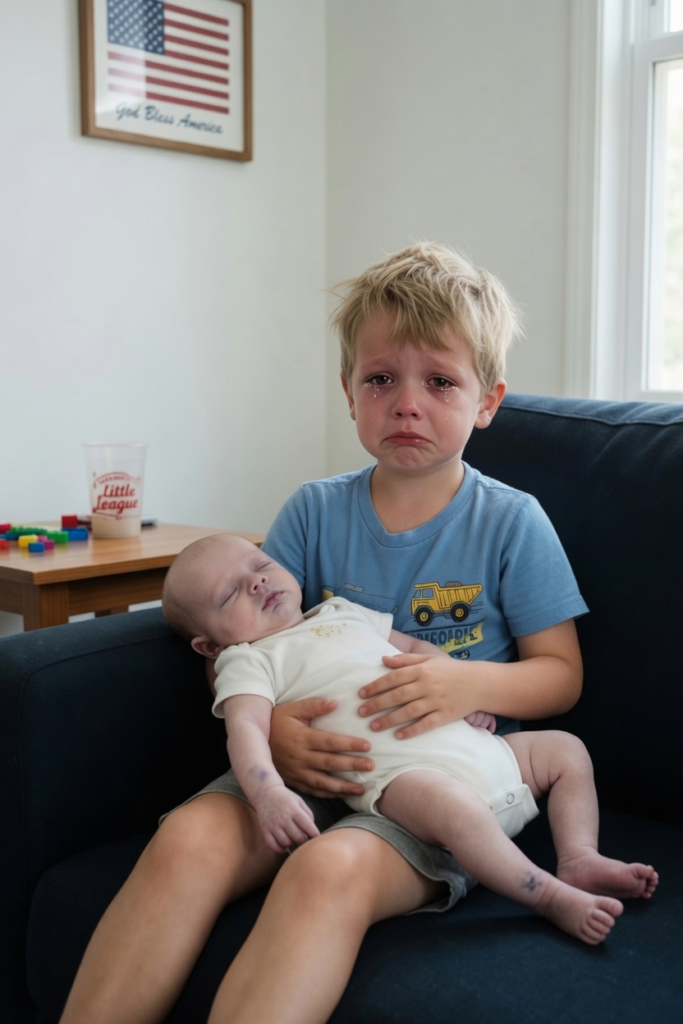
The nurse placed the baby into Ethan’s arms. He was wrapped in a white hospital blanket, smaller than Ethan expected, with a knit cap low on his forehead. Ethan sat carefully, sneakers swinging above the floor.
Every adult in the room held still. Michael stood close enough to catch him if his arms slipped. Olivia watched through tears, too weak to reach but not too weak to see.
Ethan bent his head. His voice was so soft that the nurse closest to him barely heard it.
“Don’t worry,” he whispered. “I’ll protect you, just like I promised.”
Then the monitor made one sharp beep.
At first, nobody trusted it. Grief can make a room suspicious of hope. Michael lifted his head slowly. Dr. Miller turned from the chart. The nurse who had just stepped back went still.
The sound came again.
Dr. Miller crossed the room and asked Ethan not to move. Her fingers went beneath the blanket, then to the baby’s chest, then to the cord area. Her expression changed in a way Michael never forgot.
“Call NICU back,” she said. “Now.”
The next minutes were fast and careful. The baby was taken from Ethan’s arms, placed under the warmer, stimulated, assessed, and supported. A neonatal nurse arrived with equipment. The room filled with process verbs: check, clear, listen, record, repeat.
Ethan cried then, not because he thought his brother was gone, but because suddenly everyone was moving as if something could still be done. Olivia whispered the baby’s name before anyone else did.
Noah.
Later, Dr. Miller explained that Noah had shown no spontaneous cry and almost no detectable response in the chaos of Olivia’s emergency. His signs were so faint that the team had believed they had lost him.
No one called Ethan magic. Dr. Miller would not allow that, and neither would Olivia. What happened was medical, fragile, and terrifyingly close to being missed. But Ethan’s insistence gave the room one more moment to notice.
Noah spent weeks in the NICU. There were alarms, feeding tubes, oxygen checks, and nights when Michael slept upright in a chair with a paper coffee cup gone cold in his hand.
Olivia healed slowly. Her body had survived a trauma her mind needed longer to understand. Sometimes she woke at 3:00 a.m. and reached for her belly before remembering the baby was down the hall behind glass.
Ethan was allowed to visit when the nurses said it was safe. He washed his hands like a surgeon, stood on a step stool, and pressed one finger gently against Noah’s foot.
“Still protecting you,” he whispered.
The hospital later reviewed the delivery record. The blue-ink time that had nearly become final was crossed through according to procedure, initialed, and corrected. Dr. Miller met with the family herself and answered every question Michael brought in a folded list.
No lawsuit became the center of their story. No grand speech fixed the terror of that day. What stayed with them was smaller and stronger: a child’s promise, a mother’s nod, a father learning that protection sometimes means letting love step closer.
Months later, Noah came home to the same little house with the scratched dresser and the ultrasound picture still taped to the refrigerator. Ethan showed him the backyard through the glass and described the secret fort behind the hedge.
Noah slept through the tour. Ethan did not care.
The family never forgot the cold room, the disinfectant smell, or the monitor’s tiny impossible sound. Doctors said the baby was gone, but when his brother held him and whispered, the room remembered to listen.
And from then on, whenever anyone asked Olivia what saved them that day, she always answered the same way.
“Medicine saved his life,” she said. “But Ethan made sure they heard him.”