Chapter 1: The Dirt and the Ink
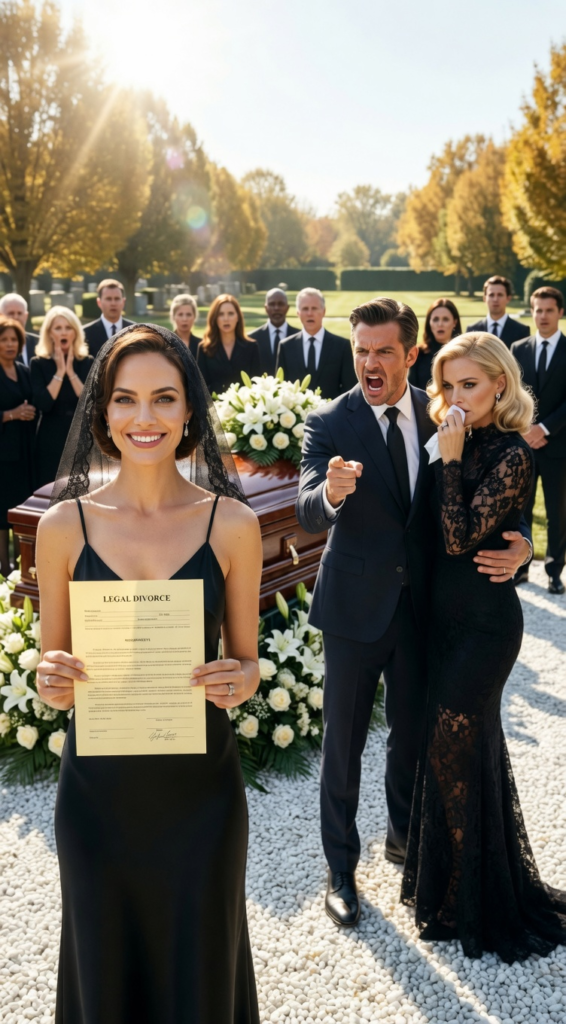
My husband shoved divorce documents across our kitchen island a mere three hours after we watched gravediggers throw dirt onto my brother’s coffin.
He stood there, framed by the sterile white cabinetry of our suburban home, still wearing the damp, charcoal suit he had selected for the funeral. His silk tie was yanked loose, hanging around his collar like a broken noose. Droplets of cold Illinois rainwater clung stubbornly to the wool of his overcoat. When I looked into his eyes, I didn’t see mourning. I saw the terrifying, icy arrogance of a man who firmly believed the earth had already been handed to him on a silver platter.
Then, he uttered the exact sequence of words required to vaporize the final, fragile illusion I harbored regarding my marriage.
“I am going to marry your brother’s wife. Sign the papers, Emily.”
I stood immobilized, the hum of the stainless steel refrigerator suddenly the loudest sound in the universe. I stared at his face for a long, fractured minute. Then, a soft, involuntary smile tugged at the corner of my mouth, and I reached for the Montblanc pen resting beside the manila envelope.
Thirty days after that signature, Ryan Miller would be violently weeping, raw and broken on his knees inside a glass-walled law firm in downtown Chicago, finally comprehending the devastating truth my brother had deduced long before his lungs stopped drawing breath. Greed functions as a blindfold, and those who wear it willingly march themselves off cliffs.
But the descent began in the mud.
The afternoon we buried Daniel Carter, the sky stretching over Naperville resembled fractured iron. A bitter, relentless drizzle swept across the manicured lawns of the cemetery in sharp gray sheets, plastering wet hair to foreheads and coating the sea of black umbrellas with a miserable, dull sheen. Everything felt hollowed out. I stood rigid beside the gaping hole in the earth, my hands tightly interwoven in front of my stomach, desperately trying to anchor myself to gravity. The presiding pastor droned on about legacy, civic duty, and the spirit of generosity, but his platitudes dissolved into white noise the second the lacquered wood of the casket descended into the soil.
Daniel had been forty-two. He was statistically too young to vanish, and frankly, too brutally disciplined to die. My brother operated with the precision of a Swiss timepiece; he woke at 5:00 AM every single day, pounded three miles of pavement regardless of blinding blizzards, and treated his annual medical physicals like binding corporate contracts.
Then, an intoxicated teenager crossed a concrete median just outside Aurora, accelerating his rusted sedan directly into the grill of Daniel’s SUV. Just like that, the most formidable human being I had ever known was reduced to a framed photograph propped against a mound of white lilies.
The mourners bleeding out from the edges of the burial plot were a testament to his life. Employees from Carter Freight Solutions accounted for half the crowd. Gnarled truck drivers, weary dispatch managers, and sharply dressed accountants stood shoulder-to-shoulder in the sludge. Daniel possessed an encyclopedic memory for humanity; he remembered his mechanics’ birthdays, the names of their chronically ill children, the silent struggles of their impending foreclosures. Grown men, toughened by decades on the asphalt, wept without shame beside the astroturf because my brother had quietly restructured their loans to keep roofs over their heads during the last recession.
Ryan loomed beside me throughout the service. He kept one heavy hand resting artificially against the small of my back. He was pantomiming grief, executing the performance the way politicians pray for the cameras—visible, calculated, and entirely devoid of pulse. In retrospect, my skin crawls at the memory. He never actually squeezed my shoulder to offer comfort. He never leaned in to whisper, Are you surviving this? Instead, his gaze kept drifting. It slid relentlessly toward the front row, locking onto Vanessa Carter.
My brother’s widow was a portrait of curated tragedy. Tall, impossibly elegant, with raven hair tucked beneath a tasteful black fascinator, she wore oversized, dark sunglasses despite the suffocating gloom of the storm. She pressed a pristine white handkerchief beneath her nose, producing delicate, rhythmic sniffles. Yet, watching her, a cold prickle of revulsion crawled up my spine. Her devastation felt synthetic. It was the rehearsed agony of a background actor trying to mimic a sorrow she had only ever observed on television.
At the time, standing over my brother’s grave, I mentally lacerated myself for the uncharitable thought. Grief turns you into a paranoid monster, I told myself. You are looking for enemies in the dark. As the catered reception at the parish hall dwindled, the attendees gradually retreated back into their breathing, uninterrupted lives. Taillights bled into the evening fog until the parking lot emptied. Ryan navigated my car back to our neighborhood in suffocating silence. He steered with his left hand; his right hand was surgically attached to his smartphone, aggressively scrolling and typing every time we hit a red light.
I rested my temple against the cold passenger glass, watching the raindrops race each other horizontally. My mind drifted backward, twenty-five years into the past, to the bruised summer afternoon Daniel taught me to ride a bicycle. He had sprinted behind me down the cracked pavement of our childhood street, his voice a booming anchor of encouragement while I shrieked in absolute panic. Even after I inevitably lost my balance and careened headfirst into a neighbor’s aluminum mailbox, he hadn’t coddled me. He hauled me to my feet, dusted the gravel from my bleeding knees, and delivered a piece of advice that embedded itself in my DNA.
“Fear passes faster than regret, Emmy.” He was the only soul on this earth who still called me Emmy.
The tires crunched against the wet concrete of our driveway. Ryan shoved his door open before I had even unbuckled my seatbelt. He marched toward the front porch with an agitated, aggressive stride, moving like an executive running unforgivably late for a merger.
I trailed behind him, kicking off my ruined heels in the foyer. The moment I stepped into the ambient light of the kitchen, Ryan ripped his tie off and tossed a thick, heavy legal envelope onto the dark granite island. It landed with a meaty, definitive smack.
“You need to review those tonight,” he commanded, his voice stripped of any recognizable warmth.
I blinked at the yellow paper. “What is this?”
“Divorce papers.”
The oxygen vanished from the room. The rhythmic drumming of the storm outside ceased to exist. Even the blood pumping in my own ears went dead silent. I slowly lifted my chin, searching his face.
“What?”
Ryan expelled a long, aggrieved sigh, pinching the bridge of his nose like a weary manager dealing with an exceptionally slow intern. “Oh, come on, Emily. Let’s not do the theatrics. We both know this marriage has been a corpse for years.”
A corpse. “My brother was buried today,” I whispered, the words catching on the razor blades in my throat.
“I am aware of the calendar,” he countered. The absolute refrigeration of his tone terrified me far more than the demand for a divorce. He didn’t even look at me. He strolled over to the built-in liquor cabinet, uncorked a bottle of reserve bourbon, and poured a heavy measure over a single block of ice. He leaned his hip against the counter, taking a casual sip. “Honestly, logically speaking, this is the optimal time to execute it. Clean break. A fresh start for all involved parties.”
I stared at him, my brain desperately waiting for the punchline, for the mask to slip, for the humanity to bleed through. Surely, this was a stress-induced psychotic break.
Nothing broke. He just swirled the amber liquid in his glass.
Then, he delivered the sentence that inverted my entire reality.
“I’m going to be with Vanessa.”
My eyelids fluttered. “Daniel’s wife?”
“Widow,” he corrected seamlessly, devoid of hesitation. “She is a widow now.”
My hands shot out, gripping the freezing edge of the granite island because the floor suddenly felt like a churning ocean. A cold sweat pricked my scalp.
“How long?” The question tasted like ash.
Ryan took another deliberate sip of bourbon. “A while.”
A while. The vagueness was a weapon.
“We never engineered this, Emily. It just happened.”
That specific lie nearly provoked a hysterical laugh. Human beings employ a very specific cadence when they are reciting a monologue they have rehearsed in the shower for months. Ryan was reciting lines.
“You were always suffocatingly dependent,” he continued, leaning forward to justify his butchery. “You lack drive. Vanessa understands genuine ambition. She comprehends the trajectory I require out of life.”
I stared at the stranger occupying my husband’s skin. We had shared a bed for eleven years, and I realized in a blinding flash that I had been sleeping next to a ghost.
Ryan Miller was a man constructed from nothing. When I met him, he was drowning in predatory student loans, bouncing between precarious sales gigs, and living in a series of increasingly depressing, mold-scented apartments. It was Daniel who threw him a lifeline. When we married, my brother carved out a lucrative position for Ryan at Carter Freight Solutions. Daniel personally mentored him. He promoted him twice. He handed him the keys to corporate accounts worth millions of dollars.
And now, three hours after we lowered Daniel into the mud, this parasite was casually sipping whiskey in my kitchen, announcing his intention to slide into my dead brother’s bed.
“You are unbelievable,” I breathed out, my chest aching.
“No,” he corrected, flashing a sociopathic half-smile. “I am simply being transparent.”
Then came the kill shot. Delivered with astonishing, clinical precision.
“You were never built for the life I actually want, Emily.”
I waited for the tsunami of rage. I anticipated the urge to hurl the heavy crystal tumbler resting by the sink directly into his smug, perfectly shaven jaw. But the explosion never came. Instead, a bizarre, sub-zero calm flooded my veins. Because in that exact fraction of a second, my memory violently resurrected a notification I had swiped away two nights before Daniel’s fatal collision.
A voicemail from my brother. Unplayed.
Daniel despised leaving voicemails. He was a ruthless texter. If he left an audio message, the sky was falling.
Ryan tapped the manila envelope, nudging it an inch closer to my hands. “Just ink the bottom line. We can avoid dragging this through the courts. It’s cleaner.”
I forced my eyes down to the documents. Illinois No-Fault Dissolution of Marriage. Waiver of Marital Support. Total Asset Separation Clause. They were impeccably drafted, legally ironclad, and clearly prepared weeks in advance. Which meant this absolute bastard had orchestrated my disposal while my brother was still eating breakfast, still breathing, still alive.
That realization didn’t burn; it froze. It settled over my ribcage like a block of industrial ice.
Ryan watched me with hawkish intensity, his muscles coiled, clearly bracing for a screaming match or a cascade of desperate tears.
Instead, I reached forward. My fingers closed around the cool metal barrel of the Montblanc.
His eyebrows shot toward his hairline. “Seriously?”
I offered him a smile that did not reach my eyes. “Fine.”
I pressed the nib to the thick paper and signed my name with flawless, sweeping cursive.
For the first time all evening, the smug mask slipped, replaced by raw bewilderment. “You’re… processing this significantly better than I calculated.”
I spun the documents around, sliding them back across the granite. “You seem to be in an incredible rush to leave my house.”
He offered a pathetic, half-hearted shrug. “There’s no utility in pretending anymore.”
He didn’t possess an ounce of shame. He was practically vibrating with relief. Ryan snatched the envelope, drained the last of his bourbon, and bypassed me completely, heavy footsteps thudding up the oak staircase to pack his designer luggage.
I remained utterly motionless in the center of the kitchen. I stood there for forty agonizing minutes, listening to the muffled thuds of drawers opening and slamming shut above my head.
When he finally descended, dragging a leather suitcase behind him, he paused with his hand on the brass doorknob.
“You’ll survive this eventually,” he offered. It wasn’t an olive branch; it was an absolution of his own guilt.
The door clicked shut. The deadbolt engaged.
I stood paralyzed until the hum of his sports car’s engine faded into the rainy night. Only then did my hands begin to violently tremble. I thrust my hand into my slacks, pulling out my phone. My thumb shook as I navigated to my missed calls, pressing play on a voice I would never hear in the present tense again.
Static hissed through the speaker. Then, a long, heavy exhalation.
“Emmy.” His voice sounded ragged, weighted down by an exhaustion I had never heard him carry. “If you are listening to this recording, it means something catastrophic happened before I had the runway to sit you down and explain the math myself.” My breath hitched. I stopped breathing entirely.
Daniel’s voice dropped to a low, urgent whisper.
“Do not trust a single soul until Richard Lawson reads the will.”
Chapter 2: Echoes from the Grave
For seventy-two hours after Ryan vacated the premises, sleep refused to claim me.
The insomnia wasn’t born of longing. That was the most jarring revelation. I paced the hardwood floors of my empty house, waiting for the crippling devastation of a shattered marriage to flatten me, waiting to mourn the husband I thought I knew. But the grief for Ryan never manifested.
Instead, I was consumed by a suffocating, terrifying clarity. It’s the exact psychological sensation a driver experiences after surviving a horrific highway pileup, suddenly replaying every ignored speed limit sign, every slick patch of black ice they sped over in the ten miles leading to the crash.
When the anesthesia of shock wore off, memory became a merciless interrogator.
Ryan’s endless “client dinners” that stretched until 2:00 AM. His sudden, intense preoccupation with bespoke Italian suits. The heavy, platinum Rolex he casually claimed was a reward from a generic vendor incentive program. The way Vanessa’s laughter always pitched half an octave higher whenever Ryan spoke at company holiday parties, her manicured hand lingering just a second too long on his forearm.
All the disparate, jagged pieces rearranged themselves into a hideous, undeniable mosaic.
I spent those initial days quarantined inside my home, a ghost haunting my own hallways. The spring storms continued to batter the bay windows, a relentless assault of gray water. My phone vibrated endlessly. Well-meaning friends called to offer condolences for my brother, weeping into my voicemail. Others called, their voices hushed with scandalous concern, asking if the rumors about Ryan moving out were true. Neighbors dropped off heavy casseroles that sat rotting in the refrigerator.
I ignored the world. I only answered calls from my mother, and even then, I lied through my teeth. She was seventy years old and had just buried her firstborn child. I refused to inflict the wound of my public humiliation upon her shattered heart.
Meanwhile, Ryan and Vanessa abandoned any pretense of discretion.
They didn’t even grant the dirt on Daniel’s grave time to settle. Exactly four days after the funeral, an image materialized on my social media feed. It was a brightly lit photograph taken at Gibson’s Steakhouse in the heart of downtown. Vanessa sat in a curved leather booth, swirling a glass of Cabernet, looking radiant. Ryan was seated beside her, his arm draped possessively around her waist, flashing a brilliant, predatory smile at the camera.
A mutual acquaintance had tagged the location. Another had commented: “Such a beautiful couple. Finding light in the dark!”
Beautiful. I stared at the pixels until my vision blurred. My brother had been dead for ninety-six hours.
By the time the weekend arrived, their digital victory lap escalated. They flooded the internet with dispatches from Lake Geneva. There were photos of them clinking expensive cocktails on the deck of a chartered speedboat. Selfies of them huddled together beneath a luxury woven blanket beside a roaring outdoor fire pit.
But it was the third photograph that brought me to my knees.
Ryan was standing on a dock, smiling into the wind. He was wearing Daniel’s custom-tailored, navy cashmere overcoat. The exact coat my brother had purchased in Milan during a grueling logistics conference three years prior.
That specific image nearly cracked my sanity in half. Not because Ryan looked triumphant, but because my brother had loved him. Daniel had trusted him implicitly.
There is a unique, rotting horror embedded in posthumous betrayal. The dead are utterly defenseless. They cannot rise to revise their misplaced loyalties. They cannot strip away the love they freely gave to parasites who no longer deserve it. The dead are forced to remain loyal for eternity. The living operate with no such constraints.
On the seventh dawn following the funeral, I dressed in a severe black pantsuit, picked up my car keys, and drove toward the belly of the beast: Carter Freight Solutions.
The corporate headquarters loomed just outside the city limits, a dominating six-story monolith of dark, reflective glass. Daniel had acquired the complex outright after his initial expansion across the Midwest. He had built this empire from dirt, starting with three rusted delivery trucks and a damp, unheated warehouse in Joliet. Two decades later, he was managing massive commercial freight contracts across six different states.
I navigated my Honda into the subterranean parking garage. I killed the engine and sat in the suffocating silence for ten full minutes, my hands gripping the steering wheel until my knuckles turned white. I had to mentally construct armor before stepping into the elevator.
The moment the polished steel doors parted on the executive floor, the ambient hum of corporate life died.
It wasn’t a cinematic, dramatic silence. It was the subtle, abrupt cessation of keyboard clicking and hushed water-cooler chatter. Dozens of eyes flicked toward me, wide with a potent cocktail of morbid sympathy and raw discomfort. Corporate ecosystems feed on rumor with the same desperation that coastal towns feed on tourism. Every single person in this building already knew that Ryan Miller had abandoned my bed to occupy Vanessa’s.
Megan, Daniel’s fiercely loyal executive assistant of twelve years, practically sprinted down the carpeted hallway toward me. Her face was flushed with righteous fury on my behalf.
“Oh my god,” she breathed, wrapping her arms around my stiff shoulders in a crushing embrace. “Emily. I am so profoundly sorry.”
I patted her back, my expression carved from stone. “Give me the casualty report, Megan. How toxic is the environment up here?”
Megan pulled back, her eyes darting nervously toward the frosted glass of the corner offices. She lowered her voice to a conspiratorial whisper. “Ryan has been strutting around here like he holds the deed to the property.”
A cold vise clamped around my chest. “Define ‘strutting’.”
“He’s been physically occupying Daniel’s primary office. Every single day.”
Of course he had. The parasite moves directly into the host’s brain.
Megan swallowed hard, looking genuinely pained. “And Vanessa… she’s been up here, too.”
I closed my eyes, a wave of nausea washing over me. The sheer, unadulterated cruelty of the human species is a bottomless chasm.
Megan hooked her arm through mine, aggressively steering me toward a vacant, soundproofed conference room. She shoved a steaming cup of black coffee into my hands and began delivering the intelligence briefing.
Ryan had unilaterally started injecting himself into high-level senior leadership briefings, despite the fact that his official HR title was merely Regional Director of Sales. Worse, Vanessa had been cornering senior logistics managers, casually discussing structural reorganizations and aggressive “modernization” strategies, acting as though she were the newly crowned Empress of the board.
They were moving with terrifying velocity. It was too fast, too aggressive. They operated like thieves sprinting out of a bank, terrified that if they stopped running, the illusion would shatter.
That specific observation stuck in my mind like a jagged splinter. Why the rush? When I finally gathered the nerve to approach Daniel’s corner office, my courage almost evaporated.
I pushed the heavy oak door open. The sensory assault was immediate. The room still smelled fiercely of him: rich cedarwood cologne, the crisp scent of fresh printer paper, and the biting chill of the Chicago wind seeping through the partially cracked window blinds. His framed degree from Northwestern hung proudly on the wall, flanking photographs of him smiling at various children’s charity galas. The massive mahogany desk remained impeccably uncluttered, a testament to Daniel’s belief that a messy workspace indicated a chaotic, weak mind.
But a profound corruption had infected the room.
Ryan was sitting in my dead brother’s ergonomic leather chair. He was hunched over my dead brother’s desk. And he was still wearing my dead brother’s navy cashmere coat indoors.
The visual cocktail of disrespect made my stomach violently twist.
Ryan glanced up from a glowing Excel spreadsheet. He didn’t flinch. He didn’t look ashamed. He offered a casual, relaxed smile, as if this scenario were the most natural progression in the world.
“Emily,” he said smoothly, his voice dripping with faux-managerial patience. “You really should have pinged my assistant before coming up here.”
I stared at him, my jaw practically unhinged. “What, exactly, are you doing behind that desk?”
“Working.” He spread his hands innocently. “Nature abhors a vacuum, Em. Somebody has to step up and man the helm.”
The sheer, unbridled arrogance of the statement knocked the wind out of me.
Ryan leaned back, lacing his fingers together behind his head. “To be completely candid, the infrastructure here requires an anchor of stability right now. The lower-level employees are getting spooked by the transition.”
“You are a regional sales rep, Ryan. You are not the Chief Executive Officer.”
“Titles are fluid during a crisis.”
I forced my eyes to sweep the surface of the desk. Beside his elbow sat three heavily redacted folders: Quarterly Financial Disclosures, Liquid Asset Portfolios, and Prospective Acquisition Targets. He was already excavating the financial bedrock of the company.
“Did Daniel legally authorize you to review restricted documents?” I asked, my voice dropping to a dangerous hush.
Ryan let out a patronizing scoff. “Daniel is gone, Emily.”
The absolute lack of reverence in his delivery—cold, utilitarian, deeply inconvenienced by the concept of grief—triggered a permanent, tectonic shift in my psyche.
In that precise second, the cryptic voicemail from the grave finally decoded itself in my brain.
Do not trust anyone until Richard Lawson reads the will. Daniel hadn’t said be careful. He hadn’t said watch your back. He explicitly instructed me to trust no one.
Ryan stood up, pacing slowly around the perimeter of the desk, projecting dominance. “Listen to me. You are fragile right now. You need to focus entirely on your emotional healing journey. Let the adults who actually understand corporate leverage handle the heavy lifting.”
A month ago, that suffocating condescension would have reduced me to angry, defensive tears. Today, it only sharpened my vision into high definition.
“Fascinating,” I murmured, tilting my head. “What exactly fuels this sudden delusion that this corporation belongs to you?”
His expression twitched. It was microscopic, a fleeting glitch in the matrix, but I caught it.
Fear. It sparked in his pupils and vanished just as quickly.
Ryan aggressively crossed his arms over his chest. “Vanessa inherited Daniel’s estate. End of story.”
There it is. The foundational assumption supporting his entire paper castle. He firmly believed Vanessa was the sole heir to the Carter fortune. And by infiltrating Vanessa’s bed, he believed he had effectively bypassed the corporate ladder to inherit the throne.
I nodded slowly, chewing on the inside of my cheek as though evaluating a brilliant business proposal. Then, I dropped a match into the gasoline.
“Did Daniel know about your affair before the accident?”
The muscles in Ryan’s jaw tightened so violently I thought his teeth might shatter. “That is entirely irrelevant to the operational status of this firm.”
“That was not the question I asked.”
The silence that stretched across the mahogany desk was lethal. Ryan broke eye contact first, staring out the window at the skyline.
Fascinating. Before he could attempt to regain control of the narrative, three sharp knocks echoed against the doorframe.
Richard Lawson stepped into the office.
Richard was a towering, silver-haired patrician who had served as Daniel’s personal attorney and corporate counsel for fifteen years. He was impeccably tailored in a charcoal three-piece suit, projecting the terrifying calm of a man who had spent decades managing the disastrous impulses of the ultra-wealthy.
Richard’s slate-gray eyes swept the room, noting Ryan’s position behind the desk, before settling gently on me.
“Mr. Miller,” Richard said, his tone perfectly polite but lined with razor wire. “I will require a private consultation with Emily now.”
Ryan bristled, looking severely inconvenienced, but he plastered on a diplomatic smile. “Of course, Richard. I need to run a divisional meeting anyway.”
As Ryan collected his tablet and brushed past the lawyer, I noticed a tiny, glorious detail. Ryan extended his hand. Richard completely ignored it, stepping out of the way to let him pass.
The door clicked shut. We were alone.
Richard remained standing. He waited a full ten seconds to ensure nobody was lingering in the corridor.
“Did you listen to the audio recording?” he asked.
“Yes.”
He gave a single, curt nod. “Excellent.”
My heart began to hammer against my ribs. “Richard, what is happening here?”
The lawyer unclasped his leather briefcase, extracting a thick, sealed envelope bearing the wax crest of his firm. He placed it squarely in the center of the desk.
“Your brother executed severe amendments to his estate planning documents twelve days prior to his fatal collision,” Richard stated, his voice a metronome of legal precision. “Furthermore, he provided me with explicit, non-negotiable instructions prohibiting the disclosure of these amendments until exactly thirty days had elapsed from the date of his passing.”
I stared at the wax seal. “Why thirty days?”
Richard Lawson looked at me, a profound sadness briefly breaking through his stoic mask.
“Because,” Richard said softly, “your brother deeply believed that human beings only reveal their absolute true character when they are convinced they have already won.”
Chapter 3: The King of Paper Castles
The mandated thirty-day purgatory crawled by at an agonizing pace for me. For Ryan, however, it was a reckless sprint.
That inherent difference in velocity is what ultimately doomed him. Searing emotional pain forces intelligent people to become quiet, meticulous, and agonizingly observant. Unearned greed achieves the exact opposite. It renders people loud, incredibly sloppy, and fatally overconfident.
By the fourth week following the burial, Ryan was practically levitating through the streets of Chicago, acting like a newly anointed monarch. Vanessa was his eager queen, validating every delusion of grandeur.
They began hosting lavish, catered dinner parties inside Daniel’s sprawling estate. I fundamentally refused to acknowledge the property as theirs, but the reality was they had occupied it. Megan, bless her espionage skills, provided me with horrifying daily updates. They packed my brother’s dining room with parasites who had barely bothered to sign the funeral guestbook: aggressive venture capitalists, vapid socialites, predatory real estate brokers, and self-important men who unironically abused terms like synergy and market disruption while downing twelve-hundred-dollar bottles of imported whiskey beside the marble fireplace.
The same fireplace where Daniel used to sit in silence on freezing January nights, reading thick historical biographies.
“They are actively gutting the executive suite,” Megan told me one rainy Tuesday, stirring her latte aggressively inside a cafe down the street from the firm. “Ryan literally ordered maintenance to take down the gallery wall of Daniel’s family photographs.”
I stared at her over the rim of my mug, my blood running cold. “He threw away photos of our parents?”
“He told the design consultants the company needed a more ‘forward-looking, aggressive visual identity’.”
For a terrifying, blinding moment, the urge to drive my car through the front lobby of the building was nearly overwhelming. I wanted to tear him apart with my bare hands. But then, a different, colder emotion suppressed the rage.
Patience.
Richard Lawson had finally begun accepting my daily phone calls. While bound by attorney-client privilege not to explicitly reveal the contents of the sealed will, men like Richard communicated volumes through omission and precision. Every clipped conversation, every carefully constructed hypothetical scenario he posed, cemented the quiet, terrifying suspicion gestating in my gut.
Daniel had known. He might not have intercepted every text message or uncovered every motel receipt, but his intuition had flagged the rot. He had spent the final frantic weeks of his life laying tripwires.
The morning of the official will reading finally arrived. Chicago greeted the day with a slate-gray sky and a biting wind whipping relentlessly off Lake Michigan.
I stood paralyzed in the center of my walk-in closet for twenty minutes, staring blankly at rows of clothing. It felt absurd to agonize over fabric when the structural integrity of my entire existence had collapsed in less than a month. Yet, I knew the optics of today were critical. I wasn’t dressing for revenge; I was dressing because I realized Daniel had engineered this day relying entirely on my spine holding up.
I opted for armor disguised as simplicity. A tailored pair of black slacks, a high-necked cream silk blouse, a single gold pendant, and hair pulled back into a severe clasp. No performative mourning. No visible devastation. Just absolute, terrifying composure.
When my Uber pulled up to the glass-fronted high-rise housing the offices of Lawson & Green, a cluster of aggressive freelance reporters and photographers were already camped on the pavement. Whispers regarding the sheer magnitude of Daniel’s liquid assets had inevitably leaked into the financial district’s bloodstream. A dead multi-millionaire always attracts bottom-feeders the way chum attracts great whites.
I ignored the flashing bulbs, bypassing security, and stepped into the elevator. As the cab launched upward, I caught my reflection in the mirrored panels. I didn’t recognize the woman staring back. Thirty days ago, she would have been hyperventilating, terrified of confronting the husband who discarded her. Today, her pulse was a steady, rhythmic drumbeat.
When I pushed through the heavy glass doors of the primary conference room, Ryan and Vanessa were already entrenched.
Naturally.
Ryan was leaning casually against the floor-to-ceiling windows, admiring the skyline, wearing a breathtakingly expensive charcoal suit. A suit Daniel had helped him select for a charity gala two years ago. Vanessa was seated at the center of the massive mahogany table, her legs crossed elegantly, draped in a fitted black designer dress, her diamond earrings catching the sterile fluorescent light. They looked like a stylized, sociopathic advertisement for extreme wealth.
Ryan spotted me. His face split into a grin of open, malicious triumph.
“Well,” he announced, his voice echoing in the large room. “Look who actually crawled out of hiding.”
I didn’t blink. I selected a leather chair at the absolute farthest end of the table, placing my purse on the floor.
Vanessa leaned forward, resting her chin on her steepled fingers. “How are you holding up, Emily? Truly?”
The synthetic, dripping concern in her tone was a masterclass in psychological warfare.
I locked eyes with the woman who was sleeping in my brother’s bed. “Significantly better than anyone in this room anticipated.”
Ryan let out a patronizing chuckle. “That’s fantastic, Em. Healing is a process. It really matters.”
Healing. The man who had immolated my life and danced on the ashes was lecturing me on wellness. If the gravity of the room hadn’t been so crushing, I would have burst into hysterical laughter.
At exactly 9:00 AM, the heavy oak doors opened. Richard Lawson strode in, flanked by a paralegal carrying three mountainous stacks of manila folders. Richard’s face was carved from granite.
“Emily,” he said, offering a curt, respectful nod. He then turned his gaze toward the windows. “Mr. Miller. Mrs. Carter.”
Vanessa immediately straightened her spine, dropping the faux-sympathy. “Can we expedite this, Richard? We have a massive board restructuring meeting scheduled for noon.”
Richard slowly pulled out the leather chair at the head of the table and sat down. He steepled his fingers.
“The duration of this proceeding,” Richard stated, his voice a low rumble, “will depend entirely on the behavioral compliance of the individuals in this room.”
A microscopic fraction of Ryan’s smug smile evaporated. Good. Richard opened the primary binder, deliberately adjusting his reading glasses. “Daniel Carter executed comprehensive amendments to his estate planning portfolio exactly twelve days prior to his decease. These amendments were legally witnessed, aggressively notarized, and are ironclad under the statutes of Illinois law.”
Ryan slouched back in his chair, attempting to project boredom. “Makes total sense. Dan was always a stickler for paperwork.”
Richard ignored the interruption, reading off the ledger. “The estate encompasses the entirety of Carter Freight Solutions, multiple highly leveraged investment portfolios, extensive real estate holdings spanning Illinois and Wisconsin, robust retirement assets, and three charitable trusts.”
Vanessa’s posture tightened. She looked like a predator smelling blood.
Then, Richard Lawson delivered the sentence that shattered their universe.
“Under the revised, legally binding terms of Daniel Carter’s final will and testament, the sole controlling beneficiary of the primary estate is Emily Carter.”
Silence.
It wasn’t a quiet room. It was an absolute, suffocating vacuum.
Ryan blinked heavily, like a man trying to clear a concussion. Vanessa’s brow furrowed in genuine, profound confusion, as if Richard had suddenly started speaking Mandarin. I simply stared at the lawyer, my heart slamming against my ribs.
“The corporation,” Richard continued, completely unfazed by the paralysis in the room, “including absolute executive authority, all voting rights, and total majority ownership shares, transfers immediately and irrevocably to Ms. Emily Carter.”
Ryan barked out a laugh. A sharp, ugly, disbelieving sound.
“Okay,” Ryan scoffed, looking around the room. “Very funny. Is this some kind of stress test?”
Richard lowered his documents and looked at my ex-husband with eyes devoid of mercy. “Mr. Miller, I assure you, nothing concerning probate law is designed for comedic effect.”
The blood drained from Vanessa’s face so rapidly she looked translucent. “That is legally impossible,” she hissed, her voice trembling.
Richard casually slid a stack of stapled documents across the polished mahogany. “You are welcome to retain independent counsel to review the amended filings.”
Ryan lunged forward, snatching the papers with aggressive, panicked movements. His eyes darted frantically across the legal jargon, scanning pages faster and faster. The smug arrogance melted off his face, replaced by a twisting, hideous mask of pure panic.
“No,” Ryan muttered, his breathing turning shallow. “No, this is wrong. This is a mistake. Vanessa was his legal spouse!”
“Indeed,” Richard replied smoothly. “And Mr. Carter provided for her basic personal support through a heavily restricted, separate trust. However, operational control of all corporate assets, the primary estate, and the liquid wealth belongs exclusively to Emily.”
Vanessa turned her head with agonizing slowness, locking eyes with Ryan.
I sat back and watched the exact moment pure terror infected both of their souls. It wasn’t embarrassment. It wasn’t disappointment. It was primal fear. Because the opulent, powerful, untouchable future they had constructed on top of my brother’s grave had just evaporated into thin air.
Ryan shot out of his chair, his palms slamming flat onto the table. “Daniel would never do this! He loved this company! He wouldn’t hand it to a housewife!”
Richard neatly folded his hands together. “Actually, he did. And he provided an explanation.”
Richard reached into his briefcase and extracted a small, black remote control. “There is an addendum. A recorded audiovisual statement.”
My pulse skyrocketed. Ryan’s expression darkened into something feral. “A what?”
Richard aimed the remote at the far wall. The massive flat-screen television flickered to life.
Static buzzed for a second, and then, my brother materialized.
Daniel was sitting behind his mahogany desk, wearing a familiar navy zip-up sweater. He looked profoundly exhausted, the dark circles under his eyes resembling bruises, but his jaw was set with terrifying determination. The digital timestamp in the corner indicated it was recorded a mere four days before the crash.
For one agonizing second, the grief finally punched through my armor. There he was. Breathing. Blinking. Alive.
“If you are watching this,” Daniel’s voice filled the room, calm and commanding, “then Richard’s timeline was correct. And things became incredibly ugly the moment I left the room.” Ryan slowly, weakly, sank back into his leather chair.
Daniel leaned forward into the camera lens. “I spent the better part of a decade operating under the naive assumption that loyalty could be purchased through extreme generosity. I was catastrophically wrong.” The temperature in the room plummeted below freezing.
Daniel’s eyes seemed to pierce through the screen, looking directly at the man who had betrayed him. “Ryan. I know you have been actively embezzling from the regional client accounts.” Ryan’s face turned the color of wet ash.
“And,” Daniel continued, his voice devoid of emotion, “I know exactly what you and Vanessa have been doing in hotel rooms.” Vanessa let out a strangled gasp, clamping both hands over her mouth.
I closed my eyes, a single tear slipping free. He knew everything. The sheer agony he must have carried in those final days. “I remained silent,” the digital ghost of my brother stated, “because I required time to gather undeniable forensic proof of the financial fraud. And more importantly, because I needed to legally shield my sister from the fallout before the truth detonated.” Ryan exploded from his chair, a cornered rat. “This is manipulated!” he screamed, pointing a trembling finger at me. “She manipulated him! She poisoned his mind while he was stressed!”
I almost felt pity for him in that moment. Almost. Desperate, guilty men become transparent so quickly it’s embarrassing to witness.
Richard’s voice cracked like a whip. “Sit down, Mr. Miller.”
Ryan ignored him, pacing like a lunatic. “I’ll contest this! I’ll tie this up in litigation for a decade!”
Richard calmly opened a final, slender red folder. “There is one concluding matter regarding your specific legal standing, Mr. Miller.”
Ryan halted, his chest heaving, staring wildly at the lawyer.
“During your aggressive push to expedite your divorce filings,” Richard stated, practically purring the words, “you voluntarily signed a comprehensive Marital Asset Waiver. You legally relinquished any and all future claims connected to Emily Carter’s personal holdings and inheritances.”
Ryan stood perfectly still.
I watched the exact, microscopic second the guillotine blade dropped on his neck. I watched his brain connect the dots.
He had rushed the divorce. He had demanded I sign the papers on the night of the funeral because he believed I was a worthless liability. He believed Vanessa was the golden goose. He had legally severed himself from me to protect his stolen future.
And in doing so, he had locked himself out of the empire Daniel had just handed me.
Everything. The sprawling estate, the multi-million dollar corporation, the investment portfolios, and the executive company accounts Ryan had been draining to fund his lifestyle.
Ryan’s lips parted, but no sound came out. His face was a mask of absolute horror. “No,” he finally whimpered.
Richard didn’t even blink. “Effective immediately, Mr. Miller, all your unauthorized access to Carter Freight Solutions accounts, properties, and digital networks is permanently terminated.”
Vanessa slowly turned her head. She looked at Ryan not with love, not with partnership, but as if she were inspecting a rotting carcass on the side of the road.
And Ryan looked across the massive mahogany table at me. His eyes were wide, wet, and begging. He wasn’t looking at me with hatred.
He was looking at me with unadulterated terror.
Chapter 4: A Beggar in the Rain
Men constructed like Ryan Miller rarely experience total psychological collapse in a single dramatic moment. They do not shatter; they splinter. They crack in agonizing, progressive stages, much like thin ice giving way beneath the tread of a heavy boot.
In the immediate aftermath of Richard’s proclamation, Ryan desperately attempted to cling to his delusion. He babbled incoherently, insisting there must be a codicil, an alternative trust, a hidden account that would magically restore the timeline he believed he was owed.
There wasn’t. Daniel had engineered a flawless execution. Every signature was notarized, every transfer legally fortified. My brother had built complex freight supply chains across the frozen Midwest; risk mitigation was coded into his DNA. In the tragic, lonely final months of his life, he had identified the cancer eating at his legacy across his own dinner table, and he had surgically excised it.
Vanessa defected first.
That specific detail continues to astound me. Not the betrayal itself—parasites like Vanessa instinctively abandon the host the second the nutrient supply vanishes—but the sheer, whiplash velocity of her departure.
One minute, she was sitting rigidly beside him, staring at the disinheritance documents with a look of pale shock. The next, she smoothly rose to her feet, slinging her ten-thousand-dollar Birkin bag over her shoulder. She looked down at Ryan with an expression of profound, glacial disgust.
“You explicitly told me the company was functionally yours,” she hissed, her voice sharp enough to cut glass.
Ryan reached out, his fingers desperately grabbing at the silk of her dress. “Vanessa, baby, wait. Please. I can fix this. I can hire lawyers.”
“No,” she snapped, violently jerking her arm away. “You told me Daniel trusted you implicitly. You told me you held the leverage. You are an idiot.”
She was already walking backward toward the heavy oak doors. For the first time since my brother’s death, I saw Vanessa stripped of her cinematic glamour and practiced elegance. Stripped of the wealth, she was merely a brutally pragmatic opportunist who had just realized she bet her entire life savings on a lame horse.
She paused at the door, her eyes flickering toward me. She wasn’t seeking forgiveness. She was running a rapid, internal calculus to determine if acknowledging my existence held any strategic value.
The math returned a zero. She spun on her designer heel and walked out, the heavy door clicking shut behind her.
Ryan stared at the empty space she had occupied, looking exactly like a drowning man watching the final rescue helicopter fly over the horizon. He was gasping for air in a room full of oxygen.
Richard Lawson concluded the proceedings with brutal efficiency.
Within minutes, two massive security representatives from Carter Freight Solutions—men Daniel had hired personally—entered the conference room. They flanked Ryan. With terrifying, silent professionalism, they confiscated his corporate security badge, his company-issued smartphone, his encrypted laptop, and his platinum corporate credit cards.
The humiliation was clinical. There was no screaming, no cinematic brawling. Just the methodical stripping of a man’s identity.
Ryan’s eyes kept darting toward me throughout the confiscation. He was hunting for a lifeline. He was frantically searching for the soft, compliant woman who used to shield him from the consequences of his own incompetence whenever his life grew difficult.
But that version of Emily Carter had died somewhere in the mud of the Naperville cemetery. I stared back at him with the cold indifference of a stone gargoyle.
I exited the building thirty minutes later. The Chicago wind was howling through the concrete canyons of the financial district. I ignored the shouting reporters pinned behind the velvet ropes, aiming my focus toward the sanctuary of the parking garage.
But frantic, echoing footsteps rushed up behind me before I could reach the safety of the elevator bay.
“Emily!”
Ryan grabbed my bicep, his grip desperate and bruising.
I stopped. I turned my head slowly, staring pointedly at his hand until he released me.
Up close, the deterioration was shocking. He was sweating profusely despite the biting wind. The unshakeable, arrogant confidence he had worn like a tailored suit for the past thirty days had completely evaporated, leaving behind a terrified, hollow-eyed boy.
“You knew,” he breathed, his chest heaving. “You set me up.”
“No,” I replied, my voice steady. “I suspected. You dug the grave entirely on your own.”
He stepped closer, invading my space, lowering his voice into a pathetic, wheedling tone. “Emily, please. Listen to me. We can reverse this. We can fix it.”
A harsh, ugly laugh escaped my lips. “Fix it? As if committing adultery with my brother’s wife, betraying his business, and tossing me aside like garbage were simple accounting errors we could amend with a tax form?”
“I made mistakes!” he pleaded, his eyes wide and frantic.
“You moved into Daniel’s master bedroom four days after we put him in the ground.”
He flinched as if I had struck him. “I was confused! I was grieving!”
“You told me,” I whispered, stepping into his personal space, forcing him to hold my gaze, “that I was not built for the life you wanted.”
“Emily, God, please—”
“Well,” I interrupted, my voice dropping to a lethal calm. “Now you get to learn exactly who wasn’t built to survive it.”
That sentence landed with the force of a sledgehammer. I watched it shatter his ribs. Because Ryan’s deepest, most closely guarded terror was never poverty. It was insignificance. He was terrified of being a nobody.
The elevator pinged behind me. The doors slid open. I stepped backward into the cab, never breaking eye contact.
“Goodbye, Ryan.”
The stainless steel doors slid shut, cutting his terrified face off from my world.
Seventy-two hours later, Carter Freight Solutions officially, publicly terminated Ryan Miller’s employment. The grounds were “severe internal financial irregularities.” Daniel’s forensic audit had been flawless. Ryan hadn’t embezzled millions—he wasn’t smart enough for a massive heist—he had skimmed just enough off the top to fund his designer suits and expensive dinners, believing he was clever enough to remain undetected.
The resulting criminal investigation was initially kept out of the press, but in the incestuous circles of Chicago logistics, rumors travel at the speed of light.
The fallout was catastrophic. The gala invitations abruptly stopped. His phone calls went straight to voicemail. The wealthy executives who had eagerly clapped him on the shoulder at country club mixers suddenly couldn’t recall his name. Social status in America is a fragile pane of glass. One verified scandal, one public humiliation, and your entire network evaporates before breakfast.
Vanessa scrubbed her existence from the internet. According to Megan’s intelligence network, she packed her bags and vacated Daniel’s estate exactly nine days after the disastrous will reading.
Nine days. That was the epic, world-conquering romance that had justified the destruction of my eleven-year marriage.
Three weeks later, on a torrential Thursday evening in late May, a shadow appeared on my front porch.
I saw him through the rain-streaked glass of the bay window before he even knocked. It was Ryan. He looked like a ghost haunting his own life. The bespoke suits were gone, replaced by a wrinkled, generic windbreaker. He was soaked to the bone, shivering violently under the amber glow of the porch light, staring at my front door like a damned man looking at the gates of heaven.
A part of me debated leaving him out there to rot in the storm. Instead, I unbolted the lock and opened the door halfway, leaving the chain engaged.
“What do you want?” I asked, my voice devoid of inflection.
His face crumpled the second he saw me. “I lost everything,” he choked out, his voice cracking into a sob.
I stared at him in silence. I didn’t feel sadistic joy. I just felt a profound, unsettling emptiness. Watching a human being you once loved degrade into a pathetic, unrecognizable creature is a uniquely horrifying experience.
“You engineered your own choices,” I stated simply.
Tears—genuine, terrified tears—spilled over his eyelashes, mixing with the rainwater tracking down his cheeks. “I was so stupid, Emily. I was so blind.”
Yes, you were. He swallowed audibly, shivering in the wind. “I thought… I thought if I finally had enough success, it would make me enough. As a man.”
That specific confession hung heavy in the damp air. Beneath the suffocating arrogance, beneath the greed, Ryan had always been hollowed out by massive insecurity. He had weaponized Daniel’s wealth because he falsely equated capital with intrinsic worth. He genuinely believed that stealing an empire could erase his internal shame, erase his mediocrity, and cure his terror of being ordinary.
“I loved you,” he whispered desperately, gripping the doorframe.
I looked at him for a very long time. I evaluated the wreckage of the boy I met in my twenties.
“I think,” I replied with brutal honesty, “that a small part of you actually did.”
That truth seemed to physically injure him more than any screamed insult could have. His knees buckled.
Right there, on the flooded concrete of the front porch, beneath the freezing Illinois rain, Ryan Miller collapsed. He fell to his knees, his hands clutching the wet wood, sobbing hysterically. He begged for mercy, destroyed by the very greed he had fatally misidentified as ambition.
But the image that will be permanently burned into my retinas wasn’t his pathetic apologies. It was what occurred a moment later.
Through the crack in the doorway, his bloodshot eyes drifted past my shoulder. They locked onto the mantle above the living room fireplace. Sitting there, illuminated by a reading lamp, was a silver-framed photograph of Daniel, smiling brightly with his arm wrapped around my shoulders during a Christmas party three years ago.
Ryan stared at the face of the man who had pulled him out of the gutter. He stared at the man whose life he had tried to steal. And in the agonizing silence, broken only by the distant roll of thunder, I watched Ryan Miller finally understand the colossal, unforgivable weight of his betrayal.
He stayed on his knees. He wiped his face with violently trembling hands, trying to summon the oxygen to speak. The words were jammed in his throat.
Good, I thought. Swallow them. Let the truth lacerate you on the way down. “Emmy,” he rasped, his voice shredded. “I know… I know I don’t deserve your forgiveness.”
“No,” I said, my voice softer than the rain. “You don’t.”
He dropped his chin to his chest. He didn’t fight me.
For a terrifying, fleeting second, the ghost of the wife I used to be wanted to unchain the door. She wanted to pull him inside, wrap him in a towel, and tell him the nightmare was over. That urge terrified me. Compassion is a beautiful instinct, but it is a lethal liability when directed toward a predator who mistakes mercy for an open window.
“I would do anything,” he sobbed to the concrete. “Anything to fix it.”
“You can’t.”
I reached to the side of the entryway, picked up a black umbrella, and slid it through the crack in the door, dropping it onto the porch beside his knee.
“Go home, Ryan.”
He looked up at me, his face contorting in sheer agony. He realized the fatal flaw in my instruction.
He didn’t have a home. Daniel’s estate had evicted him. Vanessa had ghosted him. The country club had exiled him. And the career he had spent a decade building was currently the subject of a federal fraud inquiry.
His trembling fingers closed around the handle of the umbrella.
“I never meant for this to happen,” he whimpered.
I almost slammed the door in his face. That single sentence summarized his entire toxic pathology. Men like Ryan never view themselves as the villain of the narrative. They believe disasters are weather events that simply “happen” to them, entirely ignoring the fact that betrayal is constructed brick by brick, one selfish, cowardly decision at a time.
I looked down at him one last time.
“You kept choosing yourself, Ryan. Over every single person who loved you.”
I closed the heavy oak door. I slid the deadbolt into place. And I never saw him again.
Chapter 5: The Crown of Steel
The heat of the Illinois summer arrived with a suffocating, humid vengeance.
The initial weeks following Ryan’s exile were a trial by fire. I assumed the mantle of CEO at Carter Freight Solutions surrounded by an atmosphere of intense, suffocating scrutiny. I understood the granular logistics—Daniel had been teaching me payroll architectures and supply chain routes over Sunday dinners for years—but commanding a multi-million-dollar empire was terrifying.
During executive board meetings, the older VPs watched me with thinly veiled skepticism. Some were patronizingly supportive; others clearly bet money that the grieving, inexperienced younger sister would drive Daniel’s life work straight into bankruptcy within a fiscal quarter.
But grief is an incredible alchemist. It transmutes women.
Society often conflates kindness with weakness, assuming a soft voice indicates a soft spine. They operate under this delusion until absolute catastrophe forces that kindness to forge itself into ruthless discipline.
I began arriving at the headquarters at 4:30 AM, beating the sun. I ruthlessly audited every vendor contract, fired three regional managers who were loyal to Ryan’s toxic culture, and spent my afternoons walking the concrete floors of the Joliet warehouses, wearing safety goggles and listening far more than I spoke.
Gradually, the tectonic plates shifted. The employees began to trust me.
Not because I possessed a savant-like business acumen, but because I bled for them the exact way Daniel had. Exhausted truck drivers began pulling me aside on the loading docks, removing their greasy caps to tell me stories of how my brother had secretly paid for their wives’ chemotherapy treatments. Warehouse supervisors pitched logistical efficiency ideas they had never bothered bringing to Ryan, because Ryan only valued conversations that resulted in a bonus check.
For the first time in my adult life, I shed the cloak of invisibility. I realized I wasn’t weak; I had simply spent a decade standing in the shadow of aggressively loud people.
Months later, Megan informed me that Ryan had fled the state. He had relocated to a dismal, rusted town in Indiana, adopting his middle name, and was working a grueling, entry-level sales position for a minor pallet supplier. The criminal fraud investigation was quietly concluded with a massive, crippling restitution settlement brokered by Richard Lawson, avoiding a public trial and prison time.
It was exactly how Daniel would have orchestrated it. My brother firmly believed that consequences should function as harsh educators, not mere instruments of total annihilation. Stripping Ryan of his wealth, his status, and his stolen identity forced him to finally inhabit the skin of the mediocre man he had been sprinting away from his entire life.
As for Vanessa, she liquidated the jewelry Daniel had showered her with and vanished to the sun-baked golf courses of Scottsdale, Arizona. Mutual acquaintances occasionally spotted her draped on the arms of various elderly, wealthy widowers at country club galas, forever hunting for a new host to attach herself to. Some souls are condemned to spend their entire existence mistaking financial comfort for human love. That is a prison of its own design.
By September, the company wasn’t just surviving; it was accelerating. I aggressively renegotiated our largest shipping contract, boosting our regional revenue by fourteen percent.
One crisp autumn afternoon, a veteran dispatcher named Harold cornered me near the employee breakroom. He was a man carved from leather and cigarette smoke.
“You know what the foundational difference is?” Harold asked, leaning against a vending machine.
“Between what?” I asked, smiling tiredly.
“Between you and Miller.”
I raised an eyebrow. “I am terrified to hear the punchline.”
Harold crossed his arms. “Ryan desperately needed this company to make him feel important. You just want this company to take care of the people in it.”
I carried that sentence with me into the winter. Daniel had understood the ultimate truth that evaded Ryan until the end: True leadership isn’t about possession. It is the crushing, beautiful burden of responsibility.
In late November, we officially launched the Daniel Carter Foundation. It was a massive, fully funded endowment providing full-ride scholarships for the children of our logistical employees pursuing either university degrees or advanced vocational trade certifications. Richard managed the legal scaffolding, but I personally read every single essay application.
When I called a mechanic’s daughter to inform her we were fully funding her civil engineering degree, she wept with such ferocity she dropped the phone. After I disconnected the line, I sat in the absolute silence of Daniel’s office, staring out the massive glass windows at the glittering Chicago skyline.
For the very first time since the funeral, the grief in my chest didn’t feel like a serrated knife. It felt profound. It felt useful. Loss, I realized, eventually changes its molecular structure if you survive it long enough.
In late December, exactly one year to the day after my brother left that frantic voicemail, I drove out to the Naperville cemetery.
I was alone. A fresh, brilliant layer of snow blanketed the rolling hills, and a sharp, freezing wind whipped between the granite headstones under a pale, bruised sky. I carried a massive bouquet of stark white lilies. Daniel used to buy them for our mother every single Easter when we were broke teenagers.
I brushed the snow off the top of the dark granite marker and stood in the freezing silence for a very long time.
“You were completely right,” I whispered to the wind.
The bare branches of a nearby oak tree rattled in agreement.
“I trusted the wrong people. I was blind.”
Memories cascaded over me in a rushing river. Daniel holding the back of my bicycle seat. Daniel quietly loaning Ryan the money for an engagement ring. Daniel sitting silently beside me in the sterile fluorescent glare of a hospital waiting room after our father’s heart gave out. He was always the anchor. Always absorbing the blows. Always throwing his body over the grenade to protect people who didn’t possess the capacity to deserve it.
Especially the people who didn’t deserve it.
A single tear escaped, instantly freezing against my cheekbone.
“But you also taught me the most important lesson of all, Danny,” I said softly, my breath pluming in the freezing air. “You taught me that I don’t actually need a savior.”
That was the absolute truth.
Ryan Miller operated under the pathetic delusion that revenge requires screaming, public humiliation, and mutual destruction. But genuine, terrifying revenge is a much quieter frequency.
Real revenge is the act of rebuilding your architecture so flawlessly, so magnificently, that the parasites who attempted to break you can no longer even comprehend the entity standing in front of them. It is the realization that their cowardly betrayal was the exact catalyst required to unearth your dormant titanium. It is thriving in the sunlight while they suffocate beneath the debris of their own catastrophic choices.
I knelt in the snow, placing the white lilies carefully against the base of the headstone.
Then, I stood up and smiled. Not because the absence of my brother hurt less, but because the universe had finally balanced the ledger.
As I turned my back to the grave and began the long walk toward my car, the heavy, suffocating winter clouds cracked open. A brilliant shaft of pale gold sunlight spilled across the frozen earth, illuminating the path ahead.
For the first time in my entire adult life, the vast, unwritten horizon of the future didn’t paralyze me with fear.
It felt entirely, undeniably earned.