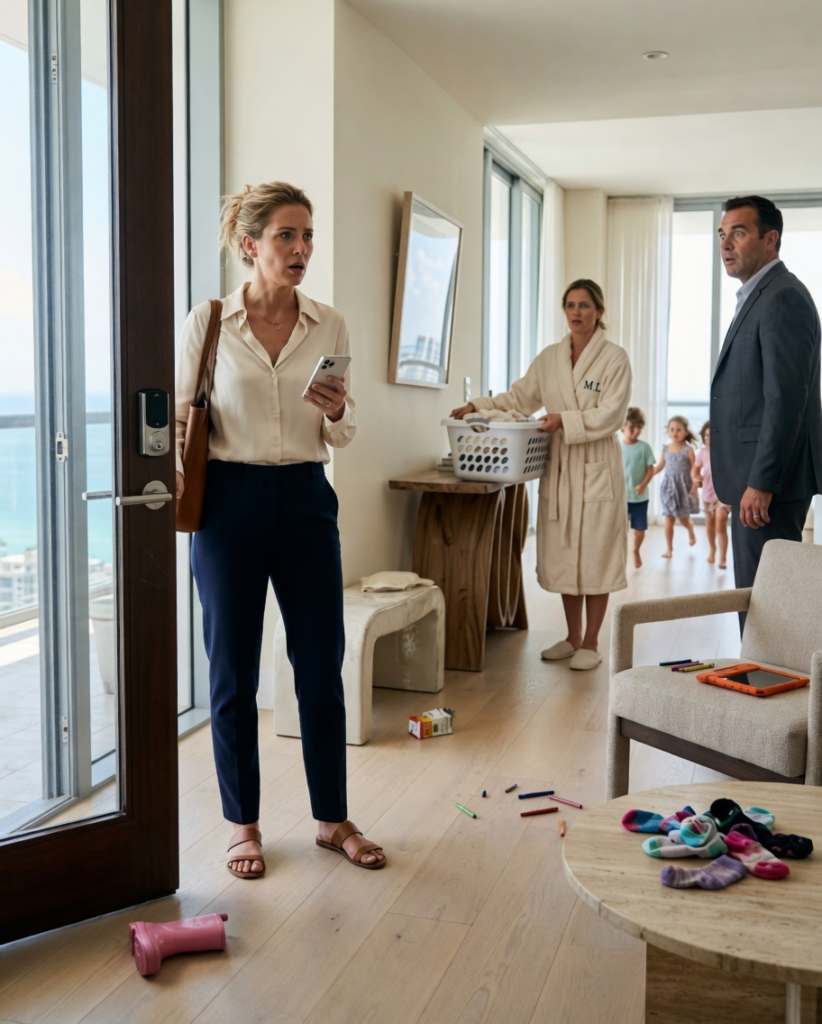
I Went To My Second Home With A Property Management Company To Prepare It For Rental, And Found My Sister And Her 3 Kids Living There.
She Laughed And Said, “Mom And Dad Gave Me Permission.
IF YOU DON’T LIKE IT, WHY DON’T YOU CALL THE POLICE?” When I Said, “THEN I WILL,” She Started To Panic.
People like to say success has a sound.
For me, it always sounded like my office printer at eleven-thirty at night, coughing out invoices while the air conditioner rattled overhead and the whole strip mall outside went dark one storefront at a time.
It sounded like sample books slapping shut, stilettos on polished concrete, a client exhaling in awe and saying, “I didn’t know a room could feel like this.”
That was the sound of my twenties.
I’m Morgan Bennett, thirty-one, interior designer, Miami born, self-built.
My company started with freelance mood boards for people who wanted luxury on a discount and grew into a real firm with employees, contracts, and clients wealthy enough to argue passionately about the emotional temperature of marble.
Every inch of it, I earned.
That fact mattered to me because my family had a strange relationship with effort.
They admired success from a distance, but the second it got close enough to touch, they acted like it had appeared by magic.
I had spent years building a business, and all my mother ever seemed to hear was that I had money now.
My father was warmer, but weak where conflict was concerned.
My older sister, Rebecca, had the most dangerous response of all.
She looked at anything I built and saw something available.
At thirty, I bought a penthouse overlooking South Beach.
I told everyone it was an investment.
That was partly true.
But it was also proof to myself that the life I kept imagining during all those hungry years had finally become real.
The apartment was quiet in a way that felt expensive.
White oak floors, lime-washed walls, creamy textiles, bronze accents, soft amber lighting.
I had spent two years collecting pieces for it: a hand-thrown vase from Oaxaca, linen curtains from Belgium, a carved stone bowl from Greece, a reading chair so perfect I once refused to sit in it for a week because I didn’t want to crease the cushion.
Nothing in that home was accidental.
It was the only place I ever lived that felt entirely mine.
Then an opportunity opened in Beverly Hills.
It started as a joke between me and a contractor after a successful install for a celebrity client with a vacation home in Bal Harbour.
“You should be in L.A.,” he said.
“They’d eat this up there.”
I laughed, then I ran the numbers, then I stopped laughing.
A studio-gallery in Beverly Hills would change my company.
It would also cost a fortune.
So I made the practical decision: rent out the Miami penthouse for two years, use that income to help fund the expansion, and return to it once the new office was stable.
I hired Jason Martinez, a property manager I trusted because he was the opposite of dramatic.
Jason was organized, discreet, and so careful with details that he made me feel relaxed in ways I rarely allowed.
“I’ll screen thoroughly,” he said when I gave him the listing packet.
“You want professional, financially strong, respectful tenants? That’s what you’ll get.”
“My attorney has already prepared the lease,” I told him.
“No subletting, no unauthorized occupants, no nonsense.”
“That sentence should be engraved on your business card,” he said.
Before we listed the unit, I refreshed the place.
Rugs professionally cleaned, walls touched up, art adjusted, batteries replaced, smart lock updated.
I had cameras in the entry hall and service corridor, a monitored system, and a hidden backup key safe built into a frame in the foyer.
Only three people knew about that safe.
Me.
Jason.
And my father, Robert, because he had helped install it when I bought the apartment.
A week later, I went to my parents’ house for Sunday dinner and made the mistake of mentioning the rental plan.
My mother’s house always smelled like bleach, overcooked chicken, and one vanilla candle that never quite won the fight.
My father stood at the counter carving meat with his reading glasses low on his nose.
My mother arranged green beans as if she were trying to punish them.
“I’m opening in Beverly Hills,” I said once we sat down.
“So I’m renting the penthouse for a while.”
My father looked proud immediately.
“That’s a big move, sweetheart.”
My mother frowned.
“To strangers?”
“To vetted tenants,” I said.
“It’s temporary.”
Rebecca appeared in the doorway before I finished the sentence.
She hadn’t knocked.
She never did.
Her three children spilled around her like dropped groceries.
Emma, eight, had sticky hands.
Tyler, six, was dragging a dinosaur over the baseboard.
Sophie, three, had a juice pouch upside down and was somehow unconcerned by the fact that gravity existed.
“Morgan’s renting out her place?” Rebecca asked, too quickly.
I already knew that tone.
She wasn’t curious.
She was calculating.
“It’s for the business,” I said.
Her eyes sharpened.
“Perfect.
Rent it to us.”
I set down my fork.
“No.”
The table went still.
Rebecca blinked.
“Excuse me?”
“No,” I repeated.
“You don’t have stable income.
You’ve been evicted twice.
And the building has occupancy rules.
I’m not risking my property.”
My mother made the offended little inhale she used whenever someone said something true at an inconvenient moment.
Rebecca laughed, brittle and mean.
“Unbelievable.
You’d rather hand it to strangers than help your own sister.”
“This is not help,” I said.
“It’s liability.”
Then came the chorus.
My mother said Rebecca was having a hard time.
My father asked me to be compassionate.
Rebecca said I had so much that one apartment meant nothing to me.
That part hit me harder than it should have.
Because that apartment meant something very specific to me.
It was the first thing I’d ever bought that nobody could claim they had helped me get.
“It’s not available,” I said, standing.
“And this conversation is over.”
Rebecca muttered, “You always think money makes you better than everyone.”
I left before dessert and changed my access codes that night.
Two weeks later, Jason called to say he had the perfect tenant.
A plastic surgeon relocating from New York.
Excellent credit, clean background, references checked, twelve months prepaid if we wanted it.
Exactly the kind of easy, quiet arrangement I had hoped for.
We scheduled a final walkthrough before lease signing.
I flew back to Miami the night before, met Jason the next morning in the lobby, and took the private elevator upstairs.
The doors opened into my foyer.
At first, everything looked normal.
Then I saw a small pink rain boot lying on its side next to my sculptural bench.
Beside it sat a crushed juice box.
On top of my console, on a stack of imported design books, was a half-eaten banana turning brown.
I stopped so abruptly Jason nearly walked into me.
“What the hell is that?”
My front door was unlocked.
Not just unlocked.
The smart lock plate had fresh scratches by the battery compartment.
Jason went pale.
“Morgan, I didn’t authorize any access.”
I pushed the door open and stepped inside.
The smell hit first.
Noodles, syrup, damp laundry, old snacks, children’s shampoo, and the stale lived-in heaviness of people who did not belong there.
My dining table was covered in crayons.
A cartoon blared from a tablet set directly on my boucle chair.
Tiny socks dangled off the edge of my travertine coffee table.
One of my Belgian linen pillows had a purple stain spreading across the seam.
Then I heard a child laugh.
Then a woman’s voice.
“Emma, I said leave it, that’s not yours anymore.”
Rebecca came around the corner carrying a laundry basket.
She was wearing my robe.
Not one like mine.
Mine.
Cream cashmere, monogrammed inside the cuff.
Behind her, Tyler ran from the guest room holding one of my alabaster bookends.
Sophie sat on the floor in a diaper, banging a spoon against the base of my floor lamp.
Emma was drawing at my kitchen island using the gold pen set a client had given me in Paris.
For one frozen second, nobody spoke.
Then Rebecca smiled.
“Well,” she said, adjusting the basket on her hip.
“This is awkward.”
I could barely breathe.
“Get out of my house.”
She laughed, as if I were being uptight over a scheduling mix-up.
“Mom and Dad gave me permission.”
Jason looked at her, then at me.
“They what?”
“We needed somewhere to stay,” Rebecca said.
“Mom had the spare key.
Don’t act dramatic.
The place was sitting here empty.”
I moved past her and saw the damage in full.
My closet doors were open.
My skincare sat uncapped on the counter.
My bathtub was full of plastic toys.
There was a casserole dish in my sink.
Family photos of Rebecca’s children had been propped along my backsplash where my orchid used to be.
My orchid was dead in the trash.
“How long have you been here?” I asked.
Rebecca shrugged.
“A few weeks.
Maybe a month.”
A month.
Jason was already pulling up the system logs on his tablet.
His forehead tightened.
“No authorized maintenance.
No guest entry approvals.
Morgan…
the interior cameras went offline thirteen days ago.
Manually.”
Rebecca’s smile wavered.
I turned to her.
“You tampered with my security system?”
“It kept beeping,” she snapped.
“The kids couldn’t sleep.”
That was when I saw the frame in the foyer hanging slightly crooked.
Inside that frame was the hidden backup key safe.
I looked at the frame, then at Rebecca.
Her eyes shifted away first.
“You had help,” I said.
She didn’t answer.
I took out my phone.
“Get your children together and leave. If you’re not out in ten minutes, I’m calling the police.”
She folded her arms.
“Call them.”
I stared at her.
“Go ahead,” she said more loudly.
“Tell them your sister and her kids are staying in your extra condo because your parents said it was fine.
Tell them you want children thrown into a hallway.
See how that sounds.”
“This is not an extra condo,” I said.
“It is my property.
You broke in, disabled my security, and moved your family into it.”
Rebecca rolled her eyes.
“Broke in is dramatic.
Mom and Dad gave me permission.
If you don’t like it, why don’t you call the police?”
I lifted the phone.
“Then I will.”
The confidence vanished from her face so quickly it startled me.
She went pale.
The basket slipped from her hands.
Small shirts spilled across the floor.
“Morgan, wait,” she said.
Jason stared.
“Why panic if your story is true?”
Rebecca’s eyes flicked down the hallway toward the locked owner’s storage room.
That room contained archived client files, antique material samples, tax records, and a fireproof box holding a few pieces of jewelry I hadn’t yet moved to the bank.
Jason followed her gaze.
“Morgan,” he said quietly, “that lock has fresh marks on it.”
I told the dispatcher there were unauthorized occupants in my property and possible tampering with the security system.
Before I could finish answering questions, my mother called.
Her name flashed across my screen again and again.
Rebecca stared at it in horror.
“Don’t answer.
Please don’t answer.”
That was the second honest thing she’d said all day, and it was worse than the first.
The police arrived within fifteen minutes.
Two officers came up with building security, and the entire dynamic changed the moment one of them saw the deed and property records on my phone and the other saw the cut alarm wiring in the utility panel.
Rebecca tried to soften instantly.
“This is a family misunderstanding,” she said, now sounding small and tired instead of bold.
“Our parents told me it was okay.
We thought she knew.”
“Did she know?” the female officer asked.
“No,” I said.
The officer turned back to Rebecca.
“Then it wasn’t okay.”
My father arrived ten minutes later.
Not my mother.
Just my father, sweat darkening his collar, eyes darting everywhere except at me.
He looked older than he had the week before.
“Morgan,” he began, voice shaking, “let’s not do this in front of everyone.”
The words landed like a confession before he even said anything else.
“Did you give her access?” I asked.
He closed his eyes for one second.
That was answer enough.
My hands turned cold.
“Dad.”
“Your mother was upset,” he said weakly.
“Rebecca and the kids had nowhere to go.
It was only supposed to be for a few days.”
“You used my key safe.”
He nodded once.
I had imagined anger when that moment came.
What I felt was worse.
A clean, hollow break.
The officer asked him directly whether he had permission from the owner to grant entry.
He looked at me, then at the floor.
“No.”
Rebecca snapped then, all fear turning to blame.
“You told me it was fine! You said it was family property.
You said she’d cool off once I was already settled.”
Family property.
The phrase explained years in a single breath.
Not Morgan’s.
Ours.
My mother arrived just in time to hear Rebecca say it.
She came in furious, cheeks flushed, handbag swinging at her side.
“This is disgusting,” she said to me, not to the officers, not to her daughter standing in my robe, to me.
“Calling the police on your own sister?”
The room went silent.
I turned toward her slowly.
“Did you know Dad gave her my key?”
She lifted her chin.
“Of course I knew.
She’s your sister.
She needed help.”
“So you broke into my home.”
“Don’t use that word.”
“What word would you prefer?” I asked.
“The one where you entered without permission, disabled my security, and let someone move children into my property while I was arranging a legal lease?”
Her mouth tightened.
“You have always been selfish.”
The female officer actually looked up at that.
Jason, who had stayed quiet out of professionalism, finally spoke.
“Ma’am, there is visible property damage, security tampering, and unauthorized occupancy.
This is not a personal style disagreement.”
My mother glared at him.
“Stay out of family matters.”
He didn’t blink.
“She hired me to protect her property.
That makes it my matter.”
I loved him a little in that moment.
One of the officers asked whether I wanted them formally removed.
My father looked crushed.
My mother looked furious.
Rebecca looked terrified.
I looked around my apartment.
At the stains, the scratches, the broken lamp base, the toys in my bathtub, the dead orchid, the pen marks on my island, the open drawers, the invasion of it all.
And I heard myself say, very clearly, “Yes.”
The children were the only part of the entire scene that made my chest ache.
Emma started crying quietly.
Tyler asked if they were in trouble.
Sophie reached for Rebecca with both hands.
The officers kept their voices gentle.
Building security arranged for Rebecca to gather essentials.
Jason photographed every room.
I stood in my own kitchen and watched my sister remove her children’s cereal boxes from my pantry.
Then the female officer came out of the hallway holding my fireproof box.
“Was this opened today?” she asked.
My stomach dropped.
The box was normally stored inside the owner’s storage room closet behind locked shelving.
It now sat open on the counter.
I crossed the room and looked inside.
Some of the contents were still there.
Family papers.
Insurance forms.
A pair of earrings.
But the velvet pouch that held my grandmother’s bracelet and two diamond rings was gone.
So was the envelope containing a cashier’s check I had set aside for a contractor deposit before wiring the funds.
The room tilted.
“No,” I said.
“No, that’s missing.”
Rebecca started crying instantly.
Too quickly.
“I didn’t take anything,” she said.
Nobody had accused her yet.
My father looked stunned.
My mother looked not stunned enough.
The officer asked everyone to stay put.
It turned out desperation makes people sloppy.
When Rebecca had panicked earlier, she had shoved a bundle of documents into one of the children’s backpacks near the sofa.
The cashier’s check was folded inside a coloring book.
One diamond ring was inside a zip pouch with crayons.
The bracelet was wrapped in a baby sock and tucked into the bottom of my own robe pocket.
The second ring was not in the apartment.
That was when the officer asked for permission to check Rebecca’s large tote bag near the entry.
Rebecca refused.
The officer informed her that, based on the stolen property already recovered and the circumstances on site, refusal would not prevent further action.
Jason turned away.
My father sat down like his legs had given out.
Inside the tote bag were snack wrappers, wipes, a bottle of children’s medicine, two overdue notices, and my missing ring.
My engagement ring.
I had never worn it because there had never been an engagement.
It was my grandmother’s ring, passed down to me after she died because I was the one who had spent time with her at the end.
My mother knew exactly what it was.
She looked at Rebecca and whispered, horrified now for real, “What did you do?”
Rebecca burst into loud, ugly tears.
“I was going to pawn it and get it back before anyone knew.
We needed money.
Darren left, the landlord changed the locks, the credit cards were maxed, and Mom said Morgan had more than enough.
She said she wouldn’t even miss it.”
Silence.
Absolute, devastating silence.
I turned to my mother.
She had the decency to look ashamed for half a second before trying to rearrange the scene.
“I didn’t mean that literally.”
But she had meant it enough.
Enough for my father to hand over a key.
Enough for my sister to move into my home.
Enough for theft to feel justified.
The officers arrested Rebecca.
My father tried to intervene once, then stopped when the male officer explained, in a voice stripped of all softness, that this was now a criminal matter involving burglary, unlawful entry, property tampering, and stolen valuables.
My mother cried then, loudly, theatrically, but nobody moved to comfort her.
Child services was not called because my father agreed to take the children immediately and there was no evidence they had been directly harmed, though the officers documented the scene carefully.
Emma clung to his hand.
Tyler asked where Mommy was going.
Sophie kept crying for a snack nobody could find.
Rebecca looked at me as they led her out.
I expected rage.
What I saw was something more unsettling: disbelief.
As if some part of her had genuinely believed the world would once again bend around her choices.
As if she could still not understand how this had become real.
After they left, the apartment was finally quiet.
But not the kind I loved.
This quiet felt scorched.
Jason stayed and helped me catalog the damage.
Two rugs ruined.
One lamp dented.
Multiple wall marks.
A cracked side table.
Missing linens.
Security system repair.
Professional deep cleaning.
Lock replacement.
Art inspection.
The total climbed quickly.
My father called that night.
I didn’t answer.
My mother left three voicemails, each one different.
Angry, then pleading, then cold.
In the last one she said, “I hope you’re happy.”
I deleted them all.
Over the next month, I did what I always did.
I handled it.
I hired counsel.
I filed insurance documentation.
I submitted damage reports to the building.
I paid for repairs.
I replaced the locks and gave no family member access to anything I owned ever again.
My father came to my office once and asked to speak.
I met him in the lobby.
He cried before I did.
“I thought I was helping,” he said.
“You were helping the person asking,” I told him.
“Not the person being harmed.”
He nodded like the truth hurt, which was appropriate.
He offered to repay part of the damage out of his retirement account.
I told him to keep his money and live with the cost another way.
That was harder for him, I think.
Rebecca eventually took a plea deal.
My lawyer was blunt: because stolen property had been recovered on site and because there was a clear trail of unauthorized entry and tampering, she had no defense worth pretending to believe.
I did not ask for jail time beyond what the court imposed.
I did insist on restitution.
My mother never forgave me for that.
I never forgave her for calling theft survival and betrayal selfishness.
The penthouse was repaired in six weeks.
When I went back after the cleaners finished and the walls were repainted, the space looked like itself again.
Almost.
A room can be restored.
That doesn’t mean it forgets.
I stood in the foyer for a long time looking at the place where the rain boot had been, at the console where the banana had rotted over my books, at the hallway leading to the storage room that had changed everything.
Then I walked through slowly, touching the edges of things I had chosen carefully before any of this happened.
The apartment still felt beautiful.
It just didn’t feel like a sanctuary anymore.
So I made one last practical decision.
I did rent it out, but not for two years.
I sold it six months later at a profit and put the money into the Beverly Hills studio instead.
On opening day, I stood in my new gallery surrounded by stone, fabric, light, and all the evidence of what I had built without anyone’s permission.
Clients wandered through with glasses of sparkling water.
My staff moved confidently between samples and displays.
The sign on the door had my name on it and nobody else’s.
My father sent flowers.
My mother didn’t come.
Rebecca sent nothing.
Sometimes people ask what the biggest red flag was, and I always think they mean Rebecca moving into my house.
But that wasn’t the first red flag.
The first red flag was much smaller and much older.
It was every time my family treated what I earned like shared property and my boundaries like a phase.
The break-in was just the first time I stopped translating that behavior into softer words.
I still think about the moment Rebecca told me to call the police.
About the confidence in her voice right before fear took over.
That was the moment the fantasy collapsed.
The one where family was supposed to excuse everything, where need erased theft, where love meant surrendering the lock and thanking the person who turned it.
Maybe some people would have handled it quietly.
Maybe some people would have protected the family story instead of the truth.
I protected the truth.
And even now, on the rare nights when I wonder whether I was too hard, I remember my dead orchid in the trash, my grandmother’s ring in my sister’s bag, and my mother saying, with a straight face, that I probably wouldn’t even miss it.
That’s when the doubt disappears.
Not because what I did felt good.
Because sometimes the most honest thing you can do is finally stop pretending you were never the one being robbed.